© The McGraw-Hill Companies, Inc., 2018. All rights reserved.
Solutions Manual, Appendix 10A 71
Problem 10A-11 (30 minutes)
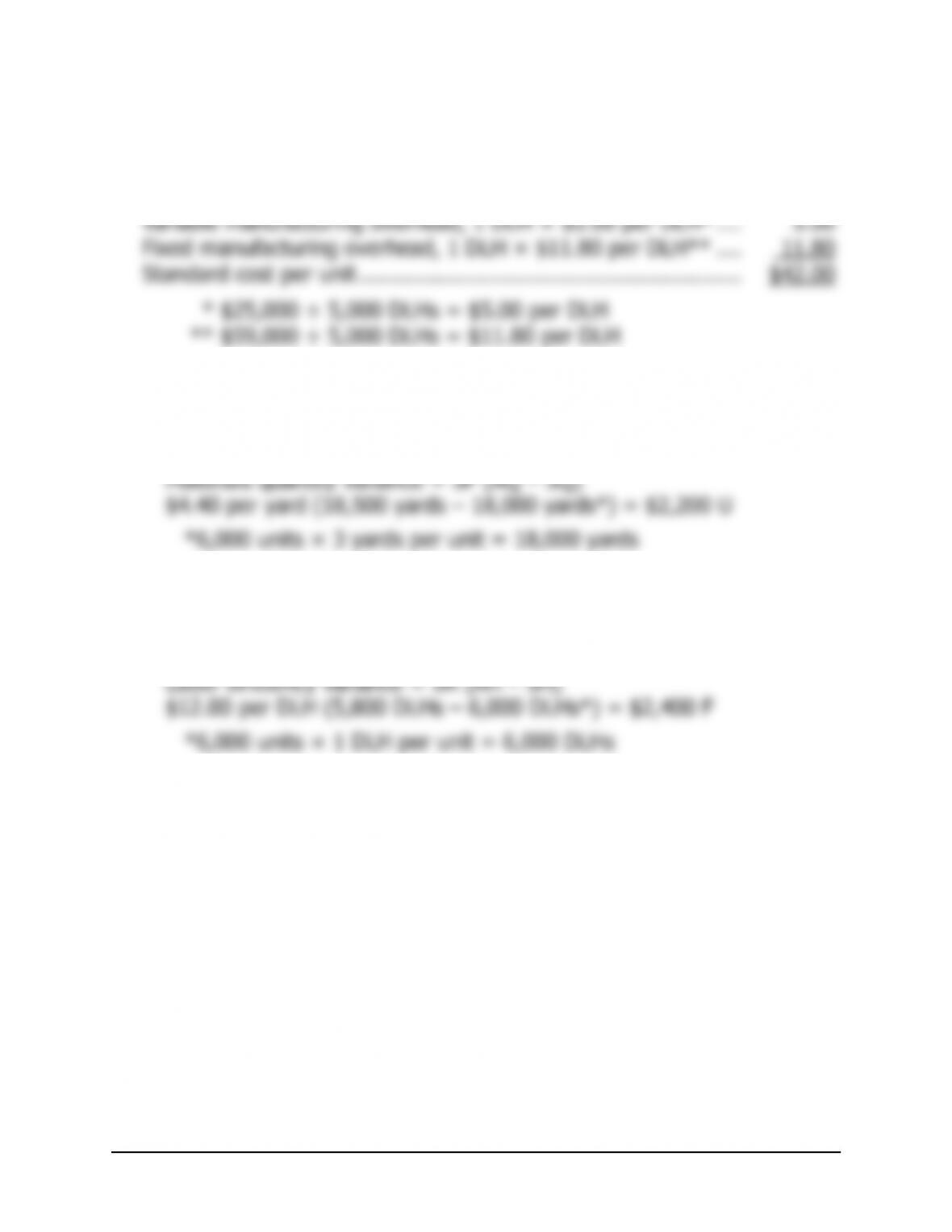
1. Direct materials, 3 yards × $4.40 per yard ……………….………. $13.20
Direct labor, 1 DLH × $12.00 per DLH …………………………….. 12.00
2. Materials variances:
Materials price variance = AQ (AP – SP)
24,000 yards ($4.80 per yard – $4.40 per yard) = $9,600 U
Labor variances:
Labor rate variance = AH (AR – SR)
5,800 DLHs ($13.00 per DLH – $12.00 per DLH) = $5,800 U
Problem 10A-11 (continued)
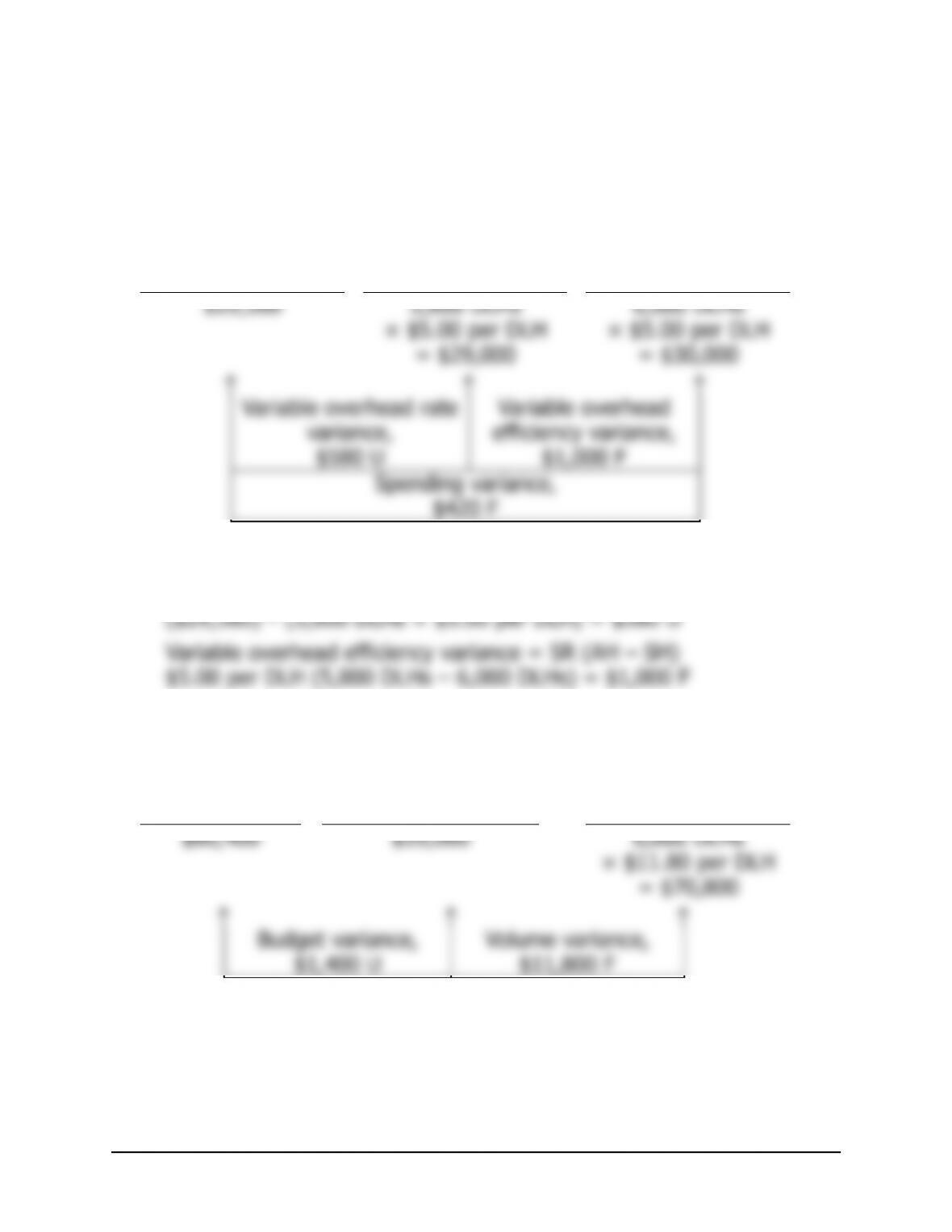
3. Variable overhead variances:
A
ctual DLHs of
Input, at the
Actual Rate
A
ctual DLHs of
Input, at the
Standard Rate
Standard DLHs
Allowed for Output,
at the Standard Rate
(AH ×
A
R) (AH × SR) (SH × SR)
v
v
v
© The McGraw-Hill Companies, Inc., 2018. All rights reserved.
Solutions Manual, Appendix 10A 73
Problem 10A-11 (continued)
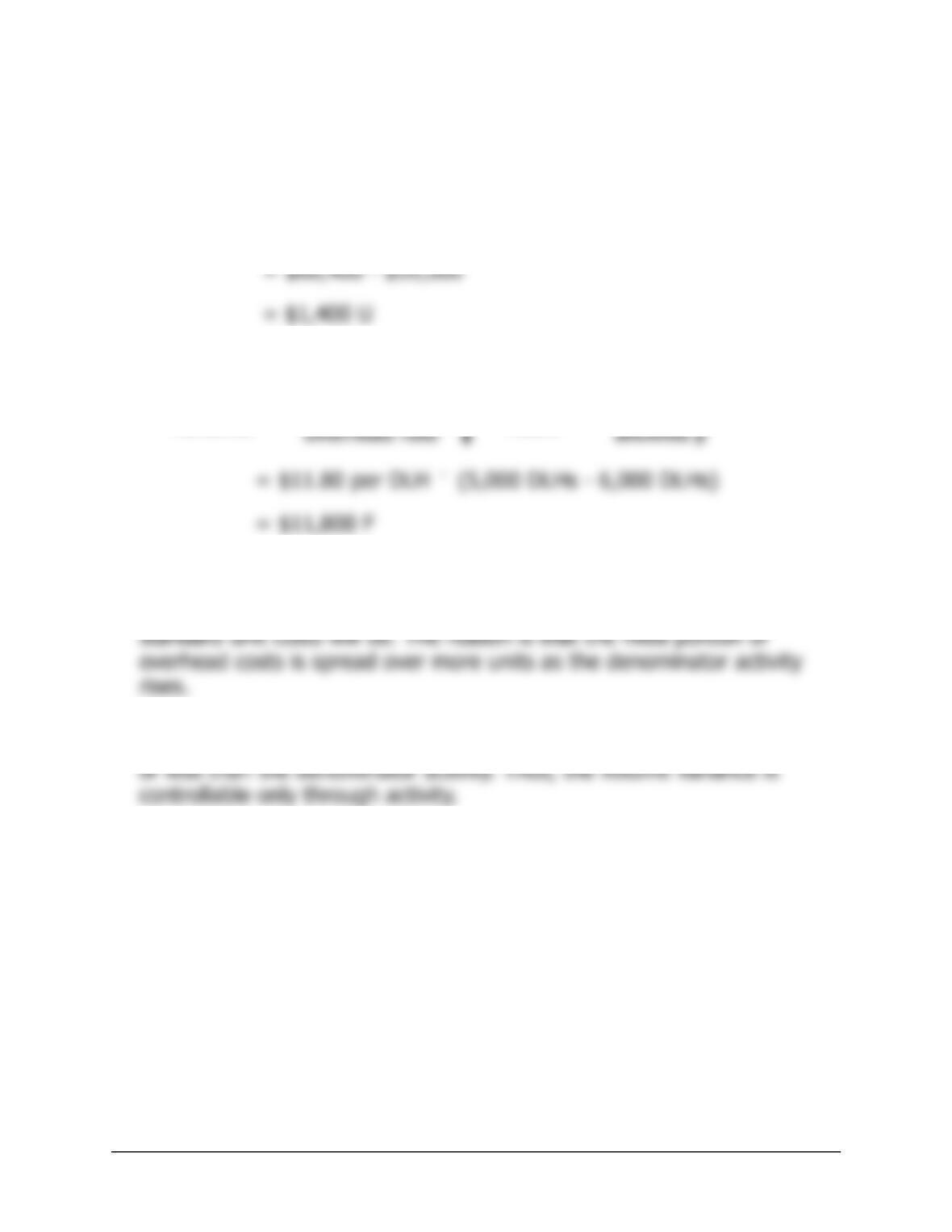
Alternative approach to the budget variance:
Bud
g
et Actual fixed Bud
g
eted fixed
= –
variance overhead overhead
Alternative approach to the volume variance:
æö
÷
ç÷
ç÷
ç÷
ç÷
Fixed portion of Standard
Volume Denominator
= the predetermined – hours
Variance hours
4. The choice of a denominator activity level affects standard unit costs in
that the higher the denominator activity level chosen, the lower
The volume variance cannot be controlled by controlling spending. The
volume variance simply reflects whether actual activity was greater than
© The McGraw-Hill Companies, Inc., 2018. All rights reserved.
74 Managerial Accounting, 16th Edition
Problem 10A-12 (45 minutes)
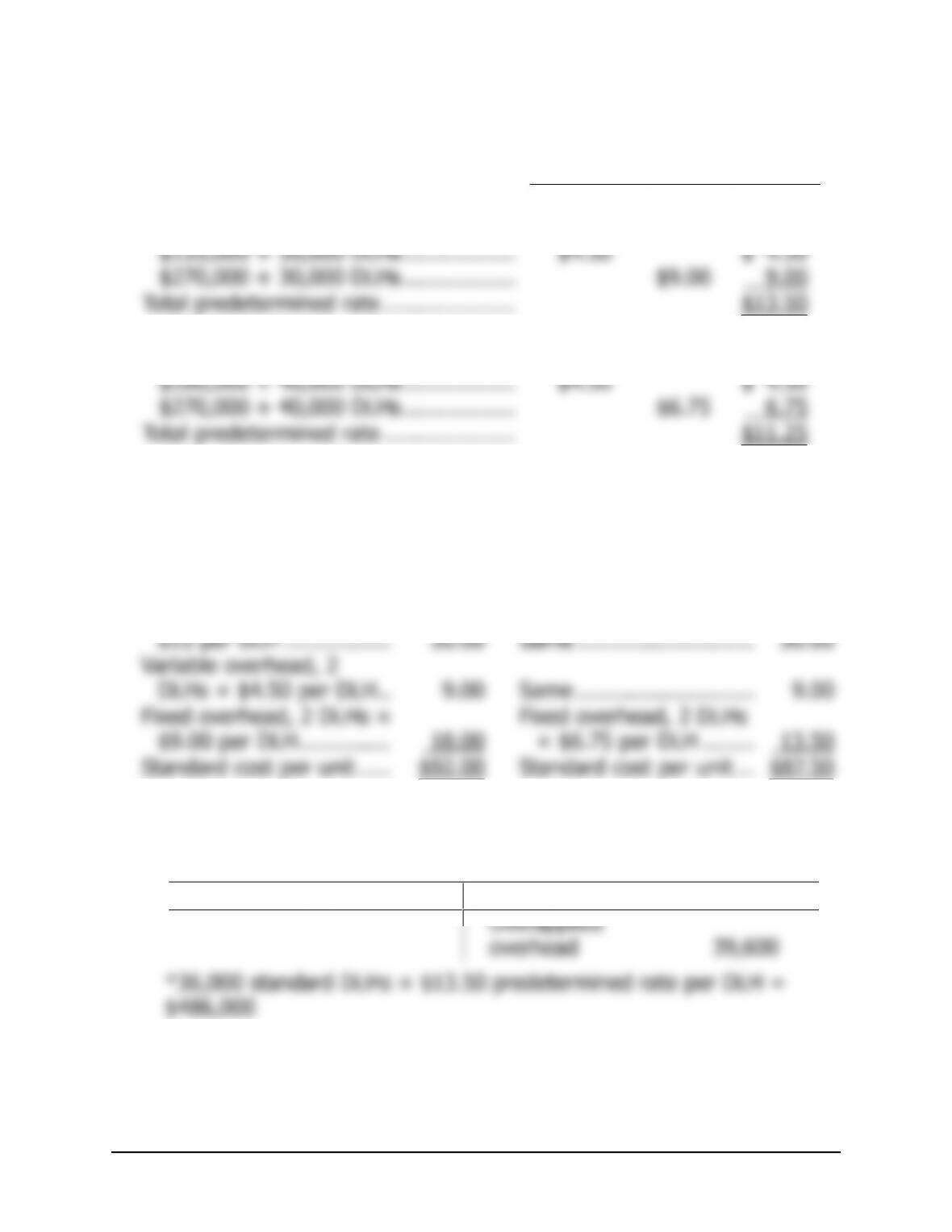
1. and 2.
Per Direct Labor-Hour
Variable Fixed Total
Denominator of 30,000 DLHs:
Denominator of 40,000 DLHs:
T
3.
Denominator Activity:
30,000 DLHs
Denominator Activity:
40,000 DLHs
Direct materials, 4 feet ×
$8.75 per foot ………….. $35.00 Same ……………………… $35.00
Direct labor, 2 DLHs ×
V
4. a. 18,000 units × 2 DLHs per unit = 36,000 standard DLHs
b. Manufacturin
g
Overhead
A
ctual costs 446,400
A
pplied costs 486,000 *
T
© The McGraw-Hill Companies, Inc., 2018. All rights reserved.
Solutions Manual, Appendix 10A 75
Problem 10A-12 (continued)
c. Variable overhead variances:
A
ctual DLHs of
Input, at the
Actual Rate
A
ctual DLHs of
Input, at the
Standard Rate
Standard DLHs
Allowed for Output,
at the Standard Rate
(AH ×
A
R) (AH × SR) (SH × SR)
Alternative solution:
Variable overhead rate variance = (AH × AR) – (AH × SR)
Fixed overhead variances:
A
ctual Fixed
Overhead
Bud
g
eted Fixed
Overhead
Fixed Overhead Applied to
Work in Process
g
v
v
© The McGraw-Hill Companies, Inc., 2018. All rights reserved.
76 Managerial Accounting, 16th Edition
Problem 10A-12 (continued)
Alternative solution:
Budget variance:
Bud
g
et Actual fixed Bud
g
eted fixed
= –
variance overhead overhead
Volume variance:
æö
÷
ç÷
ç÷
ç÷
ç÷
÷
ç
èø
Fixed portion of Standard
Volume Denominator
= the predetermined – hours
Variance hours
overhead rate allowed
Summary of variances:
Variable overhead rate variance ……………. $ 3,800 U
Variable overhead efficiency variance …….. 9,000 U
© The McGraw-Hill Companies, Inc., 2018. All rights reserved.
Solutions Manual, Appendix 10A 77
Problem 10A-12 (continued)
5. The major disadvantage of using normal activity is the large volume
variance that ordinarily results. This occurs because the denominator
activity used to compute the predetermined overhead rate is different
from the activity level that is anticipated for the period. In the case at
hand, the company has used a long-run normal activity figure of 30,000
On the other hand, using long-run normal activity as the denominator
results in unit costs that are stable from year to year. Thus,
© The McGraw-Hill Companies, Inc., 2018. All rights reserved.
78 Managerial Accounting, 16th Edition
Appendix 10B
Standard Cost Systems: A Financial Reporting
Perspective Using Microsoft Excel
Exercise 10B-1 (10 minutes)
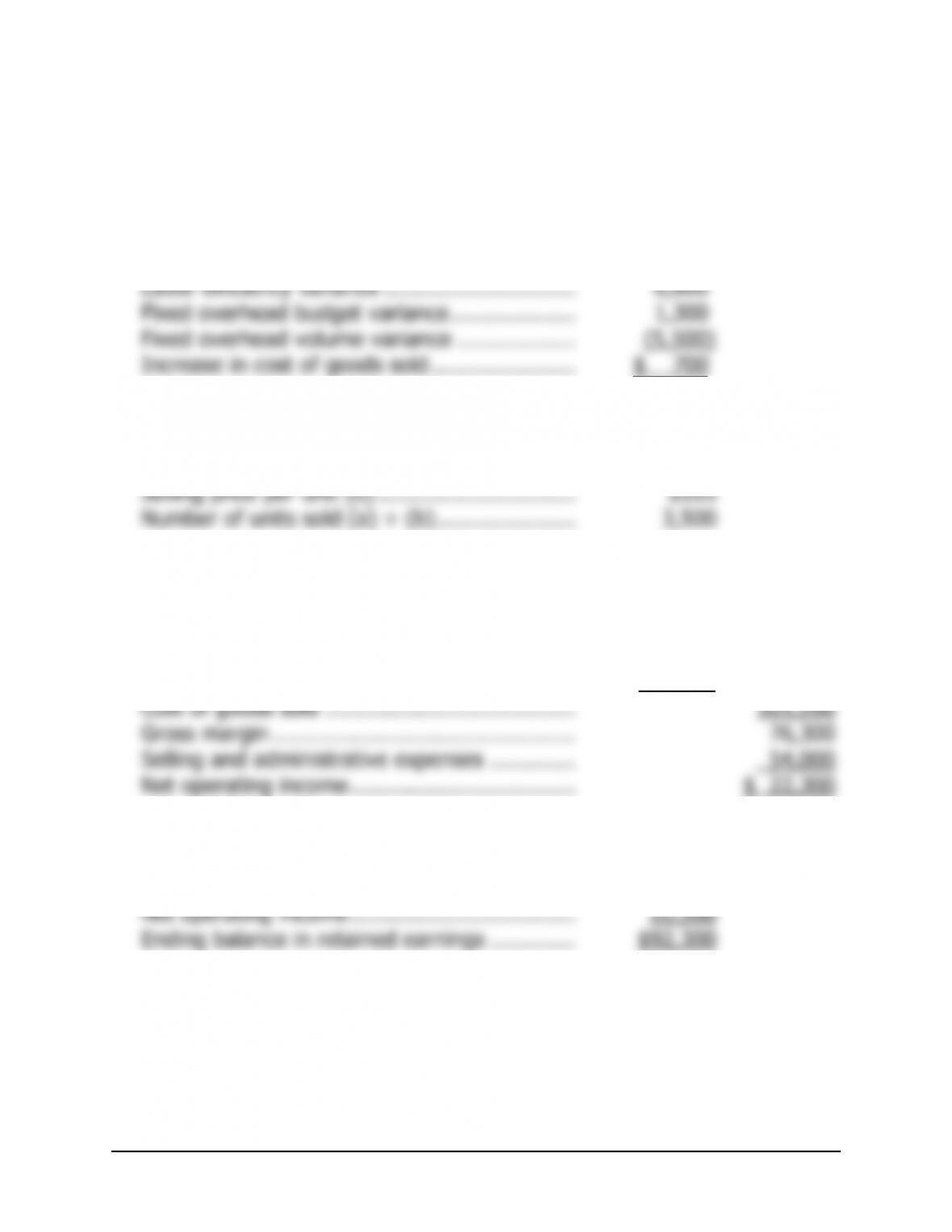
1. The cost of goods sold will decrease by:
Materials price variance …………………………. $ (6,500)
Materials quantity variance …………………….. 10,200
2. The income statement is as follows:
Sales (10,000 units × $135) …………………… $1,350,000
Cost of
g
oods sold at standard (10,000 units
× $105) …………………………………………… $1,050,000
g
© The McGraw-Hill Companies, Inc., 2018. All rights reserved.
Solutions Manual, Appendix 10B 79
Exercise 10B-2 (15 minutes)
1. The cost of goods sold will increase by:
Materials price variance …………………………. $ 3,400
Materials quantity variance …………………….. (9,000)
Labor rate variance ………………………………. 3,900
2. The first step is to compute the number of units sold as follows:
T
otal sales (a) …………………………………….. $577,500
The income statement is as follows:
Sales …………………………………………………. $577,500
Cost of
g
oods sold at standard (3,500 units ×
$143) ……………………………………………… $500,500
T
otal variance ad
j
ustments …………………….. 700
g
3. The ending balance in Retained Earnings is computed as follows:
Be
g
innin
g
balance in retained earnin
g
s……… $70,000
© The McGraw-Hill Companies, Inc., 2018. All rights reserved.
80 Managerial Accounting, 16th Edition
Exercise 10B-3 (20 minutes)
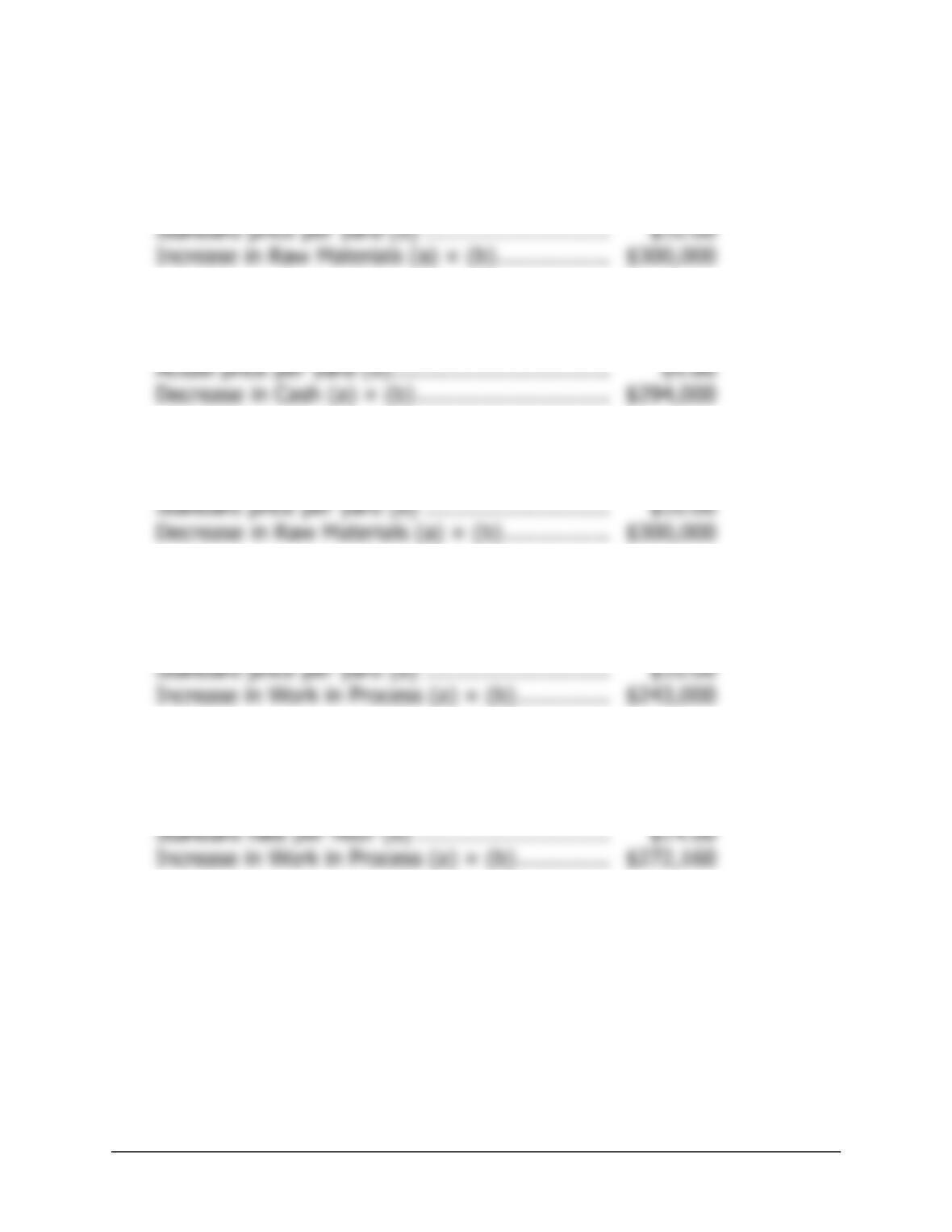
1a. The Raw Materials will increase by $300,000 computed as follows:
A
ctual quantity purchased (a) ……………………. 30,000 yards
1b. The Cash will decrease by $294,000 computed as follows:
A
ctual quantity purchased (a) ……………………. 30,000 yards
A
2a. The Raw Materials will decrease by $300,000 computed as follows:
A
ctual quantity used (a) …………………………… 30,000 yards
2b. The Work in Process will increase by $243,000 computed as follows:
Standard quantity allowed (8,100 units
× 3 yards per unit) (a) ………………………… 24,300
yards
3a. The Work in Process will increase by $272,160 computed as follows:
Standard hours allowed (8,100 units
× 2.4 hours per unit) (a) ……………………… 19,440
hours
3b. The Cash will decrease by $290,000—the amount of cash paid to direct
laborers.