© The McGraw-Hill Companies, Inc., 2018. All rights reserved.
Solutions Manual, Chapter 10 1
Chapter 10
Standard Costs and Variances
Solutions to Questions
10-1 A quantity standard indicates how much
10-3 The materials price variance is usually
10-4 The materials price variance can be
computed when materials are purchased or
10-5 This combination of variances may
indicate that inferior quality materials were
10-6 If standards are used to find who to
blame for problems, they can breed resentment
with high hourly rates of pay can be given duties
10-8 If poor quality materials create
production problems, a result could be excessive
10-9 If overhead is applied using direct labor-
hours, then the variable overhead efficiency
variance and the direct labor efficiency variance
10-10 If labor is a fixed cost and standards are
tight, then the only way to generate favorable
output of the entire system is limited by the
capacity of the bottleneck. If workstations
before the bottleneck in the production process
© The McGraw-Hill Companies, Inc., 2018. All rights reserved.
Solutions Manual, Chapter 10 3
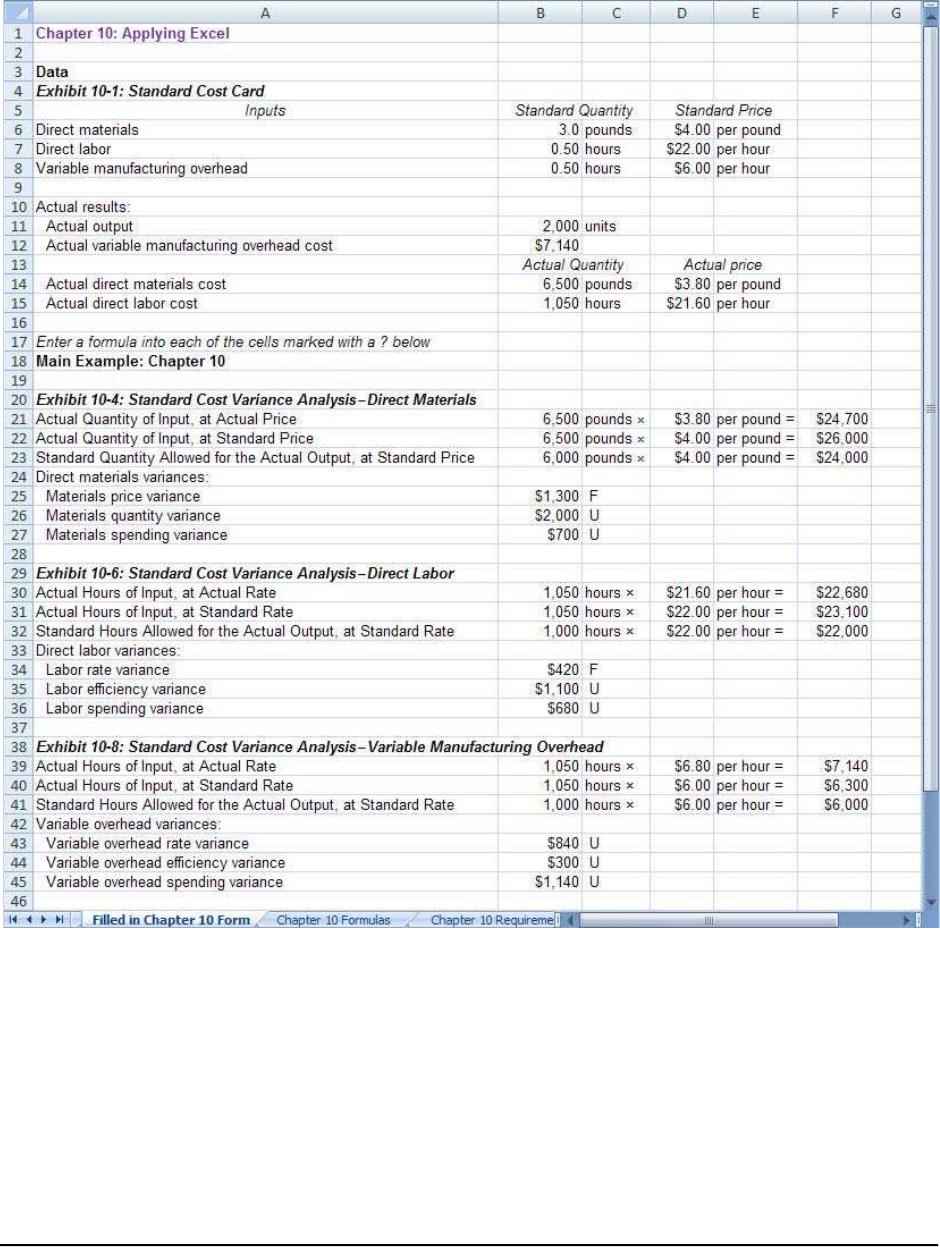
Chapter 10: Applying Excel
The completed worksheet is shown below.
© The McGraw-Hill Companies, Inc., 2018. All rights reserved.
4 Managerial Accounting, 16th Edition
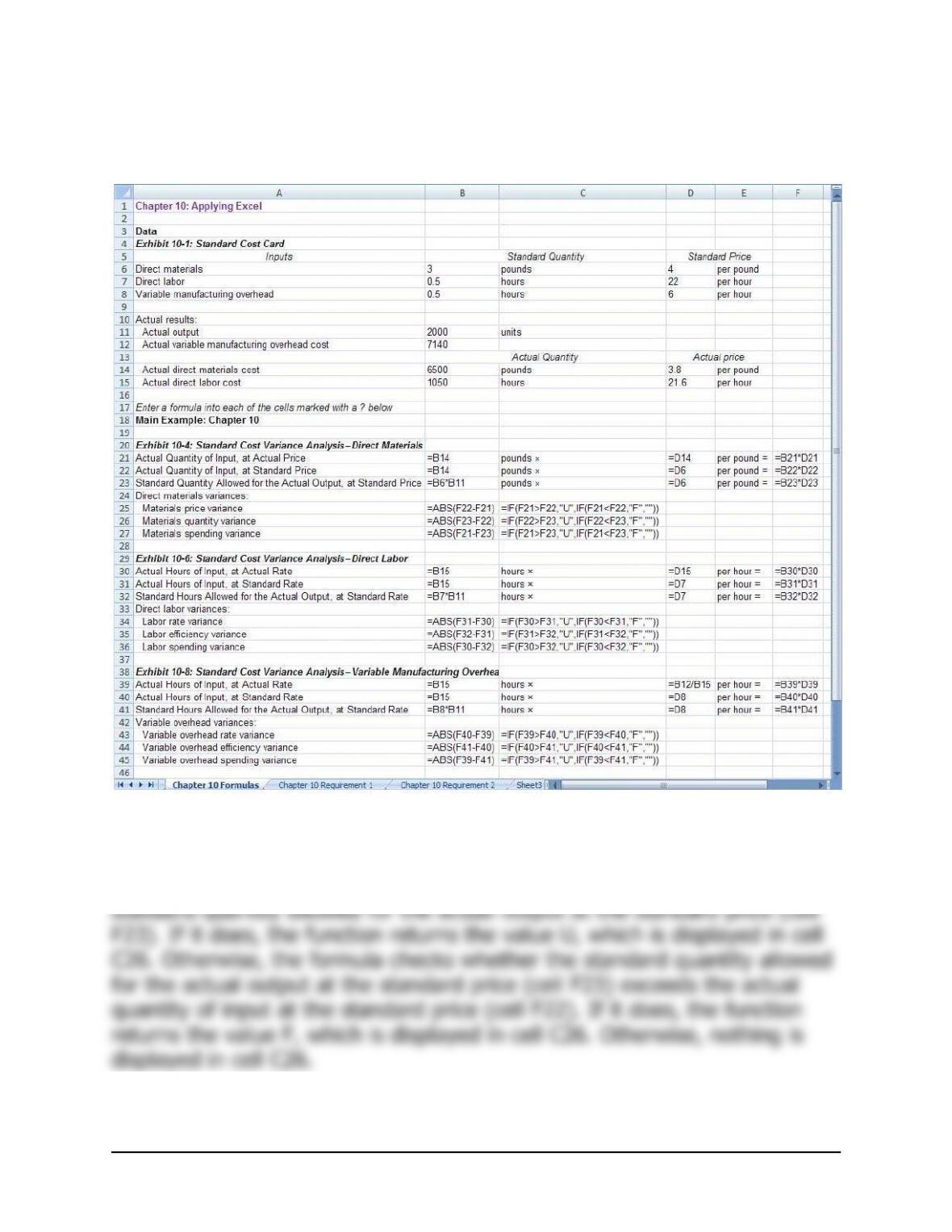
Chapter 10: Applying Excel (continued)
The completed worksheet, with formulas displayed, is shown below.
Note: The formulas to compute whether a variance is Favorable or
Unfavorable use the IF() function. For example, in cell C26, the formula is
=IF(F22>F23,”U”,IF(F22<F23,”F”,””)). This formula first checks whether
the actual quantity of input at the standard price (cell F22) exceeds the
© The McGraw-Hill Companies, Inc., 2018. All rights reserved.
Solutions Manual, Chapter 10 5
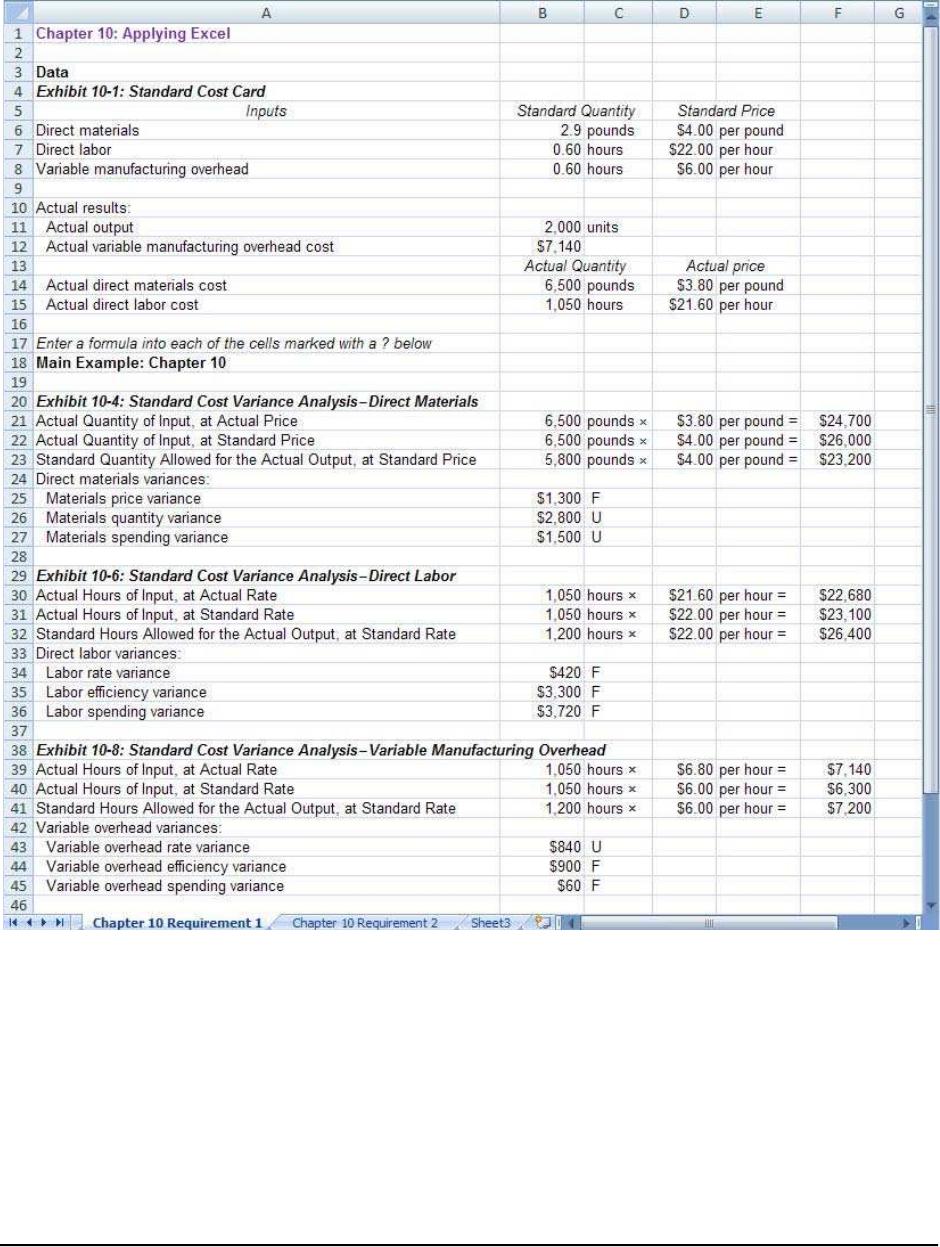
Chapter 10: Applying Excel (continued)
1. With the changes in data, the result is:
© The McGraw-Hill Companies, Inc., 2018. All rights reserved.
6 Managerial Accounting, 16th Edition
a. The materials quantity variance is $2,800 U. This variance is the
difference between the amount of materials that should have been
b. The labor rate variance is $420 F. This variance is the difference
between the standard labor rate and the actual labor rate, multiplied
© The McGraw-Hill Companies, Inc., 2018. All rights reserved.
Solutions Manual, Chapter 10 7
Chapter 10: Applying Excel (continued)
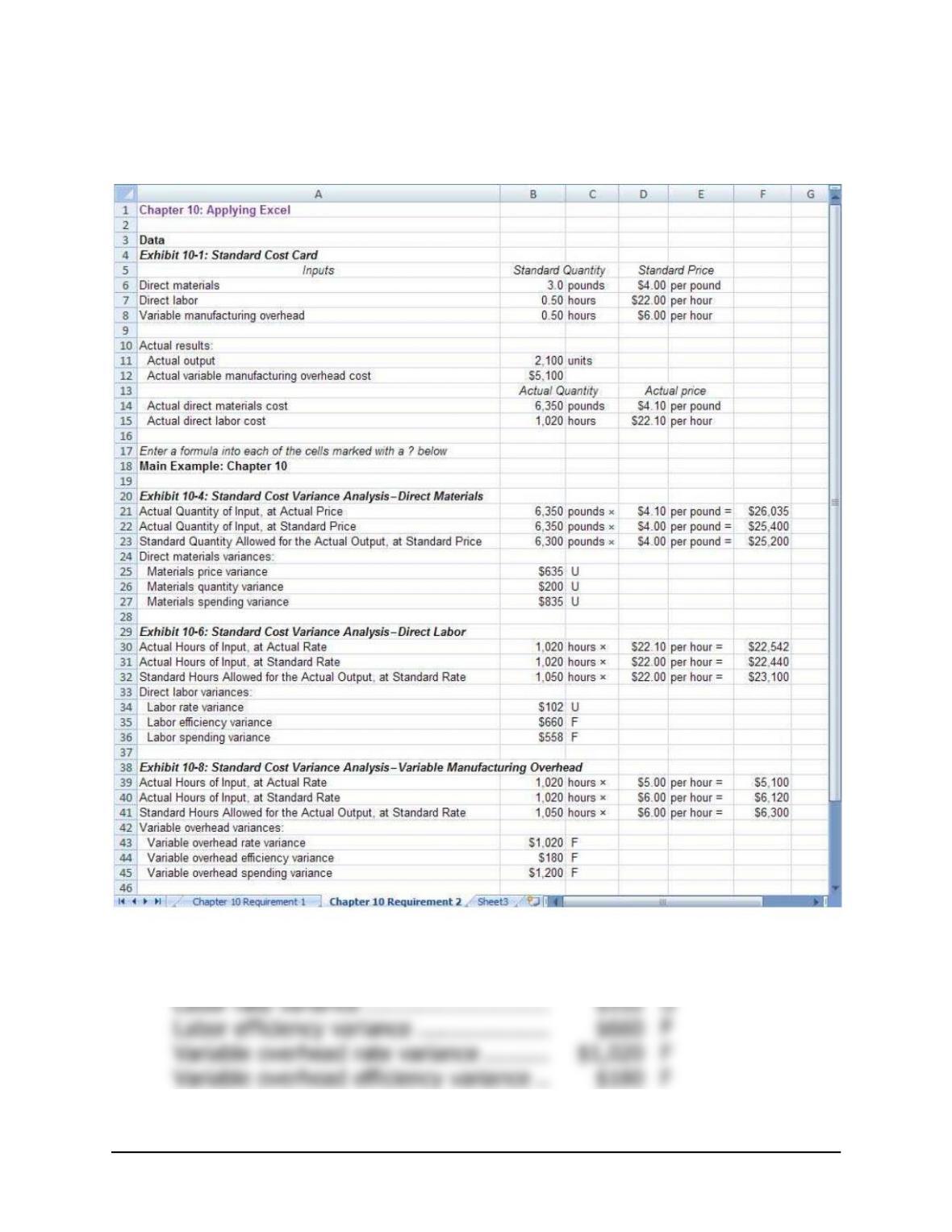
2. With the revised data, the worksheet should look like this:
Parts a, b, and c:
Materials price variance …………………. $635 U
Materials quantity variance …………….. $200 U
© The McGraw-Hill Companies, Inc., 2018. All rights reserved.
8 Managerial Accounting, 16th Edition
The Foundational 15
1. The raw materials cost included in the planning budget is $1,000,000
2, 3, and 4.
The raw materials cost included in the flexible budget (SQ × SP =
$1,200,000), the materials price variance ($80,000 F), and the materials
quantity variance ($80,000 U), can be computed using the general model
for cost variances as follows:
Actual Quantity of
Input,
at Actual Price
Actual Quantity of
Input,
at Standard Price
Standard Quantity
Allowed
for Actual Output,
at Standard Price
Alternatively, the variances can be computed using the formulas:
Materials price variance = AQ (AP – SP)
© The McGraw-Hill Companies, Inc., 2018. All rights reserved.
Solutions Manual, Chapter 10 9
The Foundational 15 (continued)
5. and 6.
The materials price variance ($85,000 F) and the materials quantity
variance ($80,000 U) can be computed as follows:
Actual Quantity
of Input,
at Actual Price
Actual Quantity
of Input,
at Standard Price
Standard Quantity
Allowed for Actual
Output,
at Standard Price
Materials price variance
= $85,000 F
160,000 pounds ×
$8.00 per pound
= $1,280,000
Alternatively, the variances can be computed using the formulas:
Materials price variance = AQ (AP – SP)
© The McGraw-Hill Companies, Inc., 2018. All rights reserved.
10 Managerial Accounting, 16th Edition
The Foundational 15 (continued)
7. The direct labor cost included in the planning budget is $700,000 (=
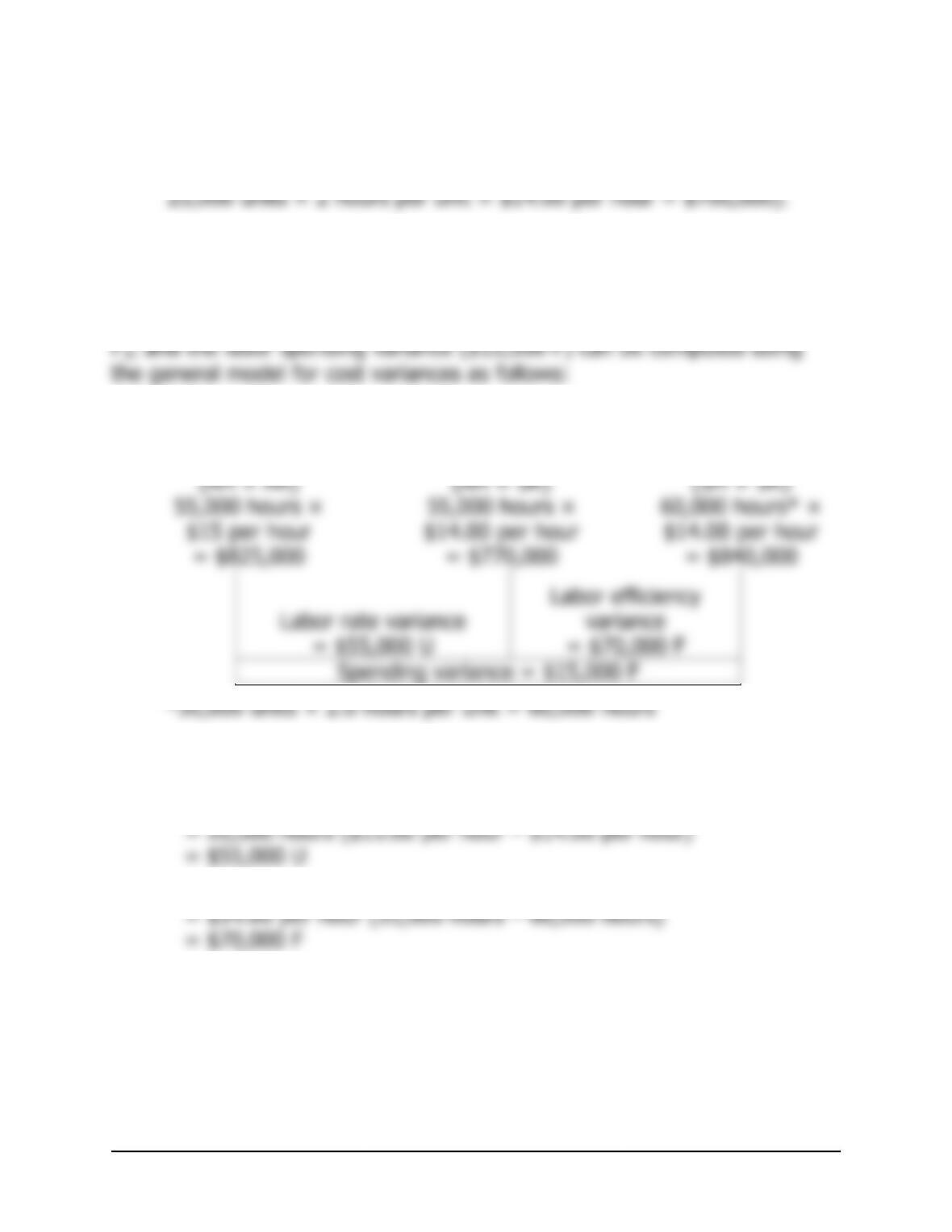
8, 9, 10, and 11.
The direct labor cost included in the flexible budget (SH × SR = $840,000),
the labor rate variance ($55,000 U), the labor efficiency variance ($70,000
Actual Hours of Input,
at Actual Rate
Actual Hours of Input,
at Standard Rate
Standard Hours
A
llowed
for Actual Output,
at Standard Rate
Alternatively, the variances can be computed using the formulas:
Labor rate variance = AH (AR – SR)
Labor efficiency variance = SR (AH – SH)