
Chapter 09 – Game Theory and Strategic Thinking
CHAPTER 9
GAME THEORY AND STRATEGIC THINKING
Chapter Overview
This chapter introduced the concept of strategic games. Many real-life
situations can be analyzed as if they were strategic games, with associated
rules, strategies, and potential payoffs.
Game theory can explain the logic behind outcomes that might not seem
intuitive at “rst. Sometimes, for example, both players in a simultaneous
game may choose to behave in a way that makes both worse off. When
games are played in turns rather than simultaneously, the “rst mover’s
decision can dictate the outcome of the entire game. With repeated play,
however, the “rst mover’s advantage weakens. Players who can
communicate with each other and agree on a strategy can often secure a
better outcome than if they acted alone. Such agreements may break down
if one side tries to get ahead by defecting.
Backward induction is another useful analytical tool; it allows you to break
down your decisions and predict how they will affect others’ decisions and
shape the “nal payoff.
When trying to solve a real-life problem, whether societal, personal, or
business, it helps to think through these strategic issues. Doing so can help
you see how to “play” the game given the rules and constraints. It also can
help you see how to change the rules and constraints, if possible, to help get
to a better outcome.
Much of the analysis in this chapter involved one player guessing what the
other will do and acting accordingly. In the next chapter, we’ll see that
knowing what one player is planning to do isn’t always easy, and that a lack
of information can have real economic consequences.
Learning Objectives
LO 9.1: Understand strategic behavior and describe the components of a
strategic game.
LO 9.2: Explain why noncooperation is always the outcome in the prisoners’
dilemma.
LO 9.3: Identify whether or not a player has a dominant strategy in a one-
time game.
LO 9.4: Identify whether or not a Nash equilibrium will be reached in a one-
time game.
9-1
Copyright © 2018 McGraw-Hill Education. All rights reserved. No reproduction or distribution without the prior written consent of McGraw-Hill
Education.

Chapter 09 – Game Theory and Strategic Thinking
LO 9.5: Explain how a commitment strategy can be used to achieve
cooperation in a one-time game.
LO 9.6: Explain how repeated play can enable cooperation.
LO 9.7: Explain how backward induction can be used to make decisions.
LO 9.8: Use a decision tree to solve a sequential game.
LO 9.9: De”ne “rst-mover advantage and identify it in practice.
LO 9.10: Explain why patient players have more bargaining power in
repeated games.
LO 9.11: Explain how a commitment strategy can allow players to achieve
their goals by limiting their options.
Chapter Outline
OPENING STORY: LITTERBUGS BEWARE
Games and Strategic Behavior (LO 9.1)
Rules, Strategies, and Payoffs
One-Time Games and the Prisoner’s Dilemma
Prisoner’s Dilemma (LO 9.2)
Finding the Dominant Strategy (LO 9.3)
Reaching Equilibrium (LO 9.4)
Avoiding Competition through Commitment (LO 9.5)
Promoting Competition in the Public Interest
Repeated Play in the Prisoners’ Dilemma (LO 9.6)
The Tit-for–Tat Strategy
BOX FEATURE: REAL LIFE – WHAT DO PRICE-MATCHING GUARANTEES
GUARANTEE?
BOX FEATURE: FROM ANOTHER ANGLE – TIT-FOR–TAT AND HUMAN EMOTIONS
Sequential Games
Think Forward, Work Backward (LO 9.7)
Deterring Market Entry: A Sequential Game (LO 9.8)
BOX FEATURE: WHAT DO YOU THINK? – SURVIVING WITH STRATEGIC
THINKING
First-Mover Advantage in Sequential Games (LO 9.9)
Repeated Sequential Games (LO 9.10)
Commitment in Sequential Games (LO 9.11)
BOX FEATURE: REAL LIFE – DR. STRANGELOVE, OR HOW WE LEARNED TO
LOVE THE COMMITMENT DEVICE
Beyond the Lecture
Class Discussion: Games and Strategic Behavior (LO 9.1)
Consider showing students this brief interview with Vanessa Rousso, a
professional poker player brieJy discussing the use of game theory in poker.
1. What strategic behavior occurs in poker (or similar games)?
2. How can game theory be applied in poker?
3. Can game theory give someone an advantage in poker?
9-2
Copyright © 2018 McGraw-Hill Education. All rights reserved. No reproduction or distribution without the prior written consent of McGraw-Hill
Education.

Chapter 09 – Game Theory and Strategic Thinking
Class Activity: Games, Strategic Behavior, and the Prisoner’s
Dilemma (LO 9.1, LO 9.2)
Consider placing students in groups and having them work through a game
theory problem. A simple prisoner’s dilemma works well with the class. You
can set up a number of scenarios for students to discuss. Additionally,
consider having students attempt one of the free game theory applets
available here.
Class Discussion: One-Time Games and the Prisoner’s Dilemma [LO
9.2]
Consider showing this clip from the British game show Golden Balls. The
players must simply decide to split or steal. If they both choose split, they
split a sum of money. If one person splits and one steals, the person who
steals gets all of the money. If they both steal, they get nothing. You can use
well-timed pauses while showing the video to ask students if they
understand and what they think is going to happen. It’s a great example of
the prisoner’s dilemma, attempts at cooperative game theory, and [Spoiler
Alert] a player defecting from the cooperation strategy. Students really
respond well to the “surprise” ending in this clip.
Class Discussion: One-Time Games and the Prisoner’s Dilemma [LO
9.2]
For a short comic relief, you can show this clip from the cartoon Dilbert.
Keep in mind that games only work if we assume everyone understands the
game, strategies, payoffs, and rules. If we begin to include outside
inJuence, the strategies and payoffs can change.
Clicker Questions
There are three main purposes to clicker questions. First, they are a great
way to do a quick and instant “on demand” test of student understanding of
the material. You can cover material, and instantly get feedback on student
comprehension. You can see whether you need to explain certain topics
again, or move on to the next subject. Second, they are a great method to
break up the class and take a moment away from lecture. It gets the
students actively involved. Finally, certain clicker questions can be framed in
a “discussion” manner, in which you can invite students to talk about the
possible right answer with their peers. You can instruct students to convince
their classmate of a right or wrong answer.
1. What does it mean for a strategy to be dominant? [LO 9.1, LO 9.2]
A. The strategy provides the highest payoffs most of the time
9-3
Copyright © 2018 McGraw-Hill Education. All rights reserved. No reproduction or distribution without the prior written consent of McGraw-Hill
Education.
Chapter 09 – Game Theory and Strategic Thinking
Feedback: Dominant strategies are best for you no matter the choice of the
other players.
2. Players will be more likely to cooperate in simultaneous games when [LO
9.3]
D. The rules and payoffs of the game aren’t understood by one of the players
3. In sequential games, backwards induction means that? [LO 9.4]
A. The game is played in reverse and the last player chooses “rst
4. The prisoners’ dilemma is a famous game, and has many real-life
applications. What is true about this type of game? [LO 9.2]
A. The Nash equilibrium is not a result of dominant strategies
Feedback: The Nash equilibrium leads to worse payoffs for both players
compared to a cooperative outcome. However, it is the dominant strategy of
both players to NOT cooperate!
5. Which of the following could most likely turn into a prisoner’s dilemma
game? [LO 9.2]
A. A husband and wife each deciding how much spending money to bring on
vacation
Feedback: Perhaps a student discussion question. [C] and [D] could both
be correct. For the boys, the strategies are “embarrass” or “not embarrass”
their friend, with a dominant strategy for each being “embarrass”, even
9-4
Copyright © 2018 McGraw-Hill Education. All rights reserved. No reproduction or distribution without the prior written consent of McGraw-Hill
Education.
Chapter 09 – Game Theory and Strategic Thinking
though it makes them both look bad. For the two countries, the dominant
strategy could be “get more nukes”.
Solutions to End-of–Chapter Questions and Problems
Review Questions
1. Taking an exam can be considered a game. Describe a rule, a strategy,
and payoff for this game. [LO 9.1]
Answer: Rule: The exam might have a time limit, such as one hour.
Another rule could be that you have to show your work when solving a
2. Why is strategic behavior required to win a presidential election? Describe
some of the rules, strategies, and payoffs that de”ne this game in the real
world. [LO 9.1]
Answer: Strategic behavior is about thinking about what your opponent
is likely to do and letting this inform your own choices. Elections involve a
3. Felix and Sam are roommates. They both want the dishes to be washed,
but each would prefer that the other person do it. Use the decision matrix in
Figure 9Q-1 to explain why Felix and Sam are likely to end up with a sink full
of dirty dishes. Their preferences are ranked from 1 (lowest) to 4 (highest).
[LO 9.2]
Answer: If Sam does dishes, Felix prefers not do the dishes (4) rather
than to help Sam (2). If Sam does not do dishes, Felix prefers not to do
dishes either (3) rather than do all the dishes himself (1). No matter what
9-5
Copyright © 2018 McGraw-Hill Education. All rights reserved. No reproduction or distribution without the prior written consent of McGraw-Hill
Education.
Chapter 09 – Game Theory and Strategic Thinking
4. Two neighbors share a pond they have stocked with cat”sh. They have
agreed upon the amount of “shing each can do in order for the stock of
cat”sh to replenish itself. If one neighbor increases the amount he “shes a
little bit, the cat”sh stock could still replenish itself. If both neighbors
increase their “shing, the stock will not be sustainable. Both neighbors would
like to cheat and increase the amount they “sh, but want the other neighbor
to stick to the agreement. [LO 9.2]
a. What is the noncooperative outcome, and why does it occur?
b. What is the cooperative outcome, and how could the neighbors achieve
this outcome?
Answer:
a. The noncooperative outcome is for both neighbors to increase “shing,
which will make them both worse off. This outcome occurs because
b. The cooperative outcome is to stick to the original agreement about
the amount of “shing that is sustainable without having to restock the
5. You have been texting with your friends trying to make plans for this
evening. Your best friend Jocelyn is not sure if she will “nish her homework in
time to come out, but if she does, she wants to go to a new restaurant on the
north end of town that you’ve both been wanting to try. Another group of
friends is going to a restaurant on the south end of town, but you’ve already
been to this restaurant and it was only okay. No one is returning your calls,
but you need to get on the subway and head into town if you want to do
anything this evening. You have to decide whether to head north or south.
Do you have a dominant strategy? Explain why or why not.
Answer: Something can only be a dominant strategy if you want to
6. You have just played rock, paper, scissors with your friend. You chose
scissors and he chose paper, so you won. Is this a Nash equilibrium? Explain
why or why not.
Answer: Even though you don’t regret your choice, your friend regrets his
choice. A Nash equilibrium is reached when all players choose the best
9-6
Copyright © 2018 McGraw-Hill Education. All rights reserved. No reproduction or distribution without the prior written consent of McGraw-Hill
Education.
Chapter 09 – Game Theory and Strategic Thinking
7. Two “rms each have the option of polluting during production or cleaning
up their production process such that they don’t pollute. Of course, polluting
is cheaper than not polluting. The payoffs for each of the choice
combinations are shown in the decision matrix in Figure 9Q-2. The
government would like to stop pollution by making it illegal and charging a
“ne if a “rm is found polluting. How large does the “ne need to be to keep a
“rm from polluting?
Answer: If the government charges a “ne for pollution, this changes the
8. Explain how you could use a tit-for-tat strategy to motivate your
roommate to do his share of the cleaning. [LO 9.6]
Answer: Tit-for-tat involves taking the same action (or inaction) as the
other player. If your roommate does not pull his weight on cleaning, tit-for–
9-7
Copyright © 2018 McGraw-Hill Education. All rights reserved. No reproduction or distribution without the prior written consent of McGraw-Hill
Education.
Chapter 09 – Game Theory and Strategic Thinking
9. Toni and Kala are new coworkers. They make a plan to go out together
every Thursday night. On their “rst Thursday night out, Toni buys a pitcher of
beer and shares it with Kala. Kala is excited to discover that her Thursday
night outings will include free beer as well as a way to have fun with her new
coworker. Explain why Kala is likely to be disappointed. [LO 9.6]
Answer: It is unlikely that Toni was signaling that she will always buy the
10. Suppose your goal is to be promoted at your job. Use backward
induction to determine what you should do to work toward that goal right
now, and describe each step in your logic. [LO 9.7]
Answer: If your goal is to be promoted, you would start by “nding out the
requirements and preferred quali”cations of the job you want. Next, you
11. You are playing a game with a friend. It’s your move but you don’t have
a dominant strategy. Your payoff depends on what your friend does after your
move. You consider Jipping a coin to decide what to do. You are about to
reach for a coin, but then you realize that your friend has a dominant
strategy. Explain how using backward induction (rather than a coin toss) will
now determine your next move. [LO 9.7]
Answer: If you don’t have a dominant strategy because your payoff
depends on what your friend does after your move, it’s unclear how you
12. Melissa let Jill cheat off of her during a history exam last week. Now
Melissa is threatening to tell on Jill unless Jill pays her $50. Use the decision
tree in Figure 9Q-3 to explain whether Jill will pay Melissa to keep her quiet.
[LO 9.8]
9-8
Copyright © 2018 McGraw-Hill Education. All rights reserved. No reproduction or distribution without the prior written consent of McGraw-Hill
Education.
Chapter 09 – Game Theory and Strategic Thinking
Answer: Jill will not pay Melissa. Jill knows that Melissa will also be
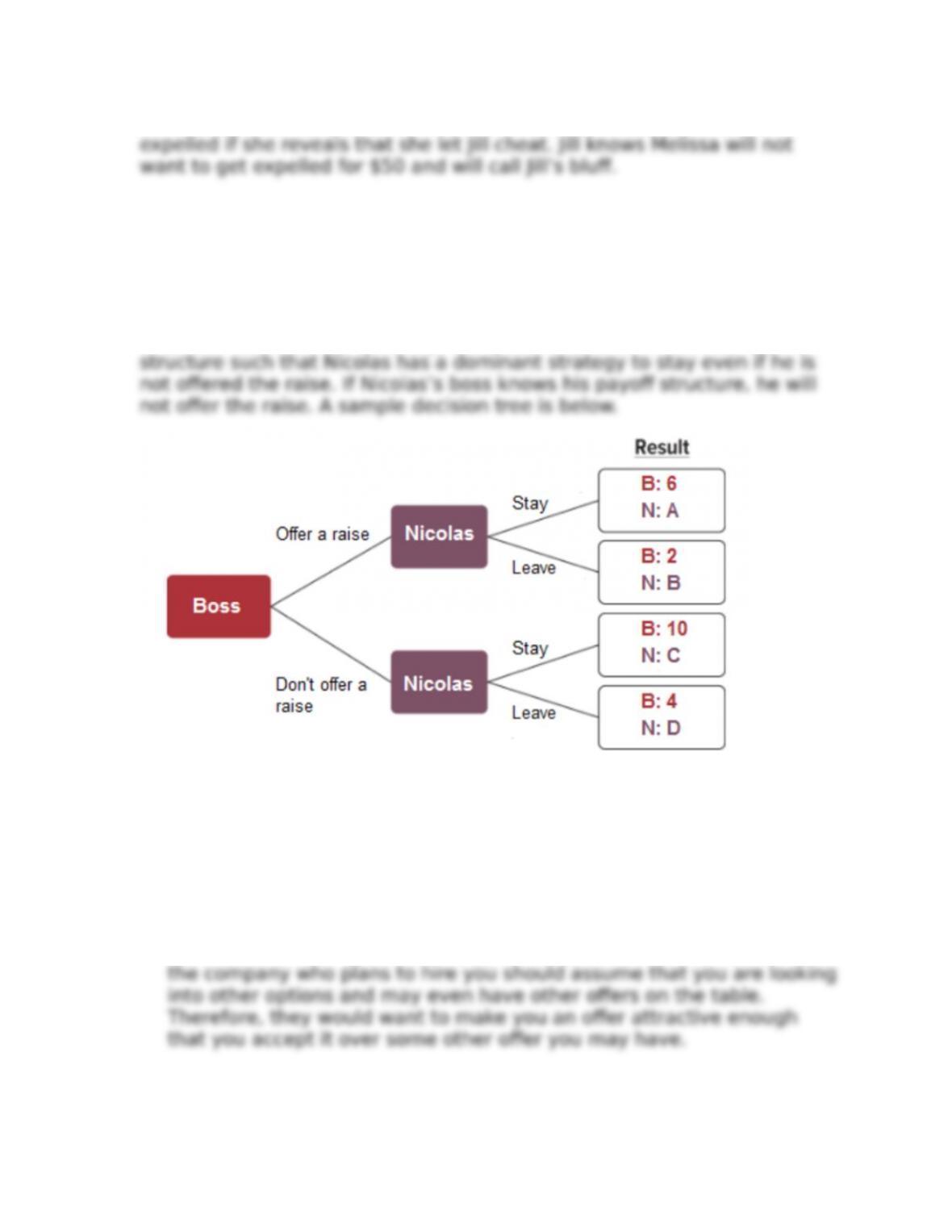
13. Nicolas has asked for a raise. His boss must decide whether to approve
his request. If Nicolas doesn’t get the raise, he will have to decide whether to
stay at his job or quit. Construct a decision tree for these sequential
decisions and choose a payoff structure where Nicolas has a dominant
strategy to stay at his job even without getting the raise. [LO 9.8]
Answer: Numbers are arbitrary, but students should choose a payoff
14. Job offers could be considered a one-round bargaining game with a
“rst-mover advantage: The company offers you a job at a certain salary, and
you can take it or leave it. Explain why the company might not capture all
the surplus in this game, even if you can’t make a counteroffer. [LO 9.9]
Answer: Even if you cannot make a counteroffer, you do still have
options. Presumably, you have applied to more than one place. At least
9-9
Copyright © 2018 McGraw-Hill Education. All rights reserved. No reproduction or distribution without the prior written consent of McGraw-Hill
Education.