
Chapter 07 – Consumer Behavior
CHAPTER 7
CONSUMER BEHAVIOR
Chapter Overview
The ideas in this chapter are at the heart of economic analysis. Everything in
the following chapters (and, for that matter, the preceding chapters) is in
some way based on the assumption that people attempt to maximize their
utility within the limitations of their resources.
We’ll enrich this picture in the coming chapters, seeing that individuals have
to answer many tough questions when making even commonplace decisions:
What is the timing of the bene&ts, now or later? What is the timing of the
costs? What are the risks? Am I fully informed about the situation? Are others
competing with me for the same goal?
The idea of utility maximization is remarkably *exible. We’ll see that people
often have preferences that extend far beyond a narrow de&nition of their
own bene&t. Sometimes they pursue their goals in unexpected or not entirely
rational ways. Nonetheless, the essential idea of individuals pursuing the
things they want in the face of scarcity drives economic analysis from A to Z.
Learning Objectives
LO 7.1: Explain how revealed preferences indicate which goods or activities
give a person the most utility.
LO 7.2: Show how the budget constraint affect utility maximization.
LO 7.3: Show how a change in income affect consumption choices.
LO 7.4: Show how a change in price affect consumption choices, and
distinguish between the income and substitution effect.
LO 7.5: Outline the ways in which utility is in*uenced by other people.
LO 7.6: Describe how people get utility from altruism and reciprocity.
Chapter Outline
OPENING STORY: THE SEASON FOR GIVING
The Basic Idea of Utility
Utility and Decision Making
Revealed Preference (LO 7.1)
BOX FEATURE: REAL LIFE – THE SCIENCE OF HAPPINESS
Utility Functions
Marginal Utility
Maximizing Utility within Constraints (LO 7.2)
Responding to Changes in Income and Prices
Changes in Income (LO 7.3)
7-1
Copyright © 2018 McGraw-Hill Education. All rights reserved. No reproduction or distribution without the prior written consent of McGraw-Hill
Education.

Chapter 07 – Consumer Behavior
Changes in Prices (LO 7.4)
Utility and Society
Utility and Status (LO 7.5)
BOX FEATURE: FROM ANOTHER ANGLE – CONSPICUOUS CONSUMPTION AND
CONSPICUOUS CHARITY
BOX FEATURE: WHAT DO YOU THINK – CHOOSING A LEAGUE
Utility and Altruism (LO 7.6)
BOX FEATURE: REAL LIFE – WHY WE GIVE
Utility and Reciprocity
Beyond the Lecture
Class Video: Diminishing Marginal Utility (LO 7.2)
Consider showing a clip from the TV show “Man vs. Food” in which Adam
attempts to complete a food challenge. Be sure to &nd a challenge is related
to the volume of food consumed rather than spiciness. In this great
example, you can hear phrases that really illustrate diminishing marginal
utility, such as “Will tacos 4-8 be as kind as the &rst 3?”
Class Discussion: Revealed Preference, Maximizing Utility within
Constraints, and Changes in Income (LO 7.1, LO 7.2, LO 7.3)
Consider showing two brief scenes from the movie Dumb and Dumber. In the
movie, Harry and Lloyd discover that they have a suitcase full of money in
their possession. They had been barely scraping by throughout the movie,
but by the end of the movie they have so much money that they use it to
blow their nose. Show 1:10:10 to 102:00:00 and 1:25:15 to 102:00:00.
Class Discussion: Changes in Prices (LO 7.4)
Ask students to imagine that they are planning a party with friends. Present
this scenario for them: they have $50 to spend on pizza for 20 people, and
they estimate that they need &ve pizzas for everyone to have two pieces.
They think that the pizzas are $10 each. However, when they arrive at the
restaurant, they &nd that pizzas are on sale for $5 each.
1. How many pizzas will they buy?
2. What do the income and substitution e3ects suggest will occur in
terms of quantity purchased?
3. How will they spend the savings due to the sale price (if at all)?
Class Discussion: Utility and Status (LO 7.5)
Show students this brief video from TEDx (locally organized TED type talks),
which discusses the difference between relative and absolute happiness.
1. Ask students what makes them happy. Do they care more about
relative or absolute measures?
2. Why might people care about relative well-being? How could this
influence decisions and feelings?
Clicker Questions
7-2
Copyright © 2018 McGraw-Hill Education. All rights reserved. No reproduction or distribution without the prior written consent of McGraw-Hill
Education.
Chapter 07 – Consumer Behavior
There are three main purposes to clicker questions. First, they are a great
way to do a quick and instant “on demand” test of student understanding of
the material. You can cover material, and instantly get feedback on student
comprehension. You can see whether you need to explain certain topics
again, or move on to the next subject. Second, they are a great method to
break up the class and take a moment away from lecture. It gets the
students actively involved. Finally, certain clicker questions can be framed in
a “discussion” manner, in which you can invite students to talk about the
possible right answer with their peers. You can instruct students to convince
their classmate of a right or wrong answer.
1. Why is the idea and method of revealed preference important? [LO 7.1]
A. We analyze what people say they will prefer
Feedback: It’s important to remember that in Economics, we want to study
behavior. Not thoughts or words or even what we think is best for
ourselves… but actual behavior that people engage in.
2. What is the most likely example of something giving negative marginal
utility? [LO 7.2]
A. Having too much money
3. What determines the slope of the budget constraint? [LO 7.3]
A. A person’s income
Feedback: The constraint shows what you can buy. If I want more X, I have
to give up some Y. The amount of Y I must give up depends on the relative
prices of X and Y.
4. Which of the following is most likely to be a Veblen good? [LO 7.5]
A. Used furniture
7-3
Copyright © 2018 McGraw-Hill Education. All rights reserved. No reproduction or distribution without the prior written consent of McGraw-Hill
Education.
Chapter 07 – Consumer Behavior
Feedback: Remember that a Veblen good is one which people may buy
more of when the price goes up. This is because the person is using the
expensive good to *aunt status or wealth.
5. Why might a person engage in volunteering, charity, or altruistic
endeavors? [LO 7.6]
A. They may enjoy the internal good feelings these behaviors cause
Solutions to End-of–Chapter Questions and Problems
Review Questions
1. Which of the following activities give you positive utility? [LO 7.1]
a. Playing sports
b. Receiving a prestigious scholarship
c. Buying a new TV
d. Eating Brussels sprouts
e. All of the above
Answer: For me, the answer is e, all of the above. Playing sports,
receiving a scholarship, and buying a TV would all give me utility—and
2. Your gym offer two classes at the same time: weightlifting and yoga.
Both classes are included in your membership and have space available.
Your friend tells you he wants to work on his strength and take the
weightlifting class, but you always see him in yoga class. Which class gives
him more utility? How do you know this? [LO 7.1]
Answer: Yoga class gives your friend the most utility. You know this
because your friend reveals his preference by his actions. The fact that
3. Evie has a gift pass for unlimited roller-coaster rides on her birthday.
Given the information about Evie’s utility in Table 7Q-1, explain why she
chooses to ride only three times. [LO 7.1]
7-4
Copyright © 2018 McGraw-Hill Education. All rights reserved. No reproduction or distribution without the prior written consent of McGraw-Hill
Education.
Chapter 07 – Consumer Behavior
Answer: Evie’s marginal utility is positive for the &rst three rides. It
4. Dan likes to spend his allowance on two things: candy and toys. What are
the three constraints that determine the possible consumption bundles of
toys and candy available to Dan? [LO 7.2]
Answer: Dan’s budget constraint is determined by the amount of his
5. Evan has $40 to spend at an amusement park. The roller coaster costs
$10 per ride. Given the information about Evan’s utility in Table 7Q-2, explain
why he chooses to ride only three times. [LO 7.2]
Answer: Evan can afford four roller coaster rides, and his marginal utility
from the fourth ride is still positive. The fact that Evan does not choose to
6. Suppose a wedge of cheese is $10, and a loaf of bread is $5. What is the
opportunity cost of purchasing a wedge of cheese (in terms of bread)?
Explain what happens to the opportunity cost of purchasing a wedge of
cheese (in terms of bread) if your income decreases by 20 percent. [LO 7.3]
Answer: The opportunity cost of purchasing a wedge of cheese is two
loaves of bread because the $10 you spend on a wedge of cheese could
7. Simone spends $200 a month on voice lessons and dance lessons. She
just learned that starting next month her favorite dance instructor is moving
out of town and the monthly rent for her apartment is increasing. How will
each of these events a3ect Simone’s budget constraint for voice and dance
lessons? [LO 7.3]
7-5
Copyright © 2018 McGraw-Hill Education. All rights reserved. No reproduction or distribution without the prior written consent of McGraw-Hill
Education.
Chapter 07 – Consumer Behavior
Answer: The fact that Simone’s favorite instructor is moving may reduce
her consumption of dance lessons, but it will not a3ect her budget
8. Julian buys plants and *owers every month. Both are normal goods. When
the price of *owers fell, Julian purchased fewer plants. Which e3ect was
stronger for Julian, the income e3ect or the substitution e3ect? [LO 7.4]
Answer: The substitution e3ect was stronger. When the price of *owers
falls, the income e3ect predicts that Julian will buy more *owers and more
9. Sarah spends her monthly entertainment budget on books and movies.
Sarah’s initial utility-maximizing combination of books and movies is &ve
movies and two books a month. Assume the price of books falls. Sarah’s new
utility-maximizing combination of books and movies is &ve movies and four
books. Given this information, can we say whether movies are a normal
good? [LO 7.4]
Answer: Yes. We know that the substitution e3ect will lead Sarah to
substitute away from movies and toward books, since books are now
10. Your friend says, “I’d rather be a big &sh in a small pond than a small &sh
in a big pond.” What concept does this comment illustrate? [LO 7.5]
Answer: Your friend has illustrated the concept of frames of reference.
Your friend is saying that she would rather be an in a smaller setting if
7-6
Copyright © 2018 McGraw-Hill Education. All rights reserved. No reproduction or distribution without the prior written consent of McGraw-Hill
Education.
Chapter 07 – Consumer Behavior
11. Suppose that in addition to being a college student, you run your own
business and earn $35,000 per year. Your friends are all in college, and their
average annual income is $10,000 per year. When you graduate from
college, you decide to continue running your business. Your friends accept
jobs that pay $50,000 per year. Do you expect your utility to increase,
decrease, or stay the same after graduation? Why? [LO 7.5]
Answer: Even though your own income has not changed, you now make
relatively less than your friends instead of relatively more. Your frame of
12. You come home to discover that your roommate has left their dirty dishes
in the sink (again!). Why might you be likely to leave your own dirty dishes in
the sink (which you know annoys your roommate), even though you usually
prefer a clean kitchen to a messy kitchen? [LO 7.6]
Answer: Reciprocity means responding to another’s action with a similar
13. An organization that raises money to provide meals for seniors gives tote
bags to its donors. Sami thinks it is wasteful to spend donated money on tote
bags for donors because the money could be used to provide more meals.
Explain to Sami why giving tote bags could make &nancial sense for the
organization. [LO 7.6]
Problems and Applications
1. Total utility is maximized when marginal utility becomes (positive, zero,
negative). [LO 7.1]
Answer: Total utility is maximized when marginal utility becomes zero. If
marginal utility is positive, total utility will increase if you consume the
7-7
Copyright © 2018 McGraw-Hill Education. All rights reserved. No reproduction or distribution without the prior written consent of McGraw-Hill
Education.
Chapter 07 – Consumer Behavior
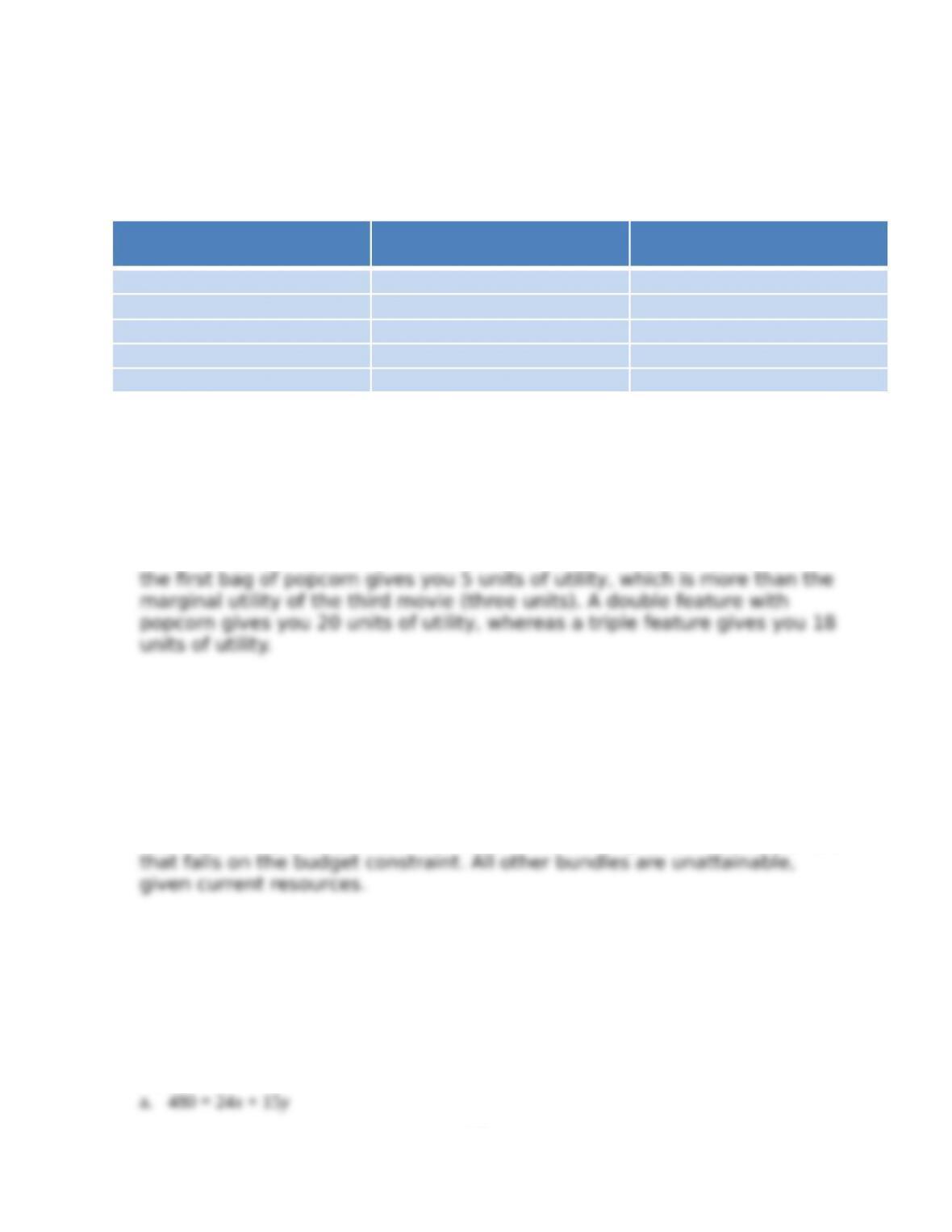
2. Table 7P-1 shows the total utility that John gets from ice cream, for each
quantity he consumes. Fill in the third column showing the marginal utility he
gets from each additional scoop. [LO 7.1]
Answer:
Quantity of ice cream
(scoops) Total utility Marginal utility of the
last scoop eaten
1 10 10
2 17 7
3 21 4
4 23 2
5 23 0
3. You love going to the movies. For your birthday, your friend offer to take
you to a triple feature without popcorn or a double feature with two bags of
popcorn. Table 7P-2 shows your utility for movies and popcorn. Which option
should you choose? [LO 7.1]
Answer: You will be happiest choosing the double feature with popcorn.
Even though you get no additional utility from the second bag of popcorn,
4. Refer to the budget constraint for jeans and T-shirts in Figure 7P-1. Which
of the following consumption bundles is attainable? [LO 7.2]
a. 3 pairs of jeans, 1 T-shirt.
b. 2 pairs of jeans, 4 T-shirts.
c. 2 pairs of jeans, 3 T-shirts.
d. 1 pair of jeans, 4 T-shirts.
Answer: d: 1 pair of jeans, 4 T-shirts. This is the only consumption bundle
5. Petra has $480 to spend on DVDs and books. A book costs $24 and a DVD
costs $15. [LO 7.2]
a. Write an equation for the budget constraint. Let x = 5 books. Let y = 5
DVDs.
b. Use your equation to determine how many books Petra can buy if she
buys 8 DVDs.
Answer:
7-8
Copyright © 2018 McGraw-Hill Education. All rights reserved. No reproduction or distribution without the prior written consent of McGraw-Hill
Education.
Chapter 07 – Consumer Behavior
b. 480 = 24x + 15(8)
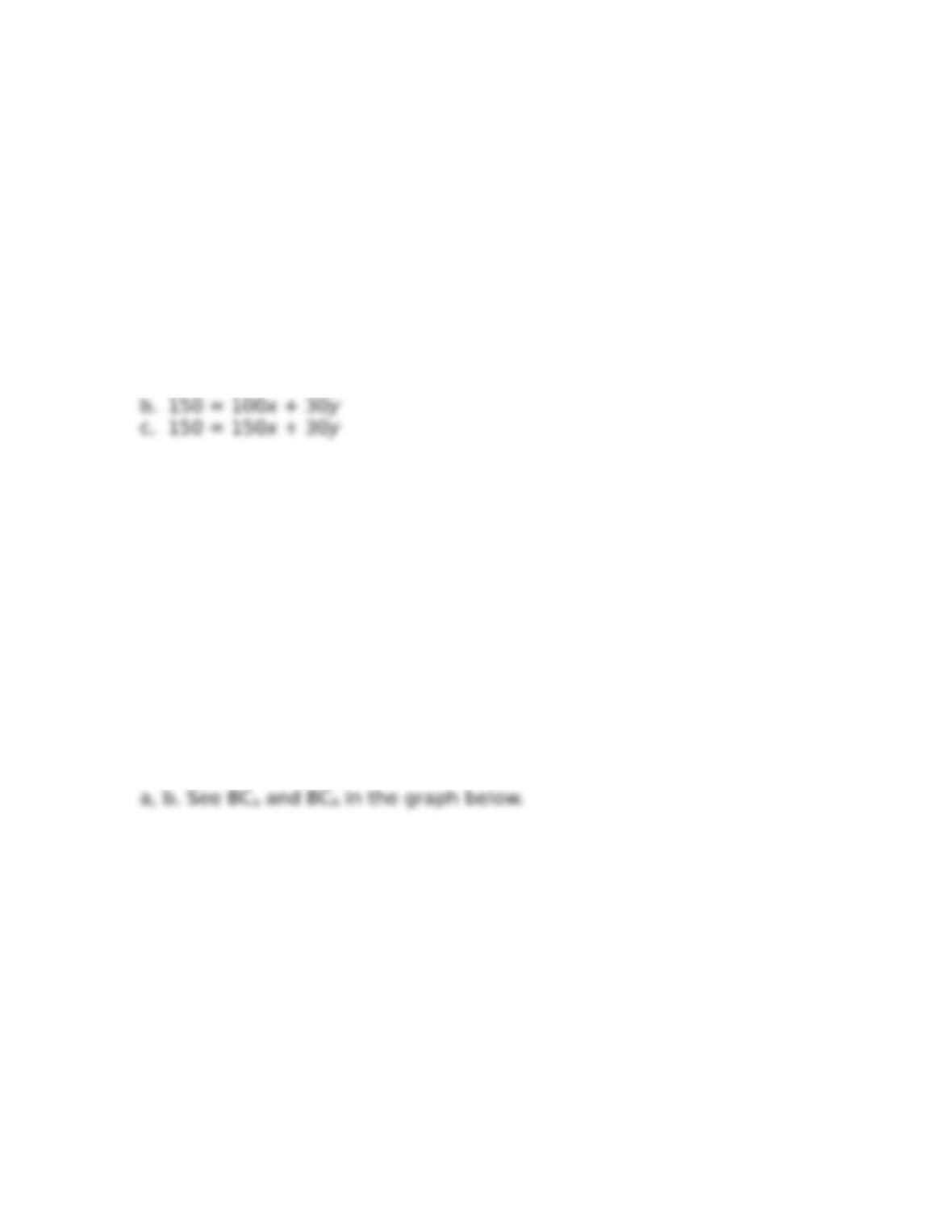
6. Jordan visits her sister several times a year. Jordan’s travel budget is
$600, which she uses to buy bus tickets and train tickets. The train costs
$120 per trip, and the bus costs $40. [LO 7.2, 7.3]
a. Graph Jordan’s budget constraint.
b. How many total trips can Jordan take if she takes the train three times?
c. Suppose Jordan’s travel budget is cut to $360. Draw her new budget
constraint.
d. How many train trips can she take if she doesn’t want to reduce the total
number of trips she takes each year?
Answer:
b. Taking the train 3 times costs Jordan $360. This leaves her with $240
7-9
Copyright © 2018 McGraw-Hill Education. All rights reserved. No reproduction or distribution without the prior written consent of McGraw-Hill
Education.
Chapter 07 – Consumer Behavior
7. Maria has a $300 gift certi&cate at a spa that she can use on massages or
manicures. A massage costs $100, and a manicure costs $30. [LO 7.3, 7.4]
a. Write the equation for Maria’s budget constraint. Let x = massages. Let y
= manicures.
b. Suppose Maria decides to split her gift certi&cate with a friend and
transfers half of the value of her gift certi&cate to her friend. Write the
equation for her new budget constraint.
c. After giving away half of her gift certi&cate, suppose the price of a
massage increases by 50 percent before Maria can use her gift certi&cate.
Write the equation for her new budget constraint.
Answer:
a. 300 = 100x + 30y
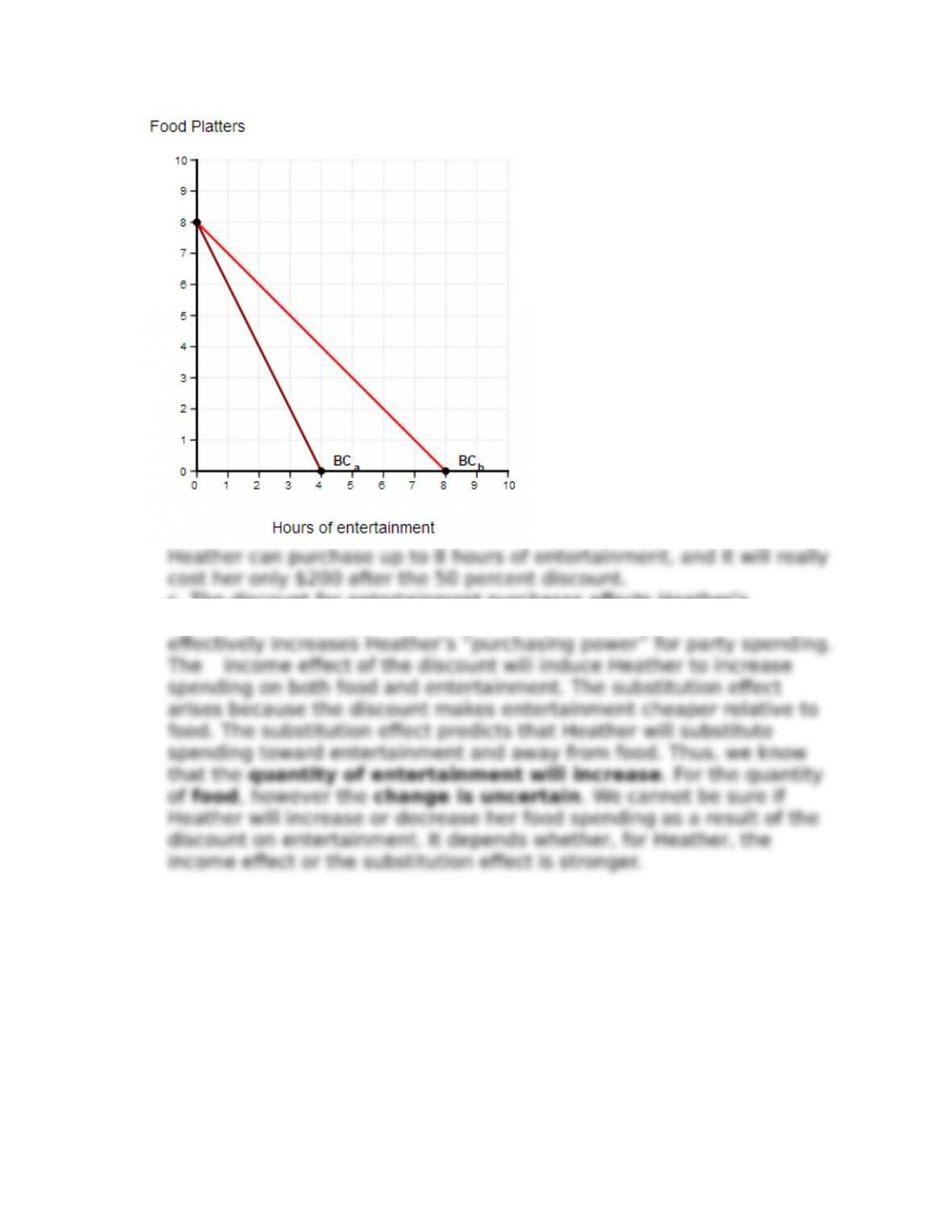
8. Every year, Heather hosts a holiday party for her friends. Her party
budget is $200. Heather spends her budget on food platters that cost $25
each and on entertainment, which costs $50 per hour. [LO 7.4]
a. Graph Heather’s budget constraint for food and entertainment.
b. To reward her loyal business, the entertainment company Heather hires
has offered her a 50 percent discount on entertainment purchases for this
year’s party. On your graph, illustrate Heather’s new budget constraint for
food and entertainment.
c. Assuming that food platters and entertainment are normal goods, what
can you say about the quantity of each good that Heather will purchase after
the discount? Will the quantity of entertainment increase or decrease, or is
the change uncertain? Will the quantity of food increase or decrease, or is
the change uncertain?
Answer:
7-10
Copyright © 2018 McGraw-Hill Education. All rights reserved. No reproduction or distribution without the prior written consent of McGraw-Hill
Education.
Chapter 07 – Consumer Behavior
c. The discount for entertainment purchases affect Heather’s
spending in two ways. The income e3ect results because the discount
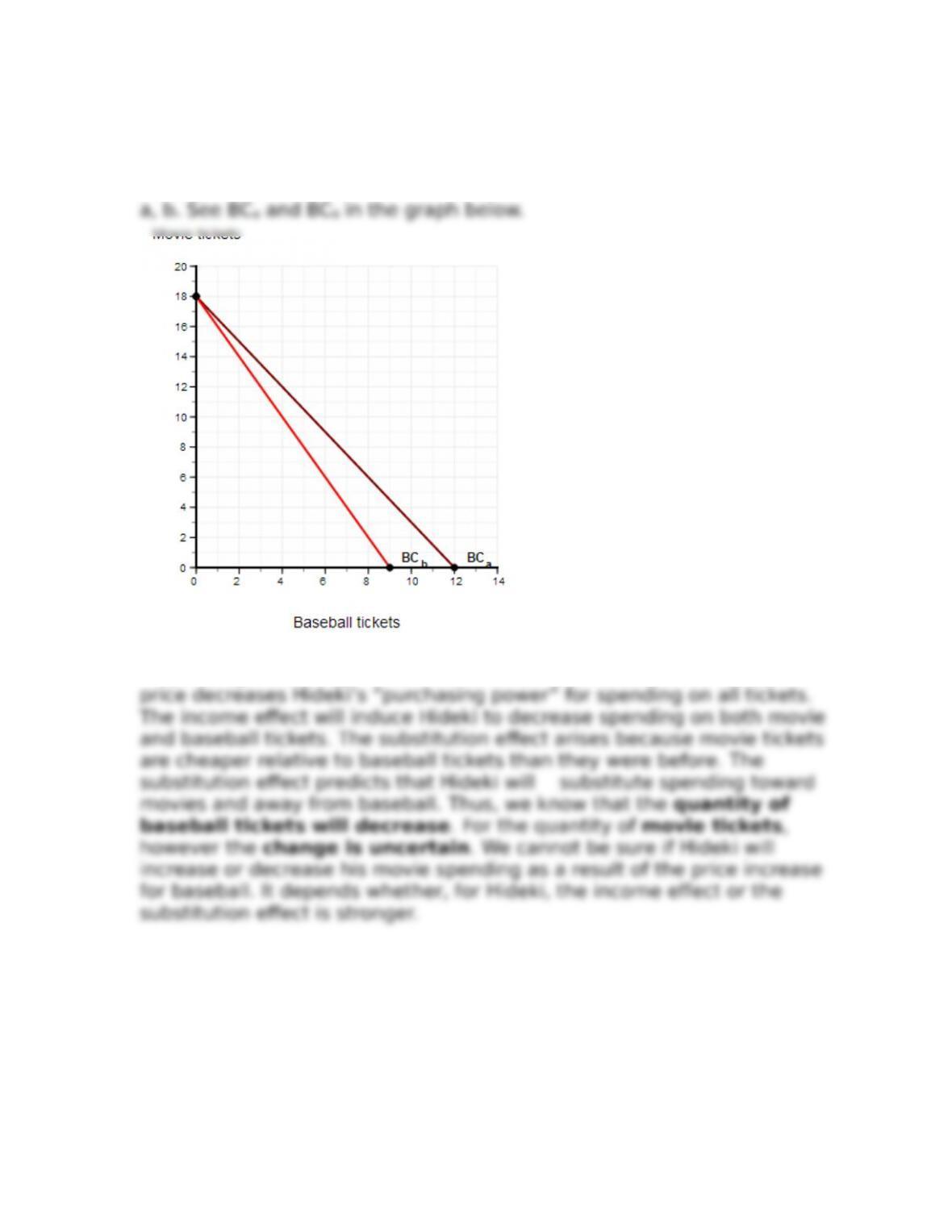
9. Hideki attends baseball games and goes to movie theaters. Baseball
tickets cost $15, and movie tickets cost $10. His entertainment budget is
$180. [LO 7.4]
a. Graph Hideki’s budget constraint for baseball and movie tickets.
b. Suppose the home team is having a good season, and the price of
baseball tickets goes up to $20 per game. Graph the new budget constraint.
c. Assuming that baseball and movie tickets are normal goods, what can you
say about the quantity of each good that Hideki will consume after the price
of baseball tickets goes up? Will the quantity of baseball games he attends
7-11
Copyright © 2018 McGraw-Hill Education. All rights reserved. No reproduction or distribution without the prior written consent of McGraw-Hill
Education.
Chapter 07 – Consumer Behavior
increase or decrease, or is the change uncertain? Will the quantity of movies
he watches increase or decrease, or is the change uncertain?
Answer:
c. The increase in the price of baseball tickets affect Hideki’s
spending in two ways. The income e3ect results because increase in
7-12
Copyright © 2018 McGraw-Hill Education. All rights reserved. No reproduction or distribution without the prior written consent of McGraw-Hill
Education.
Chapter 07 – Consumer Behavior
10. For which of the following goods is the utility you get from consuming
them likely to be affected by the opinions of others? [LO 7.5]
a. MP3s.
b. A new car.
c. Running shoes.
d. A new laptop for class.
Answer: All of the above (a−d). The utility we get from consuming most
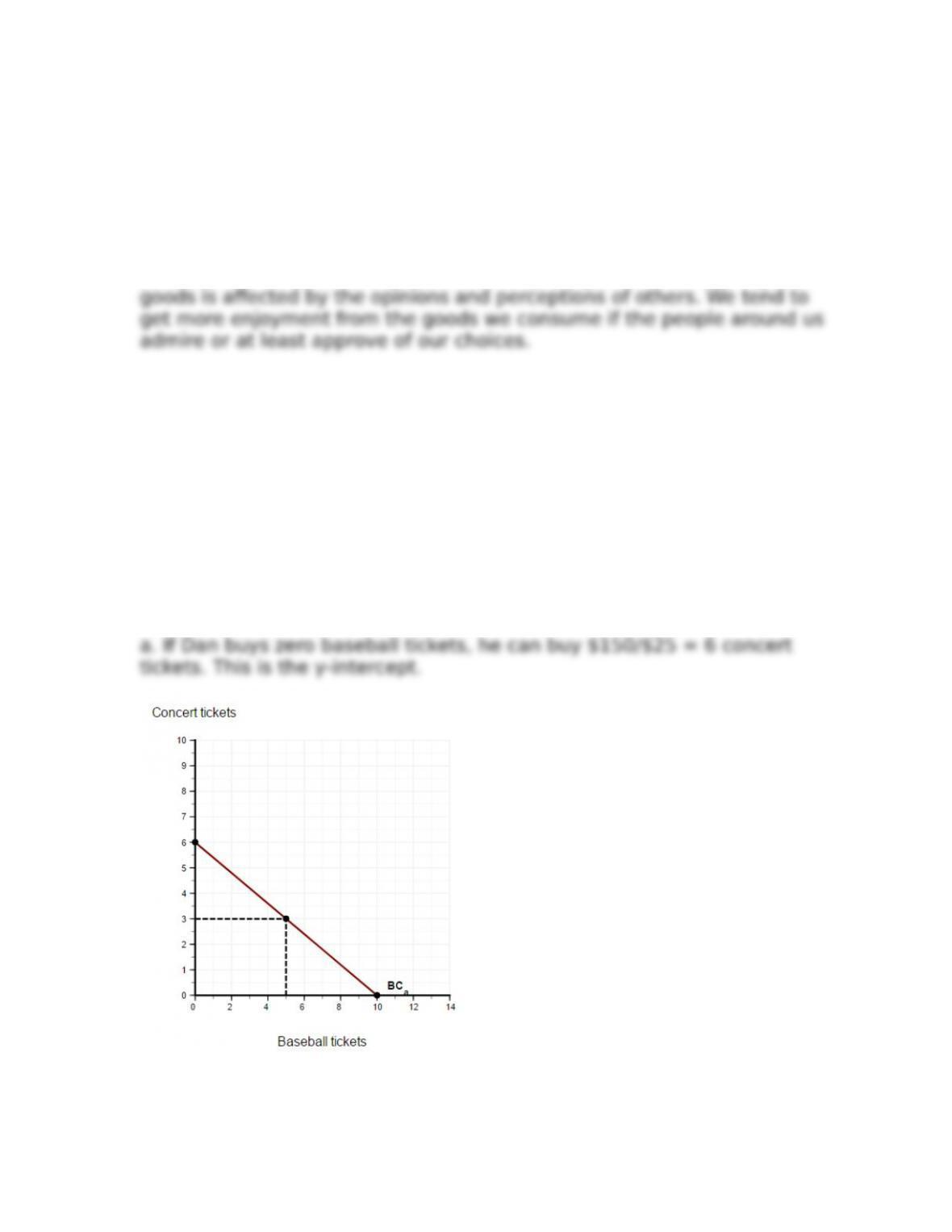
11. Dan spends his money on baseball games and concert tickets. Baseball
tickets cost $15, and concert tickets cost $25. His entertainment budget is
$150. [LO 7.5]
a. Draw Dan’s budget constraint, putting baseball tickets on the x-axis.
b. Dan decides to attend three concerts and &ve baseball games. Plot this
point on the budget constraint.
c. Dan’s best friend Jay tells Dan that his favorite thing to do is go to
concerts. In fact, going to concerts is popular with a lot of Dan’s friends. Will
Dan’s budget constraint increase, decrease, or stay the same? Will the
quantity of concerts he attends increase, decrease, or stay the same?
Answer:
7-13
Copyright © 2018 McGraw-Hill Education. All rights reserved. No reproduction or distribution without the prior written consent of McGraw-Hill
Education.
Chapter 07 – Consumer Behavior
b. The point (5 baseball tickets, 3 movie tickets) is on the budget
c. Like most of us, Dan’s utility is probably influenced by his friends. Even
12. Samuel’s utility is influenced by reciprocity. He is likely to respond to a
surprisingly generous birthday gift from his best friend in what way? [LO
7.6]
a. Not giving his friend a birthday gift at all.
b. Giving his friend the birthday gift he had originally planned to give.
c. Giving his friend a more thoughtful or more generous gift that he had
originally planned to give.
d. Returning the birthday gift he received.
Answer: Reciprocity involves doing good things for people who did good
13. Say whether each of the following situations is an example of altruism
or reciprocity. [LO 7.6]
a. Giving a few canned goods to the local food bank for its annual food drive.
b. Helping someone move her couch after she helped you study for an
upcoming exam.
c. The biological relationship between cleaner &sh and large predators in the
ocean, in which cleaner &sh keep the predator free from parasites and the
predator keeps the cleaner &sh safe.
Answer: Reciprocity involves doing good things for people who did good
things for us. Altruism involves simply wanting others to be better o3.
7-14
Copyright © 2018 McGraw-Hill Education. All rights reserved. No reproduction or distribution without the prior written consent of McGraw-Hill
Education.