
Chapter 06 – Government Intervention
CHAPTER 6
GOVERNMENT INTERVENTION
Chapter Overview
If you listen to the news, it might seem as if economics is all about business
and the stock market. Business matters, but many of the most important,
challenging, and useful applications of economic principles involve public
policy.
This chapter gives you the basic tools you need to understand government
interventions and some of the ways they can affect your everyday life. Of
course, the real world is complicated, so this isn’t our last word on the topic.
Later, we discuss how to evaluate the bene”ts of both markets and
government policies. We’ll also discuss market failures and whether and
when governments can “x them.
Learning Objectives
LO 6.1: Calculate the effect of a price ceiling on the equilibrium price and
quantity.
LO 6.2: Calculate the effect of a price +oor on the equilibrium price and
quantity.
LO 6.3: Calculate the effect of a tax on the equilibrium price and quantity.
LO 6.4: Calculate the effect of a subsidy on the equilibrium price and
quantity.
LO 6.5: Explain how elasticity and time period influence the impact of a
market intervention.
Chapter Outline
OPENING STORY: FEEDING THE WORLD, ONE PRICE CONTROL AT A TIME
Why Intervene?
Three Reasons to Intervene
Four Real-World Interventions
Price Controls
Price Ceilings (LO 6.1)
BOX FEATURE: WHAT DO YOU THINK? – PUT A CAP ON PAYDAY LENDING?
Price Floors (LO 6.2)
Taxes and Subsidies
Taxes (LO 6.3)
Subsidies (LO 6.4)
BOX FEATURE: REAL LIFE – THE UNINTENDED CONSEQUENCES OF BIOFUEL
SUBSIDIES
6-1
Copyright © 2016 McGraw-Hill Education. All rights reserved. No reproduction or distribution without the prior written consent of McGraw-Hill
Education.

Chapter 06 – Government Intervention
Evaluating Government Interventions (LO 6.5)
How Big Is the Effect of a Tax or Subsidy?
BOX FEATURE: WHERE CAN IT TAKE YOU? – PUBLIC ECONOMICS
Long-Run versus Short-Run Impact
BOX FEATURE: WHAT DO YOU THINK? – FARM SUBSIDIES
Beyond the Lecture
Class Discussion: Price Ceilings (LO 6.1)
Have students read Rent-Stabilized Apartments, Ever More Elusive by Mark
Santora. The NY Times article highlights the shortage of rent-stabilized
apartments in New York City and discusses some of the other issues
associated with rent controls. Additionally, consider showing this clip from
the TV show Seinfeld (Season 2: The Apartment), where Jerry discusses rent
control apartments in New York City.
1. What are the proposed bene”ts of rent controls? What are the costs?
2. How do rent controls impact price and quantity?
3. How do rent controls impact the market for housing?
You can also use this opportunity to talk about “unintended consequences”,
where the policy may hurt those it intended to help. This is sort of an
economic irony. Rent control is meant to help low-income people, but the
resulting shortage often causes the existing units to be allocated to the
highest bidder by bribery, under-the-table money, or even by nepotism or
other networking. This certainly hurts low-income people, as they most likely
won’t have upfront money to pay to get the cheap unit.
Class Discussion: Price Floors (LO 6.2)
Discuss the minimum wage with students as an example of a price +oor.
Students really enjoy this topic. Consider asking students to read The
Business of the Minimum Wage by Christina D. Romer. This is a nice topic for
a small group in the classroom or for students in an online format. The
following are great questions to consider with students:
1. What are the proposed bene”ts and potential problems associated with
an increase in the minimum wage?
2. What is the likely impact on price (wage in this case) and quantity?
3. Although economists care deeply about improving the situation of
individuals earning low salaries, why might many economists be less
likely to support higher minimum wages relative to other policies to
help lower-income individuals?
Class Discussion: Taxes (LO 6.3)
In order to highlight the potential impact of a tax, show students this map of
the United States, which displays the total gasoline tax per gallon that
drivers face in each state.
1. Have students consider the impact of an increase in the gasoline tax
on price and quantity.
6-2
Copyright © 2016 McGraw-Hill Education. All rights reserved. No reproduction or distribution without the prior written consent of McGraw-Hill
Education.
Chapter 06 – Government Intervention
2. How does the price elasticity of demand play a role in the impact of a
tax?
3. Ask students how they would respond to increased gas taxes.
Class Discussion: Subsidies (LO 6.4)
Have students view this short video report by Angel Gonzalez from the Wall
Street Journal. It discusses the impact of subsidized gasoline in Venezuela.
The report shows the opportunity for arbitrage in neighboring Colombia,
where gasoline prices are much higher. Additionally, the attempt of the
government to combat gasoline smuggling is discussed.
1. How do gasoline subsidies impact gasoline prices in Venezuela? How
does the subsidy impact the quantity demanded?
2. How does the gasoline subsidy in Venezuela create an arbitrage
opportunity?
Clicker Questions
There are three main purposes to clicker questions. First, they are a great
way to do a quick and instant “on demand” test of student understanding of
the material. You can cover material, and instantly get feedback on student
comprehension. You can see whether you need to explain certain topics
again, or move on to the next subject. Second, they are a great method to
break up the class and take a moment away from lecture. It gets the
students actively involved. Finally, certain clicker questions can be framed in
a “discussion” manner, in which you can invite students to talk about the
possible right answer with their peers. You can instruct students to convince
their classmate of a right or wrong answer.
1. Why is a reason the government would intervene in the market? [LO 6.1,
6.2]
A. To reduce overall surplus
Feedback: While “fairness” is often a reason given for intervention,
remember that this is a normative argument. In addition, intervention often
reduces eIciency by creating deadweight loss.
2. While a price ceiling may increase consumer surplus, what is a negative
market consequence? [LO 6.1]
A. Producers will produce too much of the good
6-3
Copyright © 2016 McGraw-Hill Education. All rights reserved. No reproduction or distribution without the prior written consent of McGraw-Hill
Education.
Chapter 06 – Government Intervention
Feedback: The price ceiling (and low price) may not do all consumers well if
there isn’t enough of the good available to buy at the low price! Producers
don’t want to produce as much at low prices.
3. How can government eliminate excess supply with binding price +oors?
[LO 6.2]
A. Government forces consumers to buy the supply at reduced prices
Feedback: This may keep prices high. It’s effectively the government
arti”cially increasing demand to keep the price high. But that government
spending is paid for by tax dollars!
4. The tax wedge model shows that if a tax is levied on consumers, then [LO
6.3]
A. The consumers will pay all of the tax
Feedback: Note that the split may not be 50/50 in terms of who pays. In
addition, the only time the tax burden is paid entirely by “rms or consumers
is if there is a perfectly inelastic or perfectly elastic demand or supply
function.
5. If subsidies increase the amount of market activity, how do they create
deadweight loss? [LO 6.4]
A. When the government pays for the subsidy, it spends tax dollars that
could have been spent elsewhere.
Feedback: It’s a tough question! But remember that any deviation away
from equilibrium results in deadweight loss. This can include doing too much
of the activity as well as doing too little.
6-4
Copyright © 2016 McGraw-Hill Education. All rights reserved. No reproduction or distribution without the prior written consent of McGraw-Hill
Education.
Chapter 06 – Government Intervention
Solutions to End-of–Chapter Questions and Problems
Review Questions
1. You are an advisor to the Egyptian government, which has placed a price
ceiling on bread. Unfortunately, many families still cannot buy the bread they
need. Explain to government oIcials why the price ceiling has not increased
consumption of bread. [LO 6.1]
Answer: The price ceiling has not increased the consumption of bread
2. Suppose there has been a long-standing price ceiling on housing in your
city. Recently, population has declined, and demand for housing has
decreased. What will the decrease in demand do to the eIciency of the price
ceiling? [LO 6.1]
Answer: A binding price ceiling keeps the price below the equilibrium
quantity and creates both a shortage and a deadweight loss. If demand
3. Suppose the United States maintains a price +oor for spinach. Why might
this policy decrease revenues for spinach farmers? [LO 6.2]
Answer: A binding price +oor will guarantee a minimum price for spinach
4. Suppose Colombia maintains a price +oor for coffee beans. What will
happen to the size of the deadweight loss if the price +oor encourages new
growers to enter the market and produce coffee? [LO 6.2]
Answer: If additional producers enter the market, the supply curve would
6-5
Copyright © 2016 McGraw-Hill Education. All rights reserved. No reproduction or distribution without the prior written consent of McGraw-Hill
Education.
Chapter 06 – Government Intervention
5. Many states tax cigarette purchases. Suppose that smokers are unhappy
about paying the extra charge for their cigarettes. Will it help smokers if the
state imposes the tax on the stores that sell the cigarettes rather than on
smokers? Why or why not? [LO 6.3]
Answer: No. The statutory incidence does not matter. If sellers were
taxed instead of buyers of cigarettes, the price that consumers pay would
6. Consider a tax on cigarettes. Do you expect the tax incidence to fall more
heavily on buyers or sellers of cigarettes? Why? [LO 6.3]
Answer: The tax incidence will fall more heavily on the side of the market
7. In the United States, many agricultural products (such as corn, wheat, and
rice) are subsidized. What are the potential bene”ts of subsidizing these
products? What are the costs? [LO 6.4]
Answer: Subsidizing agricultural production will increase both consumer
and producer surplus. Consumers will be able to buy at a lower price and
8. A subsidy will increase consumer and producer surplus in a market and
will increase the quantity of trades. Why, then, might a subsidy (such as a
subsidy for producing corn in the United States) be considered ineIcient?
[LO 6.4]
Answer: A subsidy might be considered ineIcient because the prices
that consumers pay are arti”cially low and the prices sellers receive are
arti”cially high. These prices would not occur without the subsidy, which
6-6
Copyright © 2016 McGraw-Hill Education. All rights reserved. No reproduction or distribution without the prior written consent of McGraw-Hill
Education.
Chapter 06 – Government Intervention
equilibrium quantity is too low and we want more trades to occur, the cost
of the subsidy might be worth it. If not, the subsidy is ineIcient.
9. Suppose the government imposes a price ceiling on gasoline. One month
after the price ceiling, there is a shortage of gasoline, but it is much smaller
than critics of the policy had warned. Explain why the critics’ estimates
might still be correct. [LO 6.5]
Answer: Elasticity is greater over a longer time horizon. In the “rst
month, supply and demand are less responsive to a price control than
10. A state facing a budget shortfall decides to tax soft drinks. You are a
budget analyst for the state. Do you expect to collect more revenue in the
“rst year of the tax or in the second year? Why? [LO 6.5]
Answer: You would expect to collect more tax revenue in the “rst year.
You collect taxes only on trades that occur. Taxes will reduce the number
6-7
Copyright © 2016 McGraw-Hill Education. All rights reserved. No reproduction or distribution without the prior written consent of McGraw-Hill
Education.
Chapter 06 – Government Intervention
Problems and Applications
1. Many people are concerned about the rising price of gasoline. Suppose
that government oIcials are thinking of capping the price of gasoline below
its current price. Which of the following outcomes do you predict will result
from this policy? Check all that apply. [LO 6.1]
a. Drivers will purchase more gasoline.
b. Quantity demanded for gasoline will increase.
c. Long lines will develop at gas stations.
d. Oil companies will work to increase their pumping capacity.
Answer: B and C. Quantity demanded for gasoline will increase at a price
below the equilibrium price. Drivers will not purchase more gasoline,
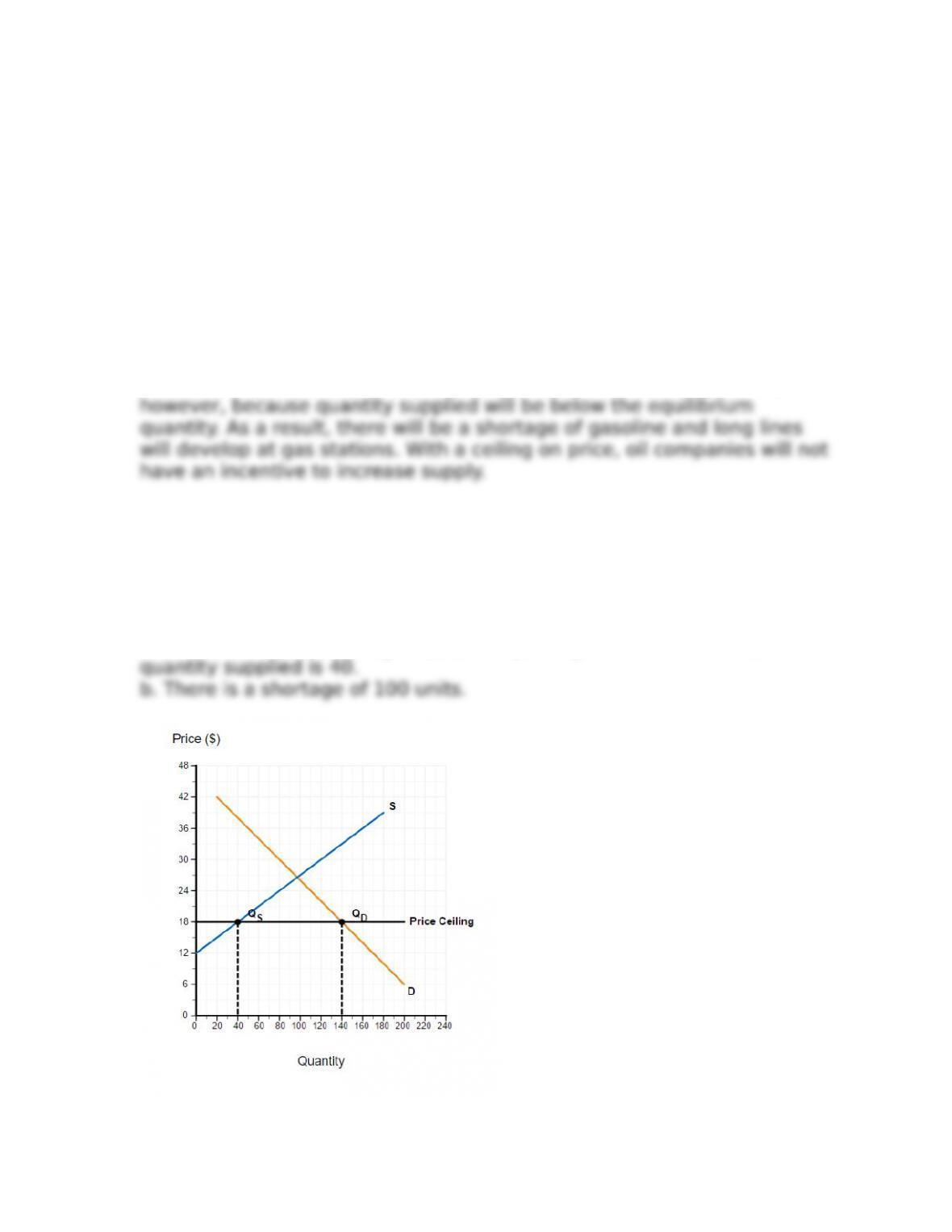
2. Consider the market shown in Figure 6P-1. The government has imposed a
price ceiling at $18. [LO 6.1]
a. At a price ceiling of $18, what is quantity demanded? Quantity supplied?
b. At this price ceiling, is there a shortage or a surplus? By how many units?
Answer:
a. If there is a price ceiling of $18, the quantity demanded is 140, and the
6-8
Copyright © 2016 McGraw-Hill Education. All rights reserved. No reproduction or distribution without the prior written consent of McGraw-Hill
Education.
Chapter 06 – Government Intervention
6-9
Copyright © 2016 McGraw-Hill Education. All rights reserved. No reproduction or distribution without the prior written consent of McGraw-Hill
Education.
Chapter 06 – Government Intervention
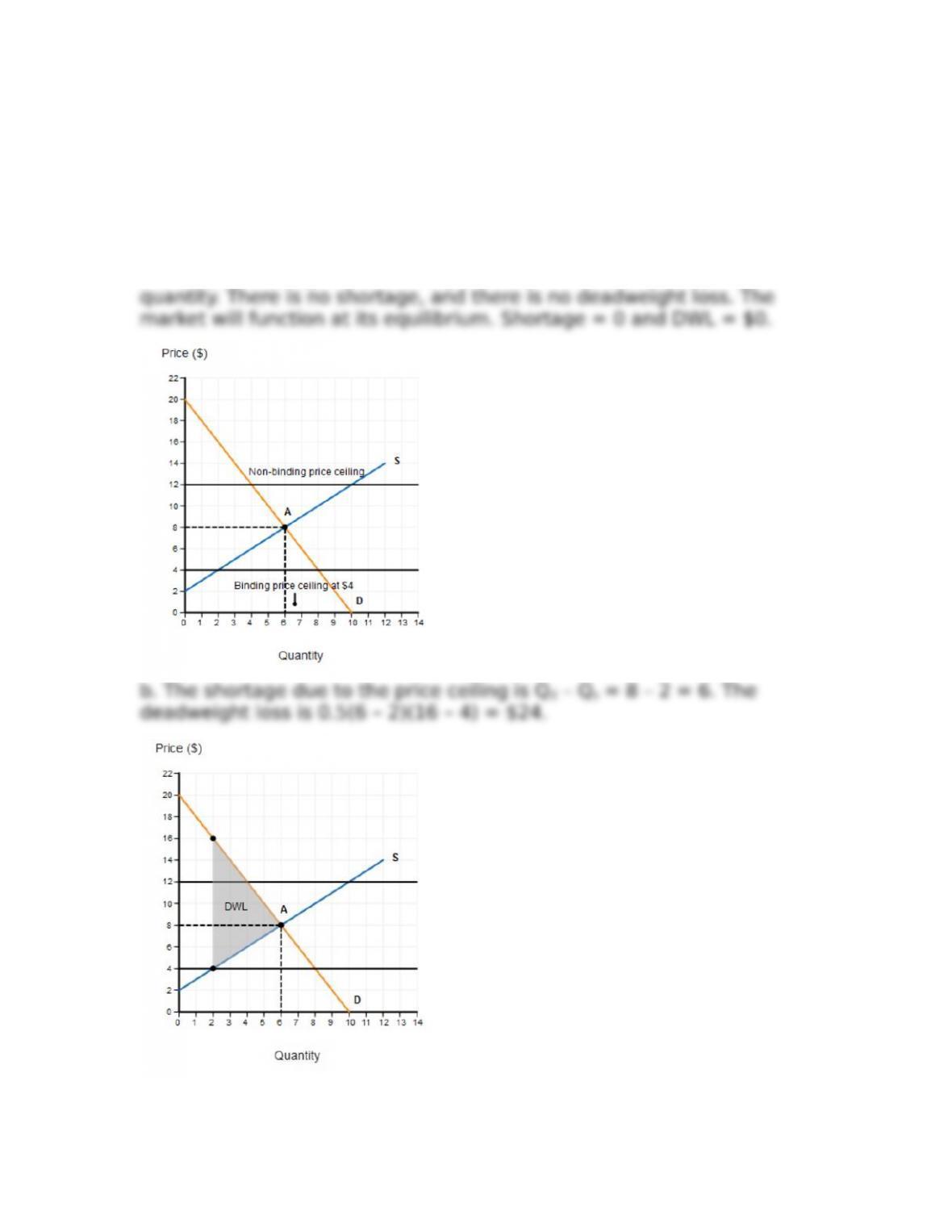
3. Figure 6P-2 shows a market in equilibrium. [LO 6.1]
a. Draw a price ceiling at $12. What is the amount of shortage at this price?
Draw and calculate the deadweight loss.
b. Draw a price ceiling at $4. What is the amount of shortage at this price?
Draw and calculate the deadweight loss.
Answer:
a. The price ceiling is non-binding because it is above the equilibrium
6-10
Copyright © 2016 McGraw-Hill Education. All rights reserved. No reproduction or distribution without the prior written consent of McGraw-Hill
Education.
Chapter 06 – Government Intervention
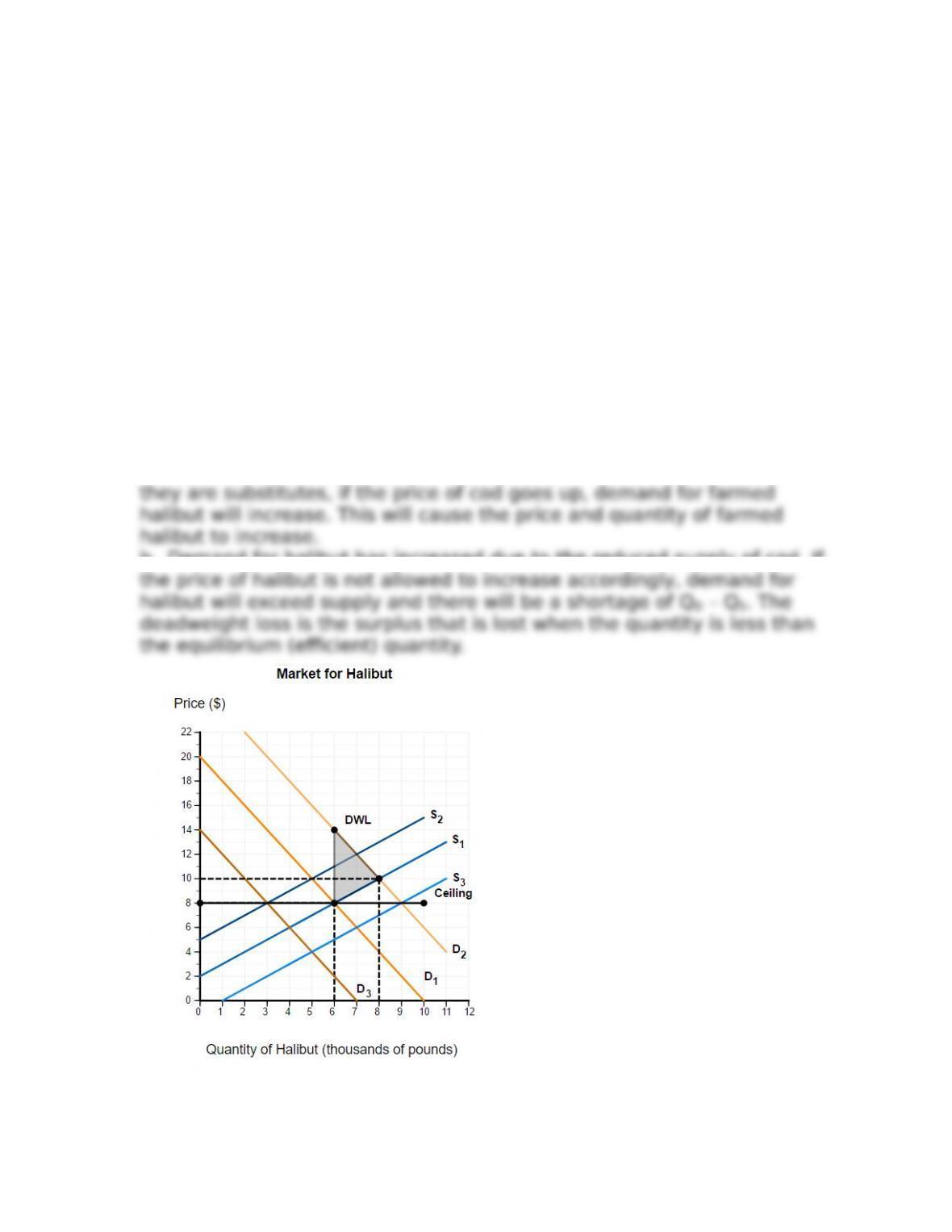
4. Decades of over”shing have dramatically reduced the world supply of cod
(a type of white”sh). Farm-raised halibut is considered a close substitute for
ocean-“shed cod. Figure 6P-3 shows the market for farm-raised halibut. [LO
6.1]
a. What effect will over”shing cod have on the price of cod? On the graph,
show the effect of over”shing cod on the market for farmed halibut.
b. A fast-food chain purchases both cod and halibut for use in its Fish ’n’
Chips meals. Already hurt by the reduced supply of cod, the fast-food chain
has lobbied aggressively for price controls on farmed halibut. As a result,
Congress has considered imposing a price ceiling on halibut at the former
equilibrium price—the price that prevailed before over”shing reduced the
supply of cod. What will happen in the market for farmed halibut if Congress
adopts the price control policy? Draw and label the price ceiling, quantity
demanded, quantity supplied, and deadweight loss.
Answer:
a. Due to the reduced supply of cod, the price of cod will rise. Because
b. Demand for halibut has increased due to the reduced supply of cod. If
6-11
Copyright © 2016 McGraw-Hill Education. All rights reserved. No reproduction or distribution without the prior written consent of McGraw-Hill
Education.
Chapter 06 – Government Intervention
6-12
Copyright © 2016 McGraw-Hill Education. All rights reserved. No reproduction or distribution without the prior written consent of McGraw-Hill
Education.
Chapter 06 – Government Intervention
5. Consider the market shown in Figure 6P-4. The government has imposed a
price +oor at $36. [LO 6.2]
a. At a price +oor of $36, what is quantity demanded? Quantity supplied?
b. At this price +oor, is there a shortage or a surplus? By how many units?
Answer:
a. If there is a price floor of $36, the quantity demanded is 90 and the quantity supplied is 225.
6. The Organization for the Promotion of Brussels Sprouts has convinced the
government of Ironia to institute a price +oor on the sale of brussels sprouts,
at $8 per bushel. Demand is given by P = 9 − Q and supply by P = 2Q, where
Q is measured in thousands of bushels. [LO 6.2]
a. What will be the price and quantity of brussels sprouts sold at market
equilibrium?
b. What will be the price and quantity sold with the price +oor?
c. How big will be the excess supply of brussels sprouts produced with the
price +oor?
Answer:
P = $6.
b. The price +oor is above the equilibrium price, so it is binding. The price
7. The traditional diet of the citizens of the nation of Ironia includes a lot of
red meat, and ranchers make up a vital part of Ironia’s economy. The
government of Ironia decides to support its ranchers through a price +oor,
which it will maintain by buying up excess meat supplies. Table 6P-1 shows
the supply and demand schedule for red meat; quantities are given in
thousands of pounds. [LO 6.2]
a. How many thousands of pounds of meat would you recommend that the
government purchase to keep the price at $4/pound?
b. How much money should the government budget for this program?
Answer:
a. At a price of $4, quantity supplied = 60,000 but quantity demanded
b. If the government buys 25,000 of excess supply at $4 per unit, it will
6-13
Copyright © 2016 McGraw-Hill Education. All rights reserved. No reproduction or distribution without the prior written consent of McGraw-Hill
Education.
Chapter 06 – Government Intervention
6-14
Copyright © 2016 McGraw-Hill Education. All rights reserved. No reproduction or distribution without the prior written consent of McGraw-Hill
Education.
Chapter 06 – Government Intervention
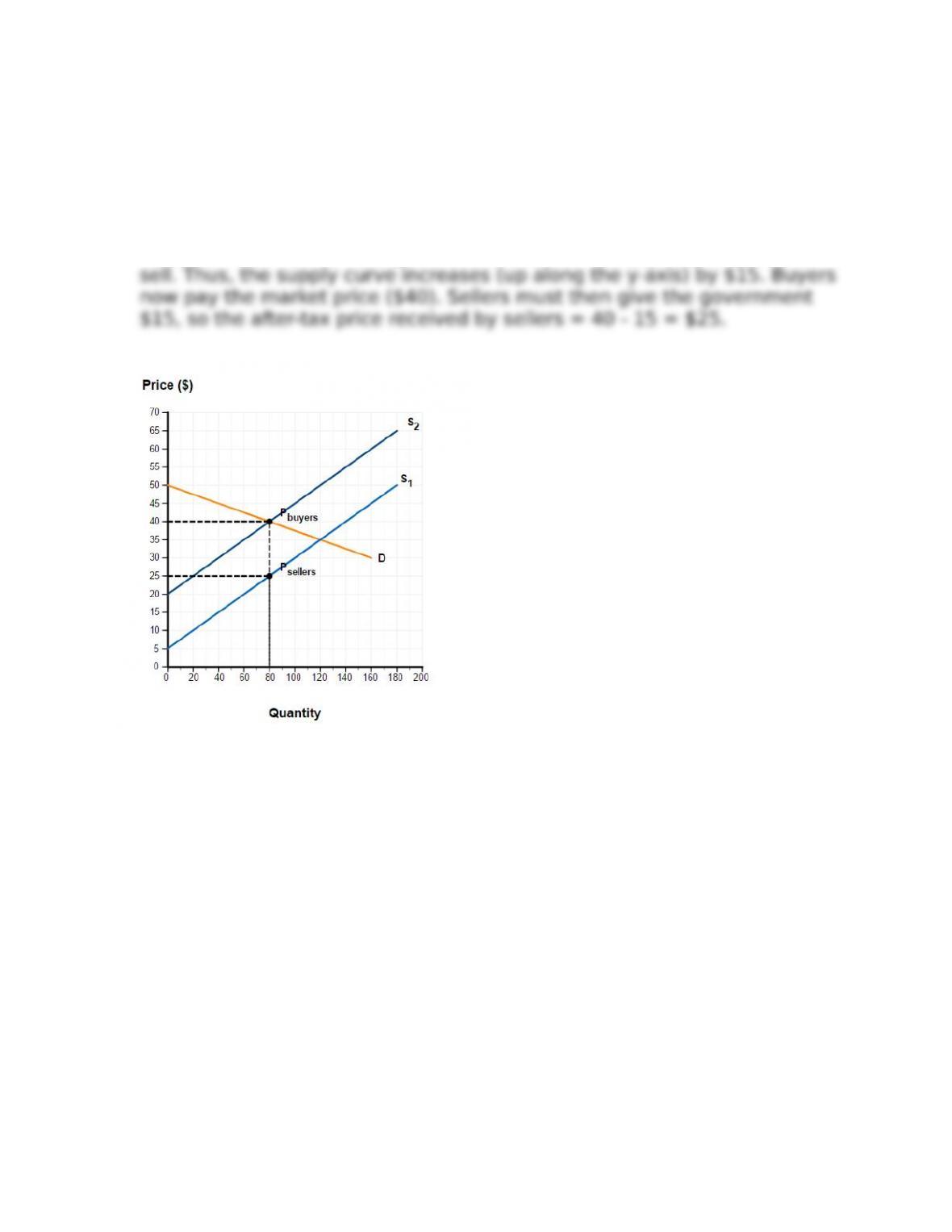
8. The market shown in Figure 6P-5 is in equilibrium. Suppose there is a $15
per unit tax levied on sellers. [LO 6.3]
a. Draw the after-tax supply curve.
b. Plot the after-tax price paid by consumers and the after-tax price paid by
sellers.
Answer: Each unit of the good is now $15 more costly to produce and
6-15
Copyright © 2016 McGraw-Hill Education. All rights reserved. No reproduction or distribution without the prior written consent of McGraw-Hill
Education.