
Chapter 05 – Efficiency
CHAPTER 5
EFFICIENCY
Chapter Overview
In this chapter we’ve introduced the concepts of willingness to pay and
willingness to sell, which help explain when individual buyers and sellers will
choose to make a trade. We’ve also discussed what it means to measure
consumer and producer surplus and shown that the market equilibrium is
e!cient because it maximizes total surplus.
As we’ll see in the next chapter, surplus and deadweight loss are powerful
tools for understanding the implications of business ideas and public policies.
Who will benefit from the policy? Who will be harmed by it? What e&ect will it
have on the economy overall? The language of surplus, e!ciency, and
distribution of benefits is particularly helpful for getting to the bottom of
controversial decisions.
Later in the book, we will describe important cases in which the e!ciency
rule about market equilibrium does not always hold true, and we’ll see how
surplus can also help us understand these cases.
Learning Objectives
LO 5.1: Use willingness to pay and willingness to sell to determine supply
and demand at a given price.
LO 5.2: Calculate consumer surplus based on a graph or table.
LO 5.3: Calculate producer surplus based on a graph or table.
LO 5.4: Calculate total surplus based on a graph or table.
LO 5.5: De$ne e!ciency in terms of surplus, and identify e!cient and
ine!cient situations.
LO 5.6: Describe the distribution of surplus, or benefits to society, that
results from a policy decision.
LO 5.7: Calculate deadweight loss.
LO 5.8: Explain why correcting a missing market can make everyone better
o&.
Chapter Outline
OPENING STORY: A BROKEN LASER POINTER STARTS AN INTERNET REVOLUTION
Willingness to Pay and Sell (LO 5.1)
Willingness to Pay and the Demand Curve
Willingness to Sell and the Supply Curve
BOX FEATURE: REAL LIFE – HAGGLING AND BLUFFING
5-1
Copyright © 2018 McGraw-Hill Education. All rights reserved. No reproduction or distribution without the prior written consent of McGraw-Hill
Education.

Chapter 05 – Efficiency
Measuring Surplus
BOX FEATURE: FROM ANOTHER ANGLE – HOW MUCH WOULD YOU PAY TO
KEEP THE INTERNET
FROM DISAPPEARING?
Consumer Surplus (LO 5.2)
Producer Surplus (LO 5.3)
Total Surplus (LO 5.4)
BOX FEATURE: REAL LIFE – AIRWAVES THAT COST $20 MILLION
Using Surplus to Compare Alternatives
Market Equilibrium and E!ciency (LO 5.5)
Changing the Distribution of Total Surplus (LO 5.6)
Deadweight Loss (LO 5.7)
Missing Markets (LO 5.8)
BOX FEATURE: WHAT DO YOU THINK – KIDNEYS FOR SALE
Beyond the Lecture
Class Activity: Consumer Surplus and Producer Surplus (LO 5.2, LO
5.3)
Class activities that highlight definition and intuition in consumer surplus
and producer surplus can help students to understand the concepts. It is
important to try to get students to consider the maximum that they would
pay for something and the minimum that they would accept. There is often a
di&erence between the market price and the price they would pay or accept.
1. Consumer surplus: Have a Dutch auction for something in class,
perhaps a college or University t-shirt or hoodie. Once the winner is
determined, ask if he/she would have been willing to pay more than
the price they actually did pay. Here is information on a Dutch auction
(only one bid and the auction is over)!
2. Producer surplus: Ask for a student “helper” for 10 minutes of your
lecture. The student can erase the board, click through slides, get
papers, or even hang up your coat or shine your shoes. Be creative.
O&er to pay $1, $2, etc. for the helper until you $nd a volunteer. After
the helper does the tasks, pay them a few dollars extra beyond the
price they accepted. Illustrate that producer surplus was received then
the student received more money than their minimum willingness to
accept.
Writing Assignment/Class Discussion: Market Equilibrium and
efficiency (LO 5.5)
Have students read Joel Waldfogel’s The Deadweight Loss of Christmas (1993
American Economic Review 83:5, pp. 1328-1336). This may be a slightly
di!cult read for some students, but most can understand the concept. Have
students write a brief essay regarding the potential for deadweight loss with
gift-giving, and consider the following questions for class:
1. Why might there be a deadweight loss associated with gift-giving?
5-2
Copyright © 2018 McGraw-Hill Education. All rights reserved. No reproduction or distribution without the prior written consent of McGraw-Hill
Education.
Chapter 05 – Efficiency
2. Who is most likely to give you a gift with a large deadweight loss? Who
is most likely to give you a gift that has little or no deadweight loss?
3. Why doesn’t everyone simply give cash as a gift?
Also, you may want to consider a brief clip from the movie Old School. In the
movie, Will Ferrell tries to give a bread maker that he received as a gift to
others.
Class Discussion: Missing Markets (LO 5.8)
In order to highlight how change and technology can impact missing
markets, have students consider the impact of the internet on consumer and
producer surplus. Many students likely do not remember the pre-internet
age, so this can be a nice small group discussion in class or in an online
environment. You can use this article from The Economist to start a
discussion. Have students consider the following:
1. What is the impact of the internet on producer and consumer surplus?
What is the impact of overall surplus?
2. What was the impact of the internet on transactions costs associated
with trades?
Clicker Questions
There are three main purposes to clicker questions. First, they are a great
way to do a quick and instant “on demand” test of student understanding of
the material. You can cover material, and instantly get feedback on student
comprehension. You can see whether you need to explain certain topics
again, or move on to the next subject. Second, they are a great method to
break up the class and take a moment away from lecture. It gets the
students actively involved. Finally, certain clicker questions can be framed in
a “discussion” manner, in which you can invite students to talk about the
possible right answer with their peers. You can instruct students to convince
their classmate of a right or wrong answer.
1. Where does consumer surplus come from? [LO 5.1]
money
D. A consumer buying high-quality good
Feedback: Low prices don’t necessarily mean consumer surplus. Maybe
the willingness to pay is also low!
2. Suppose Dave sells hot dogs from a food truck. Why doesn’t he just sell
5-3
Copyright © 2018 McGraw-Hill Education. All rights reserved. No reproduction or distribution without the prior written consent of McGraw-Hill
Education.
Chapter 05 – Efficiency
hot dogs at $500 each to generate a lot of producer surplus? [LO 5.1, LO
5.3]
D. The law of supply doesn’t include such high prices
Feedback: To get producer surplus, you actually have to sell something!
Each transaction requires a willing buyer and willing seller. No one is willing
to buy a hot dog for $500.
3. A binding price ceiling will cause deadweight loss because [LO 5.7]
A. Some producer surplus is transferred to consumers
Feedback: High or low prices themselves don’t reduce surplus. The
deadweight loss comes from the fact that we stop short of the equilibrium
quantity. We could have had more trades at a di&erent price. Those trades
would have generated surplus. But those trades don’t happen, so we can’t
get the surplus.
4. Imagine a small market where there are just a few buyers and sellers. In
order for a firm to maximize its producer surplus, the firm would have to
know _________ at various prices [LO 5.6]
D. Possible deadweight loss areas for non-equilibrium prices
Feedback: This one is a little tough. Keep in mind that at higher prices, the
$rm is willing to sell more, but consumers are willing to buy less. This may
just have to be done with a table showing everyone’s willingness to pay.
Then, the firm can measure its own surplus at various prices, being sure to
remember that they can only get surplus if a consumer buys the good at that
price!
5. Which of the following will help correct a missing market? [LO 5.8]
A. Reducing government regulations or restrictions on certain goods
5-4
Copyright © 2018 McGraw-Hill Education. All rights reserved. No reproduction or distribution without the prior written consent of McGraw-Hill
Education.
Chapter 05 – Efficiency
Feedback: Keep in mind that we may not want to correct all missing
markets. For example, we may want to keep certain drugs illegal or highly
regulated.
Solutions to End-of-Chapter Questions and Problems
Review Questions
1. Bill is a professional photographer. His camera is broken, and he needs a
new one within the next hour, or he will miss an important deadline. Lisa is a
high-school student who doesn’t have a camera but wants to get one to take
pictures at her prom next month. Who do you think would have a higher
willingness to pay for a particular camera today? Why? [LO 5.1]
Answer: Bill will have the higher willingness to pay. He needs a camera
for his job and he has no time to spare looking. Meeting his important
deadline depends on him finding a camera within the next hour. Bill’s
2. You are in the market for a new couch and have found two advertisements
for the kind of couch you want to buy. One seller notes in her ad that she is
selling because she is moving to a smaller apartment, and the couch won’t
$t in the new space. The other seller says he is selling because the couch
doesn’t match his other furniture. Which seller do you expect to buy from?
Why? (Hint: Think who would be the more motivated seller.) [LO 5.1]
Answer: You would expect to buy from the seller whose couch won’t $t in
the new space. This seller will probably be willing to sell at a lower price
because she does not have the option of keeping the couch if she can’t
3. Suppose you are at a Qea market and are considering buying a box of
vintage records. You are trying to bargain down the price, but the seller
overhears you telling a friend that you are willing to pay up to $50. Why is
5-5
Copyright © 2018 McGraw-Hill Education. All rights reserved. No reproduction or distribution without the prior written consent of McGraw-Hill
Education.
Chapter 05 – Efficiency
your consumer surplus now likely to be lower than it would have been if the
seller hadn’t overheard you? [LO 5.2]
Answer: Now that the seller knows your highest willingness to pay (how
much the records are worth to you), she knows she doesn’t have to
4. Consider a market in equilibrium. Suppose supply in this market
increases. How will this a&ect consumer surplus? Explain. [LO 5.2]
Answer: If supply increases, equilibrium price will decrease. This is a
5. You currently have a television that you want to sell. You can either pick a
price and try to sell it at a yard sale or auction it o& on eBay. Which method
do you think will yield a higher producer surplus? Why? [LO 5.3]
Answer: Auctioning the television on eBay should yield a higher price.
eBay will give you access to many more consumers than those who might
6. Consider a market in equilibrium. Suppose demand in this market
decreases. How will this a&ect producer surplus? Explain. [LO 5.3]
Answer: If demand decreases, equilibrium price will decrease. This is a
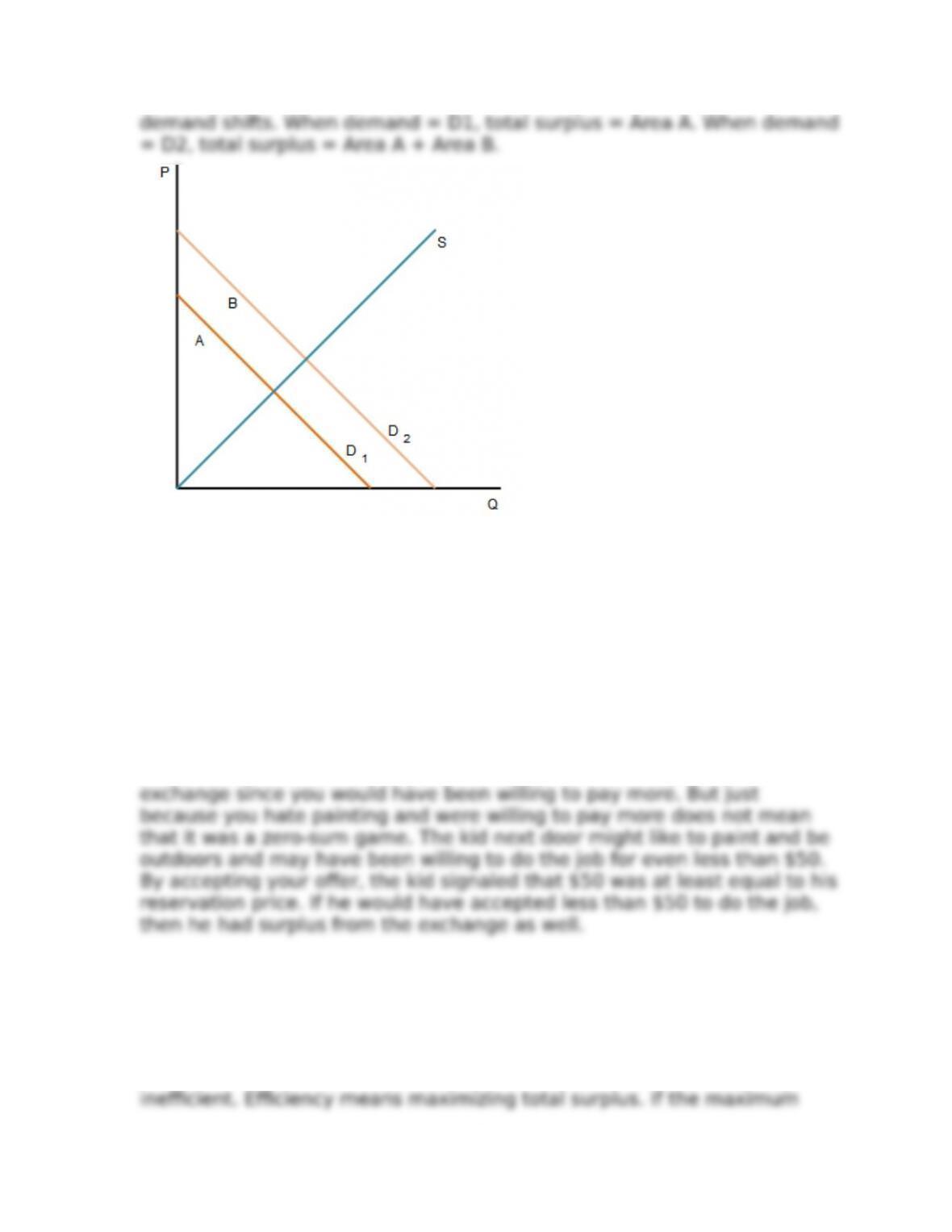
7. Consider the market for plane tickets to Hawaii. A bad winter in the
mainland United States increases demand for tropical vacations, shifting the
demand curve to the right. The supply curve stays constant. Does total
surplus increase or decrease? (Hint: Sketch out a generic supply and demand
curve and look at what happens to the size of the triangle that represents
total surplus when the demand curve shifts right.) [LO 5.4]
Answer: Willingness to buy is represented by the demand curve. When
5-6
Copyright © 2018 McGraw-Hill Education. All rights reserved. No reproduction or distribution without the prior written consent of McGraw-Hill
Education.
Chapter 05 – Efficiency
8. You need to paint your fence but you really hate this task. You decide to
hire the kid next door to do it for you. You would be willing to pay him up to
$100, but you start by o&ering $50, expecting to negotiate. To your great
surprise, he accepts your $50 o&er. When you tell your friend about the great
deal you got, she is shocked that you would take advantage of someone.
What can you tell your friend to assure her that you did not cheat the kid
next door? [LO 5.4]
Answer: You can tell your friend that as long as the kid next door was not
afraid of you and didn’t feel that he had no choice but to accept your
o&er, the trade was voluntary. You certainly received surplus from the
9. New York City has a long-standing policy of con-trolling rents in certain
parts of the city—in essence, a price ceiling on rent. Is the market for
apartments likely to be e!cient or ine!cient? What does this imply for the
size of total surplus? [LO 5.5]
Answer: The market for apartments under the maximum price policy is
5-7
Copyright © 2018 McGraw-Hill Education. All rights reserved. No reproduction or distribution without the prior written consent of McGraw-Hill
Education.
Chapter 05 – Efficiency
tradeo& between e!ciency and equity more as we move forward.
10. Total surplus is maximized at the equilibrium price and quantity. When
demand increases, price increases. Explain how total surplus is still
maximized if price increases due to an increase in demand. [LO 5.5]
Answer: When demand increases, the market moves to a new
11. When the price of gasoline was very high in the summer of 2008,
several U.S. presidential candidates proposed implementing a national price
ceiling to keep fuel a&ordable. How would this policy have a&ected producer
and consumer surplus? How would it have a&ected total surplus? [LO 5.6]
Answer: A price ceiling (maximum price) below the equilibrium price
would reduce producer surplus. There would be fewer trades and the
trades that did occur would happen at a lower price. For consumers, the
12. Consider a policy to help struggling farmers by setting a minimum
trade price for wheat. Will this be an e&ective way to increase their surplus?
Explain. [LO 5.6]
Answer: Minimum prices are also ine!cient and cause fewer trades to
occur than would occur at the equilibrium price. In the case of a
13. If rent control creates deadweight loss for both consumers and suppliers
of housing, why are consumers often in favor of this policy? [LO 5.7]
5-8
Copyright © 2018 McGraw-Hill Education. All rights reserved. No reproduction or distribution without the prior written consent of McGraw-Hill
Education.
Chapter 05 – Efficiency
Answer: Even though rent control causes fewer trades and deadweight
14. Suppose price is 5 percent above equilibrium in two markets: a market
for a necessity and a market for a luxury good. All else equal (including
supply conditions), in which market do you expect deadweight loss to be
greater? Explain. [LO 5.7]
Answer: Deadweight loss would be greater in the market for the luxury
15. Your grandmother likes old-fashioned yard sales and doesn’t understand
why everyone is so excited about eBay. Explain to her why the creation of a
market that enables people who don’t live in the same town to buy and sell
used goods increases total surplus over the yard-sale market. [LO 5.8]
Answer: Yard sales are nice because you get to meet people and chat
with them face to face, but eBay helps people connect across great
distances. If you are looking to buy something in particular and are
5-9
Copyright © 2018 McGraw-Hill Education. All rights reserved. No reproduction or distribution without the prior written consent of McGraw-Hill
Education.
Chapter 05 – Efficiency
16. At Zooey’s elementary school, children are not allowed to trade lunches
or components of their lunches with other students. Lunchroom monitors
watch closely and strictly enforce this policy. Help Zooey make an argument
about the ine!ciency of this policy to her principal. [LO 5.8]
Answer: The school policy is preventing a market that would generate
mutually beneficial trades. A student who likes bologna sandwiches better
than tuna sandwiches might trade her tuna sandwich to another student
Problems and Applications
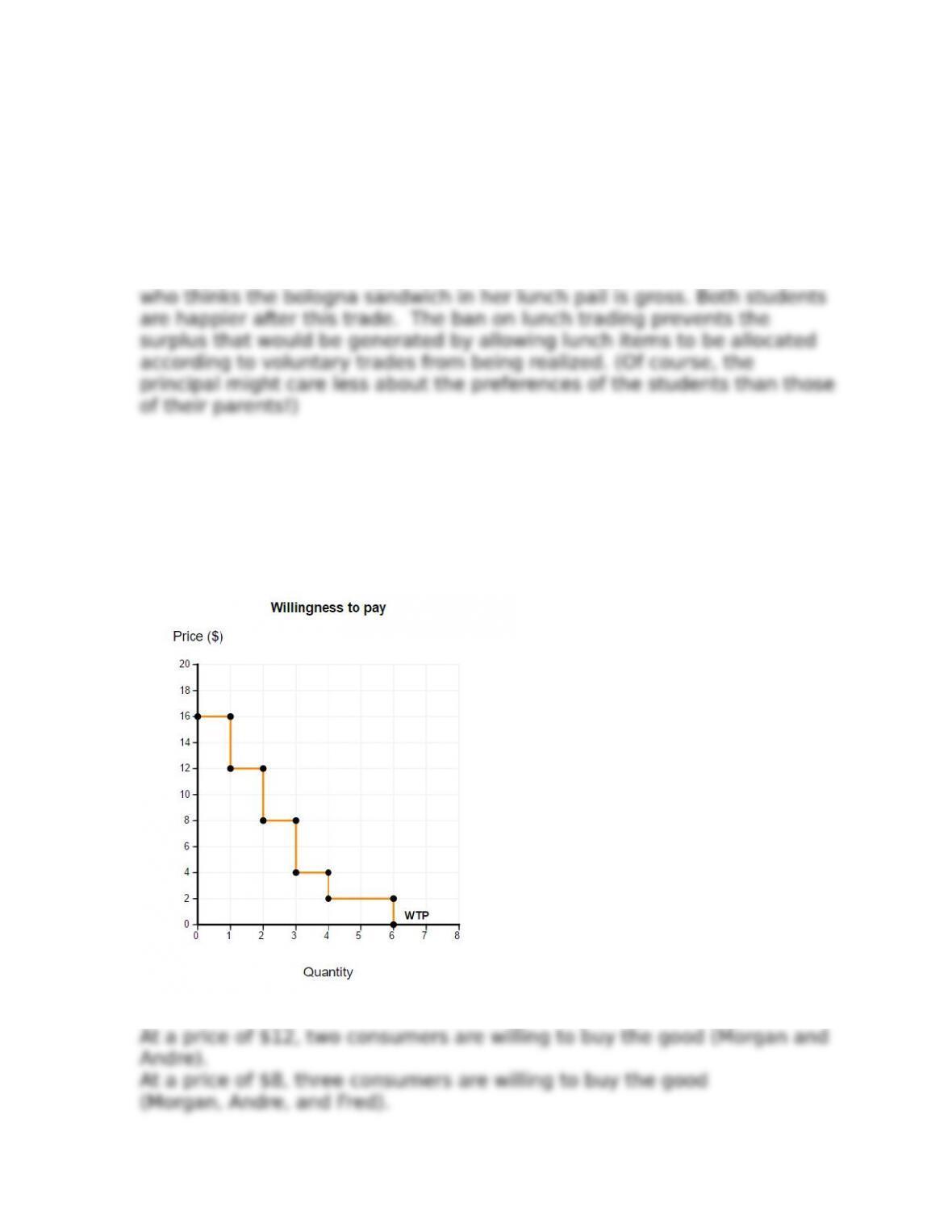
1. Use the information in Table 5P-1 to construct a step graph of the six
consumers’ willingness to pay. [LO 5.1]
Answer:
At a price of $16, one consumer is willing to buy the good (Morgan).
5-10
Copyright © 2018 McGraw-Hill Education. All rights reserved. No reproduction or distribution without the prior written consent of McGraw-Hill
Education.
Chapter 05 – Efficiency
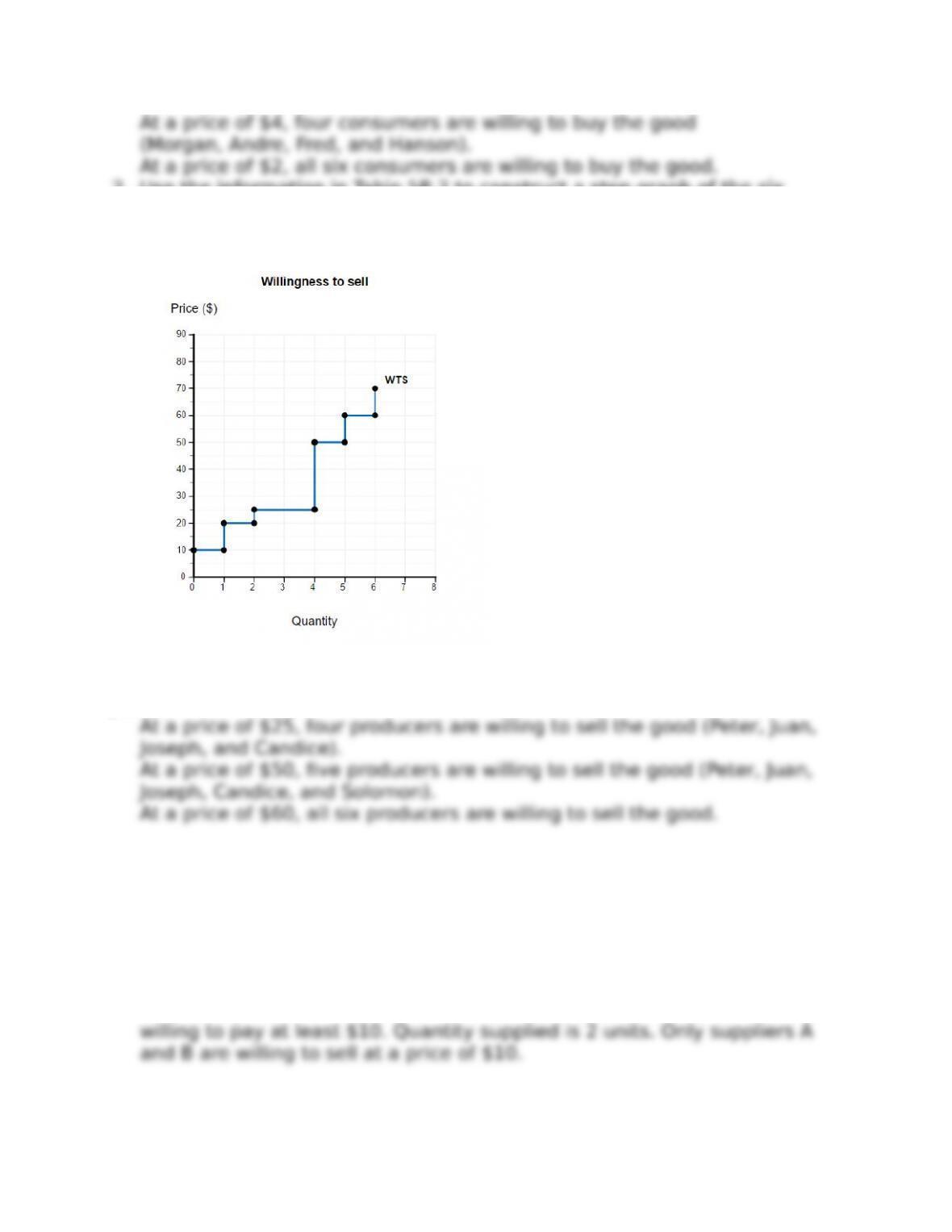
2. Use the information in Table 5P-2 to construct a step graph of the six
sellers’ willingness to sell. [LO 5.1]
Answer:
At a price of $10, one producer is willing to sell the good (Peter).
At a price of $20, two producers are willing to sell the good (Peter and
Juan).
3. Answer the following questions based on Tables 5P-3 and 5P-4. [LO 5.1]
a. What is the quantity demanded at $10? What is the quantity supplied
at $10?
b. What is the quantity demanded at $25? What is the quantity supplied
at $25?
Answer:
a. Quantity demanded is 8 units. All consumers except for consumer I are
5-11
Copyright © 2018 McGraw-Hill Education. All rights reserved. No reproduction or distribution without the prior written consent of McGraw-Hill
Education.

Chapter 05 – Efficiency
b. Quantity demanded is 3 units. Only consumers A, B, and C are willing to
5-12
Copyright © 2018 McGraw-Hill Education. All rights reserved. No reproduction or distribution without the prior written consent of McGraw-Hill
Education.