Chapter 04 – Elasticity
Problems and Applications
1. When the price of a bar of chocolate is $1.00, the quantity demanded is
100,000 bars. When the price rises to $1.50, the quantity demanded falls to
60,000 bars. Calculate the price elasticity of demand using the mid-point
method. [LO 4.1]
a. Suppose price increases from $1 to $1.50. Calculate the price elasticity of
demand.
b. Suppose price decreases from $1.50 to $1. Calculate the price elasticity of
demand.
Answer:
a. [(60,000 − 100,000)/80,000]/[(1.50 − 1.00)/1.25] = -1.25.
2. If the price elasticity of demand for used cars priced between $3,000 and $5,000 is –1.2
(using the mid-point method), what will be the percent change in quantity demanded when the
price of a used car falls from $5,000 to $3,000? [LO 4.1]
Answer:
−1.2 = % change in Qd/[(3,000 − 5,000)/4,000]
−1.2 = % change in Qd/−0.5
4-1
Copyright © 2018 McGraw-Hill Education. All rights reserved. No reproduction or distribution without the prior written consent of McGraw-Hill
Education.
Chapter 04 – Elasticity
3. Three points are identified on the graph in Figure 4P-1. [LO 4.2]
a. At point A, demand is ____.
b. At point B, demand is ____.
c. At point C, demand is ____.
Answer: For any linear demand curve, the mid-point represents demand being unit-elastic.
At any point on the upper-portion of the curve, demand is price elastic. At any point on the
4. Which of the following has a more elastic demand in the short run? [LO 4.2]
a. Pomegranate juice or drinking water?
b. Cereal or Rice Krispies®?
c. Speedboats or gourmet chocolate?
Answer:
a. Pomegranate juice. Demand for pomegranate juice would be much more elastic than
b. Rice Krispies. There are more substitutes for a particular type of cereal like Rice Krispies
c. Speedboats. Even though both goods could be considered luxuries, a speedboat is a much
5. In each of the following instances, determine whether demand is elastic, inelastic, or unit-
elastic. [LO 4.2]
a. If price increases by 10 percent and quantity demanded decreases by 15 percent, demand is
_______.
b. If price decreases by 10 percent and quantity demanded increases by 5 percent, demand is
_______.
Answer:
6. In each of the following instances, determine whether quantity demanded will increase or
decrease, and by how much. [LO 4.2]
a. If price elasticity of demand is -1.3 and price increases by 2 percent, quantity demanded will
______ by ______ percent.
b. If price elasticity of demand is -0.3 and price decreases by 2 percent, quantity demanded will
______ by ______ percent.
Answer:
a. Quantity demanded will decrease by > 2 percent.
4-2
Copyright © 2018 McGraw-Hill Education. All rights reserved. No reproduction or distribution without the prior written consent of McGraw-Hill
Education.
Chapter 04 – Elasticity
Problems 7 and 8 refer to the demand schedule shown in Table 4P-1. For each price change,
say whether demand is elastic, unit-elastic, or inelastic, and say whether total revenue
increases, decreases, or stays the same.
7. Consider each of the following price increase scenarios. [LO 4.2]
a. Price increases from $10 to $20. Demand is _____ and total revenue _____.
b. Price increases from $30 to $40. Demand is _____ and total revenue _____.
c. Price increases from $50 to $60. Demand is _____ and total revenue _____.
Answer:
a. Demand is inelastic: [(300 – 350)/325]/[(20-10)/15] =-0.15/0.67= -0.22. Because elasticity
b. Demand is inelastic: [(200 – 250)/225]/[(40-30)/35] =-0.22/0.29= -0.76. Because elasticity
c. Demand is elastic: : [(100 – 150)/125]/[(60-50)/55] =-0.40/0.18= -2.22. Because elasticity
8. Price decreases from $70 to $60. Demand is ______ and total revenue ______. [LO 4.2]
Answer: Demand is elastic: [(100 – 50)/75]/[(60-70)/65] = 0.67/-0.15 = -4.44. Total revenue
Problems 9–12 refer to Figure 4P-2.
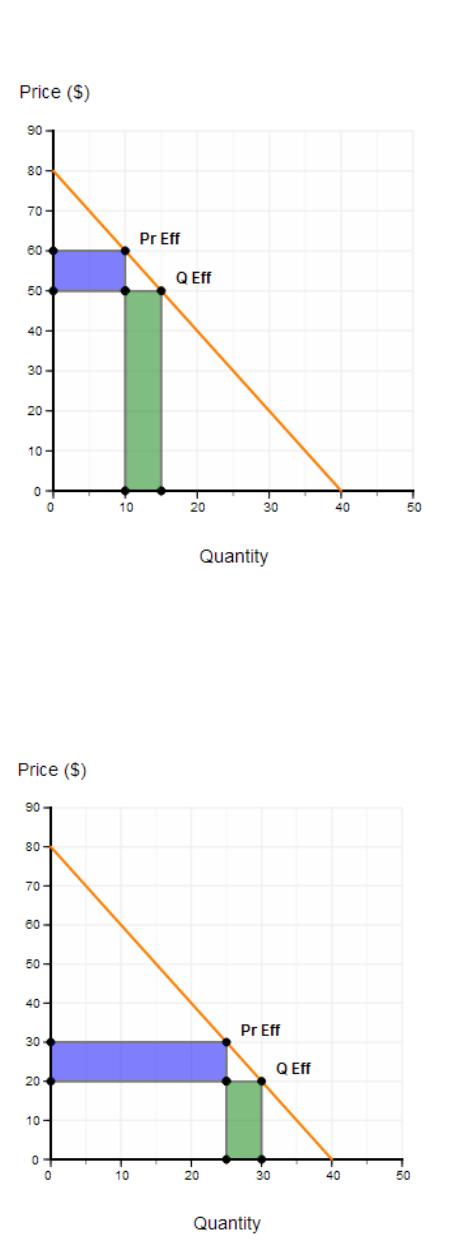
9. Draw the price e.ect and the quantity e.ect for a price change from $60
to $50. Which e.ect is larger? Does total revenue increase or decrease? No
calculation is necessary. [LO 4.2]
Answer: The quantity e.ect is larger and total revenue increases.
4-3
Copyright © 2018 McGraw-Hill Education. All rights reserved. No reproduction or distribution without the prior written consent of McGraw-Hill
Education.
Chapter 04 – Elasticity
10. Draw the price e.ect and the quantity e.ect for a price change from
$30 to $20. Which e.ect is larger? Does total revenue increase or decrease?
No calculation is necessary. [LO 4.2]
Answer: The price e.ect is larger, and total revenue decreases.
4-4
Copyright © 2018 McGraw-Hill Education. All rights reserved. No reproduction or distribution without the prior written consent of McGraw-Hill
Education.
Chapter 04 – Elasticity
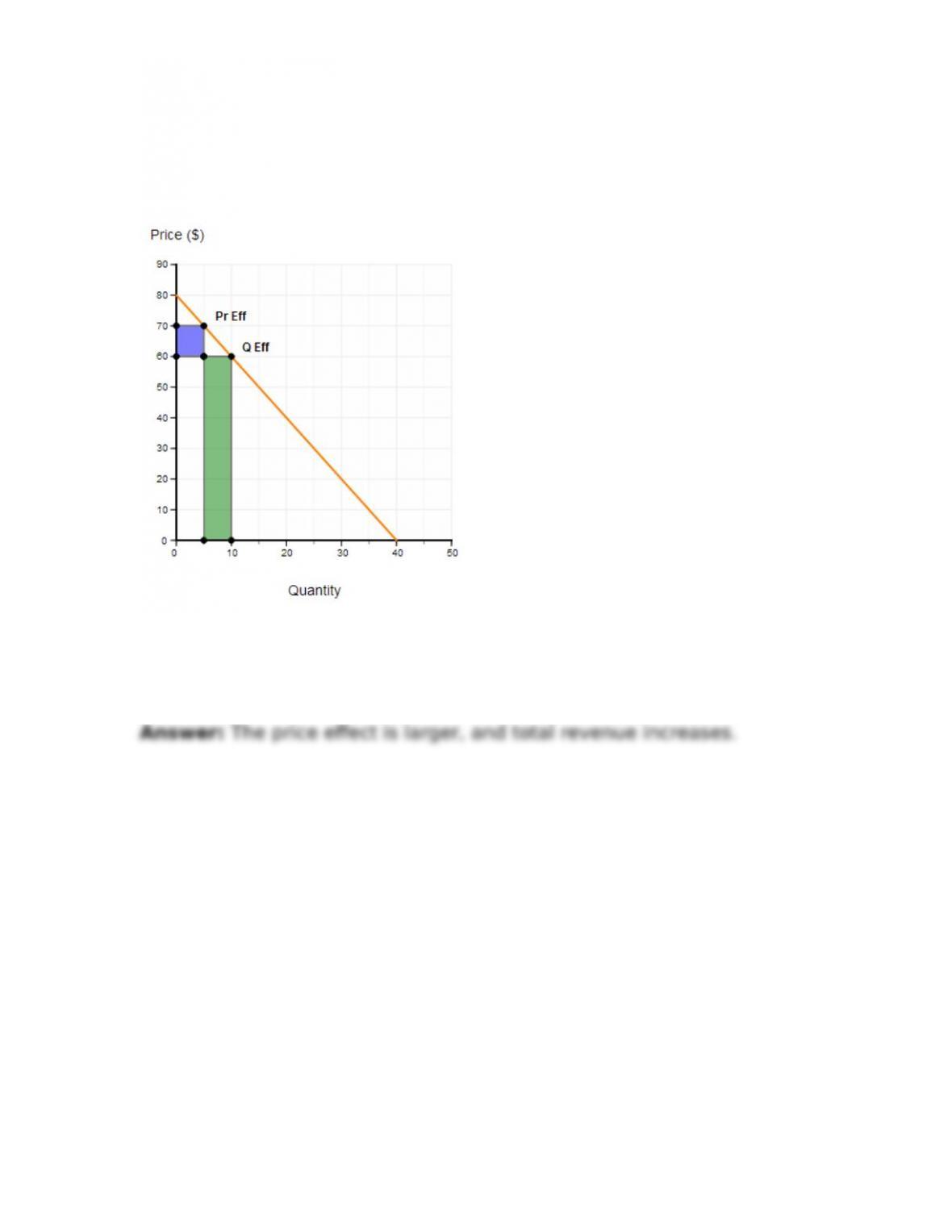
11. Draw the price e.ect and the quantity e.ect for a price change from
$60 to $70. Which e.ect is larger? Does total revenue increase or decrease?
No calculation is necessary. [LO 4.2]
Answer: The quantity e.ect is larger, and total revenue decreases.
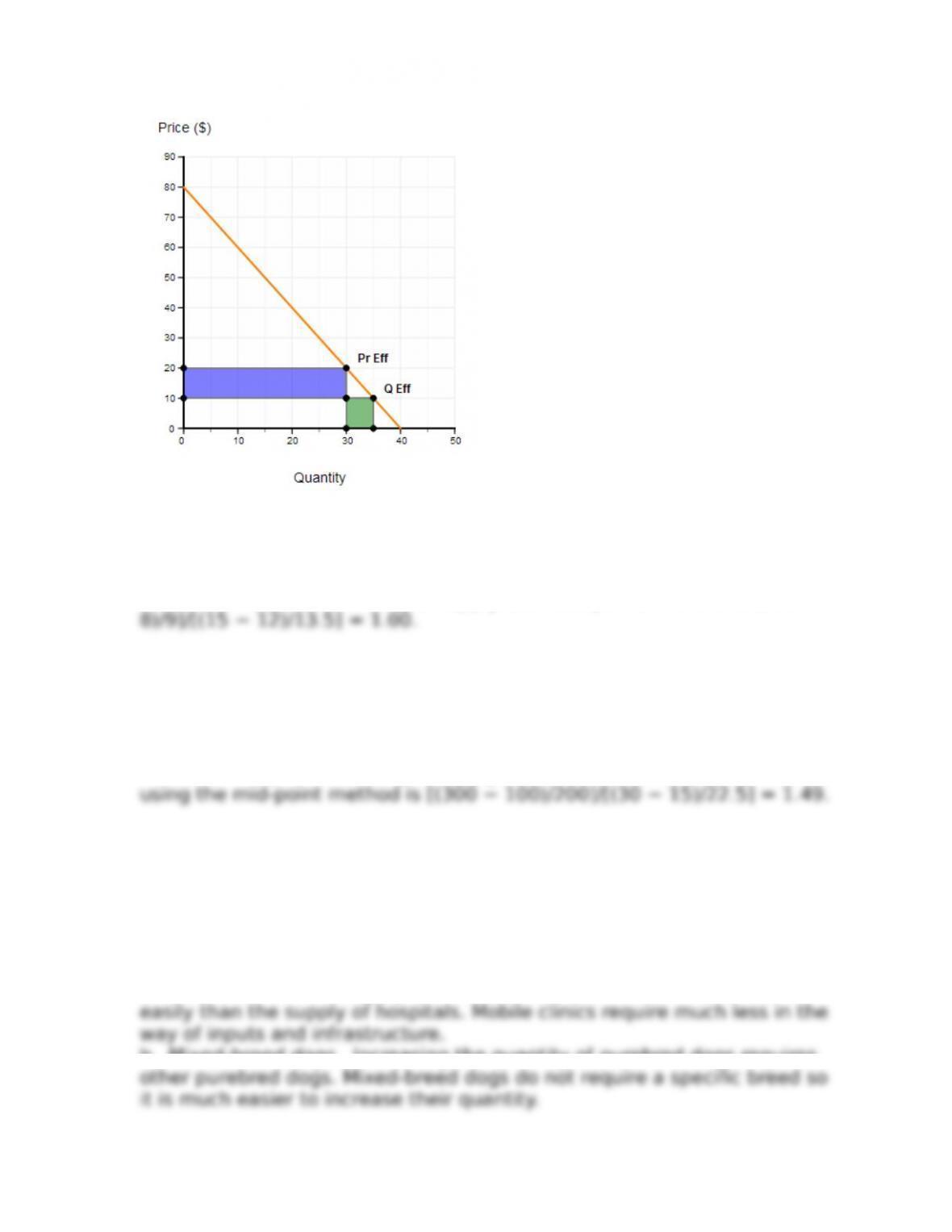
12. Draw the price e.ect and the quantity e.ect for a price change from
$10 to $20. Which e.ect is larger? Does total revenue increase or decrease?
No calculation is necessary. [LO 4.2]
4-5
Copyright © 2018 McGraw-Hill Education. All rights reserved. No reproduction or distribution without the prior written consent of McGraw-Hill
Education.
Chapter 04 – Elasticity
13. Use the graph in Figure 4P-3 to calculate the price elasticity of supply
between points A and B using the mid-point method. [LO 4.3]
Answer: The price elasticity of supply between points A and B is [(10 −
14. If the price of a haircut is $15, the number of haircuts provided is 100. If
the price rises to $30 per haircut, barbers will work much longer hours, and
the supply of haircuts will increase to 300. What is the price elasticity of
supply for haircuts between $15 and $30? [LO 4.3]
Answer: The price elasticity of supply for haircuts between $15 and $20
15. Which of the following has a more elastic supply in the short run? [LO
4.4]
a. Hospitals or mobile clinics?
b. Purebred dogs or mixed-breed dogs?
c. On-campus courses or online courses?
Answer:
a. Mobile clinics. The supply of mobile clinics can be modi?ed much more
b. Mixed-breed dogs. Increasing the quantity of purebred dogs requires
4-6
Copyright © 2018 McGraw-Hill Education. All rights reserved. No reproduction or distribution without the prior written consent of McGraw-Hill
Education.
Chapter 04 – Elasticity
c. Online courses. Courses online are easier to expand because they have
16. In each of the following instances, determine whether supply is elastic, inelastic, or unit‐
elastic. [LO 4.4]
a. If price increases by 10 percent and quantity supplied increases by 15 percent, supply is
______.
b. If price decreases by 10 percent and quantity supplied decreases by 5 percent, supply is
______.
Answer:
4-7
Copyright © 2018 McGraw-Hill Education. All rights reserved. No reproduction or distribution without the prior written consent of McGraw-Hill
Education.
Chapter 04 – Elasticity
17. In each of the following instances, determine whether quantity supplied will increase or
decrease, and by how much. [LO 4.4]
a. If price elasticity of supply is 1.3 and price increases by 2 percent, quantity supplied will
_____ by _____ percent.
b. If price elasticity of supply is 0.3 and price decreases by 2 percent, quantity supplied will
_____ by _____ percent.
Answer:
18. Suppose that the price of peanut butter rises from $2 to $3 per jar.
[LO 4.5]
a. The quantity of jelly purchased falls from 20 million jars to 15 million jars.
What is the cross-price elasticity of demand between peanut butter and jelly?
Are they complements or substitutes?
b. The quantity of jelly purchased increases from 15 million jars to 20 million
jars. What is the cross-price elasticity of demand between peanut butter and
jelly? Are they complements or substitutes?
Answer:
a. The cross-price elasticity of demand between peanut butter and jelly
b. The cross-price elasticity of demand between peanut butter and jelly
19. For each of the following pairs, predict whether the cross-price
elasticity of demand will be positive or negative: [LO 4.5]
a. Soap and hand sanitizer.
b. CDs and MP3s.
c. Sheets and pillowcases.
Answer:
a. Positive. Soap and hand sanitizer are substitutes. If the price of soap increases, the
b. Positive. CDs and MP3s are substitutes. If the price of CDs increases, the demand for
c. Negative. Sheets and pillowcases are complements. If the price of sheets increases, the
4-8
Copyright © 2018 McGraw-Hill Education. All rights reserved. No reproduction or distribution without the prior written consent of McGraw-Hill
Education.
Chapter 04 – Elasticity
20. Suppose that when the average family income rises from $30,000 per
year to $40,000 per year, the average family’s purchases of toilet paper rise
from 100 rolls to 105 rolls per year. [LO 4.6]
a. Calculate the income-elasticity of demand for toilet paper.
b. Is toilet paper a normal or an inferior good?
c. Is the demand for toilet paper income-elastic or income-inelastic?
Answer:
a. The income-elasticity of demand is [(105 − 100)/102.5]/[(40,000 − 30,000)/35,000] =
0.17.
21. In each of the following instances, determine whether the good is normal or inferior, and
whether it is income‐elastic or income‐inelastic. [LO 4.6]
a. If income increases by 10 percent and the quantity demanded of a good increases by
5 percent, the good is ______ and ______.
b. If income increases by 10 percent and the quantity demanded of a good decreases by
20 percent, the good is ______ and ______.
Answer:
a. If income increases by 10% and the quantity demanded of a good increases by 5%, the
b. If income increases by 10% and the quantity demanded of a good decreases by 20%, the
4-9
Copyright © 2018 McGraw-Hill Education. All rights reserved. No reproduction or distribution without the prior written consent of McGraw-Hill
Education.