
Chapter 23 – Public Policy and Choice Architecture
CHAPTER 23
PUBLIC POLICY AND CHOICE ARCHITECTURE
Chapter Overview
Advertisers know that sales depend on more than delivering an appealing
economic proposition. Clinching the deal often depends on hitting the right
psychological buttons. Recently economists have also started bringing
psychology into their problem-solving approach, and it’s delivering practical
ways to help people make choices that they are less likely to regret.
Choices are often in uenced by the way that options are presented. Almost
any presentation subtly pushes people toward one option or another, so it’s
di!cult for choice frameworks to be truly neutral. In this chapter, we
described how “choice architects” can present options in a way that helps
people overcome biases and voluntarily make choices they are happier with.
We’ve walked through some of the tools that choice architects can use to
“nudge” people toward better decisions. Often, these nudges are simple and
inexpensive: changing the wording or increasing the clarity of information
provided to people, redefining default options, or offering people ways to
commit to a desired course of action. Used thoughtfully, nudges can help
companies earn more profit and can help policy-makers achieve economic
and social goals. One of the most striking lessons from behavioral economics
is that small changes in choice architecture can sometimes lead to big
changes in behavior.
Learning Objectives
LO 23.1 De(ne choice architecture and explain how nudges can in uence
individual decision making.
LO 23.2 Explain several ways in which human decision making does not
conform to the model of full information and rational choices.
LO 23.3 Explain how demand for commitment devices can be rational.
LO 23.4 Explain how information, when presented well, can help people
make decisions that are good for them.
LO 23.5 Describe how default rules affect people’s choices and the
implications for policy.
LO 23.6 Describe how framing affects the way people process information
and its implications for policy.
Chapter Outline
SAVING MORE FOR TOMORROW
23-1
Copyright © 2018 McGraw-Hill Education. All rights reserved. No reproduction or distribution without the prior written consent of McGraw-Hill
Education.

Chapter 23 – Public Policy and Choice Architecture
Choice Architecture and Nudges
Why Nudge? (LO 23.1)
BOX FEATURE: REAL LIFE – COMMITTING TO FERTILIZER
Mistakes People Make (LO 23.2)
Tools of Choice Architecture
Commitment Devices (LO 23.3)
Information Campaigns and Disclosure Rules
BOX FEATURE: REAL LIFE – IS PAYDAY LENDING PREDATORY?
Default Rules (LO 23.5)
BOX FEATURE: REAL LIFE – WHO DOESN’T WANT TO BE AN ORGAN DONOR?
Framing Choices (LO 23.6)
BOX FEATURE: FROM ANOTHER ANGLE – TURN DOWN THE AC FOR A SMILEY
FACE
BOX FEATURE: REAL LIFE – SCHOLARSHIPS, DEBT FORGIVENESS, AND PUBLIC
SERVICE
Beyond the Lecture
Class Discussion and Video: Behavioral Economics and Social
Psychology (LO 23.1)
Watch this video from a TED talk from Social Psychologist Dan Gilbert. The
talk details problems with decision making such as time inconsistency and
framing bias. He also mentions issues that people have when incorrectly
calculating the probability and value of certain outcomes. The clip is long,
and you may want to just watch the first half, skipping the Q&A session at
the end.
Class Discussion: Why Nudge? (LO 23.1)
Consider showing this brief clip from the episode The Calzone from the TV
show Seinfeld. In the episode, George places a tip into a tip jar at a
restaurant. However, the worker does not see George tip, and George is
upset that he did not get credit for tipping. Have students consider the
following:
1. Are you more likely to tip if there is a tip jar included at a counter?
2. Can you think of other strategies that might be likely to induce
consumers to tip?
Reading Assignment: Mistakes People Make (LO 23.2)
Ask students to read this brief article from The Economist, which provides an
overview of some of the finding in Thinking, Fast and Slow by Daniel
Kahneman (2011). The article highlights several interesting experiments
where humans make seemingly irrational decisions or form unreasonable
opinions. This article can be used as a conversation starter to debate the full
information and rational decision-making models.
Class Discussion: Commitment Devices (LO 23.3)
23-2
Copyright © 2018 McGraw-Hill Education. All rights reserved. No reproduction or distribution without the prior written consent of McGraw-Hill
Education.
Chapter 23 – Public Policy and Choice Architecture
Have students consider the use of commitment devices for individuals who
decide to diet (for weight loss, general health, or other reasons). Discuss the
di)erent types of commitment strategies involved in various diet programs;
for example, Jenny Craig provides prepackaged meals that replace regular
meals, while Weight Watchers provides a method for calculating your intake
via regular meals. You can (nd a list of the “best diets overall” (as ranked by
U.S. News & World Report) here.
1. How could some of these diet programs be viewed as commitment
strategies?
2. Why would someone want a commitment strategy to help with dieting?
Clicker Questions
There are three main purposes to clicker questions. First, they are a great
way to do a quick and instant “on demand” test of student understanding of
the material. You can cover material, and instantly get feedback on student
comprehension. You can see whether you need to explain certain topics
again, or move on to the next subject. Second, they are a great method to
break up the class and take a moment away from lecture. It gets the
students actively involved. Finally, certain clicker questions can be framed in
a “discussion” manner, in which you can invite students to talk about the
possible right answer with their peers. You can instruct students to convince
their classmate of a right or wrong answer.
1. Why do people sometimes fall victim to time inconsistency bias? [LO
23.2]
D. We ignore present costs and focus on future benefit
Feedback: People tend to discount the future. We’d rather have $50 now
than $50 later. We would sometimes even prefer $50 now over having $60
later, depending on how long in the future “later” happens.
2. Why do economists consider loss aversion a problem with regards to
decision making? [LO 23.2]
A. It causes people to ignore costs of decisions
Feedback: Sometimes, risks are “good” in the sense that they will likely
increase our well-being. If we are very risk-averse, we may avoid any risk
taking, despite the probability being in our favor.
23-3
Copyright © 2018 McGraw-Hill Education. All rights reserved. No reproduction or distribution without the prior written consent of McGraw-Hill
Education.
Chapter 23 – Public Policy and Choice Architecture
3. What is the purpose of a commitment device? [LO 23.3]
A. To make sure contracts between parties are upheld
Feedback: “I’ll work out tomorrow”. Sounds good, but when tomorrow
comes, you might change your mind. A commitment device can help you
keep your promise to yourself.
4. In what situation is a person most likely to use a “rule of thumb”? [LO
23.4]
A. Studying for an economics exam
Feedback: Why? There are literally thousands of choices for the new car.
The buyer wouldn’t analyze every single vehicle. They would say something
like “I want a new, four-door, red SUV that gets good gas mileage.” That can
greatly reduce the possible choices and help a purchase get made.
5. What have economists discovered about choices and framing? [LO 23.5]
probability is large
D. Consumers almost always read all of the “(ne print” and rules
Solutions to End-of-Chapter Questions and Problems
Review Questions
1. Is instituting a $200 (ne for anyone caught littering a nudge? Why or why
not? [LO 23.1]
Answer: No. Nudges cannot signiticantly alter the economic incentives
2. Suppose two parents present their 16-year-old with a list of the cars that
they will allow him to buy. If the parents decide to add another vehicle to the
list, is that affecting the choice architecture for their son? Why or why not?
[LO 23.1]
23-4
Copyright © 2018 McGraw-Hill Education. All rights reserved. No reproduction or distribution without the prior written consent of McGraw-Hill
Education.
Chapter 23 – Public Policy and Choice Architecture
Answer: No, adding another car to the list does not affect the choice
3. Suppose you have plans to save 5 percent of your salary next year. Then
your company goes bankrupt, your pay gets slashed by 30 percent, and you
end up not saving at all. Is this an example of time inconsistency? Why or
why not? [LO 23.2]
Answer: No. Time inconsistency arises when the only thing that changes
5. At the website stickK.com (started by one of the authors of this book), you
can sign up for a contract in which you promise to meet certain weight-loss
targets each week and forfeit money that you put up as stakes if you fail to
meet those targets. Describe why a rational person might be willing to pay
money if he does not lose weight, and how this constitutes a commitment
strategy. [LO 23.3]
Answer: If someone decides in the present that they want to lose weight,
it is rational for them to risk losing money in the future if they don’t end
6. One contributor to the rational demand for commitment devices is the
time-inconsistency problem. Explain how limited processing capacity might
also contribute to the demand. [LO 23.3]
Answer: If someone uses a commitment device, that will limit the
23-5
Copyright © 2018 McGraw-Hill Education. All rights reserved. No reproduction or distribution without the prior written consent of McGraw-Hill
Education.
Chapter 23 – Public Policy and Choice Architecture
7. Suppose you need to estimate the cost of your textbooks for the
upcoming semester. What would be a good “anchor” to use in your estimate?
[LO 23.4]
Answer: Anchoring involves estimating unknown quantities by starting
8. Jaelyn sees a sweater that she likes in a store. The price is $22. Jaelyn
wouldn’t usually purchase the sweater at this price, but then she notices a
sign that says the sweater is marked down from $44 and decides to buy the
sweater. Is Jaelyn’s decision an example of a commitment device, the
endowment effect, a nudge, or anchoring bias? Explain. [LO 23.4]
Answer: Anchoring involves estimating unknown quantities by starting
9. Many online subscription services have “automatic renewal” policies, in
which they will automatically bill you for another year’s subscription when
your current one runs out. Why is this default rule a savvy business strategy
on the part of the online company? [LO 23.5]
Answer: The magazine’s strategy is smart because it exploits the effect
10. Explain the psychological bias that causes people’s decisions to be
affected by default rules or the endowment effect. [LO 23.5]
Answer: Both effects relate to status-quo bias. For the default rule, one
11. Imagine a public service announcement on television that is intended
to scare kids away from using drugs. A big focus of the PSA is that a lot of
teens are already on drugs. The directors of the PSA intend this statement to
emphasize the size of the problem. Explain why this strategy for framing the
anti-drugs message to teenagers could back-(re. [LO 23.6]
Answer: This strategy could back(re because of the effect of social
23-6
Copyright © 2018 McGraw-Hill Education. All rights reserved. No reproduction or distribution without the prior written consent of McGraw-Hill
Education.
Chapter 23 – Public Policy and Choice Architecture
12. Suppose you’re trying to get your friends to go to dinner with you.
Which of the following statements is more likely to convince your friends to
go out to dinner? [LO 23.6]
Statement 1: “The dinner would only cost $5 more than the food we would
make ourselves.” Statement 2: “Dinner at our favorite restaurant will cost $5
less than a meal at every other restaurant around town.”
Answer: It would be wiser to tell them that the dinner out will cost $5
less than a meal at every other restaurant in town because that makes
Problems and Applications
1. In each of the following scenarios, determine whether the change in
people’s behavior is the result of a nudge or a substantive change in
economic incentives. [LO 23.1]
a. A country with a low birth rate decides to offer free public child care for
kids under the age of (ve.
b. A nonprofit organization runs a highly publicized campaign offering
teenage girls a very small symbolic reward (say, $5) for each week that they
stay in school, come to support group meetings, and avoid pregnancy.
c. A country with a rapidly growing population levies steep (nes on any
family that has more than two children.
d. A government agency runs an ad on television informing women about
low-cost birth-control options.
Answer: A nudge is using choice architecture in a deliberate fashion to
alter people’s behavior in a predictable way. Choice architecture is the
organization of the context and process in which people make decision.
a. Economic incentive.
2. Determine whether each of the following changes represents a shift in the
choice architecture of a decision. [LO 23.1]
a. After presenting the dessert menu to patrons, the waiter at a restaurant
mentions that there’s an additional option for dessert not on the menu.
b. A restaurant presents dessert menus to patrons before they have eaten.
c. A waiter shows patrons a menu without prices.
23-7
Copyright © 2018 McGraw-Hill Education. All rights reserved. No reproduction or distribution without the prior written consent of McGraw-Hill
Education.
Chapter 23 – Public Policy and Choice Architecture
d. A waiter asks patrons whether they would like to order more fries after
telling the couple that the plate of fries is very small.
Answer:
a. No; the choice architecture refers to the framing of a decision. If after
b. Yes; this is a di)erent system of choosing than the traditional method.
c. No; if the couple were informed of the prices after they had chosen,
3. Label each of the following examples as a case of time inconsistency,
limited processing capacity, status-quo bias, or framing. [LO 23.2]
a. A person buys a nice bottle of wine for $50 and leaves it in the pantry for
20 years. At that point, the wine has aged and the value has appreciated to
$250. Although he would never be willing to buy a bottle of the same wine
for $250, the person plans to drink his old bottle rather than sell it.
b. Every night, a person sets her alarm for 7 a.m. the next morning, and
every morning, she hits the snooze button at least four times.
c. People who are told the survival rate for a surgical procedure are more
likely to undergo it than people who are told the death rate (even though the
death rate is actually the same in both cases).
Answer: Status-quo bias is the tendency to stick with the current
situation over other options, even when it is cheap to switch. Time
inconsistency is a situation when we change our minds about what we
a. Status-quo bias.
4. Determine whether each of the following represents loss aversion. [LO
23.2]
a. Nearing retirement, an investor chooses investments with lower return
and lower risk because she wants to make sure she has a certain amount of
money available in (ve years.
b. A gambler refuses to play a game in which if heads shows up after a coin
toss he will win $40, but if tails shows up he will lose $50.
23-8
Copyright © 2018 McGraw-Hill Education. All rights reserved. No reproduction or distribution without the prior written consent of McGraw-Hill
Education.
Chapter 23 – Public Policy and Choice Architecture
c. O)ered a brand-new blanket that is twice as comfortable and cute as her
old one—the only two criteria she cares about in a blanket—a toddler refuses
to give up her old blanket.
Answer: Loss aversion is a general tendency for people to put more effort
into avoiding losses than achieving gains.
a. No; an investor would want to ensure that she has enough money for
b. No; obviously this game is geared so that you’ll lose money on
The following information applies to Problems 5, 6, and 7: Clocky ™ is an
alarm clock that rolls o! your bedside table and runs away when you hit the
5. Clocky is a commitment device to help overcome time inconsistency.
Which of the following are the time periods over which someone might have
inconsistent preferences and need Clocky’s help? [LO 23.3]
a. Between the time the person hits the snooze button and the time the
alarm goes o) again. b. Between the time the person sets the alarm
the previous night and the time the alarm goes o).
c. Between the time the person actually gets out of bed one morning and
the time he sets his alarm for the next morning.
Answer: Time inconsistency is a situation when we change our minds
about what we want simply because of the timing of the decision. It helps
6. Which of the following are relevant areas of preference inconsistency that
Clocky is able to help with? [LO 23.3]
a. The optimal volume for an alarm.
b. What time to go to bed at night.
c. What time to wake up in the morning.
d. Whether an alarm should be placed on the bedside table or across the
room.
Answer: c and d. People’s preferences about the present are inconsistent
23-9
Copyright © 2018 McGraw-Hill Education. All rights reserved. No reproduction or distribution without the prior written consent of McGraw-Hill
Education.
Chapter 23 – Public Policy and Choice Architecture
23-10
Copyright © 2018 McGraw-Hill Education. All rights reserved. No reproduction or distribution without the prior written consent of McGraw-Hill
Education.
Chapter 23 – Public Policy and Choice Architecture
7. How much should someone with time-inconsistent preferences be willing
to pay for Clocky? [LO 23.3]
a. Nothing, because a regular alarm will work just as well.
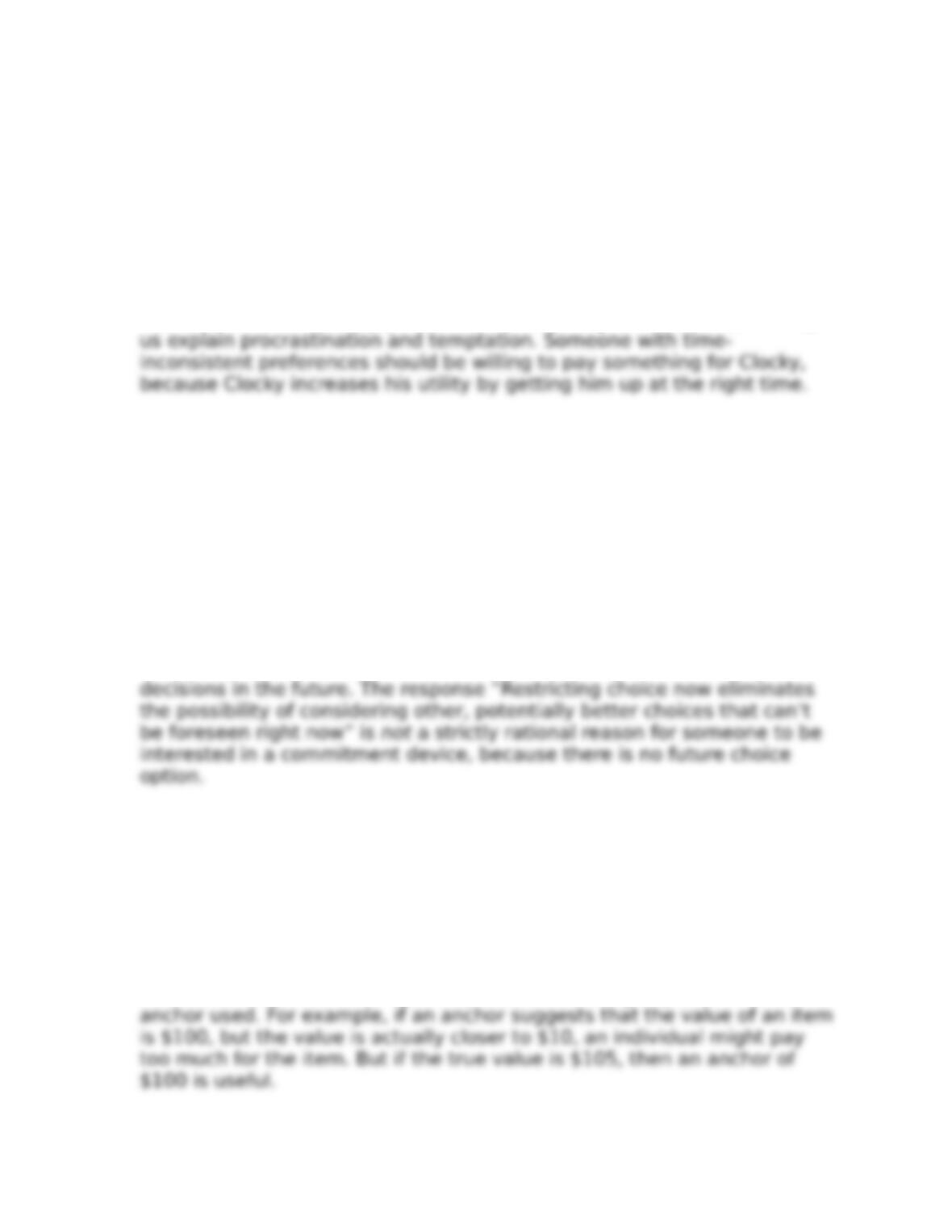
b. Something, because Clocky increases his utility by getting him up at the
right time.
c. You’d have to pay him to use Clocky, because his utility is decreased by
having to get out of bed and search around to shut o) the alarm.
Answer: Time inconsistency is a situation when we change our minds
about what we want simply because of the timing of the decision. It helps
8. Which of the following is not a strictly rational reason for someone to be
interested in a commitment device? [LO 23.3]
a. The device can eliminate the time-inconsistency problem.
b. By making the decision to restrict choices now, the person saves future
effort in deciding among more, but undesirable, choices.
c. Restricting choice now eliminates the possibility of considering other,
potentially better choices that can’t be foreseen right now.
d. The device helps the person make the choice that she wants to make right
now, but might not make in the future.
Answer: c. A commitment device is a strategy or tool that allows people
to voluntarily restrict later choices now so that they can make better
9. When it comes to making decisions, which of the following statements are
true? Select all that apply. [LO 23.4]
a. Individuals will make the same choices no matter how information is
presented.
b. Anchoring is always helpful when making decisions.
c. Anchoring can mislead individuals into making suboptimal choices.
d. Anchoring can help individuals make better decisions
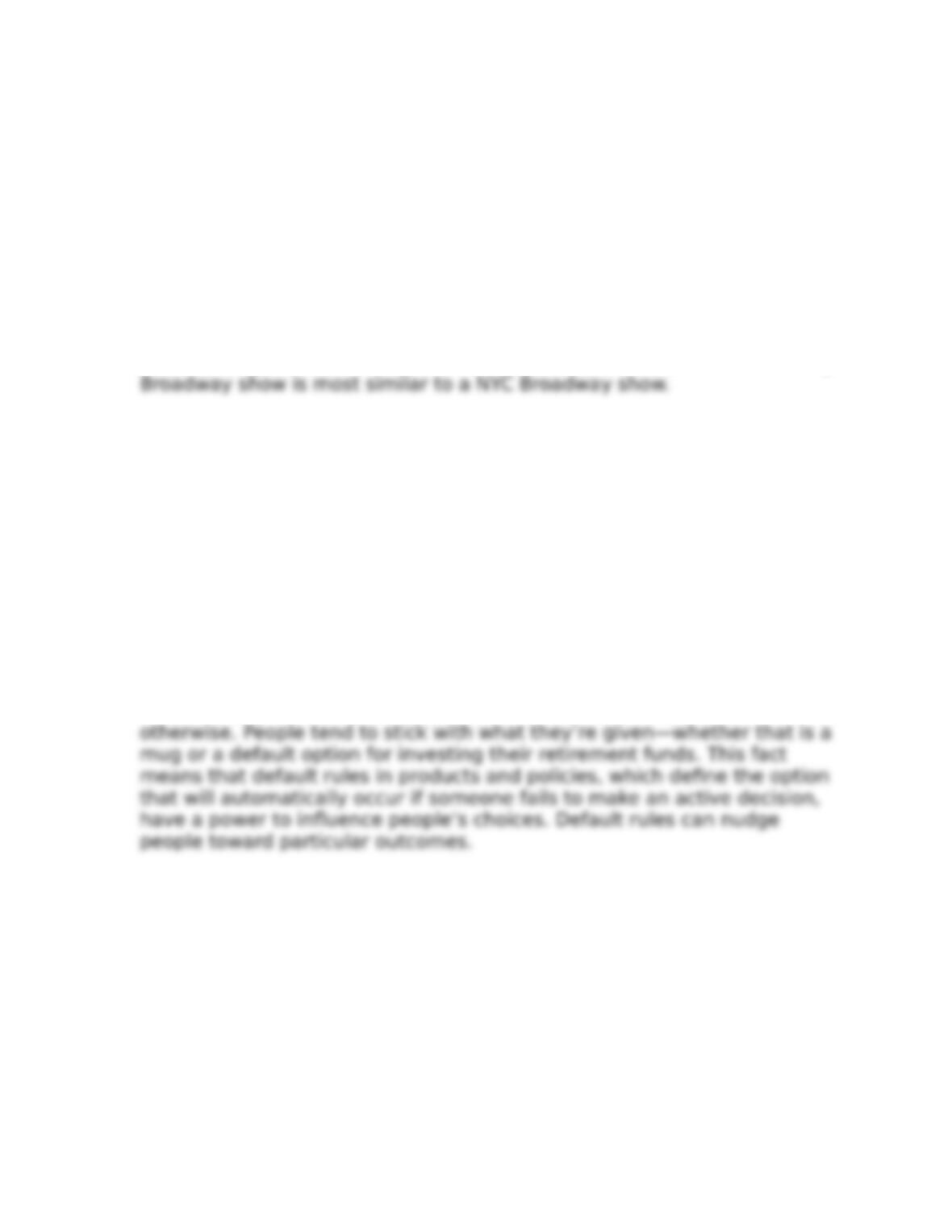
Answer: Whether anchoring is helpful or misleading depends on the
23-11
Copyright © 2018 McGraw-Hill Education. All rights reserved. No reproduction or distribution without the prior written consent of McGraw-Hill
Education.
Chapter 23 – Public Policy and Choice Architecture
10. Suppose you want to buy your signiticant other tickets to see his or her
favorite musical on Broadway in New York City, but you have never
purchased tickets to a Broadway musical before and don’t know how much
they cost. What would be a good “anchor” to use in your estimate? [LO
23.5]
a. The cost of movie tickets.
b. The cost of the soundtrack to the musical.
c. The cost of tickets to a musical performed by your local community
theater group.
d. The cost of tickets to a Broadway production touring in your hometown.
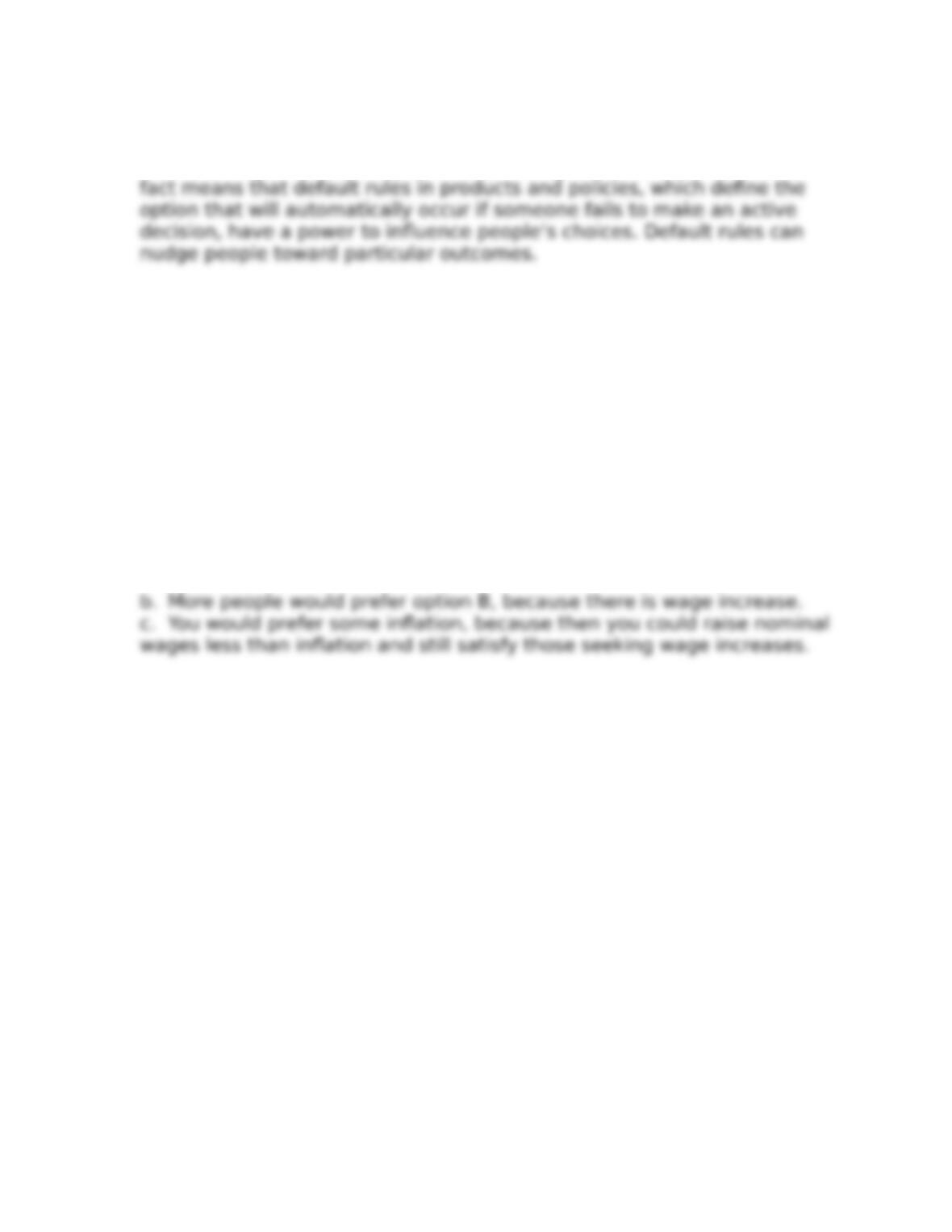
Answer: A good anchor is similar to the item you wish to value. A touring
11. Which of the following are true statements about default rules? (You can
choose more than one.) [LO 23.5]
a. Defaults have staying power because opting out of them is typically very
costly, requiring people to hire lawyers or prove to authorities that they have
su!cient reason for choosing another option.
b. The more di!cult it is to opt out of the default option, the more likely
people are to stick with it.
c. One reason default options might have staying power is that people often
equate “default option” with “recommended option.”
d. Default rules work to in uence choices only if people are aware of the
default option.
Answer: b and c. A default rule is defining the option that will
automatically occur if a chooser fails to make an active decision
12. In which of the following examples would we see the in uence of a
default option? (You can choose more than one.) [LO 23.4]
a. A doctor recommends continuing treatment, but the ultimate decision of
whether to continue treatment is left up to the patient.
b. A website automatically checks the option “share my activity with my
friends on Facebook” when users sign up.
c. Pets from an animal shelter are automatically spayed or neutered unless
the owner would prefer them not to be.
d. A mobile phone user has to enter a choice at start-up between installing a
special feature or not. The user is informed that most people choose to
install the special feature.
23-12
Copyright © 2018 McGraw-Hill Education. All rights reserved. No reproduction or distribution without the prior written consent of McGraw-Hill
Education.
Chapter 23 – Public Policy and Choice Architecture
Answer: b and c. People tend to stick with what they’re given—whether
that is a mug or a default option for investing their retirement funds. This
13. A group of people is offered two scenarios and asked which they would
prefer: (A) a 3 percent wage decrease in a world with no in ation or (B) a 3
percent wage increase in a world with 6 percent in ation. [LO 23.6]
a. What is the increase or decrease in the real wage in option A? What about
in option B?
b. Knowing what you know about framing and loss aversion, which option do
you expect more people to prefer?
c. In light of your answer to b, if you were an employer trying to cut real
labor costs, would you prefer to have some in ation or no in ation in the
economy?
Answer:
a. In option A, there is a loss of 3 percent. In option B, there is also a loss
of 3 percent.
14. Choose the statement that people are more likely to choose based on
the framing of the choice. [LO 23.6]
a. Stock investment:
i. Invest in a stock with low uncertainty of return.
ii. Invest in a stock with high certainty of return.
b. Car purchase:
i. Buy a car that costs $20,000, which is $5,000 cheaper than the next
level for that maker.
ii. Buy a car that costs $20,000, which is $5,000 more expensive than the
lower level for that maker.
c. Movie choice:
i. Go to the movie to which 100 out of 150 people give a (ve-star rating.
ii. Go to the move to which 50 out of 150 people give less than a (ve-star
rating.
d. Choice of college class:
i. Take a class in which 50 percent of students get an A.
ii. Take a class in which 50 percent of students don’t get an A.
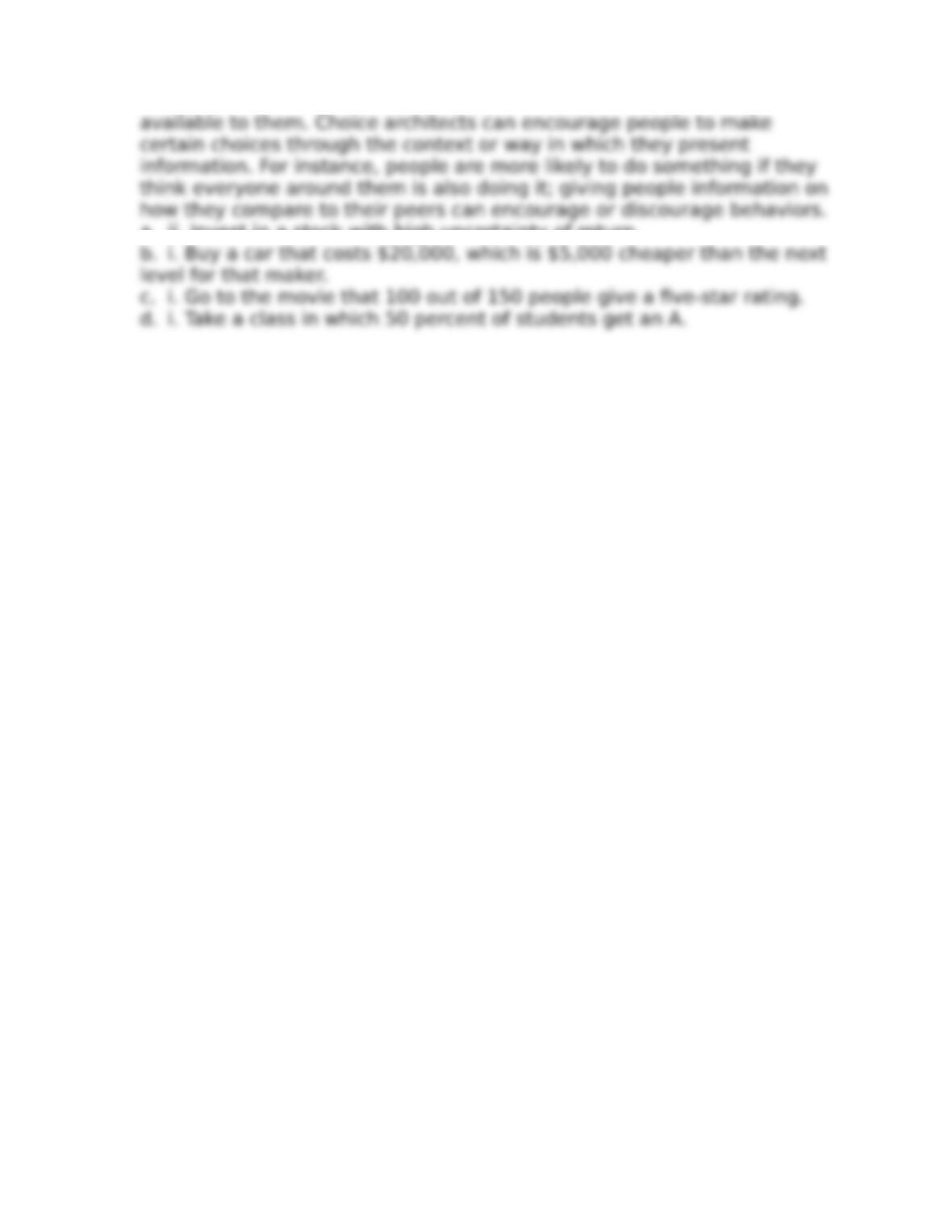
Answer: People respond to the way in which the choices are framed,
even when that framing does not change the substance of the options
23-13
Copyright © 2018 McGraw-Hill Education. All rights reserved. No reproduction or distribution without the prior written consent of McGraw-Hill
Education.
Chapter 23 – Public Policy and Choice Architecture
a. ii. Invest in a stock with high uncertainty of return.
23-14
Copyright © 2018 McGraw-Hill Education. All rights reserved. No reproduction or distribution without the prior written consent of McGraw-Hill
Education.