
Chapter 22 – Political Choices
CHAPTER 22
POLITICAL CHOICES
Chapter Overview
As students of economics, we are interested in how policy is formed—both
for its own sake as an important realm of human decision making and for the
effect it has on the economy. In this chapter, we began with a simpli ed
model of political choices: Voters are fully informed and rational, they pick
the candidate that best ts their views, and that candidate then faithfully
carries out the policy platform on which he or she was elected.
We then moved to a more nuanced model of political choices. First, we saw
that even if voters are informed and rational, aggregating their opinions
through elections is not as simple as just tallying the votes. In fact, no
process exists that can meet even a fairly basic set of criteria we’d hope for
in an ideal voting system.
Second, we questioned just how rational and informed voters really are—and
whether a rational person would even choose to vote. Then, we looked at
government o+cials as fallible humans with their own biases and interests.
Many of these biases are shaped by the rules of the political system, and we
showed how these rules affect policy outcomes.
In the next chapter, we’ll take a look at how policy-makers can in.uence
outcomes, sometimes without even changing the underlying policies.
Sometimes the way policies are presented can lead to important changes in
the choices people make, on topics as important as retirement savings and
as simple as what to eat for breakfast.
Learning Objectives
LO 22.1 Explain the predictions and assumptions of the median-voter
theorem.
LO 22.2 List the characteristics of an “ideal” voting system and assess which
criteria are met by real systems.
LO 22.3 Discuss problems with the idea of the “rational voter” and de ne
the idea of rational ignorance.
LO 22.4 Explain the persistence of policies that provide concentrated
bene ts to a few while imposing diffuse costs on the majority.
LO 22.5 Explain why corruption and rent-seeking can persist in a democratic
system.
LO 22.6 List three major features of political structure and identify how they
can affect policy choices.
22-1
Copyright © 2018 McGraw-Hill Education. All rights reserved. No reproduction or distribution without the prior written consent of McGraw-Hill
Education.
Chapter 22 – Political Choices
22-2
Copyright © 2018 McGraw-Hill Education. All rights reserved. No reproduction or distribution without the prior written consent of McGraw-Hill
Education.

Chapter 22 – Political Choices
Chapter Outline
GLOBAL WARMIMG HOT POTATO
The Economics of Elections
Stick to the Middle: Median-Voter Theorem (LO 22.1)
The Elusive Perfect Voting System (LO 22.2)
Political Participation and the Myth of the “Rational Voter” (LO 22.3)
BOX FEATURE: REAL LIFE – FACE VALUE—MAY THE BEST-LOOKING POLITICIAN
WIN
The Economics of Policy-Making
Diffuse Costs, Concentrated Bene ts (LO 22.4)
Corruption and Rent-Seeking (LO 22.5)
BOX FEATURE: REAL LIFE – MONITORING CORRUPTION IN INDONESIA
The System Matters: How Political Structure Affects Outcomes (LO 22.6)
BOX FEATURE: REAL LIFE – ENFRANCHISING THE POOR HELPS THE POOR
Beyond the Lecture
Class Discussion: Median-Voter Theorem (LO 22.1)
Show students this brief clip to start a discussion about the median-voter
theorem.
1. What is the median-voter theorem?
2. What does the median-voter theorem predict regarding political
candidates?
3. Why are extreme candidates unlikely to win?
Class Discussion: Political Participation and the Rational Voter Myth
(LO 22.3)
Ask students to view this CNN article about voter turnout for the 2016
presidential election. Ask students to consider the following:
1. Why doesn’t everyone vote?
2. Why do voters vote if they are unlikely to individually determine the
election?
3. What are the costs and bene ts of voting?
Class Discussion: Di+use Costs, Concentrated Bene.ts (LO 22.4)
Show students this brief clip to introduce the concept of special interest
groups and their impact on policy, and then discuss the following:
1. How can small, concentrated groups in.uence policy?
2. Why doesn’t the majority do something to counter the efforts of
smaller, concentrated groups?
Class Discussion: Corruption and Rent-Seeking (LO 22.5)
Show students this article discussing corruption and rent seeking among the
political class in Africa.
22-3
Copyright © 2018 McGraw-Hill Education. All rights reserved. No reproduction or distribution without the prior written consent of McGraw-Hill
Education.
Chapter 22 – Political Choices
1. Why do you think political rent-seeking, corruption, and bribery are
more common in developing countries?
2. What is the result of these actions?
Clicker Questions
There are three main purposes to clicker questions. First, they are a great
way to do a quick and instant “on demand” test of student understanding of
the material. You can cover material, and instantly get feedback on student
comprehension. You can see whether you need to explain certain topics
again, or move on to the next subject. Second, they are a great method to
break up the class and take a moment away from lecture. It gets the
students actively involved. Finally, certain clicker questions can be framed in
a “discussion” manner, in which you can invite students to talk about the
possible right answer with their peers. You can instruct students to convince
their classmate of a right or wrong answer.
1. The median voter theorem is a simply theoretical model which predicts
that politicians can maximize votes by _______________. [LO 22.1]
A. Spending the most money on advertising
Feedback: It’s a bit of a simpli ed model with two candidates, a single one-
dimensional policy question, and a majority vote winner.
2. Voters prefer apples to oranges, and they prefer oranges to pears. But
they prefer pears to apples. This scenario violates the ________ ideal of a
voting system. [LO 22.2]
A. Unanimity
Feedback: The rst two statements imply that they should prefer apples
over pears.
3. There are often times where a candidate would have won an election in a
two-party race, but the existence of the third party caused that same
candidate to not win the election. This illustrates a violation of _________ in
an ideal voting system. [LO 22.2]
A. Unanimity
22-4
Copyright © 2018 McGraw-Hill Education. All rights reserved. No reproduction or distribution without the prior written consent of McGraw-Hill
Education.
Chapter 22 – Political Choices
Feedback: People have suggested this happened go George H.W. Bush in
1992 because of Ross Perot, and Al Gore in 2000 due to Ralph Nader. Some
people even speculate that it happened to Hillary Clinton in 2016 because of
Gary Johnson and Jill Stein.
4. Arrow’s Impossibility Theorem essentially says that_______ [LO 22.3]
A. People make irrational voting choices and this in.uences elections
Feedback: In a nutshell it says that no voting system is perfect.
5. Tina is very busy with work, school, and raising a family. She will still vote,
but decides that the time and effort needed to gather information about
political candidates just isn’t worth it. This is an illustration of the __________
phenomenon in political participation. [LO 22.3, 22.4]
D. con rmation bias
Solutions to End-of-Chapter Questions and Problems
Review Questions
1. Assume there’s an election coming up in which voters need to decide
between two candidates on the question of taxes. Polls indicate the attitudes
about taxes among likely voters as shown in Table 22Q-1.
Level of taxation
(%)
Percent of voters in
favor (%)
No taxes 10
10 20
20 40
25 30
Candidate A proposes a 20 percent tax, and Candidate B, a 15 percent tax.
According to the median-voter theorem, which candidate will win? [LO
22.1]
22-5
Copyright © 2018 McGraw-Hill Education. All rights reserved. No reproduction or distribution without the prior written consent of McGraw-Hill
Education.
Chapter 22 – Political Choices
Answer: The median-voter theorem suggests that when voters are
deciding between two candidates on a single issue, they will choose the
2. Suppose we are trying to predict the positions that three candidates will
take on who should be eligible for public-housing subsidies (e.g., poor
families, the elderly, poor families with children, and so on). Can we use
the median-voter theorem to analyze this problem? Explain why or why
not, based on which of the assumptions of the median-voter theorem are
met by this situation. [LO 22.1]
Answer: This example violates the assumptions of the median-voter
theorem on two fronts. The rst is that there are three candidates
3. In researching a voting system, you discover that it obeys three of the
four criteria of an ideal voting system: transitivity, irrelevance of
independent alternatives, and unanimity. With this information, what else do
you know about this system? How can you be sure? [LO 22.2]
Answer: By Arrow’s impossibility theorem, we know that this voting
system must have a dictator; that is, someone who is able to make the
4. Every year the residents of a historical town gather to determine how
much to spend on their park, 10 percent or 15 percent of the budget. If
everyone votes for the same percentage, they will spend that amount,
unless the year before everyone voted for the opposite percentage, in which
case they spend the average of the two. What characteristic of the ideal
voting system is violated in this example? [LO 22.2]
Answer: The characteristic that is violated is unanimity. In the ideal
22-6
Copyright © 2018 McGraw-Hill Education. All rights reserved. No reproduction or distribution without the prior written consent of McGraw-Hill
Education.
Chapter 22 – Political Choices
5. Compare a national presidential election that receives around-the-clock
media coverage with an obscure local race for a state house seat. Which
imposes higher costs on people seeking to become informed voters, and
why? Which carries higher bene ts to voting, and why? [LO 22.3]
Answer: The obscure local race for a state house seat likely imposes
higher costs on getting information relative to the national race, which is
6. Explain whether you think the following changes in a voting system would
increase or decrease the number of votes cast. [LO 22.3]
a. Before casting their ballot, voters are required to watch a 30-minute video
with facts about the issues at hand, greatly increasing the information they
have about the issues.
b. A new cellphone app allows you to vote by sending a text to your local
Board of Elections.
c. After voting, voters can elect to receive a small pin that allows everyone
to know that they voted.
Answer:
a. Watching a 30-minute video before voting is likely to decrease the
b. Allowing voting via a cellphone app is likely to increase the number of
c. Giving those who vote a small pin will increase turnout. With the choice
7. Chapter 17, “International Trade,” discussed the trade restrictions that
limit imports of clothing into the United States and Europe from certain
clothing-manufacturing companies. Explain why a policy like this might
persist even if it was unpopular with the majority of voters. [LO 22.4]
Answer: Clothing manufacturers and workers in the United States bene t
from limits to clothing imports, while consumers of clothing bear the
8. As part of a plan to subsidize avocado production, farmers suggest that
the costs of a subsidy should be paid by grocery-store owners (who will
presumably bene t from higher sales of avocados). Are there concentrated
22-7
Copyright © 2018 McGraw-Hill Education. All rights reserved. No reproduction or distribution without the prior written consent of McGraw-Hill
Education.
Chapter 22 – Political Choices
bene ts in this situation? Are there diffuse costs? Is there a collective-action
problem? Explain your answer. [LO 22.4]
Answer: There are concentrated bene ts in this situation. The avocado
9. Do collective-action problems contribute to or discourage rent-seeking?
Explain your answer. [LO 22.5]
Answer: Collective-action problems often encourage rent-seeking. When
the bene ts of a policy are concentrated and the costs of it are diffuse,
10. Explain why having a minimum voting age may cause rent-seeking.
[LO 22.5]
Answer: A minimum voting age excludes a portion of the population from
11. Explain why voters are more likely to share beliefs with candidates in a
proportional-representation system than a two-party system. [LO 22.6]
Answer: Two-party systems generally lead to more centrist views. When
12. Explain why political candidates in the United States often have
unusual and also persistent combinations of policy preferences. (For
example, a candidate that is against abortion is usually also against gun
control and prefers lower taxes.) [LO 22.6]
Answer: The United States has a two-party political system. Two-party
systems generally lead to set beliefs in each party. When more parties are
Problems and Applications
22-8
Copyright © 2018 McGraw-Hill Education. All rights reserved. No reproduction or distribution without the prior written consent of McGraw-Hill
Education.
Chapter 22 – Political Choices
1. Suppose that two candidates in a local election are trying to develop their
policy positions regarding how much their town should spend on education.
The numbers break down as shown in Table 22P-1. According to the median-
voter theorem, how much will the town spend on education? [LO 22.1]
Answer: The median-voter theorem states that the policy position of the
2. A football team is voting for a captain based on how many times the
captain would have the team practice per week. Table 22P-2 below shows the
number of team members in favor of various numbers of practices per week.
[LO 22.1]
a. If the team is choosing between three captains—Buck, Jim, and Brian—can
we use the median-voter theorem?
b. Assume that at the last minute, Buck decides to withdraw from the race.
Can we use the median-voter theorem for the race as it stands now?
c. If you can use the median-voter theorem to predict the result without
Buck, how many times will the team practice? If you cannot use the theorem,
what two answers can you rule out?
d. Assume that two more players join the team before the vote. They both
prefer to practice 10 times a week. If you can use the median-voter theorem
to predict the result without Buck, how many times will the team practice? If
you cannot use the theorem, what two answers can you rule out?
Answer: The median-voter theorem suggests that politicians maximize
their votes by taking the policy position preferred by the median voter,
under certain conditions. The conditions are: there is a single, one-
dimensional policy question (such as more or less spending); voters
d. The team will practice 6 times per week.
3. Three friends are trying to decide where to go to dinner. There are four
restaurants nearby: Thai, Italian, Tex-Mex, and sushi. Assume the friends
have the following preferences: [LO 22.2] Gabe: Thai > Italian > Sushi >
Tex-Mex
Arnold: Italian > Tex-Mex > Sushi > Thai
Julie: Sushi > Tex-Mex > Thai > Italian
a. The friends decide to hold a majority vote that pits the Thai place against
the Italian; the winner of that vote against the Tex-Mex; and then the next
winner against the sushi. Which restaurant do they end up going to?
22-9
Copyright © 2018 McGraw-Hill Education. All rights reserved. No reproduction or distribution without the prior written consent of McGraw-Hill
Education.
Chapter 22 – Political Choices
b. If they vote on sushi versus Tex-Mex, the winner against Italian, and then
the winner against Thai, which restaurant will they choose?
c. Which of the criteria for an ideal voting system is violated in this
example?
Answer: Pair-wise majority voting gets its name because options are
taken in pairs, and the majority vote wins. When all options have been put
a. Thai wins against the Italian, Tex-Mex wins against Thai, and sushi wins
against Thai.
4. In a runoff election, if no candidate receives a majority of votes in the rst
round of voting, the top two candidates face each other in a second round.
Let’s say that people voting on Candidates A, B, C, and D in a runoff election
have the following preferences. [LO 22.2]
12 voters: A > B > C > D
8 voters: C > B > D > A
10 voters: D > B > C > A
4 voters: B > D > A > C
a. Does anyone receive an outright majority in the rst round? If so, which
candidate? If not, which two candidates move on to the second round, and
which of them wins?
b. Suppose Candidate A drops out of the race. Does any candidate now
receive an outright majority in the rst round? If so, which candidate? If not,
which two candidates move on to the second round, and which of them wins?
c. Does this situation violate the independence of irrelevant alternatives?
Answer: In most elections in the United States (and in many other
countries) the voting system is simple. All candidates go up against each
other at once, each voter can choose one and only one of them, and the
a. No. Candidates A and D move on to the next round, which D wins.
b. No. Candidates D and C move on to the next round, which D wins.
22-10
Copyright © 2018 McGraw-Hill Education. All rights reserved. No reproduction or distribution without the prior written consent of McGraw-Hill
Education.
Chapter 22 – Political Choices
c. No. If a group is voting on option X versus option Y, this decision should
5. According to the rational voter theory, will the following increase or
decrease voter turnout? [LO 22.3]
a. Electronic voting machines make the process of casting a ballot faster and
less complicated.
b. 24-hour news networks emphasize how close they expect the election to
be, with only a few thousand votes deciding the outcome.
c. The number of polling stations increases.
d. Pollsters predict a landslide victory for the incumbent candidate a few
days before the election.
Answer: The rational voter theory assumes that voters have preferences
regarding policy, have full information about candidates, and vote for the
one whose policy platform most nearly resembles their preferences. Once
a. Increase.
6. Determine whether each of the following represents rational ignorance.
[LO 22.3]
a. Doug doesn’t know the return on his retirement account in the last
quarter or the types of investments that comprise the account.
b. Sally doesn’t know about a new provision in nuclear energy regulation,
which is decided by a national panel overseen by nuclear physicists.
c. Jim doesn’t know whether to support new requirements for licensing
among city contractors.
d. Tom doesn’t know the average price of a parking ticket, despite parking
on the street every day.
Answer: Rational ignorance is choosing to remain ignorant when the
opportunity costs of gathering information outweigh the bene ts.
a. No: A retirement account, although complex, is something to closely
b. Yes: Unless you nd it interesting, it simply would take too much effort
c. Yes: Unless he is a contractor himself, all Jim needs to know is whether
22-11
Copyright © 2018 McGraw-Hill Education. All rights reserved. No reproduction or distribution without the prior written consent of McGraw-Hill
Education.
Chapter 22 – Political Choices
d. No: Either Tom is able to avoid nes, or he is foolishly throwing away
7. For each of the following, state who bene ts and who bears the costs, and
whether the costs and bene ts are concentrated or diffuse. Based on this
assessment, predict which side is likely to get its way. [LO 22.4]
a. A rubber producer lobbies the government to prohibit the import of
cheaper foreign rubber, driving up the cost of consumer goods.
b. The government increases federal gas taxes by 1 cent per gallon to
nance building high-speed train routes between major East Coast cities.
Answer: The theory is that groups who experience concentrated bene ts
a. The bene ts are concentrated and go to the rubber producer. The costs
b. The bene ts and the costs are both diffuse. The train routes are likely
8. For each of the following conditions, determine whether a collective-action
problem exists. [LO 22.4]
a. Diffuse bene ts, diffuse costs.
b. Diffuse bene ts, concentrated costs.
c. Concentrated bene ts, diffuse costs.
d. Concentrated bene ts, concentrated costs.
Answer: The collective-action problem is a situation in which a group of
people stands to gain from an action that it is not rational for any of the
members to undertake individually.
a. Yes.
9. Decide which of these labels best ts each of the following situations:
rent-seeking, corruption, or bureaucratic capture. (If more than one is
potentially applicable, pick the one that is the most narrowly tailored to the
scenario.) [LO 22.5]
a. A contract manager at a government department is bribed to ensure that
his friend’s company gets a construction contract even though it was not the
lowest bidder.
b. A senior-citizens group lobbies the city government to spend more on
special public-transit shuttles for the elderly.
22-12
Copyright © 2018 McGraw-Hill Education. All rights reserved. No reproduction or distribution without the prior written consent of McGraw-Hill
Education.
Chapter 22 – Political Choices
c. The president appoints a former head of an investment bank to the
Securities and Exchange Commission (which oversees capital markets and
enforces nancial regulations).
d. The head of a local teachers’ union offers support to a political candidate
in exchange for her promise to spend more of the state budget on teacher
salaries.
Answer: The use of the powers of government by public o+cials to
achieve personal gains is corruption. Rent-seeking is the act of pursuing
a. Corruption.
10. Determine whether each of the following shifts is likely to increase or
decrease the prevalence of rent-seeking. [LO 22.5]
a. The spread of smartphones enables more widespread access to
information.
b. Judges strike down a law that forces politicians to report when they
receive a gift worth over $500.
c. Congress passes a law requiring lobbyists to spend at least two years in
another unrelated position before getting hired in government to regulate
the industries they were advocating for as lobbyists.
Answer: Rent-seeking is the act of pursuing privileges that increase the
surplus of a person or group without increasing total surplus. Bureaucratic
a. Decrease.
11. Suppose that political candidates in an election are trying to develop
their policy positions regarding how high to set the top marginal tax rate. The
numbers break down as shown in Table 22P-3. If the political system is a two–
party system, will a candidate who believes the top marginal tax rate should
be 30 percent be more likely to announce support for a marginal tax rate
below 30 percent, above 30 percent, or exactly 30 percent? [LO 22.6]
22-13
Copyright © 2018 McGraw-Hill Education. All rights reserved. No reproduction or distribution without the prior written consent of McGraw-Hill
Education.
Chapter 22 – Political Choices
Answer: In a two-party system, more centrist views often prevail. The
12. Suppose that a country currently does not allow its political leaders to
be in o+ce for more than one term. The country is considering moving from
a policy of no reelection to allowing one reelection (i.e., two terms in o+ce).
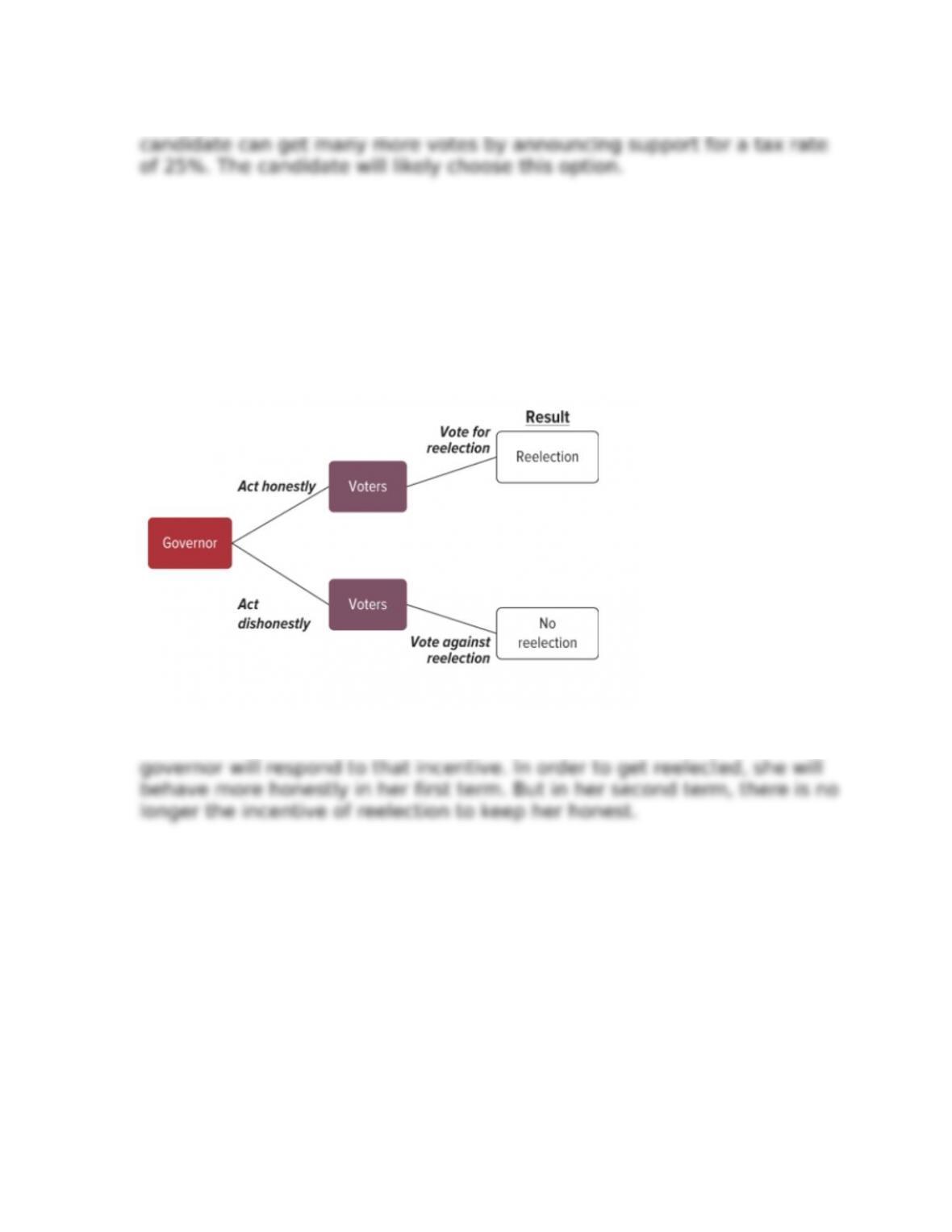
Figure 22P-1 shows a governor’s options while serving as governor. She can
either act honestly or dishonestly. If she acts honestly, the voters will vote to
reelect her. If she acts dishonestly, the voters will not vote for her reelection.
Assume that the governor would prefer to be reelected. How will moving
from a policy of no reelection to allowing one reelection affect the governor’s
honesty in her rst (and potentially second) terms? [LO 22.6]
Answer: When there is an incentive to behave more honestly, the
22-14
Copyright © 2018 McGraw-Hill Education. All rights reserved. No reproduction or distribution without the prior written consent of McGraw-Hill
Education.