
Chapter 21 – Poverty, Inequality, and Discrimination
CHAPTER 21
POVERTY, INEQUALITY, AND DISCRIMINATION
Chapter Overview
Understanding the roots of poverty, inequality, and discrimination matters
for economists and policy-makers alike. From an intellectual perspective,
these topics push us to understand how markets and institutions really work.
They also take us below the surface of statistics such as average income and
GDP to understand who gets how much and why. From the perspective of a
policy-maker or a concerned citizen, they may raise challenging economic
and social issues. What does a fair society look like? How much poverty is
acceptable? Does equality of opportunity matter more than the distribution
of income itself?
We’ve seen in this chapter that even the measurement of poverty,
inequality, mobility, and discrimination can be tricky. We have to decide
whether we care more about absolute or relative measures, adjust for
di*erences across regions, and pick out the causal factors we care about. In
the next chapter, we turn to the question of how these and other policy
issues are dealt with in the political world. We’ll see that arriving at policy
choices is even more complicated than simply finding the facts and
establishing goals. The workings of the political system itself have a huge
in.uence on the shape of the economic policies that are created.
Learning Objectives
LO 21.1 Understand how to measure poverty and describe the di*erence
between absolute and relative measures of poverty.
LO 21.2 Understand why poverty persists.
LO 21.3 Explain and interpret different methods of measuring income
inequality.
LO 21.4 Describe how income mobility differ from income equality.
LO 21.5 Identify the public policies that are used to reduce poverty and
inequality and understand their goals.
LO 21.6 Explain the trade-o* between equity and efficiency in poverty-
reduction policy.
LO 21.7 Explain why economists di*erentiate between correlation and
causation when studying discrimination and why markets do not always
eliminate discrimination.
Chapter Outline
STRIKING IT RICHER
21-1
Copyright © 2018 McGraw-Hill Education. All rights reserved. No reproduction or distribution without the prior written consent of McGraw-Hill
Education.

Chapter 21 – Poverty, Inequality, and Discrimination
Poverty
Measuring Poverty (LO 21.1)
BOX FEATURE: REAL LIFE – WHAT IF YOUR $2 A DAY DOESN’T COME EVERY
DAY?
Why are People Poor? (LO 21.2)
BOX FEATURE: REAL LIFE –GETTING OUT OF THE NEIGHBORHOOD
Inequality
Measuring Inequality (LO 21.3)
BOX FEATURE: WHAT DO YOU THINK? – THE SUPER–WEALTHY
Inequality versus Mobility (LO 21.4)
Policies to Reduce Poverty and Inequality
Public Policy Goals (LO 21.5)
The Welfare State
BOX FEATURE: FROM ANOTHER ANGLE – PAYING PEOPLE TO HELP
THEMSELVES
Trade-o*s between Equity and efficiency (LO 21.6)
Discrimination (LO 21.7)
Measuring Discrimination in the Labor Market
BOX FEATURE: REAL LIFE – ARE EMILY AND GREG MORE EMPLOYABLE THAN
LAKISHA AND JAMAL?
Do Free Markets Reduce Discrimination?
Long-Term effect of Discrimination
BOX FEATURE: WHAT DO YOU THINK? – AFFIRMATIVE ACTION IN COLLEGE
ADMISSIONS
Beyond the Lecture
Class Discussion: Measuring Poverty (LO 21.1)
This Forbes article provides a nice introduction to the topic of the wage gap
between male and females. Have students read this, or go over in class, then
discuss the following:
1. Is the entire di*erence in wages between male and female workers due
directly to discrimination?
2. What other factors could in.uence the di*erence in wages between
male and female workers?
Class Activity: Measuring Poverty and Inequality (LO 21.1, LO 21.2)
Ask students to guess the income necessary to be included in various
percentiles in terms of wealth. Many students do not have a great sense of
income distribution and inequality in general. This provides a starting point
for the chapter. You can then put the incomes into a calculator and show
them what the actual income percentiles are. You can -nd an income
percentile calculator for the U.S. here and for the rest of the world here.
Class Discussion: Measuring Poverty and Inequality (LO 21.1, LO
21.2)
21-2
Copyright © 2018 McGraw-Hill Education. All rights reserved. No reproduction or distribution without the prior written consent of McGraw-Hill
Education.
Chapter 21 – Poverty, Inequality, and Discrimination
Consider showing students a brief clip from this episode of the TV show No
Reservations, where host Anthony Bourdain visits Haiti. Any of these clips will
provide a visual of the poverty that many Haitians face on a daily basis and
will provide good insight for students. You could also ask students to watch
all of the clips on their own time. Then discuss in class:
1. What is the di*erence between poverty in Haiti and the U.S.?
2. What is the di*erence between relative and absolute poverty?
3. What do you think can be done to assist with poverty in developing
countries?
Reading Assignment/Class Discussion/Writing Assignment:
Inequality versus Mobility and the Welfare State (LO 21.3, LO 21.4)
Assign students to read this U.S. Treasury report on income mobility from
1996 to 2005. (the link goes to a summary page – the actual report is linked
on the bottom of the page). Then, either discuss the following in class or
assign as a writing exercise:
1. How much income mobility exists in the U.S., according to this study?
2. Do you think that this is a good or bad sign?
3. What, if anything, should be done to improve income mobility?
Clicker Questions
There are three main purposes to clicker questions. First, they are a great
way to do a quick and instant “on demand” test of student understanding of
the material. You can cover material, and instantly get feedback on student
comprehension. You can see whether you need to explain certain topics
again, or move on to the next subject. Second, they are a great method to
break up the class and take a moment away from lecture. It gets the
students actively involved. Finally, certain clicker questions can be framed in
a “discussion” manner, in which you can invite students to talk about the
possible right answer with their peers. You can instruct students to convince
their classmate of a right or wrong answer.
1. How is the absolute poverty line measured? [LO 21.1]
A. By the price of a basket of clothing, housing, healthcare, and food prices
2. According to data, what trend is visible with poverty? [LO 21.1]
A. Poverty rates increase when a new political party comes to power
21-3
Copyright © 2018 McGraw-Hill Education. All rights reserved. No reproduction or distribution without the prior written consent of McGraw-Hill
Education.
Chapter 21 – Poverty, Inequality, and Discrimination
3. What is true about the pre-tax income distribution of the U.S.? [LO 21.2]
D. Income is split evenly among quintiles
4. A variable that economists use to measure poverty across a country is
called the_________ [LO 21.3]
A. Laissez-Faire coefficient
5. What is an economic criticism of redistributive taxes as a method to fight
poverty? [LO 21.4, 21.5]
A. People in extreme poverty would rather have education and skills instead
of money
Feedback: A tough question. However, realize that markets and voluntary
trade are positive sum (both parties bene-t). With redistribution, there is a
“winner” and “loser” in terms of the direction the mandated tax travels.
Also, this can create disincentives to work on both sides (high earners don’t
want to be taxed, and impoverished people may want to receive the welfare
instead of work), so efficiency can decrease.
Solutions to End-of-Chapter Questions and Problems
Review Questions
1. In season three of the TV show The West Wing, the federal government
considers rede-ning the national poverty measure in a way that would
classify an additional 4 million people as poor. The president worries that his
administration will be criticized for leading the country into greater poverty.
Explain whether this change would have re.ected a shift in an absolute
measure of poverty or a relative measure of poverty, or whether it cannot be
known. Finally, explain why all else equal, the president is not responsible for
causing greater poverty. [LO 21.1]
Answer: The poverty measure in question could be relative or absolute—
so the correct answer is that we cannot know. Under either type of
21-4
Copyright © 2018 McGraw-Hill Education. All rights reserved. No reproduction or distribution without the prior written consent of McGraw-Hill
Education.
Chapter 21 – Poverty, Inequality, and Discrimination
2. Poverty in Decilia is measured relatively, with people in the bottom 10
percent of the income distribution being defined as poor. Suppose a politician
in Decilia promises to halve the poverty rate in -ve years. Explain why this
could never be achieved given the poverty statistic Decilia uses. Propose an
alternative measure of poverty that would allow the politician to achieve that
goal. [LO 21.1]
Answer: Because Decilia de-nes poverty as being in the bottom 10
percent of the income distribution, there will always be some individuals
3. Explain why it might be difficult for low income individuals to receive a
college education and why the government may need to subsidize student
loans for a college education. [LO 21.2]
Answer: For most loans, an individual offer up collateral against the
loan. (For example, to get a car loan, you agree that if you can’t pay the
Additionally, students from higher–income families may be able to borrow
4. Some people argue that unpaid internships should be illegal. In what ways
is an unpaid internship part of a poverty trap? [LO 21.2]
Answer: Increasing one’s human capital is one way to get out of poverty.
However, it can be costly to increase one’s human capital. An unpaid
21-5
Copyright © 2018 McGraw-Hill Education. All rights reserved. No reproduction or distribution without the prior written consent of McGraw-Hill
Education.
Chapter 21 – Poverty, Inequality, and Discrimination
5. Is it possible for two countries to have the same Gini coefficient but
di*erent distributions of income? Explain how you came to your conclusion.
[LO 21.3]
Answer: Yes, it is possible for two countries to have the same Gini
6. Explain why it’s possible for income inequality to decrease globally while
increasing in every country at the same time. [LO 21.3]
Answer: Imagine that in rich countries the incomes of the poor do not
increase, but the incomes of the rich increase slowly. In poor countries,
7. In which of the following countries is income mobility likely higher?
Explain your answer. [LO 21.4]
a. A country with a poverty rate of 25 percent, of which 80 percent
represents chronic poverty.
b. A country with a poverty rate of 30 percent, of which 20 percent
represents chronic poverty.
Answer: b. Chronic poverty rates re.ect the number of people who stay
under the poverty line for longer than three years. Hence, knowing
8. Suppose there is an economy where 80 percent of people earn more than
their parents and 40 percent end up in a di*erent income quintile than their
parents. What measure of the income distribution does the first statistic tell
you about? What about the second? [LO 21.4]
21-6
Copyright © 2018 McGraw-Hill Education. All rights reserved. No reproduction or distribution without the prior written consent of McGraw-Hill
Education.
Chapter 21 – Poverty, Inequality, and Discrimination
Answer: When there is income mobility, people are moving up the
income distribution as well as down the distribution. So, it would be tough
9. In March 2010, President Barack Obama signed into law the Patient
Protection and A*ordable Care Act, which required insurance companies to
accept patients with preexisting conditions. Classify this provision into one of
the approaches to alleviating poverty discussed in the chapter and explain
your reasoning. [LO 21.5]
Answer: By requiring insurance companies to accept patients with a
large number of preexisting conditions, the president took the approach of
10. If unconditional cash transfers have the same effect as conditional
cash transfers, which one allows the government to alleviate poverty more
effectively? In answering the question, draw on your knowledge of
administrative costs. [LO 21.5]
Answer: If unconditional cash transfers have the same effect as
conditional cash transfers, unconditional cash transfers will allow the
government to alleviate poverty more effectively. Since unconditional
11. John Rawls is a philosopher famous for his “maxi-min” principle, which
states that society should maximize the position of the people with the mini-
mum amount of goods, and not focus only on the level of inequality. For
instance, Rawls would favor a society in which the bottom 10 percent earn
$30,000 per year and the top 10 percent earn $2 million over a society in
which the bottom 10 percent earn $28,000 per year and the top 10 percent
earn $40,000 per year. Drawing on the trade-o* between equity and
efficiency, explain whether Rawls would favor (a) redistribution that limits
growth but creates equality or (b) economic development that encourages
growth but creates inequality. [LO 21.6]
Answer: In general, it’s likely that Rawls would favor economic
21-7
Copyright © 2018 McGraw-Hill Education. All rights reserved. No reproduction or distribution without the prior written consent of McGraw-Hill
Education.
Chapter 21 – Poverty, Inequality, and Discrimination
12. Your professor has decided that, from now on, students who receive
less than a 60 percent grade on any exam will be eligible to go to a review
session. If they attend the session, they will receive an extra 10 percent on
their grade. You see a problem with this policy, and instead propose to your
professor that people who go to the review session should receive 50 percent
of the di*erence between their grade and 60 percent. Explain why this
situation represents a trade-o* between equity and efficiency. [LO 21.6]
Answer: The original policy is more efficient than the one you proposed:
by simply adding 10 percent to the grades of people who went to the
13. Is it possible that even though men make more than women in a
particular industry, there could be gender discrimination against men in that
industry? If no, explain why not. If yes, explain why and give an example.
[LO 21.7]
Answer: Yes, it’s possible that in a certain industry men could make more
than women but still be discriminated against. For example, consider
nursing. If people discriminate against men when hiring nurses, it could
14. For each of the scenarios below, determine whether you think it is
likely that an employer could be discriminating against a person because of
his or her age. Explain why or why not. [LO 21.7]
a. A young lawyer who just finished work on a multimillion-dollar
development deal downtown is hired by an economic development -rm in
lieu of an older lawyer who works on litigation.
21-8
Copyright © 2018 McGraw-Hill Education. All rights reserved. No reproduction or distribution without the prior written consent of McGraw-Hill
Education.
Chapter 21 – Poverty, Inequality, and Discrimination
b. A large retail outlet hires an 80-year-old woman to greet customers
instead of a 30-year–old woman who has been greeting customers in other
stores for a decade.
c. The owner of a local, hip smoothie bar in a university town just fired a
graduate student who had worked at the bar for three years and instead
hired a college sophomore.
Answer:
a. Discrimination is unlikely. Although the other lawyer has been working
b. Discrimination is likely. There’s nothing in the prompt that indicates
c. Discrimination is likely. The prompt gives us no reason to believe that
15. Jackie Robinson broke baseball’s color barrier in 1947, which
precipitated integration in all major league teams after 12 years. Explain why
the market might have acted to eliminate discrimination in this example.
[LO 21.7]
Answer: Teams that wouldn’t allow African-American players arti-cially
limited the pool of talent. Those teams were thus at a disadvantage
16. Some economists have studied the effects of “lookism,” or
discrimination based on how attractive a person is. Give an example of a
case in which the market might encourage lookism and an example of a case
in which the market might combat lookism. [LO 21.7]
Answer: Any service in which the physical attractiveness of a person
adds to the experience may encourage lookism. Most often this would
21-9
Copyright © 2018 McGraw-Hill Education. All rights reserved. No reproduction or distribution without the prior written consent of McGraw-Hill
Education.
Chapter 21 – Poverty, Inequality, and Discrimination
Problems and Applications
1. Table 21P-1 shows a data set that contains the annual income of 20
households, each with a household size of four people. [LO 21.1]
a. What percent of these households are below the national poverty line of
$18,250 for a household of four people?
b. What is the average income of the bottom 20 percent of the households?
Answer:
a. 4 out of the 20 households have income below $18,250, so the answer
2. Table 21P-2 shows the incomes of 10 households in two different years,
2020 and 2021. Assume that the government is considering two different
measures of poverty, an absolute level of below $10,000 and a relative
measure of being in the bottom 40 percent of income earners. [LO 21.1]
a. What is the poverty rate using the absolute measure of poverty in 2020?
In 2021? Does it go up, down, or stay the same between the two years?
b. What is the poverty rate using the relative measure of poverty in 2020? In
2021? Does it go up, down, or stay the same between the two years?
c. Which yields a higher rate, the absolute measure of poverty or the
relative measure of poverty in 2020? In 2021?
d. Now assume that the government decides to index the poverty rate to
in.ation. Suppose in.ation was 5 percent from 2020 to 2021. Now what is
the poverty rate according to the absolute measure in 2021? Is it higher than
the relative rate in 2021?
Answer:
a. Using the absolute measure of poverty, there is a 50 percent poverty
b. The poverty rate stays the same at 40 percent for both years.
3. In the United States, public schools are often funded by property taxes
levied on the property in surrounding areas. Which of the following
statements explains how this can result in a poverty trap? Select all that
apply. [LO 21.2]
a. Individuals must buy a higher-priced home in order to attend a school that
receives more property taxes.
b. Renters do not have to pay property taxes.
21-10
Copyright © 2018 McGraw-Hill Education. All rights reserved. No reproduction or distribution without the prior written consent of McGraw-Hill
Education.
Chapter 21 – Poverty, Inequality, and Discrimination
c. Schools in areas with cheaper housing will receive less funding.
d. Low-income families are able to receive the same quality schooling for less
money.
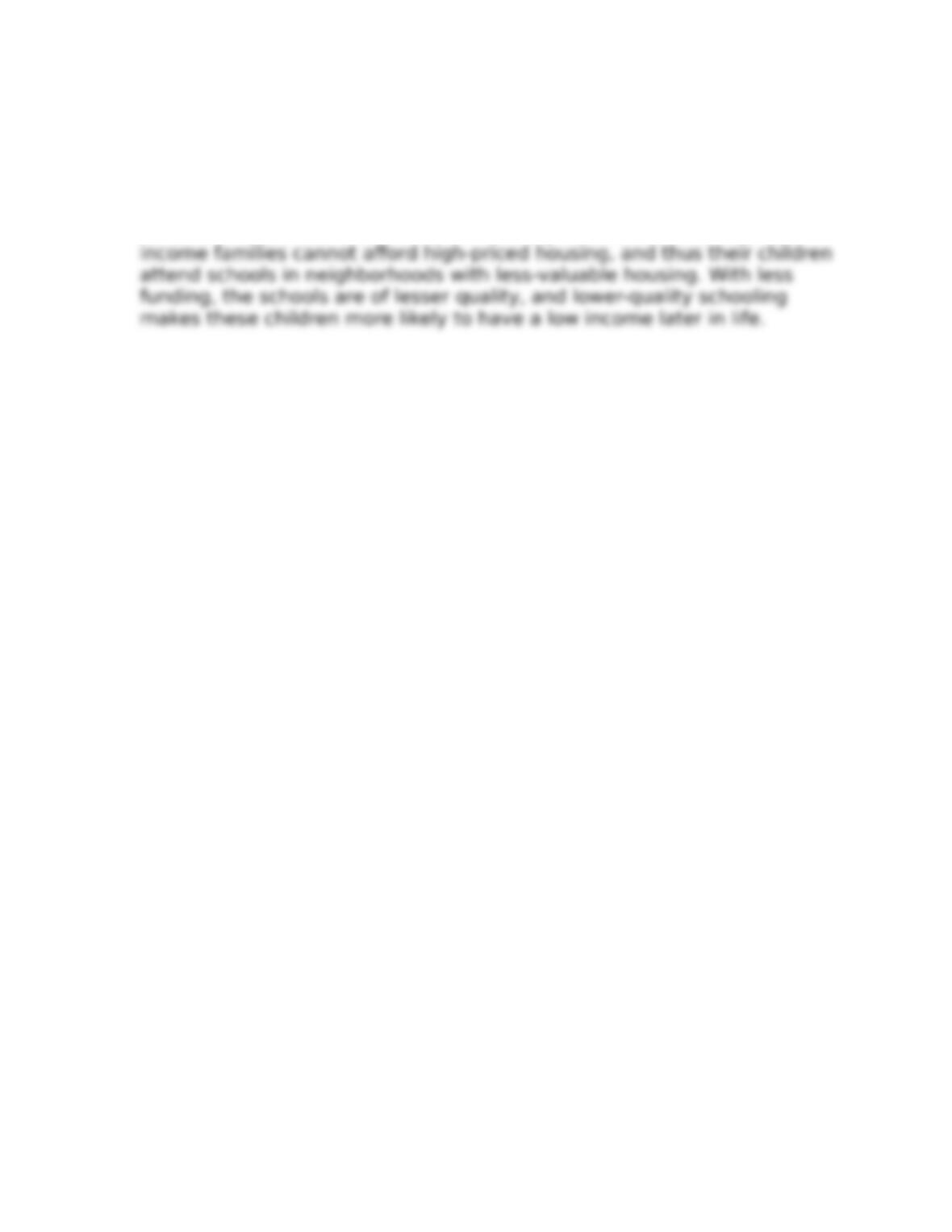
Answer: When funding is based on the value of the surrounding property,
schools in areas with more valuable housing receive more money. Low-
21-11
Copyright © 2018 McGraw-Hill Education. All rights reserved. No reproduction or distribution without the prior written consent of McGraw-Hill
Education.