Chapter 20 – Taxation and the Public Budget
1. Suppose the government wants to levy a new excise tax. For each of the
following goods, determine whether you would expect an excise tax to result
in high or low deadweight loss. [LO 20.2]
a. Alcohol.
b. Milk.
c. Diamonds.
d. Tropical vacations.
e. Socks.
Answer: The size of the deadweight loss of an excise tax depends upon
the price elasticity of the good taxed. Taxes on elastic goods entail more
a. Alcohol is relatively inelastic (there are few substitutes and many
b. Milk is inelastic because there are few substitutes. Deadweight loss
c. Diamonds are a luxury good. Deadweight loss would be relatively
d. Tropical vacations are highly substitutable and therefore price elastic.
e. Socks are a basic necessity with few substitutes, so they are price
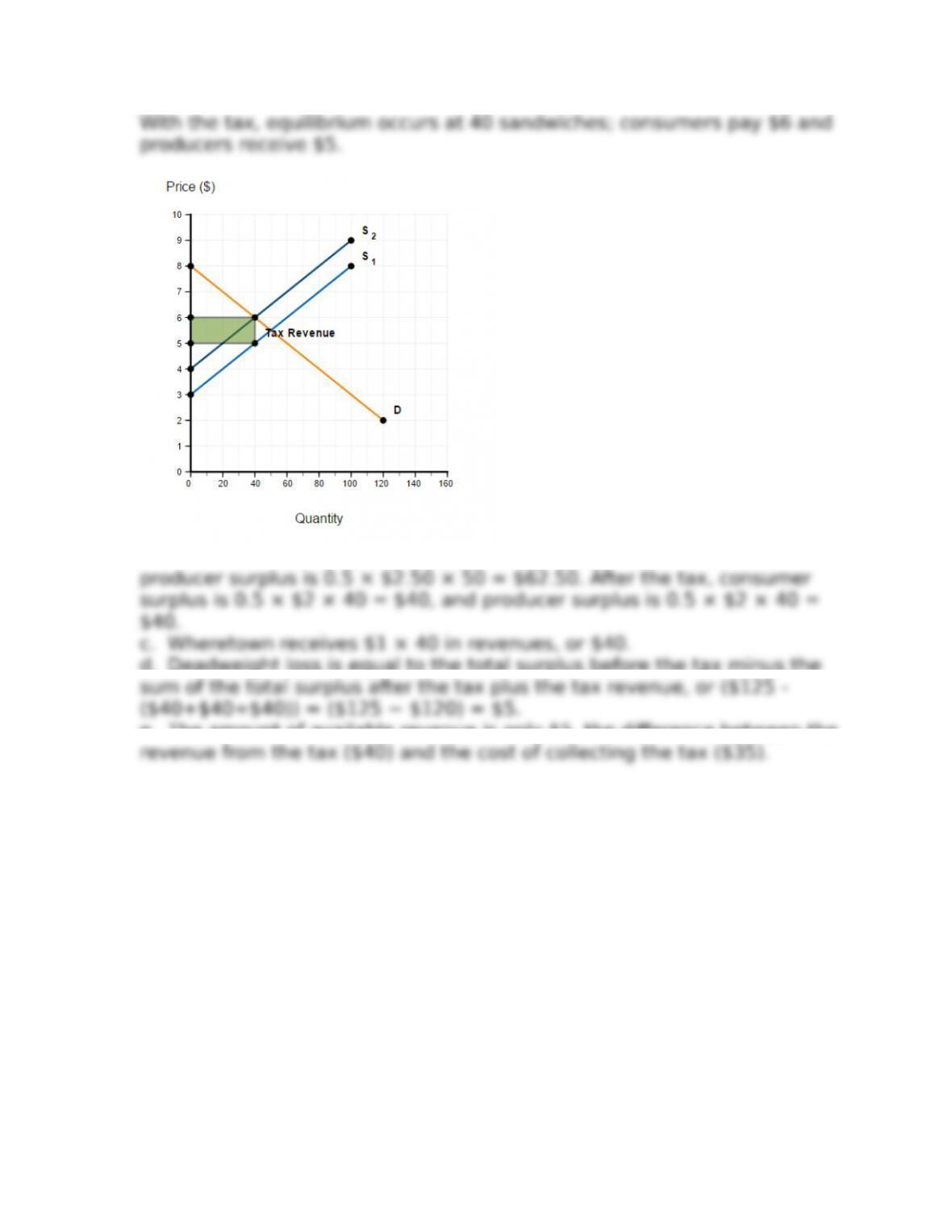
2. Table 20P-1 shows supply and demand in the market for sub sandwiches
in Wheretown, where the local government wants to raise revenue via a $1
tax on all sandwiches, collected from sandwich shops. [LO 20.2]
a. Graph the initial supply and demand curves, before the tax. Then graph
the after-tax supply curve. Before and after the tax: What is the equilibrium
quantity? What is the equilibrium price? What price is paid by consumers?
What price is received by suppliers?
b. Calculate consumer and producer surplus before and after the tax.
c. How much tax revenue does Wheretown receive? Draw this tax revenue
on the graph.
d. How much deadweight loss is caused by the tax?
e. Suppose it costs Wheretown $35 to collect the tax revenue from sandwich
shops. In the end, how much revenue from the sub tax is actually available
to spend on public services?
Answer:
a. The equilibrium price and quantity occur with 50 sandwiches at a price
20-1
Copyright © 2018 McGraw-Hill Education. All rights reserved. No reproduction or distribution without the prior written consent of McGraw-Hill
Education.
Chapter 20 – Taxation and the Public Budget
b. Before the tax, consumer surplus is 0.5 × $2.50 × 50 = $62.50, and
d. Deadweight loss is equal to the total surplus before the tax minus the
e. The amount of available revenue is only $5, the di?erence between the
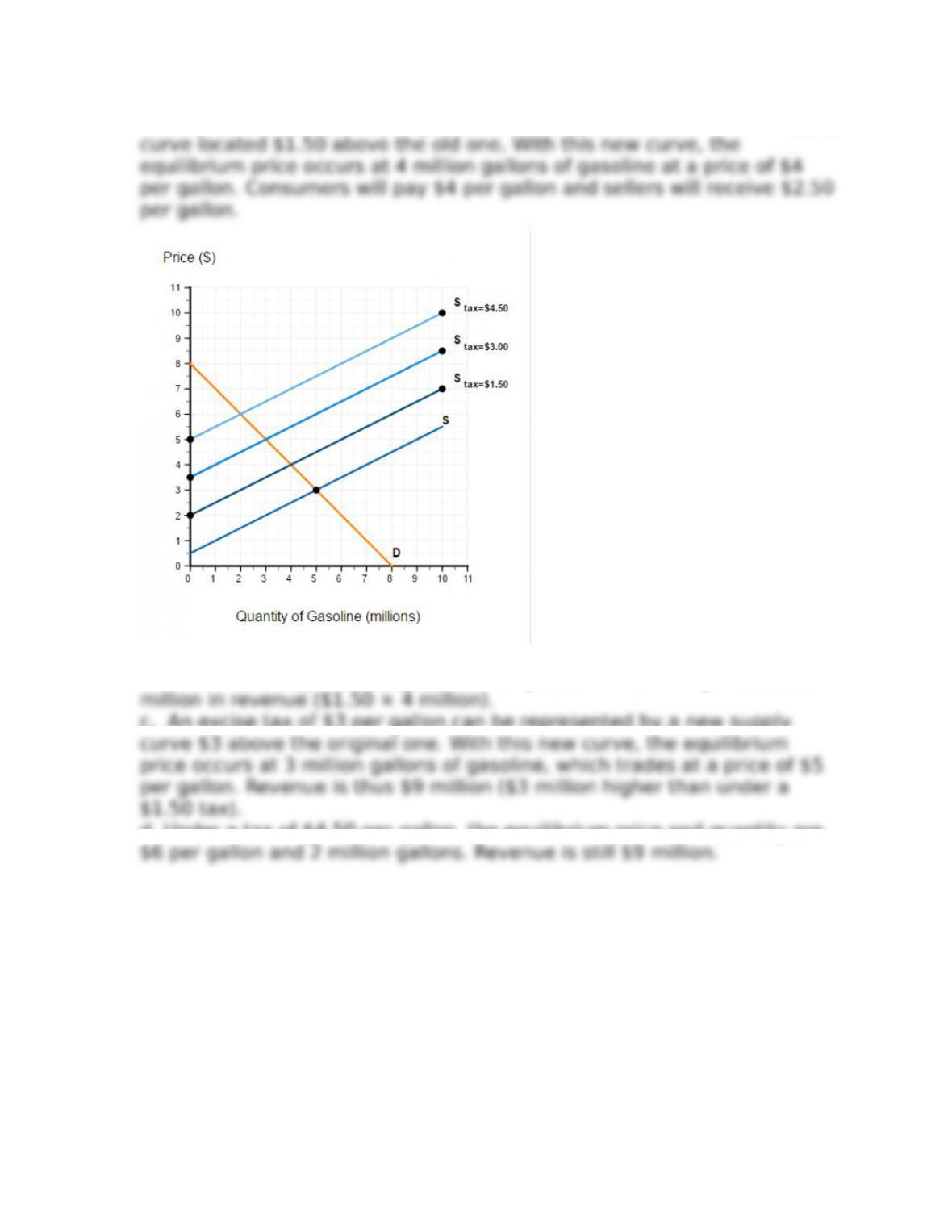
3. Figure 20P-1 shows a hypothetical market for gasoline. [LO 20.3]
a. Suppose an excise tax of $1.50 per gallon is levied on gasoline suppliers.
Draw the after-tax supply curve. What price will consumers pay? What price
will sellers receive?
b. How much government revenue will result from the tax?
c. Suppose the tax is raised to $3 per gallon. Draw the new after-tax supply
curve. How much additional revenue will this raise compared to the $1.50
tax?
d. Suppose the tax is raised again to $4.50 per gallon. Draw the new after–
tax supply curve. Does this newest tax increase cause tax revenue to
increase, decrease, or remain the same as compared to the $3 per gallon
tax?
Answer:
20-2
Copyright © 2018 McGraw-Hill Education. All rights reserved. No reproduction or distribution without the prior written consent of McGraw-Hill
Education.
Chapter 20 – Taxation and the Public Budget
a. An excise tax of $1.50 per gallon can be represented with a new supply
b. With 4 million gallons of gasoline being sold, the tax will generate $6
c. An excise tax of $3 per gallon can be represented by a new supply
d. Under a tax of $4.50 per gallon, the equilibrium price and quantity are
4. In each of the following examples, determine whether the price e?ect or
the quantity e?ect dominates when the tax is applied. [LO 20.3]
a. The government raises taxes on iPods from $10 per iPod to $20 per iPod.
Prior to the tax increase, 10 million iPods were sold each year. The new
equilibrium quantity is 9 million iPods.
b. In response to concerns about chewing gum in schools, the government
raises the tax on packs of gum from $0.20 per pack to $0.30 per pack.
Before the tax increase, 50 million packs were sold each year. After the tax
increase, 40 million packs are sold each year.
20-3
Copyright © 2018 McGraw-Hill Education. All rights reserved. No reproduction or distribution without the prior written consent of McGraw-Hill
Education.
Chapter 20 – Taxation and the Public Budget
c. Worried that Americans are addicted to co?ee, the government raises the
$0.05 tax on a cup of co?ee to $0.10. Before the tax increase, 10 billion cups
were sold each year. Afterward, 5 billion cups are sold each year.
Answer:
a. Revenue before the tax increase was $100 million; after the tax it is
b. Revenue before the tax increase was $10 million; after the increase it
c. Before the tax increase, revenue was $500 million; after it is $500
5. Determine whether each of the following taxes is proportional, regressive,
or progressive. [LO 20.4]
a. An income tax of 25 percent on income from all sources.
b. An income tax with three brackets and corresponding marginal tax rates:
10 percent for income up to $50,000; 20 percent for income up to $100,000;
and 30 percent for income over $100,000.
c. A fee of $500 per year for municipal services, charged to everyone who
lives within the city limits.
d. A capital gains tax that charges a Cat rate of 40 percent, but only on
capital gains over $1 million.
e. A payroll tax of 10 percent on income under $200,000.
Answer:
a. Proportional: Everyone is taxed at the same rate for all sources of
b. Progressive: People with higher incomes pay a higher proportion of
c. Regressive: $500 represents a greater share of total income for people
d. Progressive: People who earn more than $1 million in capital gains pay
e. Regressive: Anyone who earns over $200,000 pays a smaller
6. Table 20P-2 shows an income tax schedule for the imaginary country of
Independence. Connor is a citizen of Independence who earns $95,000 per
year at his job. Assume Connor is not eligible for any deductions or
exemptions. [LO 20.4, 20.5]
a. How much does Connor pay in income tax?
b. What is Connor’s marginal tax rate? What is his overall tax rate?
c. Connor isn’t crazy about his job and wants to move to a job in a related
industry that pays $100,000. How much will Connor have to pay in taxes in
the new job?
20-4
Copyright © 2018 McGraw-Hill Education. All rights reserved. No reproduction or distribution without the prior written consent of McGraw-Hill
Education.
Chapter 20 – Taxation and the Public Budget
d. Is the income tax in Independence regressive, proportional, or
progressive?
Answer:
a. Connor earns $95,000. According to the table, he will pay 5% for the
first $5,000 ($250); 7% for the next $10,000 ($700); 9% for the next
b. His marginal tax rate is 15%, and his overall tax rate is 11.3% ($10,750
c. Connor now earns $5,000 more, but stays within the tax bracket with a
d. The tax is progressive because people with higher incomes pay a
7. Evangeline is a citizen of Independence, whose income and expenditures
are shown in Table 20P-3. Table 20P-2 showed Independence’s personal
income tax schedule. In answering the following questions, you may assume
the following. [LO 20.5]
(1) All income other than capital gains falls under the personal income tax.
(2) Deductible expenses are subtracted from income before income tax is
calculated.
(3) Charitable donations and money paid in pay-roll taxes are tax-
deductible.
(4) Payroll tax is 5 percent of earned income up to $50,000.
(5) Capital gains tax is 3 percent on capital gains over $10,000.
(6) Sales tax is 6 percent.
a. How much does Evangeline pay in payroll taxes?
b. How much does Evangeline pay in capital gains taxes?
c. What is Evangeline’s adjusted income subject to the personal income tax?
How much does she pay in personal income tax?
d. How much does Evangeline pay in sales taxes?
e. How much does Evangeline pay in taxes, in total? What percentage of her
income does this represent?
Answer:
a. Evangeline pays 5% of $50,000 in income in payroll taxes, or $2,500.
20-5
Copyright © 2018 McGraw-Hill Education. All rights reserved. No reproduction or distribution without the prior written consent of McGraw-Hill
Education.
Chapter 20 – Taxation and the Public Budget
d. Evangeline pays 6% of the $10,000 she spent subject to sales tax, or
e. In total, Evangeline pays $12,575 ($2,500 + $300 + $9,175 + $600),
8. Table 20P-4 shows an economy’s GDP, current expenditures, and tax
revenue for 2013–2016. [LO 20.6]
a. Complete the table by ‘lling in the prior–year debt for each year listed.
b. For each year, is this economy experiencing a budget surplus or budget
deficit?
c. Debt is what percentage of GDP in 2013?
d. Between 2013 and 2016, by what percentage has GDP changed? By what
percentage has the debt changed? Is debt as a percentage of GDP growing,
constant, or shrinking between 2013 and 2016?
Answer:
a. The prior year debt for each successive year is calculated by adding
b. An economy experiences a deficit when expenditures are greater than
c. The debt-GDP ratio is calculated by dividing the level of debt by GDP;
d. Between 2013 and 2016, both GDP and the debt have changed by 8
9. Table 20P-5 shows an economy’s GDP, population, debt, and GDP per
capita for 2015 and 2016. [LO 20.6]
a. Complete the table by ‘lling in the debt per capita for both years.
b. What is the percentage change from 2015 to 2016 in each of the
following? (i) GDP. (ii) Population. (iii) Debt. (iv) GDP per capita. (v) Debt per
capita.
c. Which is growing faster—GDP per capita or debt per capita? Why?
Answer:
a. Debt per capita is calculated as total debt divided by population. Thus,
20-6
Copyright © 2018 McGraw-Hill Education. All rights reserved. No reproduction or distribution without the prior written consent of McGraw-Hill
Education.

Chapter 20 – Taxation and the Public Budget
b. Percentage changes are calculated as (new value – previous value) ÷
c. Debt per capita is growing faster, because debt is growing at a faster
20-7
Copyright © 2018 McGraw-Hill Education. All rights reserved. No reproduction or distribution without the prior written consent of McGraw-Hill
Education.