Chapter 02 – Specialization and Exchange
5. Use the production possibilities frontier in Figure 2P-2 to answer the
following questions. [LO 2.1]
a. What is the slope of the PPF between point A and point B?
b. What is the slope of the PPF between point B and point C?
c. Is the opportunity cost of producing hammers higher between points A
and B or between points B and C?
d. Is the opportunity cost of producing screwdrivers higher between points A
and B or between points B and C?
Answer:
a. The slope of the production possibilities frontier between Point A and
Point B is -(5/1) = -5.
6. For each point on the PPF in Figure 2P-3, note whether the point is
attainable and efficient, attainable and inefficient, or unattainable. [LO 2.1]
Answer: Points that lie on the frontier are called efficient, because they
squeeze the most output possible from all available resources. Points
within (inside) the frontier are inefficient because they do not use all
available resources. Points outside the frontier are unattainable with
current resources.
a. Attainable and efficient.
7. For each point on the PPF in Figure 2P-4, note whether the point is
attainable and efficient, attainable and inefficient, or unattainable. [LO 2.1]
Answer: Points that lie on the frontier are called efficient, because they
squeeze the most output possible from all available resources. Points
a. Attainable and efficient.
2-1
Copyright © 2018 McGraw-Hill Education. All rights reserved. No reproduction or distribution without the prior written consent of McGraw-Hill
Education.
Chapter 02 – Specialization and Exchange
8. The Red Cross and WIC (Women, Infants, and Children program) both
provide emergency food packages and 6rst-aid kits to New York City home-
less shelters. Table 2P-1 shows their weekly production possibilities in
providing emergency goods to NYC homeless shelters. NYC homeless
shelters need a total of 20 6rst-aid kits per week. Currently, they get 10 kits
from the Red Cross and 10 kits from WIC. With their remaining resources,
how many food packages can each organization provide to NYC homeless
shelters? [LO 2.1]
Answer: From the table, we 6nd that the Red Cross can produce 300 food
packages OR 50 6rst-aid kits OR some combination in-between (for
example, 150 food packages and 25 6rst-aid kits.) The opportunity cost of
Likewise, the WIC can produce 200 food packages OR 20 6rst-aid kits OR
some combination in-between. The opportunity cost for this organization
9. Suppose that three volunteers are preparing cookies and cupcakes for a
bake sale. Diana can make 27 cookies or 18 cupcakes per hour; Andy can
make 25 cookies or 17 cupcakes; and Sam can make 10 cookies or 12
cupcakes. [LO 2.2]
a. Who has the absolute advantage at making cookies?
b. At making cupcakes?
Answer: If a producer can generate more output than others with a given
a. Of the three workers, Diana has the absolute advantage at making
b. Diana also has the absolute advantage at baking cupcakes. She can
10. Paula and Carlo are coworkers. Their production possibilities frontiers
for counseling clients and writing memos are given in Figure 2P-5. [LO 2.2]
2-2
Copyright © 2018 McGraw-Hill Education. All rights reserved. No reproduction or distribution without the prior written consent of McGraw-Hill
Education.
Chapter 02 – Specialization and Exchange
a. Which worker has an absolute advantage in counseling clients?
b. Which worker has an absolute advantage in writing memos?
c. Which worker has a comparative advantage in counseling clients?
d. Which worker has a comparative advantage in writing memos?
Answer: Absolute advantage is the ability to produce more of a good or
service than others can with a given amount of resources. Comparative
a. Paula has the absolute advantage in counseling clients because she
b. Paula has the absolute advantage in writing memos because she can
c. Paula has the comparative advantage in counseling clients because
d. Carlo has the comparative advantage in writing memos because his
11. Two students are assigned to work together on a project that requires
both writing and an oral presentation. Steve can write 1 page or prepare 3
minutes of a presentation each day. Anna can write 2 pages or prepare 1
minute of a presentation each day. [LO 2.2]
a. Who has a comparative advantage at writing?
b. Suppose that Steve goes to a writing tutor and learns some tricks that
enable him to write 3 pages each day. Now who has a comparative
advantage at writing?
Answer: Absolute advantage is the ability to produce more of a good or
service than others can with a given amount of resources. Comparative
a. Anna has a comparative advantage at writing because she has the
lower opportunity cost. She gives up 0.5 minutes of presentation for each
b. If Steve goes to a writing tutor and increases his productivity in writing,
his opportunity costs change. If Steve is now able to write 3 pages a day,
2-3
Copyright © 2018 McGraw-Hill Education. All rights reserved. No reproduction or distribution without the prior written consent of McGraw-Hill
Education.
Chapter 02 – Specialization and Exchange
12. Suppose that the manager of a restaurant has two new employees,
Rahul and Henriette, and is trying to decide which one to assign to which
task. Rahul can chop 20 pounds of vegetables or wash 100 dishes per hour.
Henriette can chop 30 pounds of vegetables or wash 120 dishes. [LO 2.3]
a. Who should be assigned to chop vegetables?
b. Who should be assigned to wash dishes?
Answer: Comparative advantage is the ability to produce a good or
service at a lower opportunity cost than others.
a. Henriette should chop vegetables, as she has the lower opportunity
b. Rahul should be assigned to wash dishes, as she has the lowest
13. The Dominican Republic and Nicaragua both produce coDee and rum.
The Dominican Republic can produce 20 thousand tons of coDee per year or
10 thousand barrels of rum. Nicaragua can produce 30 thousand tons of
coDee per year or 5 thousand barrels of rum. [LO 2.3]
a. Suppose the Dominican Republic and Nicaragua sign a trade agreement in
which each country would specialize in the production of either coDee or
rum. Which country should specialize in producing coDee? Which country
should specialize in producing rum?
b. What are the minimum and maximum prices at which these countries will
trade coDee?
Answer:
a. If the Dominican Republic and Nicaragua sign a trade agreement in
which each country would specialize in production, coDee and rum will be
produced according to which country has a comparative advantage in the
b. The minimum price at which these countries will trade coDee is 1/6
(0.167) of a barrel of rum per ton of coDee and the maximum price is 1/2
2-4
Copyright © 2018 McGraw-Hill Education. All rights reserved. No reproduction or distribution without the prior written consent of McGraw-Hill
Education.
Chapter 02 – Specialization and Exchange
14. Eleanor and her little sister Joanna are responsible for two chores on
their family’s farm: gathering eggs and collecting milk. Eleanor can gather 9
dozen eggs or collect 3 gallons of milk per week. Joanna can gather 2 dozen
eggs or collect 2 gallons of milk per week. [LO 2.3]
a. The family wants 2 gallons of milk per week and as many eggs as the
sisters can gather. Currently, Eleanor and Joanna collect one gallon of milk
each and as many eggs as they can. How many dozens of eggs does the
family have per week?
b. If the sisters specialized, which sister should collect the milk?
c. If the sisters specialized, how many dozens of eggs would the family have
per week?
Answer: Comparative advantage is the ability to produce a good or
service at a lower opportunity cost than others.
a. Eleanor’s opportunity cost for collecting a gallon of milk is 3 dozen
eggs. Therefore Eleanor will gather 9-3 = 6 dozen eggs. Joanna’s
b. Joanna should specialize in collecting milk because she has the lower
c. If they specialize, Joanna will collect both gallons of milk and no eggs.
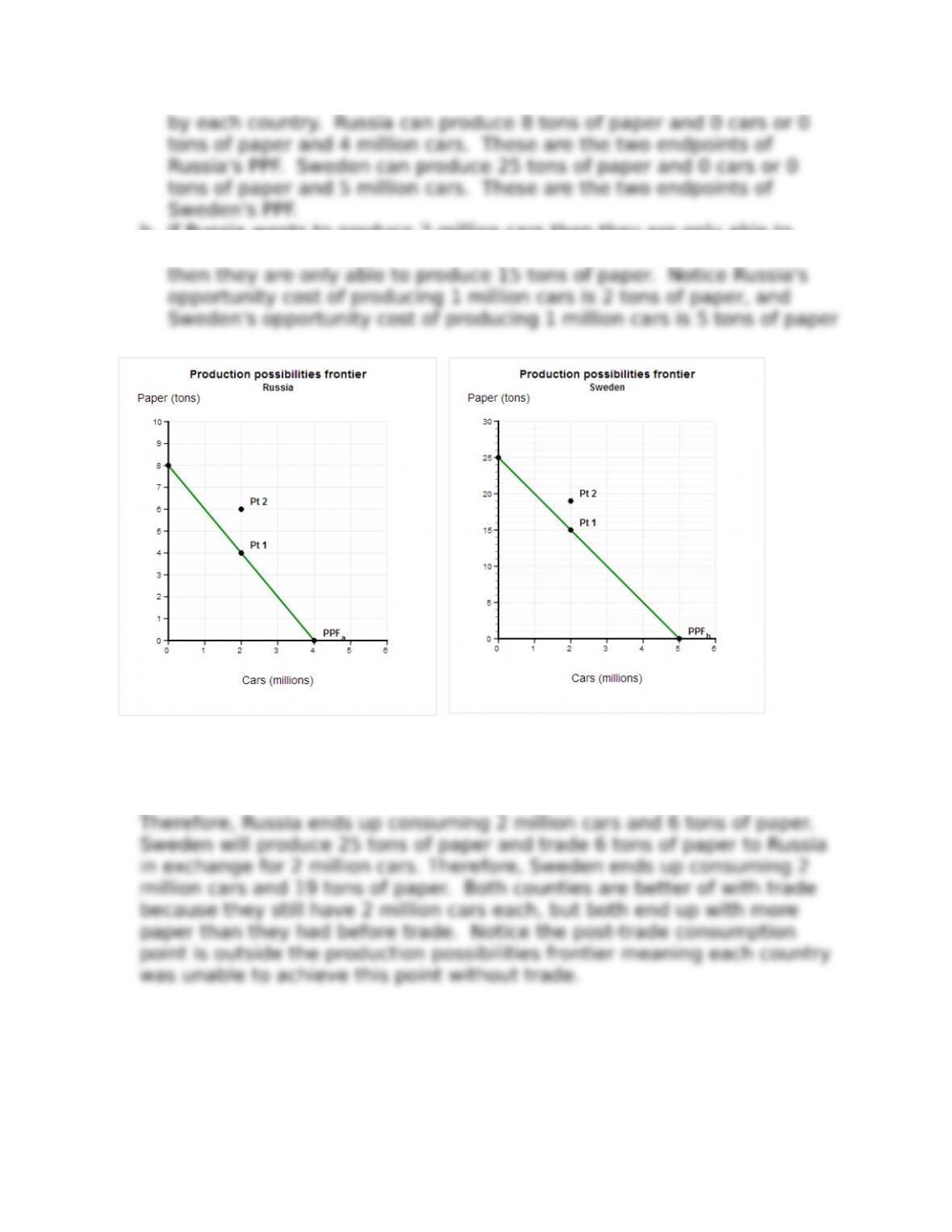
15. Suppose Russia and Sweden each produces only paper and cars.
Russia can produce 8 tons of paper or 4 million cars each year. Sweden can
produce 25 tons of paper or 5 million cars each year. [LO 2.4]
a. Draw the production possibilities frontier for each country.
b. Both countries want 2 million cars each year and as much paper as they
can produce along with 2 million cars. Find this point on each production
possibilities frontier and label it “A.”
c. Suppose the countries specialize. Which country will produce cars?
d. Once they specialize, suppose they work out a trade of 2 million cars for 6
tons of paper. Find the new consumption point for each country and label it
“B.”
Answer:
a. The production possibilities frontier identi6es the diDerent
2-5
Copyright © 2018 McGraw-Hill Education. All rights reserved. No reproduction or distribution without the prior written consent of McGraw-Hill
Education.
Chapter 02 – Specialization and Exchange
b. If Russia wants to produce 2 million cars then they are only able to
produce 4 tons of paper. If Sweden wants to produce 2 million cars
c. Russia will produce cars because Russia has a lower opportunity cost
for producing cars than Sweden.
d. Russia will produce 4 million cars (complete specialization is assumed)
and trade 2 million cars to Sweden in exchange for 6 tons of paper.
16. Maya and Max are neighbors. They both grow lettuce and tomatoes in
their gardens. Maya can grow 45 heads of lettuce or 9 pounds of tomatoes
this summer. Max can grow 42 heads of lettuce or 6 pounds of tomatoes this
summer. If Maya and Max specialize and trade, the price of tomatoes (in
2-6
Copyright © 2018 McGraw-Hill Education. All rights reserved. No reproduction or distribution without the prior written consent of McGraw-Hill
Education.
Chapter 02 – Specialization and Exchange
terms of lettuce) would be as follows: 1 pound of tomatoes would cost
between __ and __ heads of lettuce.
Answer: If Maya and Max specialize and trade, the price of tomatoes (in
terms of lettuce) would be: 1 pound of tomatoes would cost between 5
and 7 heads of lettuce. Maya will grow tomatoes because she has the
2-7
Copyright © 2018 McGraw-Hill Education. All rights reserved. No reproduction or distribution without the prior written consent of McGraw-Hill
Education.