
Chapter 02 – Specialization and Exchange
CHAPTER 2
SPECIALIZATION AND EXCHANGE
Chapter Overview
Specialization and trade can make everyone better off. It is not surprising,
then, that in an economy driven by individuals seeking to make a profit or
improve their communities, people specialize so as to exploit their
comparative advantages. That principle is as true for countries, like the
United States and Bangladesh, as it is for individuals picking their careers.
No government intervention is required to coordinate production. The great
economic thinker Adam Smith suggested the term invisible hand to describe
this coordinating mechanism:
It is not from the benevolence of the butcher, the brewer, or the baker that
we expect our dinner, but from their regard to their [self-interest]. . . . he
intends only his own gain, and he is in this, as in many other cases, led by an
invisible hand to promote an end which was no part of his intention.
The functioning of the invisible hand depends on a lot of other assumptions,
such as free competition and full information. Later in the book we will
discuss these assumptions, and when they work and when they do not.
Most people take for granted the prevalence of specialization and trade in
their everyday lives. Few stop to think about the benefits and where they
come from. In this chapter we tried to dig down to the bottom of the
assumptions people make and expose the logic behind the gains from trade.
As we proceed—especially when we return to topics like international trade
and government intervention in the markets—try to remember the
underlying incentive that drives people to interact with one another in
economic exchanges.
Learning Objectives
LO 2.1: Construct a production possibilities graph and describe what causes
shifts in production possibilities curves.
LO 2.2: Define absolute and comparative advantage.
LO 2.3: Explain why people specialize.
LO 2.4: Explain how the gains from trade follow from comparative
advantage.
Chapter Outline
2-1
Copyright © 2018 McGraw-Hill Education. All rights reserved. No reproduction or distribution without the prior written consent of McGraw-Hill
Education.

Chapter 02 – Specialization and Exchange
OPENING STORY: THE ORIGINS OF A T-SHIRT
Production Possibilities (LO 2.1)
Drawing the Production Possibilities Frontier
Choosing Among Production Possibilities
Shifting the Production Possibilities Frontier
Absolute and Comparative Advantage
Absolute Advantage (LO 2.2)
Comparative Advantage
BOX FEATURE: FROM ANOTHER ANGLE – BABE RUTH, STAR PITCHER
Why Trade?
Specialization (LO 2.3)
BOX FEATURE: REAL LIFE – SPECIALIZATION SAUCE
Gains from Trade (LO 2.4)
BOX FEATURE: WHAT DO YOU THINK? – IS SELF-SUFFICIENCY A VIRTUE?
Comparative Advantage over Time
BOX FEATURE: REAL LIFE – COMPARATIVE ADVANTAGE: THE GOOD, THE BAD,
AND THE UGLY
Beyond the Lecture
Class Discussion: Production Possibilities (LO 2.1)
In order to highlight the concept of the production possibilities curve, have
students consider the production possibilities curve for a student deciding
how to study for two exams given a fixed timeframe. This helps to highlight
the concept of tradeoffs for students, as you can ask them to consider the
tradeoff between grades on the two exams. Assume that the students have a
fixed number of hours in one evening to study for two large exams the
following day.
1. What tradeoffs does a student face when deciding how to spend his or
her time?
2. What factors should the student consider when making the decision
regarding how to study?
3. Why might different students make different decisions regarding how
to spend the hours studying?
Class Discussion: Absolute and Comparative Advantage (LO 2.2)
You can show the following clip during class from the TV show Suits. (Please
note that there is a small bit of language in the clip that some may find
objectionable). The page itself has some commentary on absolute and
comparative advantage. In short, the boss does all the work overnight
(showing his absolute advantage).
1. If the boss has the absolute advantage, why doesn’t he just do all the
work?
Writing Assignment: Specialization (LO 2.3)
2-2
Copyright © 2018 McGraw-Hill Education. All rights reserved. No reproduction or distribution without the prior written consent of McGraw-Hill
Education.

Chapter 02 – Specialization and Exchange
Have students read (or listen to the audio book for) I, Pencil by Leonard E.
Read. Ask students to write a brief essay on why no single individual can
personally produce even a seemingly simple product like a pencil.
Class Activity: Gains from Trade (LO 2.4)
A simple trading exercise can highlight the concept of gains from trade for
students. Bring a few bags of chips or other snacks to class and distribute
them to students (you may choose only a few students for this activity in a
large lecture).
1. Ask each student to rate their satisfaction with the snack you’ve given
them on a scale from 1-10, with 1 being highly dissatisfied and ten
being highly satisfied. Record their answers somewhere where all
students can see.
2. Ask the students if they want to trade, and give them a few minutes to
interact and exchange snacks. (Remind them that it must be voluntary
—they do not have to trade if they do not wish to.)
3. Ask the students about their satisfaction again, this time with their new
snack. Have the students explain any changes in their answer from
before.
After trading, students should be at the very least equally as well off in terms
of satisfaction as the first time they answered. This exercise can be used to
highlight the gains from trade. You can also discuss the fact that the original
distribution matters as well. This can tie into a number of discussions,
including income distribution and comparative advantage.
Clicker Questions
There are three main purposes to clicker questions. First, they are a great
way to do a quick and instant “on demand” test of student understanding of
the material. You can cover material, and instantly get feedback on student
comprehension. You can see whether you need to explain certain topics
again, or move on to the next subject. Second, they are a great method to
break up the class and take a moment away from lecture. It gets the
students actively involved. Finally, certain clicker questions can be framed in
a “discussion” manner, in which you can invite students to talk about the
possible right answer with their peers. You can instruct students to convince
their classmate of a right or wrong answer.
1. A movement along the production possibilities frontier would imply that
[LO 2.1]
A. firms have more labor to produce goods
2-3
Copyright © 2018 McGraw-Hill Education. All rights reserved. No reproduction or distribution without the prior written consent of McGraw-Hill
Education.
Chapter 02 – Specialization and Exchange
2. Which of the following could cause an outward shift of the production
possibilities curve? [LO 2.1]
A. a decrease in productivity
Feedback: Price increases won’t shift the PPF. Remember that the PPF
simply shows what we CAN produce, not necessarily what we would WANT to
produce. If a good has a higher price, that doesn’t automatically give us
more capabilities to produce it!
3. The production possibilities frontier model illustrates which economic
concept(s)? [LO 2.1]
A. scarcity
4. Gains from trade depend on [LO 2.4]
A. absolute advantage
Feedback: Trade can occur even if one person (or country) has the absolute
advantage in all goods. The gains come from comparative advantage, where
we take advantage of the lowest opportunity costs.
5. The United States has a lot of land. Japan has very little land area
compared to the United States. Compared to Japan, what output do you
think the United States would most likely have an absolute and comparative
advantage in producing? [LO 2.4]
D. clothing
2-4
Copyright © 2018 McGraw-Hill Education. All rights reserved. No reproduction or distribution without the prior written consent of McGraw-Hill
Education.
Chapter 02 – Specialization and Exchange
Solutions to End-of-Chapter Questions and Problems
Review Questions
1. You’ve been put in charge of a bake sale for a local charity, at which you
are planning to sell cookies and cupcakes. What would a production
possibilities graph of this situation show? [LO 2.1]
Answer: On one axis, the production possibilities graph would show the
total number of cookies you could bake if you spent all of your time and
resources baking cookies. The other axis would show the total amount of
cupcakes you could bake if you spent all of your time and resources
2. You manage two employees at a pet salon. Your employees perform two
tasks, giving Mea baths and grooming animals. If you constructed a single
production possibilities frontier for Mea baths and grooming that combined
both of your employees’ work efforts, would you expect the production
possibilities frontier to be linear (a straight line)? Explain why or why not.
[LO 2.1]
Answer: You would not expect a production possibilities frontier that
combined both of your employees’ work efforts to be linear. Each worker
3. You and another volunteer are in charge of a bake sale for a local charity,
at which you are planning to sell cookies and cupcakes. What would it mean
for one of you to have an absolute advantage at baking cookies or cupcakes?
Could one of you have an absolute advantage at baking both items? [LO
2.2]
Answer: If you have an absolute advantage in the production of cupcakes
(or cookies), it means that you can produce more cupcakes (or cookies) in
2-5
Copyright © 2018 McGraw-Hill Education. All rights reserved. No reproduction or distribution without the prior written consent of McGraw-Hill
Education.
Chapter 02 – Specialization and Exchange
4. You and another volunteer are in charge of a bake sale for a local charity,
at which you are planning to sell cookies and cupcakes. What would it mean
for you or the other volunteer to have a comparative advantage at baking
cookies or cupcakes? Could one of you have a comparative advantage at
baking both items? [LO 2.2]
Answer: If you had a comparative advantage in baking cookies, it would
mean that you have a lower opportunity cost (you give up fewer cupcakes
5. You and another volunteer are in charge of a bake sale for a local charity,
at which you are planning to sell cookies and cupcakes. Suppose you have a
comparative advantage at baking cookies, and the other volunteer has a
comparative advantage at baking cupcakes. Make a proposal to the
volunteer about how to split up the baking. Explain how you can both gain
from specializing, and why. [LO 2.3]
Answer: If you have a comparative advantage in baking cookies and the
other volunteer has a comparative advantage in baking cupcakes, then
6. At the Mower shop, where you manage two employees, your employees
perform two tasks: caring for the displays of cut Mowers and making Mower
arrangements to fill customer orders. Explain how you would approach
organizing your employees and assigning them tasks. [LO 2.3]
Answer: You would have your employees specialize in the task for which
they have the lowest opportunity cost. The worker who has the lower
opportunity cost of caring for the displays should switch to filling
2-6
Copyright © 2018 McGraw-Hill Education. All rights reserved. No reproduction or distribution without the prior written consent of McGraw-Hill
Education.
Chapter 02 – Specialization and Exchange
7. Suppose two countries produce the same two goods and have identical
production possibilities frontiers. Do you expect these countries to trade?
Explain why or why not. [LO 2.4]
Answer: We would not expect countries with the same production
possibilities frontiers to trade. Identical production possibilities frontiers
8. Brazil is the largest coffee producer in the world, and coffee is one of
Brazil’s major export goods. Suppose that in 20 years, Brazil no longer
produces much coffee and imports most of its coffee instead. Explain why
Brazil might change its trade pattern over time. [LO 2.4]
Answer: Brazil would change from exporting to importing coffee if its
comparative advantage changes. Over time, Brazil could lose its
Problems and Applications
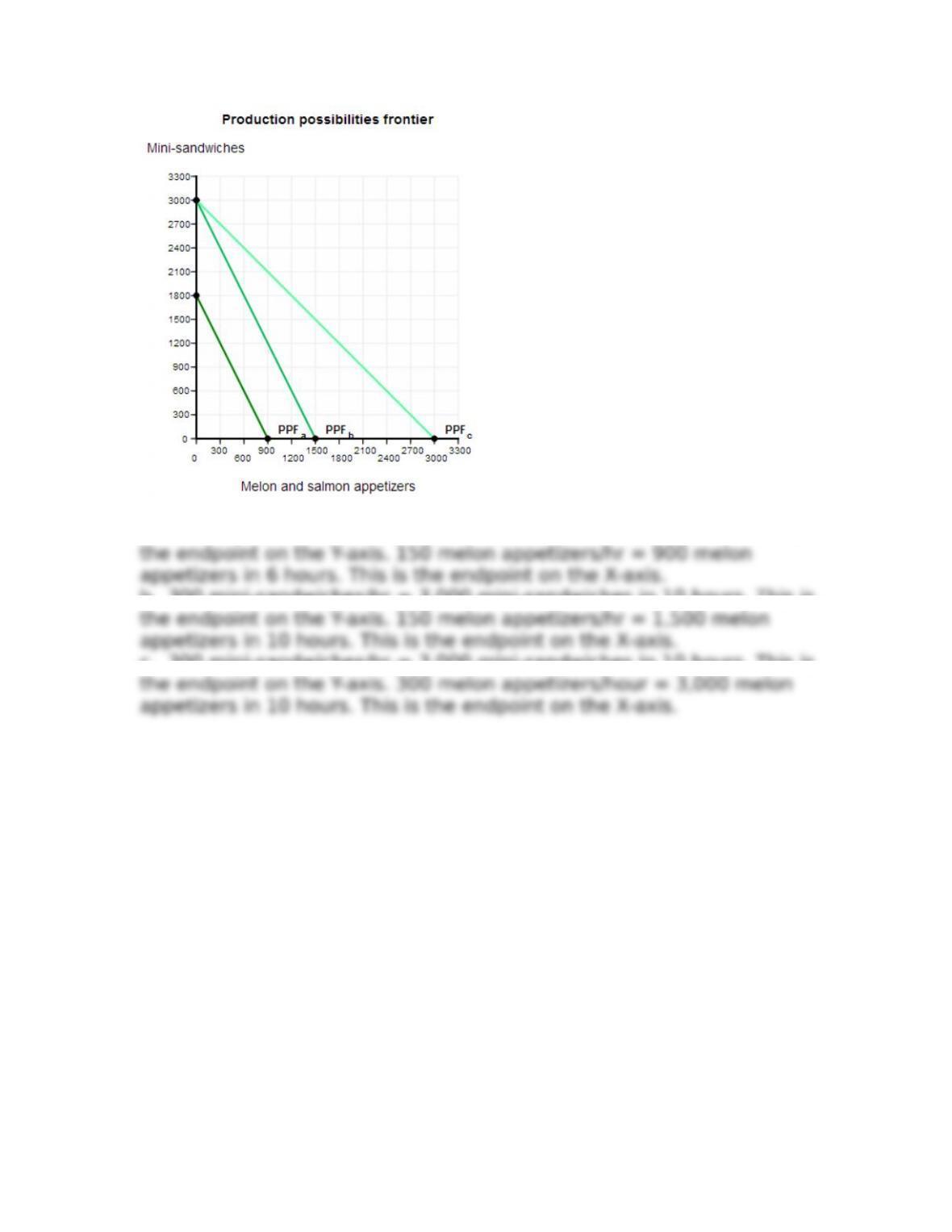
1. Your friend Sam has been asked to prepare appetizers for a university
reception during homecoming weekend. She has an unlimited amount of
ingredients but only six hours to prepare them. Sam can make 300 mini-
sandwiches or 150 servings of melon slices topped with smoked salmon and
a dab of sauce per hour. [LO 2.1]
a. Draw Sam’s production possibilities frontier.
b. Now suppose that the university decides to postpone the reception until
after the big game, so Sam has an extra four hours to prepare. Redraw her
production possibilities frontier to show the impact of this increase in
resources.
c. Now, in addition to the extra time to prepare, suppose Sam’s friend Chris
helps by preparing the melon slices. Sam can now make 300 mini-
sandwiches or 300 melon appetizers per hour. Redraw Sam’s production
possibilities frontier to show the impact of increased productivity in making
melon appetizers.
Answer:
2-7
Copyright © 2018 McGraw-Hill Education. All rights reserved. No reproduction or distribution without the prior written consent of McGraw-Hill
Education.
Chapter 02 – Specialization and Exchange
a. 300 mini-sandwiches/hr = 1,800 mini-sandwiches in 6 hours. This is
b. 300 mini-sandwiches/hr = 3,000 mini-sandwiches in 10 hours. This is
c. 300 mini-sandwiches/hr = 3,000 mini-sandwiches in 10 hours. This is
2. Your friend Sam has been asked to prepare appetizers for the university
reception. She has an unlimited amount of ingredients and six hours in which
to prepare them. Sam can make 300 mini-sandwiches or 150 servings of
melon slices topped with smoked salmon and a dab of sauce per hour. [LO
2.1]
a. What is Sam’s opportunity cost of making one mini-sandwich?
b. What is Sam’s opportunity cost of making one melon appetizer?
c. Suppose the reception has been postponed, so Sam has an extra four
hours to prepare. What is the opportunity cost of making one mini-sandwich
now?
d. Suppose the reception has been postponed, so Sam has an extra four
hours to prepare. What is the opportunity cost of making one melon
appetizer now?
e. Suppose Sam’s friend Chris helps by preparing the melon slices,
increasing Sam’s productivity to 300 mini-sandwiches or 300 melon
appetizers per hour. What is the opportunity cost of making one mini-
sandwich now?
2-8
Copyright © 2018 McGraw-Hill Education. All rights reserved. No reproduction or distribution without the prior written consent of McGraw-Hill
Education.
Chapter 02 – Specialization and Exchange
f. Suppose Sam’s friend Chris helps by pre-paring the melon slices,
increasing Sam’s productivity to 300 mini-sandwiches or 300 melon
appetizers per hour. What is the opportunity cost of making one melon
appetizer now?
Answer: The opportunity cost is the value of what you have to give up in
order to get something. It is the value of your next-best alternative.
a. To make 1 more mini-sandwich you have to give up 1/2 melon
appetizer.
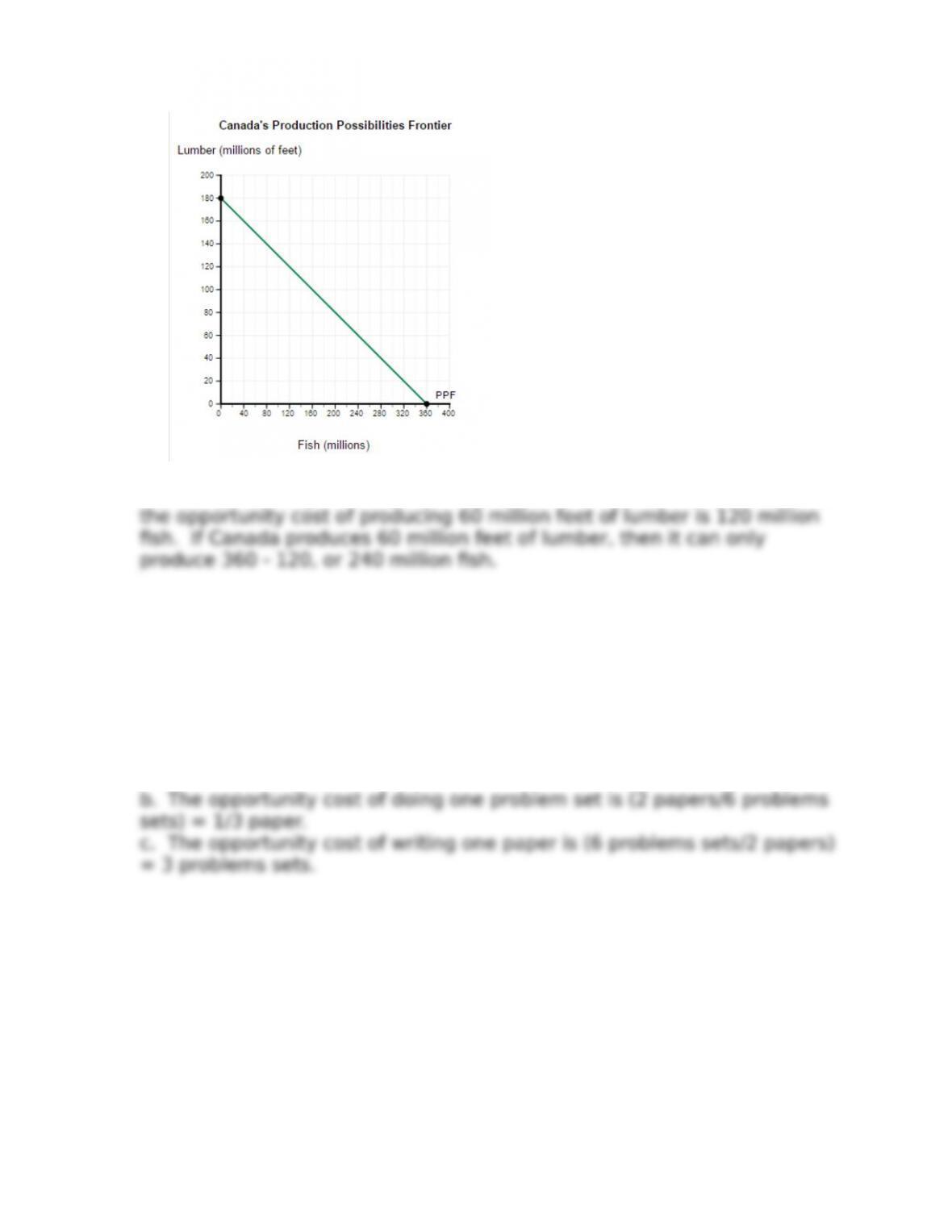
3. Suppose that Canada produces two goods: lumber and fish. It has 18
million workers, each of whom can cut 10 feet of lumber or catch 20 fish
each day. [LO 2.1]
a. What is the maximum amount of lumber Canada could produce in a day?
b. What is the maximum amount of fish it could produce in a day?
c. Draw Canada’s production possibilities frontier.
d. Use your graph to determine how many fish can be caught if 60 million
feet of lumber are cut.
Answer:
a. The maximum amount of lumber Canada could produce in a day is 10
b. The maximum amount of fish Canada could produce in a day is 20 fish
c. The two endpoints of the PPF are (0,180) and (360,0).
2-9
Copyright © 2018 McGraw-Hill Education. All rights reserved. No reproduction or distribution without the prior written consent of McGraw-Hill
Education.
Chapter 02 – Specialization and Exchange
d. The opportunity cost of producing 1 foot of lumber is 2 fish. Therefore,
4. The graph in Figure 2P–1 shows Tanya’s weekly production possibilities
frontier for doing homework (writing papers and doing problem sets). [LO
2.1]
a. What is the slope of the production possibilities frontier?
b. What is the opportunity cost of doing one problem set?
c. What is the opportunity cost of writing one paper?
Answer:
a. The slope of the production possibilities frontier is -(6/2) = -3.
2-10
Copyright © 2018 McGraw-Hill Education. All rights reserved. No reproduction or distribution without the prior written consent of McGraw-Hill
Education.