
Chapter 18 – Externalities
CHAPTER 18
EXTERNALITIES
Chapter Overview
Typically, we rely on the invisible hand of markets to maximize total surplus
by allocating the right quantity of goods to the right people. But what
happens when one person’s choices impose costs or bene”ts on others?
Free-market outcomes can be less than ideal. They sometimes result in too
much or too little of the good or activity in question.
As the examples in this chapter show, positive or negative externalities (for
both production and consumption) are a common part of economic life.
They’re the context for discussions of issues like climate change, pollution,
blighted neighborhoods, and education policy. Sometimes, individuals can
“nd private solutions, by paying others to do (or to not do) things that affect
them. However, the di,culty of coordinating or enforcing these private
agreements often overwhelms the bene”ts.
In these cases, we’ve seen that government policies like taxes and subsidies
can actually increase e,ciency, even though we typically think of taxes as
creating distortions. This is because taxes and subsidies can counterbalance
an externality by forcing buyers or sellers to take into account the value of
the external cost or bene”t. At “rst glance, quotas look like a simple way to
counter the “too much” problem of negative externalities, but they fail to
maximize surplus unless people are allowed to buy and sell the quotas.
In the next chapter, we’ll examine other challenges that are closely related
to the idea of externalities. When goods are collectively owned, individuals
have limited incentive to take into account the impact of their actions on the
publicly held resources. As we are about to see, the resulting market failures
and corresponding policy solutions look very similar to those we’ve discussed
in this chapter.
Learning Objectives
LO 18.1 Explain how external costs and bene”ts affect the trade-o*s faced
by economic decision makers.
LO 18.2 Calculate the effect of a negative externality on market price
and quantity.
LO 18.3 Calculate the effect of a positive externality on market price
and quantity.
LO 18.4 Describe how individuals could reach a private solution to an
externality and explain why this doesn’t always occur.
18-1
Copyright © 2018 McGraw-Hill Education. All rights reserved. No reproduction or distribution without the prior written consent of McGraw-Hill
Education.

Chapter 18 – Externalities
LO 18.5 Show how a tax or subsidy can be used to counteract an externality
and discuss the pros and cons of such solutions.
LO 18.6 Show how quantity regulations and tradable allowances can be used
to counteract an externality, and discuss the pros and cons of such solutions.
Chapter Outline
THE COSTS OF CAR CULTURE
What Are Externalities?
External Costs and Bene”ts (LO 18.1)
Negative Externalities and the Problem of “Too Much” (LO 18.2)
Positive Externalities and the Problem of “Too Little” (LO 18.3)
Private Solutions to Externalities (LO 18.4)
BOX FEATURE: WHAT DO YOU THINK? – RECLINING TRANSACTIONS
BOX FEATURE: FROM ANOTHER ANGLE – DOES NO-FAULT DIVORCE LAW
INCREASE THE DIVORCE RATE?
Public Solutions to Externalities
Taxes and Subsidies (LO 18.5)
Other Policy Options: Quotas and Tradable Allowances (LO 18.6)
BOX FEATURE: REAL LIFE – THE FIGHT OVER CAP-AND-TRADE LEGISLATION
Targeting Externalities with Public Policy
Beyond the Lecture
Class Media: External Costs and benefit (LO 18.1)
Have students view this brief clip from the TV show The Colbert Report. In
the clip, Colbert discusses the environmentally-friendly Sun Chips bags that
were discontinued due to “noise pollution.” At the end of the clip, he
discusses noise from wind turbines. This is a great introduction to negative
externalities. Bonus second clip to show involving dust pollution created by
goats.
Class Discussion: Negative Externalities (LO 18.2)
Show students this brief clip from the TV show Seinfeld, from the Season 8
episode “The Chicken Roaster.” In the episode, Kramer is bothered by light
from a local restaurant.
1. Does a resident have a right to darkness, or does a restaurant have the
right to display a bright light?
2. How are disputes like these resolved?
3. How do negative externalities impact price and quantity?
Class Discussion: Negative Externalities and Sriracha (LO 18.2)
Show students the following two articles from October 2013 and May 2014
about a Sriracha hot sauce factory.
1. How was the factory creating a negative externality?
2. How did the factory “x the negative externality?
18-2
Copyright © 2018 McGraw-Hill Education. All rights reserved. No reproduction or distribution without the prior written consent of McGraw-Hill
Education.
Chapter 18 – Externalities
3. Why would a city allow a “rm to operate if it creates a negative
externality?
Class Activity: Tradable Allowances (LO 18.7)
Consider conducting this class activity designed by Jill Caviglia-Harris and
Richard Melstrom about tradable pollution permits.
Clicker Questions
There are three main purposes to clicker questions. First, they are a great
way to do a quick and instant “on demand” test of student understanding of
the material. You can cover material, and instantly get feedback on student
comprehension. You can see whether you need to explain certain topics
again, or move on to the next subject. Second, they are a great method to
break up the class and take a moment away from lecture. It gets the
students actively involved. Finally, certain clicker questions can be framed in
a “discussion” manner, in which you can invite students to talk about the
possible right answer with their peers. You can instruct students to convince
their classmate of a right or wrong answer.
1. Raising your hand and asking a question during class creates a ___________
externality because the social _______ are greater than the private. [LO
18.1]
A. negative, costs
Feedback: The individual gets the bene”t of her question answered, but the
rest of the class learns something too.
2. When a negative externality remains uncorrected, we effectively
have_________. [LO 18.2]
D. Non-existent social costs
3. How does the issue of negatives externalities and “too much” result in
deadweight loss? [LO 18.2]
A. The market forces people to consume goods that hurt them
18-3
Copyright © 2018 McGraw-Hill Education. All rights reserved. No reproduction or distribution without the prior written consent of McGraw-Hill
Education.
Chapter 18 – Externalities
Feedback: We often think of DWL as a result of stopping short on
production and losing possible gains from trade. However, consuming past
the point of MB = MC means we have MC > MB, which causes ine,ciency as
well.
4. John values his afternoon nap at $50. He pays his neighbor $10 to mow
her yard early in the morning instead of the afternoon. This is an example of
_________. [LO 18.4]
A. A Pigovian tax
Feedback: Notice that he had to pay her less than his valuation, she must
value $10 more than afternoon mowing.
5. One method to correct a positive externality is through government
intervention in which people are simply legally required to consume the
good. An example of this is______. [LO 18.5, 18.6]
A. seasonal Ou shots
Feedback: In the United States, children must attend school until the age of
16.
Solutions to End-of-Chapter Questions and Problems
Review Questions
1. Describe an externality not listed in the chapter. Is it positive or negative?
Who is the economic decision maker, and who bears the external cost or
bene”t? [LO 18.1]
Answer: Having a loud party in your apartment will create an externality
because the noise will affect your neighbors. Some neighbors may see
2. Consider the decision to adopt a dog. Describe a private cost, a private
bene”t, an external cost, and an external bene”t that might result from your
decision to adopt a dog. [LO 18.1]
18-4
Copyright © 2018 McGraw-Hill Education. All rights reserved. No reproduction or distribution without the prior written consent of McGraw-Hill
Education.
Chapter 18 – Externalities
Answer: A private cost of adopting a dog could be the adoption fees or
food for the dog. A private bene”t is the enjoyment you get from your
new companion. An external cost could be that your dog barks a lot and
this annoys your neighbors. An external bene”t could be that your barking
dog discourages intruders and trespassers from your neighbors’ property
as well as yours.
3. What are the private costs and bene”ts associated with smoking
cigarettes? What are the external costs? If smokers paid the social cost of
cigarettes, what would happen to the quantity demanded? [LO 18.2]
Answer: The private costs to cigarette smoking include the price of the
cigarettes and damage to the smoker’s lungs. Private bene”ts include the
pleasure of smoking and any desirable effects from nicotine. The external
costs include the smell and the negative e*ects of second-hand smoke. If
smokers paid the social cost of cigarettes, the quantity demanded for
cigarettes would decrease to reOect that smokers had internalized the
external cost.
4. When U.S. farmers in the Southwest irrigate their land, salt in the ground
soil leaks into the Colorado River. The Colorado River has become so salty
that Mexican farmers further down the river cannot irrigate their own land,
and Mexican crops have su*ered. Explain why this situation constitutes a
negative production externality, how it leads to too much irrigation, and what
it would mean for U.S. farmers to face the externality. [LO 18.2]
Answer: U.S. farmers are not considering the external costs of irrigation,
only their private costs. When there are relevant costs not taken into
5. If education has private bene”ts to an individual as well as external
bene”ts to society, explain why a less-than-optimal amount of education
occurs. [LO 18.3]
Answer: People take into account only their own costs and bene”ts of
education when they decide how much to obtain. An individual will obtain
18-5
Copyright © 2018 McGraw-Hill Education. All rights reserved. No reproduction or distribution without the prior written consent of McGraw-Hill
Education.
Chapter 18 – Externalities
6. Hand washing has external health bene”ts, helping prevent the spread of
communicable diseases. If a program were somehow devised so that people
got paid a small reward every time they washed their hands, how would it
affect the number of people who are sick at any given time? [LO 18.3]
Answer: If a program were somehow devised so that people got paid a
7. Jimi loves turning up his electric guitar amp all the way, but his next-door
neighbor hates listening to him. How might Jimi and his neighbor reach a
private solution to their problem? Describe potential problems that might
make it hard for a private solution to occur. [LO 18.4]
Answer: One way Jimi and his neighbor could work out a private solution
is if the neighbor offer to pay Jimi to keep the noise down. This solution
8. Felix and Oscar are roommates. Oscar is messy, and Felix is planning to
move out unless they can come to an agreement. For the roommates to
reach a private solution, does it matter whether Oscar compensates Felix for
being messy or Felix pays Oscar to clean up? [LO 18.4]
Answer: It does not matter whether Oscar compensates Felix for being
9. Suppose that you are an economic-policy advisor. Environmental groups
are pressuring you to implement the highest-possible carbon tax, while
industry groups are pressuring you to implement no carbon tax at all. Both
argue that their position makes more sense economically. Explain to them
what the most-e,cient tax level will be and why there are costs to setting
the tax too high or too low. [LO 18.5]
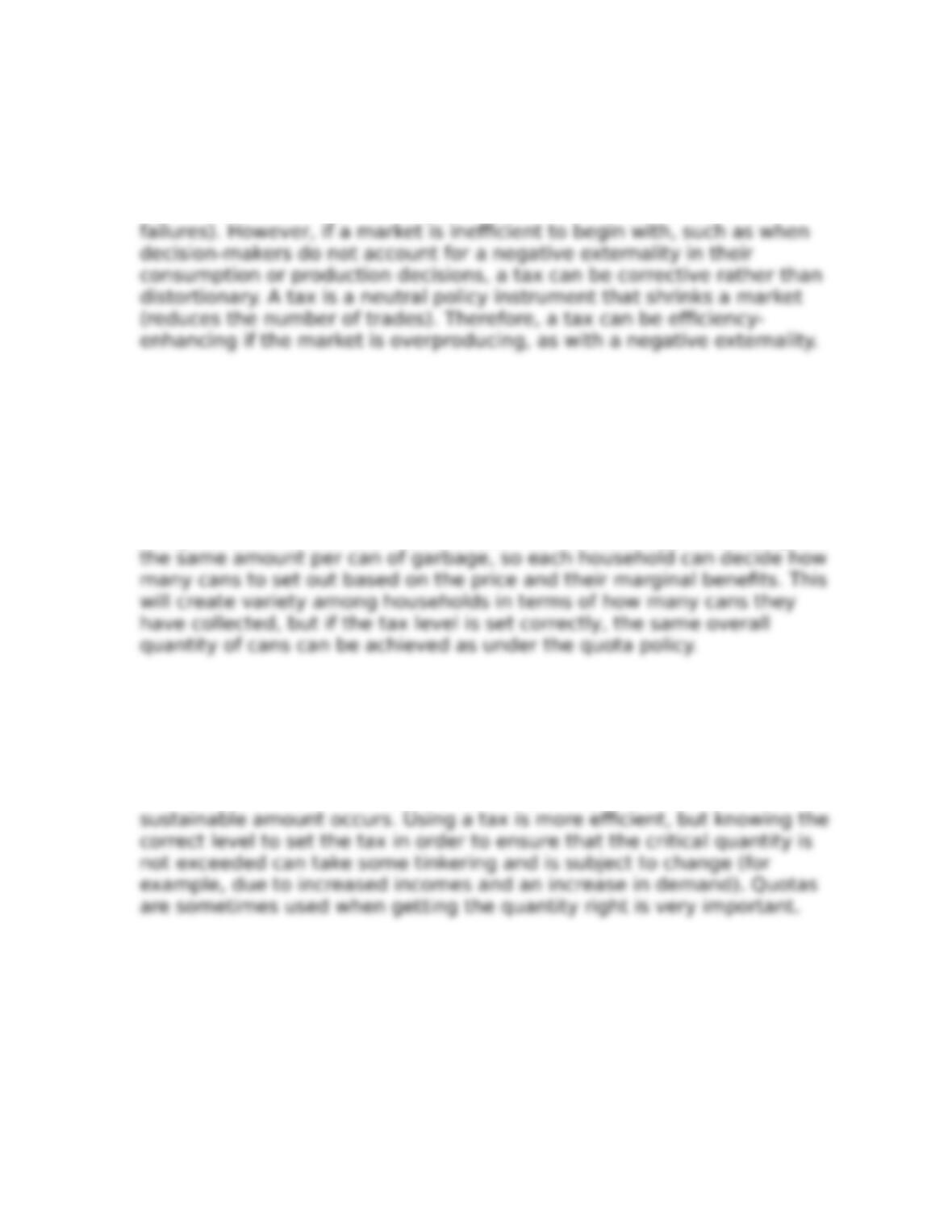
Answer: Both positions would lead to ine,ciency. No tax at all would
mean that industry groups would continue to overproduce by not
18-6
Copyright © 2018 McGraw-Hill Education. All rights reserved. No reproduction or distribution without the prior written consent of McGraw-Hill
Education.
Chapter 18 – Externalities
10. In what circumstances will a tax make a market less e,cient? In what
circumstances will a tax make a market more e,cient? [LO 18.5]
Answer: A tax will be distortionary and create a deadweight loss if the
market is functioning e,ciently (there are no externalities or other market
11. The city of Seattle limits each household to one can of free garbage
collection per week. There are fees for any extra garbage collected from the
curb. Is this policy the most e,cient way of reducing waste? Why or why
not? [LO 18.6]
Answer: A quota is not the most e,cient policy, because allowing
everyone the same quantity does not account for the di*erences in
marginal bene”ts between households. With a tax, everyone is charged
12. Suppose an environmental impact study shows that the coral reef near
Port Douglas, Australia, can sustain 20 scuba diving tours per week. Explain
why a quota might have an advantage over a tax in this situation. [LO 18.6]
Answer: The bene”t of using a quota is that because the critical amount
of tours that the reef can sustain is known, the quota will ensure that the
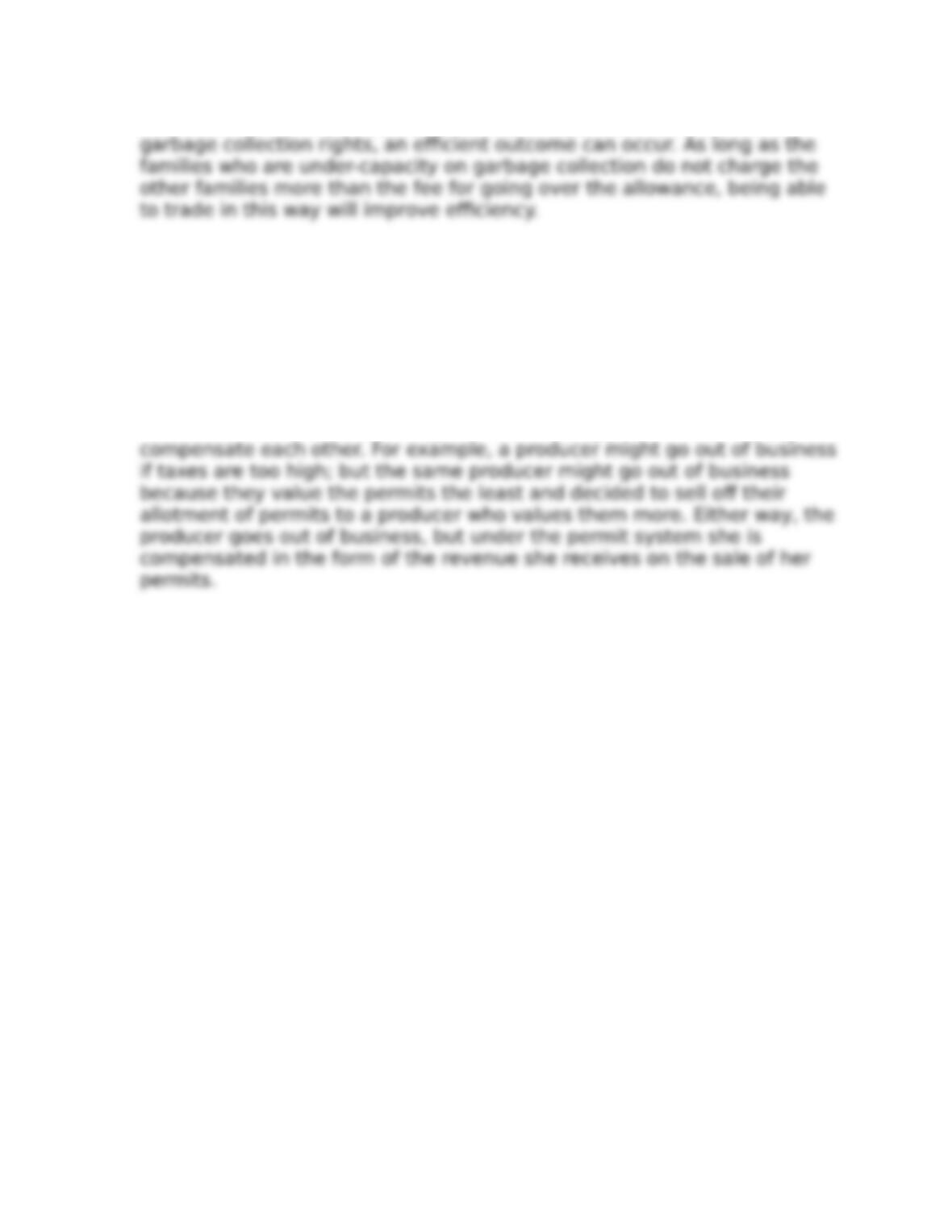
13. The city of Seattle limits each household to one can of free garbage
collection per week. There are fees for any extra garbage collected from the
curb. Sup-pose that a neighborhood group in Seattle organizes a group of
families so that those who plan to go over their one-can garbage quota can
“nd households that are under their quota and pay them to put out the extra
trash. Does this change the e,ciency of the policy? [LO 18.6]
18-7
Copyright © 2018 McGraw-Hill Education. All rights reserved. No reproduction or distribution without the prior written consent of McGraw-Hill
Education.
Chapter 18 – Externalities
Answer: Yes. If the families can trade or compensate each other for
14. Suppose the government is considering two policies to limit factory air
pollution: taxing all producers, or providing each producer with an allotment
of tradable permits. If both policies lead to the same amount of pollution
reduction, why might producers prefer the tradable-permit option? [LO
18.6]
Answer: Producers might prefer the tradable permit option because
rather than extracting money from the industry in the forms of tax
revenues, the tradable permit systems allows suppliers in the industry to
18-8
Copyright © 2018 McGraw-Hill Education. All rights reserved. No reproduction or distribution without the prior written consent of McGraw-Hill
Education.
Chapter 18 – Externalities
Problems and Applications
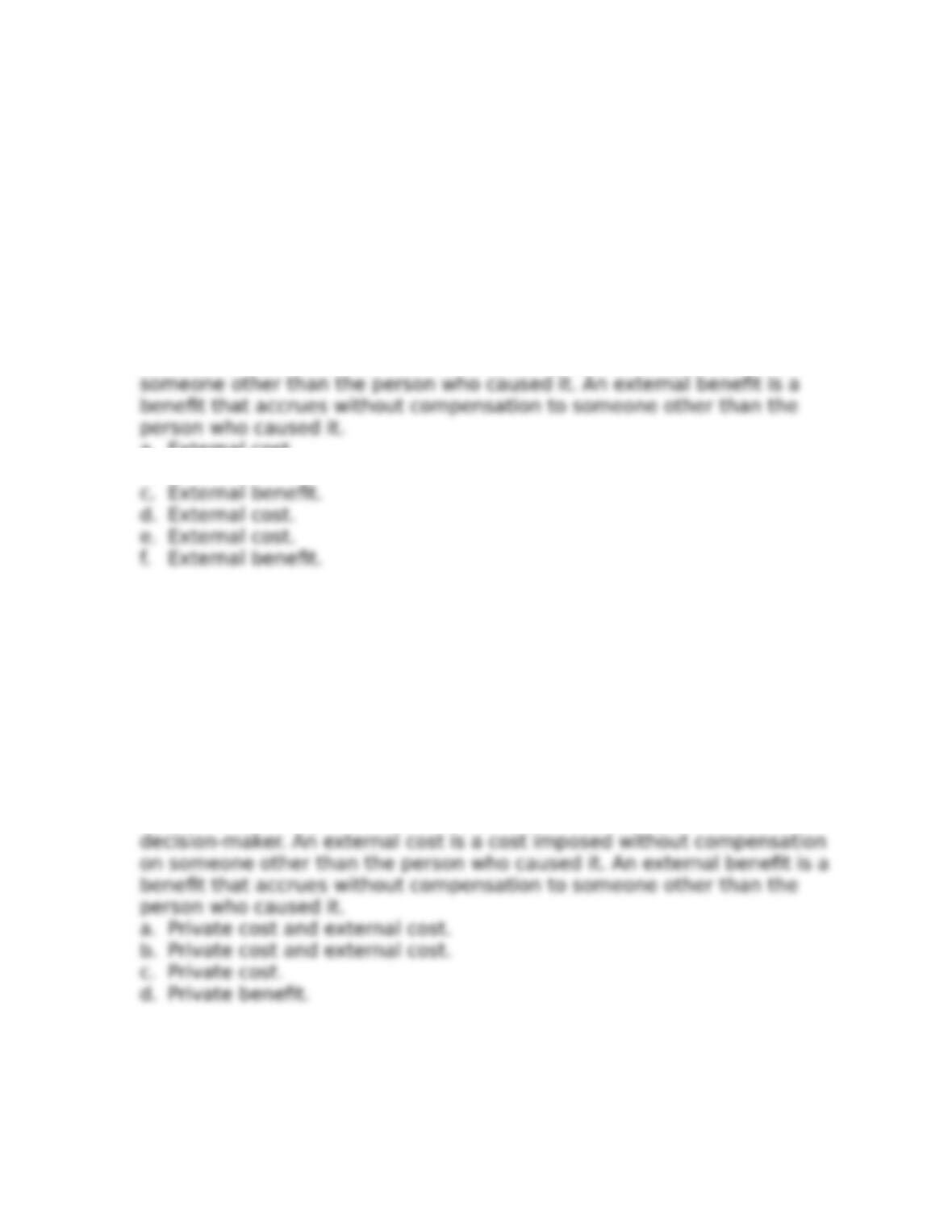
1. State whether each of the following primarily causes an external cost or
an external bene”t. [LO 18.1]
a. Fishing at a popular lakeside vacation spot.
b. Buying a fax machine.
c. Conducting research to “nd an AIDS vaccine.
d. Occupying a seat on a bench in a crowded park.
e. Littering.
f. Spaying or neutering your pet.
Answer: An external cost is a cost imposed without compensation on
a. External cost.
b. External bene”t.
2. You are considering whether to enter a holiday lights display contest that
pays $1,000 to the winner. State whether each of the following constitutes
private costs, private bene”ts, external costs, or external bene”ts. Check all
that apply. [LO 18.1]
a. Increased tra,c congestion.
b. Neighbor have di,culty parking on your street.
b. Increased electric bill from the holiday lights.
c. Winning the holiday lights display contest.
Answer: A private bene”t is a bene”t that accrues directly to the
decision-maker. A private cost is a cost that falls directly on an economic
18-9
Copyright © 2018 McGraw-Hill Education. All rights reserved. No reproduction or distribution without the prior written consent of McGraw-Hill
Education.