Chapter 17 – International Trade
1. If capital is domestically scarce in a country, do you expect owners of
capital in that country to be free-traders or protectionists? Why? [LO 17.7]
Answer: If capital is domestically scarce in a country, owners of capital in
2. Suppose Great Britain wants to take a stance on labor standards for
imports. The prime minister imposes a blanket standard that requires all
imports to meet certain labor standards. Who will benefit from this policy?
What are the drawbacks for Great Britain and countries that export to Great
Britain? [LO 17.8]
Answer: Domestic producers in Great Britain competing with imports
could benefit if they are already held to higher labor standards. Importing
countries will no longer have a cost advantage based on lower labor
3. Suppose the United States. imposes a trade embargo on North Korea in
order to exert political pressure on the government. Consider how the
embargo will a.ect U.S. producers. Under what conditions would they
support the embargo? Why might they oppose it? [LO 17.8]
Answer: U.S. producers will support the embargo if they are producing
goods for which North Korea has a comparative advantage and can
Problems and Applications
1. If a country has relatively abundant unskilled labor, with scarce land and
capital, it is more likely to have a comparative advantage in which of the
following industries? Check all that apply. [LO 17.1]
a. Food service.
b. Textiles.
c. Agriculture.
d. Financial services.
17-1
Copyright © 2018 McGraw-Hill Education. All rights reserved. No reproduction or distribution without the prior written consent of McGraw-Hill
Education.
Chapter 17 – International Trade
Answer: Since the country has relatively abundant unskilled labor, with
2. Suppose Ghana discovers it has lost its comparative advantage in the
production of maize. Which of the following could explain the loss of
comparative advantage? Check all that apply. [LO 17.1]
a. Maize-processing technology developed in Ghana spreads to other maize-
producing countries.
b. Decline in global demand for maize.
c. Immigration of cheap labor into Ghana.
d. Growth of low-skill service jobs in Ghana.
Answer: Maize processing technology developed in Ghana spreads to
3. Calculate the following values using Figure 17P-1, which shows domestic
supply and demand for steel in the United States under autarky. [LO 17.2]
a. What are the equilibrium price and quantity of steel under autarky?
b. Suppose the United States allows trade, and the post-trade domestic
quantity supplied is 150 million. What are the domestic quantity demanded
and the new world price?
c. Is the United States a net-exporter or net-importer of steel?
d. What quantity of steel is imported/exported?
Answer:
a. The equilibrium price of steel is $300 per ton and the equilibrium
b. If the post-trade domestic quantity supplied is 150 thousand tons, the
c. The domestic quantity supplied is less than the domestic quantity
d. Domestic quantity supplied is 150,000 tons and domestic quantity
4. Table 17P-1 shows the domestic supply and demand schedule for rice in
Thailand. [LO 17.2] a. In autarky, what are the domestic quantity supplied
and price?
b. The world price of rice is $1.25 per kilogram. If Thailand opens up to trade
in rice, what will be the new domestic price of rice? (Hint: You can assume
Thailand is a small producer of rice relative to the world market.)
c. What quantity of rice will be supplied by domestic producers?
17-2
Copyright © 2018 McGraw-Hill Education. All rights reserved. No reproduction or distribution without the prior written consent of McGraw-Hill
Education.
Chapter 17 – International Trade
d. What quantity of rice will be demanded by domestic consumers?
e. How much rice will Thailand import or export?
Answer:
a. In autarky, the domestic quantity supplied is 2,500 million kilograms,
b. If Thailand opens up to trade in rice and the world price is $1.25 per
consumers.
e. Thailand will export 2,800m – 2,350m = 450 million kilograms of rice.
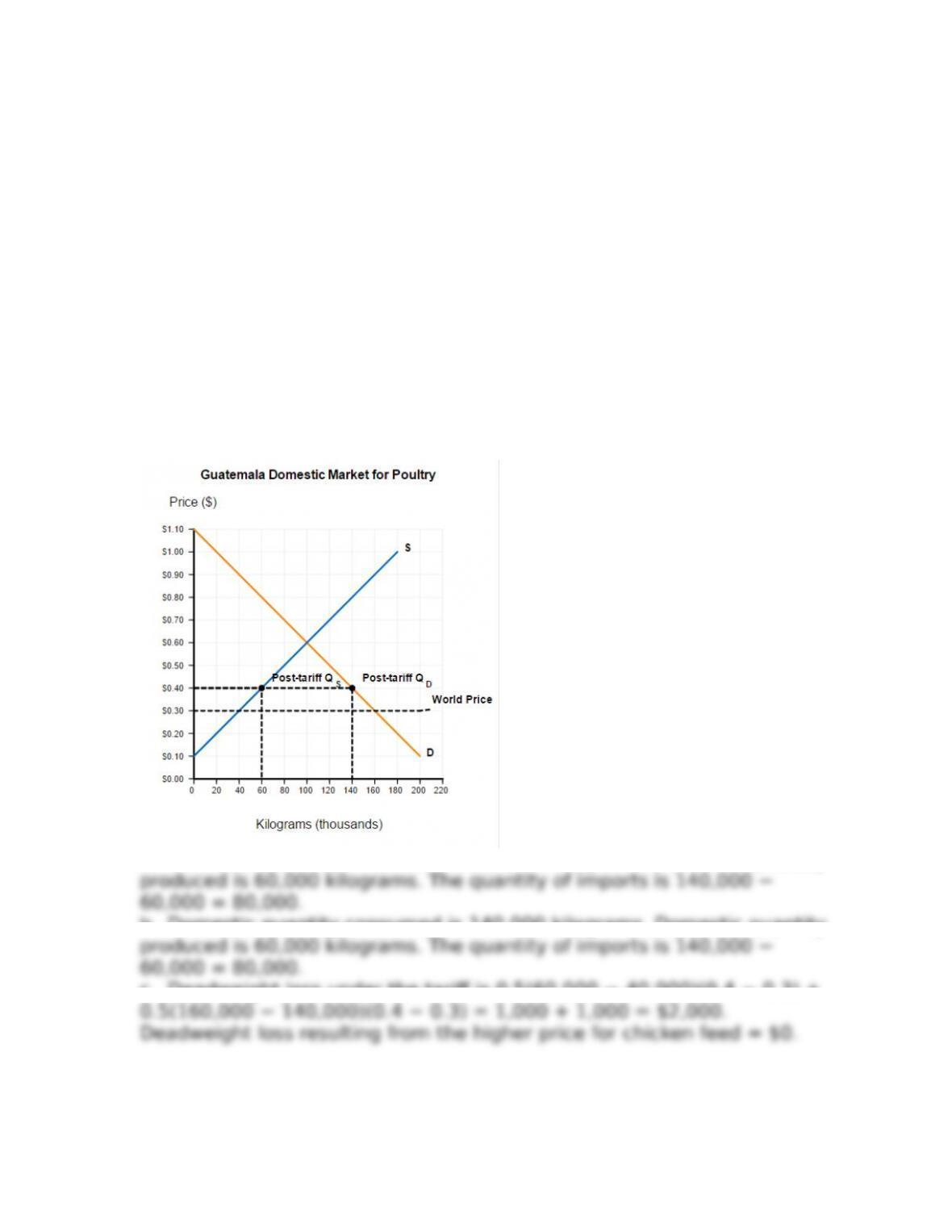
5. Guatemala represents a small part of the world poultry market. Based on
Figure 17P-2, answer the following. [LO 17.3]
a. Calculate producer and consumer surplus in autarky.
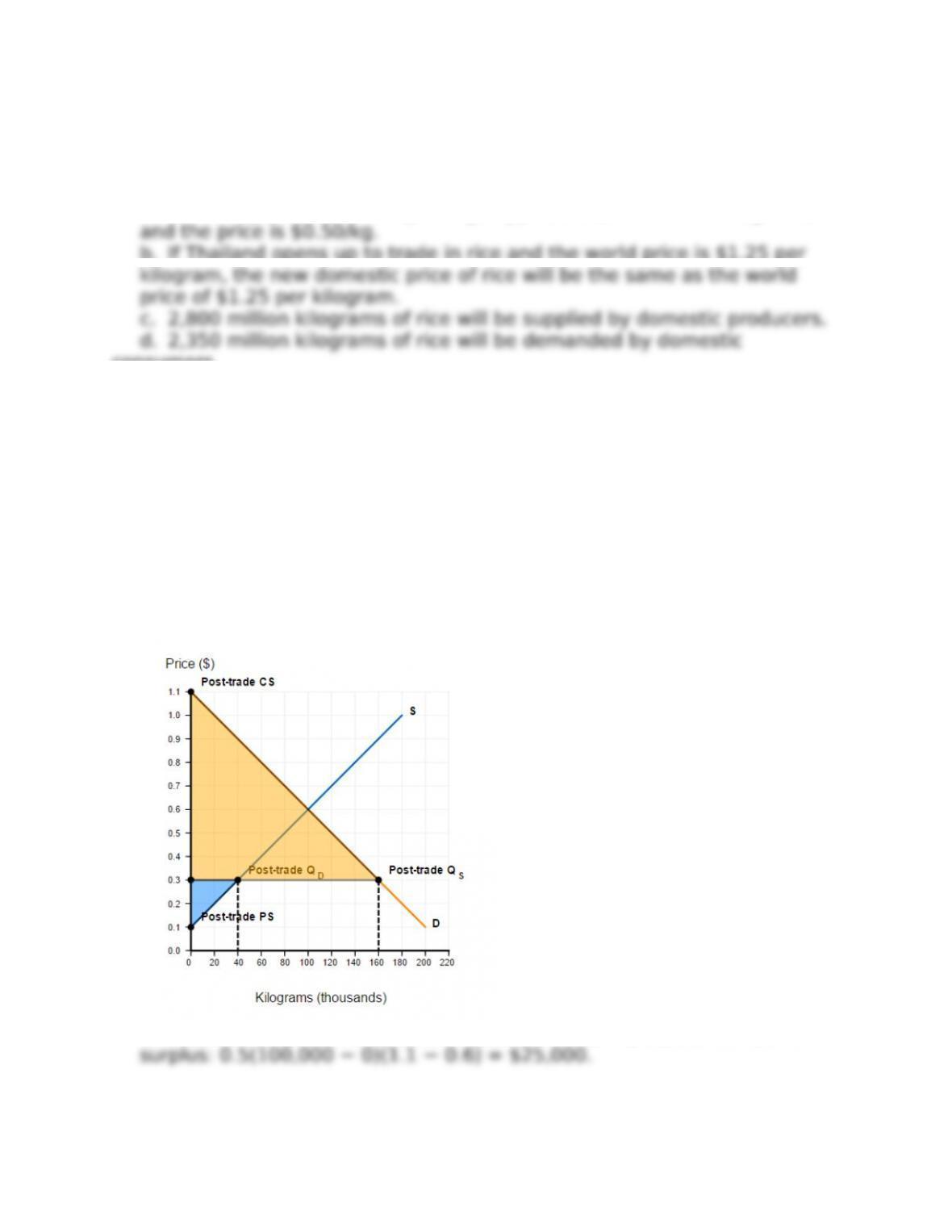
b. Assume that the world price of poultry is $0.30/kg. If Guatemala opens to
trade, what are the domestic quantity consumed and produced? Plot these
quantities on the graph. What is the quantity of imports?
c. Calculate the post-trade producer and consumer surplus, and plot these
areas on the graph. Who is better o. after trade: producers or consumers?
Answer:
a. Producer surplus: 0.5(100,000 − 0)(0.6 − 0.1) = $25,000. Consumer
17-3
Copyright © 2018 McGraw-Hill Education. All rights reserved. No reproduction or distribution without the prior written consent of McGraw-Hill
Education.
Chapter 17 – International Trade
b. Domestic quantity consumed is 160,000 kilograms. Domestic quantity
c. The post-trade consumer surplus is 0.5(160,000 − 0)(1.1 − 0.3) =
17-4
Copyright © 2018 McGraw-Hill Education. All rights reserved. No reproduction or distribution without the prior written consent of McGraw-Hill
Education.
Chapter 17 – International Trade
6. Guatemala represents a small part of the world poultry market, and is
fully open to trade. Assume the world price of poultry is $0.30/kg. Suppose a
$0.10/kg tari. is imposed on poultry imports. Based on Figure 17P-2, answer
the following questions. [LO 17.3, 17.4]
a. What are the quantity of poultry consumed and produced in Guatemala
under the tari.? Plot these quantities on the graph. What is the quantity of
imports?
b. Now suppose the tari. is eliminated and instead the world price of
chicken feed increases signiticantly. This causes the world price of poultry to
rise from $0.30/kg to $0.40kg. How much poultry is now bought and sold in
Guatemala? What is the quantity of imports?
c. Compare the eDciency of the two situations. Calculate the deadweight
loss under the tari.. Calculate the deadweight loss resulting from the higher
price of chicken feed.
Answer:
a. Domestic quantity consumed is 140,000 kilograms. Domestic quantity
b. Domestic quantity consumed is 140,000 kilograms. Domestic quantity
c. Deadweight loss under the tari. is 0.5(60,000 − 40,000)(0.4 − 0.3) +
7. Suppose the United States is initially an autarky. Figure 17P-3 shows the
domestic market for paper. When the U.S. does not allow trade, the world
17-5
Copyright © 2018 McGraw-Hill Education. All rights reserved. No reproduction or distribution without the prior written consent of McGraw-Hill
Education.
Chapter 17 – International Trade
price is $0.30. When the United States does allow trade, the world price falls
to $0.20. [LO 17.4]
Based on the figure, which of the following statements is correct?
a. The increase in world demand for paper was larger than the increase in
world supply of paper.
b. The decrease in world demand for paper was larger than the increase in
world supply of paper.
c. The increase in world supply of paper was larger than the increase in world
demand for paper.
d. The decrease in world supply of paper was larger than the increase in
world demand for paper.
Answer: c. Because we know that world price decreased after the US
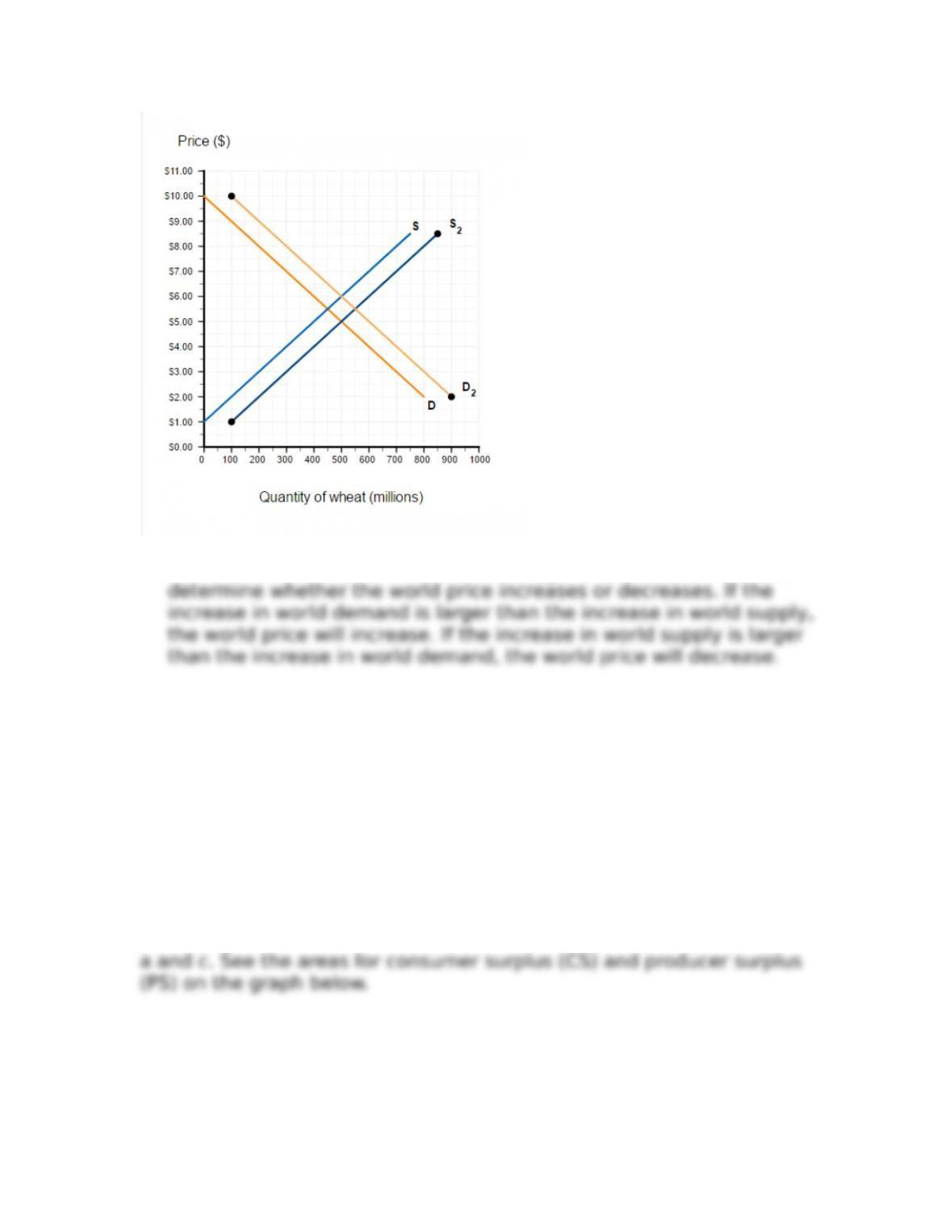
8. The world wheat market is shown in Figure 17P-4. [LO 17.4]
a. What is the initial world price?
b. Suppose a large country like the United States has been an autarky but is
now going to allow free trade. Draw the e.ect the entrance of the United
States into the world market has on the world supply and world demand
curves.
c. How will the world price be a.ected by the entrance of the United States
into the world market?
Answer:
b.
17-6
Copyright © 2018 McGraw-Hill Education. All rights reserved. No reproduction or distribution without the prior written consent of McGraw-Hill
Education.
Chapter 17 – International Trade
c. When a large economy enters a world market, both the world supply
and the world demand increase. The magnitude of these increases will
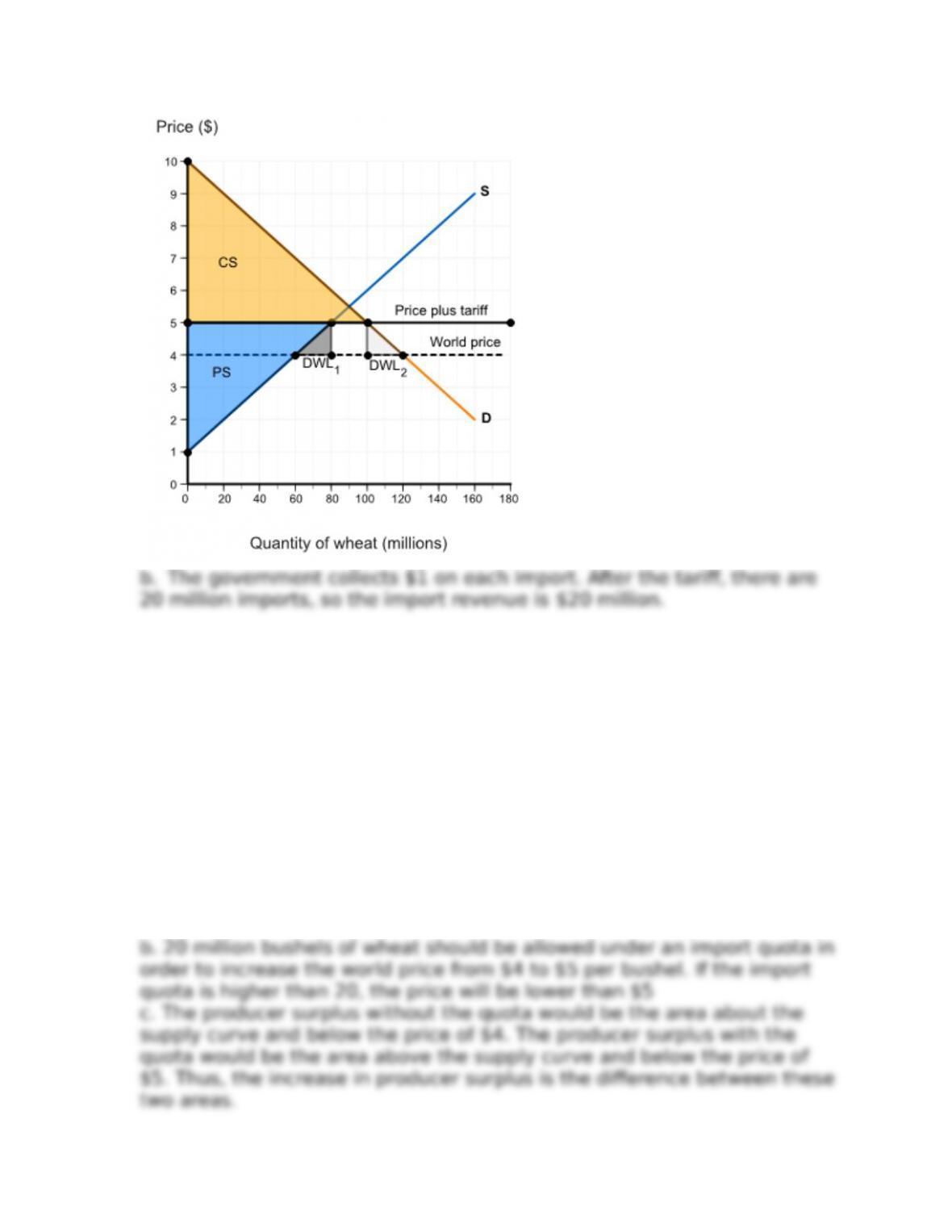
9. The United States wheat market is shown in Figure 17P-5. Suppose the
United States wants to protect its wheat industry by imposing a tari. of
$1/bushel on foreign wheat, which currently sells at world price of $4/bushel.
[LO 17.6]
a. Graph consumer and producer surplus after the $1/bushel tari. is
imposed.
b. How much revenue does the U.S. government collect from the tari.?
c. Graph the deadweight loss associated with the tari. below the equilibrium
quantity. Then graph the deadweight loss associated with the tari. above the
equilibrium quantity.
Answer:
17-7
Copyright © 2018 McGraw-Hill Education. All rights reserved. No reproduction or distribution without the prior written consent of McGraw-Hill
Education.
Chapter 17 – International Trade
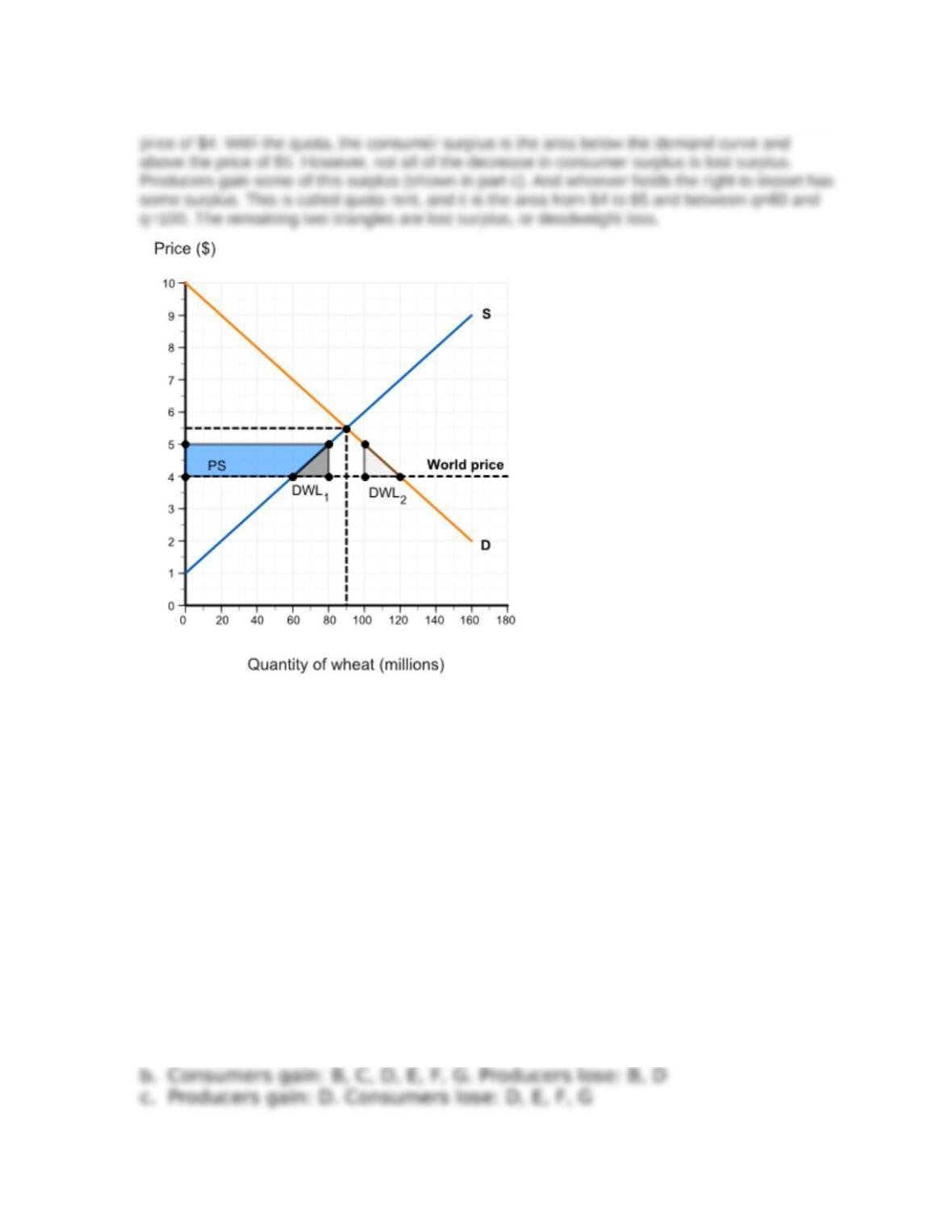
10. The United States wheat market is shown in Figure 17P-5. [LO 17.6]
a. When the world price is $4/bushel, will the United States import or export
wheat? How many bushels?
b. How many bushels of wheat should be allowed under an import quota in
order to increase the domestic price from $4 to $5 per bushel?
c. Graph the domestic producer surplus increase as a result of this quota.
d. Graph the deadweight loss associated with the quota below the
equilibrium quantity. Then graph the deadweight loss associated with the
quota above the equilibrium quantity.
Answer:
a. At a world price of $4, the quantity supplied is 60 million, and the
quantity demanded is 120 million. Thus, the country must import 60
million bushels to meet demand.
17-8
Copyright © 2018 McGraw-Hill Education. All rights reserved. No reproduction or distribution without the prior written consent of McGraw-Hill
Education.
Chapter 17 – International Trade
d. Without the quota, the consumer surplus is the area below the demand curve and above the
11. Suppose a country imposes a tari. on co.ee imports. Using the
diagram of supply and demand in Figure 17P-6, identify the correct shaded
areas as follows. [LO 17.3, 17.5, 17.6]
a. In autarky, which area(s) comprise domestic consumer surplus? Which
area(s) comprise domestic producer surplus?
b. When the country opens up to trade, which area(s) do consumers gain as
surplus? Which area(s) do producers lose?
c. After trade, if an import tari. is imposed, which area(s) do domestic
producers gain as surplus? Which do domestic consumers lose?
d. With the tari., which area is government revenue?
e. Which area(s) represent deadweight loss as a result of the tari.?
f. If the country uses an import quota instead of a tari., what is the quota
quantity if the quota price is $7?
Answer:
a. Consumer surplus: A. Producer surplus: B, D, H.
17-9
Copyright © 2018 McGraw-Hill Education. All rights reserved. No reproduction or distribution without the prior written consent of McGraw-Hill
Education.
Chapter 17 – International Trade
d. Government revenue: F.
12. Suppose a country where capital is scarce and most of the industry is
labor-intensive with low-skilled labor moves from autarky to free trade. Which
of the following do you expect to happen? Check all that apply. [LO 17.7]
a. Owners of capital become wealthier.
b. Wages for labor increase.
c. The returns to capital (surplus) decrease.
Answer:
13. Suppose two countries are considering a new agricultural trade
agreement with each other. Country A has abundant low-skilled labor and
scarce land. Country B has abundant arable land but little population. In
which country do land owners support a trade agreement? In which country
do workers support a trade agreement? [LO 17.7]
Answer: International trade equalizes the supply and demand of factors
of production across countries. The price of domestically abundant factors
14. Suppose a country has abundant capital but scarce labor. Which group
would be more harmed by a trade embargo: owners of capital or laborers?
[LO 17.7, 17.8]
Answer: Owners of capital would be more harmed by a trade embargo. If
15. Which of the following policies is likely to cause more pollution
displacement: imposing environmental standards on domestic production or
a blanket environmental standard on all imports? [LO 17.8]
Answer: Imposing environmental standards on domestic production will
cause more pollution displacement because domestic producers will have
17-10
Copyright © 2018 McGraw-Hill Education. All rights reserved. No reproduction or distribution without the prior written consent of McGraw-Hill
Education.
Chapter 17 – International Trade
17-11
Copyright © 2018 McGraw-Hill Education. All rights reserved. No reproduction or distribution without the prior written consent of McGraw-Hill
Education.