Chapter 16 – The Factors of Production
Problems and Applications
1. Recently, some college alumni started a moving service for students living
on campus. They have three employees and are debating hiring a fourth. The
hourly wage for an employee is $18 per hour. An average moving job takes
three hours. The company currently does three moving jobs per week, but
with one more employee, the company could manage !ve jobs per week.
The company charges $80 for a moving job. [LO 16.1, 16.2]
a. What would be the new employee’s marginal product of labor?
b. What is the value of that marginal product?
c. Should the moving service hire a fourth worker?
Answer:
a. 2 moving jobs.
16-1
Copyright © 2018 McGraw-Hill Education. All rights reserved. No reproduction or distribution without the prior written consent of McGraw-Hill
Education.
Chapter 16 – The Factors of Production
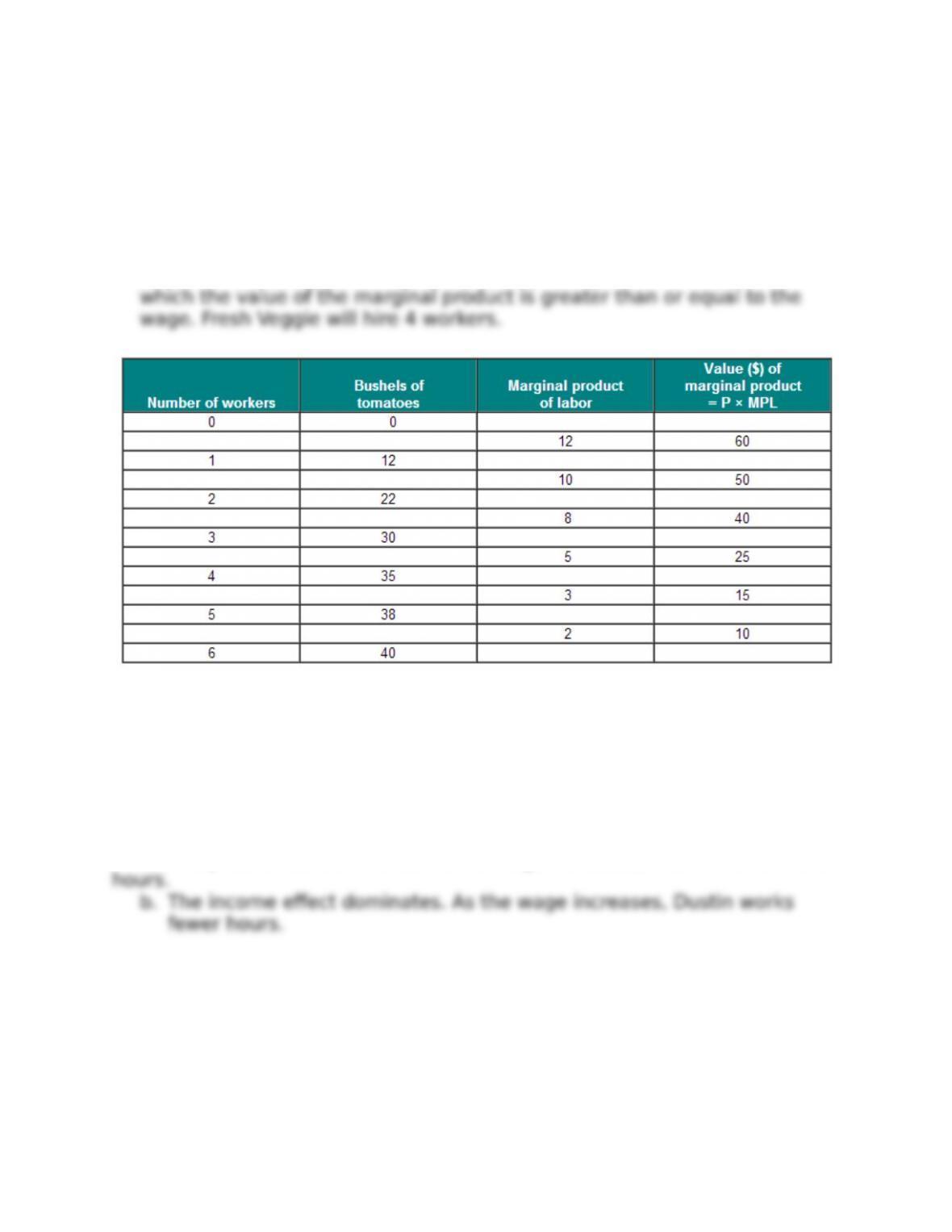
2. Fresh Veggie is one of many small farms in Florida operating in a perfectly
competitive market. Farm labor is also perfectly competitive, and Fresh
Veggie can hire as many workers as it wants for $20 a day. The daily
productivity of a tomato picker is given in Table 16P-1. If a bushel of
tomatoes sells for $5, how many workers will Fresh Veggie hire? [LO 16.1,
16.2]
Answer: Fresh Veggie maximizes pro!t by hiring all units of labor for
3. Dustin’s labor supply curve is graphed in Figure 16P-1. [LO 16.3]
a. Consider a wage increase from $5 to $6. For Dustin, does the price effect
or income effect dominate his labor supply decision?
b. Consider a wage increase from $7 to $8. For Dustin, does the price effect
or income effect dominate his labor supply decision?
Answer:
a. The price effect dominates. As the wage increases, Dustin works more
16-2
Copyright © 2018 McGraw-Hill Education. All rights reserved. No reproduction or distribution without the prior written consent of McGraw-Hill
Education.
Chapter 16 – The Factors of Production
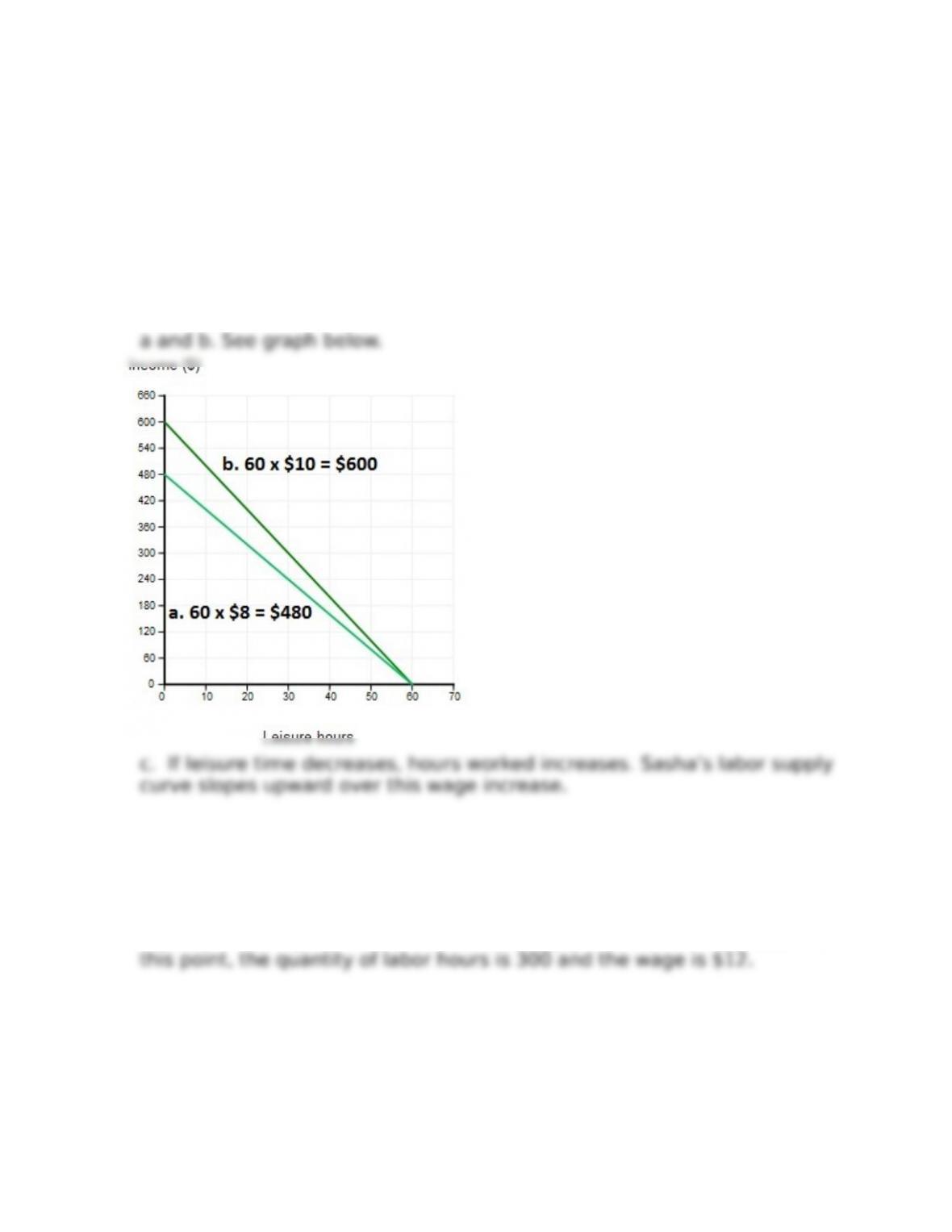
4. Sasha has 60 hours a week she can work or have leisure. Wages are
$8/hour. [LO 16.3]
a. Graph Sasha’s budget constraint for income and leisure.
b. Suppose wages increase to $10/hour. Graph Sasha’s new budget
constraint.
c. When wages increase from $8/hour to $10/hour, Sasha’s leisure time
decreases from 20 hours to 15 hours. Does her labor supply curve slope
upward or downward over this wage increase?
Answer:
5. Suppose you run a business that specializes in producing graphic T–shirts,
using labor as an input. Based on Table 16P-2, graph the labor supply and
demand curves and identify the market equilibrium wage and quantity of
labor hours. [LO 16.4]
Answer: The equilibrium occurs where supply and demand intersect. At
16-3
Copyright © 2018 McGraw-Hill Education. All rights reserved. No reproduction or distribution without the prior written consent of McGraw-Hill
Education.
Chapter 16 – The Factors of Production
6. Based on Table 16P-3, indicate what would happen in this labor market at
various wage rates by selecting one of the three choices shown for each
item. [LO 16.4]
a. At $8/hour: excess labor supply; excess labor demand; or equilibrium.
b. At $3/hour: excess labor supply; excess labor demand; or equilibrium.
c. At $5/hour: excess labor supply; excess labor demand; or equilibrium.
Answer:
a. Excess labor supply.
7. Identify which way the labor supply curve would shift under the following
scenarios. [LO 16.5]
a. A country experiences a huge inBux of immigrants who are skilled in the
textile industry.
b. Wages increase in an industry that requires similar job skills.
c. New machines require additional maintenance over time, so that the
marginal productivity of labor rises.
Answer:
a. Immigration increases labor supply. The labor supply curve would shift
to the right.
16-4
Copyright © 2018 McGraw-Hill Education. All rights reserved. No reproduction or distribution without the prior written consent of McGraw-Hill
Education.
Chapter 16 – The Factors of Production
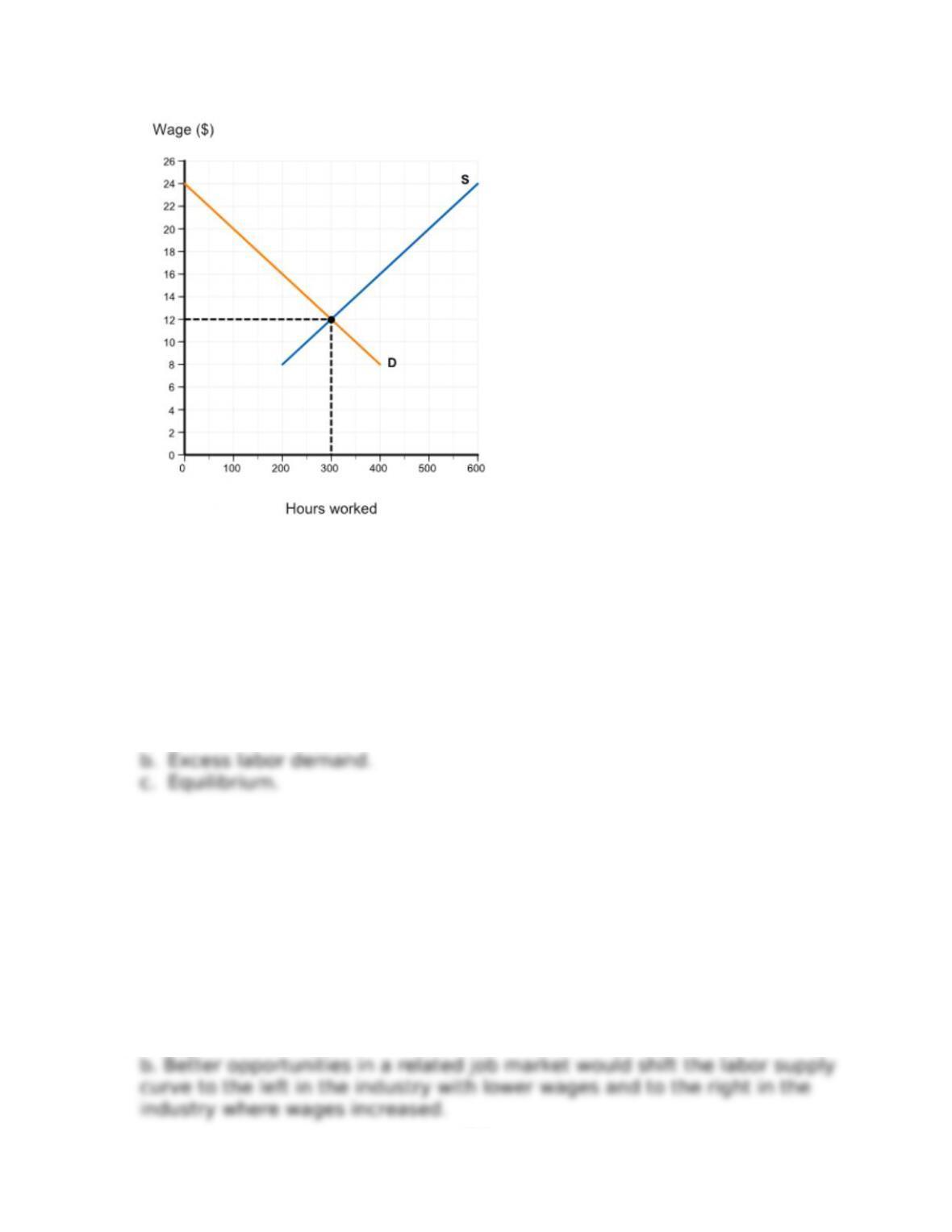
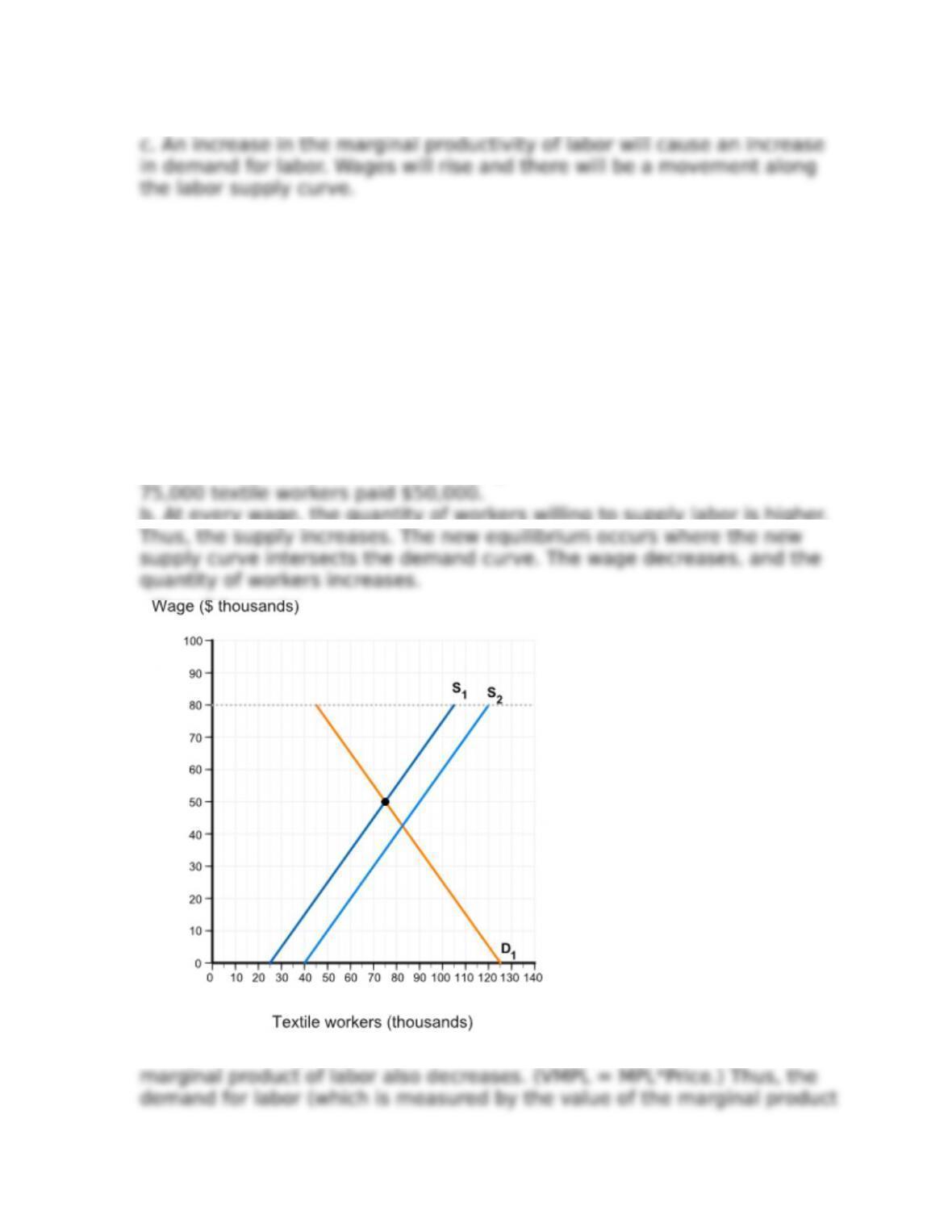
8. Figure 16P-2 shows the supply and demand for labor in the textile
industry. In each of the following scenarios, identify the direction of the shift
in either the supply or demand curve and state whether the resulting
equilibrium wage and quantity increase or decrease. [LO 16.5]
a. What are the original equilibrium wage and quantity?
b. Immigration and layo;s from other jobs increase the population of textile
workers.
c. A new technology for making self-printed T-shirts reduces the marginal
product of labor for textile workers.
Answer:
a. The equilibrium occurs where supply intersects demand. This is at
b. At every wage, the quantity of workers willing to supply labor is higher.
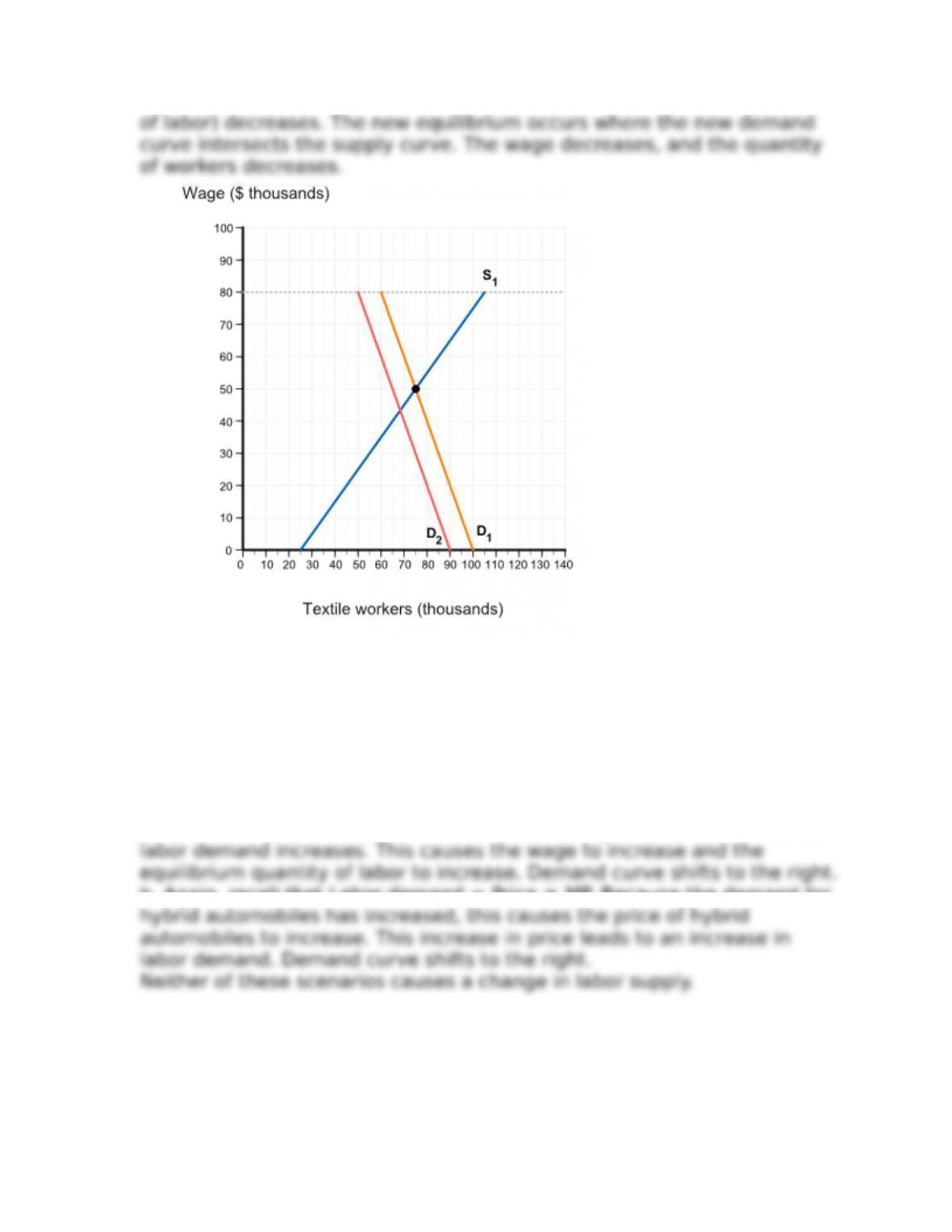
c. When the marginal product of labor decreases, the value of the
16-5
Copyright © 2018 McGraw-Hill Education. All rights reserved. No reproduction or distribution without the prior written consent of McGraw-Hill
Education.
Chapter 16 – The Factors of Production
9. Figure 16P-3 shows the supply and demand for labor in the hybrid
automobile industry. In each of the following scenarios, identify the direction
of the shift in either the supply or demand curve, and state whether the
resulting equilibrium wage and quantity increase or decrease. [LO 16.5]
a. A new tool is invented that increases each worker’s marginal product.
b. The demand for hybrid cars increases.
Answer:
a. Labor demand = Price × MP = VMP. When marginal product increases,
b. Again, recall that Labor demand = Price × MP. Because the demand for
10. Suppose that fast-food chains start using healthier ingredients,
increasing the demand for fast food and therefore for food-service workers,
as shown in Figure 16P-3. [LO 16.6]
16-6
Copyright © 2018 McGraw-Hill Education. All rights reserved. No reproduction or distribution without the prior written consent of McGraw-Hill
Education.
Chapter 16 – The Factors of Production
a. What are the new equilibrium wage and quantity of labor in the fast-food
industry?
b. Assume that the skills required of a sales clerk at a retail store are similar
to those required of workers at a fast-food restaurant. If workers are
completely indi;erent between fast-food jobs and retail-sales jobs, what will
be the wages for sales clerks?
Answer:
a. The new equilibrium wage is $30 and the new equilibrium quantity of
b. The wages of sales clerks would go up. As workers leave their jobs as
11. Suppose a town’s largest employers are its auto manufacturing plant
and its airplane manufacturing plant. Airplane manufacturing jobs require
familiarity with a technology that is not currently used in auto
manufacturing. Assume workers are indi;erent between the two types of
manufacturing work. [LO 16.6]
a. All else equal, which plant will pay its workers more?
b. Suppose the auto industry adopts the same technology used by airplane
manufacturers and trains its current workers in this technology. What will
happen to the pay di;erential between auto manufacturing and airplane
manufacturing work?
Answer:
a. The airplane manufacturing plant will pay more because it requires
additional skills. All else equal, workers at the airplane plant must possess
b. If the auto industry requires the same skills as the airplane
12. Figure 16P-5 shows a local labor market for landscapers. What is the
value of economic rent in this labor market? [LO 16.7]
Answer: Economic rent is the di;erence between the price at which the
owner of a factor of production is willing to supply that factor and the
16-7
Copyright © 2018 McGraw-Hill Education. All rights reserved. No reproduction or distribution without the prior written consent of McGraw-Hill
Education.
Chapter 16 – The Factors of Production
13. Match the following aspects of factor markets with the corresponding
characteristics. [LO 16.7]
a. analogous to producer surplus _e_ Demand for factors of
production
b. affected by an asset’s long run _a_ Economic rent
productivity _b_ Purchase markets for factors of
production
c. interest pain on loans _c_ Rental price of capital
d. determined by ownership of factors of _d_ Income
production
e. determined by the value of marginal
product
Answer:
a. Analogous to producer surplus: economic rent.
b. affected by an asset’s long-run productivity: purchase markets for
factors of production.
14. Figure 16P-6 shows a local labor market for mechanics. What are the
quantity supplied and quantity demanded when the minimum wage is each
of the following: [LO 16.8]
a. $40,000?
b. $20,000?
c. $60,000
Answer:
a. If the minimum wage is set such that an annual salary would be
c. If the minimum wage is set such that an annual salary would be
15. The market for grocery-store baggers is a competitive labor market, as
shown in Figure 16P-7. Suppose a new federal law raises the minimum wage
to $10 per hour. [LO 16.8]
a. What is the equilibrium wage rate prior to the law being enacted?
b. What are total labor earnings at the equilibrium wage?
16-8
Copyright © 2018 McGraw-Hill Education. All rights reserved. No reproduction or distribution without the prior written consent of McGraw-Hill
Education.
Chapter 16 – The Factors of Production
c. How much labor is being hired at the minimum wage?
d. What are total labor earnings with enactment of the minimum wage?
Answer: As seen in Figure 16P-7, the equilibrium wage rate is $8 per hour
with equilibrium hours at 40 per week. Labor earnings are calculated as
a. $8.00.
16-9
Copyright © 2018 McGraw-Hill Education. All rights reserved. No reproduction or distribution without the prior written consent of McGraw-Hill
Education.
Chapter 16 – The Factors of Production
16. Imagine that, faced with budget shortfalls, a government changes its
current policy of granting tax credits based on family size to a Bat rate tax
credit for a family with one or more children. [LO 16.9]
a. Over time, what will happen to the average age in the population?
b. Over time, what will happen to the size of the workforce?
Answer:
a. A Bat rate tax credit means the tax credit is the same whether a family
b. The workforce is proportional to the population. As the average age in
17. In each scenario, will wages rise above the market equilibrium or fall
below it? [LO 16.9]
a. All but one of the factories in a town go out of business.
b. All the software engineers in Silicon Valley organize into a union and go on
strike.
c. A major grocery store chain buys out all the other stores in the city.
Answer:
a. Wages will fall below equilibrium. The employer will have market
power.
16-10
Copyright © 2018 McGraw-Hill Education. All rights reserved. No reproduction or distribution without the prior written consent of McGraw-Hill
Education.