1. Explain why government is usually more concerned about regulating an
oligopoly than a monopolistically competitive market. [LO 15.8]
Answer: From an efficiency standpoint, an oligopoly will be more
problematic than a monopolistically competitive market. If an oligopoly is
Problems and Applications
1. Identify whether each of the following markets has few or many
producers, and uniform or di#erentiated products. Which market is an
oligopoly? Which market is monopolistically competitive? [LO 15.1]
a. College education.
b. Retail gas market.
Answer:
a. The college education market has many producers and di#erentiated
b. The retail gas market has few producers and a uniform product. This
2. Match the statement about goods sold in a market with the market type.
[LO 15.1]
a. There are imperfect substitutes for the goods.
b. There are no substitutes for the goods.
c. The goods may or may not be standardized.
Answer:
a. Monopolistic competition.
3. Interscope sells the music of Lady Gaga, who promotes a unique public
image and fashion style. Given her huge success, it is likely that by the end
of the coming year, multiple performers will be imitating or borrowing heavily
from her style. Suppose the current period’s supply and demand for Lady
Gaga MP3s is given in Figure 15P-1. [LO 15.2, 15.3]
a. Identify the pro”t-maximizing price and quantity for Lady Gaga MP3s on
the graph. What are the values for the pro”t-maximizing price and quantity
in the short run?
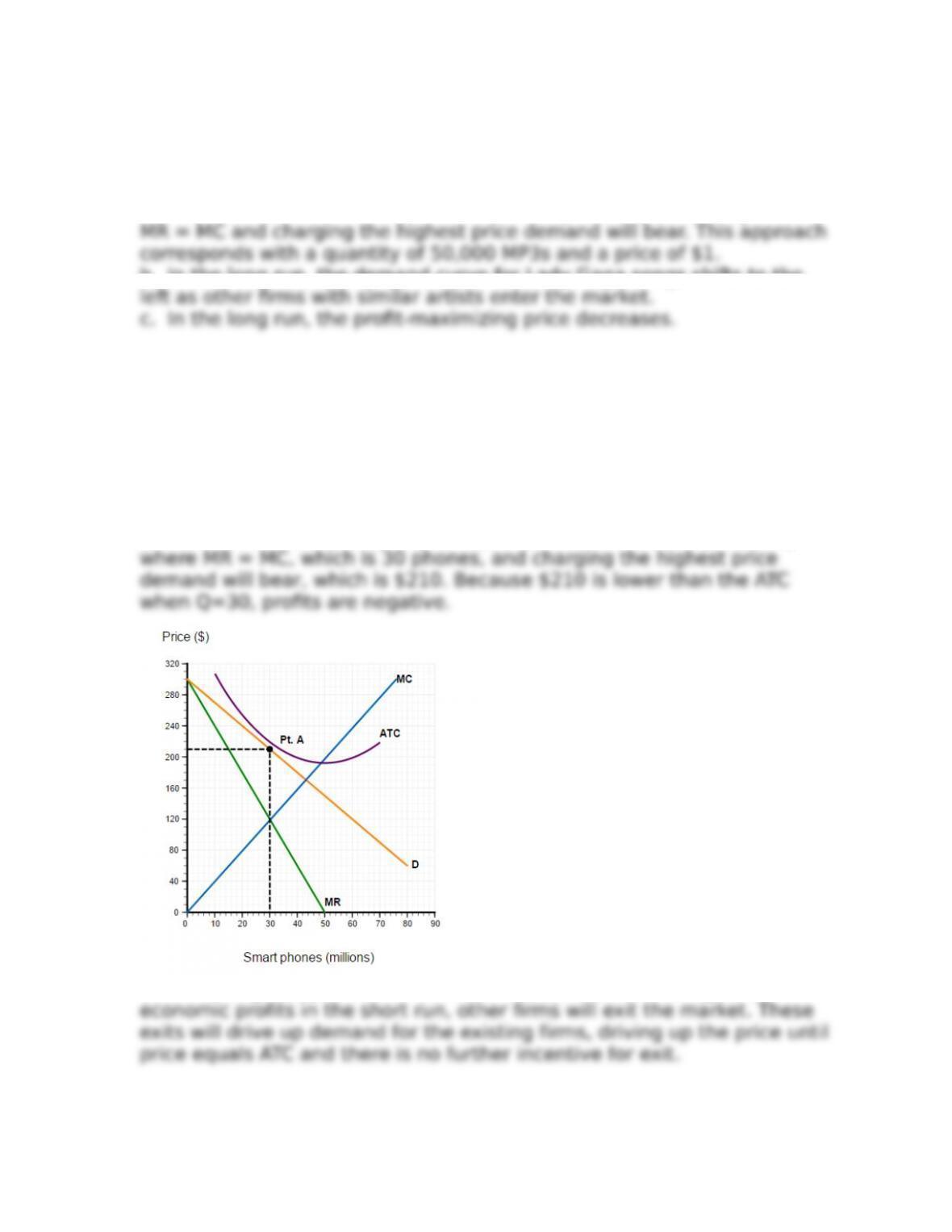
b. In the long run, what happens to the demand curve?
c. In the long run, what happens to the pro”t-maximizing price?
Answer:
a. In the short run, Interscope will maximize pro”ts by producing where
b. In the long run, the demand curve for Lady Gaga songs shifts to the
b. In the long run, pro”ts will increase. Because there are negative
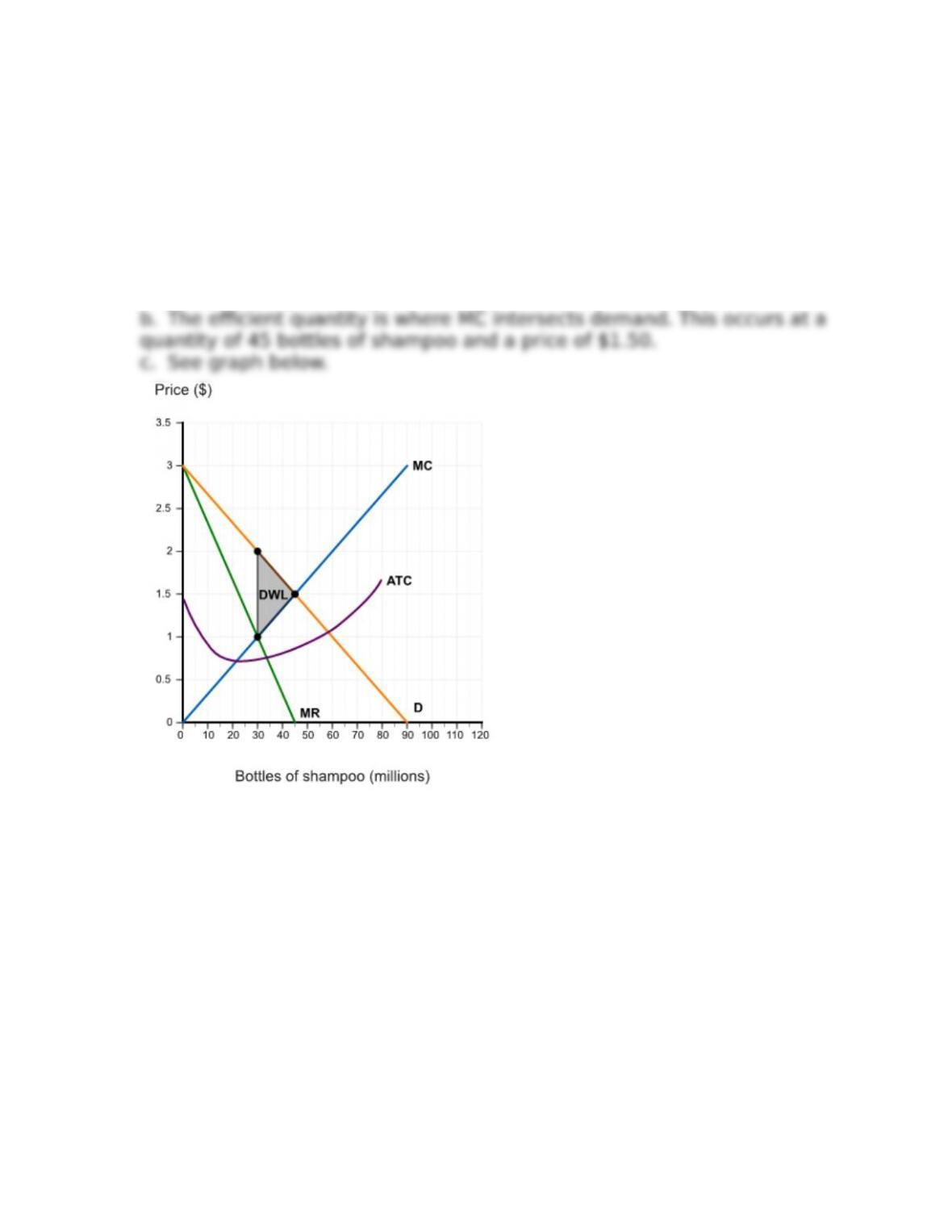
5. Figure 15P-3 shows a monopolistically competitive market for a “ctional
brand of shampoo called SqueakyKleen. [LO 15.4]
a. What is the price and quantity of SqueakyKleen in the short run?
b. What is the efficient price and quantity of SqueakyKleen?
c. Draw the deadweight loss.
Answer:
a. In the short run, SqueakyKleen behaves like a monopolist and sells 30
bottles of shampoo at a price of $2 per bottle.
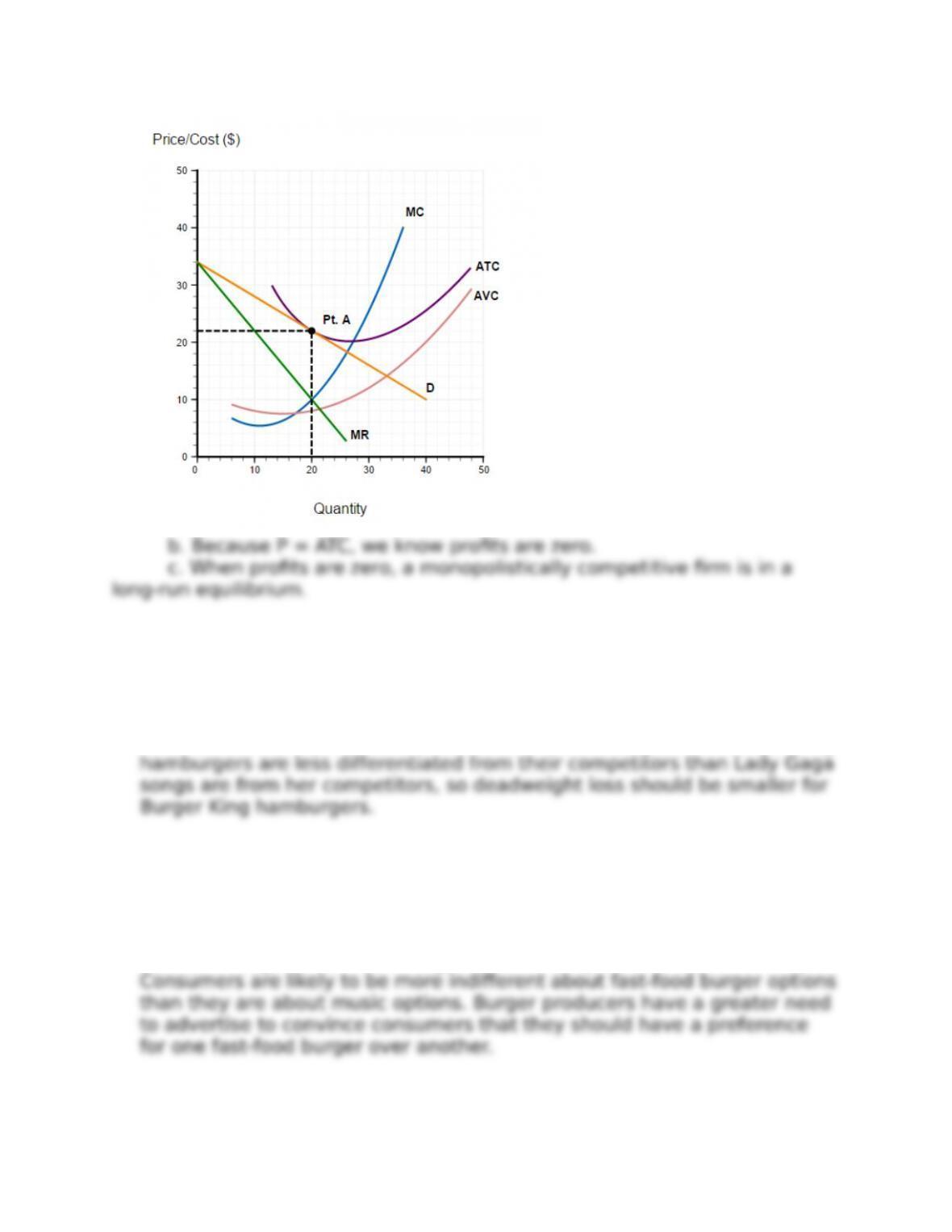
6. The marginal costs (MC), average variable costs (AVC), and average total
costs (ATC) for a monopolistically competitive “rm are shown in Figure 15P-4.
[LO 15.4]
a. Plot the pro“t-maximizing price and quantity on the graph.
b. Is this “rm earning zero, positive, or negative pro”ts? Why?
c. Is this “rm in a long-run equilibrium?
Answer:
a. The pro“t-maximizing output occurs where MC = MR or Q = 20 units.
The “rm charges a price according to the demand curve.
7. For which good would you expect deadweight loss to be smaller relative
to the total surplus in its market: Burger King hamburgers or Lady Gaga
MP3s? Explain your answer. [LO 15.4]
Answer: The less differentiated products are, the more difficult it is to
sustain inefficient prices and the smaller the deadweight loss. Burger King
8. For which product would you expect producers to have a stronger reaction
to a ban on advertising: music artists or fast-food burgers? Explain your
answer. [LO 15.5]
Answer: You would expect a stronger reaction to a ban on advertising
fast-food burgers. Fast-food burgers are not very di#erentiated.
9. Suppose you manage a “rm in a monopolistically competitive market.
Which of the following strategies will do a better job of helping you maintain
economic pro“ts: obtaining a celebrity endorsement for your product or
supporting the entry of “rms that will compete directly with your biggest
rival? Explain your answer. [LO 15.5]
Answer: Obtaining a celebrity endorsement: Consumers may have
positive feelings about a good that is endorsed by a celebrity they like or
10. Table 15P-1 shows the monthly demand schedule for a good in a
duopoly market. The two producers in this market each faces $5,000 of “xed
costs per month. There are no marginal costs. [LO 15.6]
a. What is the monthly pro”t for each duopolist if they evenly split the
quantity a monopolist would produce?
b. Suppose duopolist A decides to increase production by 200 units. How
much will each duopolist produce and what price will they charge? How much
pro”t will each duopolist earn?
Answer:
a. The monopoly outcome is to produce a quantity of 800 and charge a
b. If duopolist A increases production by 200 units, price will fall to $15 for
all units. Duopolist A will be producing 600 at a price of $15 for a total
11. Figure 15P-5 shows the monthly demand curve for a good in a duopoly
market. There are no “xed costs. [LO 15.6]
a. What is the monthly pro”t for each duopolist if they evenly split the
quantity a monopolist would produce?
b. What is the deadweight loss if the duopolists evenly split the quantity a
monopolist would produce?
c. What is the monthly pro”t for duopolist A and duopolist B if duopolist A
decides to increase production by 10 units?
d. What is the deadweight loss if duopolist A increases production by 10
units?
Answer:
a. The monopoly outcome is to produce a quantity of 50 and charge a
price of $70. If the duopolists evenly split production, each will produce 25
b. DWL = 0.5(100 − 50)(70 − 20) = $1,250.
c. If duopolist A increases production by 10, price for all units will fall to
d. If Dupolist A increases production by 10 units, DWL decreases to
12. Oil Giant and Local Oil are the only two producers in a market, as
shown in Figure 15P-6. They have an agreement to restrict oil output in order
to keep prices high. [LO 15.7]
a. What is the dominant strategy for each player?
b. If this game is played once, what is the Nash equilibrium?
c. Now suppose that both players know that the game will be played
multiple times. What outcome would we expect?
Answer:
a. The dominant strategy for Oil Giant is to compete. The dominant
strategy for Local Oil is to compete.
b. If this game is played once, the Nash equilibrium is for both “rms to
c. If the game is played multiple times, we would expect collusion to be
13. Suppose Warner Music and Universal Music are in a duopoly and
currently limit themselves to 10 new artists per year. One artist sells 2 million
songs at $1.25 per song. However, each label is capable of signing 20 artists
per year. If one label increases the number of artists to 20 and the other
stays the same, the price per song drops to $0.75, and each artist sells 3
million songs. If both labels increase the number of artists to 20, the price
per song drops to $0.30, and each artist sells 4 million songs. [LO 15.7]
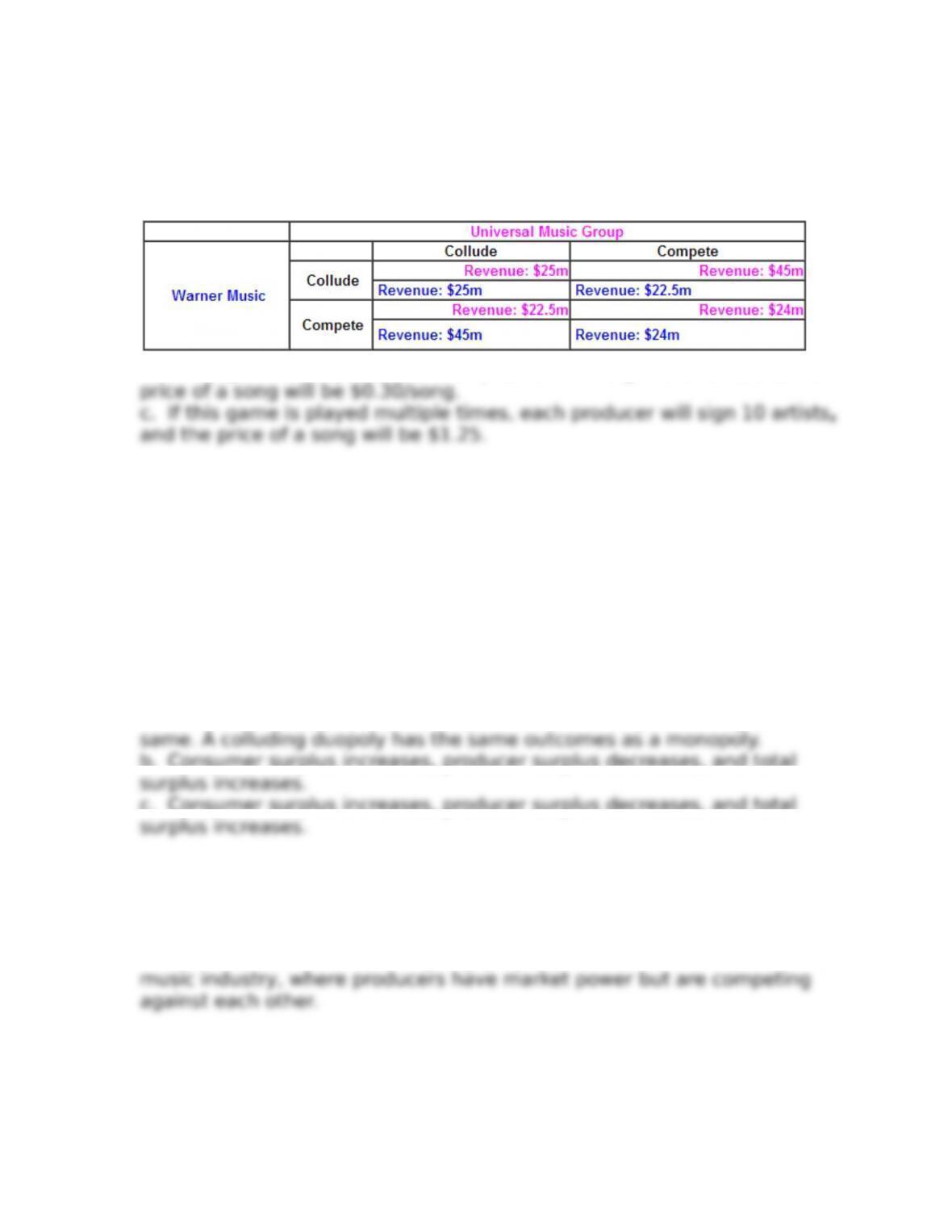
a. Fill in the revenue payo#s for each scenario in Figure 15P-7.
b. If this game is played once, how many artists will each producer sign, and
what will be the price of a song?
c. If this game is played every year, how many artists will each producer
sign, and what will be the price of a song?
Answer:
a. See “gure below.
b. If this game is played once, each producer will sign 20 artists, and the
14. Suppose a new product is developed and is supplied by a monopolist
with a patent. Compared with the monopoly outcome, indicate whether
consumer surplus, producer surplus, and total surplus increase, decrease, or
remain the same under the following scenarios. [LO 15.8]
a. Another producer creates a similar product and colludes with the original
producer.
b. Another producer creates a similar product and competes with the original
producer.
c. The patent expires.
Answer:
a. Consumer surplus, producer surplus, and total surplus all stay the
b. Consumer surplus increases, producer surplus decreases, and total
c. Consumer surplus increases, producer surplus decreases, and total
15. For which of the following markets would there be a greater increase in
total welfare if government were able to intervene and regulate prices: OPEC
or the music industry? Explain your answer. [LO 15.8]
Answer: OPEC; it is a colluding oligopoly and is more inefficient than the
\