Chapter 14 – Monopoly
1. Table 14P-1 presents the demand schedule and marginal costs facing a
monopolist producer. [LO 14.3]
a. Fill in the total revenue and marginal revenue columns.
b. What is the profit-maximizing level of output?
c. What price will the monopolist charge for the quantity in part b?
Answer:
a.
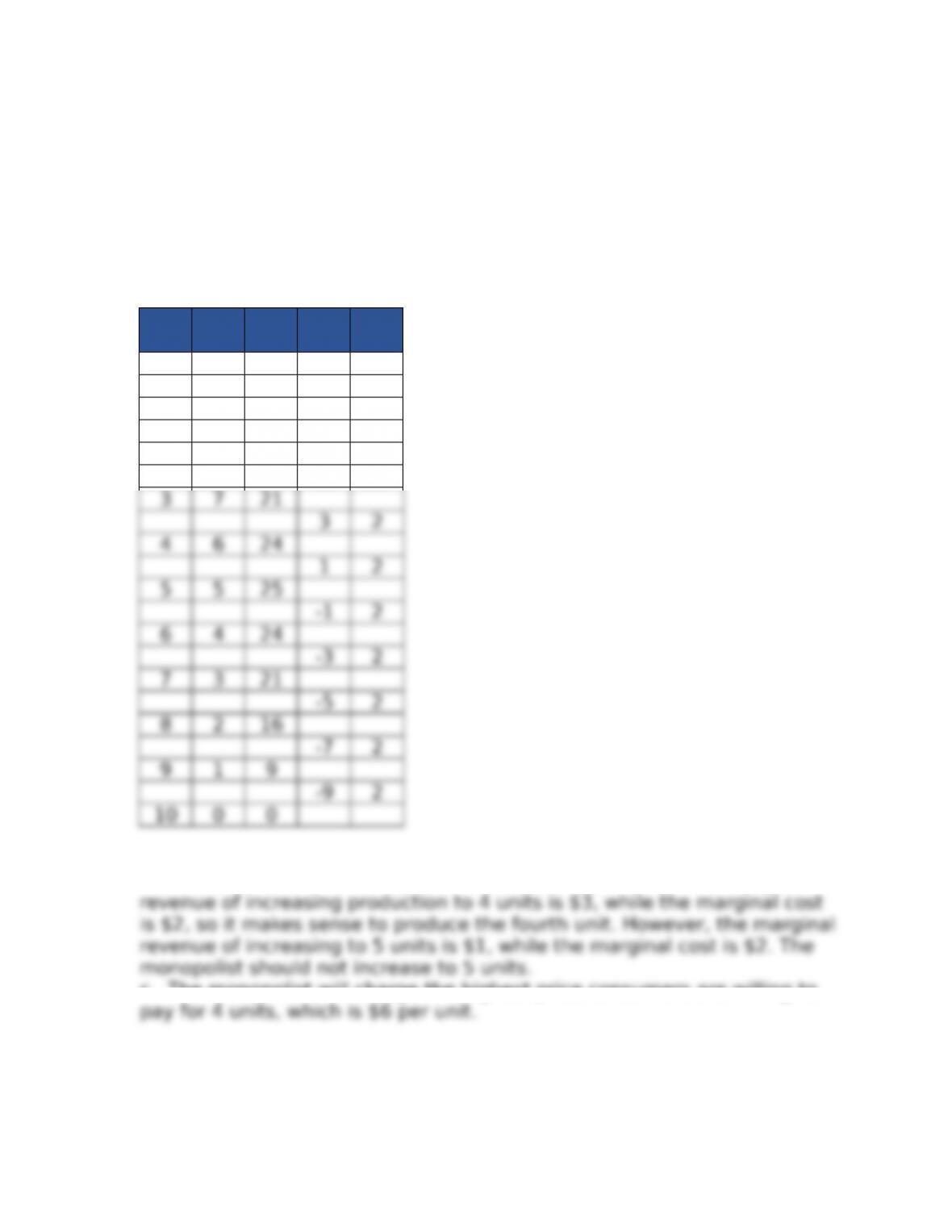
Q P
($)
TR
($)
MR
($)
MC
($)
0 10 0
9 —
199
7 2
2 8 16
5 2
b. The profit-maximizing decision rule is to increase production as long as
MR is > or = MC. This monopolist should produce 4 units. The marginal
c. The monopolist will charge the highest price consumers are willing to
14-1
Copyright © 2018 McGraw-Hill Education. All rights reserved. No reproduction or distribution without the prior written consent of McGraw-Hill
Education.
Chapter 14 – Monopoly
6. Table 14P-2 presents the demand schedule and marginal costs facing a
monopolist producer. [LO 14.3]
a. Fill in the total revenue and marginal revenue columns.
b. What is the profit-maximizing level of output?
c. What price will the monopolist charge for the quantity in part b?
Answer:
a.
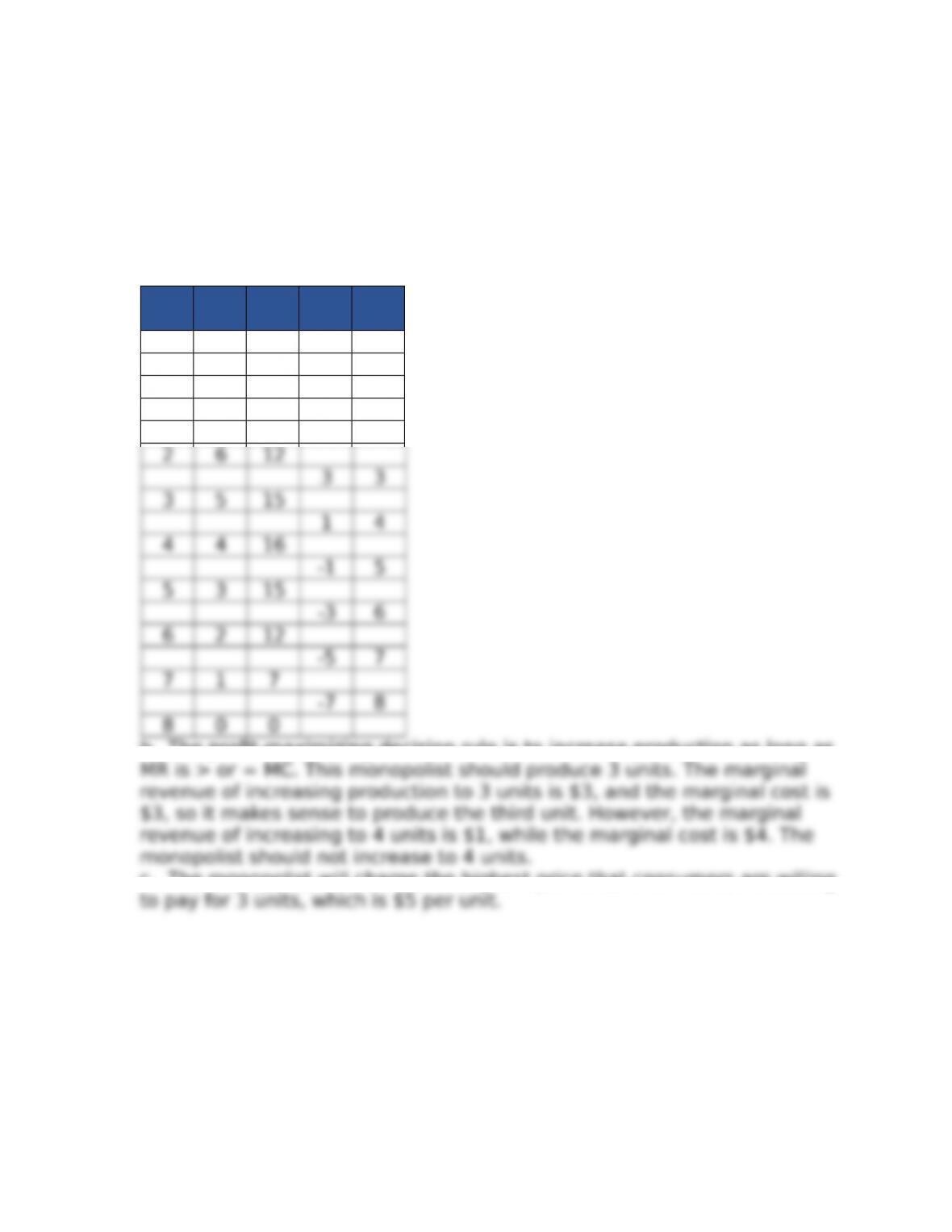
Q P
($)
TR
($)
MR
($)
MC
($)
080
7 1
177
5 2
b. The profit-maximizing decision rule is to increase production as long as
c. The monopolist will charge the highest price that consumers are willing
14-2
Copyright © 2018 McGraw-Hill Education. All rights reserved. No reproduction or distribution without the prior written consent of McGraw-Hill
Education.
Chapter 14 – Monopoly
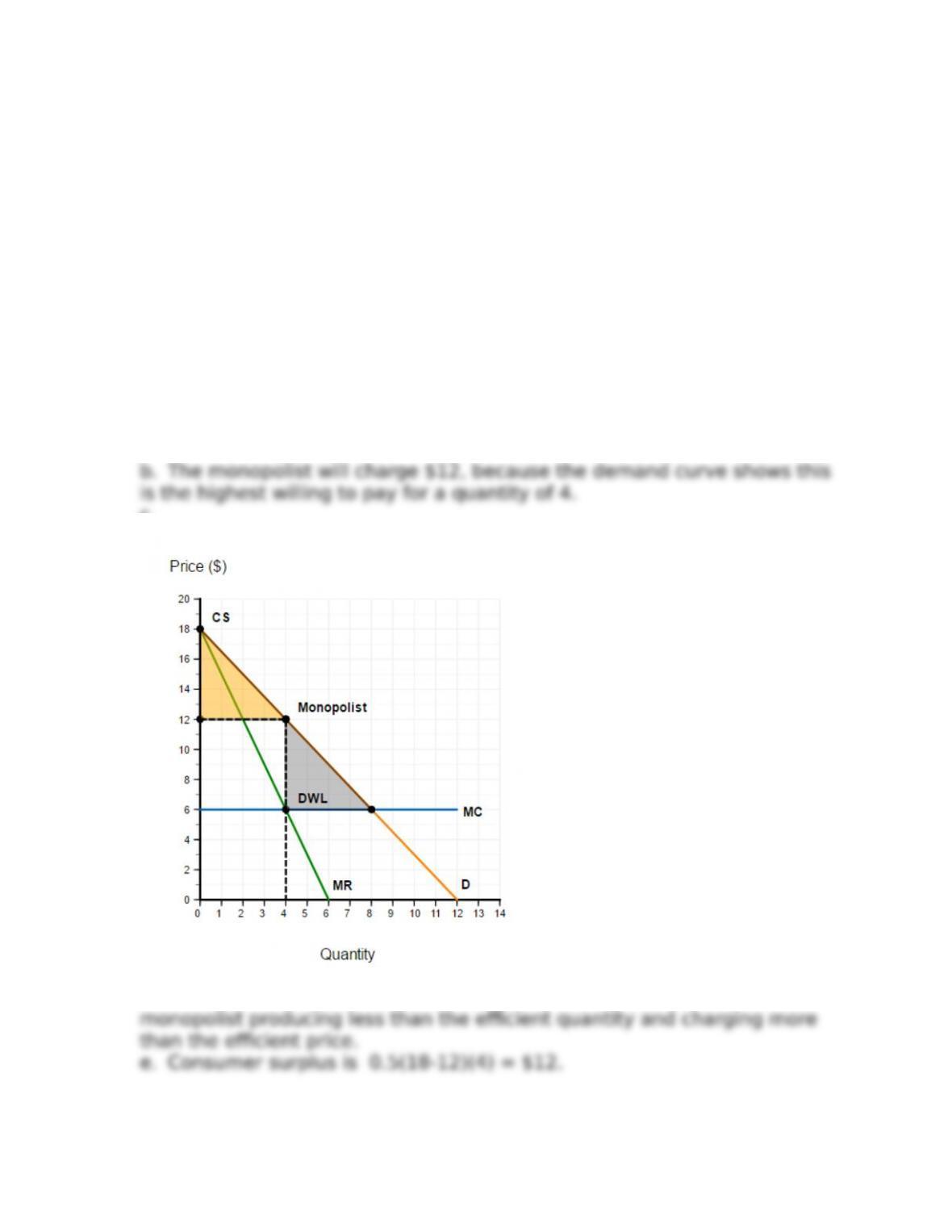
7. Figure 14P-1 presents the demand curve, marginal revenue, and marginal
costs facing a monopolist producer. [LO 14.3, 14.4]
a. What is the profit-maximizing level of output?
b. What price will the monopolist charge for the quantity in part a?
c. Plot the profit-maximizing price and quantity from parts a and b on the
graph.
d. What are the efficiency costs (deadweight loss) of monopoly
output/pricing? Provide a numerical answer and illustrate this area on the
graph.
e. What is consumer surplus under monopoly output/pricing? Illustrate this
area on the graph.
Answer:
a. The profit-maximizing level of output is 4, because this is where MR =
MC.
c.
d. DWL = 0.5(12-6)(8-4) = $12 and represents the lost surplus from the
14-3
Copyright © 2018 McGraw-Hill Education. All rights reserved. No reproduction or distribution without the prior written consent of McGraw-Hill
Education.
Chapter 14 – Monopoly
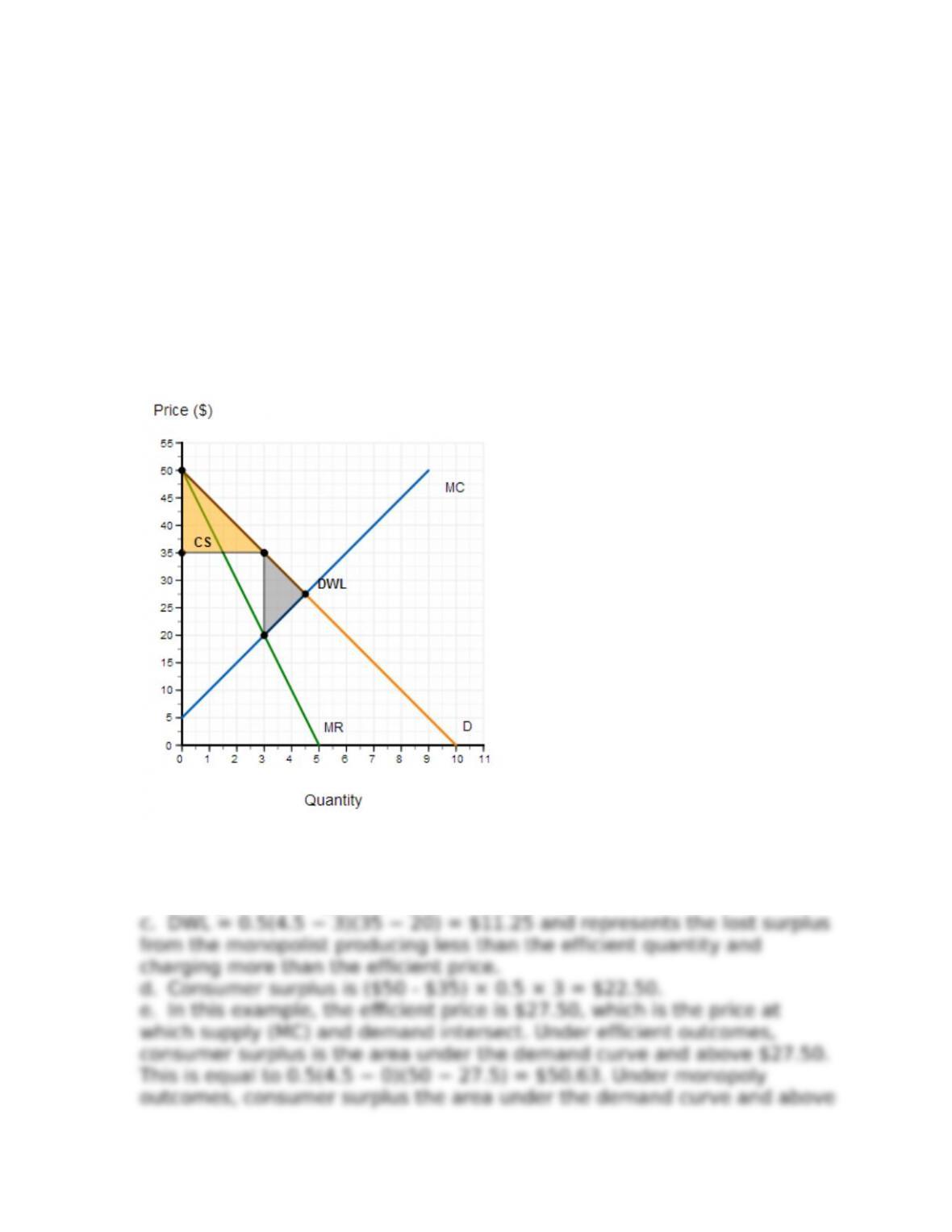
8. Figure 14P-2 presents the demand curve, marginal revenue, and marginal
costs facing a monopolist producer. [LO 14.3, 14.4]
a. What is the profit-maximizing level of output?
b. What price will the monopolist charge for the quantity in part a?
c. What are the efficiency costs (deadweight loss) of monopoly
output/pricing? Provide a numerical answer and illustrate this area on the
graph.
d. What is consumer surplus under monopoly output/pricing? Illustrate this
area on the graph.
e. What is the loss of consumer surplus under monopoly outcomes versus
efficient out-comes? Provide a numerical answer.
Answer:
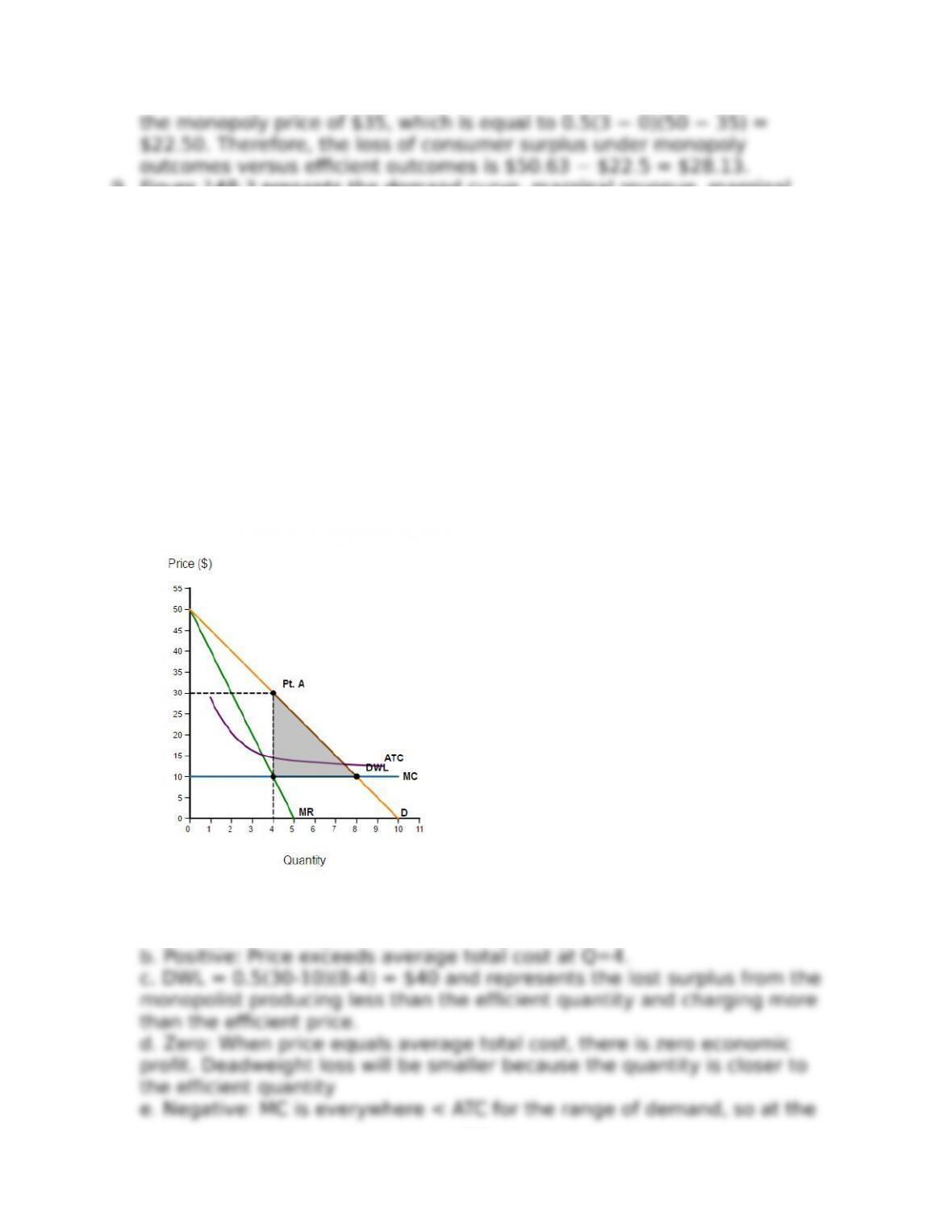
a. The profit-maximizing level of output is 3, because this is where MR =
MC.
b. The monopolist will charge $35, because the demand curve shows this
is the highest willingness to pay for a quantity of 4.
14-4
Copyright © 2018 McGraw-Hill Education. All rights reserved. No reproduction or distribution without the prior written consent of McGraw-Hill
Education.
Chapter 14 – Monopoly
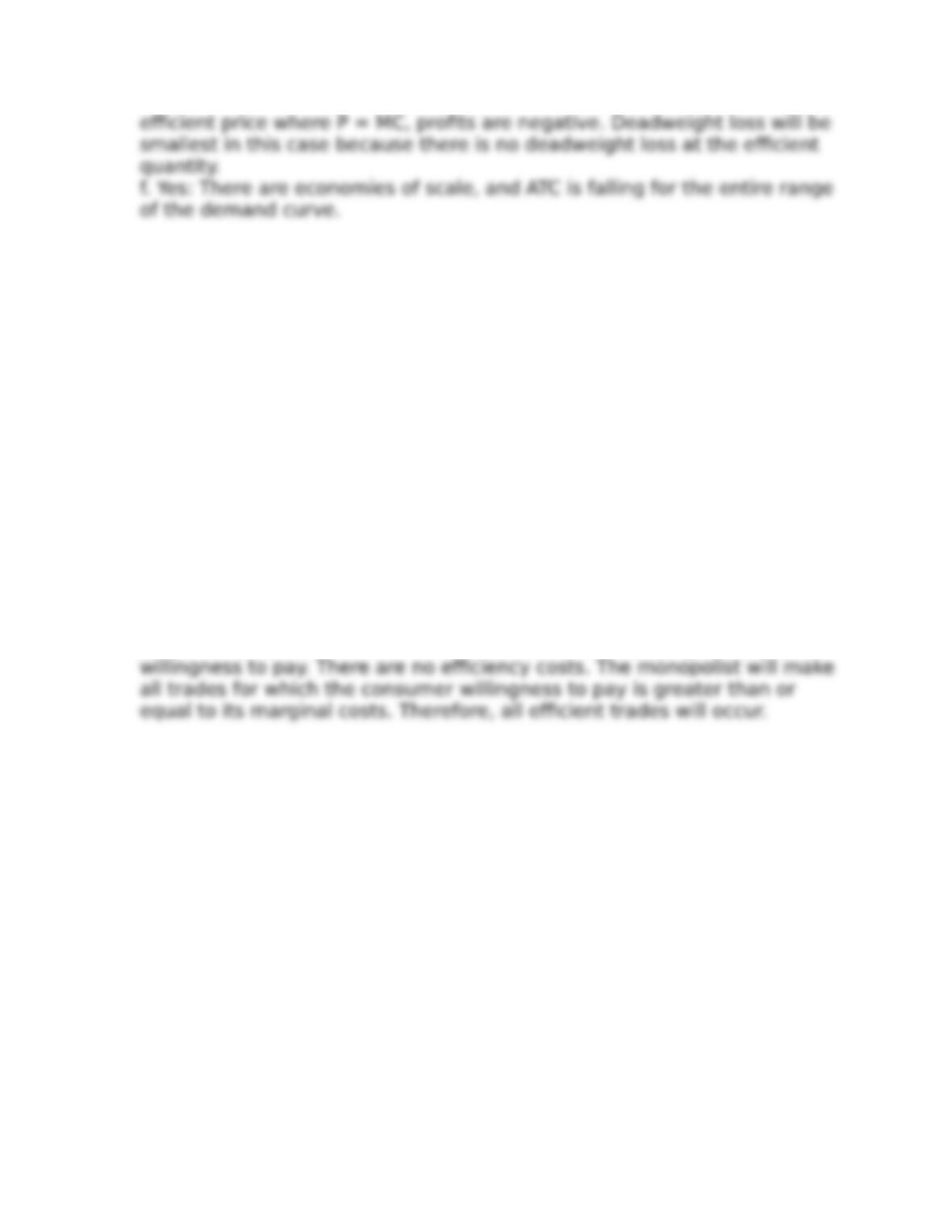
9. Figure 14P-3 presents the demand curve, marginal revenue, marginal
costs, and average total costs facing a monopolist producer. [LO 14.5]
a. Plot the profit-maximizing price and quantity on the graph.
b. Under monopoly pricing, are profits positive, negative, or zero?
c. Draw the deadweight loss under monopoly pricing.
d. If government mandates P = ATC, are profits positive, negative, or zero?
Compared to monopoly pricing, is deadweight loss smaller, larger, or the
same size?
e. If government mandates efficient pricing, are profits positive, negative, or
zero? Compared to monopoly pricing, is deadweight loss under efficient
pricing smaller, larger, or the same size? Compared to a mandate where P =
ATC, is deadweight loss under efficient pricing smaller, larger, or the same
size?
f. Is this a natural monopoly?
Answer:
a. The profit-maximizing level of output is 4 because this is where MR =
MC. The monopolist will charge $30 because the demand curve shows this
is the highest willingness to pay for a quantity of 4.
14-5
Copyright © 2018 McGraw-Hill Education. All rights reserved. No reproduction or distribution without the prior written consent of McGraw-Hill
Education.
Chapter 14 – Monopoly
10. Use Figure 14P-4 to answer the following questions. [LO 14.5]
a. If this monopolist were regulated, would it prefer average total cost
pricing (P = ATC) or efficient pricing?
b. Is this a natural monopoly?
Answer:
a. This monopolist would prefer the efficient price. The efficient price
(where supply MC = demand) is higher than ATC, so profits would still be
positive.
b. No. The defining characteristic of a natural monopoly is that it has
economies of scale so large that ATC is falling for the entire range of the
demand curve.
11. Suppose a monopolist discovers a way to perfectly price-discriminate.
What is consumer surplus under this scenario? What are the efficiency costs?
[LO 14.6]
Answer: If a monopolist discovers a way to perfectly price-discriminate,
consumer surplus is zero because each consumer is paying exactly her
12. Suppose there are three types of consumers who attend concerts at
your university’s performing arts center: students, staH, and faculty. Each of
these groups has a diHerent willingness to pay for tickets; within each group,
willingness to pay is identical. There is a fixed cost of $1,000 to put on a
concert, but there are essentially no variable costs. For each concert there
are 140 students willing to pay $20, 200 staH members willing to pay $35,
and 100 faculty members willing to pay $50. [LO 14.6]
a. If the performing arts center can charge only one price, what price should
it charge?
b. What are profits at this price?
c. If the performing arts center can price discriminate and charge two prices,
one for students and another for faculty/staH, what are its profits?
d. If the performing arts center can perfectly price discriminate and charge
students, staH, and faculty three separate prices, what are its profits?
Answer:
14-6
Copyright © 2018 McGraw-Hill Education. All rights reserved. No reproduction or distribution without the prior written consent of McGraw-Hill
Education.
Chapter 14 – Monopoly
a. If the performing arts center can charge only one price, it should
charge $35. At this price, both staH and faculty will purchase. Total
b. Profit = TR – TC.
Profit = 300 (35) − $1,000.
c. Students: 140 ($20) = $2,800.
d. Students: 140 ($20) = $2,800.
StaH: 200($35) = $7,000.
14-7
Copyright © 2018 McGraw-Hill Education. All rights reserved. No reproduction or distribution without the prior written consent of McGraw-Hill
Education.