
Chapter 13 – Perfect Competition
CHAPTER 13
PERFECT COMPETITION
Chapter Overview
In this chapter, we dug into the wants and constraints that drive firm
behavior in competitive markets. Firms will choose to produce a quantity that
maximizes their profits. In the short run, they will shut down if their revenues
don’t cover their variable costs of production. In the long run, they will exit
the market if their revenues don’t cover their total costs of production.
This analysis leads to some surprising conclusions about long-run supply in
competitive markets: Firms earn zero economic profit; they operate at their
e&cient scale; and long-run supply is, in theory, perfectly elastic. Firms are
able to enter and exit the market freely to adjust the quantity supplied at a
given price.
These choices by firms benefit consumers by keeping prices low and
ensuring that supply is responsive to needs. As we have noted, however,
real-world markets are not guaranteed to be perfectly competitive. Firms
may wield market power, or offer products that are not perfectly
standardized. There may be barriers that prevent firms from freely entering
or exiting the market. Understanding what perfect competition looks like, we
can now spend the next few chapters looking at how firms behave when we
relax the assumptions of perfect competition.
Learning Objectives
LO 13.1: Describe the characteristics of a perfectly competitive market.
LO 13.2: Calculate average, marginal, and total revenue.
LO 13.3: Find a firm’s optimal quantity of output.
LO 13.4: Describe a firm’s decision to shut down or to exit the market, and
explain the difference between these choices.
LO 13.5: Draw a short-run supply curve for a competitive market with
identical firms.
LO 13.6: Draw a long-run supply curve for a competitive market with
identical firms, and describe its implications for profit-seeking firms.
LO 13.7: Explain why a long-run supply curve can slope upward.
LO 13.8: Calculate the effect of a shift in demand on a market in long-run
equilibrium.
Chapter Outline
OPENING STORY: TRAINSIDE VARIETY
13-1
Copyright © 2018 McGraw-Hill Education. All rights reserved. No reproduction or distribution without the prior written consent of McGraw-Hill
Education.

Chapter 13 – Perfect Competition
A Competitive Market
Characteristics of a Competitive Market (LO 13.1)
BOX FEATURE: REAL LIFE – BAZAAR COMPETITION
Revenues in a Perfectly Competitive Market (LO 13.2)
Profits and Production Decisions
Deciding How Much to Produce (LO 13.3)
Deciding When to Operate (LO 13.4)
Behind the Supply Curve
Short-Run Supply (LO 13.5)
Long-Run Supply (LO 13.6)
Why the Long-Run Market Supply Curve Shouldn’t Slope Upward, But Does
(LO 13.7)
BOX FEATURE: REAL LIFE – HOW FORD CHANGED THE WORLD
Responding to Shifts in Demand (LO 13.8)
Beyond the Lecture
Class Discussion: Characteristics of a Competitive Market. Is this
Real-World Market Really an Example of Perfect Competition? (LO
13.1)
Remember the characteristics of perfectly competitive markets. Free entry
and exit, numerous buyers and sellers that have no inEuence on the price,
perfect information, homogenous products. The following markets are
sometimes provided as examples of perfect competition. Have the students
name which characteristic of perfect competition that the following markets
might not have.
1. Farming commodities (corn, wheat)
2. Stock market
3. Local farmer’s market selling fruit
Possible answers:
1. Farming may not have free entry. Today, many farms are large
agribusinesses, which require equipment that costs hundreds of
thousands of dollars. Land is very expensive too.
2. Stock markets may have a high trading volume. You can have
students look up the daily trading volume for a popular stock, such as
Bank of America (BAC). This can be done through CNBC or Yahoo
Finance. However, there are often large institutional investors which
may purchase so many shares at a time that it does affect the price.
This may violate the “one person has no inEuence on the price”
assumption.
3. Local farmer’s market selling fruit may not have homogenous products.
Some farmer may have local apples that are better (or even perceived
to be better) than other local growers. This may result in price
differences.
13-2
Copyright © 2018 McGraw-Hill Education. All rights reserved. No reproduction or distribution without the prior written consent of McGraw-Hill
Education.

Chapter 13 – Perfect Competition
Class Discussion: Characteristics of a Competitive Market (LO 13.1)
Show students this brief clip from the TV show The Oce. In the clip, a
potential customer tells Jim and Dwight that it makes more sense to pay less
for paper from a large competitor. However, they convince the customer that
their customer service is better.
1. Why would the customer be willing to pay more for their paper (which
is presumably very similar to the competitors)?
2. Can you think of products for which you prefer a specific brand and will
pay more for it?
3. Can you think of products for which you do not care about brand and
decide solely on price?
Writing Assignment/Class Discussion: Characteristics of a
Competitive Market and Deciding How Much to Produce (LO 13.1, LO
13.3)
Have students read this brief Esquire article about the relatively low price of
lobster in 2012. Consider having students write a short essay about the why
the lobstermen generally have to accept the market price. In class, you can
have a discussion.
1. What would happen if an individual seller of lobster increased price?
2. What does the demand curve for an individual lobsterman look like?
3. How does a lobsterman decide on price and output?
Class Activity: Deciding When to Operate (LO 13.4)
Consider breaking students into several small groups and having them work
on a problem about shut-down decisions. Create a few different simple
examples, providing the students with marginal revenue, marginal cost,
average variable cost, average fixed cost, and average total costs. Have the
students pick the optimal quantity. Then have students decide if the firm
should continue to operate in the current time period. You can make some
data suggesting that the firm should keep operating as-is, temporarily shut-
down, or close permanently.
Clicker Questions
There are three main purposes to clicker questions. First, they are a great
way to do a quick and instant “on demand” test of student understanding of
the material. You can cover material, and instantly get feedback on student
comprehension. You can see whether you need to explain certain topics
again, or move on to the next subject. Second, they are a great method to
break up the class and take a moment away from lecture. It gets the
students actively involved. Finally, certain clicker questions can be framed in
a “discussion” manner, in which you can invite students to talk about the
possible right answer with their peers. You can instruct students to convince
their classmate of a right or wrong answer.
13-3
Copyright © 2018 McGraw-Hill Education. All rights reserved. No reproduction or distribution without the prior written consent of McGraw-Hill
Education.
Chapter 13 – Perfect Competition
1. Which of the following is NOT a characteristic of perfectly competitive
markets? [LO 13.1]
D. Free entry and exit of firms
Feedback: In perfect competition, products are homogenous (or
standardized) rather than di*erentiated.
2. When graphed, the total revenue function for a perfectly competitive firm
would be… [LO 13.2]
A. a parabola
Feedback: It would be an upward sloping line, and the slope would be the
price. Remember that Q would be on the horizontal axis and TR on the
vertical.
3. What does it mean when a firm produces at an output level where
MR=MC? [LO 13.3]
A. Since revenues equal costs, profits are zero
Feedback: Tough question. MR=MC can be thought of as the “stopping
point”. Keep producing where MR > MC (this is how profits are made), but
stop when MR = MC. The additional profit from the last unit will be very
small, or perhaps even zero.
4. The short run decision to produce or shut down depends on…. [LO 13.4]
A. total costs
Feedback: The shutdown point is the minimum of the AVC function.
5. Why might the long run supply curve for perfectly competitive markets be
upward sloping? [LO 13.7]
A. All firms likely have the same costs
13-4
Copyright © 2018 McGraw-Hill Education. All rights reserved. No reproduction or distribution without the prior written consent of McGraw-Hill
Education.
Chapter 13 – Perfect Competition
Feedback: If new firms have higher costs, they’ll only be enticed to enter if
the price rises. Thus, we have an upward sloping relationship between price
and quantity supplied.
Solutions to End-of-Chapter Questions and Problems
Review Questions
1. You stop by a crafts fair and you notice consumers haggling with vendors
over prices. What does this tell you about the competitiveness of this
market? Suppose you plan to go to a farmers’ market next. Do you expect to
find more or less haggling at this market than you did at the crafts fair? Why?
[LO 13.1]
Answer: Consumers and sellers haggling over prices is a sign that the
market is not perfectly competitive. If the market were perfectly
competitive, consumers and sellers would be price takers, and both would
2. In the market for gold jewelry (unlike the market for gold ore), products
come in a range of designs, styles, and levels of quality. Which of the
characteristics of a competitive market is violated in the jewelry market?
What does this imply for consumers’ willingness to buy from di*erent
producers? [LO 13.1]
Answer: The characteristic of competitive markets that is violated in the
jewelry industry is that the goods are not standardized. This will mean
3. Suppose that the manager of a donut shop tells you that he sold 220
donuts today, for a total revenue of $220 and average revenue of $0.90.
What’s wrong with this story? [LO 13.2]
Answer: Average revenue is total revenue divided by quantity. If the
13-5
Copyright © 2018 McGraw-Hill Education. All rights reserved. No reproduction or distribution without the prior written consent of McGraw-Hill
Education.
Chapter 13 – Perfect Competition
4. Suppose an individual firm is one of many firms in a perfectly competitive
market. Explain why this means the firm’s marginal revenue will be equal to
the market price. [LO 13.2]
Answer: If a firm’s output is small relative to the size of the market, the
5. The manager of the donut shop tells you that he sells donuts for $1 each,
and that if he were to make additional donuts, based on his current level of
output, it would cost him $0.80 per donut. Do you recommend that the
manager increase or decrease the number of donuts he makes? [LO 13.3]
Answer: The manager should increase his production of donuts as long
as the marginal revenue is greater than or equal to the marginal cost. The
6. Suppose a firm is operating in a competitive market and is maximizing
profit by producing at the point where marginal revenue equals marginal
cost. Now suppose that consumer wealth decreases in this market (and the
good is a normal good). What might you expect to happen to the profit-
maximizing output quantity for the firm? [LO 13.3]
Answer: If consumer wealth increases, demand for a normal good
increases (shifts right). This will cause the price in the market to increase.
7. A restaurant owner is trying to decide whether to stay open at lunchtime.
She has far fewer customers at lunch than at dinner, and the revenue she
brings in barely covers her expenses to buy food and pay the sta*. What do
you recommend that she do? Explain your reasoning to her. [LO 13.4]
Answer: As long as the revenue from staying open at lunch does cover
the variable costs of doing a lunchtime service, the restaurant owner will
13-6
Copyright © 2018 McGraw-Hill Education. All rights reserved. No reproduction or distribution without the prior written consent of McGraw-Hill
Education.
Chapter 13 – Perfect Competition
8. In what ways are profit-maximizing and loss-minimizing the same? In what
ways are they different? [LO 13.4]
Answer: Profit-maximizing and loss-minimizing are the same in that they
both mean increasing production until marginal revenue equals marginal
9. Suppose that the profit-maximizing quantity of output for a firm in the
competitive textile industry is 1 million yards of cloth. If this firm is
representative of others in the industry, how can you describe total supply in
the market, with respect to the number of firms? [LO 13.5]
Answer: If the firm is representative, then all firms will maximize profit by
13-7
Copyright © 2018 McGraw-Hill Education. All rights reserved. No reproduction or distribution without the prior written consent of McGraw-Hill
Education.
Chapter 13 – Perfect Competition
10. What would you expect to happen to market supply if variable costs
decreased for individual firms in the market? [LO 13.5]
Answer: If variable costs decreased for individual firms, the individual
11. Suppose that the airline industry is in long-run equilibrium when the
price of gasoline increases, raising the cost of operating airplanes. In the
long run, what do you expect to happen to the number of airlines in
business? Why? [LO 13.6]
Answer: If the airline industry is in long-run equilibrium, economic profit
for airlines is zero (at least for the marginal airline). Therefore, if the cost
12. The firm in Figure 13Q–1 represents the cost structure for all firms in
the industry. Describe the steps that will lead to long-run equilibrium in this
market. [LO 13.6]
Answer: If the firm represented in Figure 13RQ-1 is representative of all
firms, firms in this market are making positive economic profit. We can
13. Corn farmers in Iowa are producers in a highly competitive global
market for corn. They also have some of the most fertile, productive land in
the entire world. Could Iowa’s farmers be earning a positive economic profit
in the long run? Why or why not? [LO 13.7]
Answer: Yes. A producer can be earning economic profit in the long run if
firms differ in cost structure. Long-run equilibrium means that there is no
13-8
Copyright © 2018 McGraw-Hill Education. All rights reserved. No reproduction or distribution without the prior written consent of McGraw-Hill
Education.
Chapter 13 – Perfect Competition
14. Suppose that firms in an industry have identical cost structures and
the industry is in long-run equilibrium. Explain how the profit motive could
lead to lower market prices. [LO 13.7]
Answer: If a market is in long-run equilibrium and firms have identical
cost structures, firms are making zero economic profit. Producers in a
competitive market can’t affect the price by changing their output level,
15. A market is in long-run equilibrium and firms in this market have
identical cost structures. Suppose demand in this market decreases.
Describe what happens to the profit-maximizing output quantity for
individual firms as the market leaves and then returns to long-run
equilibrium. [LO 13.8]
Answer: When demand decreases, the market price will decrease. For
the individual firm, this means that the profit-maximizing output, where
MR = MC, will be at a lower quantity. In the short run, the individual firm
16. A market is in long-run equilibrium and firms in this market have
identical cost structures. Suppose demand in this market decreases.
Describe what happens to the market quantity as the market leaves and
then returns to long-run equilibrium. [LO 13.8]
Answer: When demand decreases, the market price will decrease. At the
market level, this is a movement along the short-run supply curve, and the
market quantity will also decrease. As firms begin to exit due to negative
13-9
Copyright © 2018 McGraw-Hill Education. All rights reserved. No reproduction or distribution without the prior written consent of McGraw-Hill
Education.
Chapter 13 – Perfect Competition
Problems and Applications
1. Suppose the market for bottled water and the market for soft drinks both
have large numbers of buyers and sellers. Which of these markets is likely to
be more competitive? [LO 13.1]
Answer: If both markets meet the characteristic of large numbers of
13-10
Copyright © 2018 McGraw-Hill Education. All rights reserved. No reproduction or distribution without the prior written consent of McGraw-Hill
Education.
Chapter 13 – Perfect Competition
2. Suppose the market for steel and the market for cars both have large
numbers of buyers and sellers. Which market is likely to be affected by
information asymmetries? [LO 13.1]
Answer: Markets for goods that are not standardized are more
3. Select all that apply. In a perfectly competitive market, MR equals: [LO
13.2]
a. Price
b. Average revenue
c. Total revenue
d. Δ in total revenue / Δ in quantity
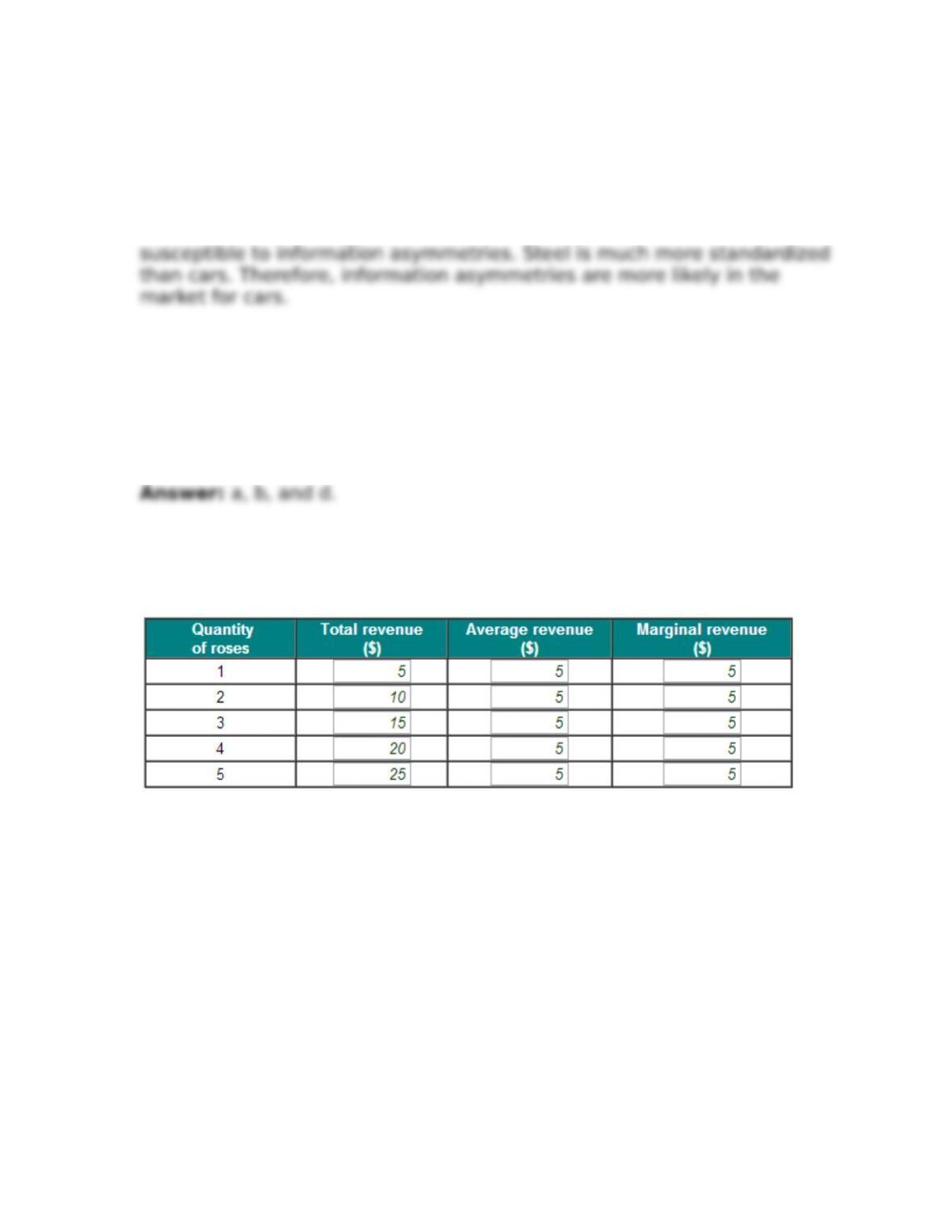
4. Darla sells roses in a competitive market where the price of a rose is $5.
Use this information to fill out the revenue columns in Table 13P-1. [LO 13.2]
Answer:
13-11
Copyright © 2018 McGraw-Hill Education. All rights reserved. No reproduction or distribution without the prior written consent of McGraw-Hill
Education.