
Chapter 12 – The Costs of Production
CHAPTER 12
THE COSTS OF PRODUCTION
Chapter Overview
In this chapter, we’ve explored the costs that all firms face when they
produce goods or services. Understanding the relationship between inputs,
outputs, and costs is crucial because costs, along with the firm’s revenues,
determine profits. The pursuit of profits, of course, drives every firm’s
decision-making process, including how much to produce and whether to
stay in business.
Over the next few chapters, we’ll continue to dig into the details of firm
behavior that determine the market supply curve. Hold onto your
understanding of production functions, di$erent types of costs, and ways of
calculating profits. We’ll build on them as we continue to describe firm
choices and market structures.
Learning Objectives
LO 12.1: Define total revenue, total cost, and profit.
LO 12.2: Explain the difference between fixed and variable costs, and give
examples of each.
LO 12.3: Explain the difference between explicit and implicit costs, and give
examples of each.
LO 12.4: Calculate economic and accounting profit, and explain the
importance of the difference.
LO 12.5: Define marginal product, and show why there is diminishing
marginal product.
LO 12.6: Define and graph total cost, average costs, and marginal cost.
LO 12.7: Explain why firms face di$erent costs in the long run than in the
short run.
LO 12.8: Understand what economies and diseconomies of scale are and
their implications for production decisions.
Chapter Outline
OPENING STORY: WHAT ARE YOU PAYING FOR IN THAT PRESCRIPTION?
The Building Blocks of Business: Revenues, Costs, and Profits
Profit Is Revenue Minus Costs (LO 12.1)
Fixed and Variable Costs (LO 12.2)
BOX FEATURE: FROM ANOTHER ANGLE – THE “PRODUCTION” OF KIDS
Explicit and Implicit Costs (LO 12.3)
Economic and Accounting Profit (LO 12.4)
BOX FEATURE: FROM ANOTHER ANGLE – BEYOND THE BOTTOM LINE
12-1
Copyright © 2018 McGraw-Hill Education. All rights reserved. No reproduction or distribution without the prior written consent of McGraw-Hill
Education.
Chapter 12 – The Costs of Production
Production Functions
Marginal Product (LO 12.5)
Cost Curves
Total, Average, and Marginal Costs (LO 12.6)
Production in the Short Run and the Long Run
Costs in the Long Run (LO 12.7)
Economies and Diseconomies of Scale (LO 12.8)
BOX FEATURE: REAL LIFE – WALMART AND ECONOMIES OF SCALE
BOX FEATURE: WHAT DO YOU THINK? – THE PROFIT MOTIVE AND “ORPHAN”
DRUGS
Beyond the Lecture
Class Activity/ Discussion: Pro*t Is Revenue minus Costs, Fixed and
Variable Costs
(LO 12.1, LO 12.2)
Have students get into small groups and consider the cost of opening a
restaurant. Ask them to list all of the primary costs that they would incur as a
new startup and then the ongoing costs of operating a restaurant. This
article provides examples of the costs associated with opening a restaurant.
This activity can serve as an introduction to the topic of costs.
1. What costs are associated with starting and operating a restaurant?
2. Which of these are fixed and which are variable?
3. What is the opportunity cost involved?
Class Media: Pro*t Is Revenue Minus Costs, Fixed and Variable Costs
(LO 12.1, LO 12.2)
Have students view this brief clip from the TV show Seinfeld, where Kramer
and Newman try to drive bottles from New York (where the bottle deposit is
$0.05) to Michigan (where the bottle deposit is $0.10). This scene highlights
both fixed and opportunity costs. A link below to The Economics of Seinfeld
discusses the clip while the second link shows the Seinfeld episode.
Class Discussion: The relationship between average and margin. [LO
12.5, LO 12.6]
It’s often diHcult to conceptualize the average product and marginal product
“hill shaped” graphs, as well as the U-shapes of the ATC, AVC, and MC
functions. Rather than having students memorize statements about what
the average will do relative to the margin, teach them the useful phrase “the
average follows the margin”. Then, ask them the following questions:
1. If Stephen Curry (NBA player) averages 30 points a game, but then has
an amazing game in which he scores 55 points, did he bring his
average up or down?
2. If a student has a grade average of 90% but then scores 70% on the
exam, did his average go up or down?
12-2
Copyright © 2018 McGraw-Hill Education. All rights reserved. No reproduction or distribution without the prior written consent of McGraw-Hill
Education.
Chapter 12 – The Costs of Production
Students may be more used to thinking about averages and margins, even
though they might not realize it. Understanding their intuitive use in sports
and GPA can help them understand it in costs and productivity with firms.
Class Activity / Discussion: Returns to Scale (LO 12.8)
Ask your students if they think their college/University is experiencing
economics of scale, constant returns to scale, or diseconomies of scale. This
can give good insight into how students feel about the size and/or eHciency
of their higher education provider. To play devil’s advocate, try and locate a
University employee with a job title such as “Vice Provost of Student A$airs”,
or any other really bureaucratic job title. Ask the students the following
questions:
1. Does this person create costs for the University?
2. Does this person generate output for the University by teaching?
3. Does this person increase or decrease average costs of education by
being here?
Clicker Questions
There are three main purposes to clicker questions. First, they are a great
way to do a quick and instant “on demand” test of student understanding of
the material. You can cover material, and instantly get feedback on student
comprehension. You can see whether you need to explain certain topics
again, or move on to the next subject. Second, they are a great method to
break up the class and take a moment away from lecture. It gets the
students actively involved. Finally, certain clicker questions can be framed in
a “discussion” manner, in which you can invite students to talk about the
possible right answer with their peers. You can instruct students to convince
their classmate of a right or wrong answer.
1. Suppose you own a bakery and sell baked goods. The costs of dough
would be considered [LO 12.2, LO 12.3]
A. Fixed and explicit
Feedback: Variable since the costs will rise as you make more baked goods.
Explicit because it is an out-of-pocket expense that you must pay for.
2. Economic profit will be _________ than accounting profit because_______.
[LO 12.4]
A. smaller; economic profit ignores fixed costs
12-3
Copyright © 2018 McGraw-Hill Education. All rights reserved. No reproduction or distribution without the prior written consent of McGraw-Hill
Education.
Chapter 12 – The Costs of Production
Feedback: Profit is revenue minus costs. When more costs are considered,
you’re subtracting out more, leaving less for profit.
3. Which of the following phrases most accurately describes the relationship
between the average and the margin? [LO 12.5, LO 12.6]
A. “The average is always above the margin”
Feedback: Tricky question. The answer [C] is incorrect because the margin
can be rising but still be below the average. In this case, the average would
still fall. We see this with the cost function graph. When MC starts to rise, it
is still below AVC and ATC, and these average functions will still be downward
sloping at this point.
4. Which of the following phrases best describes the concept and intuition of
diminishing marginal product of labor? [LO 12.5]
A. “People get lazy when they work with friends”
Feedback: Too much labor per unit of capital and labor productivity starts
to fall. Workers can’t suHciently find tasks to complete or specialize in.
5. “Economies of scale” means that firms [LO 12.7, LO 12.8]
D. become large enough to be a publicly traded company
Feedback: Be careful to note that average costs go down, not total. There
is no such thing as total costs decreasing as a result of higher output. That
would mean negative marginal costs.
Solutions to End-of-Chapter Questions and Problems
Review Questions
12-4
Copyright © 2018 McGraw-Hill Education. All rights reserved. No reproduction or distribution without the prior written consent of McGraw-Hill
Education.
Chapter 12 – The Costs of Production
1. Economists assume that firms have a goal to maximize profits. Is this a
reasonable assumption for not-for-profit organizations? [LO 12.1]
Answer: Yes. Although a not-for-profit organization uses its profits to
achieve the goals outlined in its mission rather than distributing profits to
owners and investors, it is reasonable to assume that such organizations
2. Suppose you are evaluating the profit earned by a pharmaceutical
company that produces three different medicines. What information will help
you determine the company’s revenue? What information will help you
determine the company’s total cost? [LO 12.1]
Answer: Profit is calculated as total revenue minus total cost. The
3. Suppose that a pharmaceutical company’s costs include researchers’
salaries, chemicals, warehouses, and paper and plastic packaging. Which of
these costs do you expect to be fixed in the short run, and which variable?
[LO 12.2]
Answer: You would expect researchers’ salaries and warehouses to be
4. Dustin is planning to open a catering business. Give examples of a one-
time fixed cost, an ongoing fixed cost, and a variable cost his new catering
business might incur. [LO 12.2]
Answer: A one-time fixed cost for Dustin’s catering business might be a
12-5
Copyright © 2018 McGraw-Hill Education. All rights reserved. No reproduction or distribution without the prior written consent of McGraw-Hill
Education.
Chapter 12 – The Costs of Production
5. A shopkeeper explains to you that she keeps down the cost of running her
business because her husband works in the shop for free. Is her worker really
free? Explain why or why not. [LO 12.3]
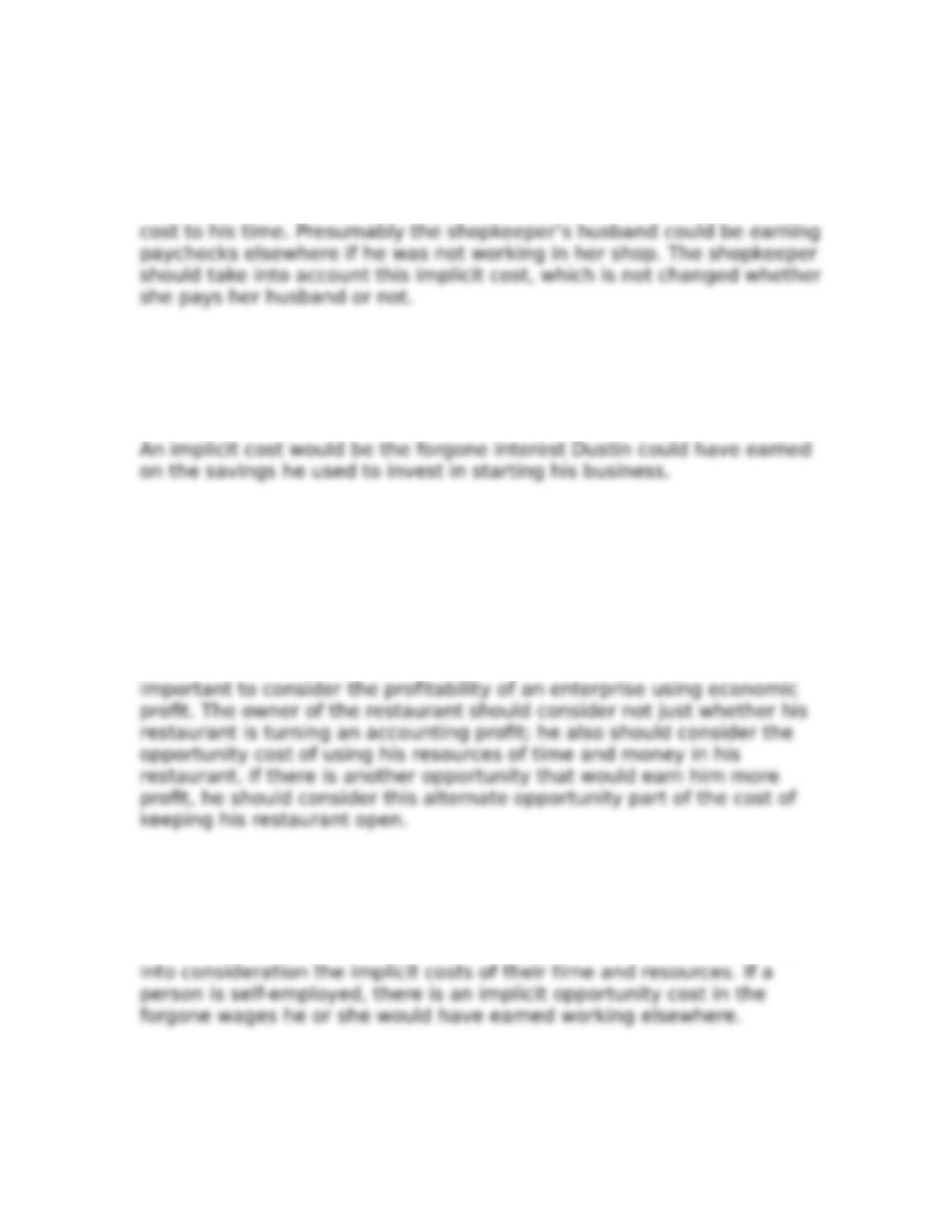
Answer: Her worker is not really free because there is an opportunity
6. Dustin is planning to open a catering business. Give examples of an
explicit cost and an implicit cost his new catering business might incur. [LO
12.3]
Answer: An explicit cost would be the wages Dustin pays his employees.
7. Imagine you’re in a meeting with the owner of a restaurant, who is trying
to decide whether to keep his restaurant open or to invest his time and
money in another way. Explain to him the di$erence between accounting and
economic profit, and why it should matter for his decision. [LO 12.4]
Answer: Accounting profit and economic profit both calculate revenues
the same way. However, accounting profit considers only explicit costs,
while economic profit considers both explicit and implicit costs. It is
8. Explain why self-employed business owners frequently overestimate their
profit levels. [LO 12.4]
Answer: Self-employed business owners often overestimate their profit
levels because they calculate accounting profits and do not always take
9. Imagine a restaurant in which tables are spread over a large area, and
there is only one wait-person. Explain to the manager why there might be
12-6
Copyright © 2018 McGraw-Hill Education. All rights reserved. No reproduction or distribution without the prior written consent of McGraw-Hill
Education.
Chapter 12 – The Costs of Production
increasing marginal product of labor associated with hiring a second
waitperson. [LO 12.5]
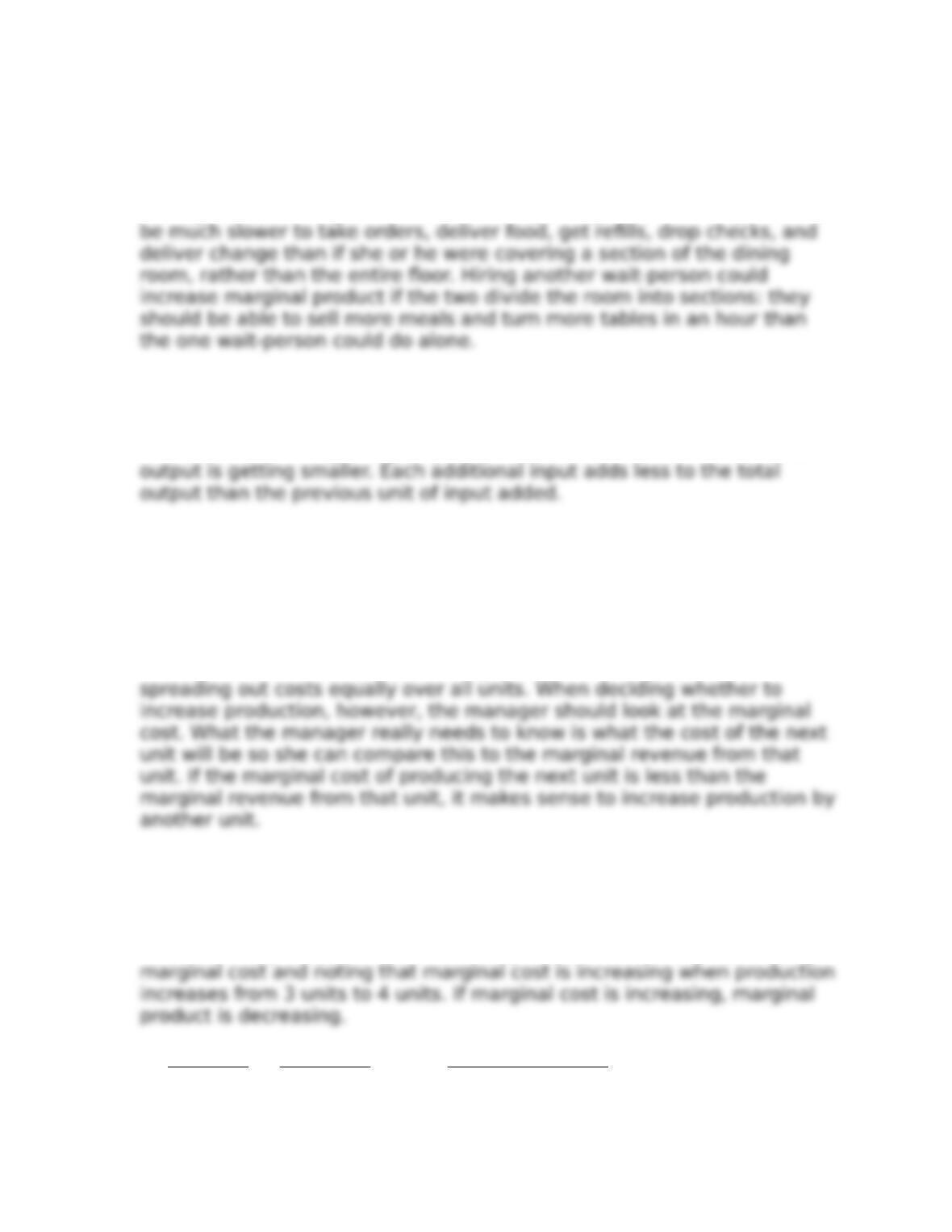
Answer: Hiring only one wait-person means that she or he has to cover a
lot of ground in a large restaurant. Working along, the one wait-person will
10. If a firm experiences diminishing marginal product, does this mean
that total output decreases? Explain. [LO 12.5]
Answer: Diminishing marginal product means that the increase in total
11. A firm is trying to decide whether it could earn higher profits by
increasing its output. Explain to the firm’s manager why she needs to
consider the marginal cost and the marginal revenue of the next unit of
output to make this decision, rather than average costs. [LO 12.6]
Answer: Looking at average total cost, average variable cost, and
average fixed cost will tell the manager the cost of a typical unit,
12. A firm’s output and total costs are given in Table 12Q–1. Going from a
quantity of 3 to a quantity of 4, is marginal product increasing or decreasing?
How can you tell? [LO 12.6]
Answer: Marginal product is decreasing. We can see this by calculating
Quantity Total Cost ($) Marginal Cost ($)
0 40
1 64 24
12-7
Copyright © 2018 McGraw-Hill Education. All rights reserved. No reproduction or distribution without the prior written consent of McGraw-Hill
Education.
Chapter 12 – The Costs of Production
13. Explain the statement, “In the long run, there are no fixed costs.” [LO
12.7]
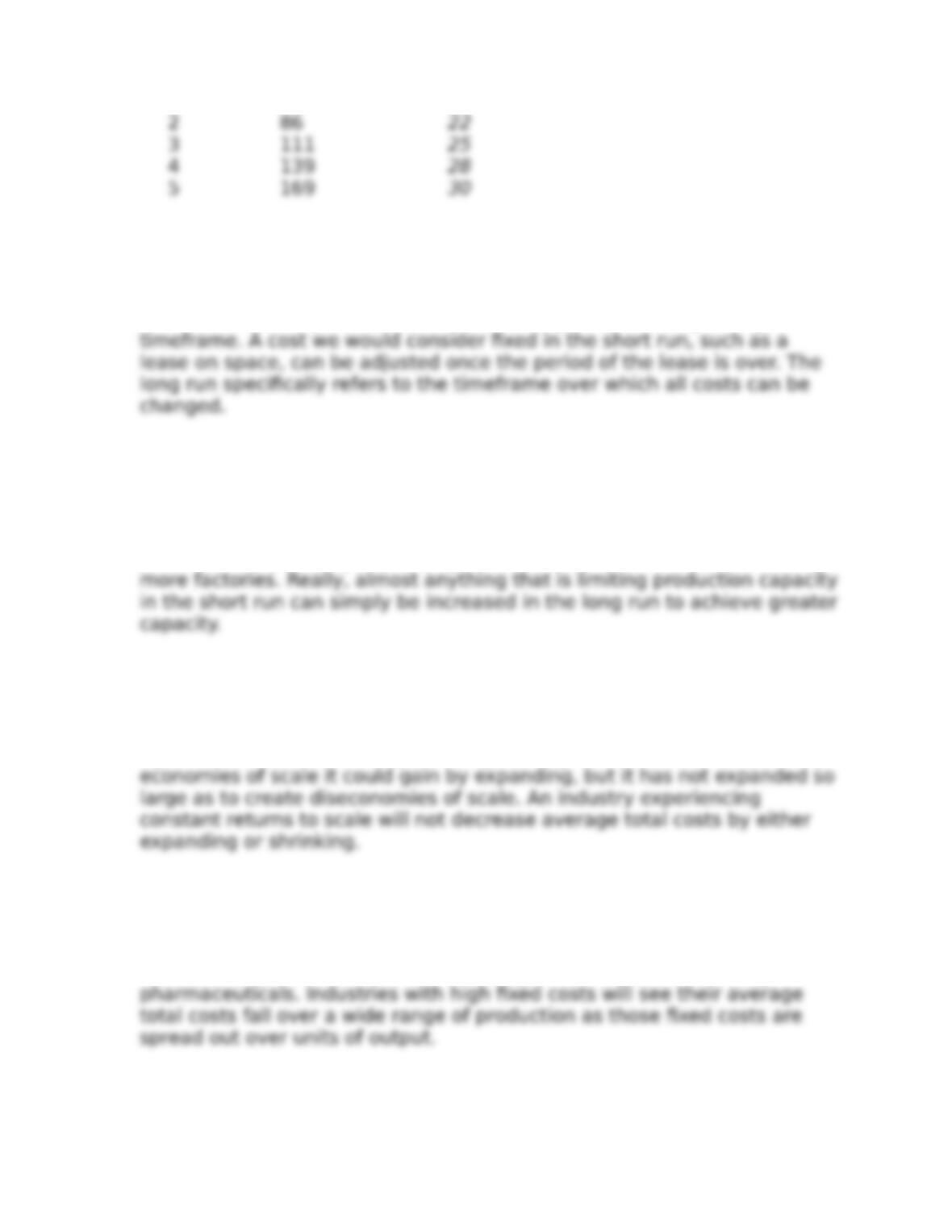
Answer: The statement, “In the long run, there are no fixed costs,” refers
to the fact that any kind of cost can be changed over a long enough
14. Suppose that a pharmaceutical company wants to grow in size, but is
constrained in the short run by its production capacity. Describe some steps
that it can take in the long run to overcome these constraints. [LO 12.7]
Answer: In the long run, the pharmaceutical company can increase its
production capacity by expanding the size of current factories or building
15. Explain why an industry experiencing constant returns to scale is “just
the right size.” [LO 12.8]
Answer: An industry experiencing constant returns to scale is just the
right size because it is has grown large enough that it has exhausted any
16. Explain why the pharmaceutical industry is characterized by large
economies of scale. [LO 12.8]
Answer: The pharmaceutical industry is characterized by large
economies of scale because there are high fixed costs in producing
Problems and Applications
12-8
Copyright © 2018 McGraw-Hill Education. All rights reserved. No reproduction or distribution without the prior written consent of McGraw-Hill
Education.
Chapter 12 – The Costs of Production
1. A hair salon offer three services: haircuts, color treatments, and styling.
The salon charges $40 for a cut, $65 for a color treatment, and $30 for
styling. Last month, the salon sold 68 haircuts, 34 color treatments, and 22
styling sessions. If the salon’s costs for the month totaled $2,843, what was
its profit? [LO 12.1]
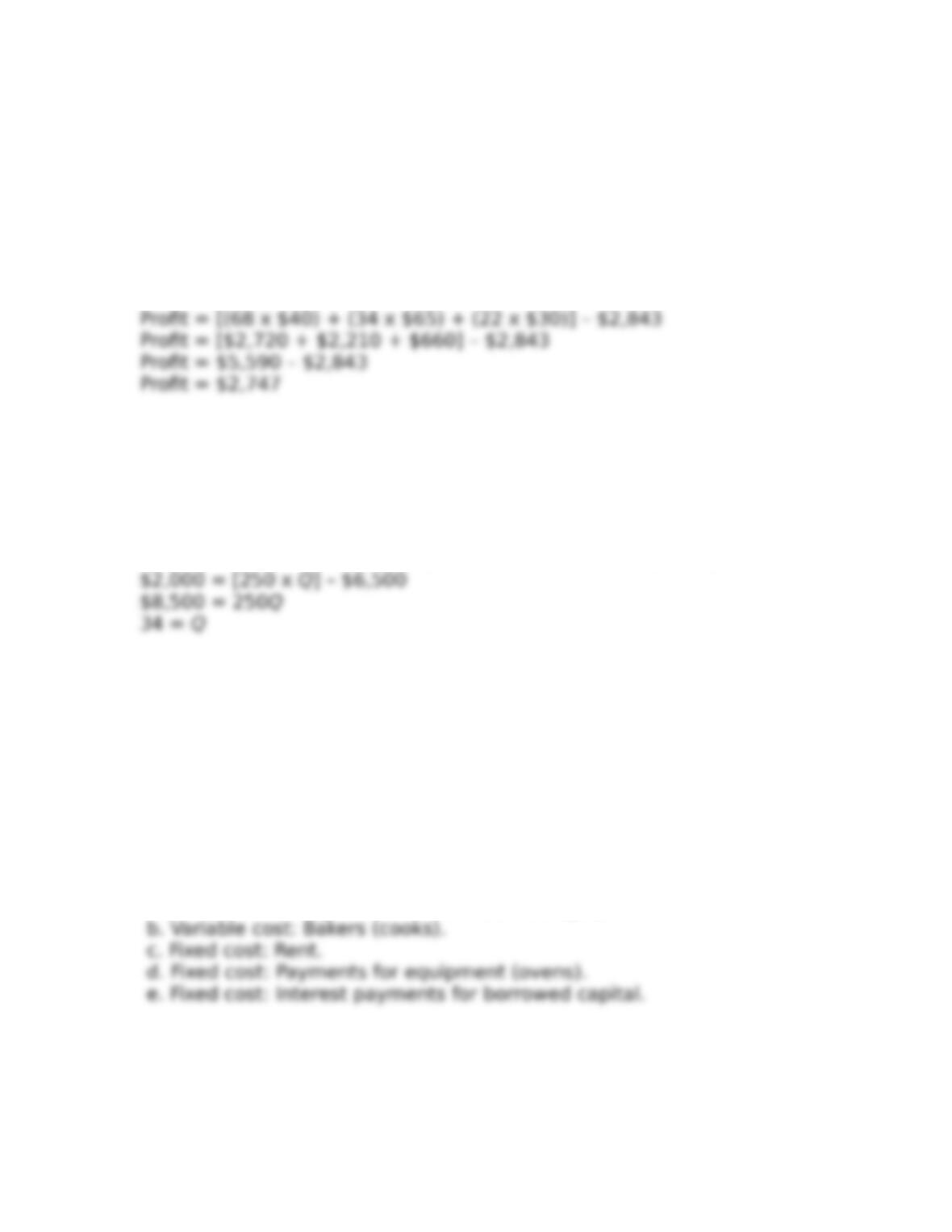
Answer: Total revenue = (Q1 x P1) + (Q2 x P2) + … + (Qn x Pn). Profit =
Total revenue – Total cost.
For the hair salon, then:
2. Lisa is a self–employed physical therapist who works from a rented space.
Lisa charges $250 for a therapy session. She incurred the following costs last
month: space and equipment rental, $1,200; wages, $3,500; materials,
$1,800. If Lisa’s profit last month was $2,000, how many clients did she see?
[LO 12.1]
Answer: Lisa saw 34 clients. Profit = Total revenue – Total cost.
3. Kat runs a cake shop. Her monthly expenses are listed below. For each
cost, indicate whether the cost is a fixed cost or a variable cost of producing
cakes in the short run. [LO 12.2]
a. Ingredients (Tour, butter, sugar).
b. Bakers (cooks).
c. Rent.
d. Payments for equipment (ovens).
e. Interest payments for borrowed capital.
Answer: Variable costs depend on the quantity of output produced. Fixed
costs do not depend on the quantity of output produced.
a. Variable cost: Ingredients (Tour, butter, sugar).
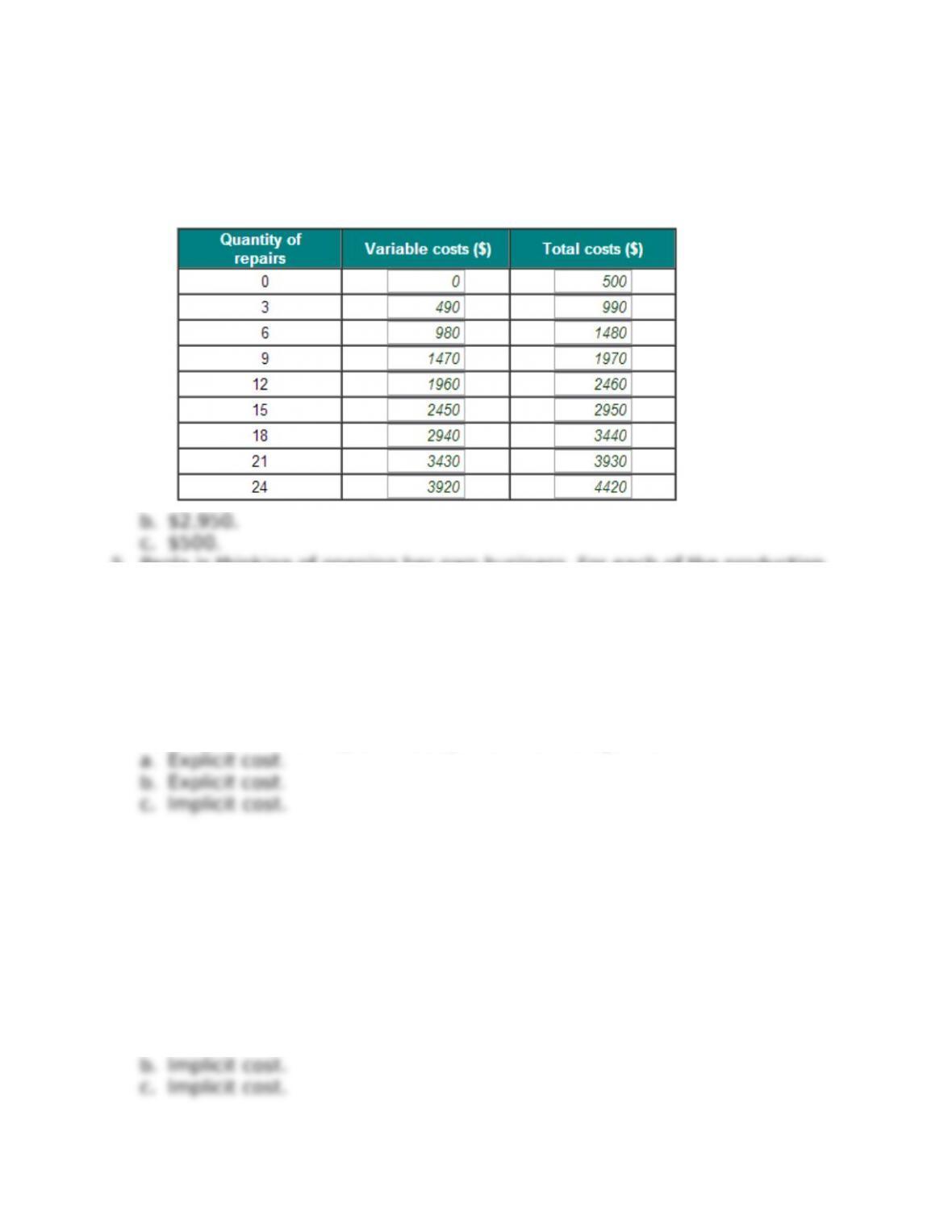
4. An auto-repair shop faces the following weekly costs: rent, $500; labor,
$400 per worker; parts and supplies, $30 per repair. Each worker can repair
three cars per week. [LO 12.2]
a. Fill in the costs in Table 12P-1.
12-9
Copyright © 2018 McGraw-Hill Education. All rights reserved. No reproduction or distribution without the prior written consent of McGraw-Hill
Education.
Chapter 12 – The Costs of Production
b. What are the total costs if the shop repairs 15 cars in a week?
c. What are the total costs if the shop repairs 0 cars in a week?
Answer:
a.
5. Paola is thinking of opening her own business. For each of the production
inputs listed below, indicate whether the input incurs an implicit cost, explicit
cost, or no cost. [LO 12.3]
a. Rent.
b. Wages.
c. Owned equipment.
Answer: Explicit costs require a firm to spend money. Implicit costs do
not require a firm to spend money or take on obligations.
6. Paola is thinking of opening her own business. For each of the production
inputs listed below, indicate whether the input incurs an implicit cost, explicit
cost, or no cost. [LO 12.3]
a. Borrowed capital.
b. Investment from savings.
c. Donated supplies.
Answer: Explicit costs require a firm to spend money. Implicit costs do
not require a firm to spend money or take on obligations.
a. Explicit cost.
12-10
Copyright © 2018 McGraw-Hill Education. All rights reserved. No reproduction or distribution without the prior written consent of McGraw-Hill
Education.
Chapter 12 – The Costs of Production
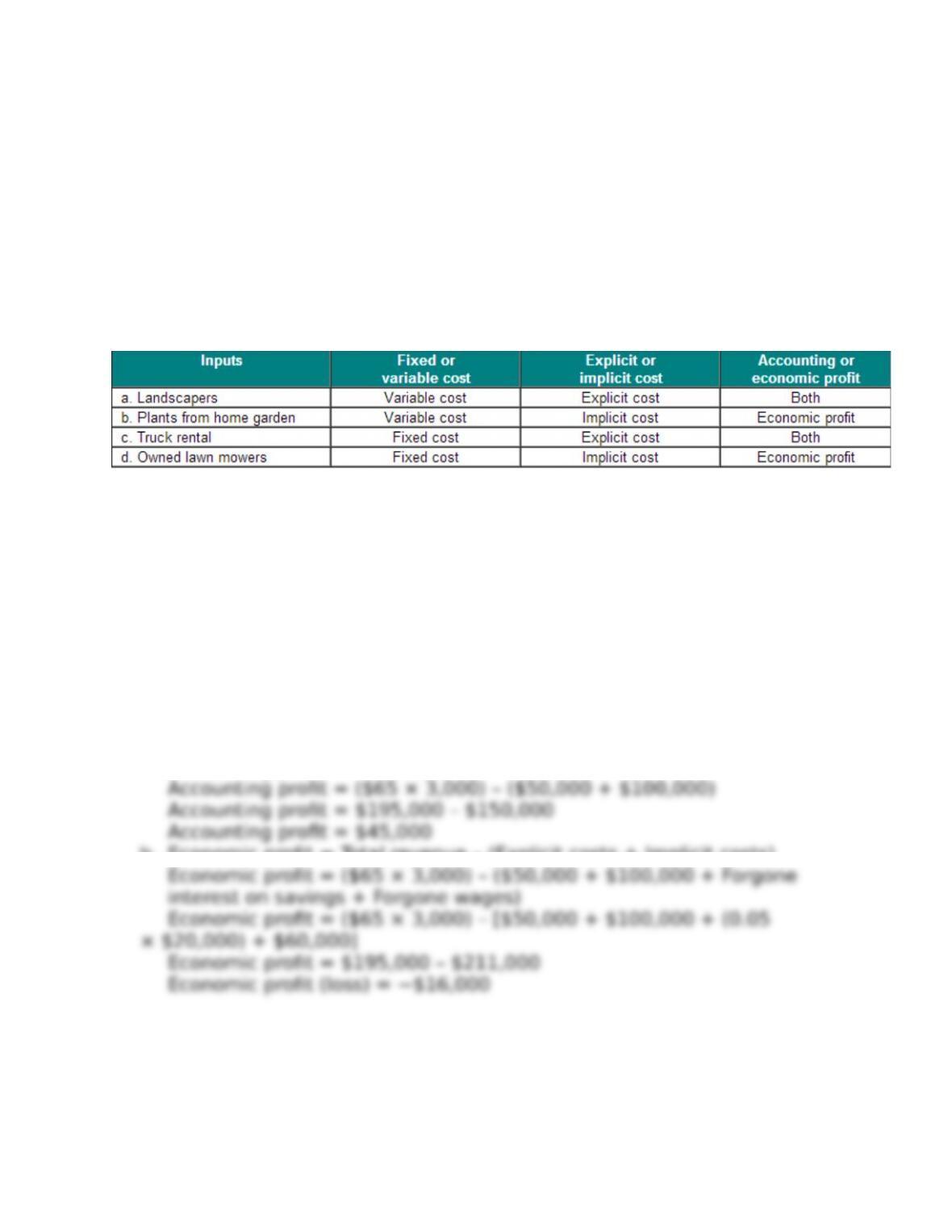
7. Keri owns a landscaping business. For each of Keri’s inputs given in the list
below, indicate whether the associated cost is fixed or variable, whether it is
explicit or implicit, and whether the cost affects accounting profit only,
economic profit only, or both. [LO 12.2, 12.3, 12.4]
a. Landscapers.
b. Plants taken from her home garden.
c. Truck rental.
d. Owned lawn mowers.
Answer:
8. Last year, Jarod left a job that pays $60,000 to run his own bike-repair
shop. Jarod’s shop charges $65 for a repair, and last year the shop performed
3,000 repairs. Jarod’s production costs for the year included rent, wages, and
equipment. Jarod spent $50,000 on rent and $100,000 on wages for his
employees. Jarod keeps whatever profit the shop earns, but does not pay
himself an oHcial wage. Jarod used $20,000 of his savings to buy a machine
for the business. His savings were earning an annual interest rate of 5
percent. [LO 12.4]
a. What is Jarod’s annual accounting profit?
b. What is Jarod’s annual economic profit?
Answer:
a. Accounting profit = Total revenue – Explicit costs
b. Economic profit = Total revenue – (Explicit costs + Implicit costs)
9. If adding an additional input does not produce additional output, what is
the slope of the production function at this point? [LO 12.5]
12-11
Copyright © 2018 McGraw-Hill Education. All rights reserved. No reproduction or distribution without the prior written consent of McGraw-Hill
Education.
Chapter 12 – The Costs of Production
Answer: The production function is a ratio of inputs to outputs. If adding
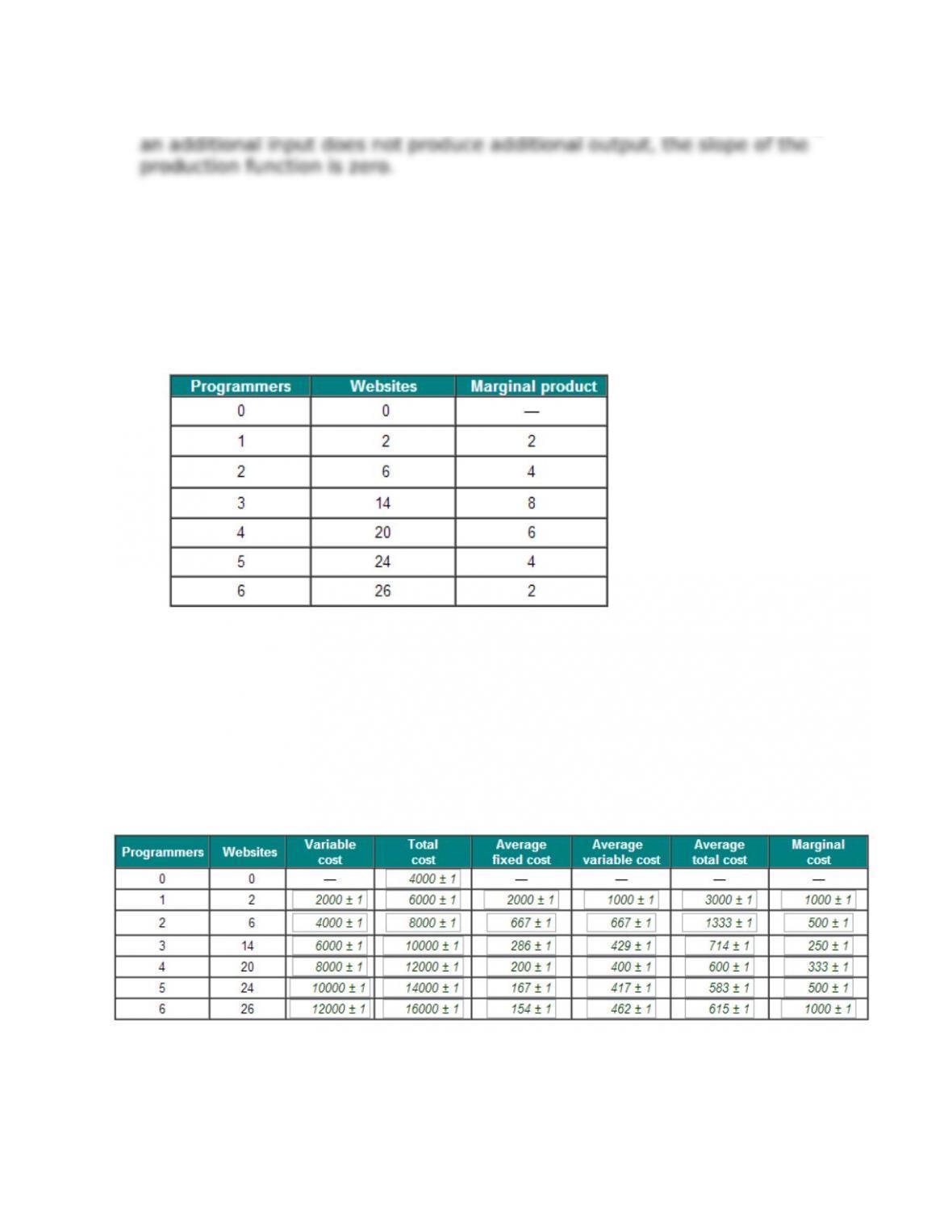
10. Webby Inc. is a web development company. Webby’s monthly
production function for developing websites is given in Table 12P-2. [LO
12.5]
a. Fill in the marginal product column.
b. After which programmer does marginal product diminish?
Answer:
a.
b. Marginal product decreases from 8 with 3 programmers to 6 with 4
programmers, so marginal product diminishes after the third programmer.
11. Webby Inc. is a web development company. Webby’s monthly
production function for developing websites is given in Table 12P-3. Webby
pays $4,000 a month in rent for oHce space and equipment. It pays each
programmer $2,000 a month. There are no other production costs. Fill in the
table of production costs. [LO 12.6]
Answer:
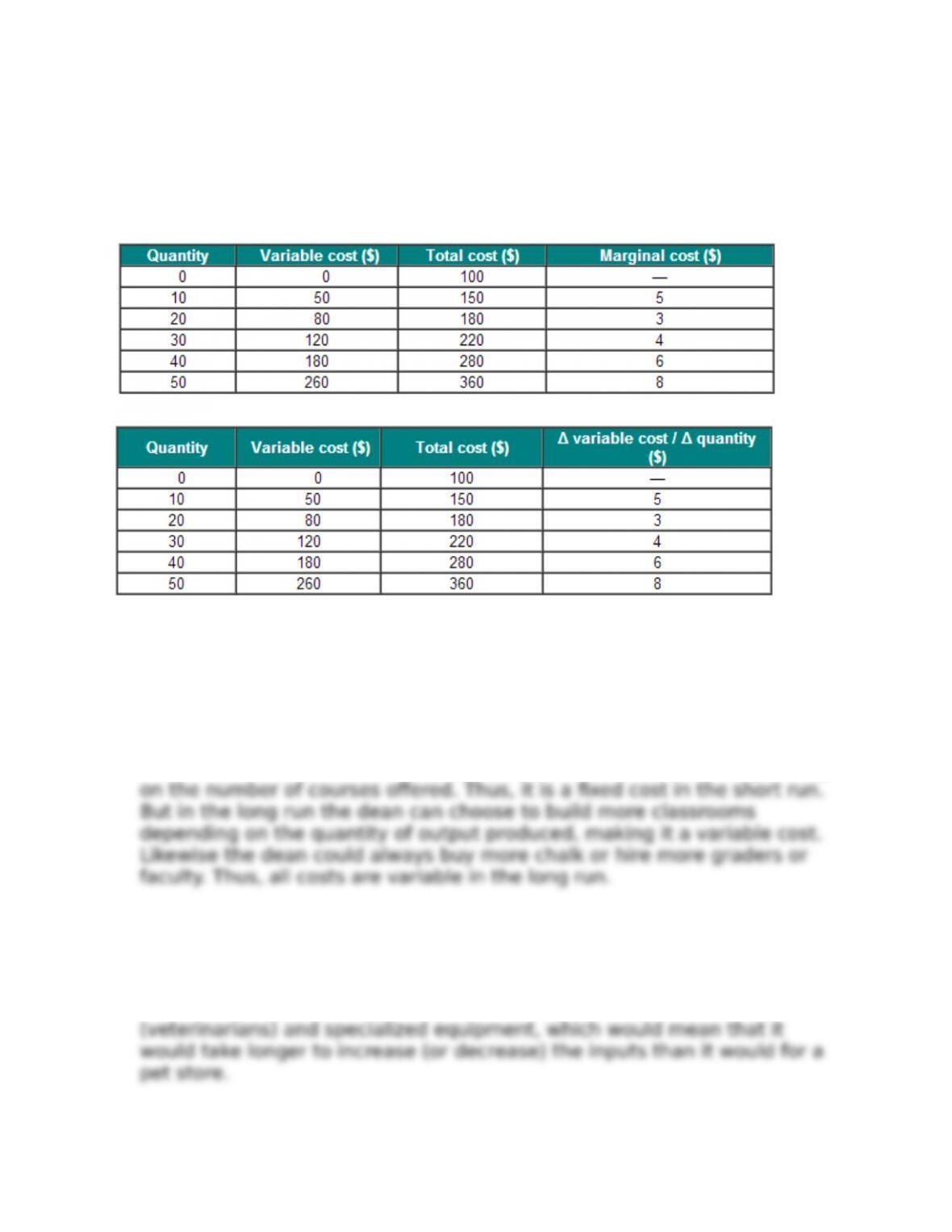
12. A firm’s output, variable costs, and total costs are given in Table 12P-4.
[LO 12.6]
12-12
Copyright © 2018 McGraw-Hill Education. All rights reserved. No reproduction or distribution without the prior written consent of McGraw-Hill
Education.
Chapter 12 – The Costs of Production
a. Calculate marginal cost using the formula given in the chapter: change in
total cost divided by change in quantity.
b. Calculate change in variable cost divided by change in quantity.
Answer:
a.
b.
13. The dean of a college faces the following costs: graders, faculty,
classroom space, and chalk. Of these costs, which are likely to be variable in
the long run? [LO 12.7]
Answer: The long run is a period of time in which a firm can vary all of its
costs, if it wants to. For example, in the short run classroom space is
limited to the facilities that exist on campus. It will not change depending
14. In the pet industry, would you expect the long run to be longer for a
pet store or a veterinary clinic? [LO 12.7]
Answer: You would expect the long run to be longer for a veterinary clinic
than for a pet store. A veterinary clinic has specialized labor
12-13
Copyright © 2018 McGraw-Hill Education. All rights reserved. No reproduction or distribution without the prior written consent of McGraw-Hill
Education.
Chapter 12 – The Costs of Production
15. Consider a firm that increases its inputs by 15 percent. For each
scenario, state whether the firm experiences economies of scale,
diseconomies of scale, or constant returns to scale. [LO 12.8]
a. Outputs increase 15 percent.
b. Outputs increase by less than 15 percent.
c. Outputs increase by greater than 15 percent.
Answer:
a. Constant returns to scale.
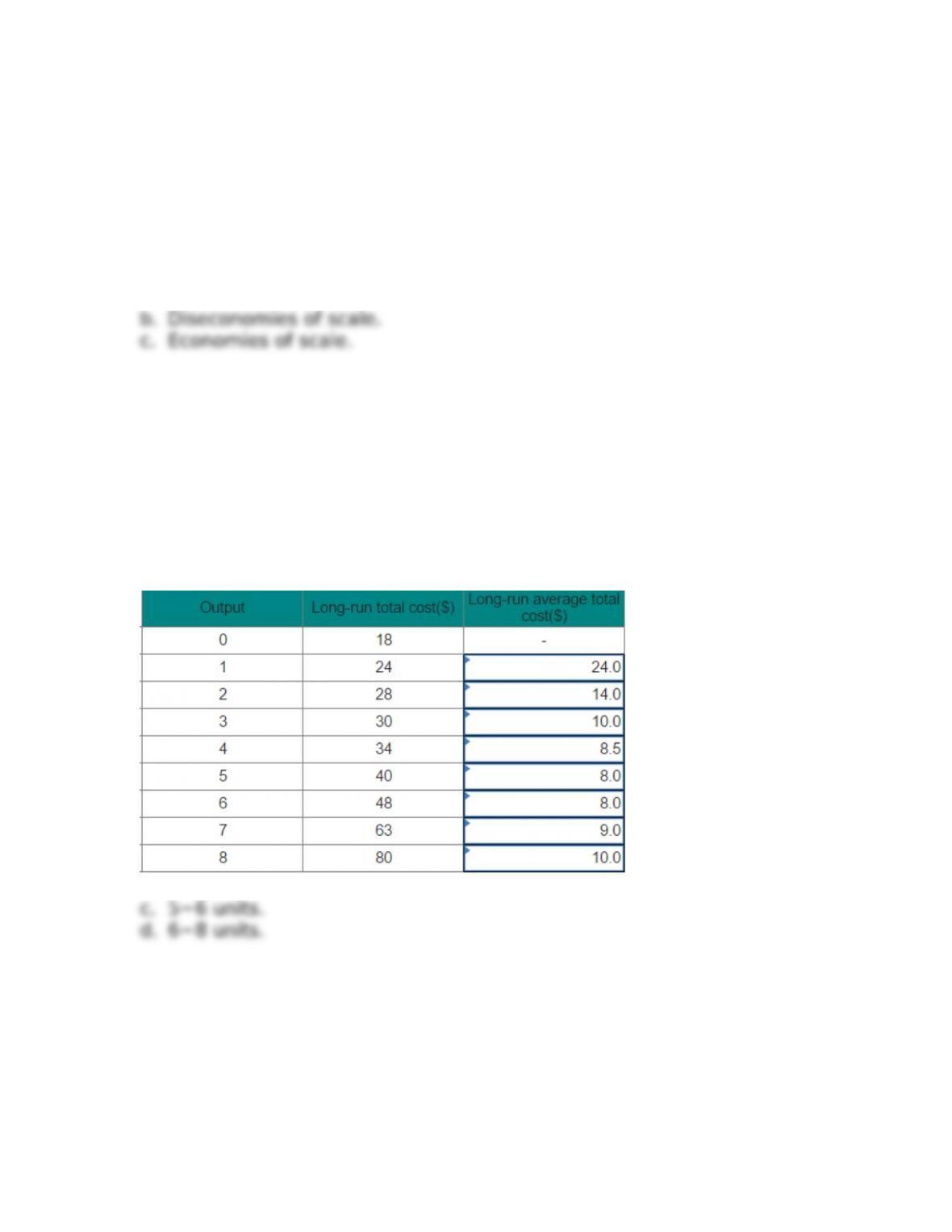
16. A firm’s long-run total costs are given in Table 12P-5. [LO 12.8]
a. Fill in the long-run average total cost column.
b. Over what production range does this firm experience economies of scale?
c. Over what production range does this firm experience constant returns to
scale?
d. Over what production range does this firm experience diseconomies of
scale?
Answer:
a.
b. 0−5 units.
12-14
Copyright © 2018 McGraw-Hill Education. All rights reserved. No reproduction or distribution without the prior written consent of McGraw-Hill
Education.