Chapter 11 – Time and Uncertainty
1. Many individuals prefer to have insurance (health insurance, car
insurance, etc.) rather than not, even if the expected value of their wealth is
higher without insurance. What does this imply about their willingness to
take on risk? [LO 11.5]
Answer: Not having insurance can be very risky. There is a chance that
you might face very high costs if you have a car accident, need surgery,
2. Lenders tend to o&er lower interest rates to borrowers with high credit
scores and higher interest rates to borrowers with low credit scores. What
does this imply about lenders’ willingness to take on risk? [LO 11.5]
Answer: Just like individual people, businesses are also typically risk-
3. Alie is outraged when she hears that a company is o&ering insurance
against being attacked by zombies: “Zombies aren’t even real! This company
is just taking advantage of people.” Without acknowledging the possible
existence of zombies, provide an alternative perspective on the insurance
company’s ethics. [LO 11.6]
Answer: Some people are afraid of zombies and believe in the possibility
of a zombie attack. The insurance company may not be selling protection
4. Julia pays $1,200 for an insurance policy with an expected value of
$1,000. Explain why this is a rational choice for Julia. [LO 11.6]
Answer: Paying more for insurance than its expected value is a rational
5. Suppose that the crop yield of corn farmers in Iowa depends solely on
rainfall levels. Also suppose that every part of the state gets approximately
the same amount of rain as every other part in any given year. Will the corn
11-1
Copyright © 2018 McGraw-Hill Education. All rights reserved. No reproduction or distribution without the prior written consent of McGraw-Hill
Education.
Chapter 11 – Time and Uncertainty
farmers of Iowa be able to e&ectively use pooling to reduce their exposure to
risk? Why or why not? [LO 11.7]
Answer: The farmers will not be able to e&ectively pool their risk. Risk
pooling works only if everyone in the pool is paying premiums but not
6. An insurance company that faces 5erce competition from other providers
is considering a strategy to sell more policies by simplifying its portfolio and
becoming the expert in =ood insurance for the state. The company managers
reason, “Everyone buys =ood insurance in this state, so let’s focus our e&orts
on becoming the preferred provider.” Evaluate this strategy. [LO 11.7]
Answer: This strategy is risky for the insurance company. If everyone in
7. Suppose the economy is su&ering and many people are afraid they will be
laid o& from their jobs. Workers would like to protect against this risk with
insurance. Identify and explain two problems that prevent insurance
companies from o&ering layo& insurance. [LO 11.8]
Answer: Adverse selection: Individuals probably have more knowledge
about their own risk of layo& than does the insurance company. Those
8. BackPedal is a bike-rental shop that rents bicycles, helmets, and other
gear by the day. [LO 11.8]
a. BackPedal o&ers an optional helmet rental for $10/day with the rental of a
bicycle. To his surprise, the store manager has noticed that cycling accidents
are higher among customers who rent helmets than those who do not.
Explain this phenomenon using economic concepts. Assume that customers
who do not rent helmets also do not own helmets.
b. BackPedal is considering o&ering helmets for free with a bike rental.
Explain how this new policy will a&ect the issues you identified in part a.
Answer:
11-2
Copyright © 2018 McGraw-Hill Education. All rights reserved. No reproduction or distribution without the prior written consent of McGraw-Hill
Education.
Chapter 11 – Time and Uncertainty
a. Both moral hazard and adverse selection may be at play. In terms of
moral hazard, because cyclists feel safer when they are wearing a helmet,
b. Adverse selection will be reduced. O&ering helmets without charge will
cause many of the less-risky riders who may not have been willing to pay
Problems and Applications
1. Your bank o&ers 3 percent annual interest on savings deposits. If you
deposit $560 today, how much interest will you have earned at the end of
one year? [LO 11.1]
Answer: If you invest $560 for one year at 3 percent interest, you will
2. You have $350, which a friend would like to borrow. If you don’t lend it to
your friend, you could invest it in an opportunity that would pay out $392 at
the end of the year. What annual interest rate should your friend o&er you to
make you indi&erent between these two options? [LO 11.1]
Answer: In order to break even, you will need to receive $42 in interest.
This corresponds with a 12 percent interest rate.
3. If you deposit $500 in a savings account that o&ers 3 percent interest,
compounded annually, and you don’t withdraw any money, how much
money should you expect to have in the account at the end of three years?
[LO 11.2]
4. Suppose you run up a debt of $300 on a credit card that charges an
annual rate of 12 percent, compounded annually. How much will you owe at
the end of two years? Assume no additional charges or payments are made.
[LO 11.2]
11-3
Copyright © 2018 McGraw-Hill Education. All rights reserved. No reproduction or distribution without the prior written consent of McGraw-Hill
Education.
Chapter 11 – Time and Uncertainty
Answer: If you run up a debt of $300 on a credit card that charges 12
5. Your savings account currently has a balance of $32,300. You opened the
savings account two years ago and have not added to the initial amount you
deposited. If your savings have been earning an annual interest rate of 2
percent, compounded annually, what was the amount of your original
deposit? [LO 11.3]
Answer: If your savings account has a balance of $32,300 and has been
6. You run a business and are considering o&ering a new service. If you o&er
the new service, you expect it to generate $60,000 in pro5ts each year for
your business over the next two years. In order to o&er the new service, you
will need to take out a loan for new equipment. Assume a 5 percent annual
interest rate. [LO 11.3]
Answer: The present value of the pro5ts is: ($60,000 / 1.05) + ($60,000 /
7. You are driving home from work and get stuck in a traMc jam. You are
considering turning o& from your usual route home and taking a longer route
that might have less traMc. However, you know that there is some chance
that the traMc on your usual, shorter route will clear up. Based on Table 11P-
1, calculate the expected value (in minutes until you arrive home) of each
option. [LO 11.4]
Answer: The expected value of Route 1 is 39 minutes. The expected
value of Route 2 is 30 minutes. You should take route 2.
Route 1 Expected Value:
Route 2 Expected Value:
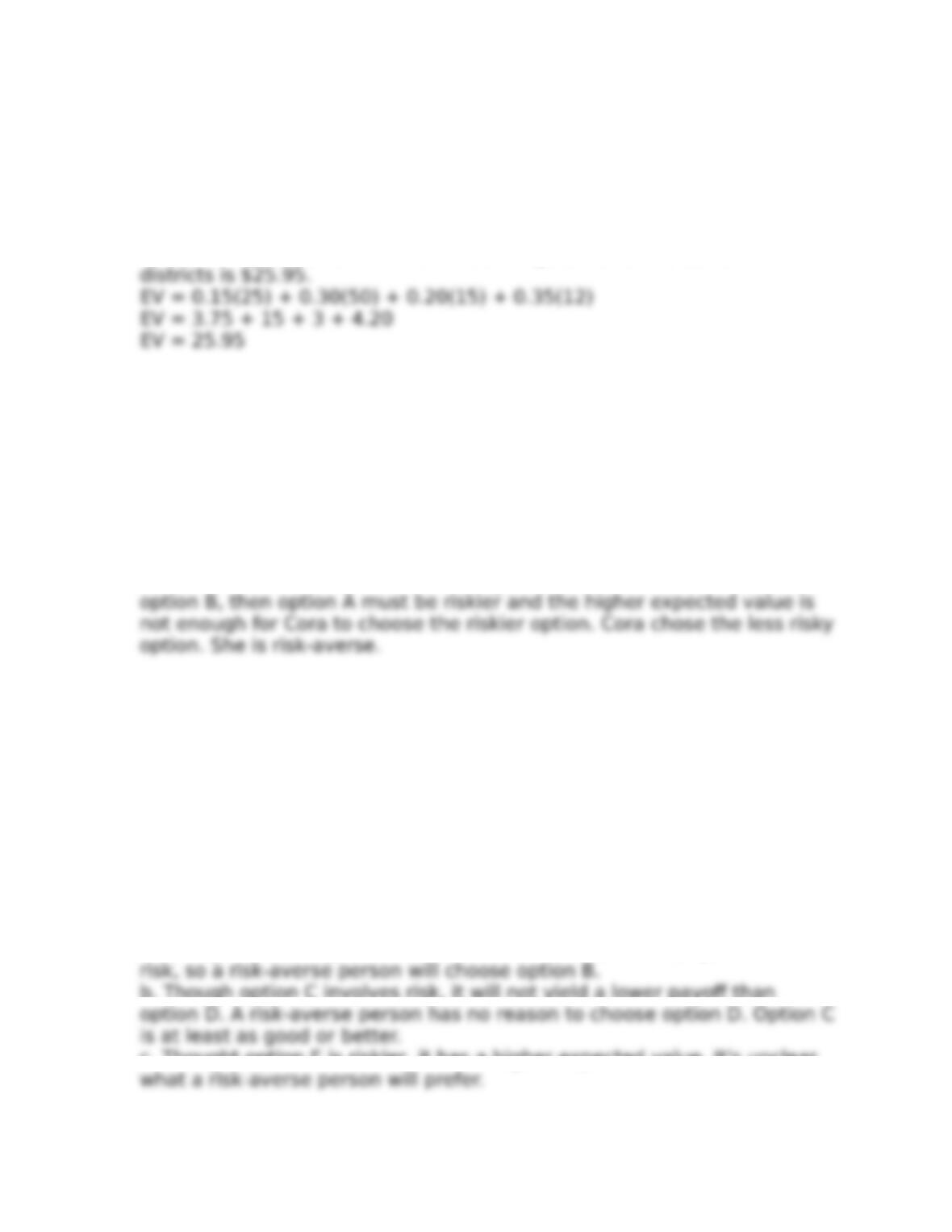
8. Books for Kids is a not-for-pro5t organization that runs after–school
reading programs in four school districts. Books for Kids is planning a fund-
11-4
Copyright © 2018 McGraw-Hill Education. All rights reserved. No reproduction or distribution without the prior written consent of McGraw-Hill
Education.
Chapter 11 – Time and Uncertainty
raiser to buy new books. Last time it held a fund-raiser, donors were allowed
to specify which district program they wanted to receive their donation. Table
11P-2 shows the average donations and the percent of all donations that
went to each district. Using the last fund-raiser as a projection, what is the
expected value of the average donation across all four programs? [LO 11.4]
Answer: The expected value of the average donation across all four
9. Cora had two options when buying car insurance. The expected value of
her wealth would be higher with Option A, but Cora chose option B. From the
list below, what can we assume about these policies and Cora’s willingness
to take on risk? Check all that apply. [LO 11.5]
a. Option B was riskier.
b. Option A was riskier.
c. Cora is risk-seeking.
d. Cora is risk-averse.
Answer: b and d. If option A had a higher expected value but Cora chose
10. Consider the following scenarios. For each scenario, determine whether
a risk averse person will definitely choose Option A, definitely choose Option
B, be indi&erent between Options A and B, or might choose either Option A
or B. [LO 11.5]
a. Option A: There is a 50% chance of winning $1,000 and a 50% chance of winning $0. Option
B: There is a 100% chance of receiving $500.
b. Option A: There is a 40% chance of winning $90 and a 60% chance of winning $110. Option
B: There is a 100% chance of winning $90.
c. Option A: There is a 50% chance of winning $0 and a 50% chance of winning $100. Option B:
There is a 50% chance of winning $20 and a 50% chance of winning $60.
Answer:
a. Though the two options have the same expected value, option B has no
b. Though option C involves risk, it will not yield a lower payo& than
c. Thought option E is riskier, it has a higher expected value. It’s unclear
11-5
Copyright © 2018 McGraw-Hill Education. All rights reserved. No reproduction or distribution without the prior written consent of McGraw-Hill
Education.
Chapter 11 – Time and Uncertainty
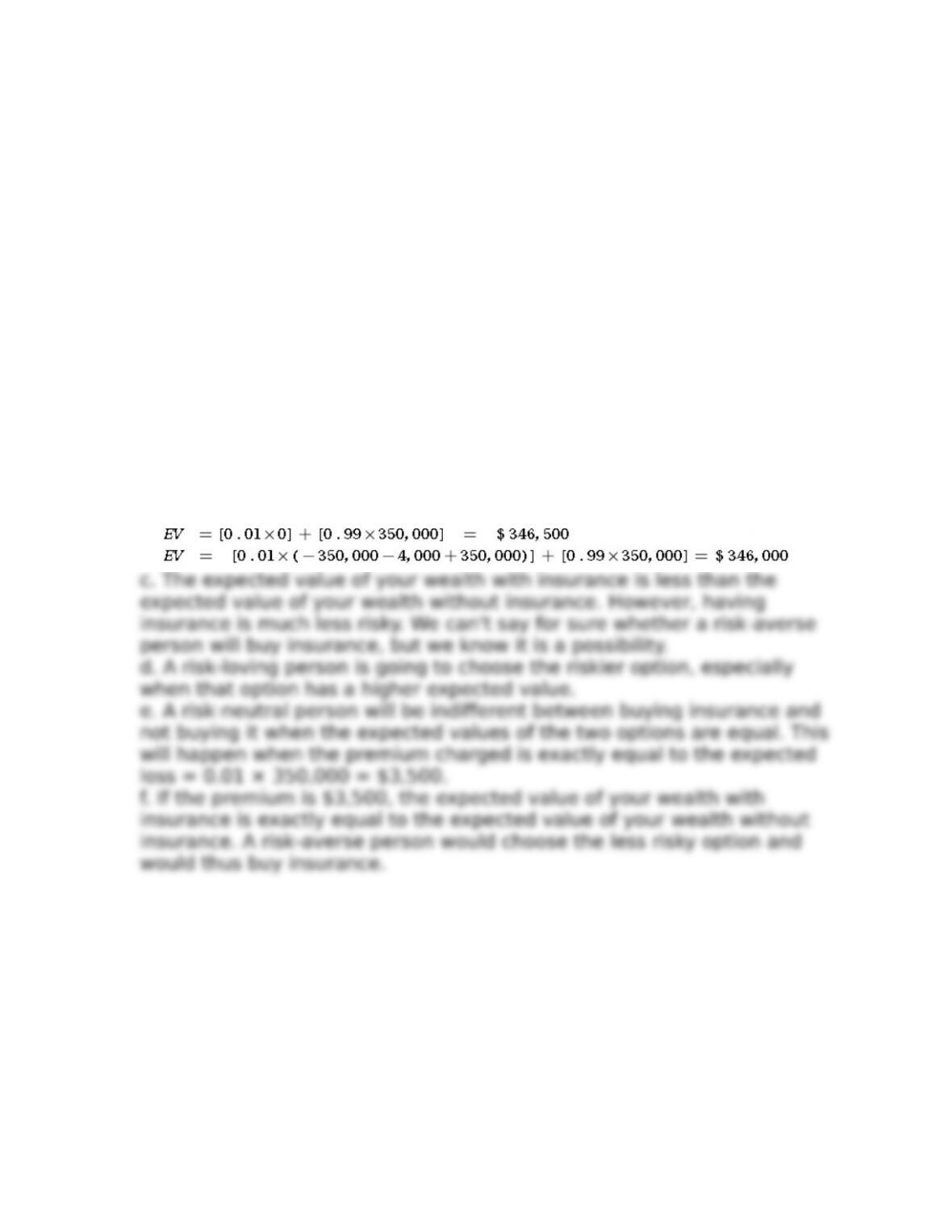
11. Suppose you own a beach house on a coast that has a small chance of
encountering a hurricane each year. There is a 1% chance that there will be a
hurricane this year that would completely destroy your $350,000 home.
(Assume that this home is the only store of wealth that you have.) An
insurance company has o&ered you insurance that would reimburse you the
entire value of your home in the event of a hurricane. The premium for this
insurance is $4,000. [LO 11.6]
a. What is the expected value of your wealth if you do not purchase
insurance?
b. What is the expected value of your wealth if you purchase the insurance at
a $4,000 premium?
c. Will a risk-averse person choose to purchase insurance?
d. Will a risk-seeking person choose to purchase insurance?
e. What would the premium have to be to make a risk-neutral person
indi&erent between buying the insurance and not buying the insurance?
f. If the insurance company o&ered the premium you found in part (e), would
a risk-averse person purchase insurance?
Answer:
a.
b.
12. You are considering buying one of two types of health insurance. You
guess that in the next year there is a 1 percent chance of serious illness that
will cost you $67,500 in health care; a 9 percent chance of a moderate illness
that will cost you $2,500; and a 90 percent chance of regular health care
needs that will cost you $500. One type of health insurance is emergency–
only coverage; it will cover your expenses for serious illness but not
moderate illness or regular care. The other type covers moderate illness and
regular expenses, but its payout is capped, so it will not cover the cost of a
serious illness. [LO 11.6]
11-6
Copyright © 2018 McGraw-Hill Education. All rights reserved. No reproduction or distribution without the prior written consent of McGraw-Hill
Education.
Chapter 11 – Time and Uncertainty
a. What is the expected value of payouts from the emergency-only
insurance?
b. What is the expected value of payouts from the capped-coverage
insurance?
c. Which option is a more risk-averse person likely to choose?
Answer:
a. EV = 0.01(67,500) = $675.
b. EV = 0.09(2,500) + 0.9(500) = $675.
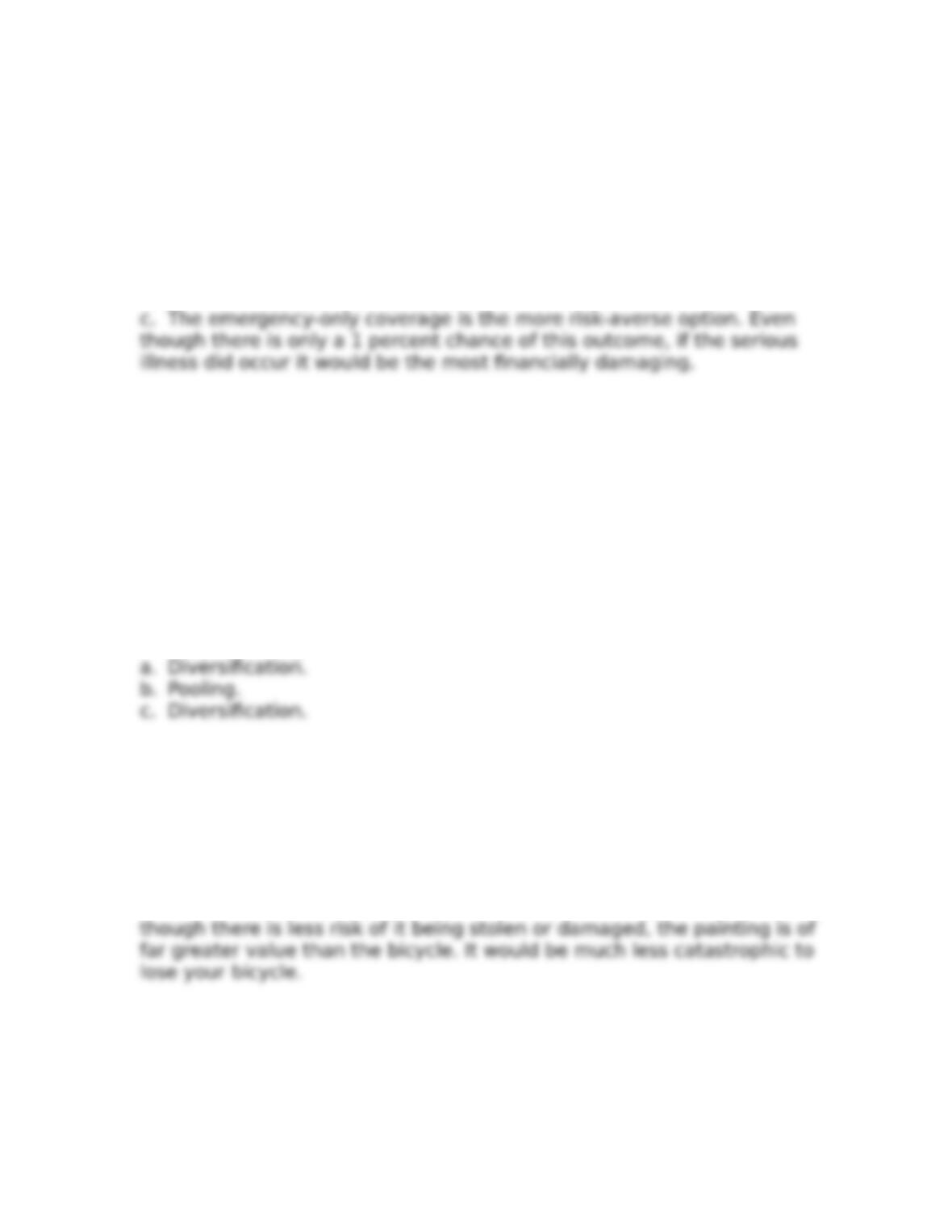
13. For each of the following scenarios, say whether pooling or
diversication is a more promising risk-mitigation strategy. [LO 11.7]
a. Employees of a company who invest their savings in that company’s
stocks.
b. Families who are worried about losing their possessions if their houses
burn down.
c. Neighboring farmers who grow the same crop, which is prone to failure in
dry years.
Answer: Risk pooling organizes people into a group to collectively absorb
the risk faced by each individual. Risk diversi5cation means avoiding large
risks by replacing them with smaller ones that are unrelated.
14. You have two possessions you would like to insure against theft or
damage: your new bicycle, which cost you $800, and a painting you
inherited, which has been appraised at $55,000. The painting is more
valuable, but your bicycle must be kept outdoors and is in much greater
danger of being stolen or damaged. You can a&ord to insure only one item.
Which should you choose? Why? [LO 11.7]
Answer: If you have to choose, you should insure the painting. Even
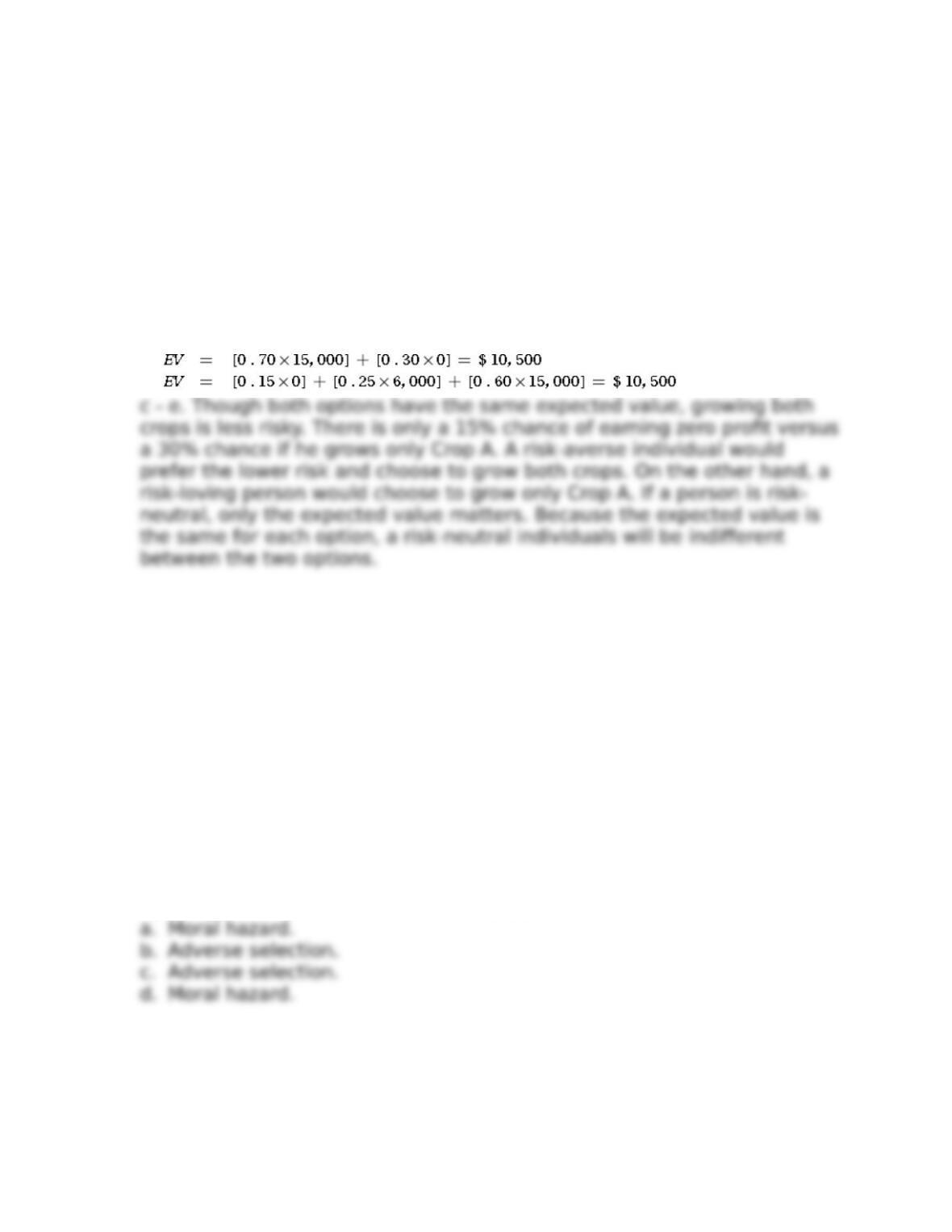
15. Farmer Tom is trying to decide what to produce on his farm in the
upcoming season. In the past, he has usually grown Crop A. If he grows Crop
A, there is a 70% chance that his crop will yield $15,000 in pro5t and a 30%
chance that he will earn zero pro5t. [LO 11.7]
a. What is the expected value of his pro5t if he grows only Crop A?
11-7
Copyright © 2018 McGraw-Hill Education. All rights reserved. No reproduction or distribution without the prior written consent of McGraw-Hill
Education.
Chapter 11 – Time and Uncertainty
b. Now Farmer Tom considers dividing his land between two crops: Crop A
and Crop B. There is a 5% chance that both crops will fail, and Tom will earn
zero pro5t. There is a 25% chance that only one crop will grow, and Tom will
earn $6,000 in pro5t. There is a 60% chance that both crops will grow, and
Tom will earn $15,000 in pro5t. What is the expected value of his pro5t if he
grows both crops?
c. Which option would a risk-averse farmer choose?
d. Which option would a risk-seeking farmer choose?
e. Which option would a risk-neutral farmer choose?
Answer:
a.
b.
16. Say whether each of the following scenarios describes an insurance
problem caused by adverse selection or by moral hazard. [LO 11.8]
a. People who have homeowners insurance are less likely than others to
replace the batteries in their smoke detectors.
b. People who enjoy dangerous hobbies are more likely than others to buy
life insurance.
c. People whose parents died young are more likely than others to seek out
health insurance with better coverage.
d. People who have liability coverage on their car insurance take less care
than others to avoid accidents.
Answer: Adverse selection occurs when buyers and sellers have di&erent
information about the quality of a good or the riskiness of a situation. With
moral hazard, people engage in behavior that is considered undesirable
by the person who bears the cost of the behavior.
17. As part of the A&ordable Care Act of 2010, all individuals in the U.S. are
now required to have health insurance. Do economists expect mandatory
health insurance to reduce adverse selection, moral hazard, both, or neither?
[LO 11.8]
11-8
Copyright © 2018 McGraw-Hill Education. All rights reserved. No reproduction or distribution without the prior written consent of McGraw-Hill
Education.
Chapter 11 – Time and Uncertainty
Answer: This policy would reduce adverse selection by removing the opt-
11-9
Copyright © 2018 McGraw-Hill Education. All rights reserved. No reproduction or distribution without the prior written consent of McGraw-Hill
Education.