Chapter 01 – Economics and Life
18. Describe an economic model you know. What does the model predict
about cause and effect? [LO 1.6]
Answer: As mentioned in this chapter, the model of demand that you will
explore in Chapter 3 predicts that a rise in price will cause a decrease in
19. Describe an economic model you know. What assumptions does the
model make? Are the assumptions reasonable? [LO 1.6]
Answer: In predicting that price increases will cause consumers to
purchase less of a good, the model of demand assumes that consumers
22. What is the difference between disagreeing about a positive statement
and disagreeing about a normative statement? [LO 1.7]
Answer: A positive statement is something that is supposed by fact,
23. Would a good economic model be more likely to address a positive
statement or a normative statement? Why? [LO 1.7]
Answer: A good model predicts cause and effect and can be tested with
24. Write a positive statement and a normative statement about your
favorite hobby. [LO 1.7]
Answer: Positive statements are based on fact: For example, “Cultures
around the world use food to convey social values.”
1-1
Copyright © 2018 McGraw-Hill Education. All rights reserved. No reproduction or distribution without the prior written consent of McGraw-Hill
Education.
Chapter 01 – Economics and Life
Problems and Applications
1. Think about how and why goods and resources are scarce. Goods and
resources can be scarce for reasons that are inherent to their nature at all
times, that are temporary or seasonal, or that are arti3cially created.
Separate the goods listed below into two groups; indicate which (if any) are
arti3cially scarce (AS) and which (if any) are inherently scarce (IS). [LO 1.1]
a. air of any quality
b. land
c. patented goods
d. original Picasso paintings
Answer: Goods and resources can be inherently scarce at all times if
there is a limited or 3nite supply of the resource, or arti3cially scarce
when access to the resource is restricted.
a. Not scarce. Air (of any quality) is abundant and need not be rationed
through prices or some other allocation mechanism
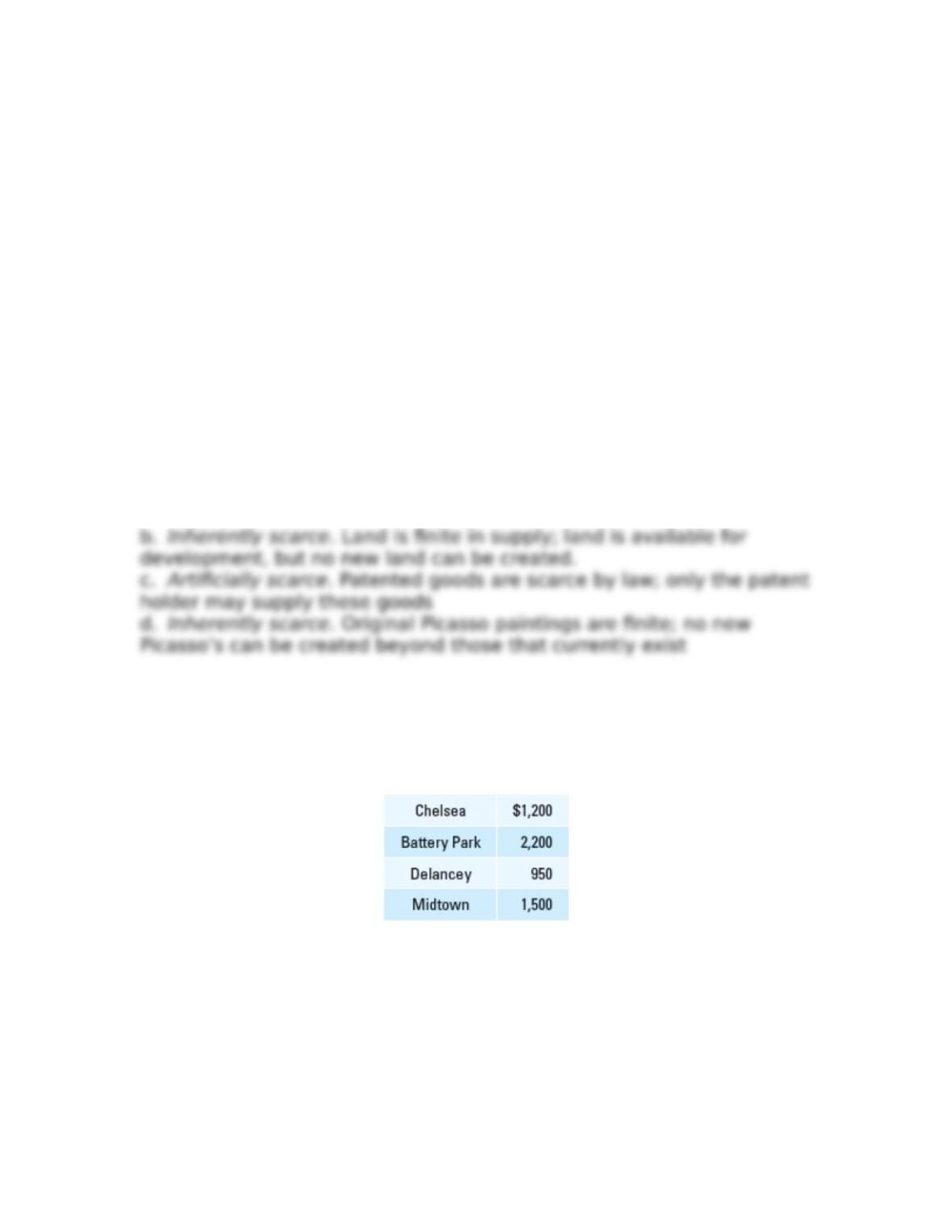
2. You are looking for a new apartment in Manhattan. Your income is $4,000
per month, and you know that you should not spend more than 25 percent of
your income on rent. You have come across the listings for one-bedroom
apartments shown in Table 1P-1. You are indifferent about location, and
transportation costs are the same to each neighborhood. [LO 1.1]
a. Which apartments fall within your budget? (Check all that apply.)
b. Suppose that you adhere to the 25 percent guideline but also receive a
$1,000 cost-of-living supplement because you are living and working in
Manhattan. Which apartments fall within your budget now?
Answer:
a. Delancey. Your income and income guidelines represent a constraint
on the choices available. Under these guidelines, 25 percent of your
1-2
Copyright © 2018 McGraw-Hill Education. All rights reserved. No reproduction or distribution without the prior written consent of McGraw-Hill
Education.
Chapter 01 – Economics and Life
b. Chelsea and Delancey. The $1,000 monthly cost-of-living supplement
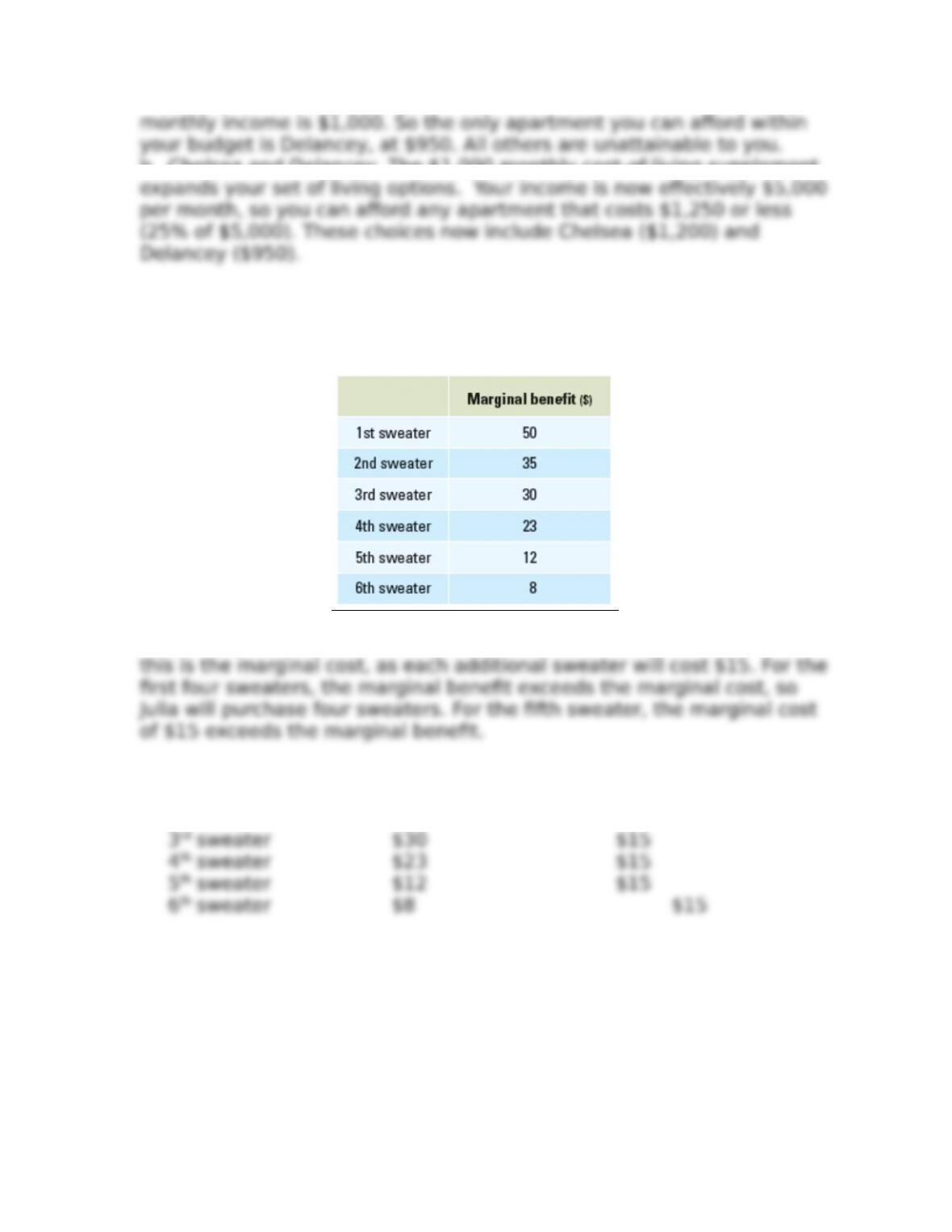
3. Suppose the price of a sweater is $15. Julia’s benefit from purchasing
each additional sweater is given in the Table 1P-2. Julia gets the most benefit
from the first sweater and less benefit from each additional sweater. If Julia is
behaving rationally, how many sweaters will she purchase? [LO 1.2]
Answer: Julia will purchase all of the sweaters for which the marginal
benefit is greater than the marginal cost. If the price of a sweater is $15,
Marginal benefit Marginal Cost
1st sweater $50 $15
2nd sweater $35 $15
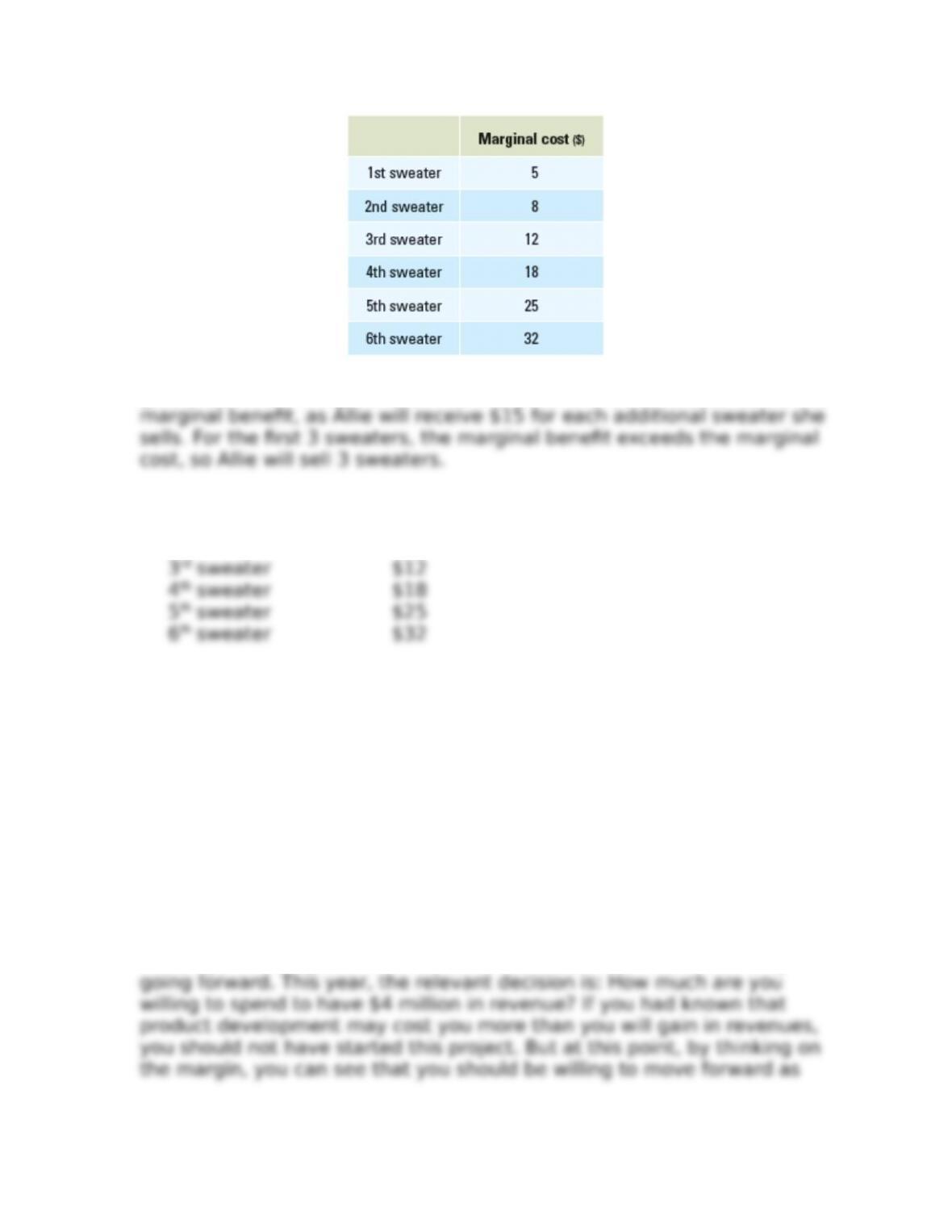
4. Sweaters sell for $15 at the crafts fair. Allie knits sweaters; her
marginal costs are given in the Table 1P-3. Allie’s costs increase with each
additional sweater. If Allie is behaving rationally, how many sweaters will she
sell? [LO 1.2]
1-3
Copyright © 2018 McGraw-Hill Education. All rights reserved. No reproduction or distribution without the prior written consent of McGraw-Hill
Education.
Chapter 01 – Economics and Life
Answer: Allie will sell all of the sweaters for which the marginal benefit is
greater than the marginal cost. If the price of a sweater is $15, this is the
Marginal Cost
1st sweater $5
2nd sweater $8
5. Last year, you estimated you would earn $5 million in sales revenues
from developing a new product. So far, you have spent $3 million developing
the product, but it is not yet complete. Meanwhile, this year you have new
sales projections that show expected revenues from the new product will
actually be only $4 million. How much should you be willing to spend to
complete the product development? [LO 1.2]
a. $0.
b. Up to $1 million.
c. Up to $4 million.
d. Whatever it takes.
Answer: You should spend up to $4 million. The $3 million you have
spent already is a sunk cost and cannot be recovered. Therefore, the $3
million you have spent is irrelevant to the decision of how much to spend
1-4
Copyright © 2018 McGraw-Hill Education. All rights reserved. No reproduction or distribution without the prior written consent of McGraw-Hill
Education.
Chapter 01 – Economics and Life
long as the costs of going forward are not greater than the benefits of
going forward ($4 million).
6. Consider the following examples. For each one, say whether the
incentive is positive or negative. [LO 1.3]
a. Bosses who offer time-and-a-half for working on national holidays.
b. Mandatory minimum sentencing for drug offenses.
c. Fines for littering.
d. Parents who offer their children extra allowance money for good grades.
Answer:
a. Positive.
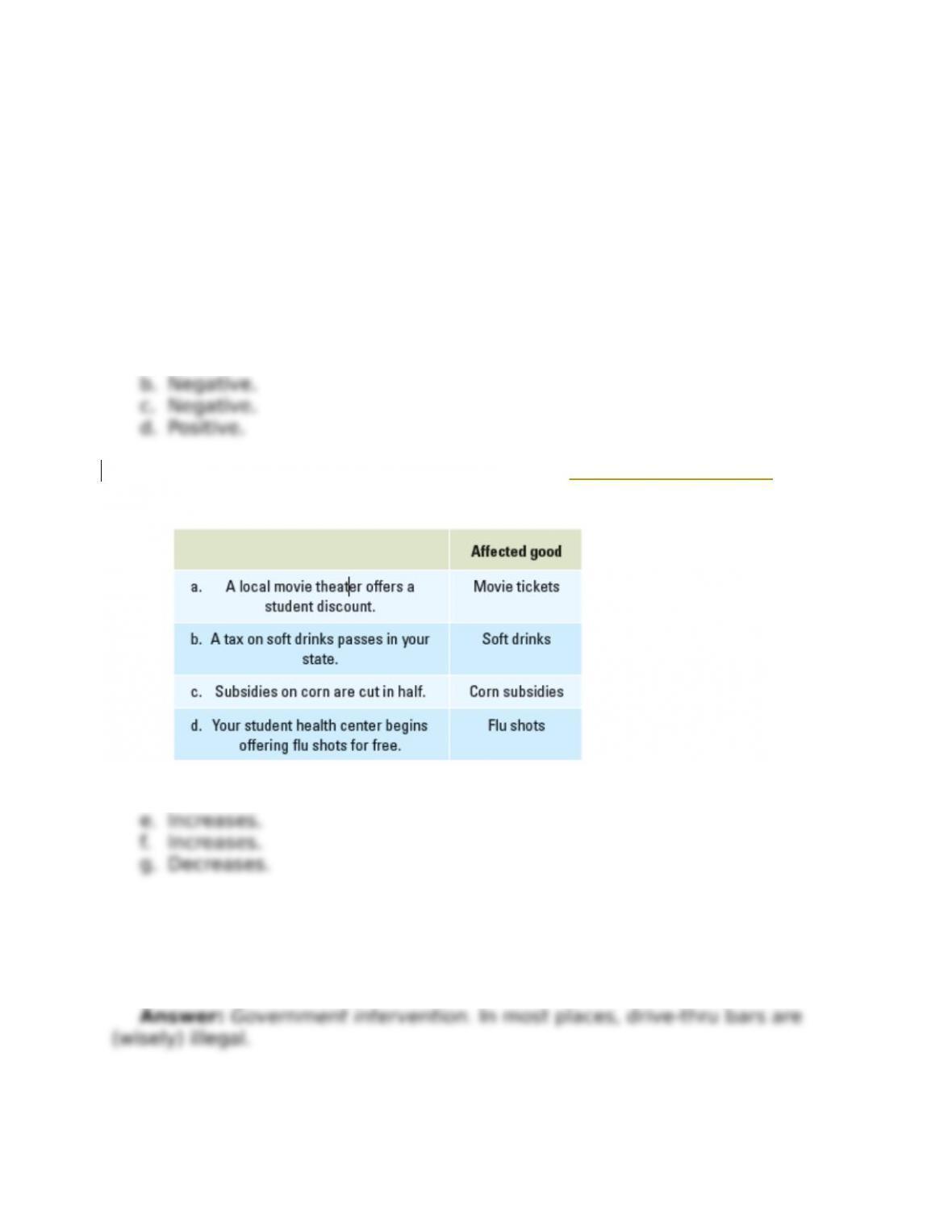
7. Consider the following events that change prices as described in Table
1P-4. For each one, say whether the opportunity cost of consuming the
affected good increases or decreases. [LO 1.3]
Answer:
a. Decreases.
8. Your best friend has an idea for a drive-through bar. Indicate the best
explanation for why others have not taken advantage of her idea: true
innovation, market failure, government intervention, or unpro3tablity. [LO
1.4]
9. Your best friend has an idea for a long-distance car service to drive
people across the country. Indicate the best explanation for why others have
1-5
Copyright © 2018 McGraw-Hill Education. All rights reserved. No reproduction or distribution without the prior written consent of McGraw-Hill
Education.
Chapter 01 – Economics and Life
not taken advantage of her idea: true innova-tion, market failure,
intervention, or unpro3tablity. [LO 1.4]
Answer: Unprotable. There are alternatives for customers that can be
10. Determine whether each of the following questionable statements is
best explained by coincidence, an omitted variable, or reverse causation.
[LO 1.5]
a. In cities that have more police, crime rates are higher.
b. Many retired people live in states where everyone uses air conditioning
during the summer. c. More people come down with the Fu during the
Winter Olympics than during the Summer Olympics.
d. For the last 3ve years, Punxsutawney Phil has seen his shadow on
Groundhog Day, and spring has come late.
Answer:
a. Reverse causation: Cities with higher crime rates will tend to have
b. Omitted variable: Having a large number of retired people live in a
c. Correlation without causation: The Winter Olympics do not cause the
d. Coincidence: There is no plausible cause-and-effect relationship here.
11. For each of the pairs below, determine whether they are positively
correlated, negatively correlated, or uncorrelated. [LO 1.5]
a. Time spent studying and test scores.
b. Vaccination and illness.
c. Soft drink preference and music preference.
d. Income and education.
Answer:
Two items are positively correlated if both variables increase at the same
a. Positively correlated. More time spent studying tends to lead to higher
test scores.
1-6
Copyright © 2018 McGraw-Hill Education. All rights reserved. No reproduction or distribution without the prior written consent of McGraw-Hill
Education.
Chapter 01 – Economics and Life
12. Each statement below is part of an economic model. Indicate whether
the statement is a prediction of cause and effect or an assumption. [LO 1.6]
a. People behave rationally.
b. If the price of a good falls, people will consume more of that good.
c. Mass starvation will occur as population outgrows the food supply.
d. Firms want to maximize pro3ts.
Answer:
a. Assumption. This is an assumption about how people behave.
b. Prediction of cause and eect. This is a prediction of cause and effect
c. Prediction of cause and eect. This is a prediction of cause and effect
13. From the list below, select the characteristics that describe a good
economic model. [LO 1.6]
a. Includes every detail of a given situation.
b. Predicts that A causes B.
c. Makes approximately accurate assumptions.
d. Fits the real world perfectly.
e. Predicts things that are usually true.
Answer: A good model should predict cause and effect (b), describe the
14. Determine whether each of the following statements is positive or
normative. (Remember that a positive statement isn’t necessarily correct; it
just makes a factual claim rather than a moral judgment.) [LO 1.7]
a. People who pay their bills on time are less likely than others to get into
debt.
b. Hard work is a virtue.
c. Everyone should pay his or her bills on time.
d. China has a bigger population than any other country in the world.
1-7
Copyright © 2018 McGraw-Hill Education. All rights reserved. No reproduction or distribution without the prior written consent of McGraw-Hill
Education.
Chapter 01 – Economics and Life
e. China’s One-Child Policy (which limits families to one child each) helped to
spur the country’s rapid economic growth.
f. Lower taxes are good for the country.
Answer: A statement that makes a factual claim about how the world
actually works is called a positive statement. A statement that makes a
claim about how the world should be is called a normative statement.
15. You just received your midterm exam results and your professor wrote
the following note: “You received a 70 on this exam, the average score. If you
want to improve your grade, you should study more.” Evaluate your
professor’s note. [LO 1.7]
a. Is the first sentence positive or normative?
b. Is the second sentence positive or normative?
Answer: A statement that makes a factual claim about how the world
actually works is called a positive statement. A statement that makes a
claim about how the world should be is called a normative statement.
1-8
Copyright © 2018 McGraw-Hill Education. All rights reserved. No reproduction or distribution without the prior written consent of McGraw-Hill
Education.