Appendix D – Math Essentials: The Area under a Linear Curve
APPENDIX D
MATH ESSENTIALS:
THE AREA UNDER
A LINEAR CURVE
Learning Objectives
LO D.1: Calculate surplus by finding the area under a linear curve.
Appendix Outline
The Area under a Linear Curve (LO D.1)
Problems and Applications
1. Use the graph in Figure DP-1 to answer the following questions. [LO
D.1]
a. What is the amount of consumer surplus?
b. What is the amount of producer surplus?
c. What is the amount of total surplus?
Answer: a. Consumer surplus is found by taking the area of the triangle
b. Measuring producer surplus is found by taking the area of the triangle
c. Total surplus is the sum of consumer and producer surplus. In this
2. Use these two supply and demand equations to answer the following
questions. [LO D.1]
a. What is the equilibrium price? What is the equilibrium quantity?
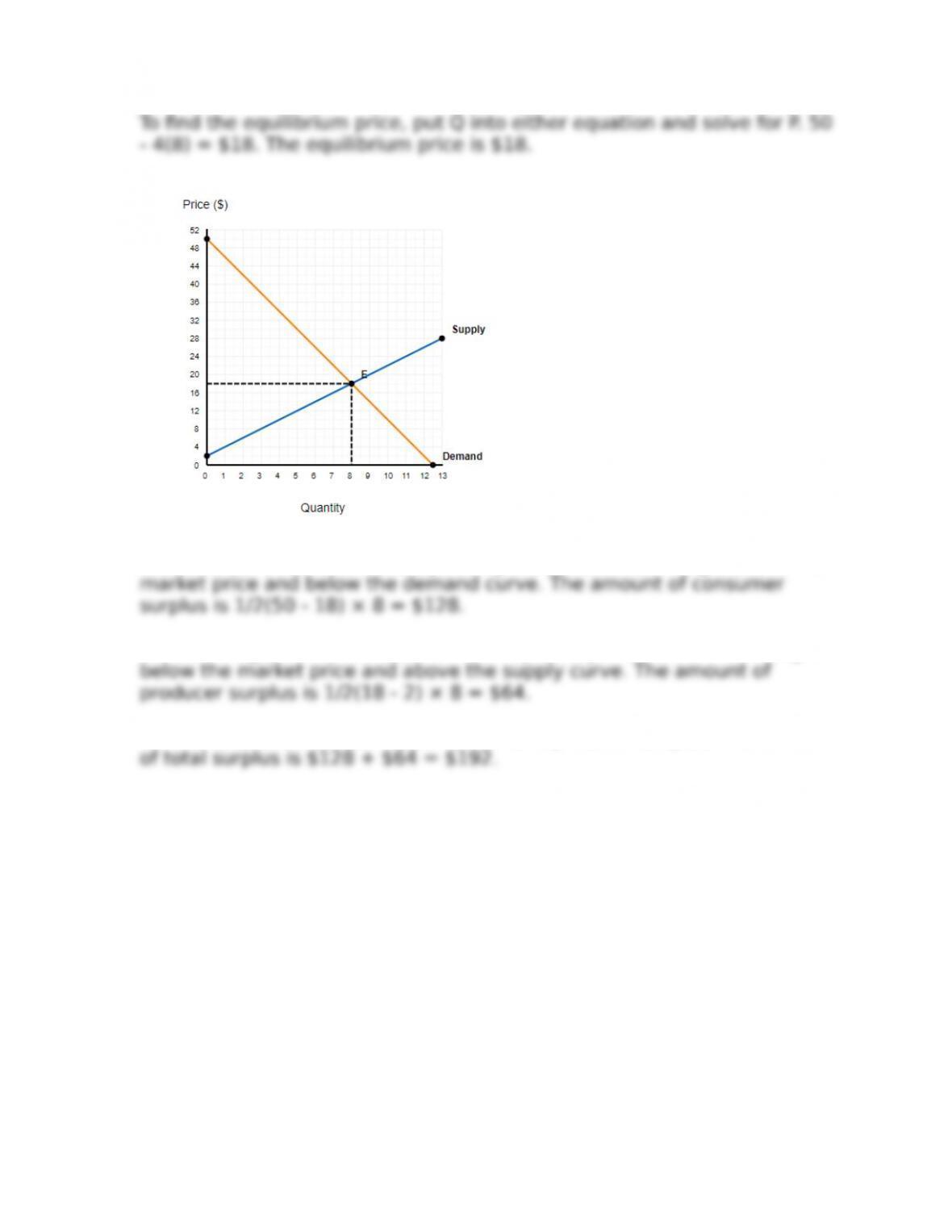
b. Draw a graph of supply and demand and illustrate the equilibrium.
c. What is the amount of consumer surplus?
d. What is the amount of producer surplus?
e. What is the amount of total surplus?
Answer: a. To find the equilibrium quantity, set demand equal to supply
and solve for Q. 50 – 4Q = 2 + 2Q, so Q = 8. The equilibrium quantity is 8.
D-1
Copyright © 2018 McGraw-Hill Education. All rights reserved. No reproduction or distribution without the prior written consent of McGraw-Hill
Education.
Appendix D – Math Essentials: The Area under a Linear Curve
b.
c. Consumer surplus is found by taking the area of the triangle above the
d. Measuring producer surplus is found by taking the area of the triangle
e. Total surplus is the sum of consumer and producer surplus. The amount
D-2
Copyright © 2018 McGraw-Hill Education. All rights reserved. No reproduction or distribution without the prior written consent of McGraw-Hill
Education.