Solution to Questions – Chapter 8
Underwriting and Financing Residential Properties
Question 8-1
What is the legislative intent of federal truth-in-lending disclosures, and what specific disclosures are required
under the act?
Question 8-2
When would the cost of credit life insurance be included in the finance charge of an APR calculations for the truth-
in-lending disclosures?
Question 8-3
What assumptions about future composite rate of interest on an adjustable rate mortgage is made when determining
the APR for federal truth-in-lending disclosures?
Question 8-4
List the closing cost items, which require RESPA disclosure. What items may be excluded from disclosures under
the act? What form can these disclosures take?
Question 8-5
What types of fees and conditions are prohibited under RESPA?
Question 8-6
For what items may a lender require escrow accounts from a borrower?
© 2019 McGraw-Hill Education. All rights reserved. Authorized only for instructor use in the classroom. No
reproduction or further distribution permitted without the prior written consent of McGraw-Hill Education.
Solution to Problems – Chapter 8
Underwriting and Financing Residential Properties
Problem 8-1
(a) To determine the APR:
First, determine the monthly mortgage payment.
PMT(i,n,PV,FV)
Next, determine the lender’s yield.
To calculate the APR, round to the nearest ¼ of a percent.
APR = 9.25%
Problem 8-2
Solution to credit account problem:
(a) Current capacity being used is calculated as:
Problem 8-3
(a) ARM with 2% annual cap & 5% life cap; negative amortization allowed.
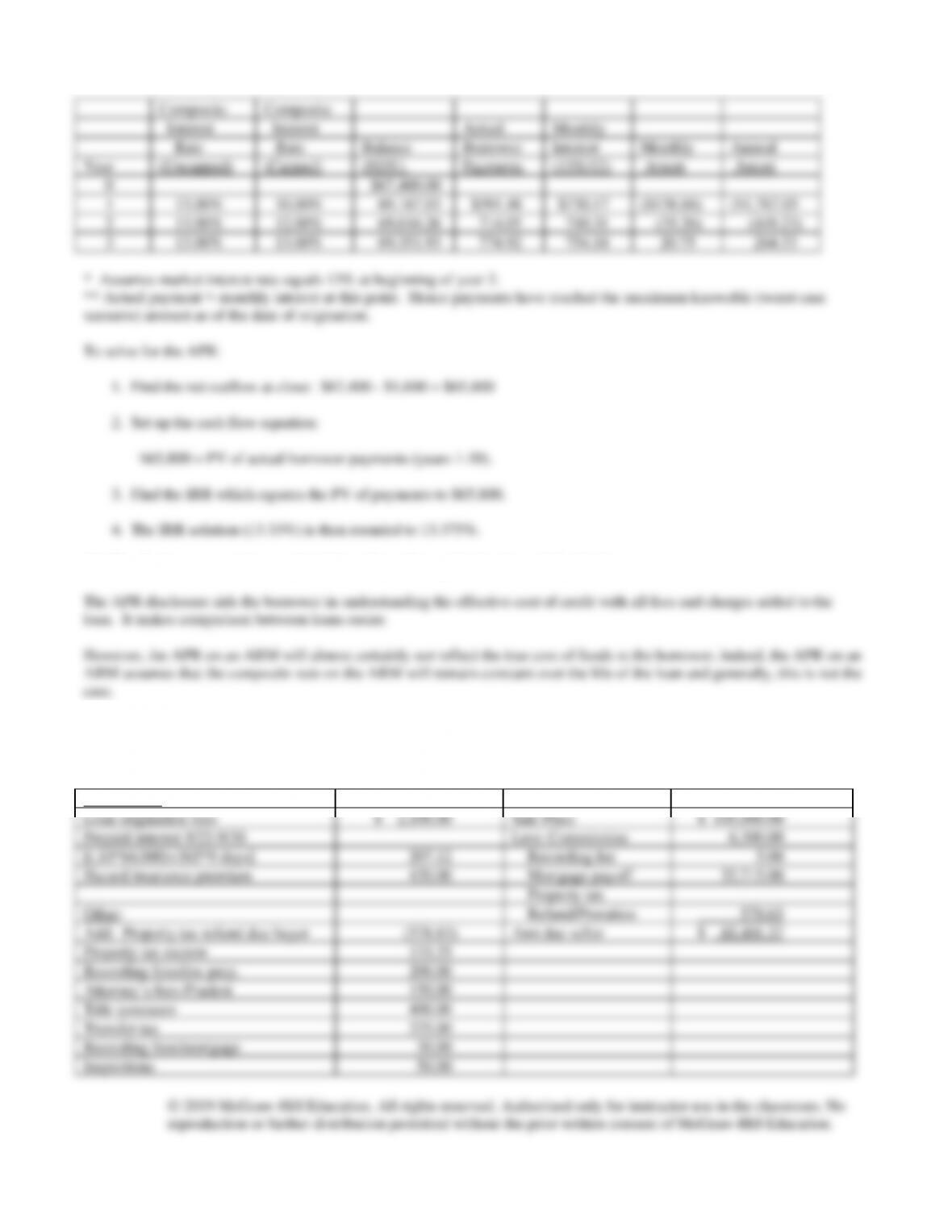
Initial Payment = $591.48
Composite
Composite
Interest
Interest
Actual
Monthly
Rate
Rate
Balance
Borrower
Interest
Monthly
Annual
Year
(Uncapped)
(Capped)
(EOY)
Payments
(13%/12)
Amort
Amort
0
$67,400.00
1
13.00%
10.00%
69,167.03
$591.48
$730.17
($138.68)
($1,767.03
2
13.00%
12.00%
69,616.26
714.05
749.31
(35.26)
(449.23)
3
13.00%
13.00%
69,351.93
774.92
754.18
20.75
264.33
* Assumes market interest rate equals 13% at beginning of year 2.
** Actual payment > monthly interest at this point. Hence payments have reached the maximum knowable (worst case
scenario) amount as of the date of origination.
To solve for the APR:
1. Find the net outflow at close: $67,400 – $1,600 = $65,800
2. Set up the cash flow equation:
$65,800 = PV of actual borrower payments (years 1-30).
3. Find the IRR which equates the PV of payments to $65,800.
4. The IRR solution (13.33%) is then rounded to 13.375%.
(b) The disclosures must be completed three days after application is made by the borrower.
Problem 8-4
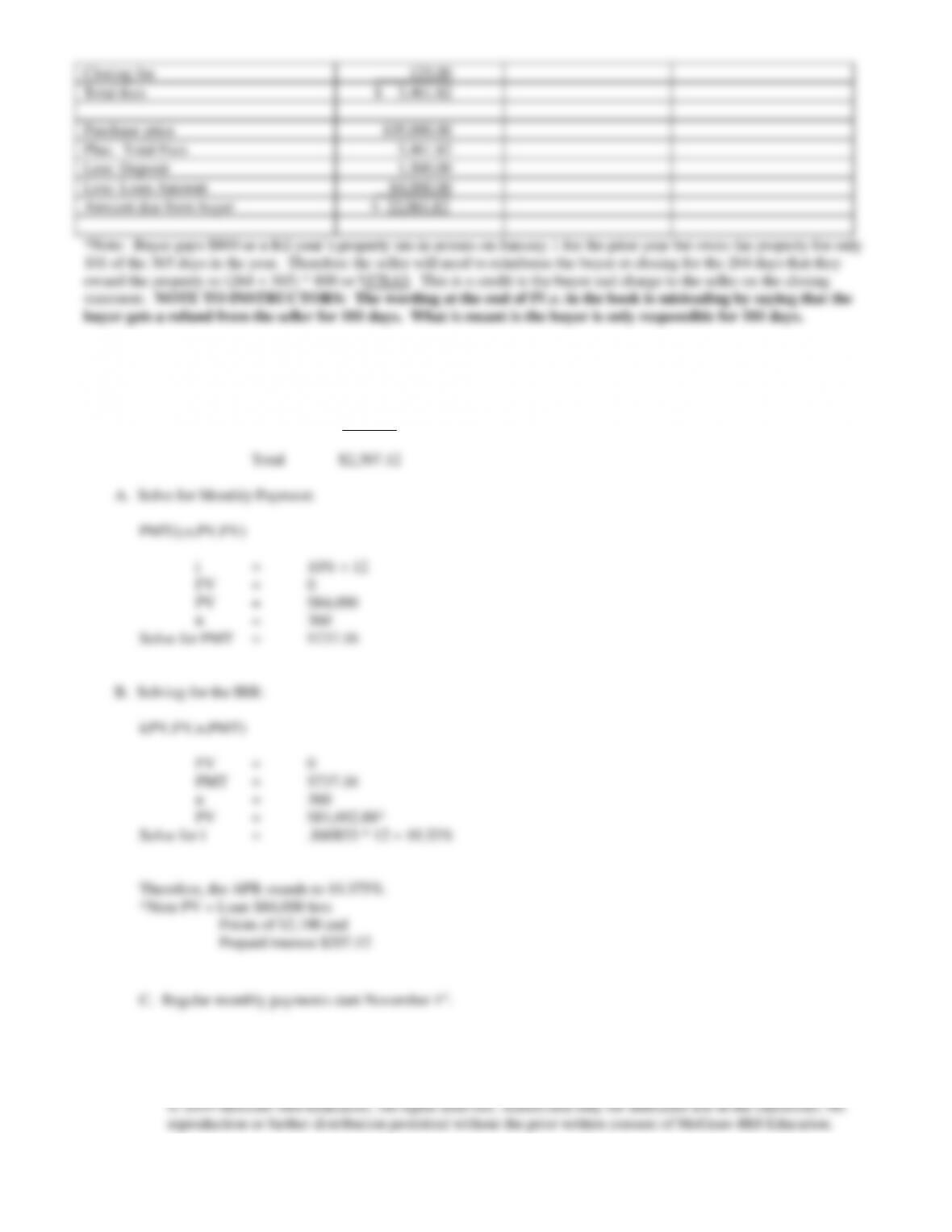
(a) Real Estate Settlement Statement
Borrower/Buyer: Seller:
Loan related:
Loan origination fees
$ 2,100.00
Sale Price
$ 105,000.00
Prepaid interest 9/22-9/30
Less: Commission
6,300.00
[(.10*84,000)÷365*9 days]
207.12
Recording fee
5.00
Hazard insurance premium
420.00
Mortgage payoff
32,715.00
Property tax
Other:
Refund/Proration
578.63
Add: Property tax refund due buyer
(578.63)
Amt due seller
$ 65,401.37
Property tax escrow
133.33
Recording fees/doc prep.
200.00
Attorney’s fees-Prudent
150.00
Title insurance
400.00
Transfer tax
225.00
Recording fees/mortgage
30.00
Inspections
50.00
Closing fee
125.00
Total fees
$ 3,461.82
Purchase price
105,000.00
Plus: Total Fees
3,461.82
Less: Deposit
1,500.00
Less: Loan Amount
84,000.00
Amount due from buyer
$ 22,961.82
*Note: Buyer pays $800 or a full year’s property tax in arrears on January 1 for the prior year but owns the property for only
101 of the 365 days in the year. Therefore the seller will need to reimburse the buyer at closing for the 264 days that they
owned the property or (264 ÷ 365) * 800 or $578.63. This is a credit to the buyer and charge to the seller on the closing
statement. NOTE TO INSTRUCTORS: The wording at the end of IV.c. in the book is misleading by saying that the
buyer gets a refund from the seller for 101 days. What is meant is the buyer is only responsible for 101 days.
(b) APR Calculation:
Prepaid finance charges
Prepaid interest 207.12
Loan origination fees 2,100.00