Solutions to Questions – Chapter 4
Fixed Interest Rate Mortgage Loans
Question 4-1
What are the major differences between the CAM, and CPM loans? What are the advantages to borrowers and risks to
lenders for each? What elements do each of the loans have in common?
Question 4-2
Define amortization.
Types of amortization are fully, partially, zero, negative and constant rates of amortization.
Question 4-3
Why do the monthly payments in the beginning months of a CPM loan contain a higher proportion of interest than principal
repayment?
Question 4-4
What are loan closing costs? How can they be categorized? Which of the categories influence borrowing costs and why?
Question 4-5
In the absence of loan fees, does repaying a loan early ever affect the actual or true interest cost to the borrower?
Question 4-6
Why do lenders charge origination fees, especially loan discount fees?
Question 4-7
What is the connection between the Truth-in-Lending Act and the annual percentage rate (APR)?
Question 4-8
What is the effective borrowing cost (rate)?
Question 4-9
What is meant by the “nominal rate” on a mortgage loan?
Question 4-10
What is the accrual rate and payment rate on a mortgage loan?
Question 4-11
An expected inflation premium is said to be part of the interest rate, what does this mean?
expected inflation.
Question 4-12
A mortgage loan is made to Mr. Jones for $30,000 at 10 percent interest for 20 years. If Mr. Jones has a choice between a
CPM and a CAM, which one would result in his paying a greater amount of total interest over the life of the mortgage?
Would one of these mortgages be likely to have a higher interest rate than the other? Explain your answer.
Question 4-13
What is negative amortization?
Question 4-14
What is partial amortization?
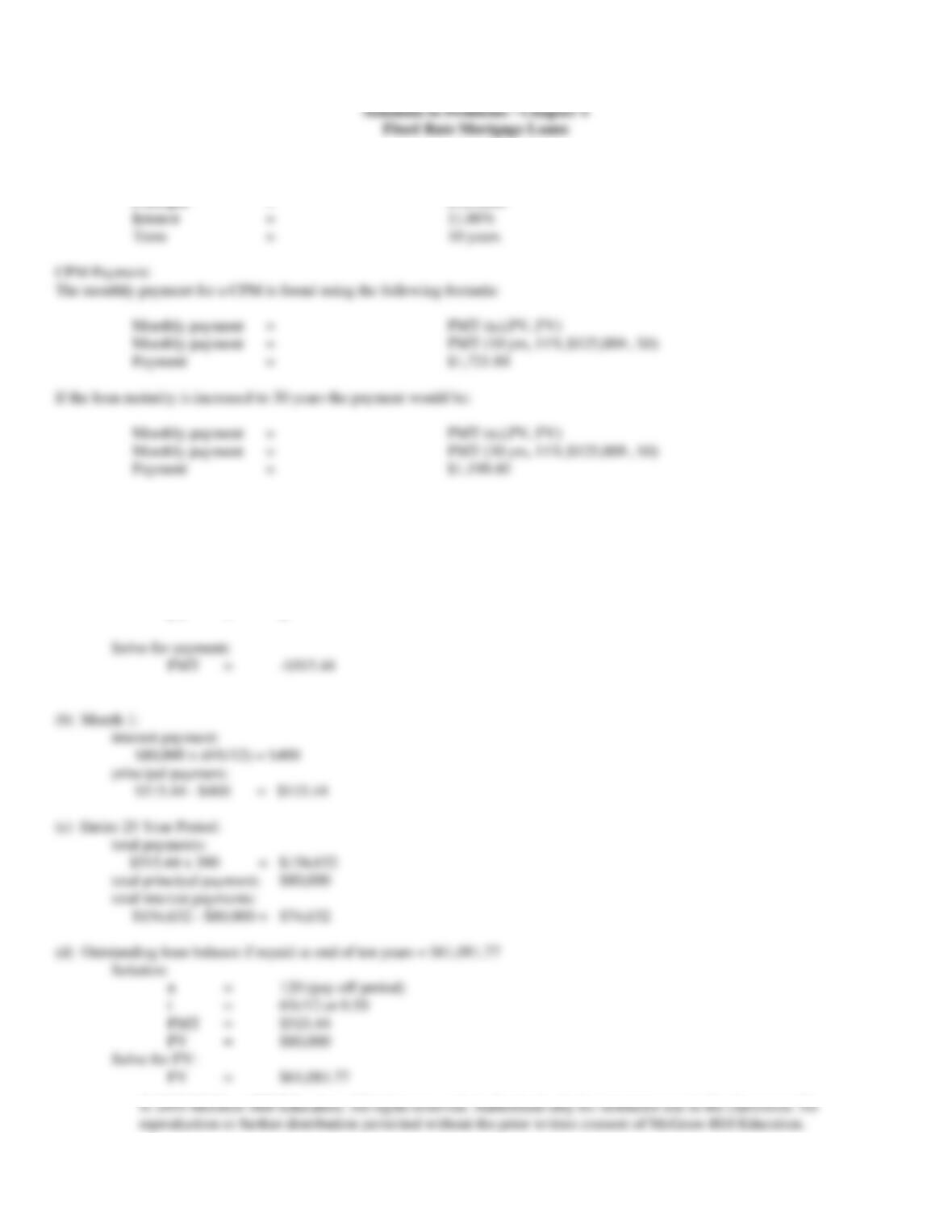
Problem 4-1
A borrower makes a fully amortizing CPM mortgage loan.
Principal = $125,000
Problem 4-2
(a) Monthly payment (PMT (n,i,PV, FV) = $515.44
Solution:
n = 25×12 or 300
i = 6%/12 or .50
PV = $80,000
FV = 0
Problem 4-3
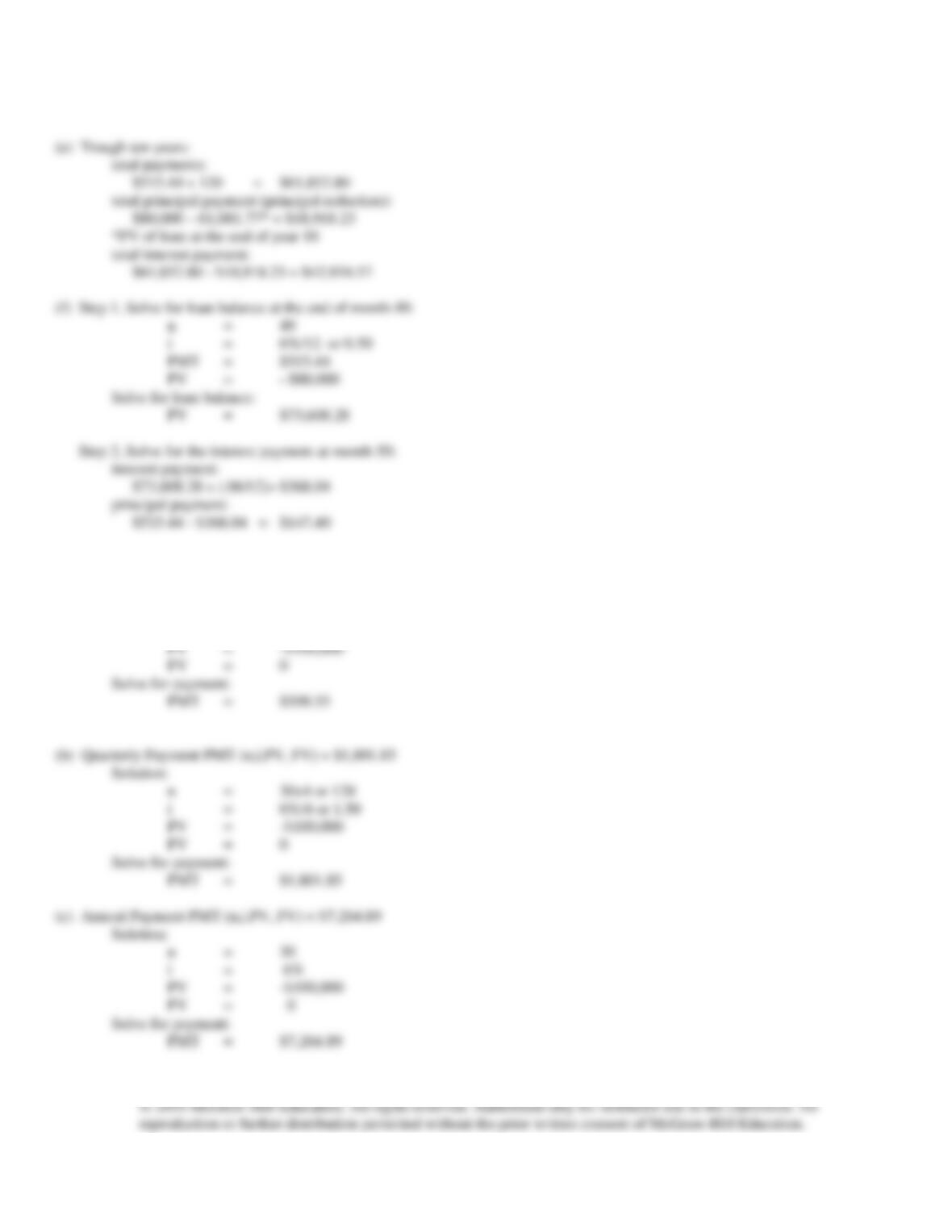
(a) Monthly payment PMT (n,i,PV, FV) = $599.55
Solution:
n = 30×12 or 360
i = 6%/12 or 0.50
Problem 4-4
Monthly:
total principal payment: $100,000
Problem 4-5
(a) Monthly Payment PMT (n,i,PV,FV):
Solution:
n = 20×12 or 240
i = 6%/12 or 0.50
(c) Outstanding loan balance if repaid at end of year eight = $73,415.98
Solution:
(d) Step 1, Solve for the loan balance at the end of year 8:
n = 96
(f) The new payment would be $667.64
Solution:
Problem 4-6
Step 1, Solve for the original monthly payment:
i = 6%/12 or 0.50
n = 30×12 or 360
PV = -$75,000
FV = 0
Solve for payment:
Problem 4-7
The loan will be repaid in 145 months.
Solution: n (PMT,i,PV,FV)
Problem 4-8
The interest rate on the loan is 12.96%.
Solution:
Problem 4-9
(a) Monthly Payments = $656.70
Solution:
Problem 4-10
(a) Monthly Payments = $666.67
Solution:
The solution does not have to be calculated because the loan balance will be the same as initial loan amount. This is because it is an
interest only loan and there is no loan amortization or reduction of principal.
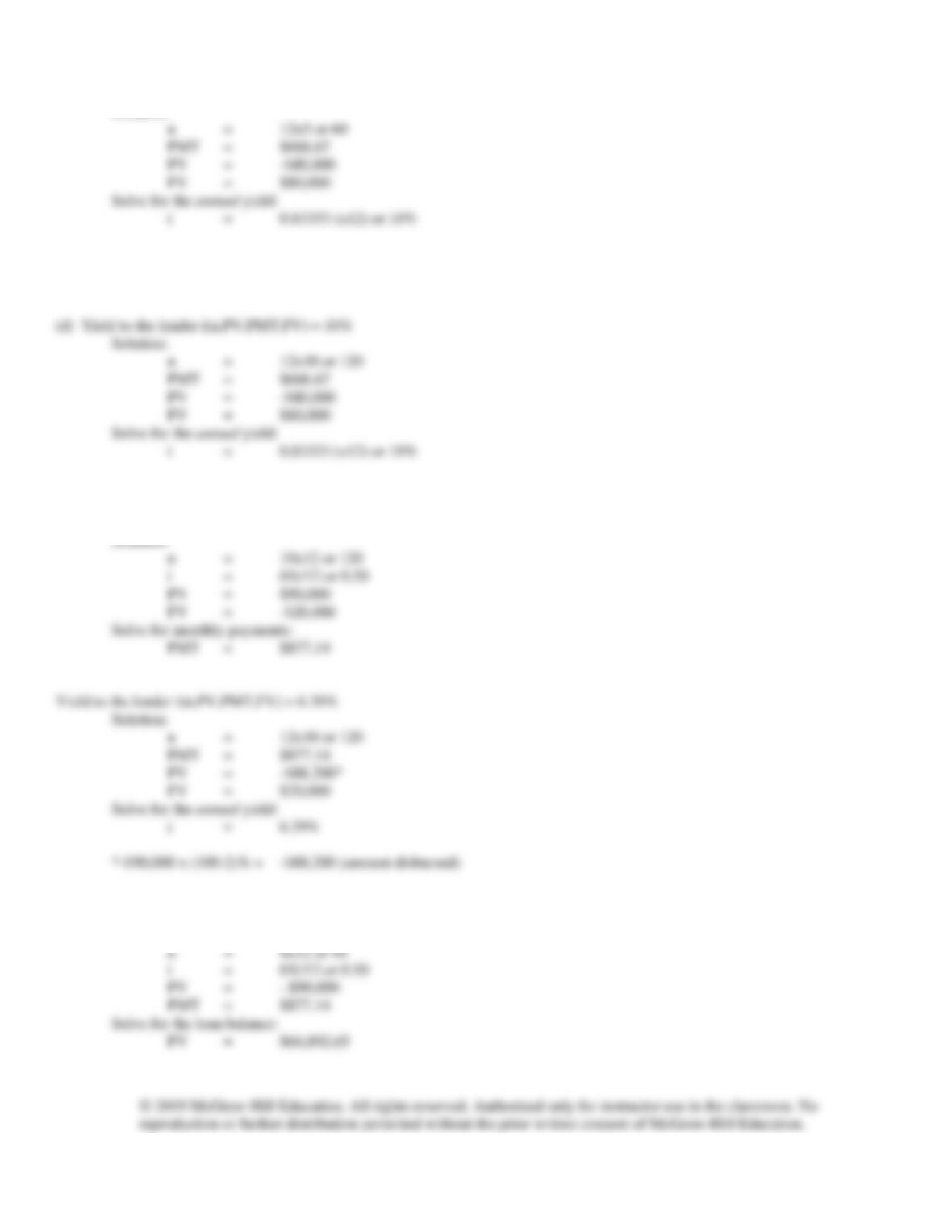
(c) Yield to the lender i(n,PV,PMT,FV) =10%
Solution:
Problem 4-11
Monthly Payments PMT (n,i,PV,FV) = $877.14
Step 1, Solve the loan balance if repaid in four years:
Solution:
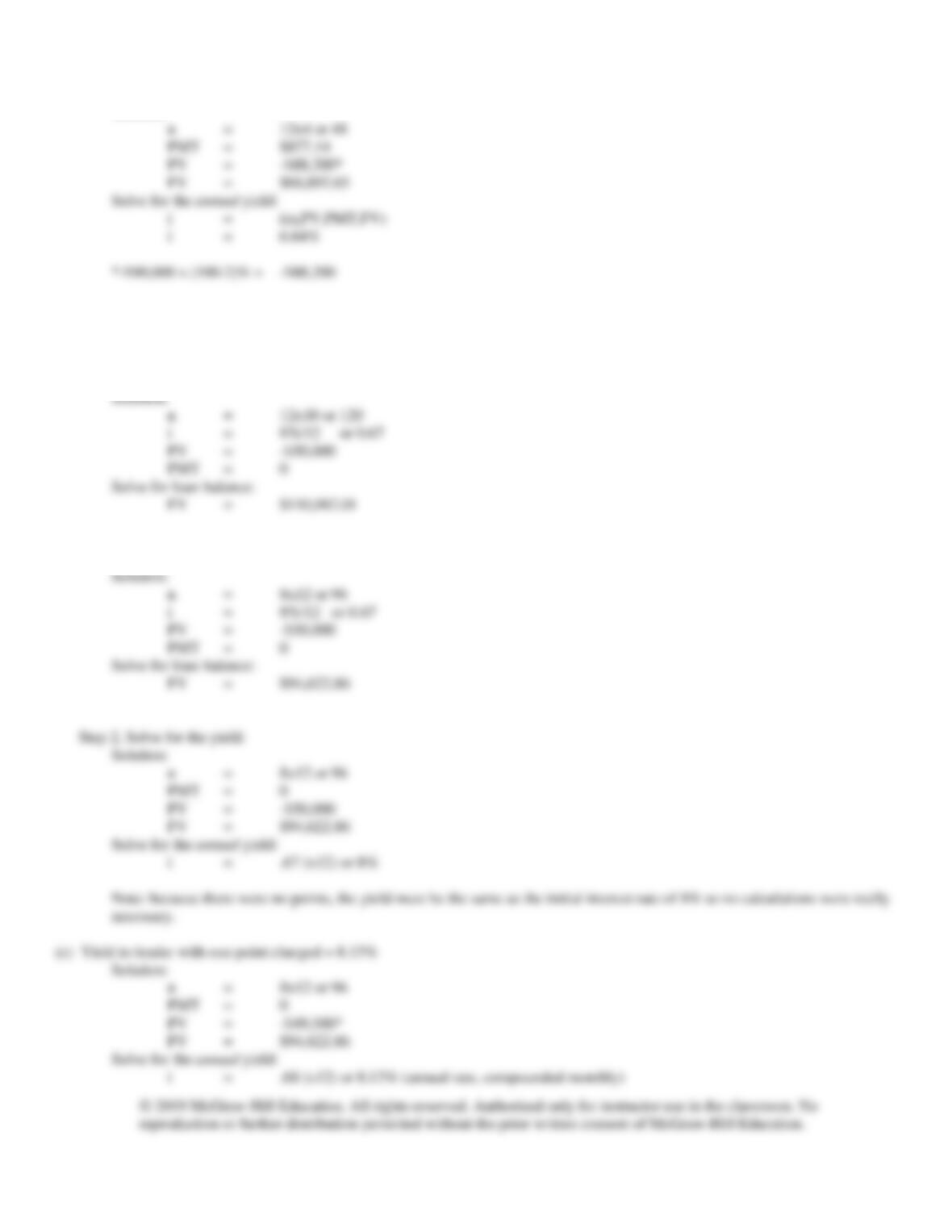
Step 2, Solve for the yield:
Solution:
Problem 4-12
(a) At the end of year ten $94,622.86 will be due:
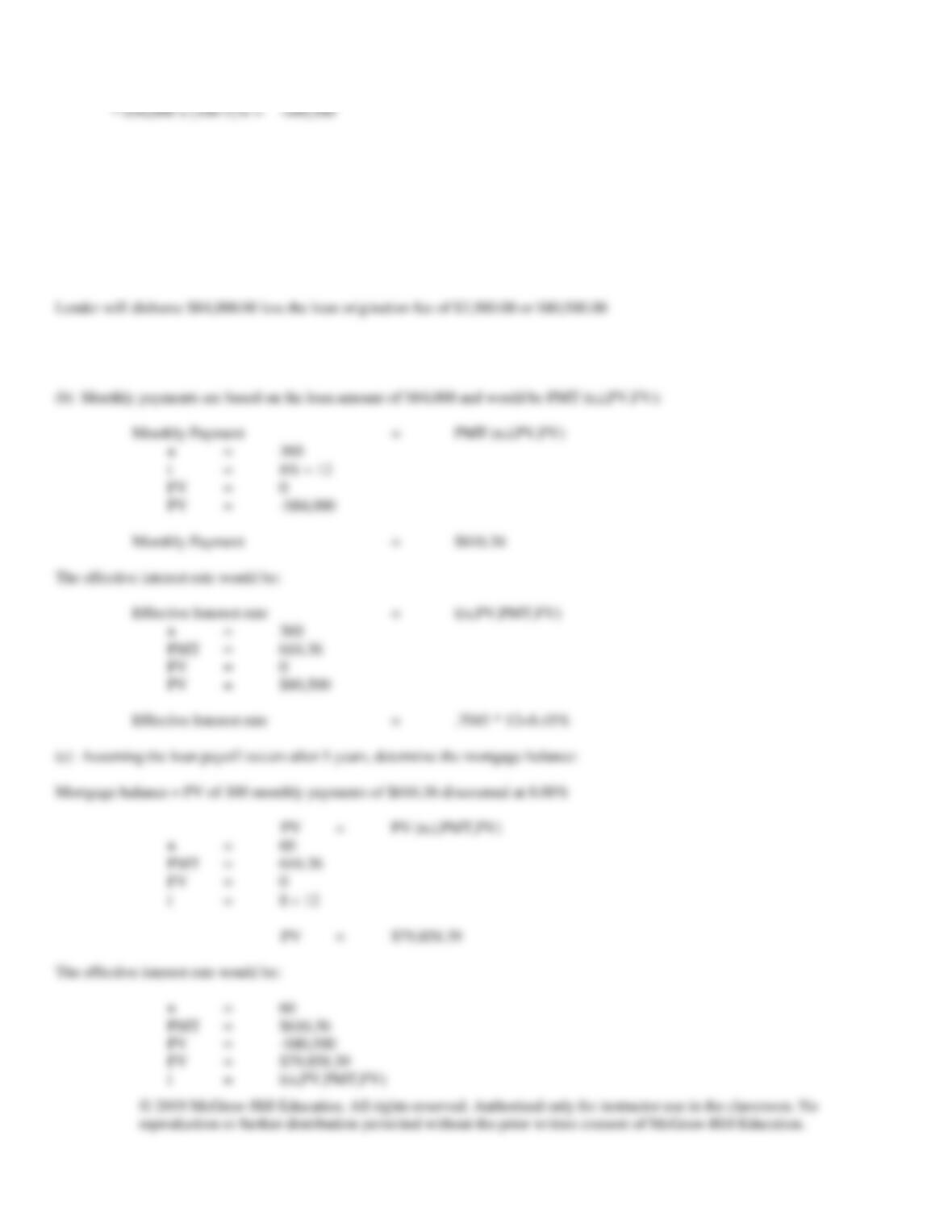
(b) Step 1, the loan yield remains 8%, this can be “proved” by solving for loan balance at end of year eight.
Problem 4-13
(a)
Property value = $105,000
Principal = $84,000
Interest rate = 8.00%
Maturity = 30 years
Loan origination fee = $3,500
Problem 4-14
Solution: Loan fees are now being loaned by adding $3,500 to $84,000. Amount barrowed is now $87,500.
(a) Lender will now disburse $87,500 less the loan fees of $3,500 or $84,000
(b) Payment calculation is based on new loan amount $87,500 and new PMT:
PV = $-87,500
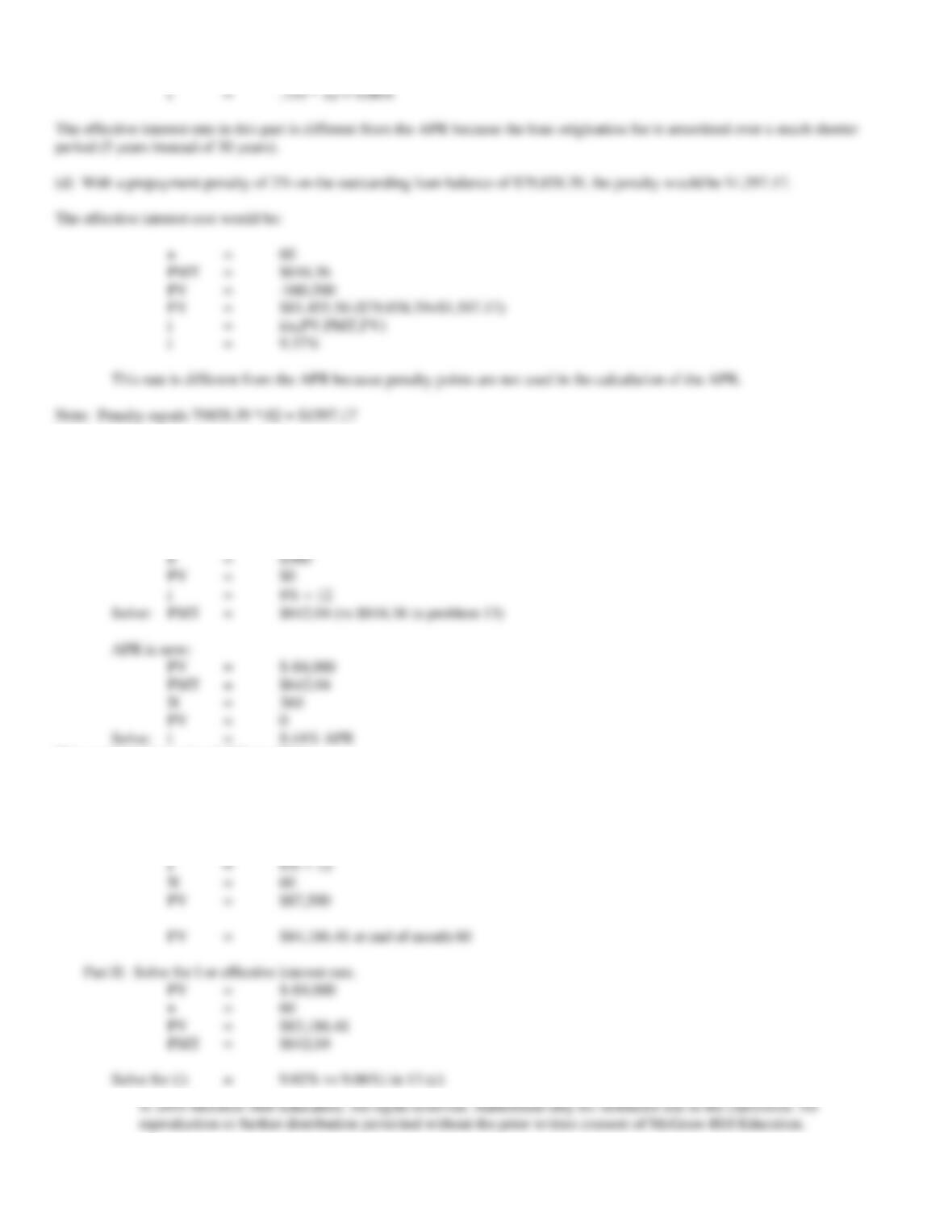
This can be compared to 8.45% in 13(b).
(c) If the loan is repaid after 5 years, the effective interest rate can be calculated as follows:
Solve for mortgage balance:
Part I:
PMT = $64,442.04