Solutions to Questions – Chapter 3
Mortgage Loan Foundations: The Time Value of Money
Question 3-1
What is the essential concept in understanding compound interest?
Question 3-2
How are the interest factors (IFs) Exhibit 3-3 developed? How may financial calculators be used to calculate IFs in
Exhibit 3-3?
Question 3-3
What general rule can be developed concerning maximum values and compounding intervals within a year? What
is an equivalent annual yield?
Question 3-4
What does the time value of money (TVM) mean?
Question 3-5
How does discounting, as used in determining present value, relate to compounding, as used in determining future
value? How would present value ever be used?
Question 3-6
What are the interest factors (IFs) in Exhibit 3-9? How are they developed? How may financial calculators be used
to calculate IFs in Exhibit 3-9?
Question 3-7
What is an annuity? How is it defined? What is the difference between an ordinary annuity and an annuity due?
Question 3-8
How must one discount a series of uneven receipts to find PV?
Question 3-9
What is the sinking-fund factor? How and why is it used?
Question 3-10
What is an internal rate of return? How is it used? How does it relate to the concept of compound interest?
Solutions to Problems – Chapter 3
The Interest Factor in Financing
Problem 3-1
Problem 3-2
Problem 3-3
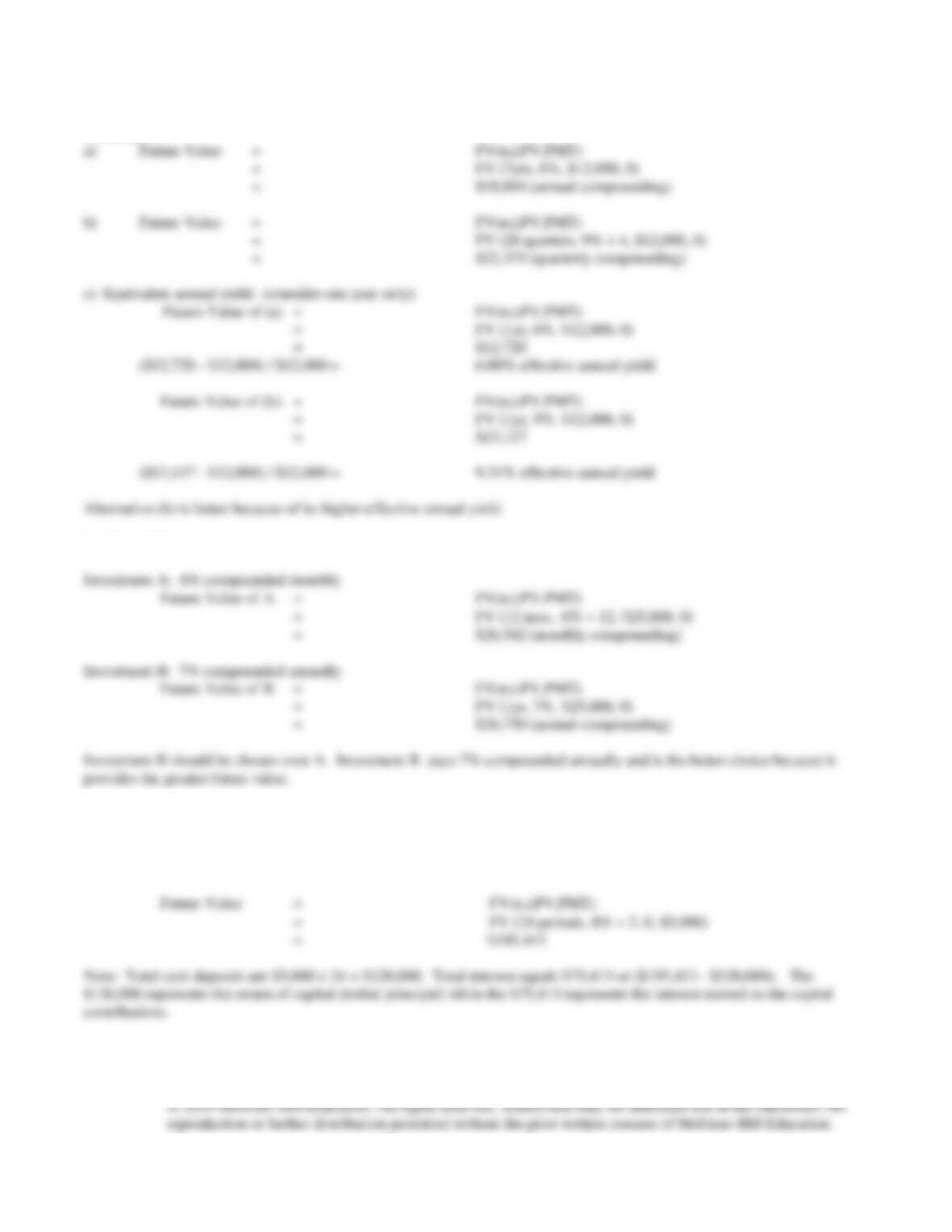
Find the future value of 24 deposits of $5,000 made at the end of each 6 months. Deposits will earn an annual rate of 8.0%,
compounded semi-annually.
Problem 3-4
Find the future value of quarterly payments of $1,250 for four years, each earning an interest rate of 10 percent annually,
compounded quarterly.
Problem 3-5
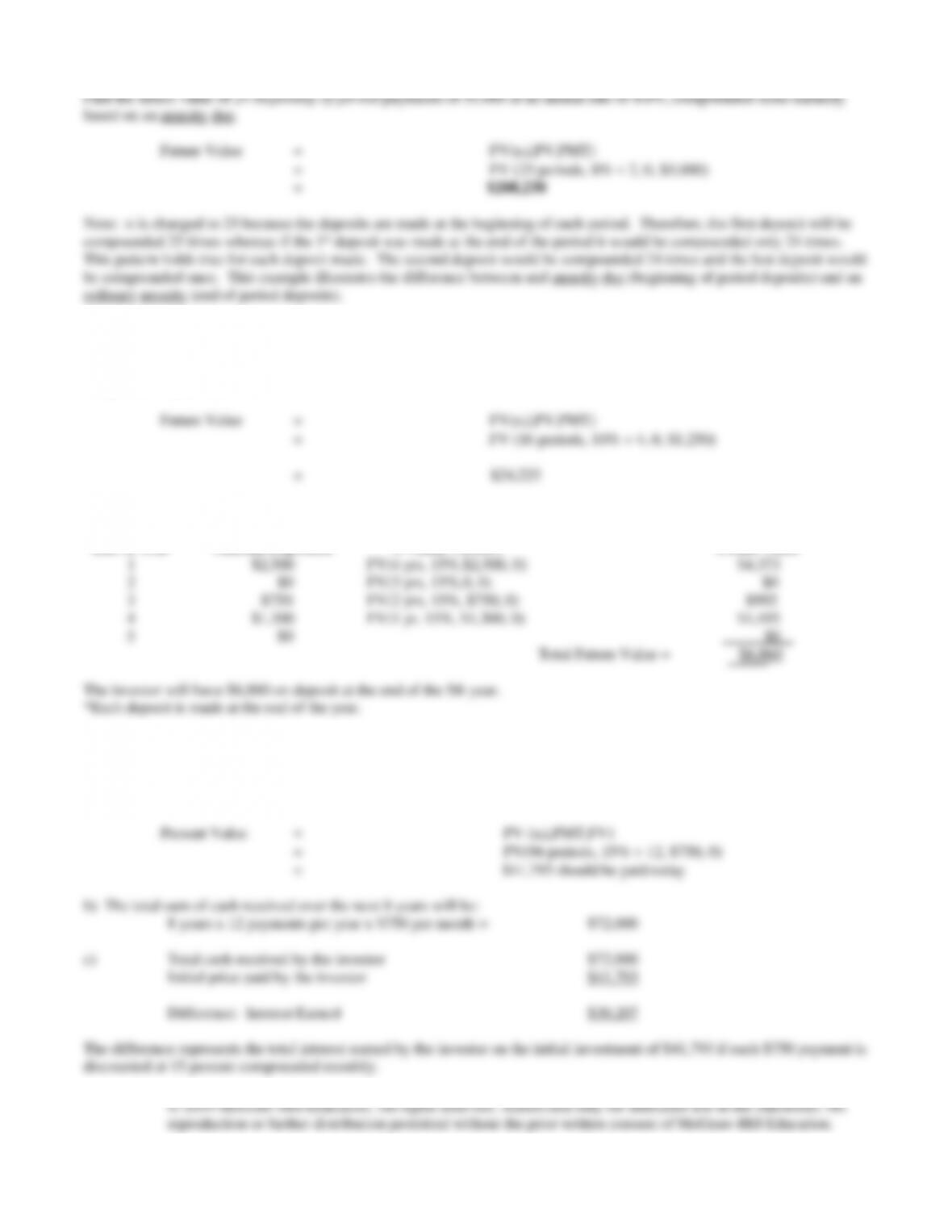
End of Year
Amount Deposited
FV(n,i,PV,PMT)
Future Value
1
$2,500
FV(4 yrs, 15%,$2,500, 0)
$4,373
2
$0
FV(3 yrs, 15%,0, 0)
$0
3
$750
FV(2 yrs, 15%, $750, 0)
$992
4
$1,300
FV(1 yr, 15%, $1,300, 0)
$1,495
5
$0
$0
Total Future Value = $6,860
The investor will have $6,860 on deposit at the end of the 5th year.
*Each deposit is made at the end of the year.
Problem 3-6
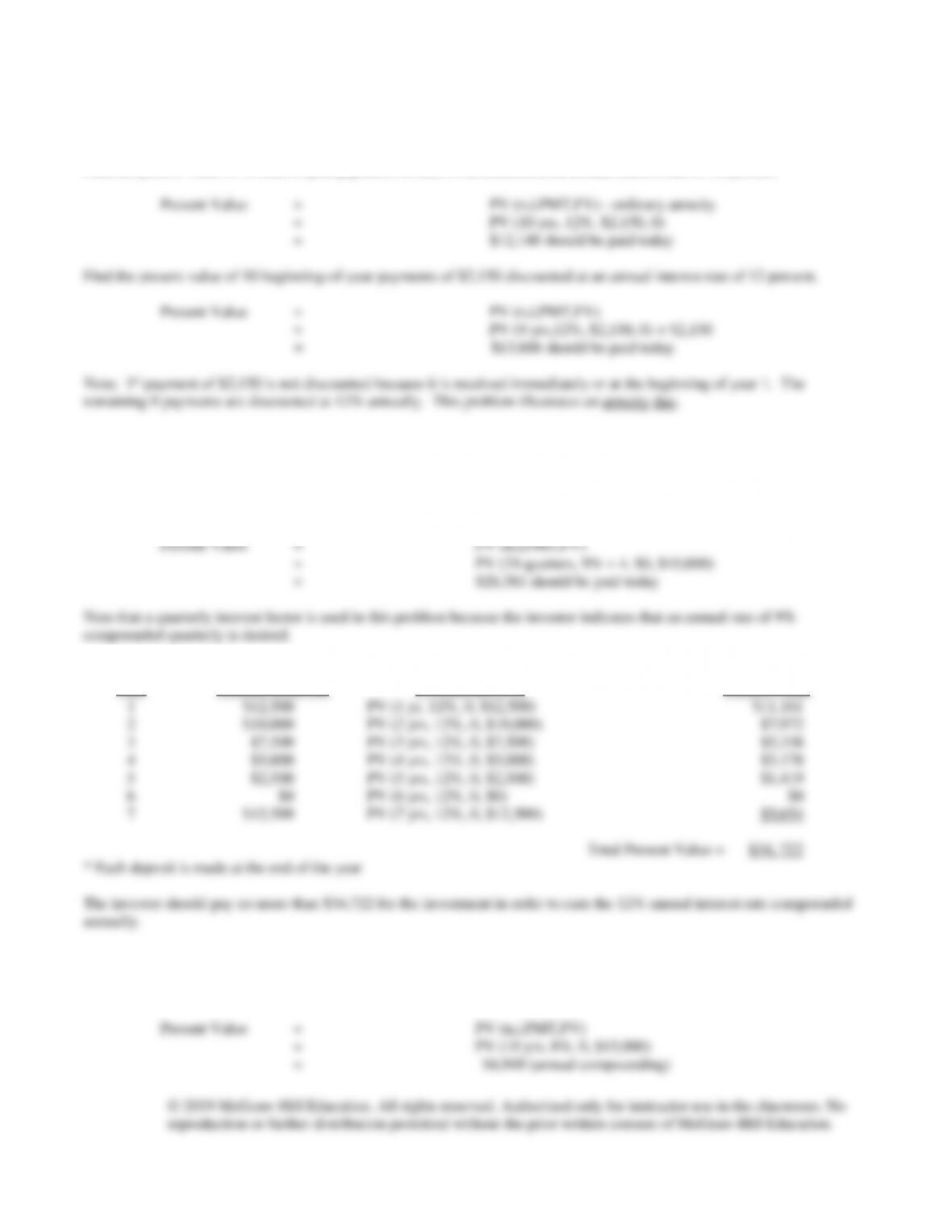
a) Find the present value of 96 monthly payments, of $750 (end-of-month) discounted at an interest rate of 15 percent
compounded monthly.
Problem 3-7
Find the present value of 10 end-of-year payments of $2,150 discounted at an annual interest rate of 12 percent.
Problem 3-8
Find the present value of $45,000 received at the end of 6 years, discounted at a 9% annual rate, compounded quarterly.
Problem 3-9
Year
Amount Received
PV (n,i,PMT,FV)
Present Value
1
$12,500
PV (1 yr, 12%, 0, $12,500)
$11,161
2
$10,000
PV (2 yrs, 12%, 0, $10,000)
$7,972
3
$7,500
PV (3 yrs, 12%, 0, $7,500)
$5,338
4
$5,000
PV (4 yrs, 12%, 0, $5,000)
$3,178
5
$2,500
PV (5 yrs, 12%, 0, $2,500)
$1,419
6
$0
PV (6 yrs, 12%, 0, $0)
$0
7
$12,500
PV (7 yrs, 12%, 0, $12,500)
$5,654
Total Present Value = $34, 722
* Each deposit is made at the end of the year
The investor should pay no more than $34,722 for the investment in order to earn the 12% annual interest rate compounded
annually.
Problem 3-10
Find the present value of $15,000 discounted at an annual rate of 8% for 10 years.
Problem 3-11
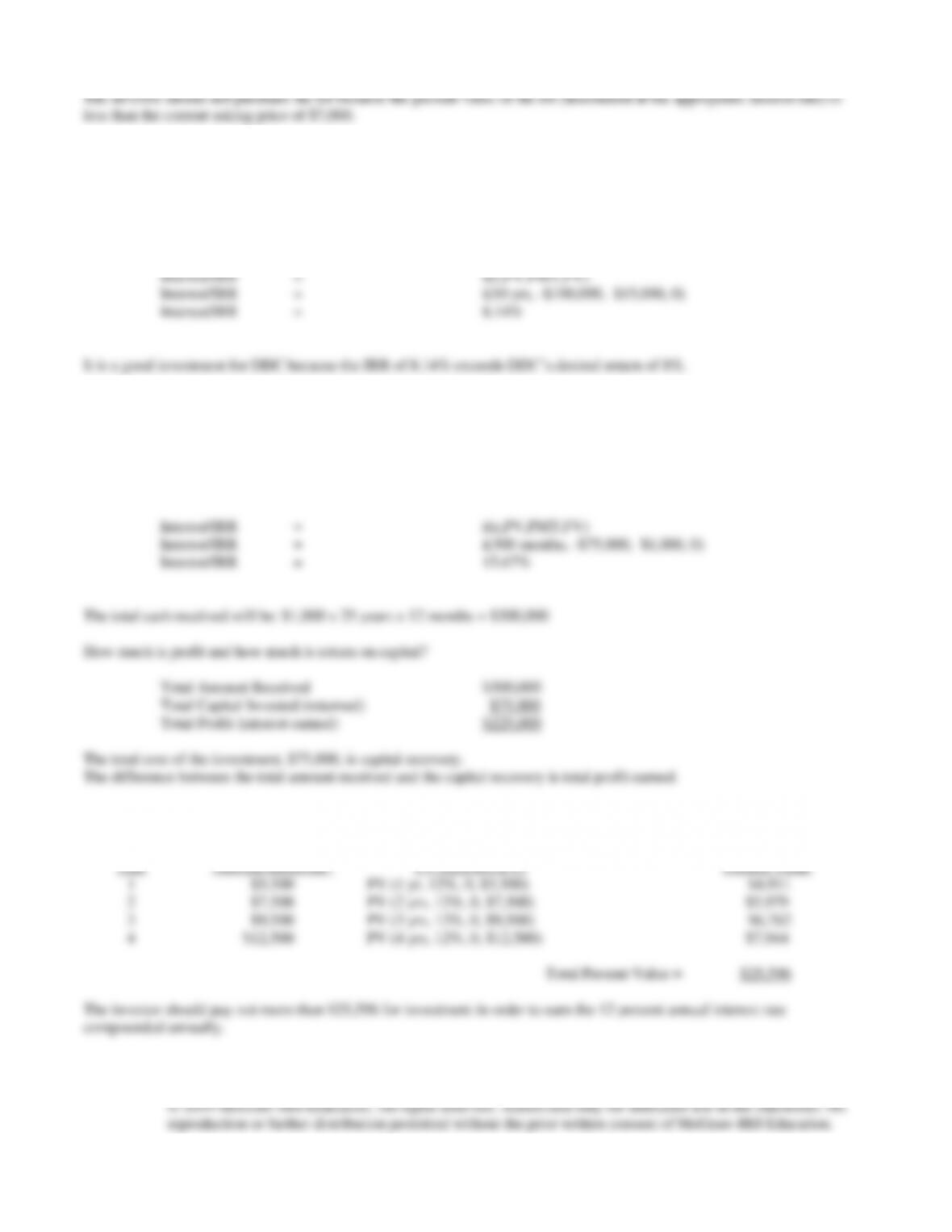
What will be the rate of return (yield) on a project that initially costs $100,000 and is expected to pay out $15,000 per year
for the next ten years?
Problem 3-12
What will be the rate of return (yield) on a project that initially costs $75,000 and is expected to pay out $1,000 per month for
the next 25 years?
Problem 3-13
(a)
Year
Amount Received*
PV (n,i,PMT,FV)
Present Value
1
$5,500
PV (1 yr, 12%, 0, $5,500)
$4,911
2
$7,500
PV (2 yrs, 12%, 0, $7,500)
$5,979
3
$9,500
PV (3 yrs, 12%, 0, $9,500)
$6,762
4
$12,500
PV (4 yrs, 12%, 0, $12,500)
$7,944
(b)
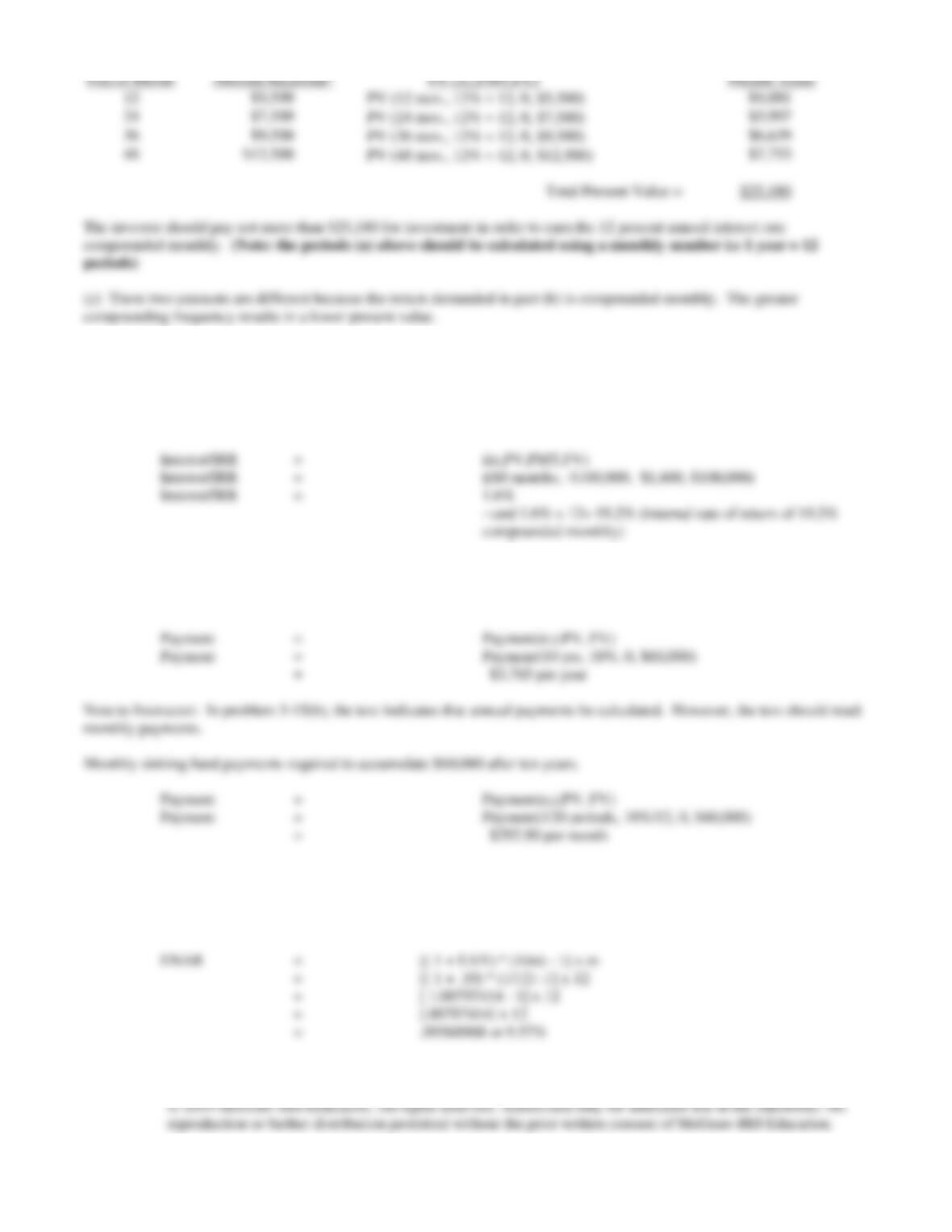
End of Month
Amount Received*
PV (n,i,PMT,FV)
Present Value
12
$5,500
PV (12 mos., 12% 12, 0, $5,500)
$4,881
24
$7,500
PV (24 mos., 12% 12, 0, $7,500)
$5,907
36
$9,500
PV (36 mos., 12% 12, 0, $9,500)
$6,639
48
$12,500
PV (48 mos., 12% 12, 0, $12,500)
$7,753
Total Present Value = $25,180
The investor should pay not more than $25,180 for investment in order to earn the 12 percent annual interest rate
compounded monthly. (Note: the periods (n) above should be calculated using a monthly number i.e 1 year = 12
periods)
(c) These two amounts are different because the return demanded in part (b) is compounded monthly. The greater
compounding frequency results in a lower present value.
Problem 3-14
What will be the internal rate of return (yield) on a project that initially costs $100,000 and is expected to receive $1,600 per
month for the next 5 years and, at the end of the five years, return the initial investment of $100,000?
Problem 3-15
Annual sinking fund payments required to accumulate $60,000 after ten years
Problem 3-16
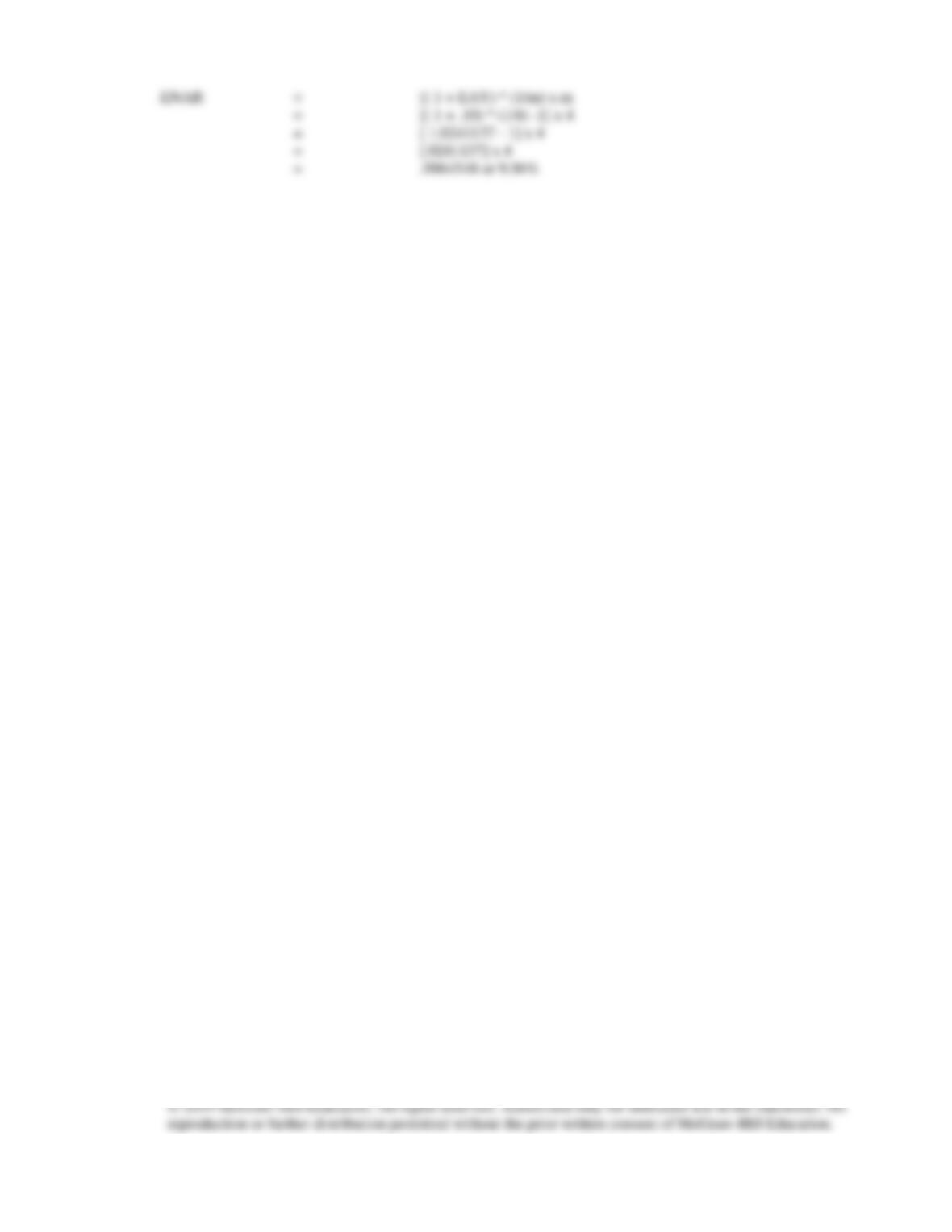
a) Find the ENAR for 10% EAY given Monthly Compounding.
b) Find the ENAR for 10% EAY given Quarterly Compounding
Problem 3-17
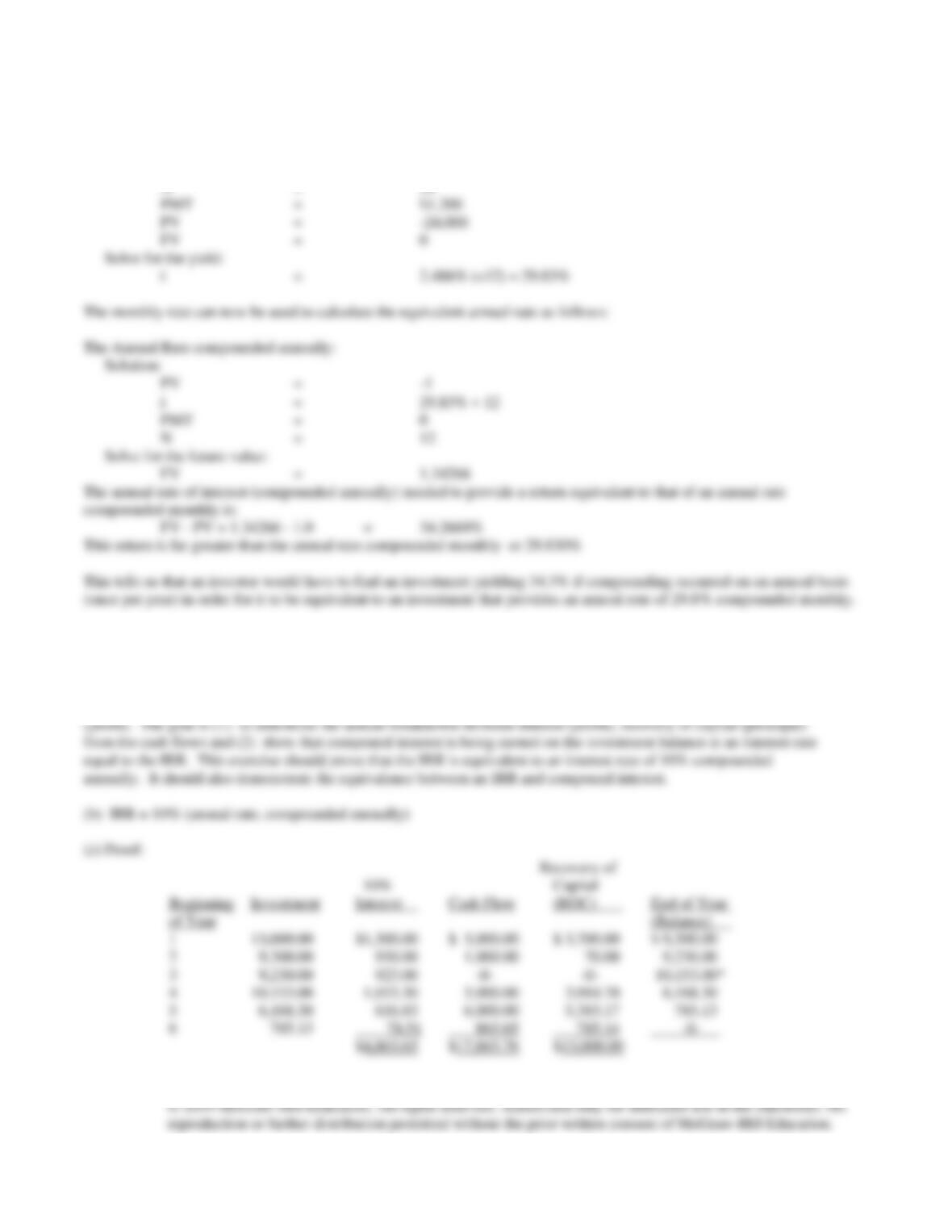
Part 1, calculate annual returns compounded annually: (Note: calculator should be set for one payment per period)
The Annual Rate compounded Monthly:
Solution:
N = 28
Problem 3-18
Goa1: To show the relationship between IRRs, compound interest, recovery of capital and cash flows.
a) Note: the sum of all cash flows is $17,863.65. The investment is $13,000, therefore $4,863.65 must be interest
(profit). The goal is (1) to determine the annual breakdown between interest (profit), recovery of capital (principal)
from the cash flows and (2) show that compound interest is being earned on the investment balance at an interest rate
equal to the IRR. This exercise should prove that the IRR is equivalent to an interest rate of 10% compounded
annually. It should also demonstrate the equivalence between an IRR and compound interest.
(b) IRR = 10% (annual rate, compounded annually)
(c) Proof:
Recovery of

* Note: Because the cash flow in year 3 is zero, interest must be accrued on the balance of $9,230 during year 3 and
added to the investment balance.