Solutions to Questions – Chapter 15
Financing Corporate Real Estate
Question 15-1
What are the main reasons that corporations may choose to own real estate?
Question 15-2
What factors would tend to make leasing more desirable than owning?
Question 15-3
Why might the cost of a mortgage loan be greater than the cost of using unsecured corporate debt to finance
corporate real estate?
Question 15-4
Why might the riskiness of cash flow from the residual value of the real estate differ from the riskiness of cash flow
from the corporation’s core business? What would cause these cash flows to be correlated?
Question 15-5
What would cause the rate of return for an investor that purchases real estate and leases it to the corporation to
differ from the rate of return earned by the corporation on the incremental investment in owning versus leasing the
same property?
Question 15-6
Why might the decision to own rather than lease real estate have an unfavorable effect on the corporation’s
financial statements?
Question 15-7
Why is the value of corporate real estate often considered “hidden” from shareholders?
Question 15-8
How does the analysis of a sale-leaseback differ from the analysis of owning versus leasing?
Question 15-9
Why is the cost of financing with a sale-leaseback essentially the same as the return from continuing to own?
Question 15-10
Why might it be argued that corporations do not have a comparative advantage when investing in real estate as a
means of diversification from the core business?
Question 15-11
Why has real estate often been a key factor in corporate restructuring?
Question 15-12
Why might refinancing be considered an alternative to a sale-leaseback?
Question 15-13
What factors might cause the highest and best use of real estate to change during the course of typical lease term?
Question 15-14
Why should corporations have their real estate appraised on a regular basis?
Question 15-15
What factors would tend to affect the value of a lease?
Solutions to Problems – Chapter 15
Financing Corporate Real Estate
INTRODUCTION
The three problems in this chapter parallel the lease versus own and sale-leaseback examples in the chapter. Emphasis
should be on the interpretation of the rate of return calculations from the point of view of the corporate decision maker.
Problem 15-1
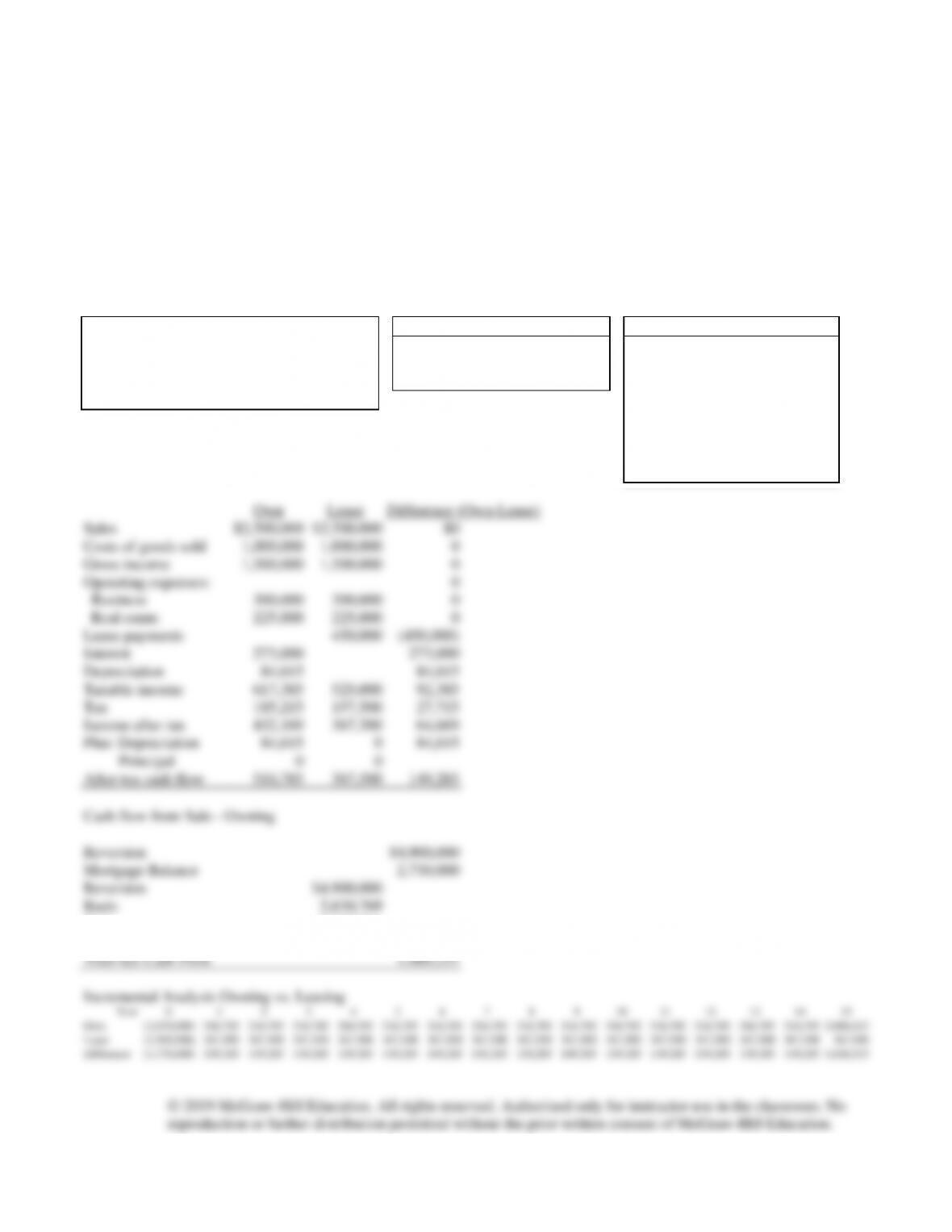
(REFER TO TEMPLATE 15_1.XLS)
ASSUMPTIONS:
Increase in sales
2,500,000
LEASE:
PURCHASE:
Costs of Goods Sold
1,000,000
Annual lease pmt.
450,000
Purchase Price
3,900,000
Increase in Corporate Overhead
300,000
Lease term
15
Land
600,000
Personal property
2,500,000
Operating Expenses
225,000
Building
3,300,000
Tax rate
30.00%
Depreciable life
39
Resale Value
4,900,000
Interest-only loan:
Amount
2,730,000
Interest rate
10.00%
Own
Lease
Difference (Own-Lease)
Sales
$2,500,000
$2,500,000
$0
Costs of goods sold
1,000,000
1,000,000
0
Gross income
1,500,000
1,500,000
0
Operating expenses:
0
Business
300,000
300,000
0
Real estate
225,000
225,000
0
Lease payments
450,000
(450,000)
Interest
273,000
273,000
Depreciation
84,615
84,615
Taxable income
617,385
525,000
92,385
Tax
185,215
157,500
27,715
Income after tax
432,169
367,500
64,669
Plus: Depreciation
84,615
0
84,615
Principal
0
0
After-tax cash flow
516,785
367,500
149,285
Cash flow from Sale – Owning
Reversion
$4,900,000
Mortgage Balance
2,730,000
Reversion
$4,900,000
Basis
2,630,769
Gain
2,269,231
Tax
680,769
After-tax Cash Flow
1,489,231
(a)
(b)
(d)
Problem 15-2
(REFER TO TEMPLATE 15_2.XLS)
ASSUMPTIONS:
Increase in sales
2,500,000
SALE-LEASEBACK
Purchase Price
3,900,000
Costs of Goods Sold
1,000,000
Annual lease pmt.
450,000
Land
600,000
Increase in Corporate Overhead
300,000
Lease term
15
Building
3,300,000
Tax rate
30.00%
Operating Expenses
225,000
Depreciable life
39
Number of years property owned
5
Resale Value
5,700,000
Value Today
4,240,000
Interest-only loan:
Amount
2,730,000
Interest rate
10.00%
Own
Lease
Difference (Own-Lease)
Sales
$2,500,000
$2,500,000
$0
Cost of goods sold
1,000,000
1,000,000
0
Gross income
1,500,000
1,500,000
0
Operating expenses:
Business
300,000
300,000
0
Real estate
225,000
225,000
0
Lease payments
450,000
-450,000
Interest
273,000
273,000
Depreciation
84,615
84,615
Taxable income
617,385
525,000
92,385
Tax
185,215
157,500
27,715
Income after tax
432,169
367,500
64,669
Plus: Depreciation
84,615
0
84,615
Principal
0
0
After-tax cash flow
516,785
367,500
149,285
Cash Flow From Sale – Owning
Year 5 (today)
Reversion
$4,240,000
Mortgage balance
2,730,000
Reversion
$4,240,000
Basis
3,476,923
Gain
763,077
Tax
228,923
After-tax Cash Flow
1,281,077
Cash Flow From Sale – Owning
Year 20
Reversion
$5,700,000
Mortgage balance
2,730,000
Reversion
$5,700,000
Basis
2,207,692
Gain
3,492,308
Tax
1,047,692
After-tax Cash Flow
1,922,308
ATIRR (owning vs. leasing difference): 12.90%
(a)
(d)
In considering a sale-leaseback, the firm should consider the implications for its financial statements; its ability to shelter
Problem 15-3
(a) This causes the cost of owning to increase since the corporation can not use the tax benefits.
Problem 15-4
(a) The IRR for owning versus leasing drops to 11.15% from 14.1% as a result of the lower lease rate. Owning is less