Solutions to Questions – Chapter 12
Financial Leverage and Financing Alternatives
Question 12-1
What is financial leverage? Why is a one-year measure of return on investment inadequate in determining whether
positive or negative financial leverage exists?
Question 12-2
What is the break-even mortgage interest rate (BEIR) in the context of financial leverage? Would you ever expect
an investor to pay a break-even interest rate when financing a property? Why or why not?
Question 12-3
What is positive and negative financial leverage? How are returns or losses magnified as the degree of leverage
increases? How does leverage on a before-tax basis differ from leverage on an after-tax basis?
Question 12-4
In what way does leverage increase the riskiness of a loan?
Question 12-5
What is meant by a participation loan? What does the lender participate in? Why would a lender want to make a
participation loan? Why would an investor want to obtain a participation loan?
Question 12-6
What is meant by a sale-leaseback? Why would a building investor want to do a sale-leaseback of the land? What
is the benefit to the party that purchases the land under a sale-leaseback?
Question 12-7
Why might an investor prefer a loan with a lower interest rate and a participation?
Question 12-8
Why might a lender prefer a loan with a lower interest rate and a participation?
Question 12-9
How do you think participations affect the riskiness of a loan?
Question 12-10
What is the motivation for a sale-leaseback of the land?
Question 12-11
What criteria should be used to choose between two financing alternatives?
Question 12-12
What is the traditional cash equivalency approach to determine how below-market rate loans affect value?
Question 12-13
How can the effect of below-market rate loans on value be determined using investor criteria?
Solutions to Problems – Chapter 12
Financial Leverage and Financing Alternatives
INTRODUCTION
The problems in this chapter are designed to reinforce the students’ understanding of alternative methods of structuring debt
financing and how financing can affect the cash flows and the leverage of the real estate project. The conditions necessary
for positive financing leverage and how the use financial leverage affects risk are also discussed.
The third problem extends problem 5 in chapter 10 which involved calculation of the expected return and standard deviation
for an investment. In this chapter financing is added to the problem. Instructors should emphasize that the risk (measured b
the standard deviation) will always increase with leverage. However, whether the expected return increases depends on
whether leverage is favorable or unfavorable.
Problem 12-1
(REFER TO TEMPLATE 12_1.XLS)
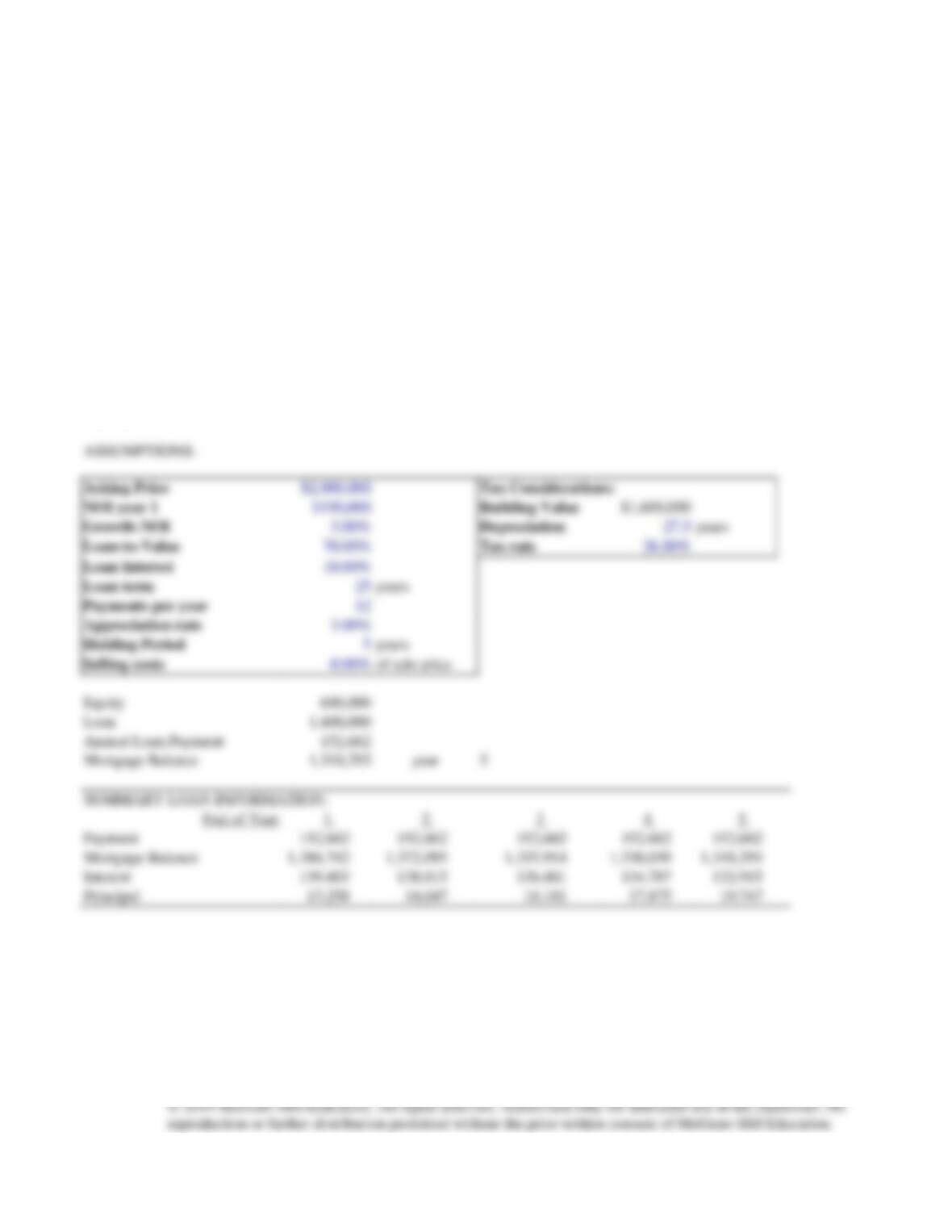
(a) 70% LOAN (70% and 10% are the original variables contained in the template. It must be changed for any other
answer.)
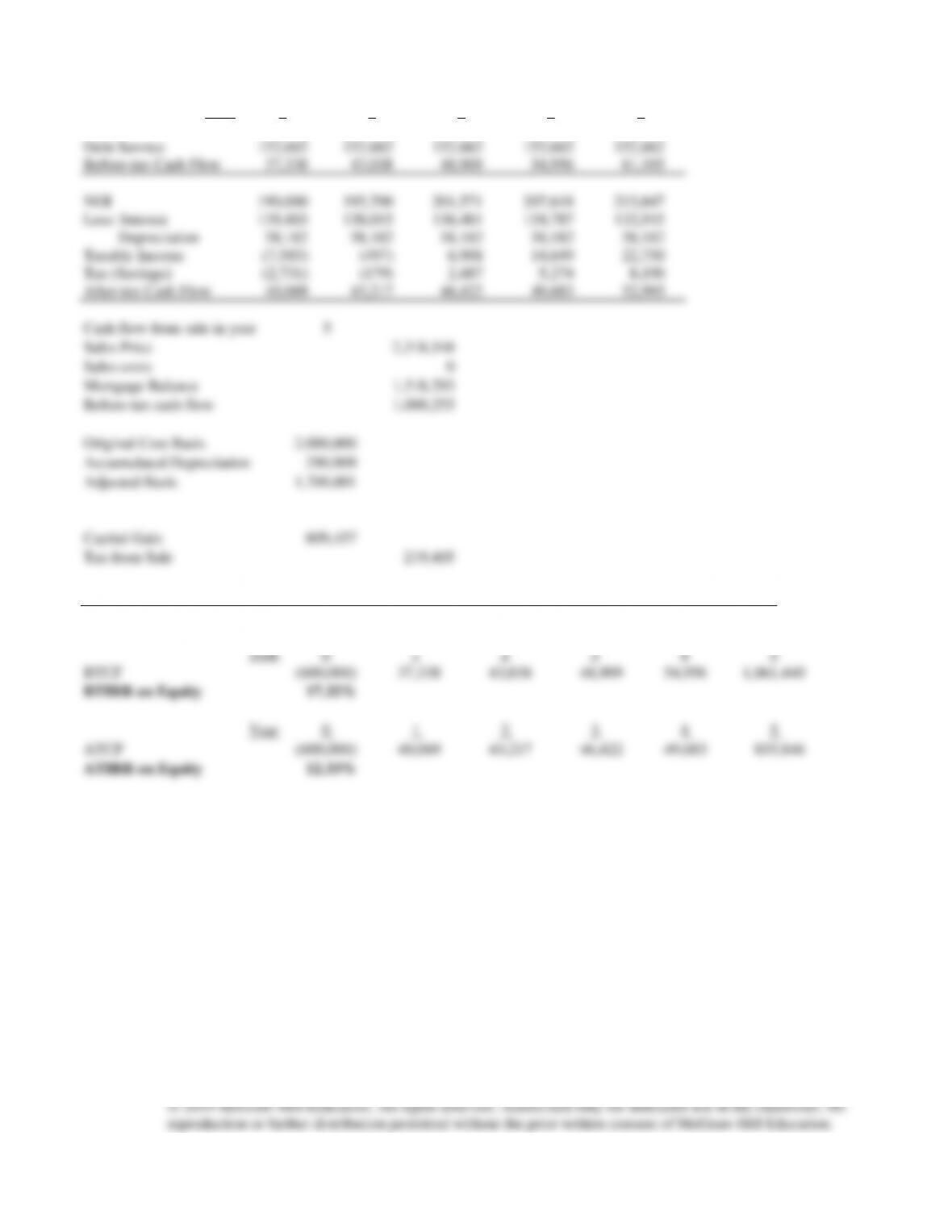
Year
1
2
3
4
5
NOI
190,000
195,700
201,571
207,618
213,847
Debt Service
152,662
152,662
152,662
152,662
152,662
Before-tax Cash Flow
37,338
43,038
48,909
54,956
61,185
NOI
190,000
195,700
201,571
207,618
213,847
Less: Interest
139,403
138,015
136,481
134,787
132,915
Depreciation
58,182
58,182
58,182
58,182
58,182
Taxable Income
(7,585)
(497)
6,908
14,649
22,750
Tax (Savings)
(2,731)
(179)
2,487
5,274
8,190
After-tax Cash Flow
40,069
43,217
46,422
49,683
52,995
Cash flow from sale in year
5
Sales Price
2,318,548
Sales costs
0
Mortgage Balance
1,318,293
Before-tax cash flow
1,000,255
Original Cost Basis
2,000,000
Accumulated Depreciation
290,909
Adjusted Basis
1,709,091
Capital Gain
609,457
Tax from Sale
219,405
After-tax cash flow from sale
780,851
EQUITY
Year
0
1
2
3
4
5
BTCF
(600,000)
37,338
43,038
48,909
54,956
1,061,440
BTIRR on Equity
17.32%
Year
0
1
2
3
4
5
ATCF
(600,000)
40,069
43,217
46,422
49,683
833,846
ATIRR on Equity
12.33%
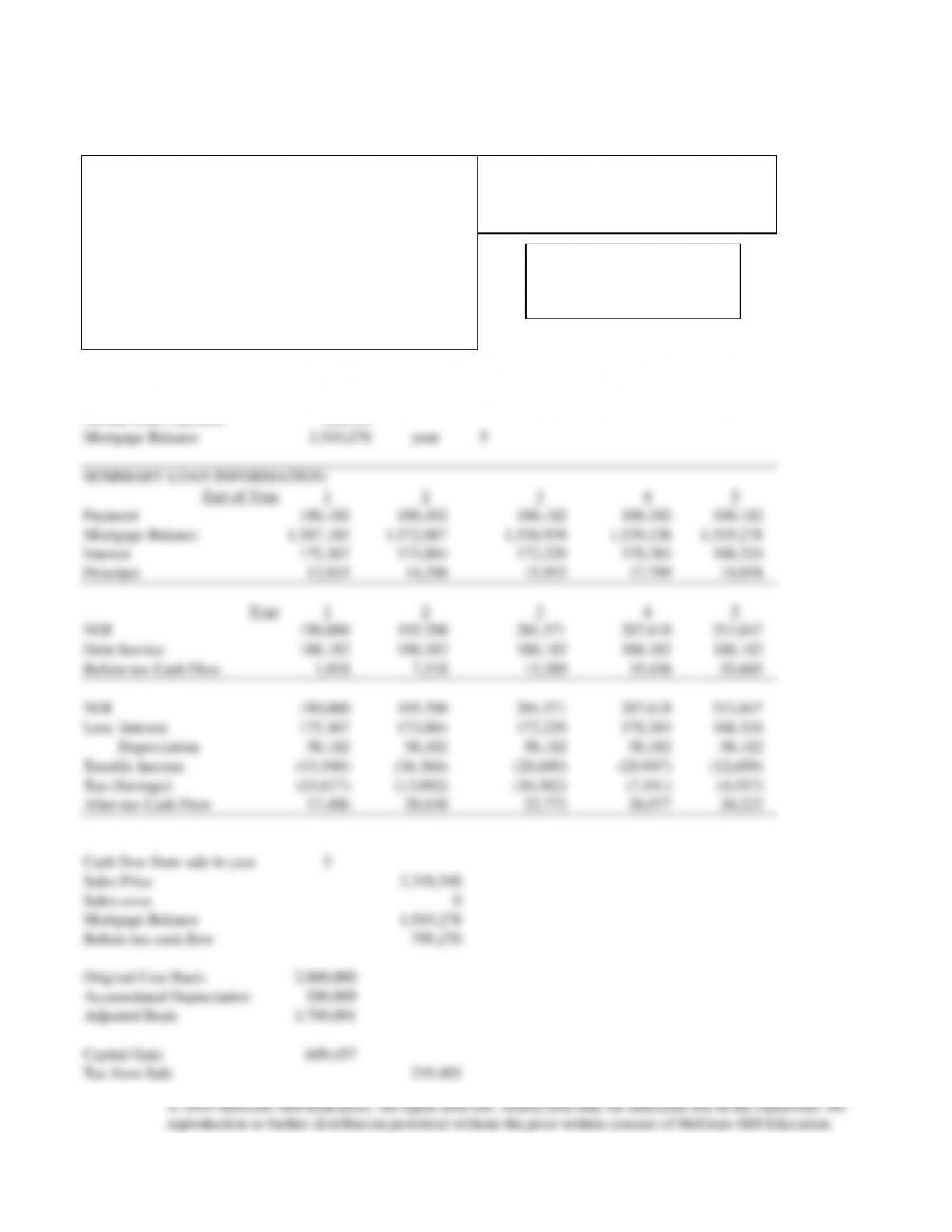
(a) 80% LOAN (Change 70 to 80% and 10 to 11%. All other variables are constant.)
ASSUMPTIONS:
Asking Price
$2,000,000
Tax Considerations:
NOI year 1
$190,000
Building Value
$1,600,000
Growth-NOI
3.00%
Depreciation
27.5
years
Loan-to-Value
80.00%
Tax rate*
36.00%*
Loan Interest
11.00%
Loan term
25
years
Payments per year
12
Appreciation rate
3.00%
Holding Period
5
years
Selling costs
0.00%
of sale price
Equity
400,000
Loan
1,600,000
Annual Loan Payment
188,182
Mortgage Balance
1,519,278
year
5
SUMMARY LOAN INFORMATION:
End of Year
1
2
3
4
5
Payment
188,182
188,182
188,182
188,182
188,182
Mortgage Balance
1,587,185
1,572,887
1,556,934
1,539,136
1,519,278
Interest
175,367
173,884
172,229
170,383
168,324
Principal
12,815
14,298
15,953
17,799
19,858
Year
1
2
3
4
5
NOI
190,000
195,700
201,571
207,618
213,847
Debt Service
188,182
188,182
188,182
188,182
188,182
Before-tax Cash Flow
1,818
7,518
13,389
19,436
25,665
NOI
190,000
195,700
201,571
207,618
213,847
Less: Interest
175,367
173,884
172,229
170,383
168,324
Depreciation
58,182
58,182
58,182
58,182
58,182
Taxable Income
(43,548)
(36,366)
(28,840)
(20,947)
(12,659)
Tax (Savings)
(15,677)
(13,092)
(10,382)
(7,541)
(4,557)
After-tax Cash Flow
17,496
20,610
23,772
26,977
30,222
Cash flow from sale in year
5
Sales Price
2,318,548
Sales costs
0
Mortgage Balance
1,519,278
Before-tax cash flow
799,270
Original Cost Basis
2,000,000
Accumulated Depreciation
290,909
Adjusted Basis
1,709,091
Capital Gain
609,457
Tax from Sale
219,405
*To be applied to all items of
income, capital gains and
recapture of depreciation.
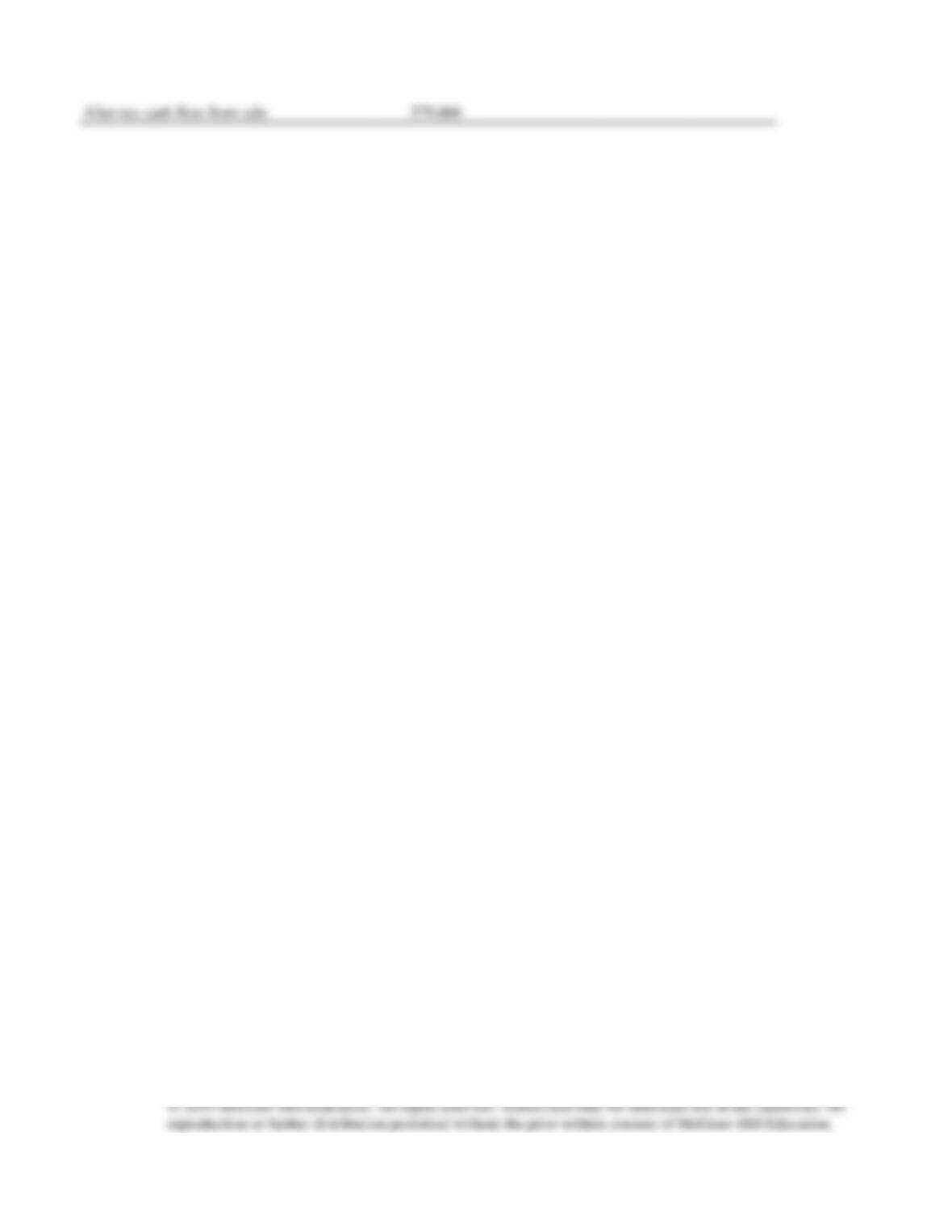
After-tax cash flow from sale
579,866
EQUITY
Year
0
1
2
3
4
5
BTCF
(400,000)
1,818
7,518
13,389
19,436
824,935
BTIRR on Equity
17.12%
Year
0
1
2
3
4
5
ATCF
(400,000)
17,496
20,610
23,772
26,977
610,088
ATIRR on Equity
12.74%
(b) BEIR
(To calculate the Break Even Interest Rate (BEIR), the ATIRR must first be calculated as if there were no
financing.)
ASSUMPTIONS:
Asking Price
$2,000,000
Tax Considerations:
NOI year 1
$190,000
Building Value
$1,600,000
Growth-NOI
3.00%
Depreciation
27.5
years
Loan-to-Value
0.00%
Tax rate
36.00%
Loan Interest
11.00%
Loan term
25
years
Payments per year
12
Appreciation rate
3.00%
Holding Period
5
years
Selling costs
0.00%
of sale price
Equity
2,000,000
Loan
0
Annual Loan Payment
0
Mortgage Balance
0
year
5
SUMMARY LOAN INFORMATION:
End of Year
1
2
3
4
5
Payment
0
0
0
0
0
Mortgage Balance
0
0
0
0
0
Interest
0
0
0
0
0
Principal
0
0
0
0
0
*To be applied to all items of
income, capital gains and
recapture of depreciation.
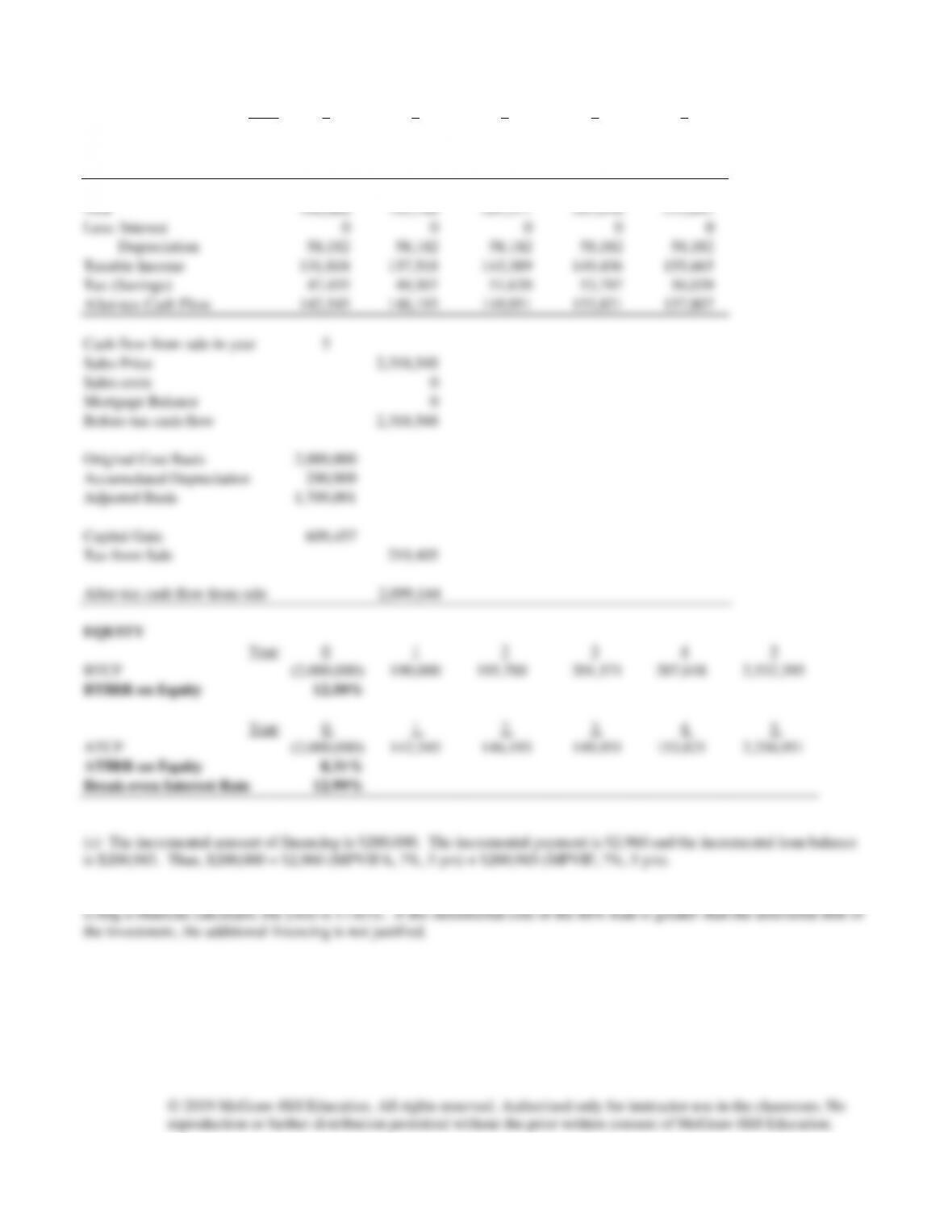
Year
1
2
3
4
5
NOI
190,000
195,700
201,571
207,618
213,847
Debt Service
0
0
0
0
0
Before-tax Cash Flow
190,000
195,700
201,571
207,618
213,847
NOI
190,000
195,700
201,571
207,618
213,847
Less: Interest
0
0
0
0
0
Depreciation
58,182
58,182
58,182
58,182
58,182
Taxable Income
131,818
137,518
143,389
149,436
155,665
Tax (Savings)
47,455
49,507
51,620
53,797
56,039
After-tax Cash Flow
142,545
146,193
149,951
153,821
157,807
Cash flow from sale in year
5
Sales Price
2,318,548
Sales costs
0
Mortgage Balance
0
Before-tax cash flow
2,318,548
Original Cost Basis
2,000,000
Accumulated Depreciation
290,909
Adjusted Basis
1,709,091
Capital Gain
609,457
Tax from Sale
219,405
After-tax cash flow from sale
2,099,144
EQUITY
Year
0
1
2
3
4
5
BTCF
(2,000,000)
190,000
195,700
201,571
207,618
2,532,395
BTIRR on Equity
12.50%
Year
0
1
2
3
4
5
ATCF
(2,000,000)
142,545
146,193
149,951
153,821
2,256,951
ATIRR on Equity
8.31%
Break-even Interest Rate
12.99%
(c) The incremental amount of financing is $200,000. The incremental payment is $2,960 and the incremental loan balance
is $200,985. Thus, $200,000 = $2,960 (MPVIFA, ?%, 5 yrs) + $200,985 (MPVIF, ?%, 5 yrs).
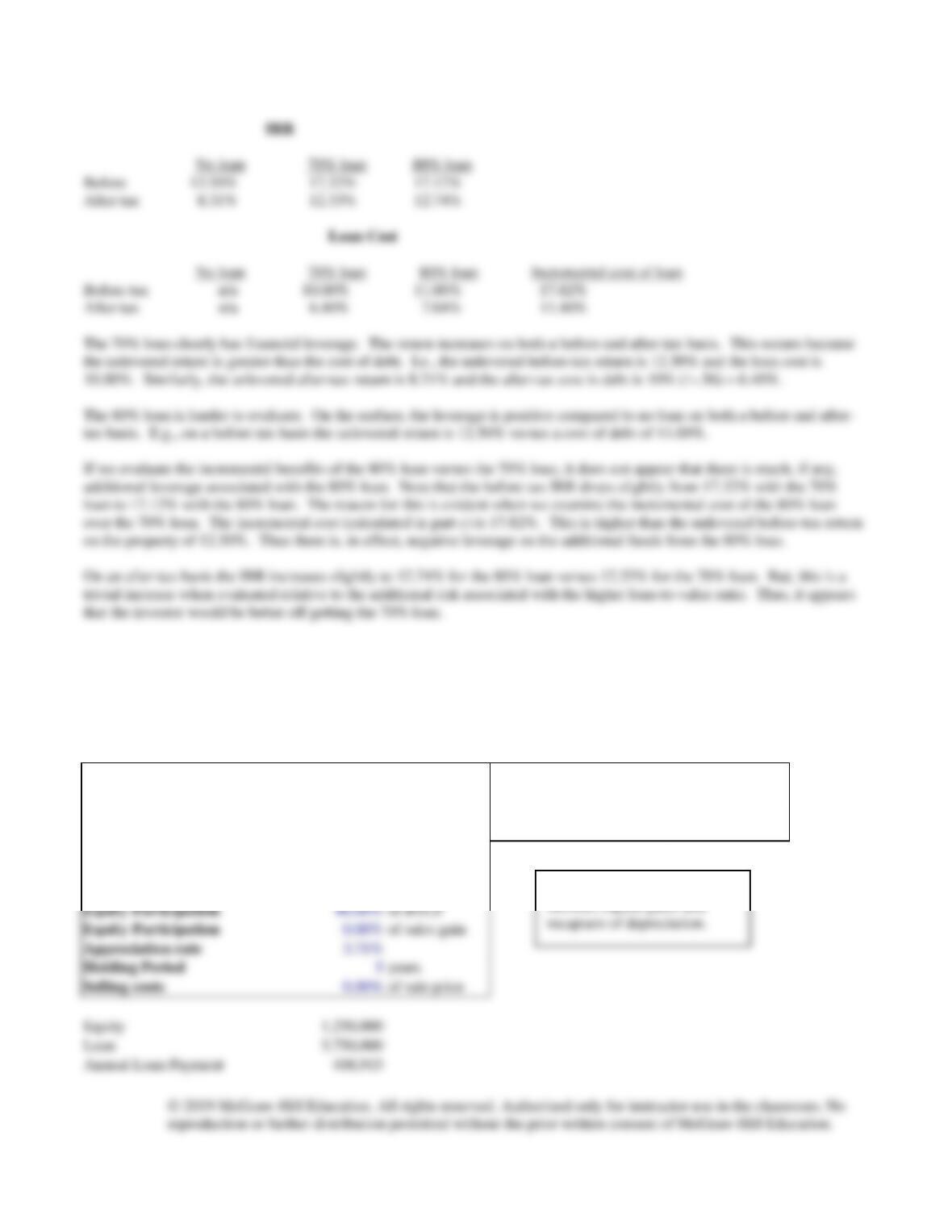
(d) To answer this question it is helpful to prepare the following summary:
Problem 12-2
(REFER TO TEMPLATE 12_2.XLS)
(a)
ASSUMPTIONS:
Asking Price
$5,000,000
Tax Considerations:
NOI year 1
$475,000
Building Value
$4,000,000
Growth-NOI
3.00%
Depreciation
39
years
Loan-to-Value
75.00%
Tax rate
28.00%
Loan Interest
10.00%
Loan term
25
years
Payments per year
12
Equity Participation
40.00%
of BTCF
Equity Participation
0.00%
of sales gain
Appreciation rate
3.71%
Holding Period
5
years
Selling costs
0.00%
of sale price
Equity
1,250,000
Loan
3,750,000
Annual Loan Payment
408,915
*To be applied to all items of
income, capital gains and
recapture of depreciation.
Mortgage Balance
3,531,141
year
5
SUMMARY LOAN INFORMATION:
End of Year
1
2
3
4
5
Payment
408,915
408,915
408,915
408,915
408,915
Mortgage Balance
3,714,486
3,675,254
3,631,913
3,584,034
3,531,141
Interest
373,402
369,683
365,575
361,036
356,023
Principal
35,514
39,233
43,341
47,879
52,893
Year
1
2
3
4
5
NOI
475,000
489,250
503,928
519,045
534,617
Debt Service
408,915
408,915
408,915
408,915
408,915
Before-tax Cash Flow
66,085
80,335
95,012
110,130
125,701
Equity Participation
26,434
32,134
38,005
44,052
50,281
Cash Flow after Participation
39,651
48,201
57,007
66,078
75,421
NOI
475,000
489,250
503,928
519,045
534,617
Less: Interest
373,402
369,683
365,575
361,036
356,023
Depreciation
102,564
102,564
102,564
102,564
102,564
Participation
26,434
32,134
38,005
44,052
50,281
Taxable Income
(27,400)
(15,131)
(2,216)
11,393
25,749
Tax (Savings)
(7,672)
(4,237)
(621)
3,190
7,210
ATCF after Participation
47,323
52,437
57,628
62,888
68,211
Cash flow from sale in year
5
Sales Price
6,000,000
Sales costs
0
Mortgage Balance
3,531,141
Before-tax cash flow
2,468,859
Participation in Gain
0
BTCF after Participation
2,468,859
Sales Price
6000000
Sales Costs
0
Participation
0
Original Cost Basis
5,000,000
Accumulated Depreciation
512,821
Adjusted Basis
4,487,179
Capital Gain
1,512,821
Tax from Sale
423,590
After-tax cash flow from sale
2,045,269
Payment
0
0
0
Mortgage Balance
0
0
0
Interest
0
0
0
Principal
0
0
0
EQUITY
Year
0
1
2
3
4
5
BTCF after Participation
(1,250,000)
39,651
48,201
57,007
66,078
2,544,279
BTIRR on Equity
17.98%
Year
0
1
2
3
4
5
ATCF
(1,250,000)
47,323
52,437
57,628
62,888
2,113,480
ATIRR on Equity
14.11%
(b) BEIR (To calculate the Break Even Interest Rate (BEIR), the ATIRR must first be calculated as if there were no
financing.)
NO LOAN (Change 75 to 0% and remove the participation by changing 40 to 0%. All other variables are constant.)
ASSUMPTIONS:
Asking Price
$5,000,000
Tax Considerations:
NOI year 1
$475,000
Building Value
$4,000,000
Growth-NOI
3.00%
Depreciation
39
years
Loan-to-Value
0.00%
Tax rate
28.00%
Loan Interest
10.00%
Loan term
25
years
Payments per year
12
Equity Participation
0.00%
of BTCF
Equity Participation
0.00%
of sales gain
Appreciation rate
3.71%
Holding Period
5
years
Selling costs
0.00%
of sale price
Equity
5,000,000
Loan
0
Annual Loan Payment
0
Mortgage Balance
0
year
5