Chapter 04 – Accounting for Governmental Operating Activities—Illustrative Transactions and Financial Statements
4-1
CHAPTER 4: ACCOUNTING FOR GOVERNMENTAL OPERATING
ACTIVITIES⎯ILLUSTRATIVE TRANSACTIONS AND
FINANCIAL STATEMENTS
OUTLINE
Number
Topic
Type/Task
Status
(re: 18/e)
Questions:
4-1
Appropriate choice of governmental fund
Analyze
New
4-2
Encumbrances outstanding at year-end
Explain
Same
4-3
Tax anticipation notes
Explain
Same
4-4
Dual effects of transactions
Explain, examples
4-1
4-5
Property tax revenue
Compute
Same
4-6
Differences in property tax revenues
Explain
New
4-7
Purchases and consumption method of
accounting for supplies
Explain
Same
4-8
Interim financial reporting
Explain
New
4-9
Permanent funds
Describe
Same
4-10
Classes of nonexchange transactions
Describe
Same
4-11
Deferred inflows of resources
Describe
New
Cases:
4-12
Analyzing budget and actual data
Examine, write
New
4-13
Policy issues relating to property taxes
Analyze, write
Same
4-14
Delinquent taxes and tax liens
Research, write
Same
4-15
Reporting grant transactions
Analyze, explain
Revised
Exercises/Problems:
4-16
Examine the CAFR
Examine
Updated
4-17
Various
Multiple Choice
Revised
4-18
Recording encumbrances and expenditures
JEs
Same
4-19
Accounting for property taxes
Calculate, JEs
Revised
4-20
Differences in accounting for property taxes
Calculate, JEs
New
4-21
Calculating required tax anticipation
financing and recording issuance of TANs
Calculate, JEs
Same
4-22
Adjusting and closing entries
Analyze, JEs
Revised
4-23
Special revenue fund, voluntary
nonexchange transactions
Analyze, JEs
Same
4-24
Transactions and budgetary comparison
schedule
JEs and schedule
Revised
4-25
Interfund and interactivity transactions
JEs
Revised
4-26
Comparison of inventory methods
Calculate, JEs
New
4-27
Operating transactions and financial
statements
JEs and statement
Revised
4-28
Permanent fund accounting
JEs and statements
Same
Chapter 04 – Accounting for Governmental Operating Activities—Illustrative Transactions and Financial Statements
4-2
CHAPTER 4: ACCOUNTING FOR GOVERNMENTAL OPERATING
ACTIVITIES—ILLUSTRATIVE TRANSACTIONS AND
FINANCIAL STATEMENTS
Answers to Questions
4-1. In addition to the General Fund, governmental fund categories include: special revenue,
debt service, capital projects, and permanent funds. The property taxes are recorded in the
General Fund. As set forth in GASB Codification Sec. 1300, paragraph 105, special
revenue funds are used to account for and report the proceeds of specific revenue sources
that are restricted or committed to expenditure for specified purposes other than debt
General Problem Information: Appropriate choice of governmental fund
Learning Objective: 4-4, 4-6
Topic: Special Revenue Funds, Permanent Funds
Bloom’s Taxonomy: Understand
Accreditation Skills tag: AACSB: Communication, AICPA: FN Reporting
Level of Difficulty: Easy
4-2. In the statement or schedule of revenues, expenditures, and changes in fund balance
prepared on the budgetary basis, any encumbrances outstanding at year-end are added to
General Problem Information: Encumbrances outstanding at year-end
Learning Objective: 4-1
Topic: General Fund Financial Statements
Bloom’s Taxonomy: Understand
Accreditation Skills tag: AACSB: Communication, AICPA: FN Reporting
Level of Difficulty: Easy
Chapter 04 – Accounting for Governmental Operating Activities—Illustrative Transactions and Financial Statements
4-3
Ch. 4, Answers (Cont’d)
4-3. Since cash inflows to governments often do not occur on a consistent basis, many
General Problem Information: Tax anticipation notes
Learning Objective: 4-1
Topic: Tax Anticipation Notes
Bloom’s Taxonomy: Understand
Accreditation Skills tag: AACSB: Communication, AICPA: FN Reporting
Level of Difficulty: Easy
4-4. Under the GASB financial reporting model, governmental activities are reported on a
long-term perspective at the government–wide level using the economic resources
measurement focus and the accrual basis of accounting, similar to business accounting.
This means that both current and noncurrent assets and liabilities, as well as deferred
inflows and outflows of resources, are reported on the statement of net position.
General Problem Information: Dual effects of transactions
Learning Objective: 4-1
Topic: Dual-track Accounting Approach
Bloom’s Taxonomy: Understand
Accreditation Skills tag: AACSB: Communication, AICPA: FN Reporting
Level of Difficulty: Medium
Chapter 04 – Accounting for Governmental Operating Activities—Illustrative Transactions and Financial Statements
4-4
Ch. 4, Answers (Cont’d)
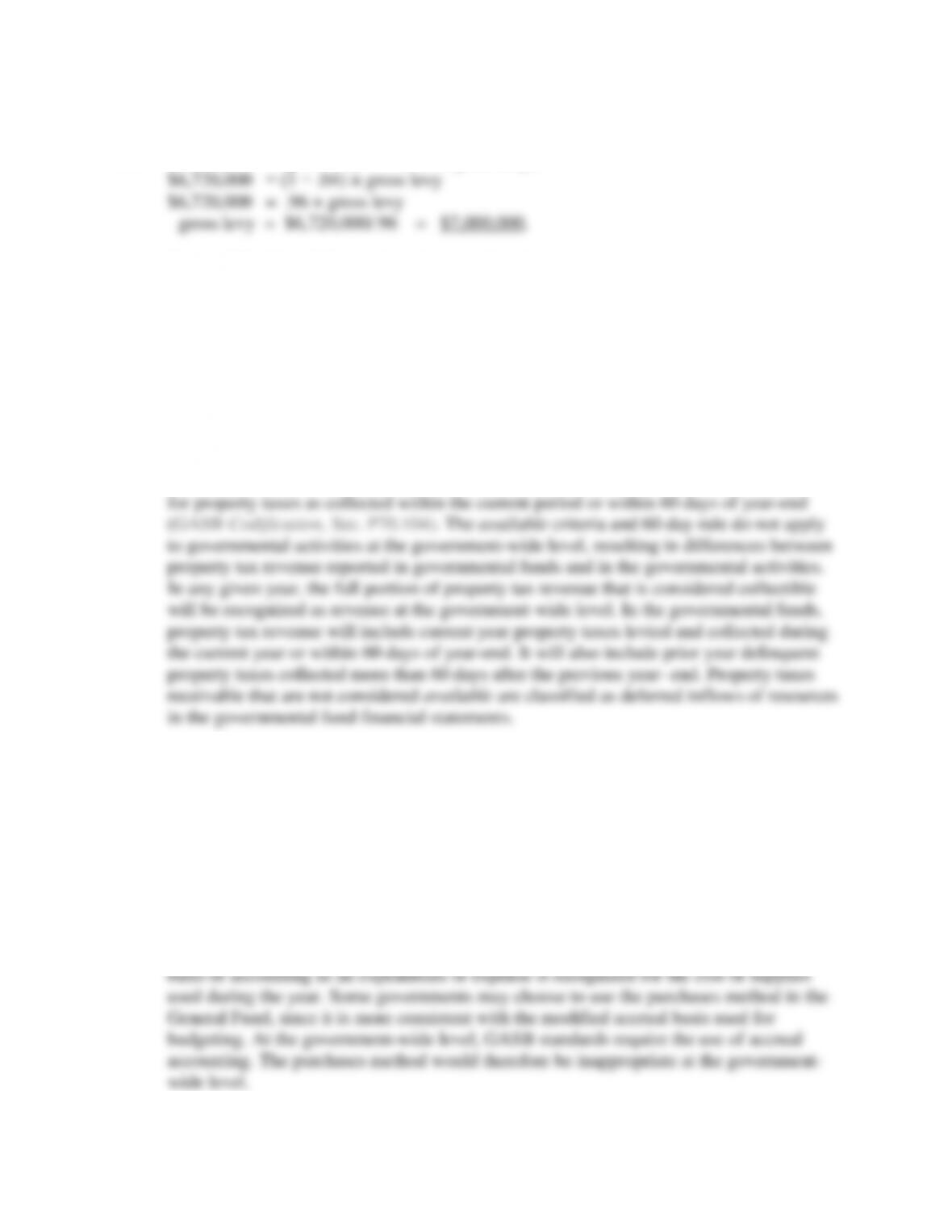
4-5. $6,720,000 = gross levy − (.04 × gross levy)
General Problem Information: Property Tax Revenue
Learning Objective: 4-1
Topic: Accounting for Property Taxes
Bloom’s Taxonomy: Apply
Accreditation Skills tag: AACSB: Knowledge Application, AICPA: FN Critical
Thinking
Level of Difficulty: Medium
4-6. Property tax revenue is an example of an imposed nonexchange revenue, thus revenue
should be credited in the year for which the tax was levied. In governmental funds,
however, revenue is recognized when measurable and available, with available specified
General Problem Information: Differences in property tax revenues
Learning Objective: 4-1, 4–7
Topic: Accounting for Property Taxes
Bloom’s Taxonomy: Understand
Accreditation Skills tag: AACSB: Communication, AICPA: FN Reporting
Level of Difficulty: Medium
4-7. The purchases method is consistent with the modified accrual basis of accounting as an
expenditure is recognized for the full cost of supplies when purchased, regardless of the
amount used during the year. The consumption method is consistent with the accrual
Chapter 04 – Accounting for Governmental Operating Activities—Illustrative Transactions and Financial Statements
4-5
Ch. 4, Answers, Question 4-7 (Cont’d)
General Problem Information: Purchases and consumption method of accounting for
supplies
Learning Objective: 4-1, 4–2
Topic: Adjusting Entries
Bloom’s Taxonomy: Remember
Accreditation Skills tag: AACSB: Communication, AICPA: FN Reporting
Level of Difficulty: Easy
4-8. Although there is no requirement for external interim financial reporting, all state and
General Problem Information: Interim financial statements
Learning Objective: 4-3
Topic: Interim financial statements (Appendix B)
Bloom’s Taxonomy: Remember
Accreditation Skills tag: AACSB: Communication, AICPA: FN Reporting
Level of Difficulty: Easy
4-9. Permanent funds and special revenue funds are both governmental fund types. If a public-
purpose trust requires that the principal amount of the contribution not be expended, but
General Problem Information: Permanent funds
Learning Objective: 4-4, 4-5
Topic: Permanent Funds
Bloom’s Taxonomy: Remember
Accreditation Skills tag: AACSB: Communication, AICPA: FN Reporting
Level of Difficulty: Easy
4-10. As shown in Appendix A to Chapter 4, the four classes of nonexchange transactions are
(1) derived tax revenues, (2) imposed nonexchange revenues, (3) government-mandated
Chapter 04 – Accounting for Governmental Operating Activities—Illustrative Transactions and Financial Statements
4-6
Ch. 4, Answers, Question 4-10 (Cont’d)
General Problem Information: Classes of nonexchange transactions
Learning Objective: 4-7
Topic: Exchange Transactions (Appendix A)
Bloom’s Taxonomy: Remember
Accreditation Skills tag: AACSB: Communication, AICPA: FN Reporting
Level of Difficulty: Medium
4-11. Deferred inflows of resources are resources that have been acquired but are applicable to
a future period (e.g. resources received but unavailable for use until a future period).
General Problem Information: Deferred inflows of resources
Learning Objective: 4-1, 4-3
Topic: Illustrative Case
Bloom’s Taxonomy: Understand
Accreditation Skills tag: AACSB: Communication, AICPA: FN Reporting
Level of Difficulty: Medium
Solutions to Cases:
4-12. a. Students will examine different governments and may locate budgetary comparisons
with the fund financial statements or in required supplementary information. The
Chapter 04 – Accounting for Governmental Operating Activities—Illustrative Transactions and Financial Statements
4-7
Ch. 4, Solutions, Case 4-12 (Cont’d)
4-13. This is a case for which there is no “right” answer. Rather students should be given credit
for how well they identify, develop, and communicate pertinent issues, and on the quality
of their analysis.
a. (1) Most students should see their tax situation during the first two years of the pre–
recession period in a very favorable light. After all, who wouldn’t be delighted to
find their property taxes declining while the market value of the same property is
increasing?
(2) Many would be alarmed to see that the assessed valuation of their property
increased by 35 percent. Because the increase only brings the assessed valuation
(3) This is the time that the student, as property owner, should be getting very
concerned. On top of owing more than the property is worth, he/she is facing an
increasing property tax payment. Many taxpayers could be expected to appeal to
the commission in hopes of obtaining a decrease in the assessed valuation of their
(2) As it was for the property owners, the recessionary period is the period of greatest
Chapter 04 – Accounting for Governmental Operating Activities—Illustrative Transactions and Financial Statements
4-8
Ch. 4, Solutions, Case 4-13 (Cont’d)
while the city manager would like to increase the property tax rate to offset
declining revenues, political opposition to any kind of tax increase can be
4-14. Student responses will vary depending upon the government selected and the policies in
General Problem Information: Delinquent taxes and tax liens
Learning Objective: 4-1
Topic: Accounting for Property Taxes
Bloom’s Taxonomy: Analyze
Accreditation Skills tag: AACSB: Analytical Thinking, AICPA: FN Decision Making
Level of Difficulty: Easy
4-15. a. Although it would be tempting to record a receivable and revenue (or, perhaps,
deferred inflows of resources) upon notification of approval, that would be
inconsistent with GASB guidance for voluntary nonexchange transactions. As
Chapter 04 – Accounting for Governmental Operating Activities—Illustrative Transactions and Financial Statements
4-9
Ch. 4, Solutions, Case 4-15 (Cont’d)
state and a revenue when eligible expenditures have been made and documentation
has been submitted to the state; however, the final determination that eligibility
requirements have been met is determined by the state.
b. Since $100,000 of allowable expenditures (expenses at the government-wide level)
have been incurred, expenditures and expenses in that amount will be reported in the
General Problem Information: Reporting of a reimbursement grant
Learning Objective: 4-1, 4–3
Topic: Accounting for Operating Grants
Bloom’s Taxonomy: Understand
Accreditation Skills tag: AACSB: Communication, AICPA: FN Reporting
Level of Difficulty: Medium
Solutions to Exercises and Problems
4-16. The answers will differ from student to student, since each has a different annual report.
General Problem Information: Examine the CAFR
Learning Objective: 4-3
Topic: Various
Bloom’s Taxonomy: Understand
Accreditation Skills tag: AACSB: Communication, AICPA: FN Reporting
Level of Difficulty: Easy
Chapter 04 – Accounting for Governmental Operating Activities—Illustrative Transactions and Financial Statements
4-10
Ch. 4, Solutions (Cont’d)
4-17. 1. a. 6. d.
General Problem Information: Various
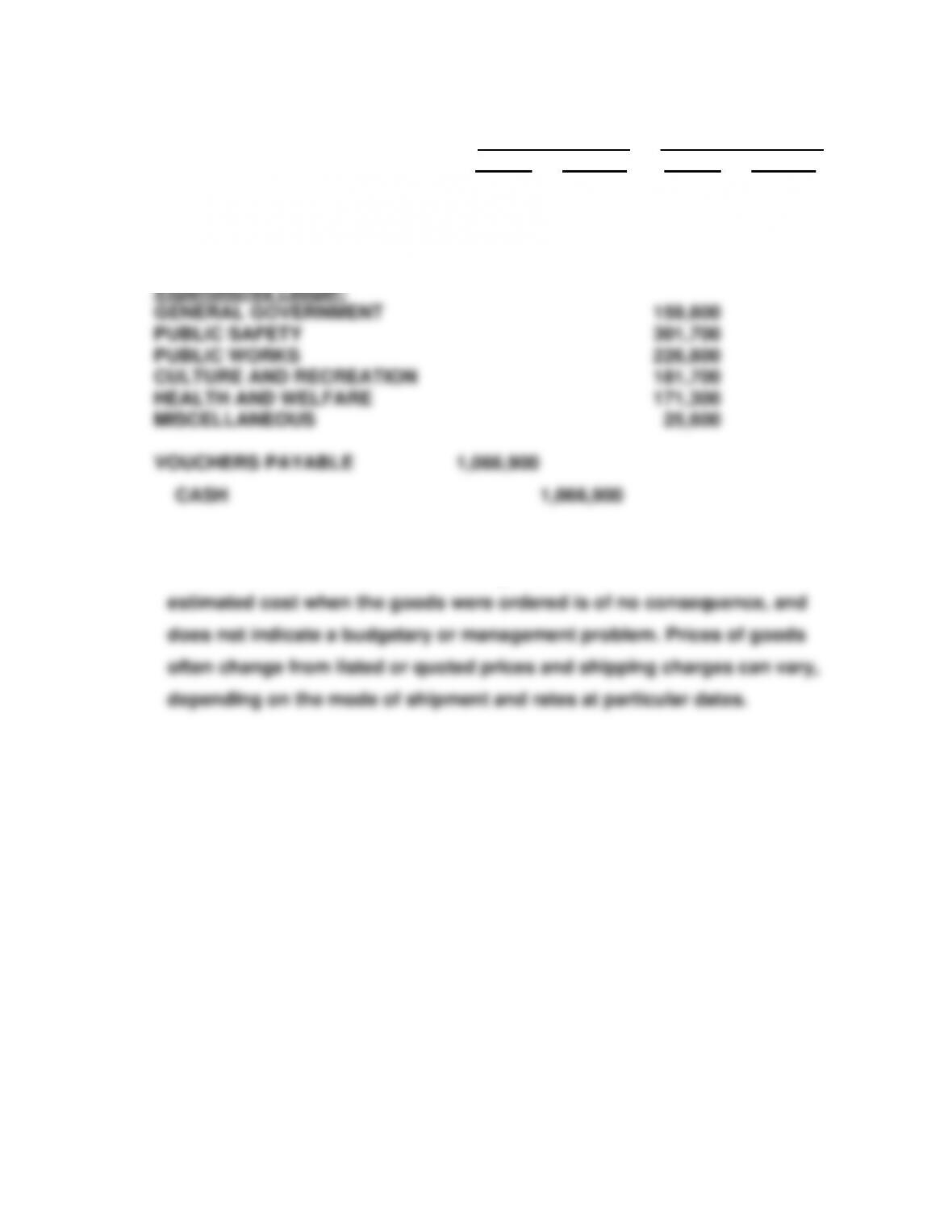
4-18. CITY OF HICKORY HILLS
General Ledger Subsidiary Ledger
Debits Credits Debits Credits
General Fund:
a. ENCUMBRANCES 1,065,000
Chapter 04 – Accounting for Governmental Operating Activities—Illustrative Transactions and Financial Statements
4-11
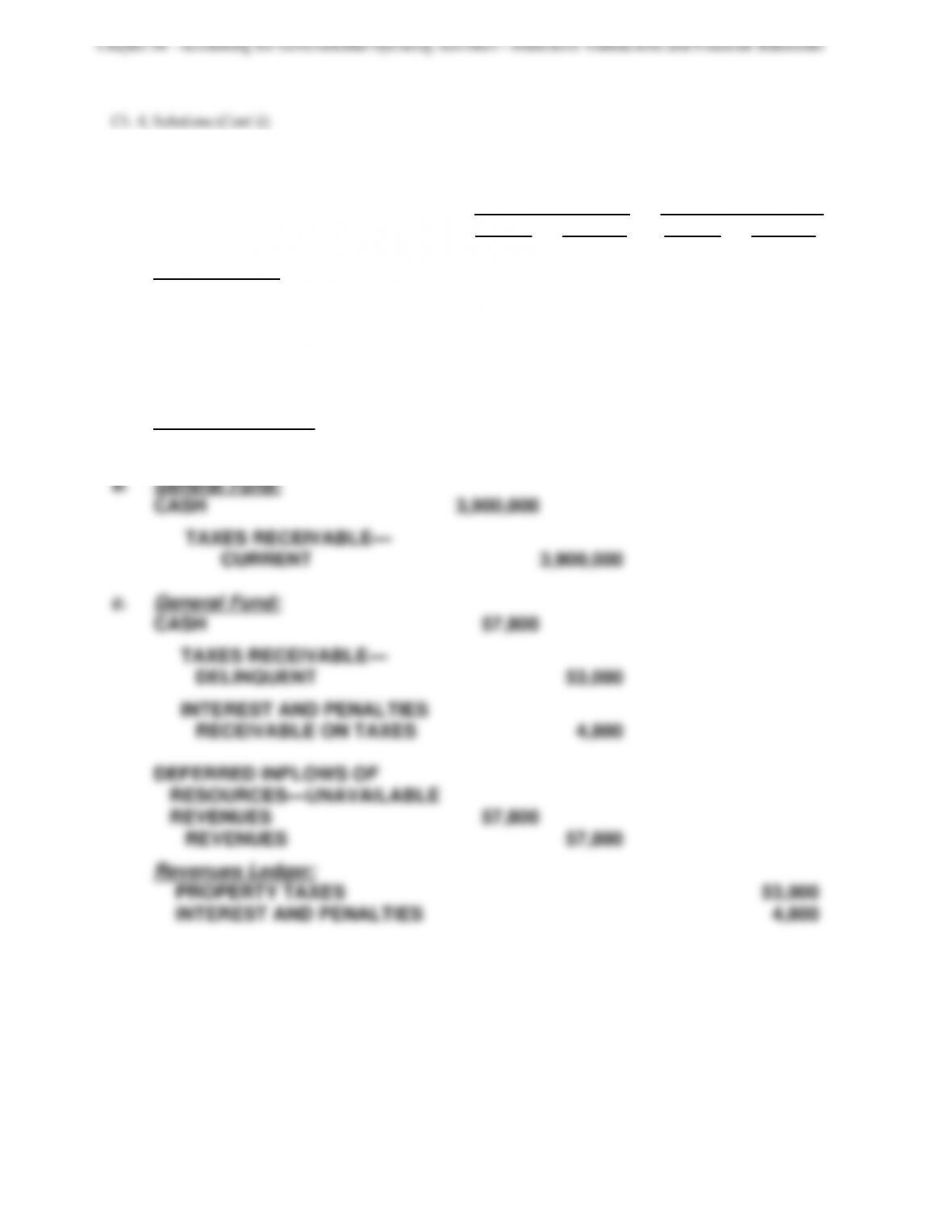
Ch. 4, Solutions, Exercise 4-18b (Cont’d)
General Ledger Subsidiary Ledger
Debits Credits Debits Credits
EXPENDITURES 1,066,900
VOUCHERS PAYABLE 1,066,900
c. The fact that the actual cost of these goods is $1,900 more than the
General Problem Information: Recording purchase orders; receipt of goods
Learning Objective: 4-1
Topic: Encumbrances and Purchasing Transactions
Bloom’s Taxonomy: Apply
Accreditation Skills tag: AACSB: Knowledge Application
Level of Difficulty: Easy
4-12
4-19. RIDGEDALE COUNTY
General Ledger Subsidiary Ledger
Debits Credits Debits Credits
General Fund:
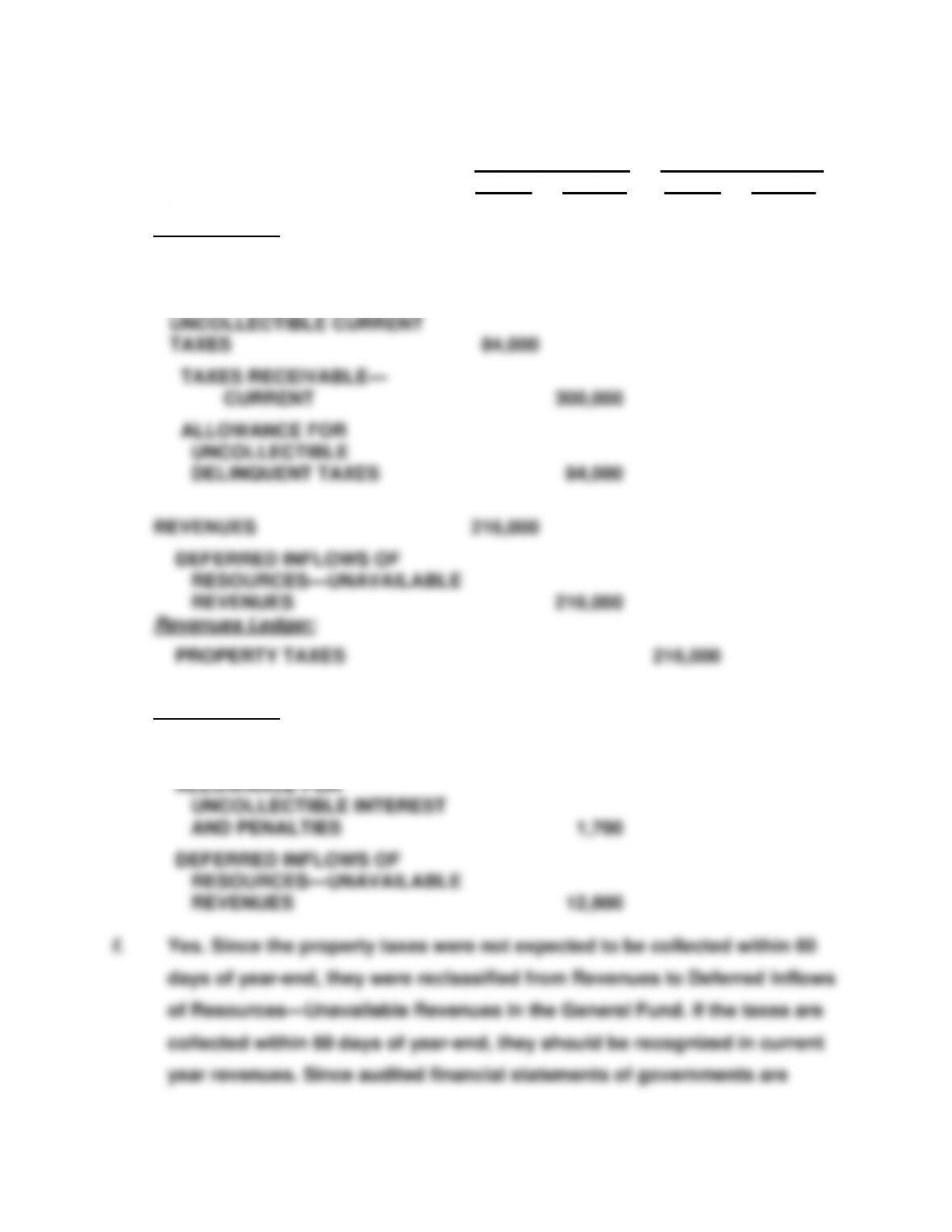
a. TAXES RECEIVABLE—CURRENT 4,200,000
ALLOWANCE FOR
UNCOLLECTIBLE CURRENT
TAXES 84,000
REVENUES 4,116,000
Revenues Ledger:
PROPERTY TAXES 4,116,000
Chapter 04 – Accounting for Governmental Operating Activities—Illustrative Transactions and Financial Statements
4-13
Ch. 4, Solutions, Exercise 4-19 (Cont’d)
General Ledger Subsidiary Ledger
Debits Credits Debits Credits
d. General Fund:
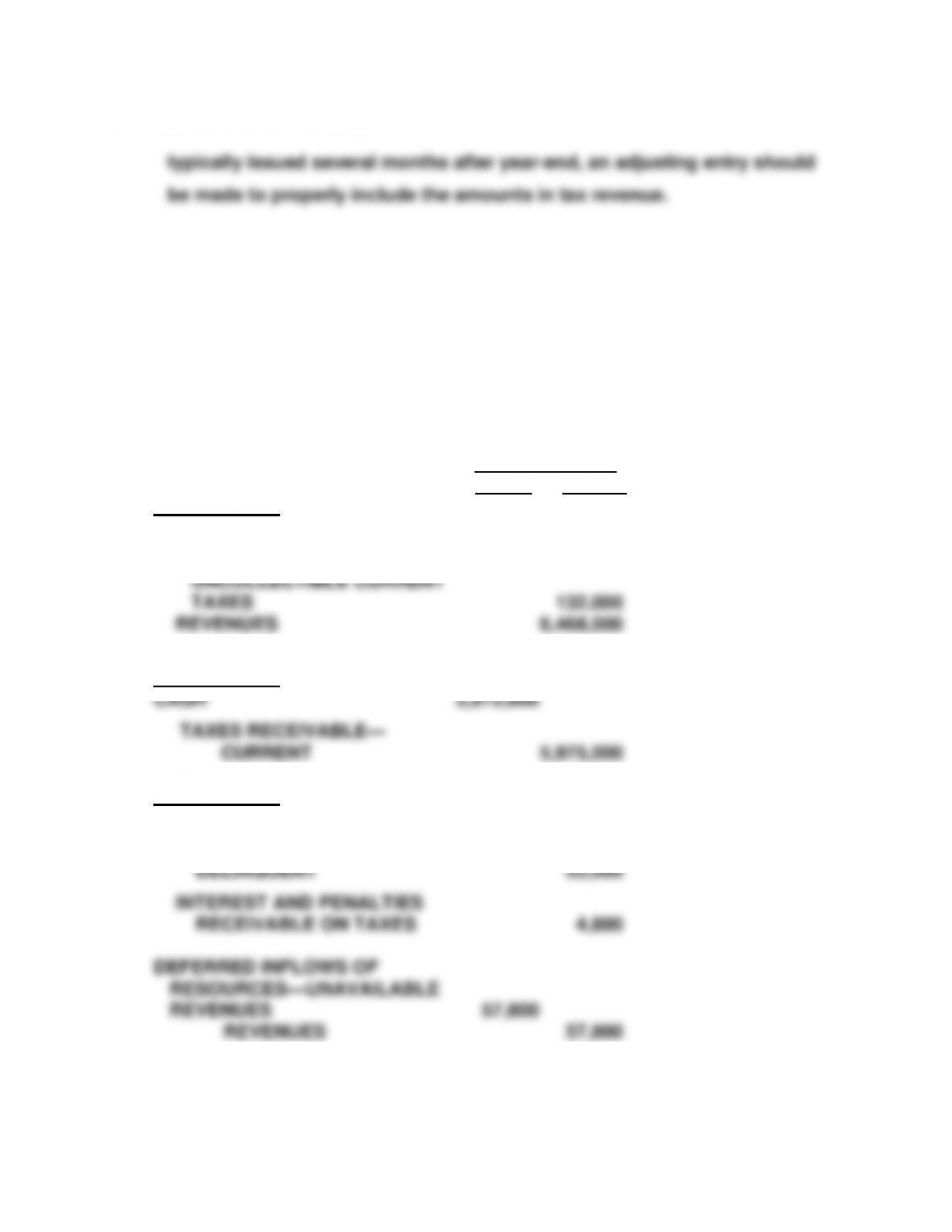
TAXES RECEIVABLE—
DELINQUENT 300,000
ALLOWANCE FOR
e. General Fund:
INTEREST AND PENALTIES
RECEIVABLE ON TAXES 14,500
Chapter 04 – Accounting for Governmental Operating Activities—Illustrative Transactions and Financial Statements
4-14
Ch. 4, Solutions, Exercise 4-19 (Cont’d)
General Problem Information: Property tax calculations and journal entries
Learning Objective: 4-1
Topic: Accounting for Property Taxes
Bloom’s Taxonomy: Apply
Accreditation Skills tag: AACSB: Knowledge Application
Level of Difficulty: Medium
4-20. a. CITY OF PLATTSBURGH
General Ledger
Debits Credits
General Fund:
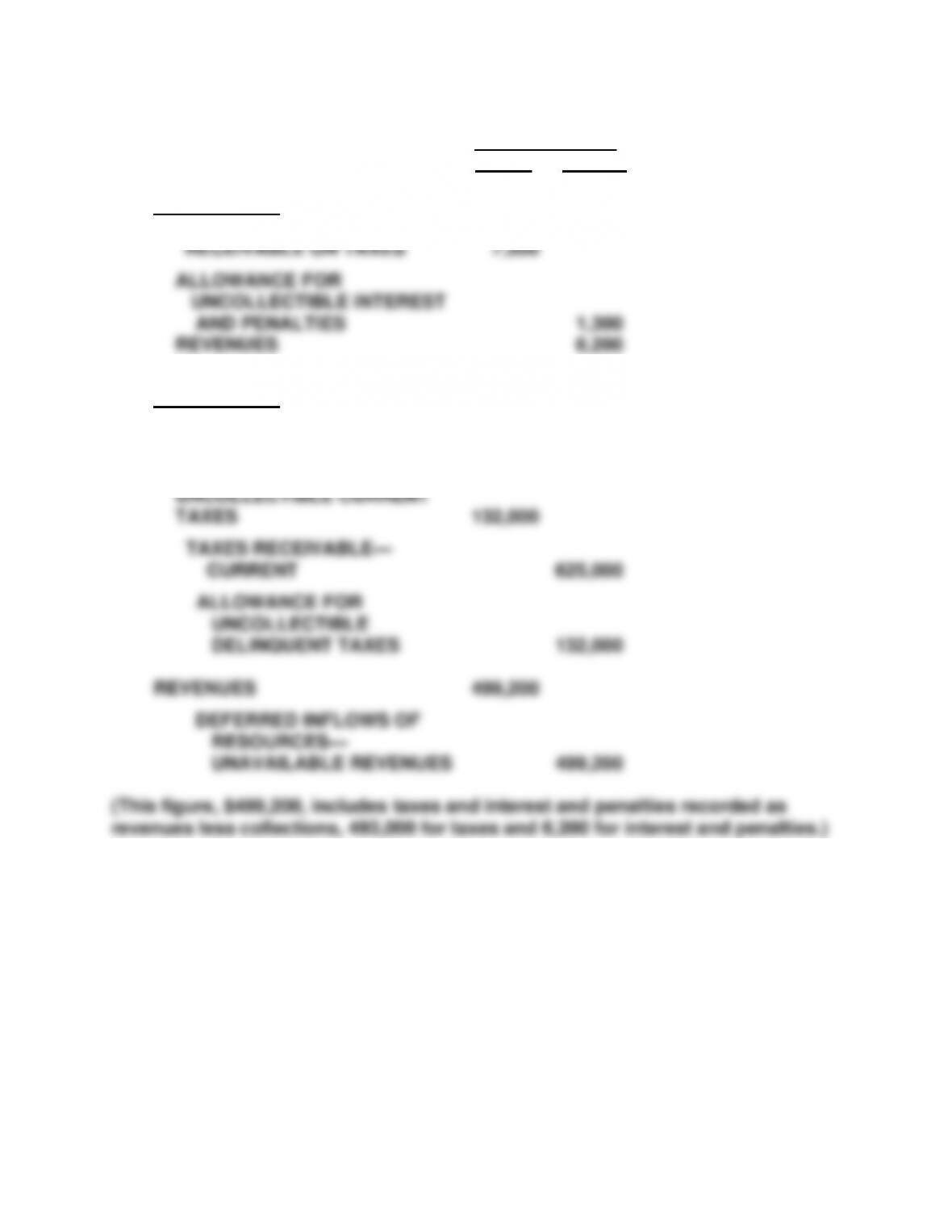
1. TAXES RECEIVABLE—CURRENT 6,600,000
ALLOWANCE FOR
2. General Fund:
3. General Fund:
CASH 57,800
TAXES RECEIVABLE—
Chapter 04 – Accounting for Governmental Operating Activities—Illustrative Transactions and Financial Statements
4-15
Ch. 4, Solutions, Exercise 4-20 a., (Cont’d)
General Ledger
Debits Credits
4. General Fund:
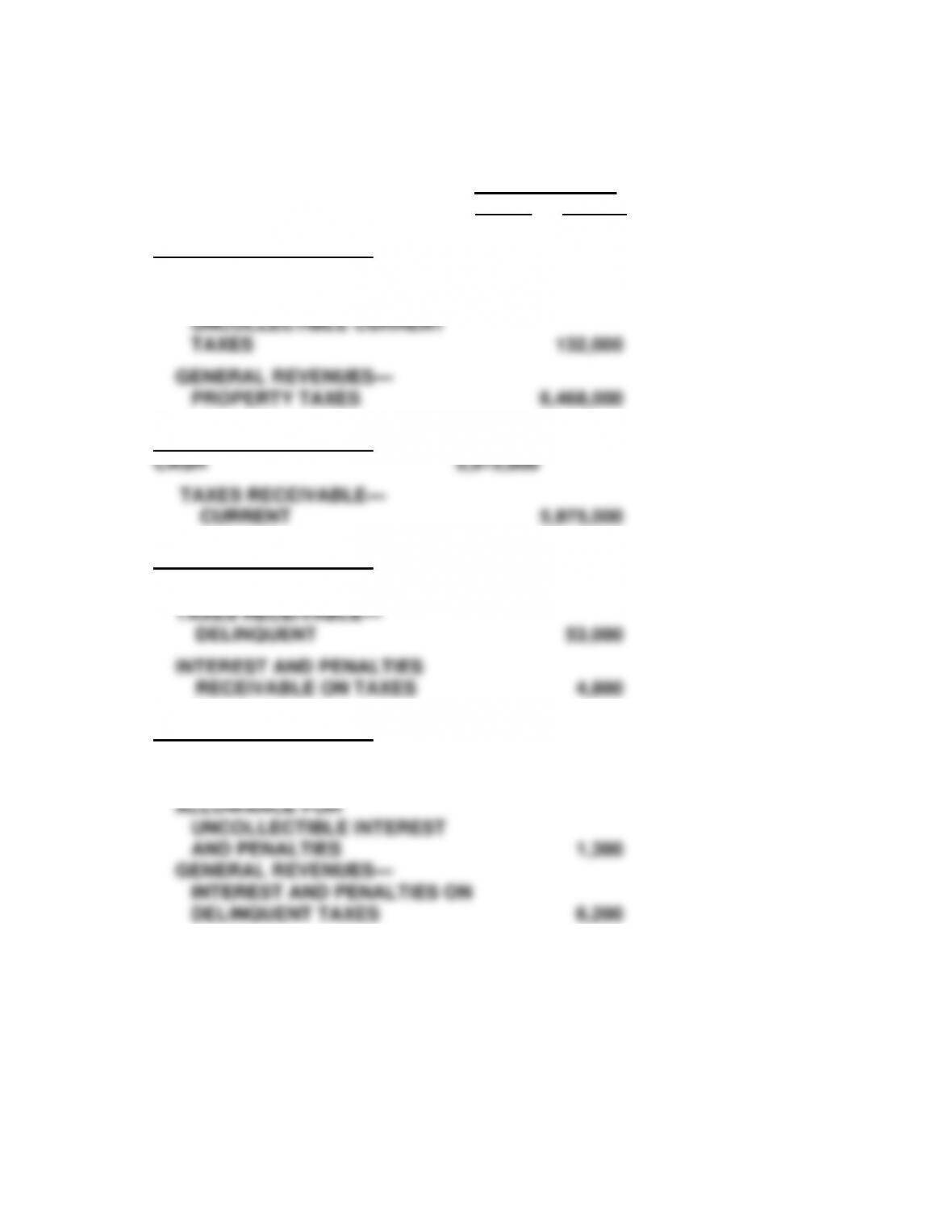
INTEREST AND PENALTIES
5. General Fund:
TAXES RECEIVABLE—
DELINQUENT 625,000
ALLOWANCE FOR
Chapter 04 – Accounting for Governmental Operating Activities—Illustrative Transactions and Financial Statements
4-16
Ch. 4, Solutions, Exercise 4-20 (Cont’d)
b. CITY OF PLATTSBURGH
General Ledger
Debits Credits
Governmental Activities:
1. TAXES RECEIVABLE—CURRENT 6,600,000
ALLOWANCE FOR
2. Governmental Activities:
3. Governmental Activities:
CASH 57,800
4. Governmental Activities:
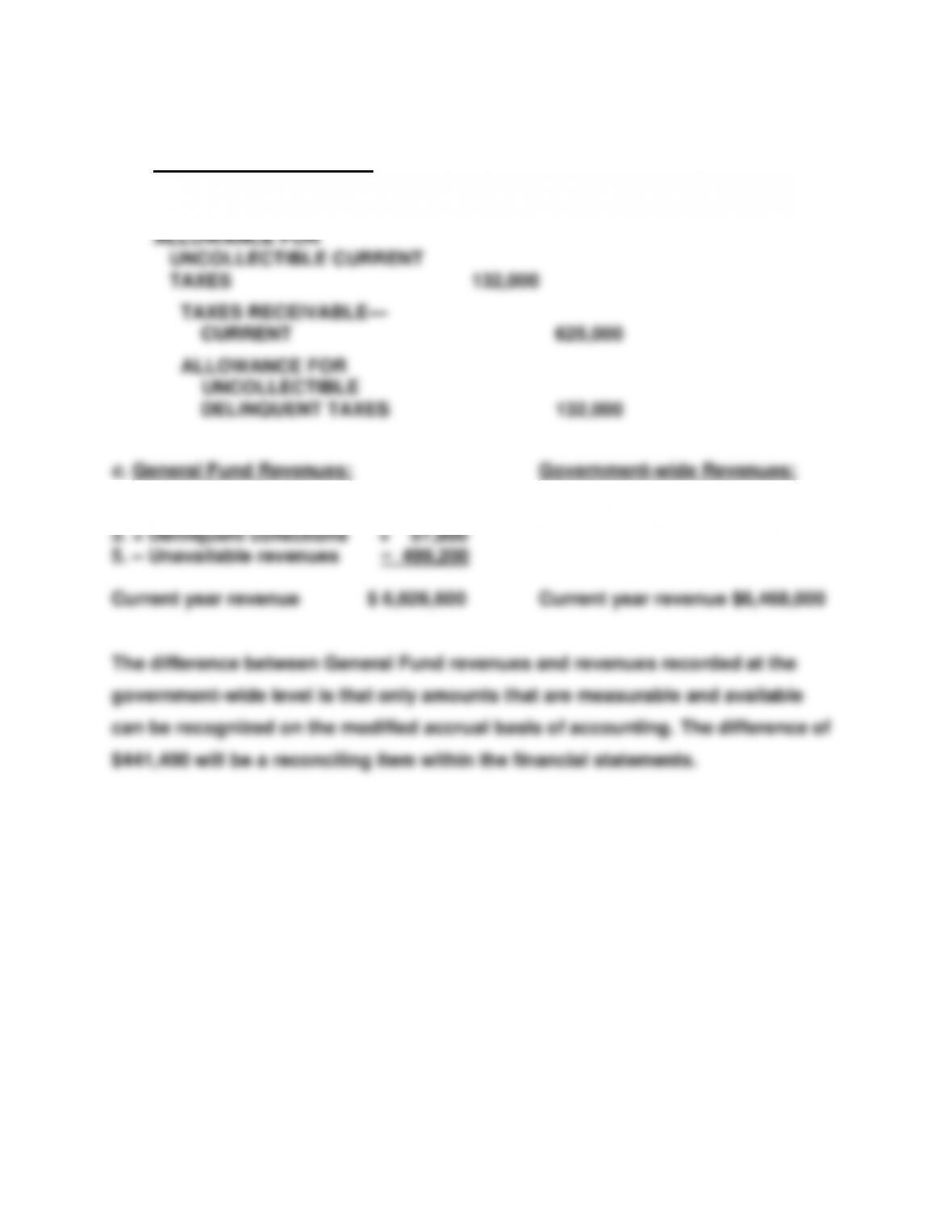
INTEREST AND PENALTIES
RECEIVABLE ON TAXES 7,500
Chapter 04 – Accounting for Governmental Operating Activities—Illustrative Transactions and Financial Statements
4-17
Ch. 4, Solutions, Exercise 4-20 b. (Cont’d)
5. Governmental Activities:
TAXES RECEIVABLE—
DELINQUENT 625,000
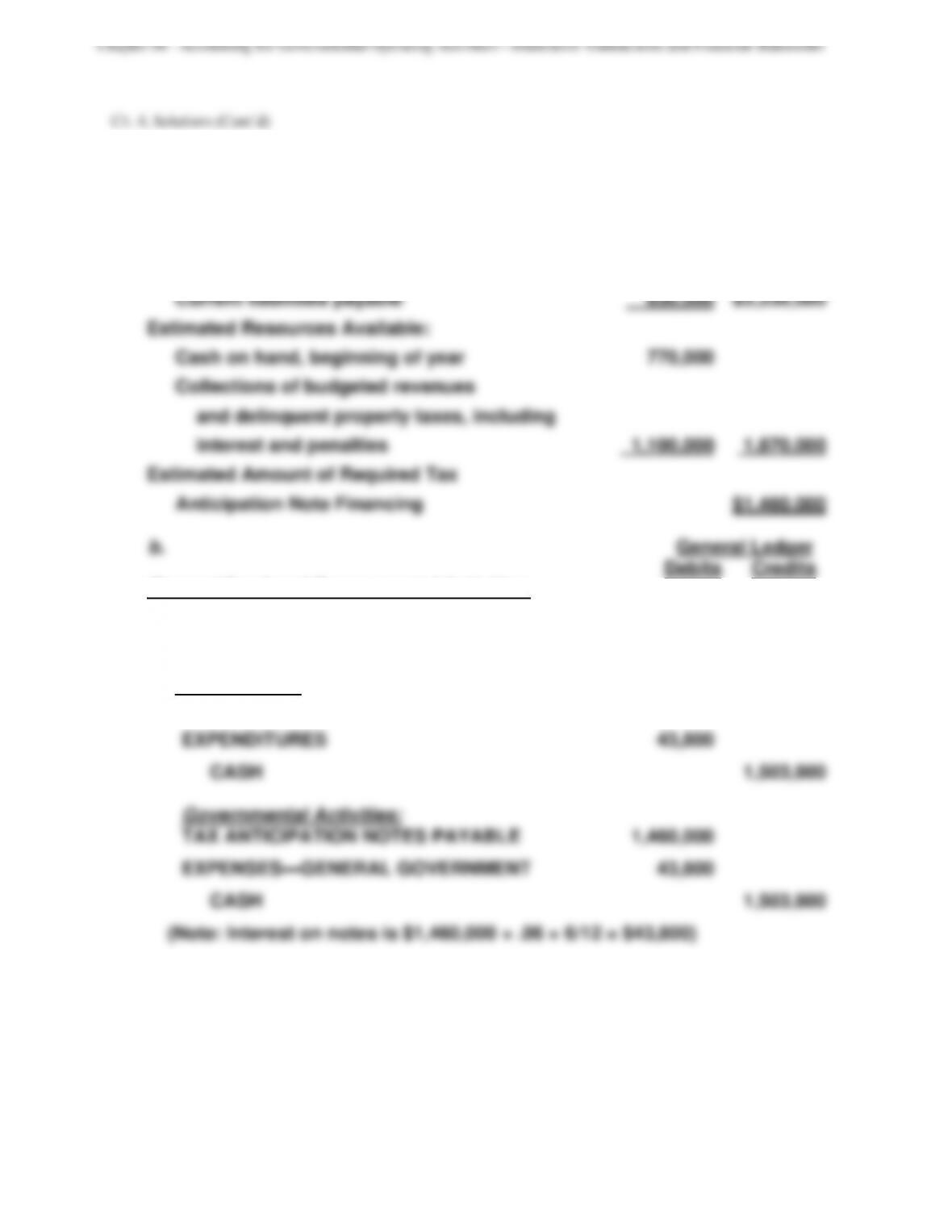
1. Tax levy $ 6,468,000 1. Tax levy $ 6,468,000
General Problem Information: Differences in accounting for property taxes
Learning Objective: 4-1
Topic: Accounting for Property Taxes
Bloom’s Taxonomy: Apply
Accreditation Skills tag: AACSB: Knowledge Application
Level of Difficulty: Medium
4-18
4-21. a. City of Troy
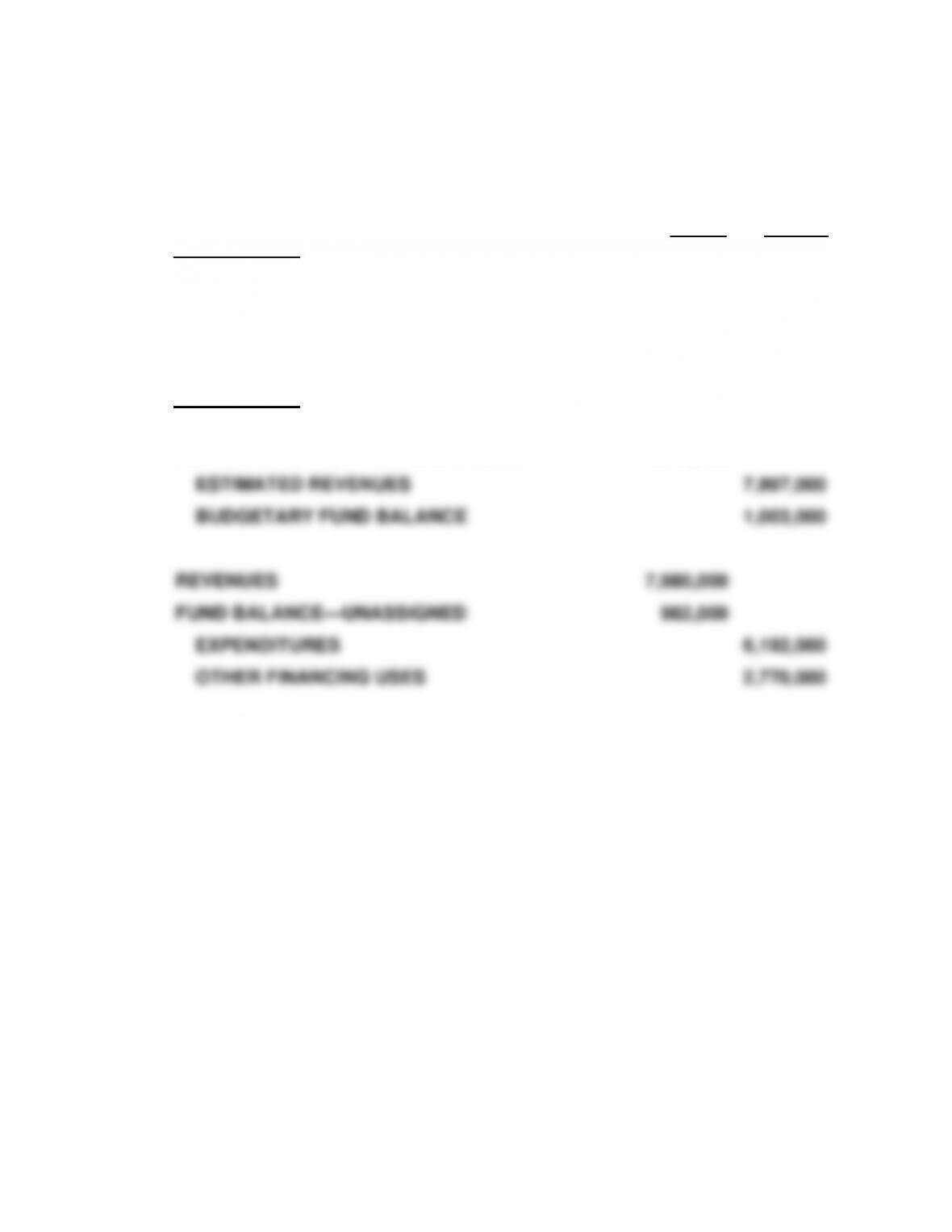
Calculation of Estimated Required
Tax Anticipation Financing
Estimated Expenditure Requirements:
Budgeted expenditures, remainder of year $2,500,000
General Fund and Governmental Activities:
CASH 1,460,000
TAX ANTICIPATION NOTES PAYABLE 1,460,000
c. General Fund:
TAX ANTICIPATION NOTES PAYABLE 1,460,000
General Problem Information: Calculation of required tax anticipation financing and
recording issuance of TANs
Learning Objective: 4-1
Topic: Tax Anticipation Notes
Bloom’s Taxonomy: Apply
Accreditation Skills tag: AACSB: Knowledge Application
Level of Difficulty: Medium
Chapter 04 – Accounting for Governmental Operating Activities—Illustrative Transactions and Financial Statements
4-19
Ch. 4, Solutions (Cont’d)
4-22. CITY OF COLUMBUS
GENERAL JOURNAL
Debits Credits
a. General Fund:
INVENTORY OF SUPPLIES 12,000
FUND BALANCE—NONSPENDABLE—
INVENTORY OF SUPPLIES 12,000
b. General Fund:
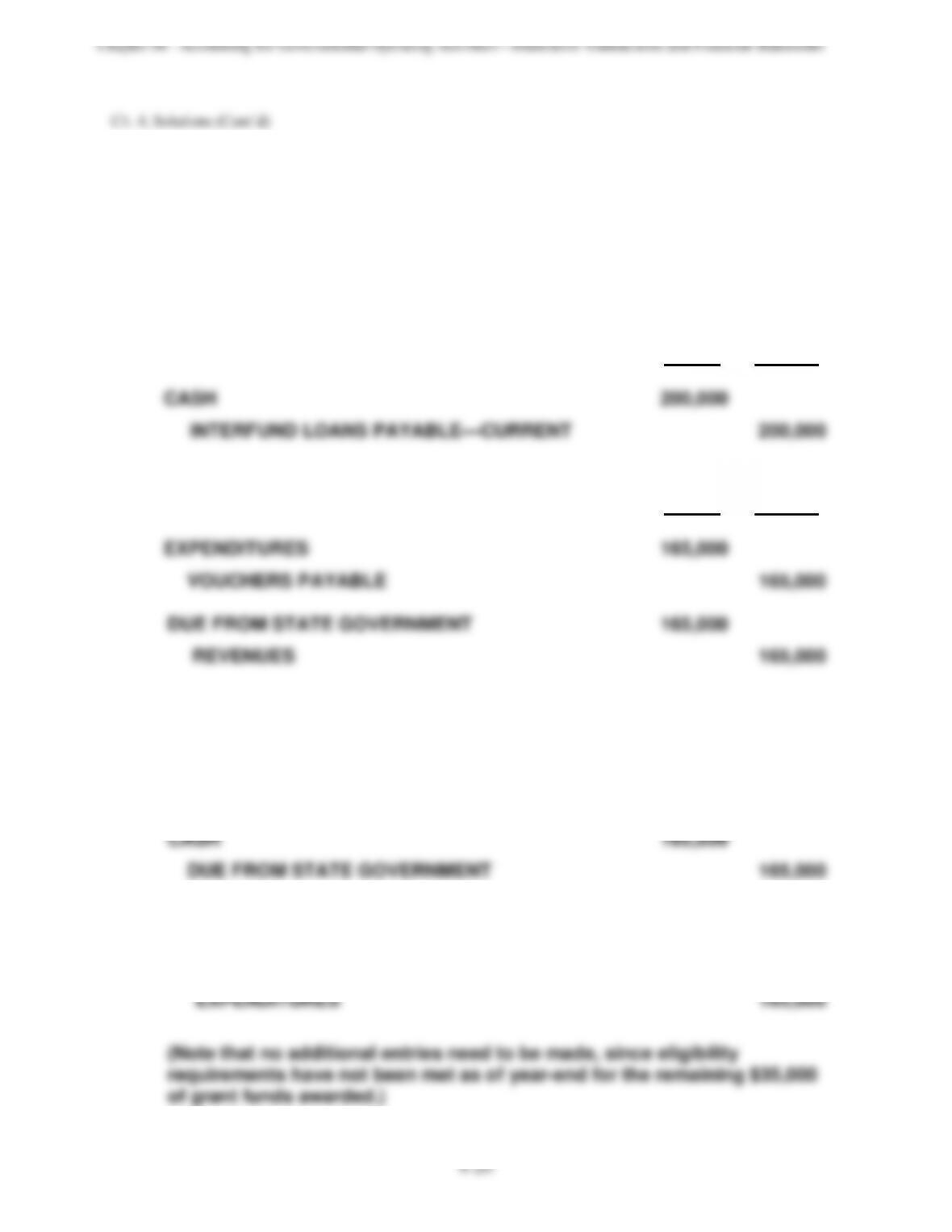
APPROPRIATIONS 6,224,000
ESTIMATED OTHER FINANCING USES 2,776,000
General Problem Information: Adjusting and closing entries
Learning Objective: 4-2
Topic: Adjusting Entries, Closing Entries
Bloom’s Taxonomy: Apply
Accreditation Skills tag: AACSB: Knowledge Application
Level of Difficulty: Medium
4-20
4-23. CITY OF WATERVILLE
GENERAL JOURNAL
1. May 1
NO ENTRY REQUIRED – Eligibility requirements must be met before an
asset and revenue can be recognized.
2. May 5
Debits Credits
3. During the year
Debits Credits
(While the city can record this entry, the final determination that eligibility
requirements have been met is determined by the state.)
(4) December 13
(5) December 31
REVENUES 165,000