Chapter 17 – Accounting and Reporting for the Federal Government
17-1
CHAPTER 17: ACCOUNTING AND REPORTING FOR THE FEDERAL
GOVERNMENT
OUTLINE
Number
Topic
Type/Task
Status
(re: 17/e)
Questions:
17-1
Roles of GOA, Treasury, and OMB in federal
financial reporting
Explain
Same
17-2
Federal GAAP hierarchy
Compare
Revised
17-3
Objectives of federal financial reporting
List, explain
Revised
17-4
Accounts used in federal accounting
Compare
Same
17-5
Net position and net assets
Compare
Same
17-6
Reporting entity
Compare
Same
17-7
Federal funds
Identify, compare
Revised
17-8
Stewardship assets
Define, compare
Same
17-9
Dual-track accounting
Explain, relate
Same
17-10
Performance accountability report
Explain, identify
Same
Cases:
17-11
Agency PAR and audit report
Calculate, explain
New
17-12
Research case—FASAB
Explain, discuss
Same
17-13
U.S. Government-wide financial statement audit
Explain, discuss
Same
17-14
Analysis of U.S federal budget deficit and net
cost of operations
Analyze, evaluate
Revised
Exercises/Problems:
17-15
Various
Multiple Choice
Revised, 11
New
17-16
Identifying account types and normal balances
Identify
Same
17-17
Fund balance with U.S. Treasury
Compute
Revised
17-18
Agency financial statements, continuation of 17-16
JE, apply
Revised
17-19
Prepare statement of net cost
Apply
Revised
17-20
Prepare statement of budgetary resources
Apply
Revised
17-21
Transactions and statement of financing
Apply
Revised
17-22
Financial statement analysis
Analysis
Revised
Chapter 17 – Accounting and Reporting for the Federal Government
17-2
CHAPTER 17: ACCOUNTING AND REPORTING FOR THE FEDERAL
GOVERNMENT
Answers to Questions
17-1. Each of these three agencies plays a significant role in the financial accounting and
reporting of federal agencies. The GAO serves as the independent audit agency for the
federal government. It is responsible for the audit of the federal government as a whole.
Its reports help ensure that the federal agencies are complying with legal requirements
and GAAP reporting requirements. As established by law, the GAO also has
17-2. The GAAP hierarchies for the federal government and state and local governments are
similar but have a few notable differences. One major difference is that federal
authoritative guidance comes from FASAB while state and local government
Chapter 17 – Accounting and Reporting for the Federal Government
17-3
Ch. 17, Answers, Question 17- 2 (Cont’d)
The category b principles include the Technical Bulletins issued by the respective
standard-setting bodies. AICPA Industry and Accounting Guides are also considered
17-3. The four objectives for federal financial reporting as outlined in SFFAC No. 1 are: (1)
budgetary integrity, (2) operating performance, (3) stewardship, and (4) adequacy of
systems and controls. Budgetary integrity is ensuring that taxes and other monies raised
by the federal government are raised in accordance with law and regulation, and that
expenditures are made in accordance with law and regulation. Operating performance
Chapter 17 – Accounting and Reporting for the Federal Government
17-4
Ch. 17, Answers, Question 17- 3 (Cont’d)
17-4. The account name Estimated Revenues used by state and local governments is a
budgetary account representing the government’s estimate of the amount of revenue
expected to be realized during the year. Federal agencies use the account Other
Appropriations Realized in their budgetary track to capture the amount Congress has
appropriated to an agency for the upcoming year. Other Appropriations Realized is for
17-5. Agree, in part. The net position account on the balance sheet of a federal agency
represents the difference between assets and liabilities, as net position does for a state or
local government. However, the net position of a federal agency is classified into two
Chapter 17 – Accounting and Reporting for the Federal Government
17-5
Ch. 17, Answers, Question 17- 5 (Cont’d)
17-6. The three perspectives from which the federal government can be viewed are the
organizational perspective, budget perspective, and program perspective. Organizational
perspective is most similar to what you would expect to see in an organizational chart; it
contains the department/agencies/commissions of the government. Budget perspective
17-7. The two groups of funds used by federal government entities are federal funds and trust
funds. There are three federal fund types—General Fund, special funds, and revolving
funds. The General Fund is similar in intent to the General Fund of state and local
governments. It receives all revenue and other receipts not designated (or identified) for a
Chapter 17 – Accounting and Reporting for the Federal Government
17-6
Ch. 17, Answers, Question 17-7 (Cont’d)
In some instances, the trust funds of the federal government actually benefit the
17-8. Stewardship assets are of two types—heritage assets and stewardship land. Heritage
assets have historical or natural significance; cultural, artistic, or educational significance;
or are architecturally significant. Stewardship land is land that is not used by the federal
government for operating purposes.
General property, plant and equipment (PP&E) of the federal government is used for
17-9. The two tracks in the dual-track system are the budgetary accounts track and the
Chapter 17 – Accounting and Reporting for the Federal Government
17-7
Ch. 17, Answers, Question 17-9 (Cont’d)
Federal budgetary accounts capture the legally approved budget and help ensure that
entities to not exceed budgetary authority. The purpose of the budgetary accounts track is
17-10. The PAR contains several components including:
• An agency head message—analogous to a transmittal letter.
• A management’s discussion and analysis.
• Performance report—provides information on the agency’s success in achieving the
goals in its strategic plan and performance budget.
17-8
Copyright ©2019 McGraw-Hill Education. All rights reserved. No reproduction or distribution without the prior written
consent of McGraw-Hill Education.
Solutions to Cases
17-11. The answers to the questions will vary by the agencies the students choose. The
Department of Defense has consistently received a disclaimer of opinion while Housing
and Urban Development (HUD) has received a disclaimer of opinion and a qualified
17-12. The information provided in the solution is current as of February 4, 2017.
a. According to the FASAB Web site the mission of the FASAB is to “serve the public
interest by improving federal financial reporting through issuing federal financial
accounting standards and providing guidance after considering the needs of external and
internal users of federal financial information.” The purpose of the FASAB mission is to
Chapter 17 – Accounting and Reporting for the Federal Government
17-9
Ch. 17, Solutions, Case 17-12 (Cont’d)
In contrast, the FASB and GASB are primarily funded by fees paid by publicly traded
companies (in the case of FASB) and municipal bond broker and dealers (in the case of
financial statements should be used to present the elements critical to meeting
financial reporting objectives, and what guidance should be provided to determine
when a certain means of communication should be used. Several other projects on the
agenda include the following.
• Accounting and Reporting of Government Land Project. Implementation of
by providing guidance to assist the DoD in resolving long-standing barriers to
complying with GAAP.
• Tax Expenditures. The FASAB will explore what information the users of
federal financial reports need in regards to tax expenditures.
• Public-Private-Partnerships. The FASAB is considering the appropriate
Chapter 17 – Accounting and Reporting for the Federal Government
17-10
Ch. 17, Solutions, Case 17-12 (Cont’d)
• Risk Assumed-Phase II. This project is considering the appropriate recognition,
17-13. The FY 2016 report for the U. S. government is available at
www.fms.treas.gov/fr/index.html. The 2017 report should be available in December of
2017. The answers to these questions are based on the FY 2016 (i.e., October 1, 2015–
September 30, 2016) report.
a. The Comptroller General of the GAO was not able to render an opinion; therefore, he
reported a disclaimer of opinion because he was unable to determine the reliability of
Chapter 17 – Accounting and Reporting for the Federal Government
17-11
Ch. 17, Solutions, Case 17-13 (Cont’d)
• support significant portions of the reported total net cost of operations, most
notably related to DOD, and adequately reconcile disbursement activity at certain
underlying information in the audited entities’ financial statements and other
financial data.
c. Twenty federal agencies out of 24 required to report under the CFO Act received
unmodified opinions in FY 2016, as did 12 of 15 additional significant reporting
agencies. The list of agencies is included in the annual financial report of the U.S.
have come in the years since audit requirements were enacted.
General Problem Information: Audit of U.S. government-wide annual report
Learning Objective: 17-4
Topic: Required Financial Reporting—U.S. Government-wide
Bloom’s Taxonomy: Understand
17-12
Copyright ©2019 McGraw-Hill Education. All rights reserved. No reproduction or distribution without the prior written
consent of McGraw-Hill Education.
Ch. 17, Solutions (Cont’d)
17-14 The answers provided below are based on information from the Fiscal Year 2016
Financial Report of the U.S. Government. If subsequent reports are used the numbers will
vary. The information to answer a-d was obtained from the “Citizen’s Guide to the Fiscal
Year 2016 Financial Report of the United States Government” section of the Financial
Report for the U.S. Government. Note the title of this section may be different in future
picture is bleaker than the budgetary picture.
c. In 2016 the five largest components of net cost were Department of Health and
Human Services (24%), Social Security Administration (22%), Department of
Veteran Affairs (15%), Department of Defense (14%), and Interest on Treasury
Securities Held by the Public (6%).
17-13
Copyright ©2019 McGraw-Hill Education. All rights reserved. No reproduction or distribution without the prior written
consent of McGraw-Hill Education.
Solutions to Exercises and Problems
2. d. 7. a.
4. d. 9. d.
5. a. 10. b.
General Problem Information: Various topics
2. P Dr 7. B Dr
4. B Cr 9. P Cr
5. P Cr 10. P Cr
General Problem Information: Identifying account types and normal balances
17-14
Copyright ©2019 McGraw-Hill Education. All rights reserved. No reproduction or distribution without the prior written
consent of McGraw-Hill Education.
Ch. 17, Solutions (Cont’d)
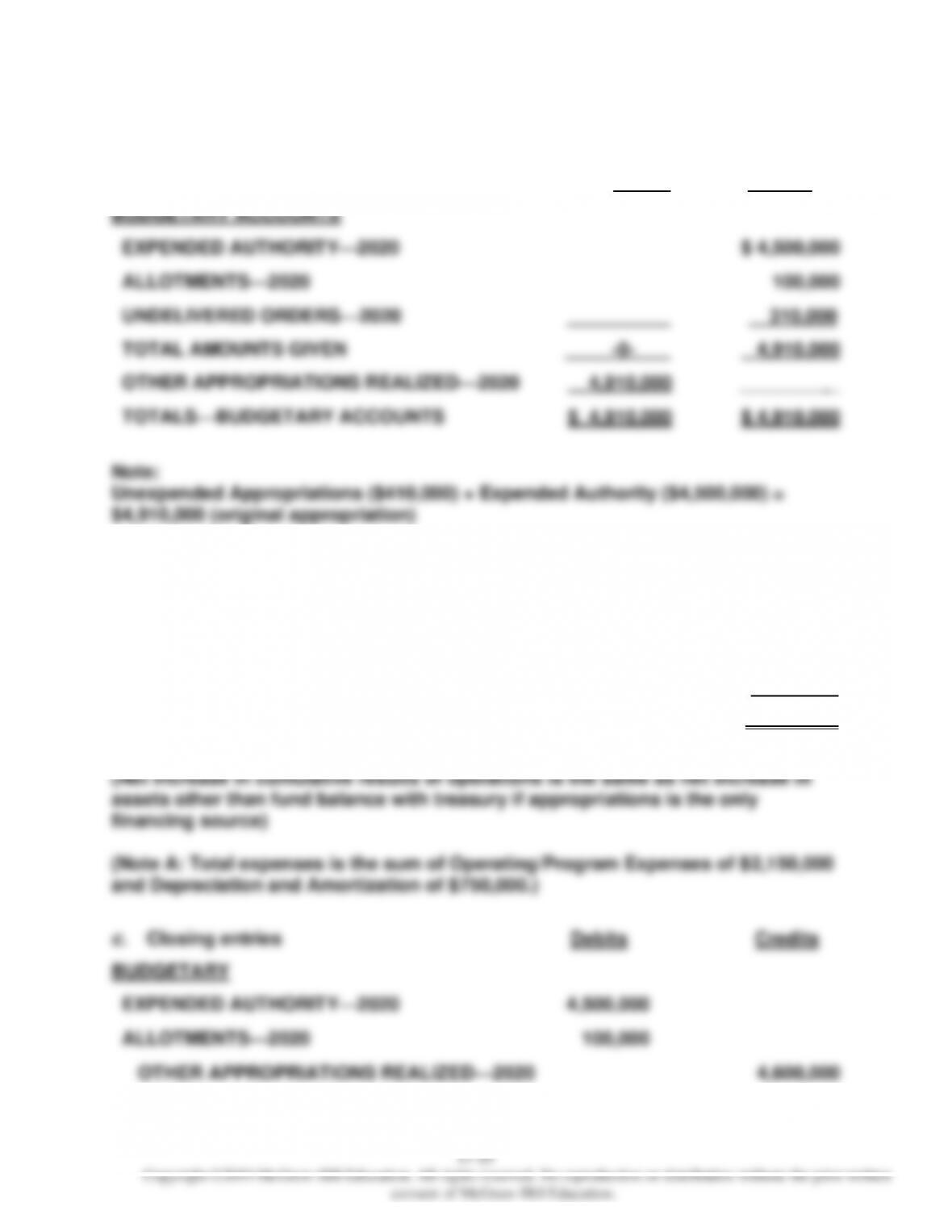
17-17. SAVE OUR RESOURCES COMMISSION
a. COMPUTATION OF MISSING AMOUNTS: Debits Credits
PROPRIETARY ACCOUNTS
ACCOUNTS PAYABLE $ 134,000
Chapter 17 – Accounting and Reporting for the Federal Government
Ch. 17, Solutions, Exercise 17-17 (Cont’d)
SAVE OUR RESOURCES COMMISSION
Debits Credits
Appropriations Used ($4,500,000) + Unexpended Appropriations ($410,000) =
$4,910,000 (original appropriation)
b.
APPROPRIATIONS USED DURING FY 2020 $4,500,000
TOTAL EXPENSES DURING FY 2020 (Note A) 2,900,000
NET INCREASE IN CUMULATIVE RESULTS OF OPERATIONS $1,600,000