Chapter 15 – Accounting for Colleges and Universities
CHAPTER 15: ACCOUNTING FOR COLLEGES AND UNIVERSITIES
Chapter 15 – Accounting for Colleges and Universities
15-2
CHAPTER 15: ACCOUNTING FOR COLLEGES AND UNIVERSITIES
15-1 FASB standards indicate that private colleges and universities are to prepare a statement
of financial position or a balance sheet; a statement of activities; and a statement of cash
flows. Similar to for-profit entities, private colleges and universities are allowed a great
deal of flexibility in preparing statements. For example, private entities can use a multi-
15-2. The FASB requires that private colleges and universities identify donor/contributor
restrictions on net assets as net assets with donor restrictions. The GASB utilizes a
similar category, restricted net position. However, the restricted net position category is
broader, including not only restrictions by donors, but also creditors, law, or regulation.
15-3
Copyright ©2019 McGraw-Hill Education. All rights reserved. No reproduction or distribution without the prior written
consent of McGraw-Hill Education.
Ch. 15, Answers (Cont’d)
15-3 Private colleges and universities follow FASB/NACUBO guidance and record bad debts
as a direct deduction to the revenue account. Thus a private entity would debit Tuition
and Fees for the estimated bad debts and credit an account such as Allowance for
Doubtful Accounts. In contrast public colleges and universities use a contra-revenue
account, such as Provision for Bad Debts, with a credit to an allowance account. The end
15-4 Not all grants are recorded as nonexchange transactions or contributions. If the grant
requires performance on the part of the college or university the receipt of the grant
would be recorded as an exchange or revenue transaction. An example would be a
15-5. For the pledges due within one year, the college can report the pledge at its net realizable
Chapter 15 – Accounting for Colleges and Universities
15-4
Ch. 15, Answers, Question 15-5 (Cont’d)
One of the methods, the one demonstrated in the textbook and used by many not-for-
15-6. Although the NACUBO accounts do not clearly identify program and support functions,
under FASB standards private colleges and universities are still required to provide
program and support information. The FASB allows that if the information about
program and support is not provided on the face of the financial statements it should be
15-7. A split-interest agreement is when a donor and a college or university enter into an
arrangement whereby the donor (or a designated beneficiary) and the college or
university share the benefits from the donor’s gift. Generally, they share in the earnings
Chapter 15 – Accounting for Colleges and Universities
15-5
Ch. 15, Answers, Question 15-7 (Cont’d)
15-8. UPMIFA stands for the Uniform Prudent Management of Institutional Funds Act. The
Act provides legal guidance to not-for-profit organizations on the management,
investment, and expenditure of funds held by the organizations for what the UPMIFA
terms charitable purposes (this includes endowment funds). UPMIFA is important to
colleges and universities since they are likely bound by its requirements, given that 49
15-9. The performance of colleges and universities can be measured utilizing financial and
nonfinancial information. When measuring performance, it is important to take the
mission of the college or university into account. For example, while it may take longer
Chapter 15 – Accounting for Colleges and Universities
15-6
Ch. 15, Answers, Question 15-9 (Cont’d)
In measuring outcomes, relevant information could include performance on nationally
ranked exams or results of surveys on student/employer satisfaction with education
15-10. Whether a college or university is subject to an audit under Governmental Auditing
Standards depends on the amount of federal dollars it has expended. Any college or
university (public or private) that expends $750,000 or more in federal funds is subject to
15-7
Copyright ©2019 McGraw-Hill Education. All rights reserved. No reproduction or distribution without the prior written
consent of McGraw-Hill Education.
Solutions to Cases
15-11. a. If the school is a public college or university it should follow the GASB
standards. There are many ways a student could identify the GASB standards
from the financial reports, including: the presence of an MD&A; a statement of
net position with the net position classifications, net investment in capital assets,
restricted, and unrestricted; a statement of revenues, expenses, and changes in net
statement of cash flow prepared using three categories of cash flows.
b. Again, the answers will vary based on the financial reports reviewed. The answer
should generally be yes, reporting standards are being followed. Remember that
reporting formats can vary somewhat and still be in compliance with reporting
standards. By comparing financial statements to the examples in the chapter,
position or the statement of activities. When searching for information to calculate
the percentage it is important to remember that grants and contracts can be
operating or nonoperating, and restricted or unrestricted.
e. This too will vary by college and university. The percentage would be calculated
by taking the total of all program expenses and dividing by the total expenses. It is
Chapter 15 – Accounting for Colleges and Universities
15-8
Ch. 15, Solutions, Case 15-11 (Cont’d)
It is unlikely that a student with a public college or university will be able to
determine the program expense as a percentage of total expenses. This
15-12. a. The private college (Catherine College) has prepared its statements under the
FASB standards, while the public college (Midland State College) has prepared
its statements under the GASB standards. Catherine College reports its expenses
using functional classifications and reports changes in net assets without donor
Chapter 15 – Accounting for Colleges and Universities
15-9
Copyright ©2019 McGraw-Hill Education. All rights reserved. No reproduction or distribution without the prior written
consent of McGraw-Hill Education.
Ch. 15, Solutions, Case 15-12 (Cont’d)
Calculations:
Catherine College
Tuition and fees (net): $66,888,492 / $91,614,600 = 73.01%
State appropriation: = 0.00%
Grants and contributions: $(2,241,863 + $9,020,584) / $91,614,600 =
12.29%
Midland State College
Tuition and fees (net): $14,939 / $46,908* = 31.85%
State appropriation: $(14,514 + $675) / $46,908 = 32.38%
Grants and contributions: ($5,173+$2,303+$1,324) / $46,908 = 18.76%
operating income, which is defined as the revenues and expenses related to the
primary activities of the colleges. Here are calculations that can be used for the
discussion:
Catherine College: $85 / 5,000 students = $0.02
In this calculation the change in net assets without donor restrictions was used. It
Chapter 15 – Accounting for Colleges and Universities
15-10
Ch. 15, Solutions, Case 15-12 (Cont’d)
It could be argued that although the appropriations and grants are considered
nonoperating revenues for classification purposes under GASB they are used to
difficult to clearly identify some of the operating revenue and expenses. For
example, it is hard to determine how much of the private college revenue was for
capital acquisitions, how much of the expenses were for interest, fund-raising or
other nonoperating activities. The same is true of the public college. Although the
public college identifies nonoperating activities, it seems that several of the items
15-13. a. The college scorecard provides an average annual cost which is the net price paid
after subtracting school, state, and/or federal financial aid. Students’ answers will
Chapter 15 – Accounting for Colleges and Universities
15-11
graphic displaying the graduation rate. Students answers will vary depending on
the schools chosen.
Ch. 15, Solutions, Case 15-13 (Cont’d)
information in their “value” assessment.
e. Students can be expected to have different views on what they believe to be
strengths and weaknesses of the college scorecard. Some possible points include:
Strengths – a national system that allows for increased comparability, increased
transparency of information, and increased accountability
15-14. a. Yes, organizations in Minnesota are subject to UPMIFA.
b. The foundation would be subject to UPMIFA since it is located in Minnesota and
it is a NFP organization that, according to UPMIFA, manages funds for a
15-12
Copyright ©2019 McGraw-Hill Education. All rights reserved. No reproduction or distribution without the prior written
consent of McGraw-Hill Education.
Ch. 15, Solutions, Case 15-14 (Cont’d)
1. Duration and preservation of the endowment fund.
3. The general economic conditions.
5. The expected total return from income and the appreciation of investments.
7. The investment policy of the institution.
Ms. Hernandez might look to criteria 1, 5 and 7 in addressing her concerns. The
expected total return is not much higher than the spending rate. If the expectation
is that the total return will not increase given the projected general economic
conditions and the existing investment policy, perhaps the investment policy needs
15-15. 1. d. 6. a.
3. c. 8. c.
5. d. 10. b.
Chapter 15 – Accounting for Colleges and Universities
15-13
Ch. 15, Solutions, Exercise 15-15 (Cont’d)
2. a. 7. a.
4. c. 9. b.
5. a. 10. c.
General Problem Information: Identifying the appropriate GAAP
15–17.
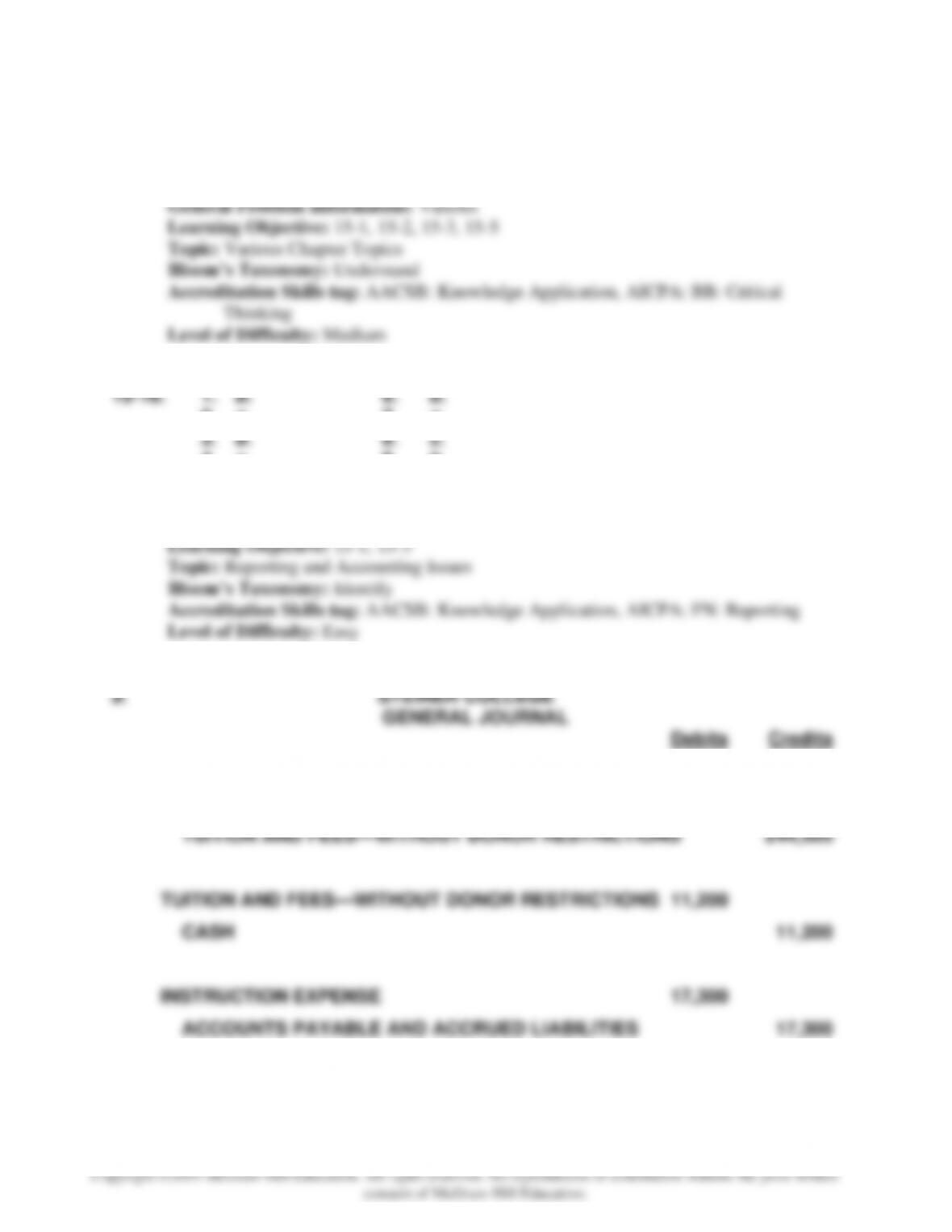
1. TUITION AND FEES RECEIVABLE 223,100
TUITION & FEES DISCOUNT AND ALLOWANCES 21,400
Chapter 15 – Accounting for Colleges and Universities
15-14
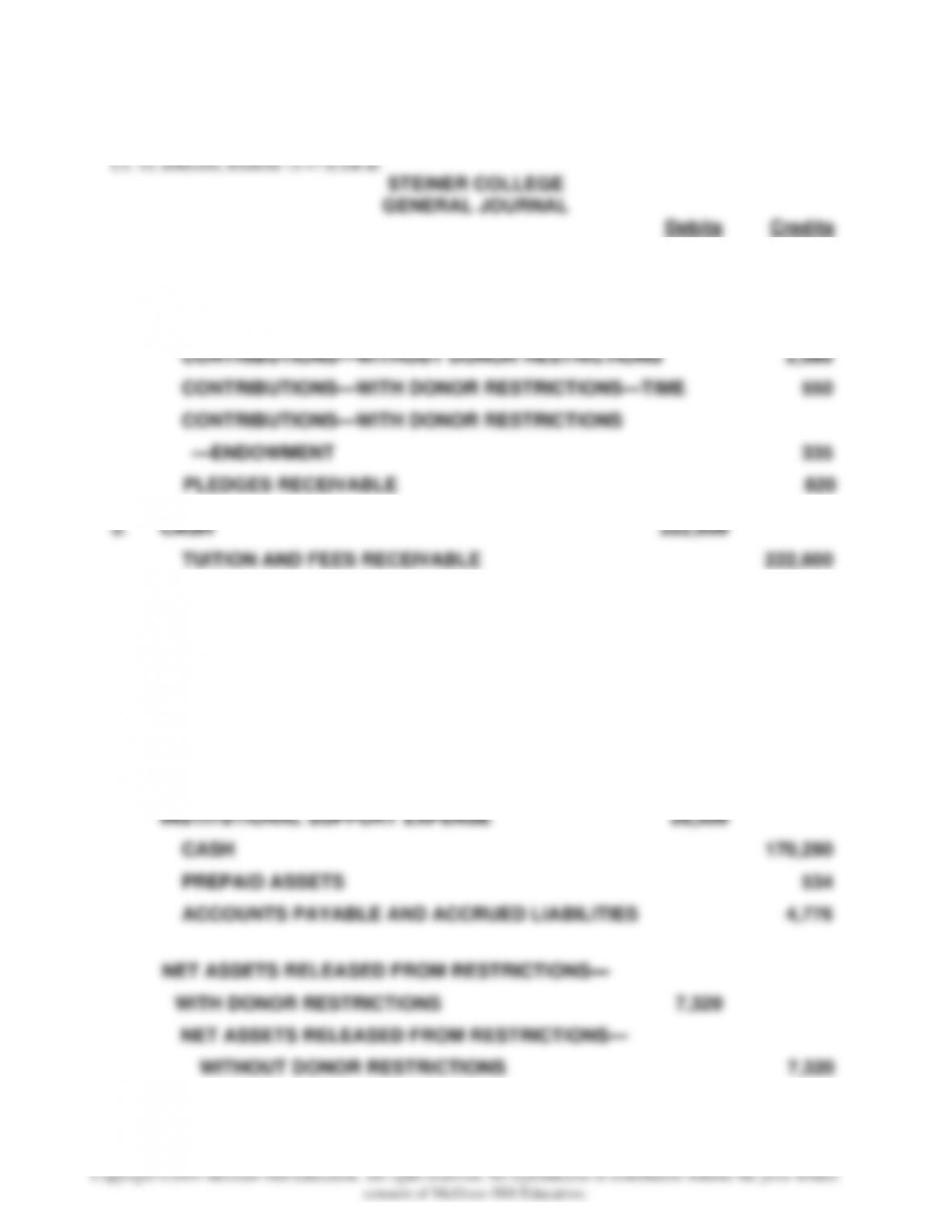
2. CASH 3,235
PLEDGES RECEIVABLE 550
4. DEPOSITS HELD IN CUSTODY FOR OTHERS 10
CASH 10
5. INSTRUCTION EXPENSE 86,100
ACADEMIC SUPPORT EXPENSE 23,300
STUDENT SERVICES EXPENSE 37,700
Chapter 15 – Accounting for Colleges and Universities
15-15
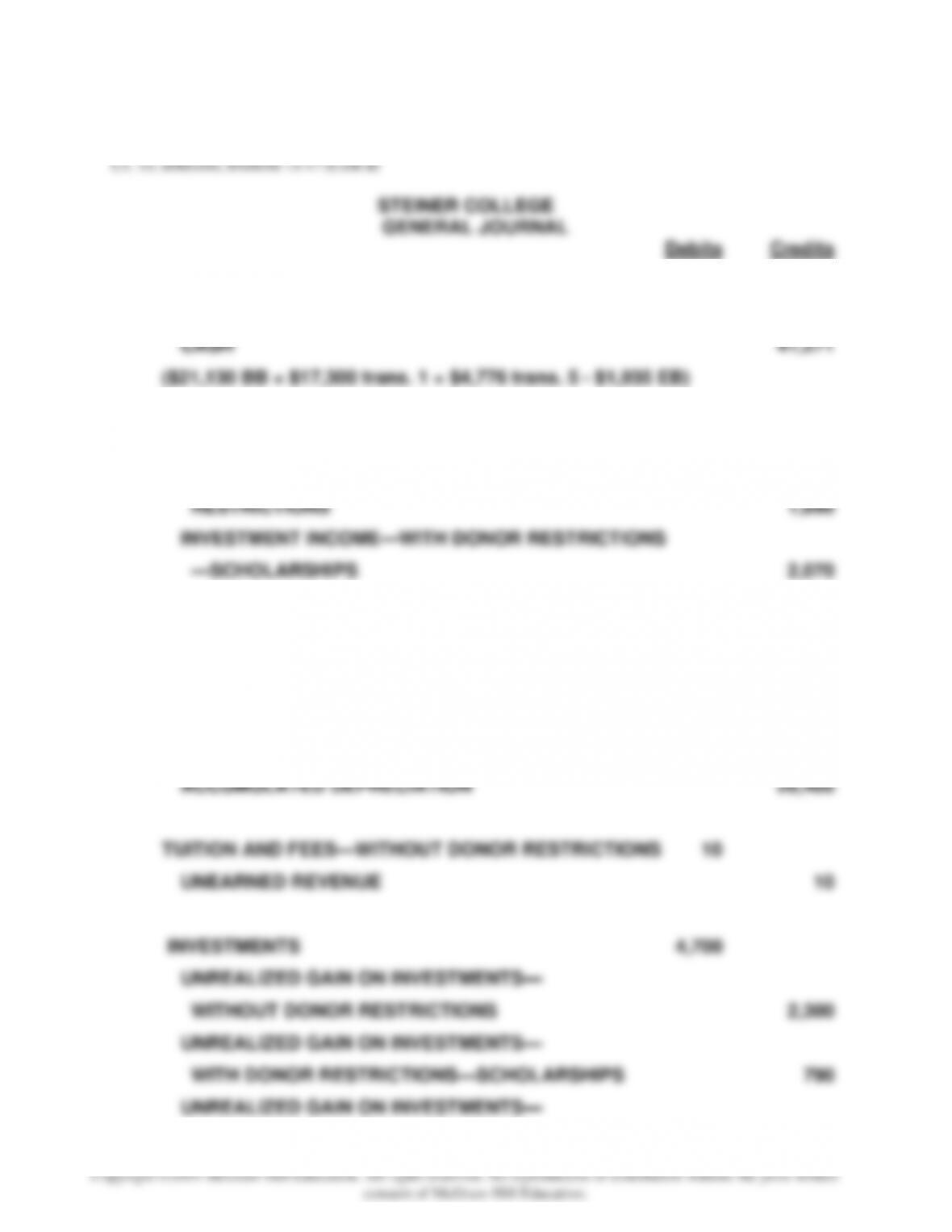
6. ACCOUNTS PAYABLE AND ACCRUED LIABILITIES 41,271
7. CASH 3,960
INVESTMENT INCOME—WITHOUT DONOR
8. TUITION AND FEES—WITHOUT DONOR RESTRICTIONS 20
ALLOWANCE FOR DOUBTFUL ACCOUNTS 20
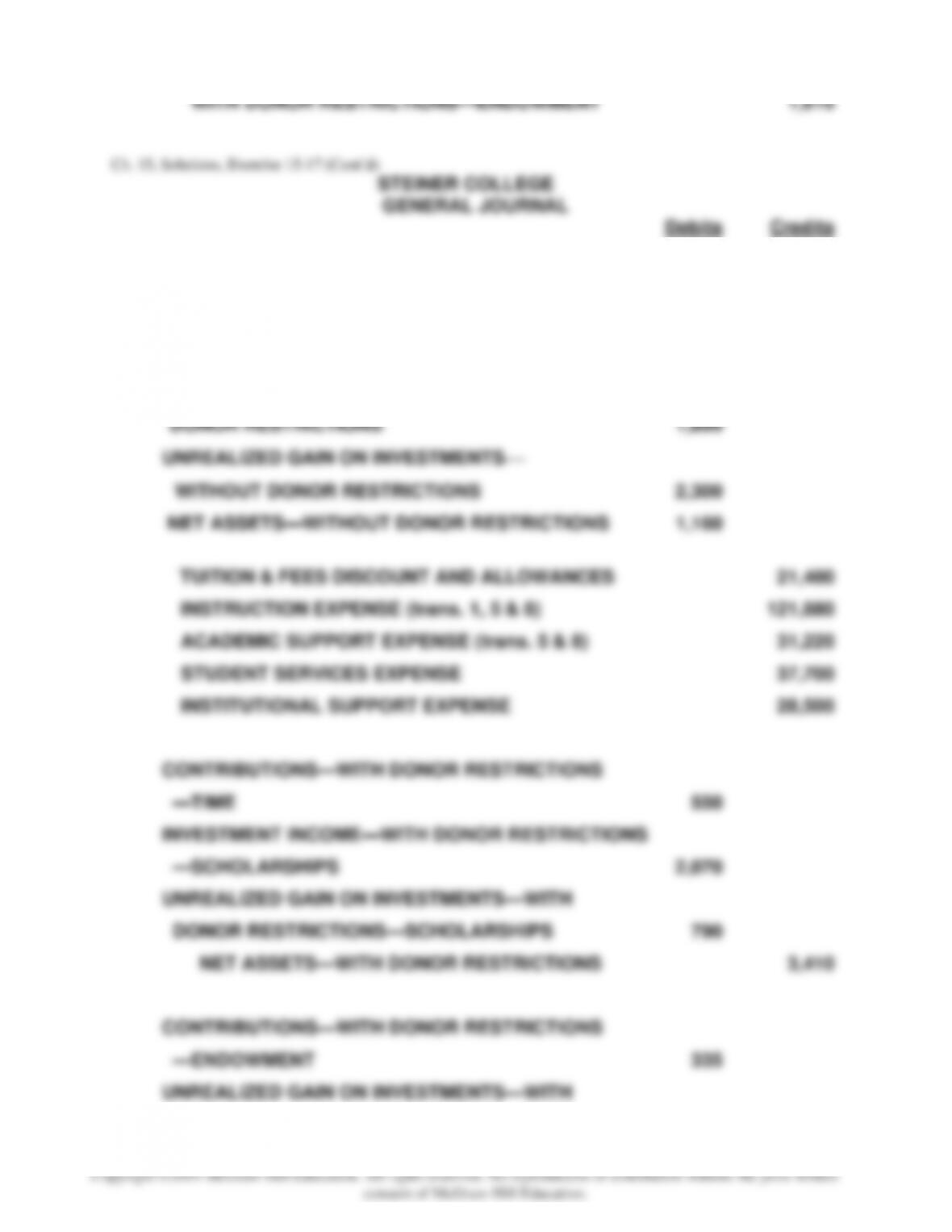
INSTRUCTION EXPENSE 18,480
ACADEMIC SUPPORT EXPENSE 7,920
Chapter 15 – Accounting for Colleges and Universities
15-16
Copyright ©2019 McGraw-Hill Education. All rights reserved. No reproduction or distribution without the prior written
consent of McGraw-Hill Education.
WITH DONOR RESTRICTIONS—ENDOWMENT 1,610
Ch. 15, Solutions, Exercise 15-17 (Cont’d)
STEINER COLLEGE
GENERAL JOURNAL
Debits Credits
9. To close nominal accounts
TUITION AND FEES⎯WITHOUT DONOR
RESTRICTIONS (trans. 1 & 8) 233,270
CONTRIBUTIONS⎯WITHOUT DONOR RESTRICTIONS 2,080
INVESTMENT INCOME—WITHOUT
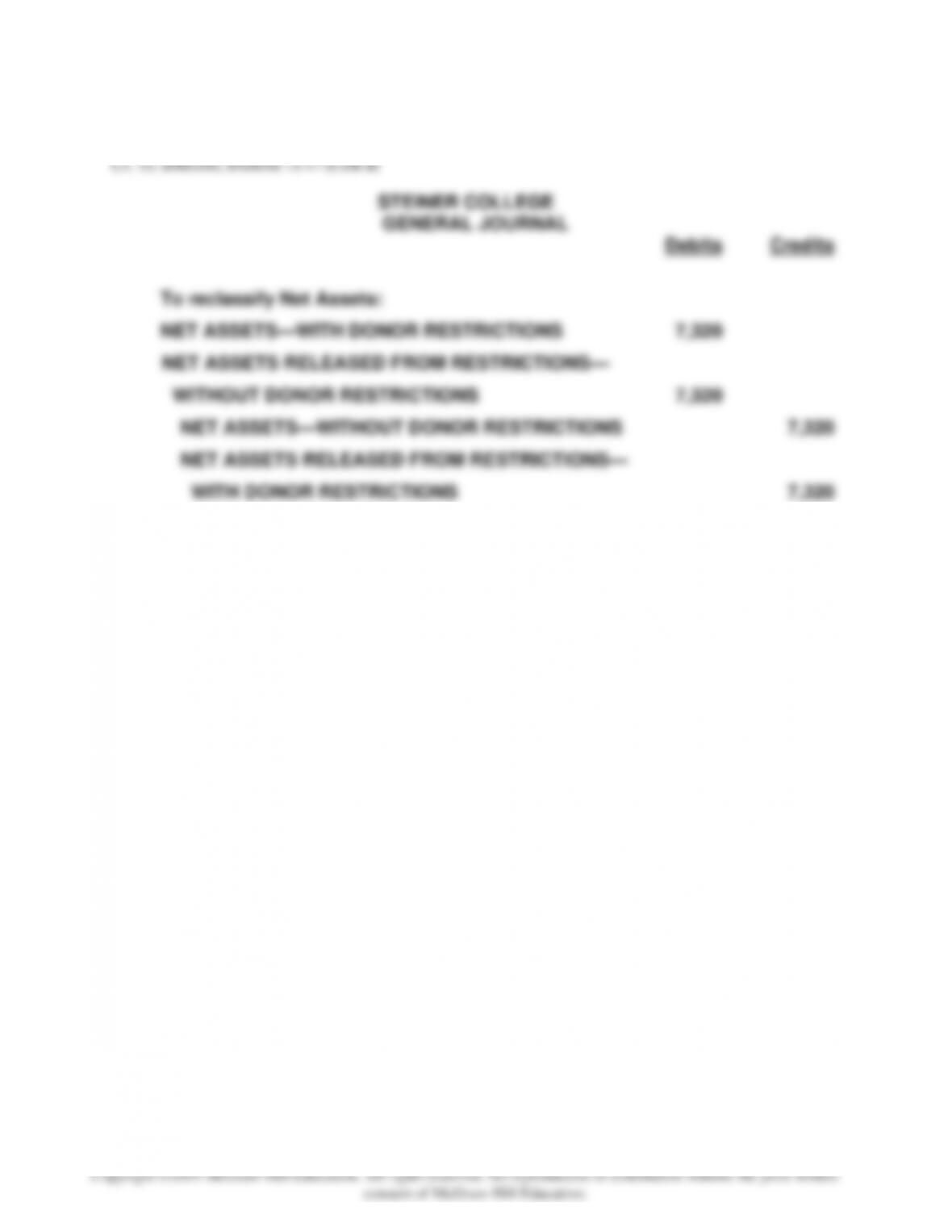
Chapter 15 – Accounting for Colleges and Universities
15-17
DONOR RESTRICTIONS—ENDOWMENT 1,610
NET ASSETS—WITH DONOR RESTRICTIONS 1,945
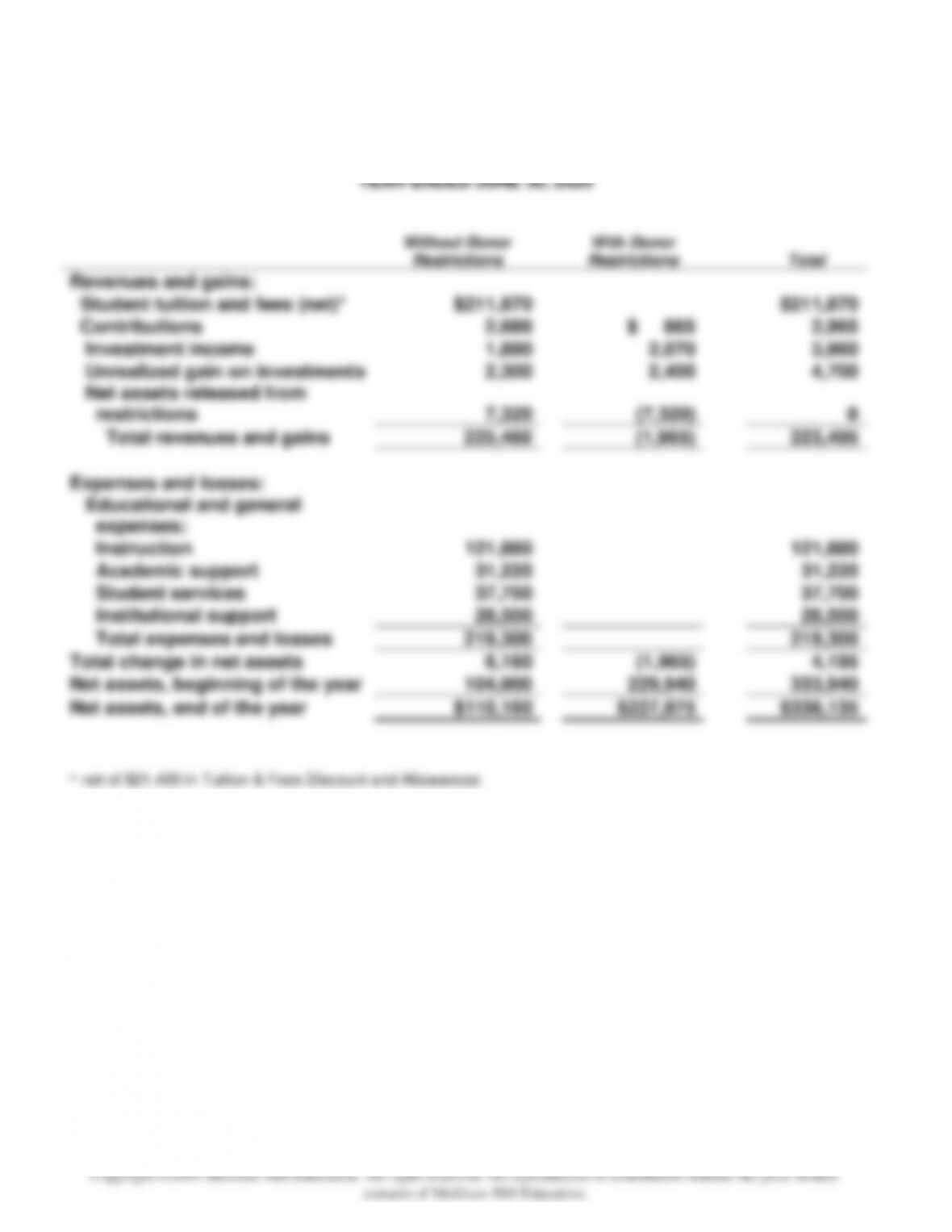
Chapter 15 – Accounting for Colleges and Universities
15-18
Ch. 15, Solutions, Exercise 15-17 (Cont’d)
b. STEINER COLLEGE
STATEMENT OF ACTIVITIES
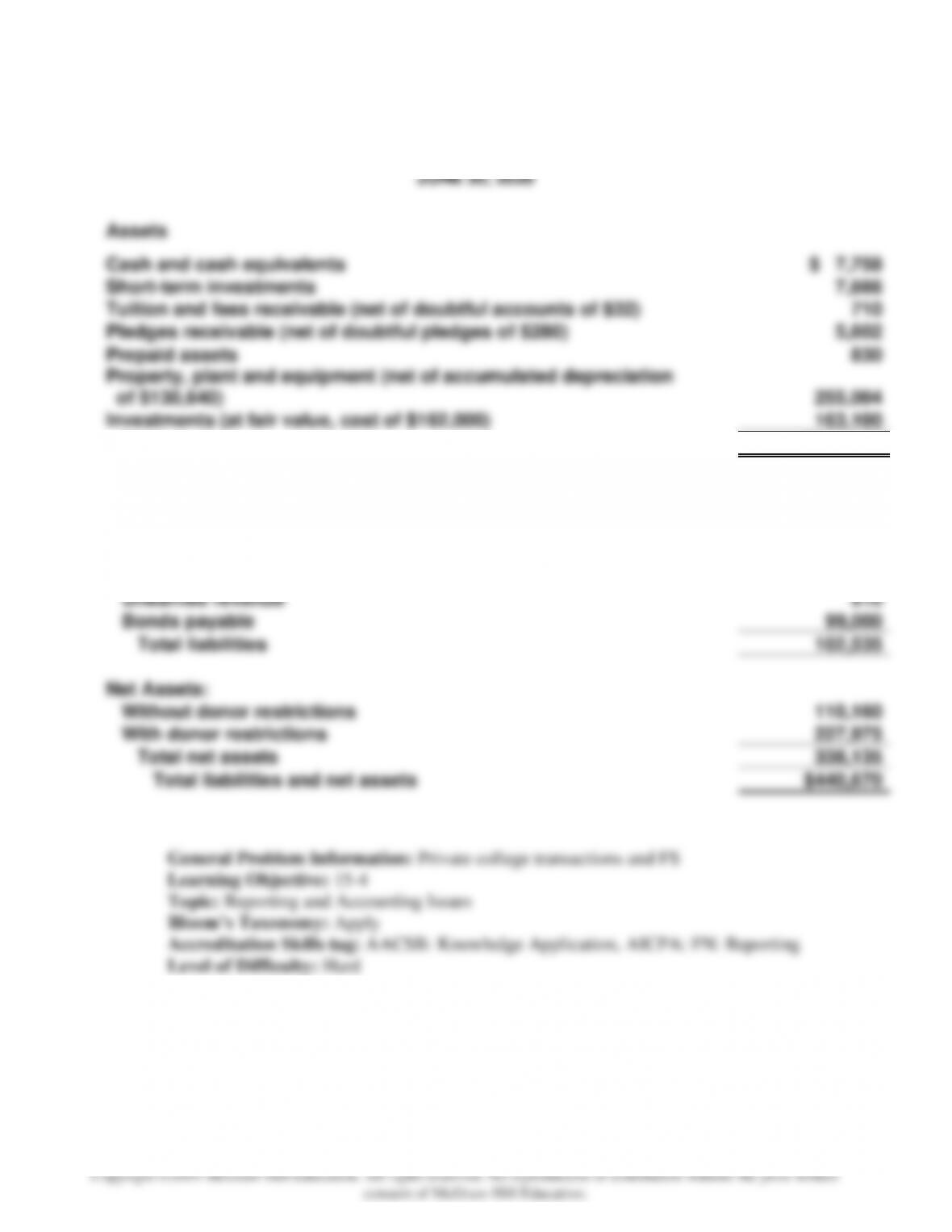
Chapter 15 – Accounting for Colleges and Universities
Ch. 15, Solutions, Exercise 15-17 (Cont’d)
c. STEINER COLLEGE
STATEMENT OF FINANCIAL POSITION
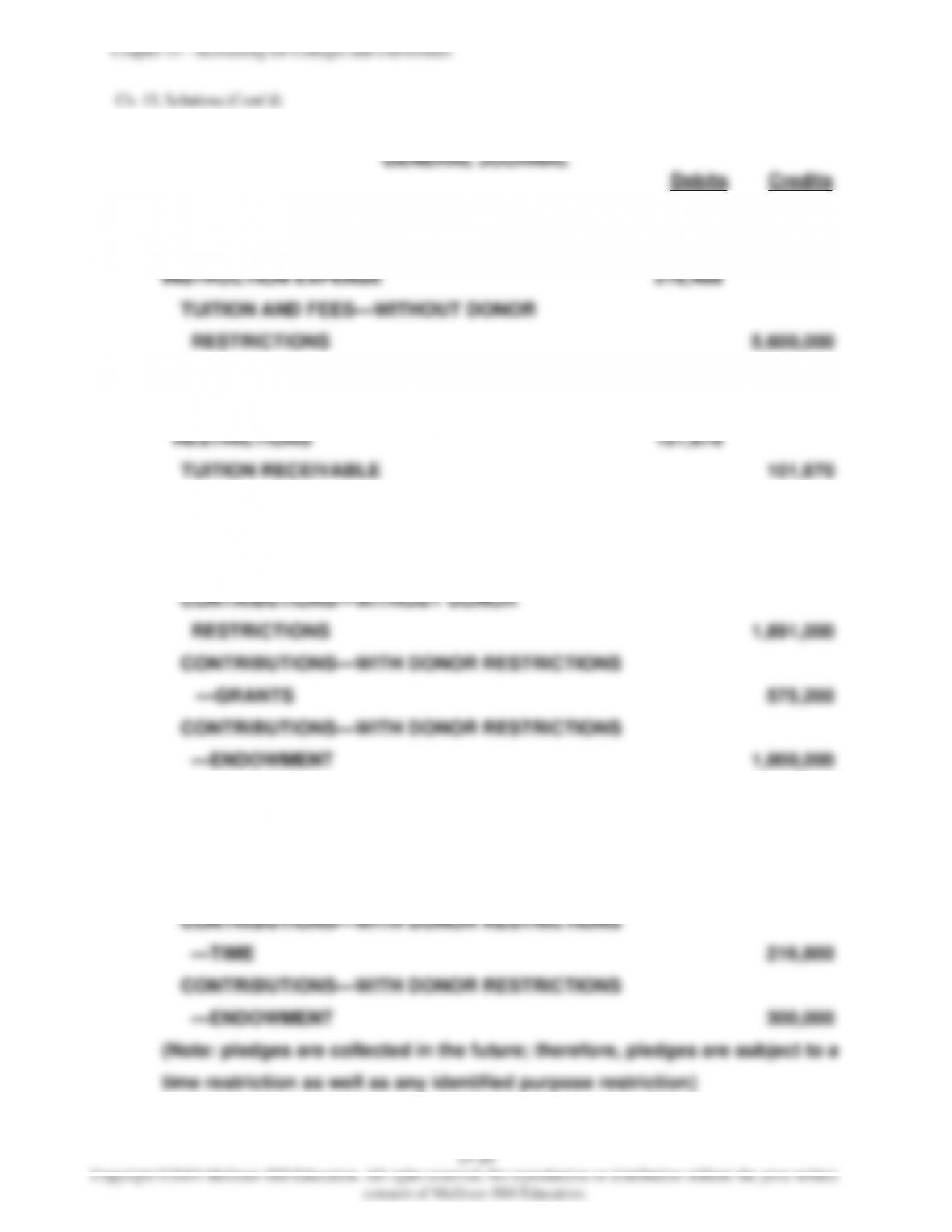
15-20
Copyright ©2019 McGraw-Hill Education. All rights reserved. No reproduction or distribution without the prior written
consent of McGraw-Hill Education.
15-18. a. ELIZABETH COLLEGE
1. TUITION RECEIVABLE 5,254,000
TUITION & FEES DISCOUNT AND ALLOWANCES 69,600
2. TUITION AND FEES—WITHOUT DONOR
3. CASH 2,466,200
INVESTMENTS 1,000,000
4. PLEDGES RECEIVABLE 1,090,000
CONTRIBUTIONS—WITH DONOR RESTRICTIONS
—CAPITAL CAMPAIGN 573,200