Chapter 14 – Accounting for Not-for-Profit Organizations
CHAPTER 14: ACCOUNTING FOR NOT-FOR-PROFIT
Chapter 14 – Accounting for Not-for-Profit Organizations
14-2
CHAPTER 14: ACCOUNTING FOR NOT-FOR-PROFIT
ORGANIZATIONS
14-1 The Financial Accounting Standards Board (FASB) has primary responsibility for
providing guidance on generally accepted accounting principles for nongovernmental
not-for-profit entities. The Governmental Accounting Standards Board (GASB) is
responsible for government organizations including governmental not-for-profit
ASC 958. In addition, the Single Audit Act and Uniform Guidance prescribe auditing
guidance that applies to government and nongovernmental NFPs expending $750,000 or
more in federal awards.
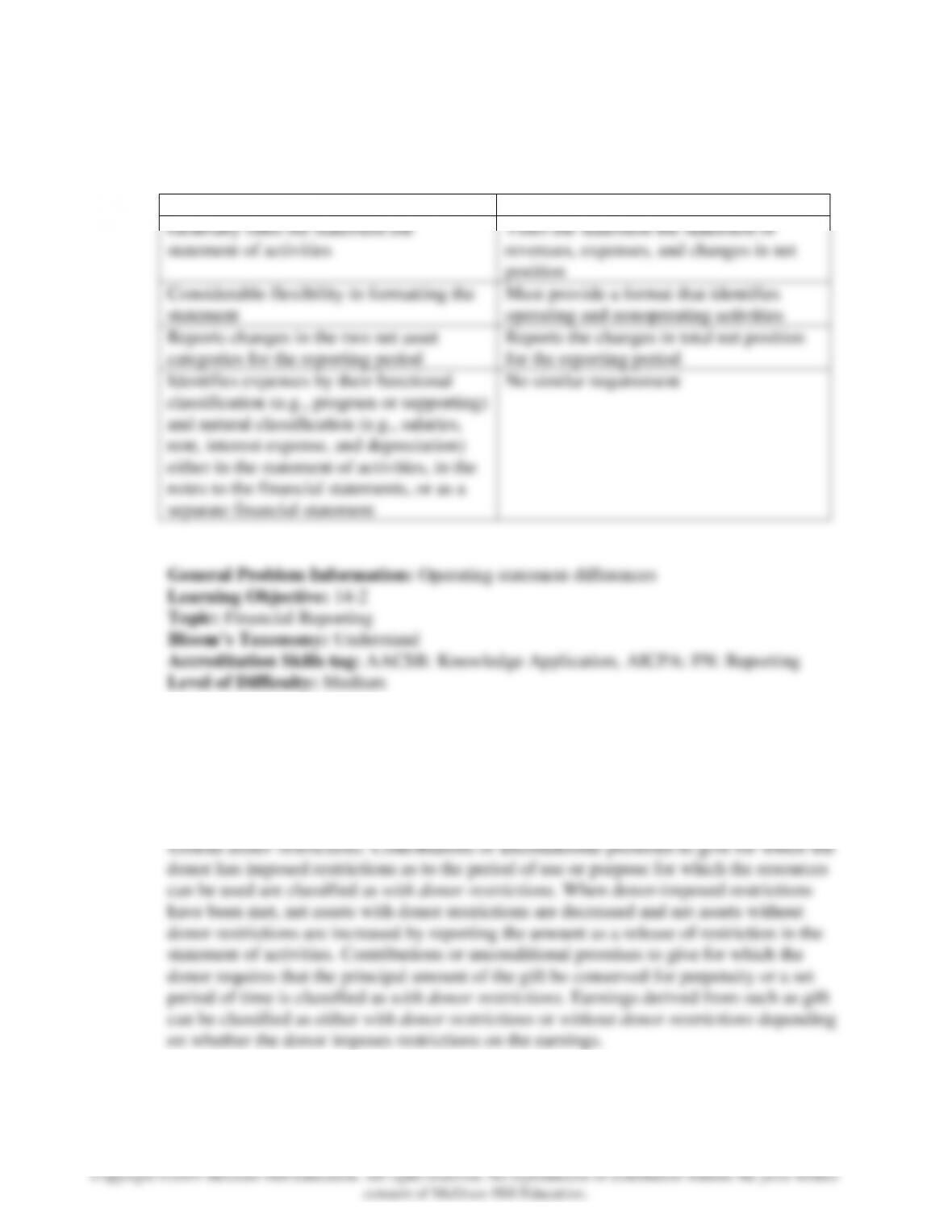
14-2 The operating statements for nongovernment NFPs and government NFPs reporting as
Chapter 14 – Accounting for Not-for-Profit Organizations
14-3
Ch. 14, Answers, Question 14-2 (Cont’d)
For example:
Nongovernment Not-for-profits
Government Not-for-profits
Generally titles the statement the
statement of activities
Titles the statement the statement of
revenues, expenses, and changes in net
position
Considerable flexibility in formatting the
statement
Must provide a format that identifies
operating and nonoperating activities
Reports changes in the two net asset
categories for the reporting period
Reports the changes in total net position
for the reporting period
Identifies expenses by their functional
classification (e.g., program or supporting)
and natural classification (e.g., salaries,
rent, interest expense, and depreciation)
either in the statement of activities, in the
notes to the financial statements, or as a
separate financial statement
No similar requirement
General Problem Information: Operating statement differences
Learning Objective: 14-2
Topic: Financial Reporting
Bloom’s Taxonomy: Understand
Accreditation Skills tag: AACSB: Knowledge Application, AICPA: FN: Reporting
Level of Difficulty: Medium
14-3. FASB ASC 958-205-45 requires not-for-profit organizations to separate net assets into
the two classifications of net assets: net assets without donor restrictions, and net assets
with donor restrictions.
Contributions received without restrictions on their use by donors are classified as
Chapter 14 – Accounting for Not-for-Profit Organizations
14-4
Ch. 14, Answers, Question 14-3 (Cont’d)
Board designated net assets is a subset of net assets without donor restrictions. Dollars
14-4. Reporting expenses by function and nature provides an analysis of the costs associated
with each of the program services and supporting services. It allows the ratio of program
expenses to total expenses and support expenses to total expenses to be computed and
compared to other entities. In addition, readers of the financial statements can see the
natural, line-item or object of expense; such as, salaries, supplies, rent or occupancy
14-5
Copyright ©2019 McGraw-Hill Education. All rights reserved. No reproduction or distribution without the prior written
consent of McGraw-Hill Education.
Ch. 14, Answers (Cont’d)
14-5. An unconditional pledge requires only the passage of time or performance on the part of
the not-for-profit entity. As a result, unconditional pledges are generally recognized in the
year the pledge is made. A conditional pledge, however, depends on the occurrence of a
future and uncertain event. Since it is unknown whether the conditions imposed on the
14-6. Expenses in a not-for-profit organization are divided into functional categories: (1)
program services, and (2) supporting services expenses. Program service expenses are
those that relate to the programs the NFP offers to the public; for example, the
Community Family Service Agency (see Illustration 14-7) reports adoption, counseling,
foster home care, and special outreach project as its programs.
Supporting services expenses are those that are necessary to make program services
possible. These expenses are typically classified into management and general expenses
and fund-raising expenses. The time that an executive director spends in overall
administration of the organization, with the board of directors, in budgeting and strategic
planning meetings, and oversight of accounting and financial reporting is considered
general and administrative, and, consequently, is classified as support expenses.
However, many executive directors will also spend considerable time in fund-raising,
and, particularly in smaller NFPs, on delivering the programs. It is proper, then, to
allocate a portion of the executive director’s salary and fringe benefits to the functional
categories of fund-raising expenses and program expenses, using an appropriate
allocation method.
Functional reporting of expenses in this manner is important since oversight bodies and
donors place importance on the ratio of program services expenses to total expenses. In
other words, they ask, “For every dollar the organization spends, how many cents go to
the organization’s programs, rather than to management and general and fund–raising?”
14-6
Copyright ©2019 McGraw-Hill Education. All rights reserved. No reproduction or distribution without the prior written
consent of McGraw-Hill Education.
Ch. 14, Answers (Cont’d)
14-7 To be recorded as contribution revenue and either an expense or asset, a donated service
must (1) create or enhance nonfinancial assets or (2) require specialized skills, that are
provided by individuals possessing those skills, and typically would have to be purchased
if not provided by donation. A good example of a donated service that meets the first
14-8. (Revised July 2019) FASB standards provide an option for reporting collections which
include historical treasures and works of art. Assuming the museum has met the criteria
for recognizing its porcelain collection as an asset, the museum has the option of
1. Hold the collection for public exhibition, education, or research in furtherance of
public service rather than financial gain.
3. Subject to an organization policy that requires that the use of proceeds from items
that are sold to be for the acquisitions of new collection items, the direct care of
existing collections, or both.
14-7
Copyright ©2019 McGraw-Hill Education. All rights reserved. No reproduction or distribution without the prior written
consent of McGraw-Hill Education.
Ch. 14, Answers (Cont’d)
14-9 Joint costs are the expenses incurred when the activities of a not-for-profit organization
include a fund-raising appeal with either a program or a management and general
function. If it is determined that a bona fide program or management and general function
has occurred in conjunction with the fund-raising appeal the joint costs would be
14-10 A merger occurs when two or more NFPs combine to create a new NFP. At the date of
the merger, the new NFP recognizes the assets and liabilities of the merging NFP
organizations at the amounts reported on the GAAP prepared financial statements of the
merging NFPs. An acquisition occurs when an NFP obtains control of one or more NFP
14-8
Copyright ©2019 McGraw-Hill Education. All rights reserved. No reproduction or distribution without the prior written
consent of McGraw-Hill Education.
Solutions to Cases
14-11 a. An example of an evaluation memo would be as follows.
Date:
To: Chair, Baytown Area United Way Allocation Panel
From: [Your Name], Financial Advisor
Re: Analysis of Baytown Rehabilitative Camp for Disabled Children’s financial
the United Way Board ultimately approved. During last year’s meeting, the camp’s
director and chairman of its board promised to take immediate action to improve the
camp’s financial condition, including such actions as more fund-raising activity and,
if necessary, cutting support staff at the camp.
When I first looked at the FY 2021 budget request and FY 2020 financial statements
When I noted the apparent funds transfer, I contacted the camp’s director who
informed me that the original donor, who had contributed $100,000 several years ago
for future building expansion, was no longer living. Further, after an exhaustive
search she was unable to locate a written agreement regarding the contribution. Upon
reporting these facts to the board of directors, a resolution was passed authorizing the
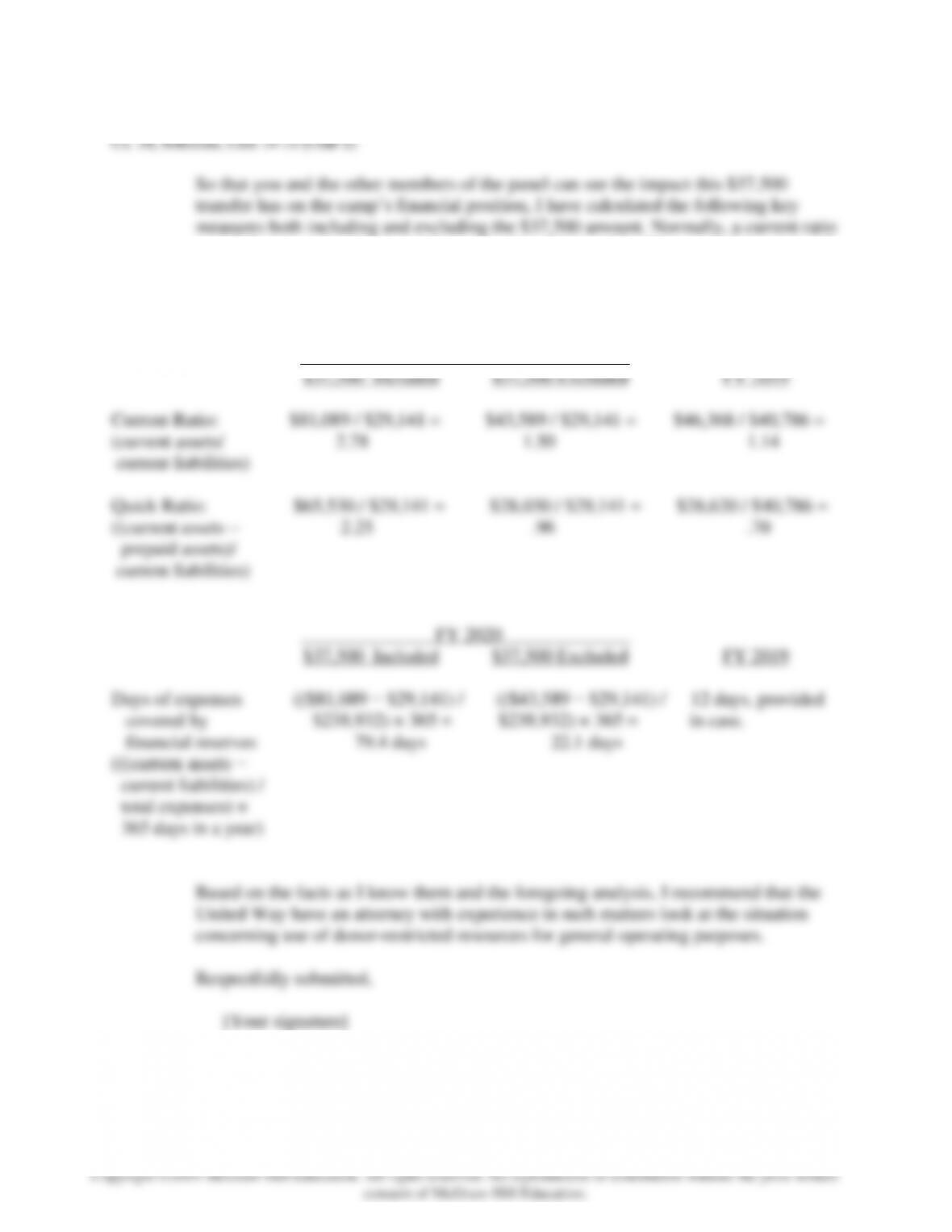
Chapter 14 – Accounting for Not-for-Profit Organizations
14-9
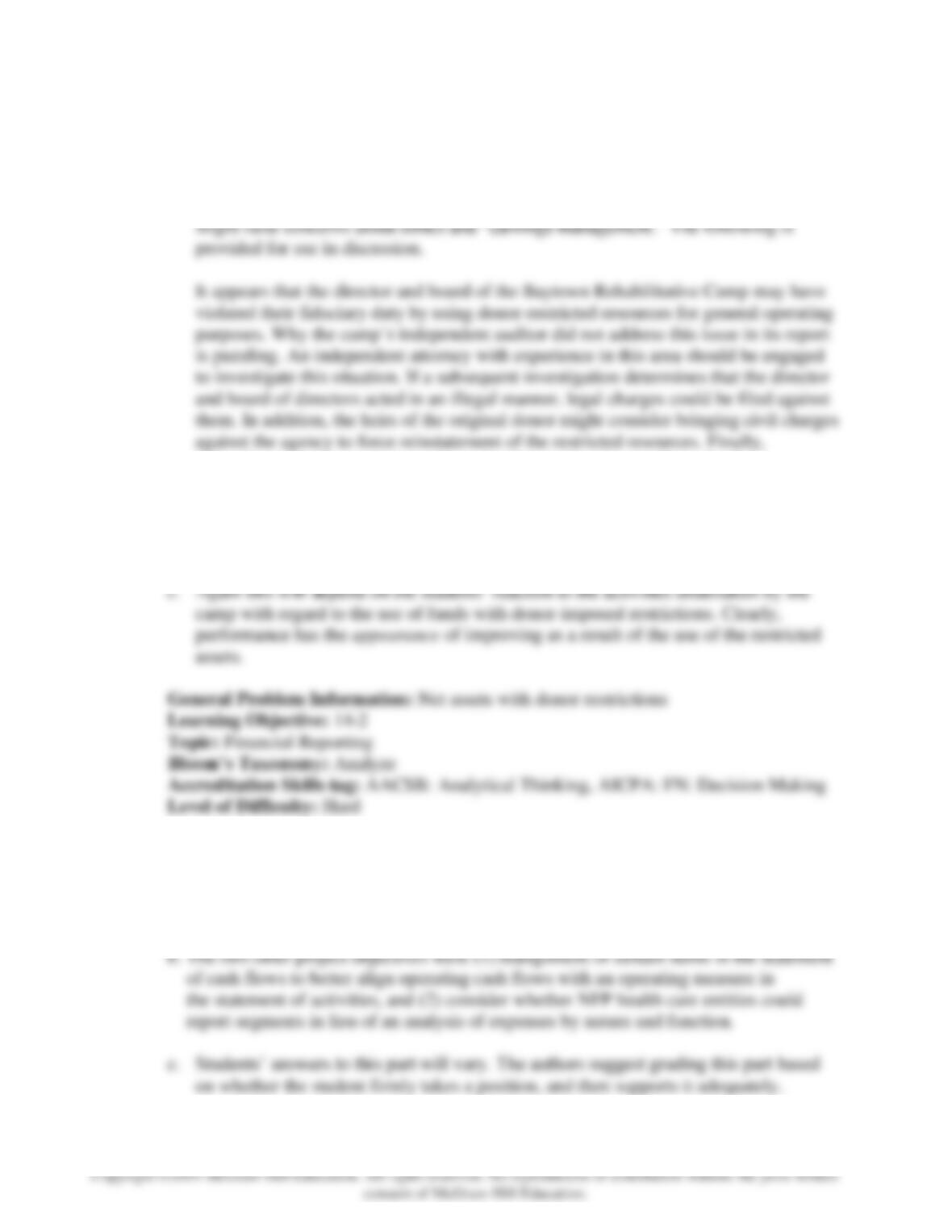
over 2.0 and quick ratio over 1.0 are considered reasonable. Three months or more of
financial reserves would be considered reasonable. As you can see, the camp’s
financial improvement without the $37,500 is minimal. In short, the organization
would still be financially distressed without the questionable $37,500 transfer.
FY 2020
Chapter 14 – Accounting for Not-for-Profit Organizations
14-10
Ch. 14, Solutions, Case 14-11 (Cont’d)
b. The answer to part b will depend on the individual students. Students should be
concerned with funding given the camp’s use of donor-restricted funds. Students
depending on state regulatory rules and policies, the state could revoke the
organization’s charter and force it to liquidate. One possible solution would be for the
camp to seek remedy from the courts, perhaps using the argument that they no longer
intend to expand the building (although there is no indication that such a policy
decision has been made).
14-12 a. The answer to this question will depend in part on the status of the project at the time
the assignment is made. As of June 14th, 2017 Phase Two has not yet been
redeliberated.
Chapter 14 – Accounting for Not-for-Profit Organizations
14-11
Ch. 14, Solutions, Case 14-12 (Cont’d)
14-13 Issue: Is the Native American Heritage Center and Museum a government not-for-profit
entity or nongovernmental not-for-profit entity? This is an essential determination
14-12
Copyright ©2019 McGraw-Hill Education. All rights reserved. No reproduction or distribution without the prior written
consent of McGraw-Hill Education.
Ch. 14, Solutions, (Cont’d)
Solutions to Exercises and Problems
14-14. 1. c. 6. d. 11. c.
3. b. 8. b. 13. c.
5. c. 10. a.
General Problem Information: Various
14-15.
1. a 5. d (no indication contributions
2. d (conditional
promises are 6. c (endowment and earnings
4. c 8. b
General Problem Information: Classification of revenues and contributions
14-13
Copyright ©2019 McGraw-Hill Education. All rights reserved. No reproduction or distribution without the prior written
consent of McGraw-Hill Education.
Ch. 14, Solutions (Cont’d)
14-16.
2. Y 6. Y
4. N 8. Y
General Problem Information: Donated services
14–17.
1. The facts suggest the Center for Nonprofit Excellence should report
the gross revenues and expenses of the quarterly lunches. The
gross revenues from the lunches represent 3.3% of the total
14-14
Copyright ©2019 McGraw-Hill Education. All rights reserved. No reproduction or distribution without the prior written
consent of McGraw-Hill Education.
Ch. 14, Solutions, Exercise 14-17 (Cont’d)
2. Based on the information provided, it appears that direct benefit
expenses of the flower sale can be netted against the gross
revenues. The gross sales of the flower sale represent 2.2% of the
3. The special event revenue should be reported gross of the direct
benefit costs. For net reporting to be applicable, the events would
4. The music concert revenues should be presented gross along with
the direct expenses. The fact that 50% of the total revenue for the
year comes from the concert makes the event a major event.
Although the music concert is only carried on once a year, the
14-15
Copyright ©2019 McGraw-Hill Education. All rights reserved. No reproduction or distribution without the prior written
consent of McGraw-Hill Education.
Ch. 14, Solutions (Cont’d)
1. Based on the information provided, it appears that the purpose,
audience, and content criteria are met for this activity to be considered
a bona fide activity. The joint costs should be allocated between the
2. This activity fails all three criteria to be considered a bona fide activity
under FASB ASC 958–720–45. All the costs of the activity should
therefore be allocated to fund-raising expenses. The purpose of the
3. Based on the information provided, it appears that the purpose,
audience, and content criteria are met for this activity to be considered
Chapter 14 – Accounting for Not-for-Profit Organizations
14-16
Ch. 14, Solutions, Exercise 14-18 (Cont’d)
The purpose of the lecture is to help accomplish the NFP’s
4. This activity would seemingly pass the three criteria; however, it
must be classified as a fund-raising event. It would appear that the
purpose of the campaign aligns with the NFP’s mission, which is to
support the city’s firefighters. An objective of all firefighters is to
Chapter 14 – Accounting for Not-for-Profit Organizations
14-17
Ch. 14, Solutions, Exercise 14-18 (Cont’d)
14-19.
a. It appears there are several modifications that should be made to the ECE
14-2 for an example of how to report). It is not apparent from the
statement presentation just what the direct expenses related to the
special event were.
• Program fees are reported as with donor restrictions. Program fees
Chapter 14 – Accounting for Not-for-Profit Organizations
14-18
Ch. 14, Solutions, Exercise 14-19 (Cont’d)
• Depreciation should be allocated to the functional areas.
14-20.
a. No. The presented statement is not in proper form for a statement of
1. Were there no fund-raising expenses related to the solicitation of
$111,400 in contributions?
2. Were the contributions of $50,000 for the Abstract Exhibit restricted by
the donor, such that the $4,000 excess of revenues over expenses will
have to be returned or spent on the program?
14-19
Copyright ©2019 McGraw-Hill Education. All rights reserved. No reproduction or distribution without the prior written
consent of McGraw-Hill Education.
Ch. 14, Solutions, Exercise 14-20 (Cont’d)
3. Should the $5,000 of equipment for the Public Exhibits program be
capitalized and depreciated? What is the capitalization policy of the
organization?
14-20
Copyright ©2019 McGraw-Hill Education. All rights reserved. No reproduction or distribution without the prior written
consent of McGraw-Hill Education.
14-21. THE SHANNON COMMUNITY KITCHEN
1. CASH 28,000
CONTRIBUTIONS—
2. PROGRAM EXPENSES 100
3. NO TRANSACTION IS RECORDED – MEAL SERVICE AND PREPARATION
DOES NOT REQUIRE A SPECIALIZED SKILL
4. CASH 5,000
5. PROGRAM EXPENSES 4,100
CASH 4,100