Chapter 13 – Not-for-Profit Organizations—Regulatory, Taxation, and Performance Issues
13-13
Ch. 13, Solutions, Case 13-14 (Cont’d)
13-15. Note: Answers to case 13-15 are based on Internet access dated 2/16/2017 and may differ
slightly at the time the case is assigned.
a. The Conservation Fund received an A+ rating. The rating is assigned based on the
following criteria:
• Program effectiveness (program expenses / total expenses)—to receive such a
Chapter 13 – Not-for-Profit Organizations—Regulatory, Taxation, and Performance Issues
13-14
Ch. 13, Solutions, Case 13-15 (Cont’d)
c. According to the BBB Web site, the Conservation Fund’s program effectiveness
percentage (program expenses / total expenses) was 98 percent, and its fund–
13-16. Answers for a and b were accessed on 2/16/2017 from the “How Do We Rate Charities’
Accountability and Transparency?” portion of the Charity Navigator Web site. The
Chapter 13 – Not-for-Profit Organizations—Regulatory, Taxation, and Performance Issues
13-15
Ch. 13, Solutions, Case 13-16 (Cont’d)
c. Charities begin with a 100 point score for Accountability and Transparency. They
then lose points as follows.
Performance Metric
Deductions
from Score
Less than 5 independent voting members of the board; or
independent members do not constitute a voting majority.
15 points
Material diversion of assets within the last two years, without a
satisfactory explanation
15 points
Material diversion of assets within the last two years, with a
satisfactory explanation
7 points
Audited financial statements are not prepared or reviewed by an
independent accountant
15 points
Audited financial statements are prepared or reviewed by an
independent accountant, but that accountant is not selected and
overseen by an internal committee.
7 points
Loans to or from officers or other interested parties
4 points
Organization does not keep board meeting minutes
4 points
Forms 990 not distributed to the board before filing
4 points
No conflict of interest policy
4 points
No whistleblower policy
4 points
No records retention and destruction policy
4 points
Does not properly report CEO compensation on form 990
4 points
Does not have a process for reviewing and updating CEO
compensation
4 points
Fails to report board members and compensation fully on the Form
990, or reports that board members are compensated for their
participation
4 points
Does not publish board members on Web site
4 points
Does not publish senior staff on Web site
3 points
Chapter 13 – Not-for-Profit Organizations—Regulatory, Taxation, and Performance Issues
13-16
Ch. 13, Solutions, Case 13-16 (Cont’d)
Does not publish latest audited financial statements on Web site
4 points
Does not publish latest Form 990 on Web site
3 points
No donor privacy policy on Web site
4 points
Opt-out donor privacy policy on Web site
3 points
Once a charity is scored out of 100, they are assigned a star rating as follows:
Accountability & Transparency
Rating:
0
Stars
Accountability &
Transparency Score:
≥ 90
≥ 80
≥ 70
≥ 55
< 55
A four star rating is the best rating a charity can receive on the accountability and
transparency metric while a zero star is the worst.
d. The answer will depend on the charity chosen by the student. Students should be
encouraged to discuss the relative importance of each category, as well as the
strengths and weaknesses of the scoring methodology.
General Problem Information: accountability and transparency evaluation of a NFP
Leaning Objective: 13-3, 13-4, 13-5
Topic: Accountability and Transparency Measures
Bloom’s Taxonomy: Evaluate
Accreditation Skills tag: AACSB: Analytical Thinking, AICPA: FN: Decision Making
Level of Difficulty: Hard
Solutions to Exercises and Problems
2. a. 7. d.
4. d. 9. c.
Chapter 13 – Not-for-Profit Organizations—Regulatory, Taxation, and Performance Issues
13-17
Ch. 13, Solutions, Exercise 13-17 (Cont’d)
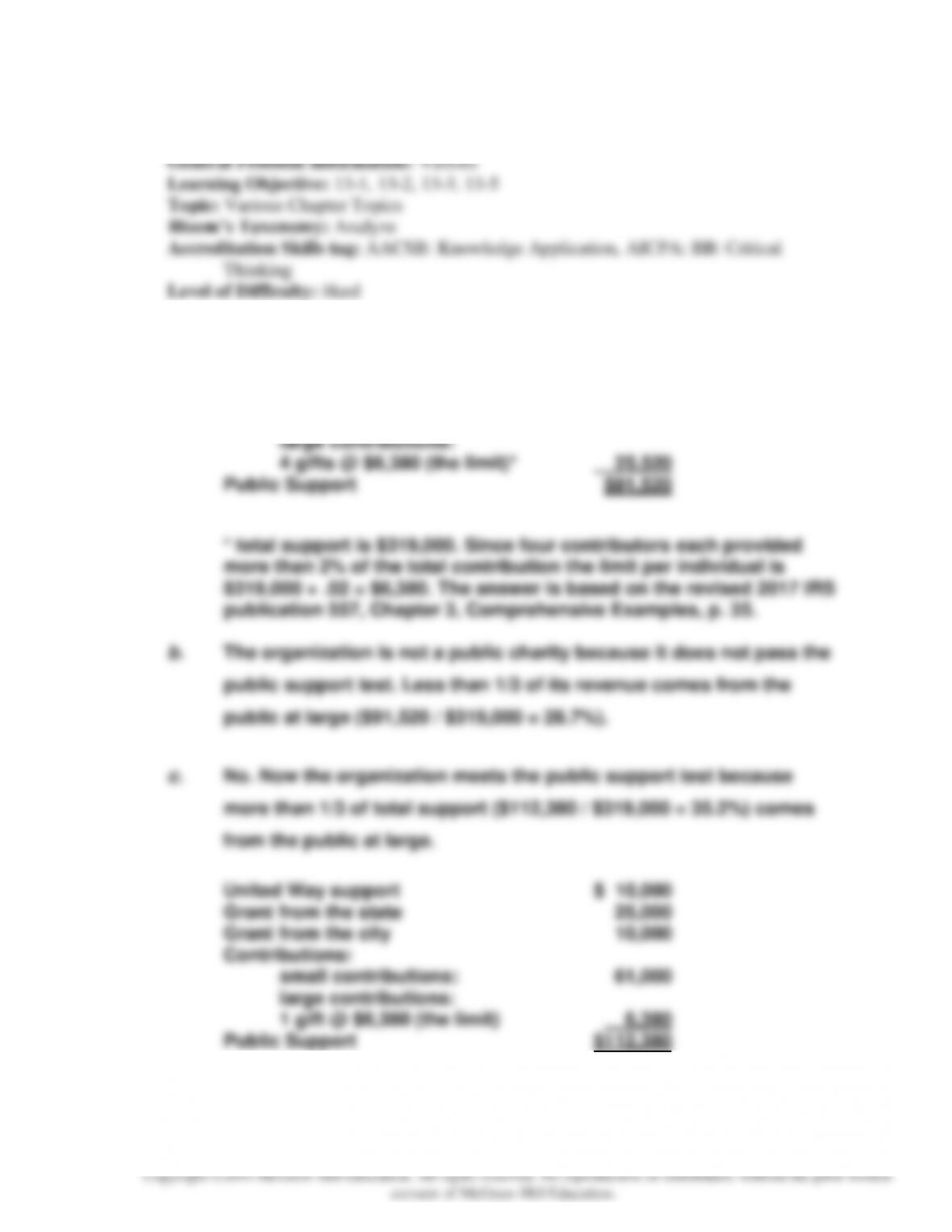
13-18. a. United Way support $ 10,000
Grant from the state 25,000
Grant from the city 10,000
Contributions:
small contributions: 21,000

Chapter 13 – Not-for-Profit Organizations—Regulatory, Taxation, and Performance Issues
13-18
Ch. 13, Solutions, Exercise 13-18 (Cont’d)
Note that a tax-exempt entity in its first five years will not have to
13-19.
2. IRC Sec. 501(c)(3)
4. IRC Sec. 501(c)(3)
6. IRC Sec. 501(k)
8. IRC Sec. 527
General Problem Information: Tax-exempt categories
13-19
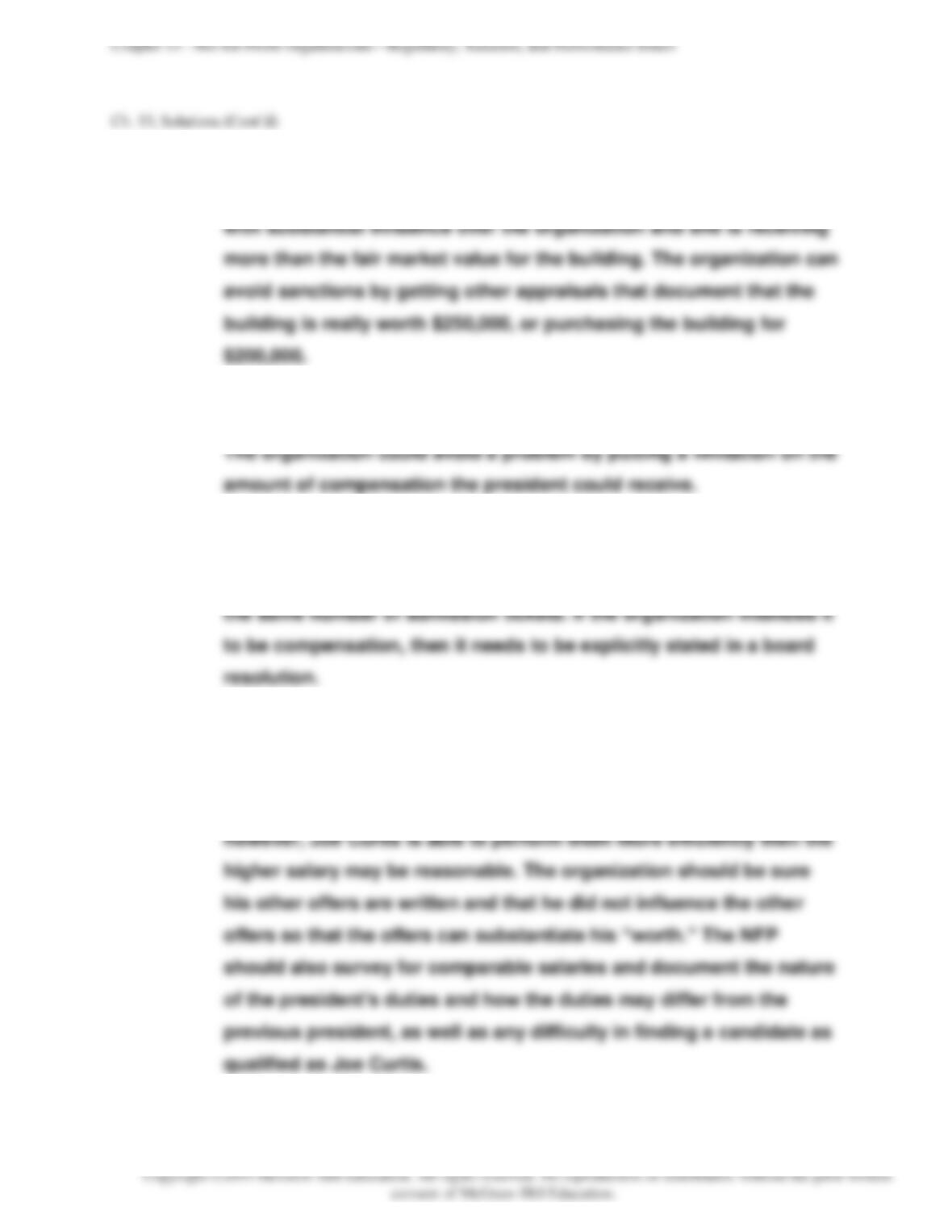
13-20.
Yes – subject to
UBIT
No – not unrelated
business income
1.
Sale of Silverton Symphony
Orchestra Concert CDs in the
facility’s gift shop.
X
2.
Rental of the facility to the
high school drama club.
X
3.
Rental of two apartments in
the facility to the symphony.
X
4.
Sale of the season ticket
membership list to a local
music store.
X
5.
Rental of the facility to the
state CPA association for
continuing professional
education events.
X
6.
Internet sales of gift shop
items with the Silverton
Symphony Orchestra logo.
X
7.
Lease of the facility’s parking
lot to the local university on
football game days.
X
Note: From the information provided, we can infer that activities
13-20
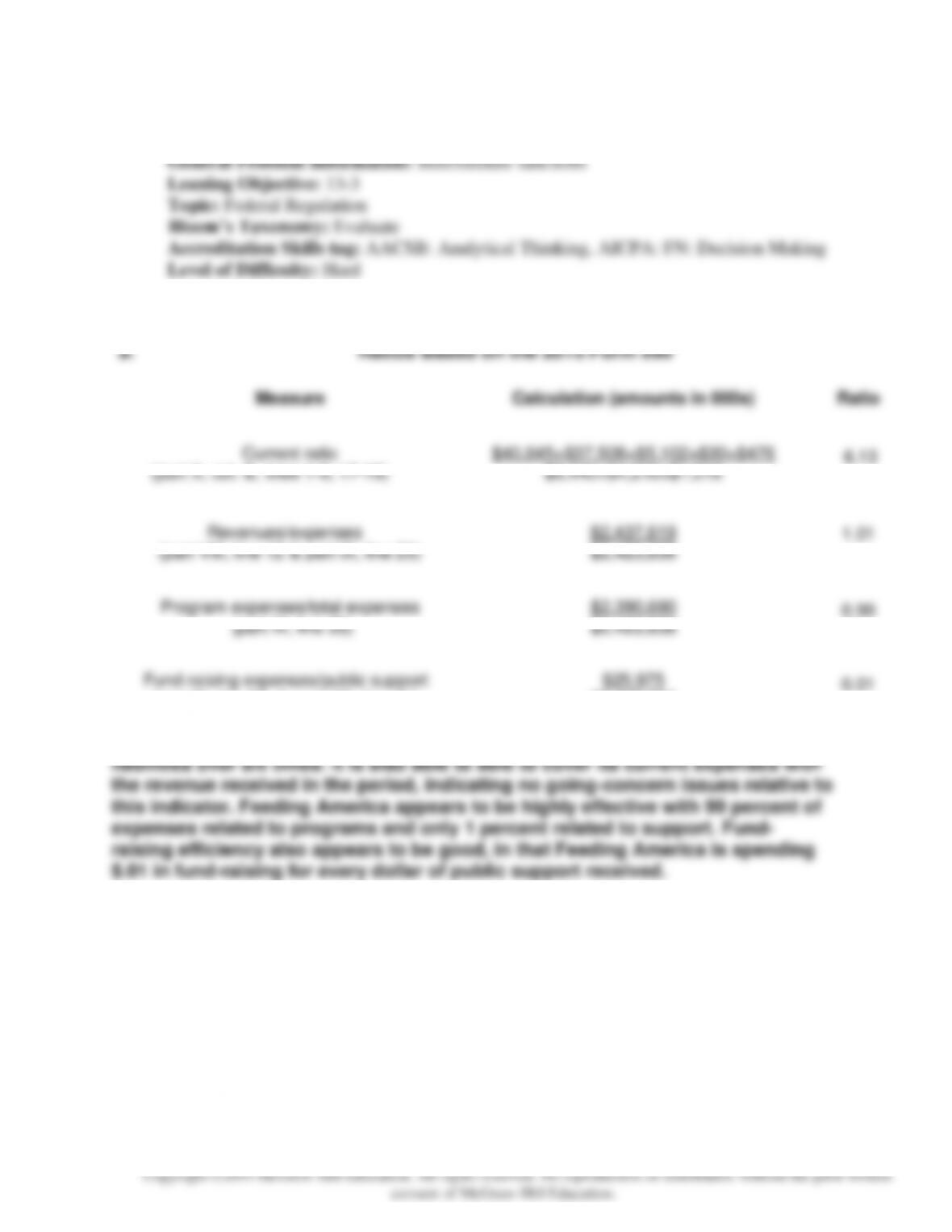
13-21. 1. Yes. This is a classic example of excess economic benefit
transactions. Jane is a disqualified person because she is an officer
2. Yes. However, the risk only occurs when the excess benefit is paid.
3. No. However, the law is silent on this particular example. She is
probably receiving the tickets as a member, if all members receive
4. Possibly. If the incoming president’s duties are similar to the
outgoing president and comparable organizations, then the
compensation may be unreasonable. If the duties are similar,
Chapter 13 – Not-for-Profit Organizations—Regulatory, Taxation, and Performance Issues
13-21
Ch. 13, Solutions, Exercise 13-21 (Cont’d)
13-22.
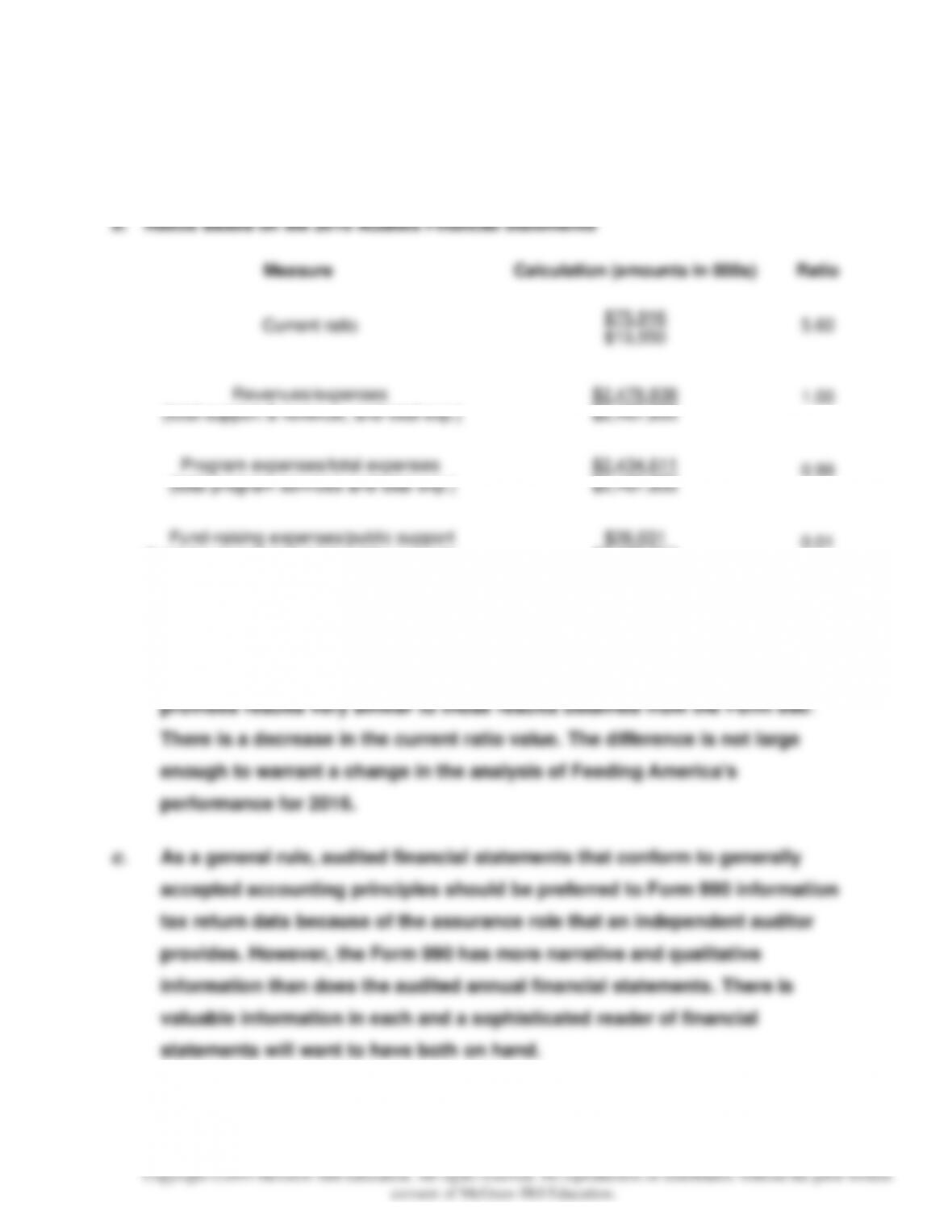
a.
Ratios Based on the 2015 Form 990
Measure
Calculation (amounts in 000s)
Ratio
Current ratio
$40,645+$37,508+$5,102+$30+$476
6.13
(part X, col. B, lines 1-9, 17–19)
$8,440+$4,216+$1,016
Revenues/expenses
$2,437,619
1.01
(part VIII, line 12 & part IX, line 25)
$2,423,838
Program expenses/total expenses
$2,390,690
0.99
(part IX, line 25)
$2,423,838
Fund-raising expenses/public support
$25,975
0.01
(part IX, line 25, & part VIII, line 1h)
$2,375,636
The current ratio indicates that Feeding America is liquid, covering its current
Chapter 13 – Not-for-Profit Organizations—Regulatory, Taxation, and Performance Issues
13-22
Ch. 13, Solutions, Exercise 13-22 (Cont’d)
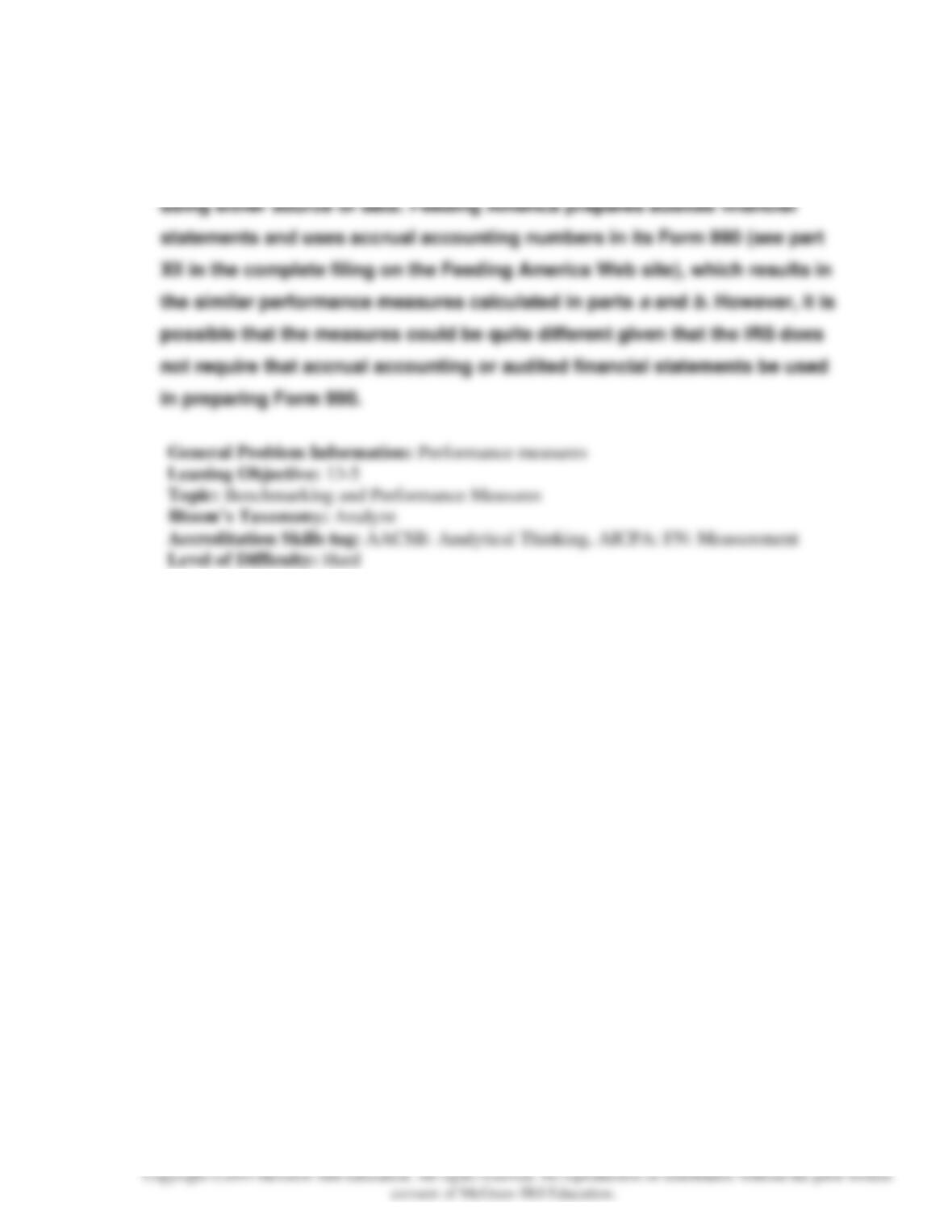
Although the numbers entering the calculations are different, using audited
financial statement information to calculate ratios for Feeding America
b.
Ratios Based on the 2016 Audited Financial Statements
Measure
Calculation (amounts in 000s)
Ratio
Current ratio
$75,916
5.60
$13,550
Revenues/expenses
$2,478,838
1.00
(total support & revenue, and total exp.)
$2,467,855
Program expenses/total expenses
$2,434,611
0.99
(total program services and total exp.)
$2,467,855
Fund-raising expenses/public support
$26,031
0.01
(fund development & total public support)
$2,408,317
Chapter 13 – Not-for-Profit Organizations—Regulatory, Taxation, and Performance Issues
13-23
Ch. 13, Solutions, Exercise 13-22 (Cont’d)
As seen with Feeding America, performance measures can be very similar