
Chapter 11 – Auditing of Government and Not–for-Profit Organizations
11-1
CHAPTER 11: AUDITING OF GOVERNMENT AND NOT-FOR-
PROFIT ORGANIZATIONS
OUTLINE
Number
Topic
Type/Task
Status
(re: 17/e)
Questions:
11-1
Definition of audit, standard setters
Define, explain
Same
11-2
GAGAS audit services
Define, explain
Same
11-3
Government audit report
Compare
New
11-4
Opinion units
Explain
11-3
11-5
GAAP hierarchy
Explain
Updated
11-6
Single Audit guidance
Explain
Same
11-7
Government audit report
Explain
Same
11-8
GAGAS versus GAAS
Explain
Same
11-9
Independence under GAGAS
Explain
New
11-10
Single Audit
Explain
New
Cases:
11-11
Audit engagement
Evaluate
Same
11-12
Audit considerations
Evaluate
Same
11-13
Research Case⎯Performance Audit
Analysis
New
11-14
Research Case⎯Single Audit
Analysis
11-13
11-15
Auditing a federal program
Analysis
Same
11-16
Auditor selection and independence
Evaluate
Same
11-17
Audit committees
Locate
Same
Exercises/Problems:
11-18
Examine the CAFR
Examine
Same
11-19
Various
Multiple Choice
1 updated,
11-13 new
11-20
Continuing professional education
Analysis
Same
11-21
Nonaudit services
Evaluate
New
11-22
Single audit
Analysis
Same
11-23
Single audit
Analysis
New
11-24
GAAS versus GAGAS standards
Analysis
Same
11-25
Audit report
Error analysis
Same
Chapter 11 – Auditing of Government and Not–for-Profit Organizations
11-2
CHAPTER 11: AUDITING OF GOVERNMENT AND NOT-FOR-
PROFIT ORGANIZATIONS
Answers to Questions
11-1. An audit involves an independent review of information or processes by an external party
for the purpose of evaluating the validity and reliability of information or assessing a
program or process. The purpose of a financial audit is to express an opinion or provide
assurance for users of the financial statements that the statements have been prepared in
11-2. Government Auditing Standards define three major types of services performed by
auditors: financial statement audits, attestation engagements, and performance audits.
Financial audits provide an auditor’s opinion that financial statements present fairly an
entity’s financial position, changes in financial position, and, where applicable, cash
Chapter 11 – Auditing of Government and Not–for-Profit Organizations
11-3
Ch. 11, Answers (Cont’d)
11-3. In addition to the sections headed “Management’s Responsibility for the Financial
Statements” and “Auditor’s Responsibility” an auditor’s report of a government should
General Problem Information: Government Audit Report
Learning Objective: 11-1
Topic: Format of the Audit Report
Bloom’s Taxonomy: Remember
Accreditation Skills tag: AACSB: Communication, AICPA: FN Reporting
Level of Difficulty: Easy
11-4. An opinion unit is related to the financial reporting structure of governments. Opinion
units include: governmental activities, business-type activities, aggregate discretely
General Problem Information: Opinion Units
Learning Objective: 11-1
Topic: Materiality for Government Audits
Bloom’s Taxonomy: Remember
Accreditation Skills tag: AACSB: Communication, AICPA: FN Reporting
Level of Difficulty: Easy
11-5. Referring to Illustration 11-3, state and local governments and federal government entity
financial reporting is governed by officially established accounting principles, including
Chapter 11 – Auditing of Government and Not–for-Profit Organizations
11-4
Ch. 11, Answers, 11-5 (Cont’d)
General Problem Information: GAAP hierarchy
Learning Objective: 11-1
Topic: The Audit Process
Bloom’s Taxonomy: Remember
Accreditation Skills tag: AACSB: Communication, AICPA: FN Reporting
Level of Difficulty: Easy
11-6. An auditor performing a single audit should be familiar with the unique purpose served
by each of these resources. OMB Uniform Administrative Requirements, Cost Principles,
and Audit Requirements for Federal Awards (Uniform Guidance) provides information
General Problem Information: Single audit guidance
Learning Objective: 11-3
Topic: Single Audits
Bloom’s Taxonomy: Remember
Accreditation Skills tag: AACSB: Communication, AICPA: FN Reporting
Level of Difficulty: Medium
11-7. An audit report for a government entity contains additional information and sections not
required in a for-profit audit report. The introductory paragraph of the report will refer to
the opinion units covered by the audit report, and the auditor’s report will refer to
General Problem Information: Government audit repot
Learning Objective: 11-1
Topic: Format of the Audit Report
Bloom’s Taxonomy: Remember
Accreditation Skills tag: AACSB: Communication, AICPA: FN Reporting
Chapter 11 – Auditing of Government and Not–for-Profit Organizations
11-5
Ch. 11, Answers, 11-7 (Cont’d)
Level of Difficulty: Medium
11-8. GAGAS is the acronym for generally accepted government auditing standards (also
General Problem Information: GAGAS versus GAAS
Learning Objective: 11-2
Topic: Government Auditing Standards
Bloom’s Taxonomy: Remember
Accreditation Skills tag: AACSB: Communication, AICPA: FN Reporting
Level of Difficulty: Medium
11-9. Government Auditing Standards, par. 3.36 identifies the following prohibited nonaudit
activities considered management responsibilities that impair independence if performed
by an independent auditor:
a. setting policies and strategic direction for the audited entity;
b. directing and accepting responsibility for the actions of the audited
Chapter 11 – Auditing of Government and Not–for-Profit Organizations
11-6
Ch. 11, Answers, 11-9 (Cont’d)
Topic: Ethics and Independence
Bloom’s Taxonomy: Remember
Accreditation Skills tag: AACSB: Communication, AICPA: FN Reporting
Level of Difficulty: Easy
11-10. When performing a single audit, federal awards programs are classified by risk. In Step 1,
the “larger” (per the sliding scale presented in Chapter 11) federal programs are identified
as “Type A.” All other programs are identified as “Type B” programs. In Step 2, any
General Problem Information: Selecting Programs for Audit
Learning Objective: 11-3
Topic: Selecting Programs for Audit
Bloom’s Taxonomy: Remember
Accreditation Skills tag: AACSB: Communication, AICPA: FN Reporting
Level of Difficulty: Easy
Chapter 11 – Auditing of Government and Not–for-Profit Organizations
11-7
Solutions to Cases
11-11. This case addresses the issue of properly defining an audit engagement. In particular,
students must assess whether a financial audit is sufficient, or whether an organization
has expended sufficient federal awards to also require a single audit. It also provides an
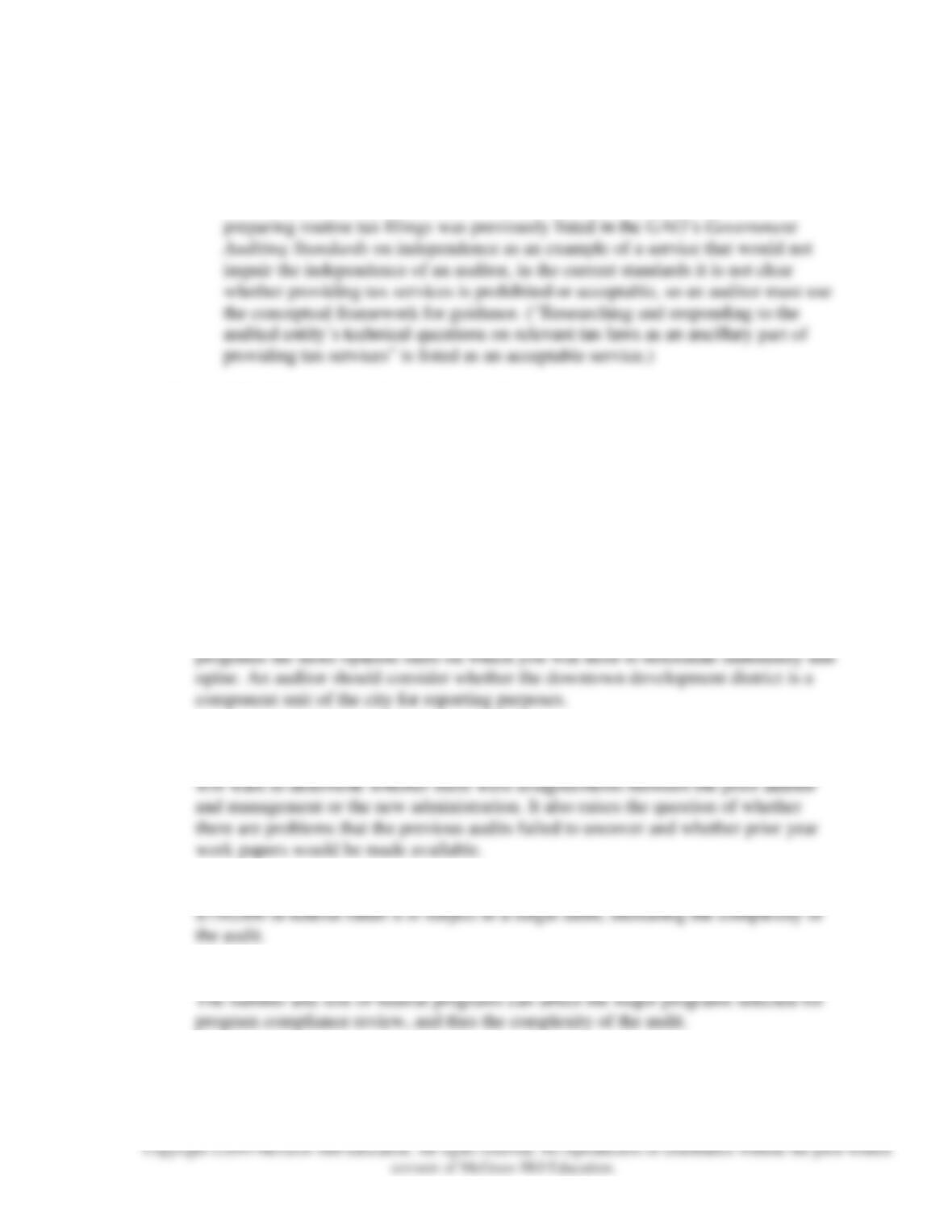
a. Analysis of expenditures of federal awards shows that Lake View Mental Health
Affiliates expended more than $750,000 in federal awards and therefore is
required to have a single audit. Total expenditures of federal awards is
determined as follows:
Item Federal Awards Expended
b. Based upon the conclusion in part a and the information provided in the
background, one could conclude that Mr. Wise would be unwise to accept this
engagement for $10,000 – the going rate for a financial audit. A single audit
Chapter 11 – Auditing of Government and Not–for-Profit Organizations
11-8
Ch. 11, Solutions, Case 11-11 (Cont’d)
c. Maybe. Mr. Wise would be required to reference the GAGAS conceptual
framework for independence shown in Illustration 11-6. While the task of
General Problem Information: Single Audit
Learning Objective: 11-1
Topic: The Audit Process
Bloom’s Taxonomy: Apply
Accreditation Skills tag: AACSB: Communication, AICPA: FN Reporting
Level of Difficulty: Medium
11-12. There is a great deal more information you will want before making your bid; however,
some of the factors affecting price that you might have on your list include:
1. Number of major programs and component units. The larger the number of major
2. Predecessor auditor. When a prior auditor chooses not to pursue an audit engagement
it may indicate that there is an element of audit risk involved. An incoming auditor
3. The amount of aid received from the federal government. If the city expends over
4. The number of federal programs and the amount of funds expended by each program.
Chapter 11 – Auditing of Government and Not–for-Profit Organizations
11-9
Ch. 11, Solutions, Case 11-12 (Cont’d)
5. Specifics of the former wastewater employee lawsuit and allegations of improper
6. In addition to the new administration and the lawsuit, other potential risk factors
General Problem Information: Government audit considerations
Learning Objective: 11-1, 11-4
Topic: The Audit Process, Special Topics Related to Audits of Governments and Not–
for-Profits
Bloom’s Taxonomy: Apply
Accreditation Skills tag: AACSB: Communication, AICPA: FN Reporting
Level of Difficulty: Medium
11-13. The objective of this case is to familiarize students with the nature of performance audits.
Instructors may choose to specify an Oregon audit for review, such as the biennial one
related to financial condition review of counties, or have students search for performance
audits within their state or local governments rather than using the Oregon web site.
Instructors may also want to specify an expected length for the required memo or provide
Chapter 11 – Auditing of Government and Not–for-Profit Organizations
11-10
Ch. 11, Solutions, Case 11-13 (Cont’d)
General Problem Information: Performance Audits
Learning Objective: 11-2
Topic: Types of Audits and Engagements
Bloom’s Taxonomy: Apply
Accreditation Skills tag: AACSB: Communication, AICPA: FN Reporting
Level of Difficulty: Medium
11-14. The objectives of this case are to familiarize students with government audit resources
available on the Internet and to illustrate the process for selecting major programs for
audit using the risk-based approach.
a. The Department of Health and Human Services sponsors the Child Care and
Development Block Grant (CFDA 93.575); the Maternal, Infant, and Early Childhood
d. The three Department of Agriculture sponsored programs are part of the child
nutrition cluster and can be treated as a cluster for audit purposes.
e. Total expenditures are $1,581,261; therefore, the criterion for selecting a major Type
A program would be $750,000 in federal funds expended. Head Start is the only
f. Based on size alone, it would be reasonable to select the Head Start program. Head
g. This is a difficult question. Notice that the only way the 40 percent coverage rule can
Chapter 11 – Auditing of Government and Not–for-Profit Organizations
11-11
Ch. 11, Solutions, Case 11-14 (Cont’d)
General Problem Information: Single audit and major programs
Learning Objective: 11-3
Topic: Single Audit Requirements
Bloom’s Taxonomy: Apply
Accreditation Skills tag: AACSB: Knowledge Application, AICPA: Critical Thinking
Level of Difficulty: Hard
11-15. Although this case requires no analysis, it is a useful exercise to give students a feel for
the resources auditors use to test for compliance in performing single audits.
a. The Catalog of Federal Domestic Assistance (CFDA) number for this program is
16.710.
b. According to the Compliance Supplement, the program’s objective is to provide
c. Based on the matrix provided in Part 2 of the April 2017 draft of the Compliance
Supplement, the description of compliance requirements in Part 3 of the Compliance