
Chapter 01 – Introduction to Accounting and Financial Reporting for Government and Not-for-Profit Entities
1-1
CHAPTER 1: INTRODUCTION TO ACCOUNTING AND FINANCIAL
REPORTING FOR GOVERNMENT AND NOT-FOR-
PROFIT ENTITIES
OUTLINE
Number
Topic
Type/Task
Status
(re: 17/e)
Questions:
1-1
Differences between types of organizations
Identify
Same
1-2
Distinguishing between general purpose and
special purpose governments
Identify
Same
1-3
Standards-setting bodies
Identify
Same
1-4
Determining which standard-setting body sets
standards for a nongovernmental NFP
Categorize
Same
1-5
Nature and significance of interperiod equity
Explain
Same
1-6
Determining the purpose of the two types of
accountability
Determine
Same
1-7
Primary reporting objectives for NFPs and
governments
Compare
Same
1-8
Comprehensive annual financial report
Recognize
Same
1-9
Federal government performance and
accountability report
Identify/Describe
Same
1-10
NFP reporting of expenses
Explain
Same
Cases:
1-11
Research Case—GASB
Apply
New
1-12
Research Case—GASB
Summarize
1-11
1-13
Research Case—FASB
Summarize
New
1-14
Research Case—FASB
Analyze
New
1-15
Research Case—FASAB
Summarize
1-13
1-16
Research Case—Federal Financial Reporting
Objectives
Analyze
1-15
Exercises/Problems:
1-17
Examine the CAFR
Examine
1-16
1-18
Financial Statement Differences
Differentiate
1-17 revised
1-19
Various
Multiple Choice
1-18 item 9 is
new; other
items are the
same or
revised
1-20
Matching concepts and reporting
characteristics or requirements for
governmental and NFP organizations
Classify
1-19 revised
1-21
Matching standards governing organizations
Classify
New
Chapter 01 – Introduction to Accounting and Financial Reporting for Government and Not-for-Profit Entities
1-2
CHAPTER 1: INTRODUCTION TO ACCOUNTING AND FINANCIAL
REPORTING FOR GOVERNMENT AND NOT-FOR-
PROFIT ENTITIES
Answers to Questions
1-1. Following is a list of some of the differences between business organizations and
government/not-for-profit organizations.
Primary operations are undertaken
Primary operations are not
General Problem Information: Differences between types of organizations
Learning Objective: 1-1
Topic: Distinguishing Characteristics of Governmental and Not–for-Profit Entities
Bloom’s Taxonomy: Remember
Accreditation Skills tag: AACSB: Communication, AICPA: BB Industry
Level of Difficulty: Easy
1-2. a. GP c. SP e. SP
General Problem Information: Distinguishing between general purpose and special
purpose governments
Learning Objective: 1-1
Topic: What are Governmental and Not-for-profit Organizations?
Bloom’s Taxonomy: Remember
Accreditation Skills tag: AACSB: Communication, AICPA: BB Industry
Level of Difficulty: Easy
Business Organizations
Government/Not–for-for profit
Organizations
Providers of resources expect either
Many providers of resources do not
Chapter 01 – Introduction to Accounting and Financial Reporting for Government and Not-for-Profit Entities
1-3
Ch. 1, Answers (Cont’d)
1-3. Illustration 1–1 depicts the standard-setting jurisdiction of the FASB, GASB and FASAB.
General Problem Information: Standards-setting bodies
Learning Objective: 1-2
Topic: Sources of Financial Reporting Standards
Bloom’s Taxonomy: Remember
Accreditation Skills tag: AACSB: Communication, AICPA: FN Reporting
Level of Difficulty: Easy
1-4. No, I do not agree with this board member’s statement. Since Beth House Museum is a
General Problem Information: Determining which standard-setting body sets standards
for a nongovernmental NFP
Learning Objective: 1-2
Topic: Sources of Financial Reporting Standards
Bloom’s Taxonomy: Understand
Accreditation Skills tag: AACSB: Communication, AICPA: FN Reporting
Level of Difficulty: Medium
1-5. Interperiod equity, whether current period revenues are sufficient to pay for current
General Problem Information: Nature and significance of interperiod equity
Learning Objective: 1-3
Topic: Objectives of Financial Reporting
Bloom’s Taxonomy: Understand
Accreditation Skills tag: AACSB: Communication, AICPA: FN Reporting
Level of Difficulty: Medium
Chapter 01 – Introduction to Accounting and Financial Reporting for Government and Not-for-Profit Entities
1-4
Ch. 1, Answers (Cont’d)
1-6. The purpose of operational accountability is to assess whether the government has used
General Problem Information: Determining the purpose of the two types of
accountability
Learning Objective: 1-4
Topic: Financial Reporting of State and Local Governments
Bloom’s Taxonomy: Understand
Accreditation Skills tag: AACSB: Communication, AICPA: FN Reporting
Level of Difficulty: Medium
1-7. The primary financial reporting objective for not-for-profit organizations is to provide
decision-useful financial information to resource providers, such as donors, members,
General Problem Information: Primary reporting objectives for NFPs and governments
Learning Objective: 1-3
Topic: Objectives of Financial Reporting
Bloom’s Taxonomy: Understand
Accreditation Skills tag: AACSB: Communication, AICPA: FN Reporting
Level of Difficulty: Medium
1-8. A CAFR should have an introductory section, financial section, and statistical section.
The contents of each section are described briefly in the section headed “Comprehensive
Annual Financial Report.” Minimum requirements for general external financial reports
Chapter 01 – Introduction to Accounting and Financial Reporting for Government and Not-for-Profit Entities
1-5
Ch. 1, Answers, Question 1-8 (Cont’d)
General Problem Information: Comprehensive annual financial report
Learning Objective: 1-4
Topic: Financial Reporting of State and Local Governments
Bloom’s Taxonomy: Remember
Accreditation Skills tag: AACSB: Communication, AICPA: FN Reporting
Level of Difficulty: Easy
1-9. The four sections of a federal agency’s performance and accountability report (PAR) are
(1) an MD&A, which provides a brief overview of the entire PAR and describes the
General Problem Information: Federal government performance and accountability
report
Learning Objective: 1-5
Topic: Financial Reporting of the Federal Government
Bloom’s Taxonomy: Remember
Accreditation Skills tag: AACSB: Communication, AICPA: FN Reporting
Level of Difficulty: Easy
1-10. Reporting program expenses separately from management and general expenses and
General Problem Information: NFP reporting of expenses
Learning Objective: 1-5
Topic: Financial Reporting of Not-for-profit Organizations (NFPs)
Bloom’s Taxonomy: Understand
Accreditation Skills tag: AACSB: Communication, AICPA: FN Reporting
Level of Difficulty: Medium
1-6
1-11. Instructors may wish to provide specific instructions for the format of the students’ brief
reports. Only some of the topics covered in the White Paper have been identified for this
assignment.
Capital assets – for-profits acquire capital assets to generate future cash flows (revenues
that create wealth); whereas, the capital assets of a government are used to provide
1-12. Instructors may wish to provide specific instructions for the format of the students’ brief
reports. The GASB’s Web site (www.gasb.org) provides extensive information about the
Board’s mission, structure, the due process it follows in setting standards, and the role of
Chapter 01 – Introduction to Accounting and Financial Reporting for Government and Not-for-Profit Entities
1-7
Ch. 1, Solutions, Case 1-12 (Cont’d)
Codification will also be able to access GARS. At the time of this edition’s publication,
1-13. Instructors may wish to provide specific instructions for the format of the students’ brief
reports. The objective of this case is to provide students with a better understanding of
how the financial reports have changed, given that some of them may see “old” formats
when conducting audits or working with NFP organizations.
Statement of Net Assets – the net asset classifications changed from three to two. Under
1-14. Instructors may wish to provide specific instructions for their students’ brief reports.
Chapter 01 – Introduction to Accounting and Financial Reporting for Government and Not-for-Profit Entities
1-8
Ch. 1, Solutions, Case 1-14 (Cont’d)
For this reason it is important that financial reports assist the users in determining not
1-15. Instructors may wish to provide specific instructions for their students’ brief reports.
FASAB’s Web site may change over time, but the Web site does provide extensive
information about the board’s mission, structure, and due process. A good source of
information is the Memorandum of Understanding between the Comptroller General,
1-16. Instructors may wish to provide specific instructions for the format of the students’ brief
reports. The four major groups of users identified by the board are citizens, Congress,
Chapter 01 – Introduction to Accounting and Financial Reporting for Government and Not-for-Profit Entities
1-9
Ch. 1, Solutions, Case 1-16 (Cont’d)
Congress – Congress is concerned with broad policies, priorities and the programs that
implement the priorities. It is responsible for imposing taxes, and determining the amount
1-10
1-17. As students may have different CAFRs, there is no single solution to this exercise. It
works well to devote class time to asking students some of the questions listed in the
exercise, and perhaps tabulating the number of reports containing statements that are
audited (1) by CPAs, (2) by state auditors, and (3) by employees of the reporting
1-18. Although the major similarities and differences have been provided, students will
undoubtedly also find additional items that you may wish to discuss.
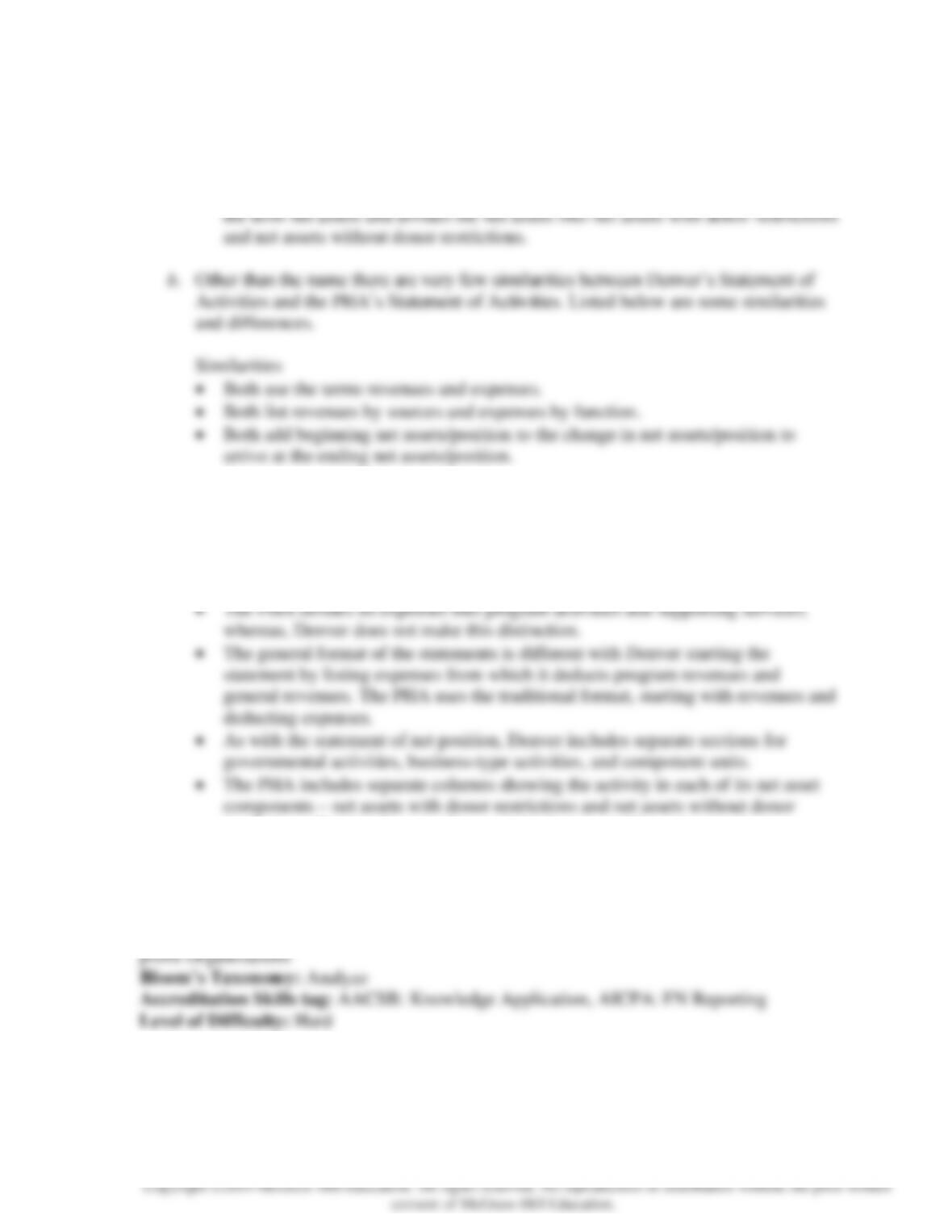
a. The following represent some of the similarities and differences in Denver’s
Statement of Net Position and the Promote Health Association’s (PHA) Balance
Chapter 01 – Introduction to Accounting and Financial Reporting for Government and Not-for-Profit Entities
1-11
Ch. 1, Solutions, Exercise 1-18 (Cont’d)
• Denver uses net position rather than net assets and divides the net position into net
investment in capital assets, restricted, and unrestricted. However, the PHA uses
Dissimilarities
• Denver divides its revenues into program revenues (charges for services,
operating grants and contributions, and capital grants and contributions) and
general revenues, whereas the PHA divides its revenues into contributions and
grants, and fees from exchange transactions.
restrictions. Denver does not show activity by net position component.
General Problem Information: Financial Statement Differences
Learning Objective: 1-4
Learning Objective: 1-5
Topic: Financial Reporting of State and Local Governments; Financial Reporting of Not-for-
2. b. 7. b.
4. d. 9. c.
5. c. 10. d.
General Problem Information: Various
Learning Objective: 1-1
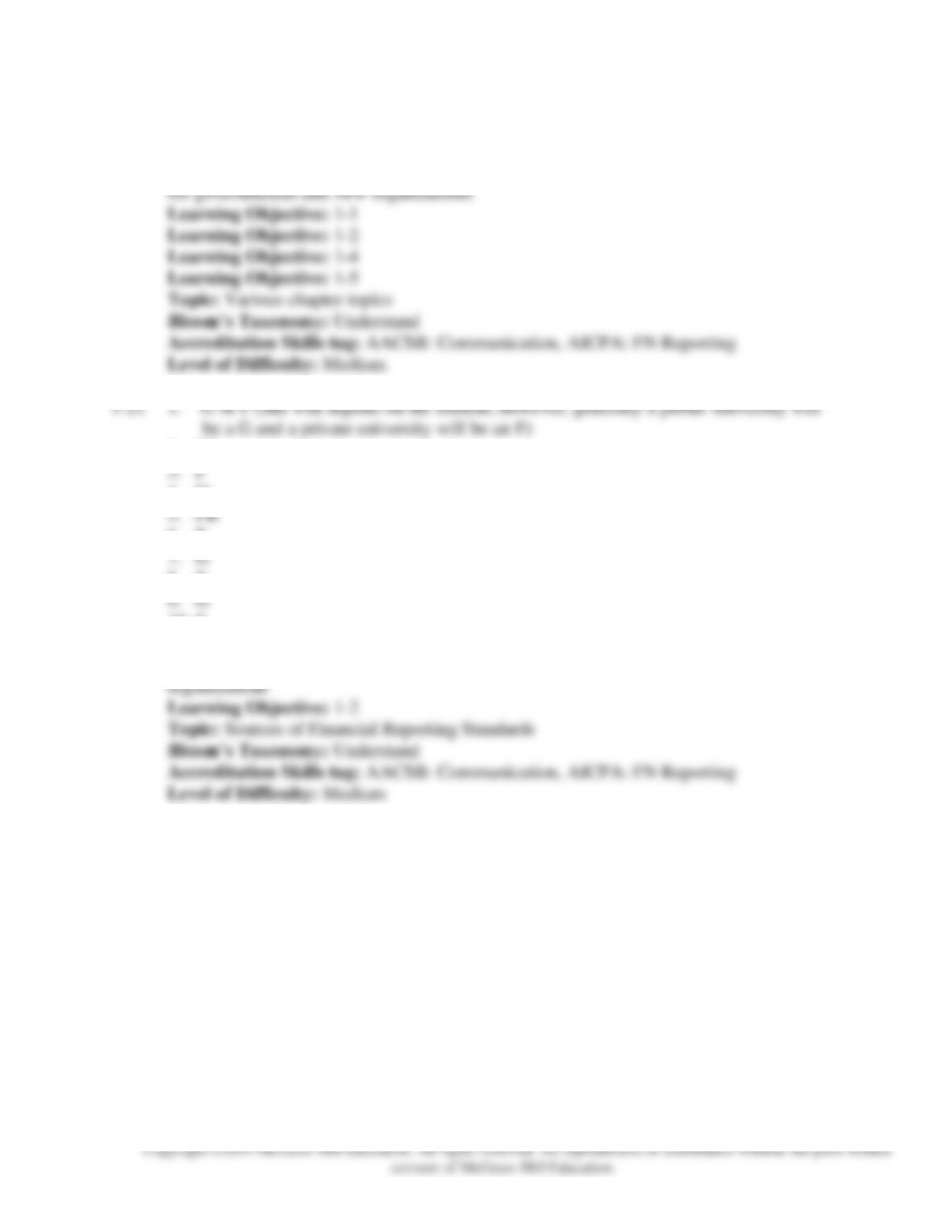
1-20. This is an exercise that may generate considerable discussion in class, as some of the
answers will be absolutely true and others partially true, depending on individual
judgments and interpretations. Keeping this in mind, you may wish to provide some
leeway in grading this exercise, depending on how literally you interpret the particular
item’s relationship to type of organization.
Characteristic, Concept, or
Financial Reporting
Requirement
State and
Local
Governments
Federal
Government
Nongovernmental
Not-for-profit
Organizations
Accountability is the foundation
of financial reporting
Y
Y
N
Management’s discussion and
analysis (MD&A)
Y
Y
N
Performance & accountability
report
N
Y
N
Stewardship is identified as a
financial statement purpose
N
Y
Y
A concern with budgetary
compliance
Y
Y
N
Absence of defined ownership
interests
Y
Y
Y
Standards set by GASB
Y
N
N
Standards set by FASB
N
N
Y
Standards set by FASAB
N
Y
N
Standards focused on just the
external users of financial
information
Y
N
Y
Chapter 01 – Introduction to Accounting and Financial Reporting for Government and Not-for-Profit Entities
1-13
Ch. 1, Solutions, Exercise 1-20 (Cont’d)
General Problem Information: Concepts and reporting characteristics or requirements
2. FB
4. G
6. F
8. F
10. F
General Problem Information: Sources of financial reporting standards for various