111 – IMK
CHAPTER 7
FINANCIAL STATEMENTS
In Chapters 1 through 6, your students used the sample company
Bellwether Garden Supply. They learned how Sage 50’s graphical user
interface works and how to navigate the software. In Chapters 1 through
6, they also recorded and posted various types of transactions. Beginning
with Chapter 9 (Part 2 of the textbook), students will learn how to set up
companies from scratch as well as use the features learned in Chapters 1-
7 in more detail.
In Chapter 7, your students learn about financial statements. Once entries
have been recorded and posted, Sage 50 automatically calculates
financial statements. Business managers and owners have the primary
responsibility for the organization. They depend on accounting information
in the form of financial statements to understand what is happening.
All of the financial statements printed reflect the current month and year-
to-date amounts.
Your students print six financial statements in Chapter 7:
1. Balance Sheet.
2. Gross Profit by Departments.
Comment: Sage 50 includes the Statement of Changes in Financial
Position even though current accounting standards require that a
112 – IMK Chapter 7
Balance Sheet
A balance sheet is a list of assets, liabilities, and capital of a business
entity as of a specific date, such as the last day of an accounting period or
the last day of the year.
Each financial statement may be modified to fit the company’s needs.
Sage 50 includes a Design icon for that purpose. Later in this chapter,
students will learn about Sage’s Help feature. In Chapter 16, Customizing
Forms, students learn more about modifying standard forms.
Gross Profit by Departments
A departmentalized accounting system provides information that
management can use to evaluate the profitability or cost effectiveness of a
department’s activities. The Gross Profit by Departments financial
statement is a custom report designed for Bellwether that details each
department’s year–to-date gross profit as of the current month. The report
shown on textbook page 215 lists the departmental gross profit totals for
the following departments: Aviary, Books, and Equipment.
Some of Bellwether’s chart of account numbers have a dash, then an AV
or a BK. For example, Account No. 40000-AV, Sales – Aviary; and
Account No. 40000-BK, Sales – Books show this departmental
designation.
Income Statement
The income statement is a summary of the revenues and expenses a
company accrues over a period of time, such as an accounting period or a
year. Only revenue and expense accounts are displayed on the income
statement. Net income is computed by subtracting total expenses from
total revenues. Net income results when revenues exceed expenses. An
excess of expenses over revenues results in a net loss. Bellwether’s net
Financial Statements 113 – IMK
loss for the current month, March 1 through March 31, 2019, is $2,523.21.
A net loss is indicated on the income statement with parenthesis
($2,523.21). Bellwether’s year–to-date net income is $25,579.22. On
textbook page 218, the Income Statement is shown.
Statement of Cash Flow
The cash flow from operations is roughly the same as income from
operations plus depreciation, depletion, and adjusted for any other
operating transactions that had no effect on cash during the period. The
statement of cash flow also reports cash transactions associated with the
purchase or sale of fixed assets (Investing Activities) and cash paid to or
received from creditors and owners (Financing Activities).
The statement of cash flow provides the answers to three questions:
Statement of Retained Earnings
The Statement of Retained Earnings shows beginning and ending
retained earnings amounts, adjustments made to retained earnings within
the report period, and the detail for all Equity-gets closed accounts. The
retained earnings balance is the cumulative, lifetime earnings of the
company less its cumulative losses and dividends.
Statement of Changes in Financial Position
The statement of changes in financial position describes changes in a
company’s financial position that may not be obvious from other financial
114 – IMK Chapter 7
statements. The statement of changes in financial position shows the
change in working capital, assets, and liabilities for a given period of time.
Sage 50 includes the Statement of Changes in Financial Position even
though current accounting standards require that a statement of cash flow
is needed as part of a full set of financial statements in place of a
statement of changes in financial position. (This information is also shown
on textbook page 221, Read Me box.)
Interrelationship of Financial Statements
The financial statements work together. The net income (or net loss) from
the income statement is on the balance sheet’s capital section. The net
income or net loss is used to update the balance sheet’s capital amount:
Capital Beginning of the Year – Net Loss (or + Net Income) = Total Capital.
On the statement of retained earnings, the Ending Retained Earnings
balance is $214,616.82. On the balance sheet, if students add the net
income $25,579.22 to the balance sheet’s retained earnings amount,
$189,037.60, the result is $214,616.82. This amount, $214,616.82, is the
same as the Ending Retained Earnings balance on the Statement of
Retained Earnings.
The statement of changes in financial position uses information from the
income statement and balance sheet. The net income is shown from the
income statement. Current assets and current liabilities are derived from
the balance sheet.
Financial Statements 115 – IMK
and statement of changes in financial position.
LEARNING OBJECTIVES
1. Restore data from Exercise 6-2. The backup was made on page 202.
3. Print the financial statements.
4. Use drill down to go from the income statement to the general ledger,
then to the original entry window.
5. Complete the Bellwether Garden Supply project online at
www.mhhe.com/yacht2019 > Student Edition link.
6. Make an optional backup of Chapter 7, save one Excel file, and save
six PDF files. (The Exercise 6-2.ptb backup includes the data needed
Exercises 7-1 and 7-2 have questions that relate to the financial
statements. There is no need to back up data for either Exercise 7-1 or 7-
2.
SAGE 50 TIPS, CHAPTER 7
➢ Since the Exercise 6-2 backup (textbook p. 202) includes all the data
116 – IMK Chapter 7
LECTURE OUTLINE FOR CHAPTER 7
A. Learning Objectives, page 205
B. Financial Statements, pages 205-206
1. Balance Sheet, page 206
3. Income Statement, page 207
5. Statement of Retained Earnings, page 208
7. Interrelationship of Financial Statements, pages 208-209
1. Departmental masking, pages 215-217
2. Drill down from the income statement to original entry, pages 219–
223
F. Backing Up Chapter 7 Data, page 223
Financial Statements 117 – IMK
Complete the following end–of-chapter activities online at
www.mhhe.com/yacht2019 > select the Student Edition > Chapter 7.
2. Going to the Net exercise: Access the article How to Value Stocks:
How to Read a Balance Sheet.
4. Assessment Rubric: Review journals, navigation centers, modules,
and task windows.
6. Bellwether Garden Supply Project
The OLC also includes links to the Appendixes:
• Appendix A: Troubleshooting (textbook and OLC)
• Appendix C: Review of Accounting Principles (OLC Student
Edition)
• Appendix D: Glossary of Terms (OLC Student Edition)
I. Exercises 7-1 and 7-2, page 227
J. Bellwether Garden Supply Project, page 227
K. Chapter 7 Index, page 228
SOLUTION TO EXERCISE 7-1:
118 – IMK Chapter 7
SOLUTION TO EXERCISE 7-2:
ANSWERS TO GOING TO THE NET
Access the article How to Value Stocks: How to Read a Balance Sheet.
The website is http://www.fool.com/investing/beginning/how-to-value-
stocks-how–to-read-a-balance-sheet.aspx.
1. What are liquid assets?
2. What are the liquid assets called on a balance sheet?
3. In the More on reading a balance sheet section, link to two other
sites. Define each link; include the website address(es) in your answer.
Financial Statements 119 – IMK
ANSWERS TO TRUE/MAKE TRUE QUESTIONS, QA TEMPLATES
1. Sage 50 automatically calculates financial statements once journal
entries have been journalized and posted.
2. In Chapter 7, you printed three financial statements.
In Chapter 7, six financial statements are printed:
a. Balance Sheet.
b. Gross Profit by Departments.
f. Statement of Changes in Financial Position
3. The statement of cash flow is roughly the same thing as the balance
sheet.
4. The balance sheet lists the revenues and expenses of the business.
5. The income statement is a summary of the revenue and expenses of
a company for a period of time, such as an accounting period or a
year.
6. The financial statements printed by Sage 50 reflect month-to-date
amounts only.
120 – IMK Chapter 7
McGraw-Hill Education, Computer Accounting with Sage 50 2019, 21e
The financial statements printed reflect the current month and year-
to-date amounts.
7. The financial statements are interrelated.
8. The term standard refers to financial statements that are designed by
the company.
9. Bellwether Garden Supply showed a net loss for the current month
on March 31, 2019.
10. The statement of changes in financial position derives its information
from the income statement.
ANALYSIS QUESTIONS
Explain the interrelationship of the financial statements. Specifically,
answer these questions.
ANSWER:
The financial statements work together. No single financial statement tells
the entire story. The income statement indicates how much revenue a
1. How are the income statement and balance sheet related to each
other?
2. Using Bellwether Garden Supply as an example, what cash accounts
does the statement of cash flow report?
The total of all the cash accounts on the Balance Sheet (Petty Cash,
3. Does the statement of cash flow use information from both the balance
sheet and income statement?
ASSESSMENT RUBRIC
Report
Date
Menu
Window
Balance Sheet
March 31, 2019
Reports & Forms >
Financial
Statements
Or, Find a Report
area of Business
Status Navigation
Center
<Standard>
Balance Sheet
Income Statement
For the three
months ended
March 31, 2019
Reports & Forms >
Financial
Statements
Or, Find a Report
area of Business
Navigation Center
<Standard> Income
Stmnt
122 – IMK Chapter 7
McGraw-Hill Education, Computer Accounting with Sage 50 2019, 21e
SOLUTION FILES
The solution files, in .ptb, .pdf, and .xlsx formats, are included on the
Online Learning Center at www.mhhe.com/yacht2019 > Instructor Edition
link. For access to the password-protected Instruction Edition website,
contact your McGraw-Hill sales representative at
https://shop.mheducation.com/store/paris/user/findltr.html.
The chart below shows the size of the Chapter 7 solution files (Sage 50
backups, Excel reports and Adobe PDF exercise files).
Chapter
Sage 50 Backup (.ptb)
Excel (.xlsx) and Adobe (.pdf)
Kilobytes1
Page
Nos.
7
Chapter 7.ptb (Optional)*
3,635 KB
223
Chapter 7_Financial Statements.xlsx
36 KB
223–225
Chapter 7_Balance Sheet.pdf
13 KB
226
Chapter 7_Income Statement.pdf
9 KB
226
Chapter 7_Gross Profit by
Departments.pdf
4 KB
226
Chapter 7_Statement of Cash Flow.pdf
13 KB
226
Chapter 7_Statement of Retained
Earnings.pdf
4 KB
226
Chapter 7_Statement of Changes in
Financial Position.pdf
13 KB
226
*Exercise 6-2.ptb file includes data for Chapter 7.
ANSWER TO BELLWETHER GARDEN SUPPLY PROJECT
1Backup sizes may differ.
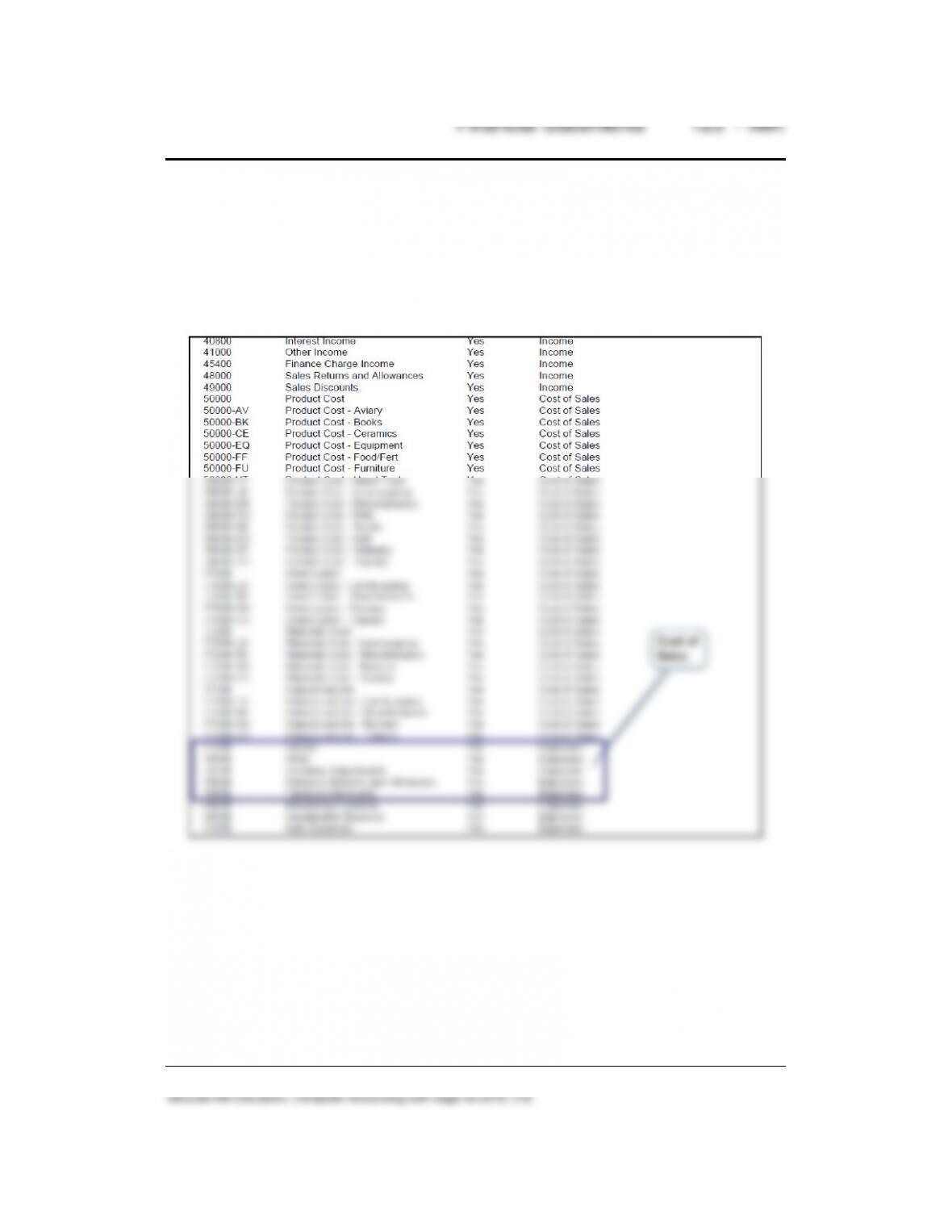
1. Examine Bellwether Garden Supply’s chart of accounts. Are all of
the account types in conformance with usual accounting
procedures? If not, list the accounts that could be classified
differently.
ANSWER:
2. What is the balance in Account No. 89500, Purchase Disc-Expense
Items? Is it a debit or credit balance? Why? (Hint: Display the
General Ledger report; select Options. In the Time Frame period,
select All. Select the filter GL Account ID from 89500 to 89500.)
Explain.