CHAPTER 14
INVENTORY & SERVICES
Merchandise inventory includes all goods owned by the business and held
for sale. The account used for Shannon’s Service Merchandise inventory
account is Account No. 12000, Merchandise Inventory.
Sage 50 uses a perpetual inventory system. In a perpetual inventory
system a merchandising business continuously updates inventory each
time an item is purchased or sold.
Inventory calculations include FIFO, LIFO, and average cost methods.
The FIFO (first in, first out) method assumes that the items in the
beginning inventory are sold first. The LIFO (last in, first out) method
assumes that the goods received last are sold first. The average cost
method is the default used for inventory items sold. The formula used is:
Average Cost x Quantity Sold = Cost of Sales.
Sage 50 tracks the inventory items that are purchased and sold. After you
post, the cost and quantity of each inventory item is automatically
updated. Generally, all of your inventory should use the same costing
method.
Tracking inventory is a three-step process:
Sage 50 does the rest automatically: adjusts inventory levels each time
you post a purchase or sale of an inventory item, tracks the cost of each
item, and makes a Cost of Goods Sold Journal entry at the end of the
accounting period.
286 – IMK Chapter 14
COST METHODS
Sage 50 includes three types of cost methods for inventory: average cost,
LIFO, and FIFO. Once you select the costing method for an inventory
item, you cannot change it if transactions have been posted. Therefore, if
you want to change the cost method for an item with posted transactions,
you must enter the item again.
Average Cost
When students set up inventory items for Shannon’s Service
Merchandise, they selected the average cost method. In Chapter 12,
Shannon’s Service Merchandise purchased four pairs of curtains from
Ronny Becker Fabrics at $30 each. What happens when these curtains
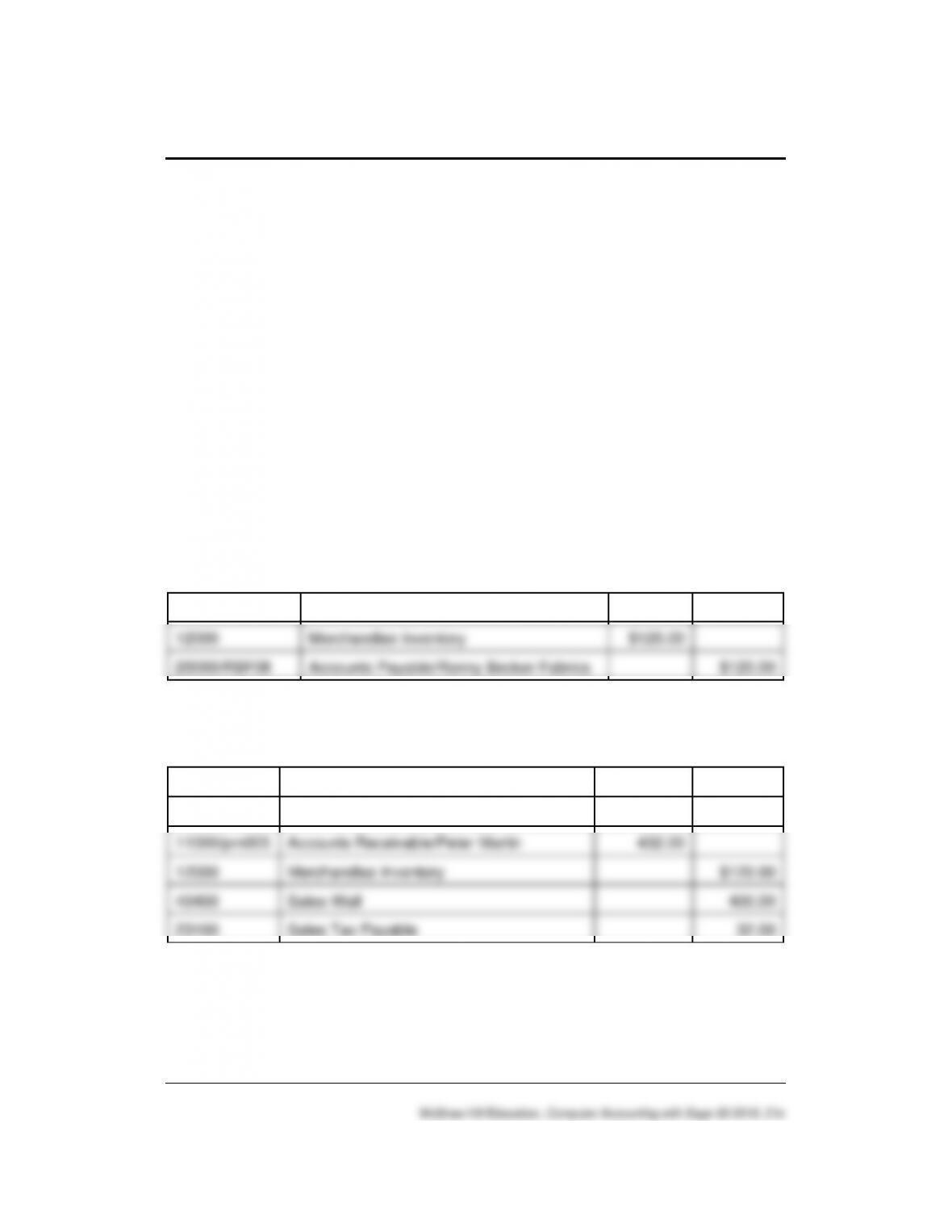
are sold? The journal entries would look like this:
Purchased four pairs of curtains from Ronny Becker Fabrics at $30 each.
(This is Invoice 210, textbook page 437.)
Account ID
Account Description, Inv. No. 210
Debit
Credit
12000
Merchandise Inventory
$120.00
20000/RBF08
Accounts Payable/Ronny Becker Fabrics
$120.00
Sold four pairs of curtains to Peter Martin at $100 each. (This is Invoice
103, textbook page 488.)
Account ID
Account Description, Inv. No. 103
Debit
Credit
50500
Cost of Sales-Wall
$120.00
11000/pm005
Accounts Receivable/Peter Martin
432.00
12000
Merchandise Inventory
$120.00
40400
Sales-Wall
400.00
23100
Sales Tax Payable
32.00
You can see from these journal entries that the Merchandise Inventory
account is constantly updated with each purchase and sale. After these
transactions, the balance in Merchandise Inventory looks like the
T-account shown on the next page.

Inventory & Services 287 – IMK
Merchandise Inventory, Account No. 12000
Purchased inventory $120
Sold Inventory $120
Balance 0
LIFO (Last In, First Out)
The LIFO (last in, first out) method of inventory pricing assumes that the
last goods received are sold first. LIFO assumes that cost is based on
replacement and that the last price paid for merchandise is more accurate.
Accountants recommend that you select LIFO when you desire to charge
the most recent inventory costs against revenue. LIFO yields the lowest
amount of net income in periods of rising costs because the cost of the
most recently acquired inventory more closely approximates the
replacement cost.
FIFO (First In, First Out)
The FIFO (first in, first out) method of inventory pricing assumes that the
items in the beginning inventory are sold first. FIFO costs your sales and
values your inventory as if the items you sell are the ones that you have
had in stock for the longest time.
Accountants recommend that you select FIFO when you desire to charge
costs against revenue in the order in which costs occur. FIFO yields a
higher amount of profit during periods of rising costs. This happens
because merchandise was acquired prior to the increase in cost.
TYPES OF INVENTORY ITEMS
There are nine types of inventory items:
➢ Stock item: This is the default in the Item Class list. It is the traditional
inventory item tracking descriptions, unit prices, stock quantities, and
Cost of Sales. For stock items, you should complete the entire window.
Once an item has been designated as a stock item, the type cannot be
changed.

288 – IMK Chapter 14
➢ Master Stock Item: Sage 50 uses this item class as a special item that
does not represent inventory stocked but contains information (item
attributes) shared with a number of substock items.
➢ Non-stock item: Sage 50 tracks the description and a unit price for
sales. You can also track default accounts. You might use this type for
service items such as hours where the unit price is set.
➢ Description only: Sage 50 keeps track of the description of an
Inventory Item. This saves time when entering purchases and sales
because you don’t have to retype the description. You might use this
type for service items where the price fluctuates.
➢ Service: This is for services you can apply to your salary and wages
account.
➢ Labor: This is for labor you can apply to your salary and wages
account. You cannot purchase labor items but you can sell them.
➢ Assembly: You can specify items as assembly items and create a bill
of materials for a unit made up of component stock or subassembly
items.
➢ Activity item: To indicate how time is spent when performing services
for a customer, for a job, or for internal administrative work. Activity
items are used with the Time & Billing feature.
➢ Charge item: Expenses recorded by an employee or vendor when
company resources are used for a customer or job.
LEARNING OBJECTIVES
1. Restore data from Chapter 13. (This backup was made on textbook
2. Enter inventory maintenance and default information.
4. Enter inventory adjustments.
Inventory & Services 289 – IMK
McGraw-Hill Education, Computer Accounting with Sage 50 2019, 21e
5. Compare Chapters 14’s Financial Manager’s Business Summary and
Key Balances to Chapter 13’s Financial Manager.
6. Make three backups, save two Excel files, and save five PDF files.
SAGE 50 TIPS, CHAPTER 14
➢ Chapters 12 and 13 must be completed before starting Chapter 14.
➢ In Chapters 12 through 14, Sage 50 automatically uses the average
inventory method.
LECTURE OUTLINE FOR CHAPTER 14
A. Learning Objectives, page 517
B. Cost Methods, page 518
1. Average Cost, pages 518-519
3. FIFO (First In, First Out), page 520
C. Types of Inventory Items, pages 520-521
D. Getting Started, page 521
E. Inventory Defaults, pages 522-523
F. Entering Inventory Item Maintenance Information, pages 523–526
G. Backing Up Your Data, page 526
H. Inventory Adjustments, pages 526-528
I. Additional Transactions, pages 528-530
J. Printing Reports, pages 530-538
K. Financial Manager, page 539
L. Backing Up Chapter 14 Data, page 539
290 – IMK Chapter 14
M. Export Reports to Excel, pages 540
N. Online Learning Center, pages 540-541
Complete end-of-chapter activities at www.mhhe.com/yacht2019 > select
Student Edition > Chapter 14.
1. Quizzes: Multiple Choice and True False questions. Interactive online
tests that are graded and can be emailed to your instructor.
2. More Resources:
a. QA Templates: Answer 10 short-answer questions and one
Analysis Question.
b. Narrated PowerPoints: Listen to the narrated PowerPoints.
c. Going to the Net Exercises: Access the BizMov Small Business
Guides website.
d. Assessment Rubric: Complete the rubric to review Sage 50’s
journals, navigation centers, modules, task windows, and reports.
The OLC also includes links to the Appendixes:
• Appendix A: Troubleshooting (textbook and OLC)
O. Exercise 14-1, pages 541-542
P. Exercise 14-2, pages 542-543
Q. Chapter 14 Index, page 544
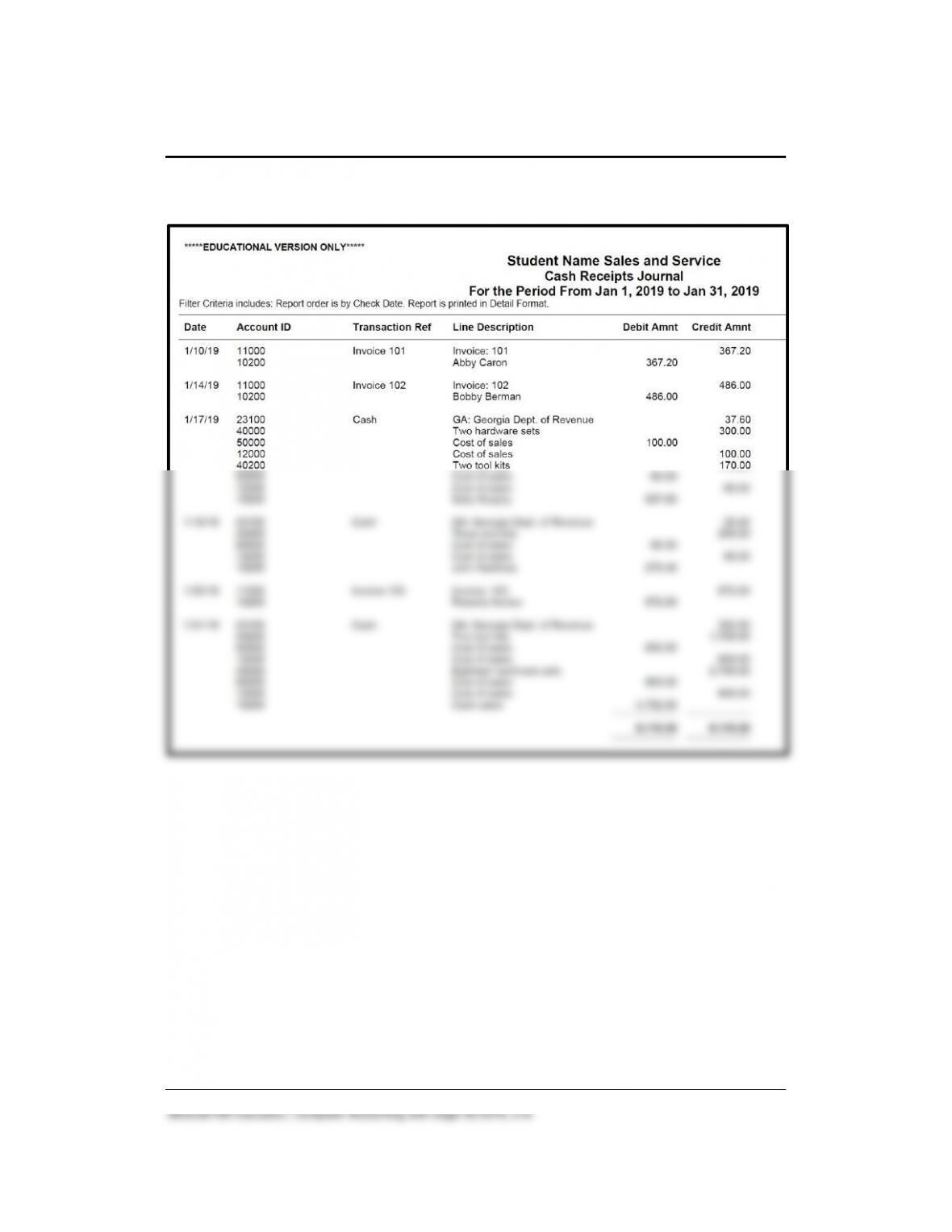
Inventory & Services 291 – IMK
Solution to Exercise 14-2 (1)
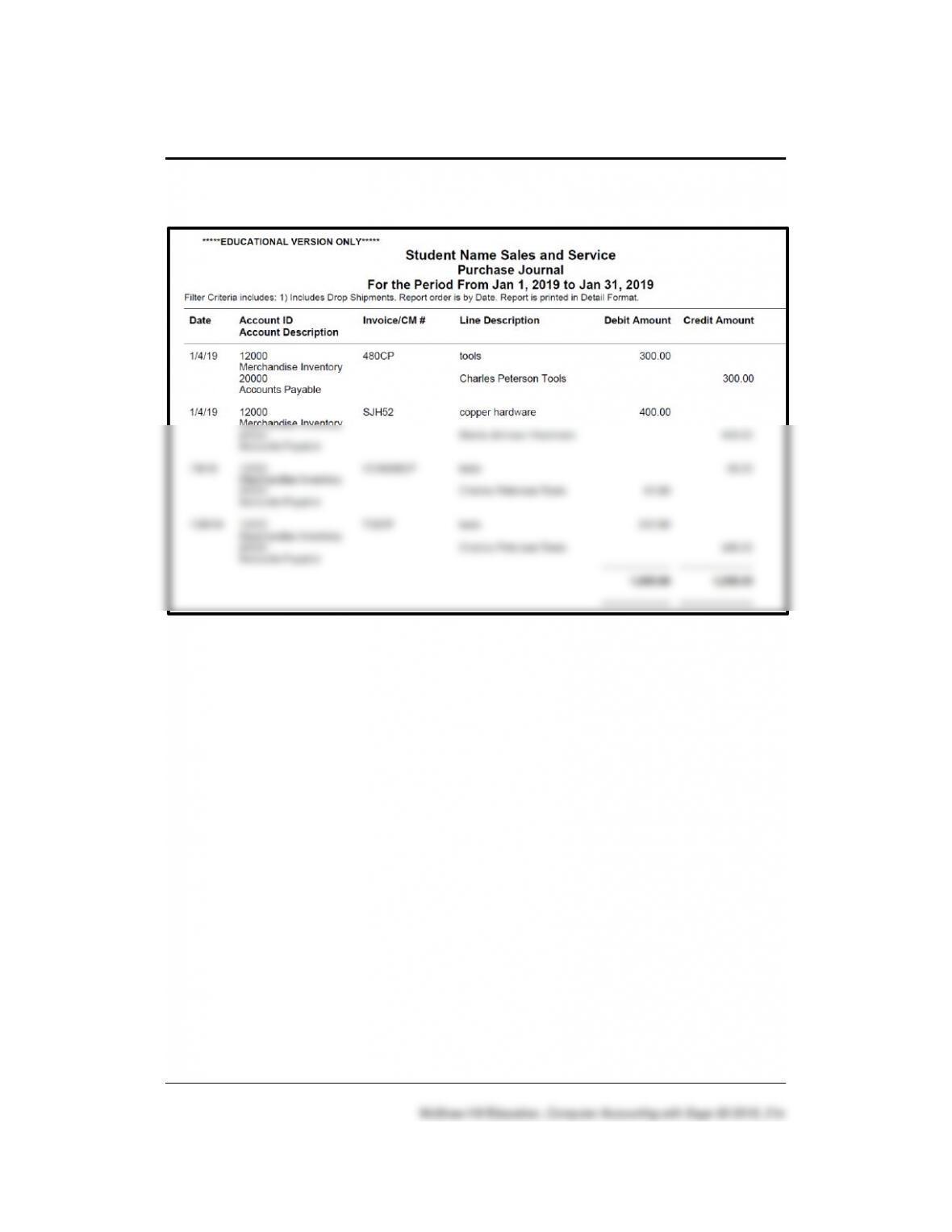
292 – IMK Chapter 14
Solution to Exercise 14-2 (2)
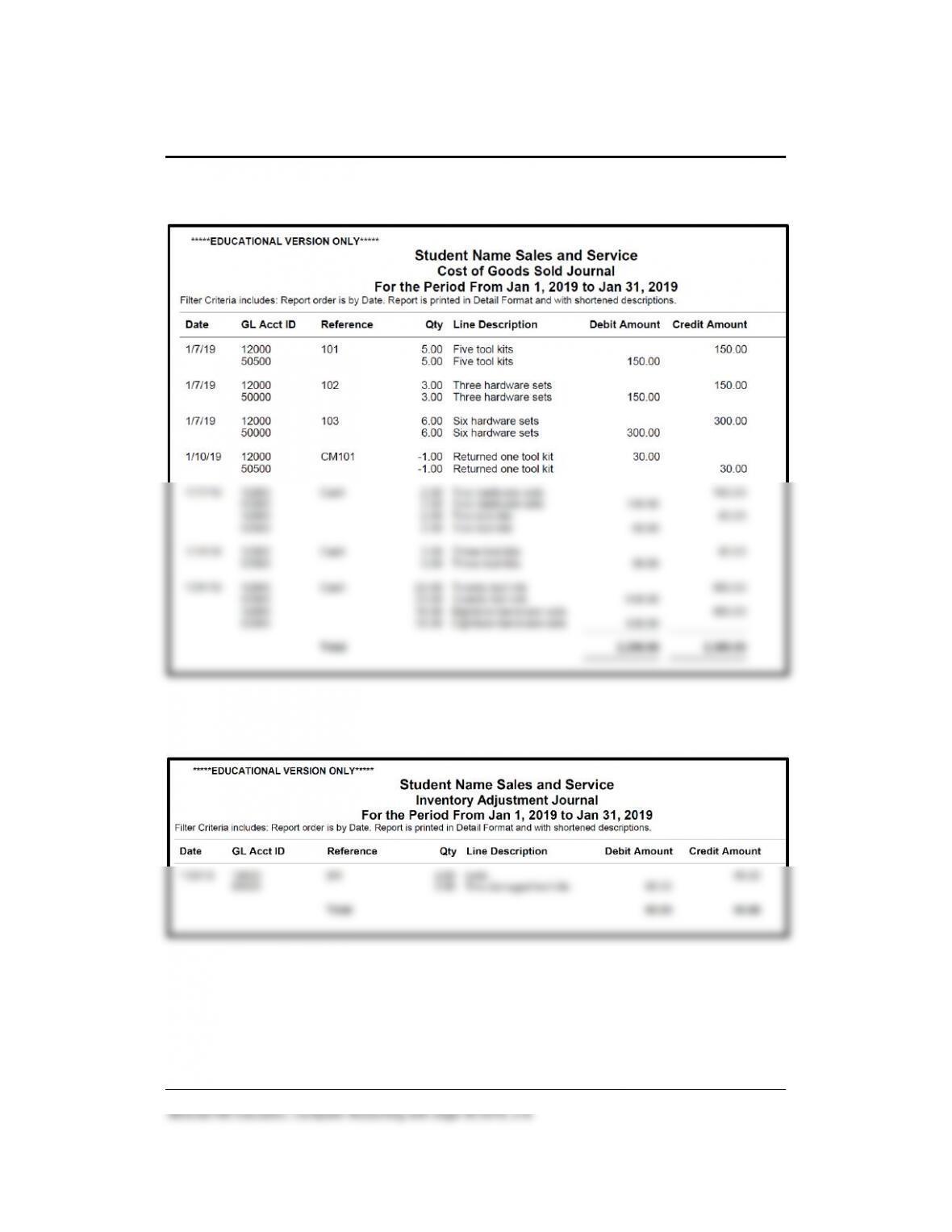
Inventory & Services 293 – IMK
Solution to Exercise 14-2 (3)
Solution to Exercise 14-2 (4)
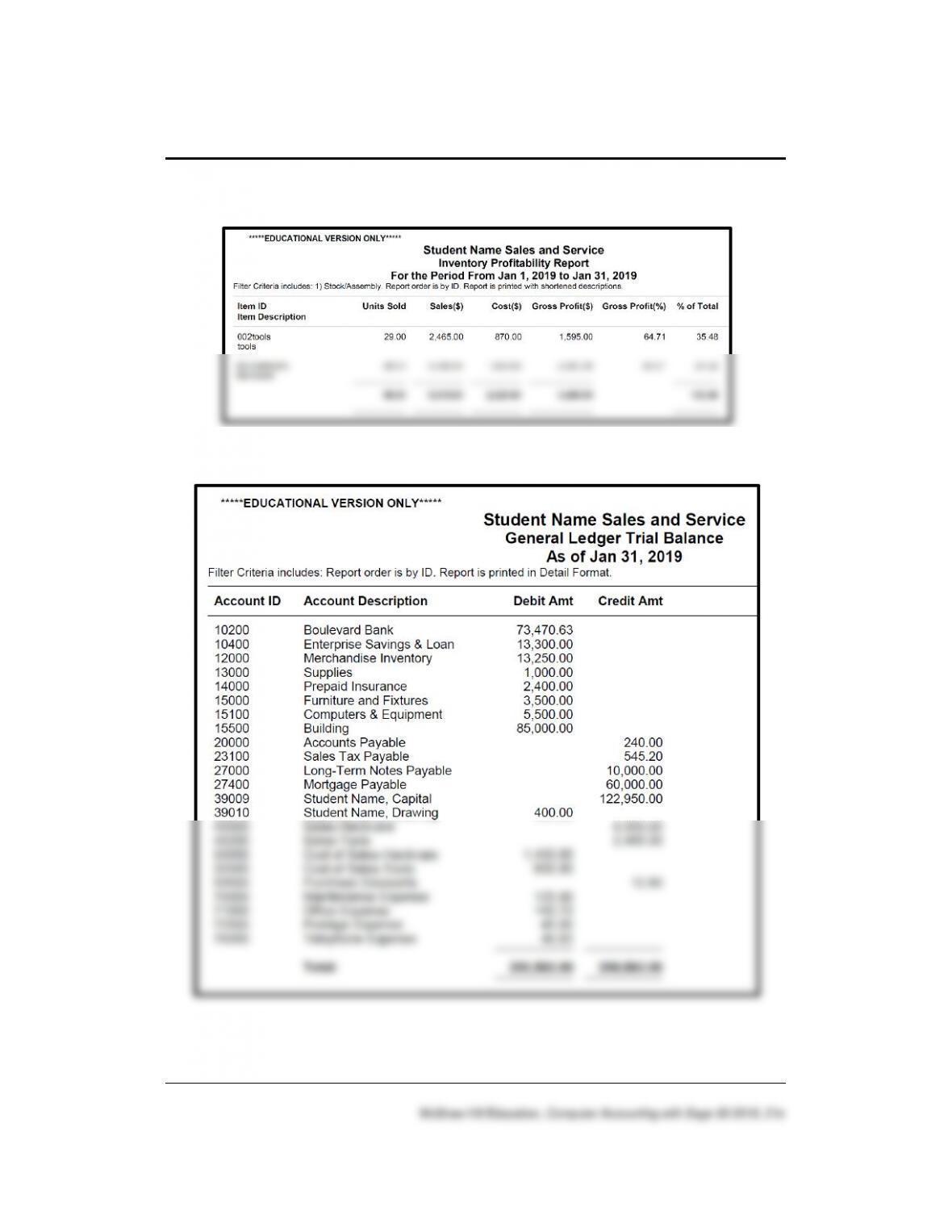
294 – IMK Chapter 14
Solution to Exercise 14-2 (5)
Solution to Exercise 14-2 (6)
Inventory & Services 295 – IMK
ANSWERS TO GOING TO THE NET
Access BizMove.com. The website is
http://www.bizmove.com/finance/m3d3.htm. Scroll down the window to
Merchandise Inventories: Perpetual Inventory. (Hint: To find areas on the
website, use <Ctrl+F>.) Answer these questions about perpetual
inventory.
1. What is perpetual inventory at retail?
Perpetual inventory involves keeping records at both retail and cost.
Purchases are added to the beginning inventory at retail, (with each
2. When is a physical count of inventory necessary?
ANSWERS TO SHORT-ANSWER QUESTIONS, QA TEMPLATES:
Answers will vary.
1. Identify and explain the three-step process for tracking inventory.
Tracking inventory is a three-step process:
a. Enter item information, including Sales account, Merchandise
Inventory account, and Cost of Sales account.
2. Explain how Sage 50 uses a perpetual inventory system.
3. Define the term merchandise inventory.
4. Explain the terms Average Cost, LIFO and FIFO.
The average cost method is the default that is used for inventory items
sold. The formula used is: Average Cost x Quantity Sold = Cost of
5. What do Invoice Nos. 106, 107, and 108 show? Identify to whom the
merchandise was sold, what was purchased, and the amount of the
invoice.
6. What are the journal entries for the following transactions when a
perpetual inventory system is used: Purchased four pairs of curtains
from Ronny Becker Fabrics at $30 each? Sold four pair of curtains to
Peter Martin for $400?
Purchased four pairs of curtains from Ronny Becker Fabrics at $30
each:
Account ID
Account Description
Debit
Credit
12000
Merchandise Inventory
$120.00
20000/RBF08
Accounts Payable/Ronny Becker Fabrics
$120.00
Inventory & Services 297 – IMK
Sold four pairs of curtains to Peter Martin for $100 each:
Account ID
Account Description
Debit
Credit
50500
Cost of Sales-Wall
$120.00
11000/pm005
Accounts Receivable/Peter Martin
432.00
12000
Merchandise Inventory
120.00
40400
Sales-Wall
400.00
23100
Sales Tax Payable
32.00
7. What kind of invoice is No. 109? Identify this transaction and the
amount.
ANALYSIS QUESTION
Which one of Shannon’s Service Merchandise inventory items shows the
highest gross profit percentage? Why?
ANSWER:
The Inventory Profitability Report shows that wall coverings show the
highest gross profit percentage at 70%. The reason is that wall coverings
298 – IMK Chapter 14
ASSESSMENT RUBRIC
Date
Transaction
Navigation
Center/Module
Task
Window
Journal
Dr./Cr.
1/30
Two tool kits purchased
from Charles Peterson
Tools on 1/28 were
damaged by you, the
owner.
Inventory &
Services >
Inventory
Adjustments
Inventory
Inventory
Adjustments
Inventory
Adjustment
Journal
Dr. 50500, Cost
of Sales-Tools,
$60
Cr. 12000,
Merchandise
Inventory, $60
1/31
Cash sales in the
amount of $4,752,
($4,400 plus 352 sales
taxes) were deposited
at Boulevard Bank: 20
tool kits, $1,700; 18
hardware sets $2,700.
Customers &
Sales > Receive
Money > Receive
Money From
Customer
Accounts
Receivable
Receive
Money
Cash Receipts
Journal
Dr. 50500, Cost
of Sales-Tools,
$600
Dr. 50000, Cost
of Sales-
Hardware, $900
Dr. 10200,
Boulevard Bank,
$4,752
Cr. 23100, Sales
Cr. 12000,
Inventory, $900
Inventory & Services 299 – IMK
SOLUTION FILES
The solution files, in .ptb, .pdf, and .xlsx formats, are included on the
Online Learning Center, www.mhhe.com/yacht2019 > Instructor Edition >
Excel Reports and PDF Reports. For access to the password-protected
Instruction Edition website, contact your McGraw-Hill sales representative
at https://shop.mheducation.com/store/paris/user/findltr.html.
The chart below shows the size of the Chapter 14 solution files (Sage 50
backups, Excel Reports and PDF Reports). Additional Chapter 14 PDFs
are included on the OLCs Instructor Edition > PDF Reports link.
Chapter
Backup (.ptb extension)
Excel (.xlsx) and Adobe (.pdf)
Kilobytes
Page Nos.
14
Chapter 14 Begin.ptb
1,086 KB
526
Chapter 14.ptb
1,091 KB
539
Chapter 14_ CL_ VL_CGSJ_IAJ_IPR_GLTB.xlsx
31 KB
540
Exercise 14-1.ptb
1,012 KB
542
Exercise 14-2_Cash Receipts Journal.pdf
13 KB
542
Exercise 14-2_Purchase Journal.pdf
12 KB
542
Exercise 14-2_Cost of Goods Sold Journal.pdf
13 KB
542
Exercise 14-2_Inventory Adjustment Journal.pdf
11 KB
542
Exercise 14-2_Inventory Profitability Report.pdf
11 KB
542
Exercise 14-2_General Ledger Trial Balance.pdf
13 KB
542
Exercise 14-2_CRJ_PJ_CGSJ_IAJ_IPR_GLTB.xlsx
30 KB
543