Structure of the Case
The case is written from the perspective of McDonald’s CEO Steve Easterbrook. Dated approxi-
mately six months after Easterbrook assumed office in March 2015, it highlights the company’s recent
and dramatic decline in performance amidst increasing competition.
McDonald’s was started by the McDonald brothers in 1940 in San Bernardino, California. By limit-
ing the menu to burgers, fries, and drinks, Dick and Mac McDonald were able to emphasize quality
and streamline operations, leading to rapid growth. In partnership with Ray Kroc, they founded the
McDonald’s Corporation in 1955 with the vision of establishing McDonald’s franchises throughout
the United States. Kroc bought out the brothers’ shares in 1961 and oversaw a period of rapid expan-
sion throughout the 1960s and 1970s. The company had its first public offering in 1965, debuting at
$22.50 per share. It opened its first international location (Canada) in 1967. Around the same time, Kroc
varying success with further efforts to adapt its menu internationally and domestically. When Jack
Greenberg became CEO in 1998, he quickly took corrective action, announcing a geographic reorgani-
zation, a new food preparation system, and a series of job cuts, all while scrapping plans for numerous
store openings. Instead, he diversified the company’s portfolio by buying different restaurant chains
(e.g., Chipotle). These purchases were later divested when McDonald’s strategy shifted yet again in the
were redesigned to promote a more modern experience for the consumer. Don Thompson served as
COO under Skinner, leading the successful McCafé campaign and cementing his path as Skinner’s
eventual successor. Unfortunately, McDonald’s struggled with weakening sales under Thompson’s
reign despite his efforts to optimize the menu, improve the customer experience, and make McDonald’s
McDonald’s Corporation
TEACHING NOTE
Professors Frank T. Rothaermel and Marne L. Arthaud-Day prepared this case from public sources. The authors are indebted to Research Associate
MHE-FTR-038
1259420477
REV: SEPTEMBER 14, 2015
Teaching Note —McDonald’s Corporation
more accessible to a broader market base. Steve Easterbrook now faces the task of implementing the
strategic turnaround that Thompson proved unable to achieve.
The next section of the case provides an overview of the external environment McDonald’s faces.
The economy continues to recover from the 2008–2009 recession, such that spending on dining out
exceeded grocery sales for the first time ever in April 2015. However, while millennials are eating out
more than ever, they are seeking increased quality and value and do not seem to think they can find
it has surpassed McDonald’s in the number of total restaurants. Meanwhile, the boundaries between
quick service and other restaurant segments have become increasingly blurred. Due to their successful
combination of high quality and reasonable prices, restaurants in the fast-casual segment (e.g., Panera
Bread, Chipotle, etc.) are experiencing steady growth. Places like Five Guys, In-N-Out Burger, and
Smashburger provide higher-quality and higher-priced burgers, attracting the premium end of the
ally bring the children). However, increasing concerns over childhood obesity have started to erode
McDonald’s appeal. Young, single professionals who earn above-average incomes are considered
“heavy users” who frequent a given chain once or twice per week, yet McDonald’s is not among their
top ten preferred eating establishments. A lack of transparency and a series of food scandals (think
“pink slime”) have also negatively affected the company’s image.
desire to eat out). Compounding these issues is McDonald’s international notoriety, making it a prime
target for labor activists who want the company to increase wages even further and who have filed suit
to make headquarters liable for the labor practices of its franchises. In brief, the company is in the midst
of its most serious identity crisis to date, and desperately needs to define a clear vision of what it wants
to be and devise a plan for how to get there.

Teaching Note —McDonald’s Corporation
Suggested Questions
AnAlysis: Focus on ExtErnAl And/or intErnAl EnvironmEnts
1. Which trends in McDonald’s external environment are likely to have the greatest impact on the
company’s ability to sustain a competitive advantage?
2. How is McDonald’s positioned vis-à-vis its major competitors?
FormulAtion: Focus on BusinEss, corporAtE,
And/or GloBAl strAtEGy
3. Which business-level strategy does McDonald’s employ? Is it effective? How so?
4. Which international strategy does McDonald’s employ? Is it effective? How so?
implEmEntAtion: Focus on rEcommEndAtions
And How to ExEcutE tHEm
5. How should Easterbrook adapt the organizational structure of McDonald’s to achieve his
strategic plan?
6. Among all the roles played by strategic leaders, which one(s) will be most important as
Easterbrook implements his strategic plan?
Suggested Answers
AnAlysis: Focus on ExtErnAl And/or intErnAl EnvironmEnts
1. Which trends in McDonald’s external environment are likely to have the greatest impact on the
company’s ability to sustain a competitive advantage?
This is a case where trends in the external environment are exerting a strong influence on industry
(and therefore firm) performance. Ask the students to perform a PESTEL analysis and then identify the
two or three segments of the most strategic importance. Next, ask them to identify the specific trends
and their likely impact on the industry. They should be able to support their analysis with data.
• Economic
The U.S. economy continues to bounce back from the 2008–2009 economic recession. The civilian
unemployment rate has been cut in half from its 2009 peak at 10.0 percent to just 5.1 percent in summer
Teaching Note —McDonald’s Corporation
of McGraw-Hill Education.
customers are working and have more money to eat out; on the other hand, customers with more dis-
posable income are likely to “trade up” to higher-quality and higher-priced food options. Recent data
on dining trends bear this out: for the first time ever, American spending on dining out exceeded gro-
cery sales in April 2015. A closer look, however, reveals key differences among market segments. Older
consumers (51- to 69-year olds) actually reported spending more on groceries and less on restaurant
dining compared to last year. The overall upward trend is due to the vast number of millennials who
view dining out as a social event and are more willing to pay for food outside of home.3
• Environmental
Beef prices began to skyrocket in late 2012 due to a severe drought in Texas (see Case Exhibit 8).
Without rain, farmers were forced to turn to more expensive forms of feed like hay and corn, ship
cattle to greener pastures in the north, or cull their herds through sales or sending heifers to the butcher
• Sociocultural
The United States is becoming increasingly health conscious. The CDC estimates that roughly 18
percent of children aged 6 to 19 years are considered obese, which places them at a higher risk for
cardiovascular disease, diabetes, bone and joint problems, sleep issues, and poor self-esteem. Obesity-
• Technological(medical)
Meanwhile, concerns over the increase in antibiotic-resistant bacteria have led to calls for the elimi-
nation of subtherapeutic antibiotic use in meat animals. Though banned in the EU and Canada, the
United States still permits farmers to administer small doses of antibiotics to livestock to increase
Teaching Note —McDonald’s Corporation
weight gain (a 3 percent increase). Exact usage data are not publicized, but doctors who study this
issue estimate that as many as 15 to 17 million pounds of antibiotics are administered to food animals
• Political/legal
Trends in this segment are consistent with and positively reinforce the sociocultural shift toward
greater health consciousness. Michelle Obama created her “Let’s Move” initiative to focus on the prob-
2. How is McDonald’s positioned vis-à-vis its major competitors?
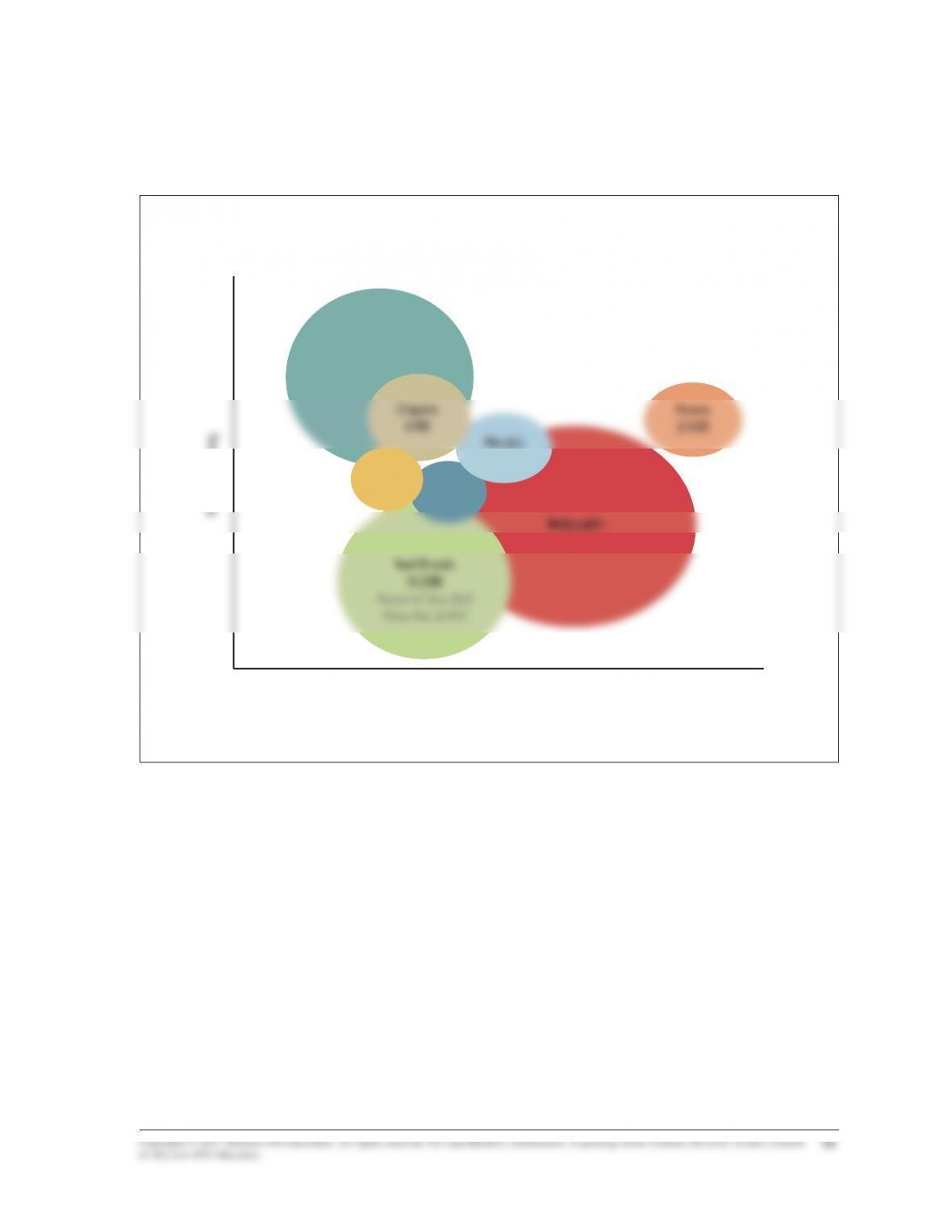
A sample strategic group map is provided next, utilizing product quality (highly correlated with
price) and menu variety as the two plot dimensions. The case authors could not locate consolidated
information on market share across all of the represented segments of the restaurant industry, so the
circle size was based on 2014 total company revenues (as reported by Yahoo! Finance; BK revenues are
based on 2013 due to data availability).
A second observation is that the competitive space is very crowded (and this is not even a full list of
competitors). While it may appear that there is “open room” in the upper end of the quality dimension,
therealityisthatseveralcompaniesinthemid-tohigh-dollar/qualityrangehavebeenomittedfrom
Teaching Note —McDonald’s Corporation
of McGraw-Hill Education.
the graph for the sake of clarity (e.g., Chili’s, Old Chicago, Ruth’s Chris Steak House, etc.). Several of
these restaurants would also have higher menu variety and fall to the right of McDonald’s on the x-axis
(the other apparent “opening”).
Basically, McDonald’s is surrounded by competitors on all sides. Taco Bell challenges the lower end
of the price spectrum, while Burger King (burgers) and Dunkin Donuts (coffee) are roughly compa-
rable in price (just much smaller). Wendy’s aims for slightly higher quality and charges slightly higher
prices. As part of the fast-casual segment, Chipotle and Panera overlap with the higher-priced end of
McDonald’smenu,makingthemareasonablealternativefortheirquality/value.Starbucksisclearly
the premium coffee outlet.
One of the reasons the smaller competitors have been successful is that they have focused on a par–
ticularfood/drinkproduct.McDonald’sisoneofthemostdiversifiedcompaniesonthechart,with
burgers, chicken, salads, ice cream and other desserts, yogurt, and a full specialty beverage line. Of the
companies depicted, only Panera’s (full bakery, sandwiches, soups, salads, and specialty beverages)
menu exceeds McDonald’s in terms of offerings. McDonald’s complexity comes with definitive costs.
FormulAtion: Focus on BusinEss, corporAtE,
And/or GloBAl strAtEGiEs
3. Which business-level strategy does McDonald’s employ? Is it effective? How so?
Asking students to analyze McDonald’s business-level strategy can be an informative and enlight-
ening exercise, as they are not likely to agree, at least initially.
Some will argue that McDonald’s is primarily a differentiator, as evidenced by:
• Thefactthatthecompanyhasoneofthemostwidelyrecognizedbrandsandlogosintheworld.16
• Premiummenuitems(product features) such as the McCafé line, salads, and chicken sandwiches,
many of which have “premium” as part of their name.
Teaching Note —McDonald’s Corporation
Others will point out various low-cost elements of McDonald’s strategy, such as:
• Thelowpricepointoffastfoodrestaurantsingeneral(this can lead into a useful discussion of defin-
ing industry boundaries for analysis purposes).
• McDonald’sDollarMenu,because“anemptystomachshouldn’tmeanemptyingyourwallet,
too.”19
With well-developed arguments on both sides, others will propose that McDonald’s is best described
as an integrator,offeringrelativelydifferentiatedproducts/servicesatlowcost.Companiesthatpur–
sue an integration strategy have to find ways to reconcile the trade-offs between these two strategic
approaches. Some possible levers they can use include:
Ask students how well McDonald’s accomplishes an integration strategy by managing these levers
or whether it is more accurately described as “stuck-in-the-middle” of both strategies, executing nei-
ther effectively. This is precisely the question raised in a recent wall street Journal article, which features
the following quotes that can be used to stimulate class discussion:22
“McDonald’s is ‘focused on trying to be all things to all people, whether it’s catering to health-minded
people with oatmeal or to Millennials with snack wraps. They’ve gone so far afield from their core menu
that they’re not really resonating with anyone,’ says Howard Penney, managing director at Hedgeye Risk
Management, an independent investment research firm.”
Teaching Note —McDonald’s Corporation
4. Which international strategy does McDonald’s employ? Is it effective? How so?
The essence of this question is to what degree does McDonald’s standardize its vast global empire
versus adapting to local conditions. Ask students to develop a list of what is common versus what is
different across McDonald’s restaurants worldwide. Some examples follow:
Integration
• Globalbrandandlogo(goldenarches)
• Knownfor“funfoodexperience”
Local Responsiveness
• Promotional materials translated into local
languages
Many students will automatically assume that a company with such a well-known global brand
must use a global strategy to achieve that level of recognition. The truth is, however, that McDonald’s
also places significant emphasis on local adaptation of its culture, menu, and operations, which is
more consistent with a transnational approach to international strategy. See, for example, the company’s
statement of strategic direction (emphasis added):
This web page previously contains the following text, which illustrates the transnational approach
even more clearly:
Teaching Note —McDonald’s Corporation
Several additional resources are listed next to supplement the case and students’ own experiences in
traveling abroad (which they are usually eager to share in class).
reporting segments:
http://www.aboutmcdonalds.com/mcd/investors/company_profile.html
Through June 30, 2015, the company was organized into geographic reporting segments:
• Othercountries&corporate(OCC)includingCanada,LatinAmerica,andcorporate
The new corporate structure is as follows:
2014 Annual report: http://www.aboutmcdonalds.com/content/dam/AboutMcDonalds/
Investors/McDonald’s%202014%20Annual%20Report.PDF
international locations:http://www.aboutmcdonalds.com/mcd/country/map.html
implEmEntAtion: Focus on rEcommEndAtions
And How to implEmEnt tHEm
5. How should Easterbrook adapt the organizational structure of McDonald’s to achieve his
strategic plan?
As long as McDonald’s tries to pursue both differentiation and cost leadership as part of its business-
level strategy, it will have to find ways to reconcile the trade-offs inherent in these two approaches. This
suggests transforming McDonald’s into an ambidextrousorganizationto balance exploitation (applying
Teaching Note —McDonald’s Corporation
current knowledge to enhance firm performance in the short term) with exploration (searching for new
knowledge that may enhance a firm’s future performance). Structurally, this implies the need to:
Ambidextrous organizations frequently make use of the following techniques to resolve trade-offs
across internal value chain activities and time:
Ask students to analyze whether (and how) Easterbrook’s initiatives are likely to help McDonald’s
increase its ambidexterity as an organization, and thereby avoid (or escape) staying “stuck-in-the-middle.”
6. Among all the roles played by strategic leaders, which one(s) will be most important as
Easterbrook implements his strategic plan?
McDonald’s new CEO Steve Easterbrook explains his turnaround plan in a video statement released
inMay2015:https://mcdonalds.webcasts.com/viewer/event.jsp?ei=1063465(23:10).
CEOs play multiple roles over the course of their careers; this question is asking students to consider
what McDonald’s most needs from its CEO, Steve Easterbrook, at this point in its corporate develop-
ment. Are his initiatives sufficient to reverse the company’s lackluster performance over the past sev-
eralyears?
Teaching Note —McDonald’s Corporation
11
Copyright © 2017 McGraw-Hill Education. All rights reserved. No reproduction, distribution, or posting online without the prior written consent
of McGraw-Hill Education.
McDonald’s has been the target of strikes by workers seeking a wage increase from $7.25 to $15.00 per
hour, forcing Easterbrook to step in as a disturbance handler (as yet he has refused to negotiate with the
strikers as most work stoppages have been relatively brief in duration). These activities emphasize the
decisional roles played by a CEO who is seeking to implement significant strategic changes.
At least one analyst was not impressed by Steve Easterbrook’s performance in the video, argu-
ing that it serves as a good lesson on how not to communicate: http://www.forbes.com/sites/
nickmorgan/2015/05/12/what-steve-easterbrook-mcdonalds-ceo-did-wrong/.
Recent Updates
Wochit (2015), “McDonald’s says it will switch to cage-free eggs in the U.S. and Canada,”
Yahoo! Finance, September 11. http://finance.yahoo.com/video/mcdonald-says-switch-cage-
free-090118610.html;_ylt=AwrXgyLtKvNVKRcABnmTmYlQ;_ylu=X3oDMTByNDN1aDMxBGNvb
G8DZ3ExBHBvcwM1BHZ0aWQDBHNlYwNzYw–
Foraprintarticlesee:http://www.bloomberg.com/news/articles/2015-09-09/mcdonald-s-switch–
ing-to-cage-free-eggs-at-u-s-canada-locations. Cage-free eggs cost 5 percent to 10 percent more, but
McDonald’s hopes to mitigate the effect on consumer pricing over the next 10 years.
Additional Resources
1. Burger King invites mcdonald’s to make a mcwhopper in honor of world peace.
2. the Hamburglar gets a makeover.
1984McDonald’sCommercial(0.31):https://youtu.be/9cIf0P-Vb-U.
2015McDonald’s Commercial(0.30):See the video embedded attheend of this article: http://
3. dollar menu dilemma
3Dmcdonalds%26primaryType%3Dmixed%26sortBy%3Drelevance%26intl%3Dfalse%26x%3D0%
26y%3D0#/video/bestoftv/2013/10/24/ym-romans-fast-food-fights.cnn (2:05). October 24, 2013.
Teaching Note —McDonald’s Corporation
4. Burger King takes on the Big mac.
3D0%26y%3D0#/video/living/2013/11/06/lead-moss-burger-king-takes-on-big-mac.cnn (2:46).
the 1980s.
5. mcdonald’s Helpline: try Foodstamps.
9%26y%3D11#/video/bestoftv/2013/10/24/exp-costello-salgado-mcdonalds.cnn (4:24). October
24, 2013. A CNN video featuring the controversy created when an employee recorded a call to a
McDonald’s employee help line. When she asked for financial assistance, she was advised on how
Teaching Note —McDonald’s Corporation
ExHIbIt tN-1 Size/EconomyofScalesAdvantagesofMcDonald’s
Yum! Brands
13.28B
Parent of Taco Bell,
Pizza Hut, & KFC
McDonald’s
27.44B
BK
1.15B
Menu Variety
Product Quantity
Starbucks
16.45B
2.06B
DD
0.75B

Teaching Note —McDonald’s Corporation
Endnotes
1 https://research.stlouisfed.org/datatrends/net/page3.php.
2 https://research.stlouisfed.org/datatrends/net/page3.php.
3 http://www.bloomberg.com/news/articles/2015-04-14/
americans-spending-on-dining-out-just-overtook-grocery-sales-for-the-first-time-ever.
4 http://qz.com/442037/what-the-hell-has-happened-to-the-price-of-ground-beef/.
5 Mintel, market drivers.
6 “Rising corn prices and your grocery bill,” market watch, July 18, 2012.
7 http://www.wisoybean.org/news/soybean_facts.php.
8 http://ncsoy.org/media-resources/uses-of-soybeans/.
9 http://www.marketplace.org/topics/business/bird-flu-winding-down-bakers-still-feel-pinch.
10http://www.marketplace.org/topics/economy/why-egg-prices-have-been-climbing-while-chicken-prices-
are-falling.
11 http://blogs.wsj.com/economics/2014/11/19/obesity-epidemic-costing-world-2-trillion-a-year-study-says/.
12http://www.pbs.org/wgbh/pages/frontline/shows/meat/safe/overview.html.
13http://www.wsj.com/articles/mcdonalds-to-curb-purchases-of-chicken-raised-with-antibiotics-1425482366.
14http://www.letsmove.gov/about.
15 Mintel, trend applications,http://bit.ly/1bN2M0c.
16http://www.interbrand.com/en/best-global-brands/2013/top-100-list-view.aspx.
17http://www.huffingtonpost.com/the-daily-meal/how-to-make-fries-that-ta_b_3791465.html.
18http://www.mcdonalds.com/us/en/food.html.
19http://www.mcdonalds.com/us/en/food/meal_bundles/dollar_menu.html.
20http://www.mcdonalds.com/us/en/food/meal_bundles/extra_value_meals.html.
21http://online.wsj.com/news/article_email/SB10001424052702304384104579139871559464960-
lMyQjAxMTAzMDIwNDEyNDQyWj.
22http://online.wsj.com/news/article_email/SB10001424052702304384104579139871559464960-
lMyQjAxMTAzMDIwNDEyNDQyWj.
23 Ibid.