
Strategic Management 3
e
Instructor Manual
12
END OF CHAPTER DISCUSSION QUESTION 1
POWERPOINT SLIDE 21
Why is it important for an organization to have alignment between its strategy and organizational structure?
Usually structure follows strategy. This is because strategy is dynamic in nature, and so the structure needs to reflect this
dynamism. Structure provides stability and flexibility, which are of utmost importance when a firm is trying to implement
11.3 Organizational Culture: Values, Norms, and
Artifacts LO 11–6
POWERPOINT SLIDES 36–42
EXAMPLE
POWERPOINT SLIDES 37
NEWER FACULTY: Organizational culture describes the collectively shared values and norms of an organization’s members.
Employees learn the culture through socialization. An example is Zappo’s orientation program to socialize employees to its
culture.
EXPERIENCED FACULTY: A four-minute video by Professor Michael Beer describes how high-commitment, high-
performance companies approach economic downturns. You can use this to connect to students’ very real experience of the
recent long-term recession.
INTEGRATION
Video Case: Organizational Culture
This video case analysis helps students see the cultural impact of hiring at Zappos. This video is less than seven minutes
long and has five embedded questions contained in it. Difficulty: Medium Blooms: Analyze AACSB: Analytic
Video Case Tips: We suggest setting the “attempts” policy to “revise the previous attempt” for video cases. This enables
students to watch parts of the video and edit their answers without needing to watch the entire video again for each
attempt at the questions.
Follow-Up Activity: The instructor can expand on the concepts in this video case by discussing how inertia limits
innovation in managerial structures even in industries where technology is making rapid changes in the products or
services offered. Students with some work experience may be able to bring to light differences in their work structure
compared to that described in the video or in the ChapterCase11 opener about Zappos.
Strategic Management 3
e
Instructor Manual
13
STRATEGY SMART VIDEO EXAMPLE
POWERPOINT SLIDE 72
This video illustrates values, beliefs, and artifacts as elements of Apple’s culture.
POWERPOINT SLIDE 39
In an interview with The Wall Street Journal 6/4/12 excerpted in “Apple after Jobs,” Tim Cook discusses how important it
was for Apple to keep the innovative culture established by Steve Jobs. This effort continues in 2015, see The Wall Street
Journal 5/26/15 video for an update on Jony Ive, the person at Apple who has taken on leadership of innovation at Apple.
POWERPOINT SLIDE 40
Post-bankruptcy, GM has been trying to change its culture to become more organic and to break down silos between
organizational units. “GM Chief labors to get rebuilt car maker into gear” (6/12/12 The Wall Street Journal) identifies some
of the challenges in trying to push cultural change down from the top in a very large firm.
DISCUSSION TOPICS
END OF CHAPTER ETHICAL/SOCIAL ISSUES 3
What makes some strong cultures helpful in gaining and sustaining a competitive advantage, while other strong
cultures are a liability to achieving that goal? AACSB 2015 Standard 9 Ethical understanding and reasoning (able to
identify ethical issues and address the issues in a socially responsible manner)
As discussed in Chapter 2 leadership is one of the most important factors. If the company’s top management team has
END OF CHAPTER DISCUSSION QUESTION 2
POWERPOINT SLIDE 38
The chapter describes the role of culture in the successful implementation of strategy. Consider an employment
experience of your own or of someone you have observed closely (e.g., a family member). Describe to the best of your
ability the values, norms, and artifacts of the organization. What was the socialization process of embedding the
culture? Do you consider this to be an example of an effective culture for contributing to the organization’s
competitive advantage? Why or why not?
If used as a classroom exercise, a good approach might be to use the culture of the student body in your business school. Ask
students how they learned the student culture at their school. Orientation programs might be a good example of the

Strategic Management 3
e
Instructor Manual
14
END OF CHAPTER ETHICAL/SOCIAL ISSUES 2
Cultural norms and values play a significant role in all organizations, from businesses in the economic sector to
religious, political, and sports organizations. Strong organizational cultures can have many benefits, such as those
described in the Zappos example. However, sometimes a strong organizational culture is less positive. Vince
Lombardi, renowned coach of the Green Bay Packers, is often quoted as saying, “Winning isn’t everything; it’s the
only thing.” Many sports teams from junior sports to professional sports have either explicitly or implicitly touted this
attitude as exemplary. Others, however, argue that this attitude is what’s wrong with sports and leads to injury,
minor misbehavior, and criminal behavior. It encourages players to do whatever it takes to win—from tripping a
player or other unsportsmanlike conduct during middle-school sports to throwing a game as part of gambling. Name
other examples of organizational culture leading to business failure, criminal behavior, or civil legal actions.
When a player hears the message as “any action will be tolerated as long as you are winning,” there can be serious
consequences on and off the field. How could leaders of sports organizations communicate the will to win and develop
the necessary skills while maintaining ethical behavior? Think of examples of coaches who coaxed players to play by
the rules and maintain high personal ethical standards. What other socialization experiences could a coach use? What
is the role of team leaders in encouraging high ethical standards while building the desire to win? AACSB Standard 9
Ethical understanding and reasoning (able to identify ethical issues and address the issues in a socially responsible manner)
Students will have many examples of coaches as leaders. Some interesting contrasts between well-known coaches might be
Bobby Knight and Mike Krzyzewski (Coach K) who trained under Bobby Knight. An example of methods by which leaders
communicate high ethical standards might be the “Coach K Teaching Character Through Sports” award. In addition to the
focus on the leaders role in sports ethics, you might also move the discussion into the player’s role in creating and
On the opposite end of the spectrum, Pitney Bowes is altering its culture for the new realities of its much more mature market
of postage meters. It is trying to become more client-centered and has replaced a number of senior leaders to bring in new
management perspectives. Invite students to debate the pros and cons of bringing in new leadership when a significant
change in culture is needed. (See “Pitney Bowes readies 21st century message” 6/26/13 The Wall Street Journal.)
One of the greatest challenges of large-scale mergers is the integration of the two firms’ cultures. Halliburton and Baker
Hughes are undergoing such a transformation in 2015. The CFO of Halliburton, Mark McCollum has been named chief
integration officer and is overseeing the entire integration process. His interview with Deloitte partner, Jeff Walker, was
published in The Wall Street Journal 11/12/15. He is quoted as saying, “I think it can be easy to take for granted the cultural

Strategic Management 3
e
Instructor Manual
15
the change management process. We intend to codify our cultural values in written form to help articulate the culture of the
combined organization after the closing to our new employees and help them to embrace it.”
11.4 Strategic Control–and–Reward Systems
LO 11–7
POWERPOINT SLIDES 43–46
EXAMPLES
POWERPOINT SLIDE 44
NEWER FACULTY: Strategic control and reward systems are internal governance mechanisms put in place to align the
incentives of principals and agents. The control and rewards system is a CRITICAL part of a successful implementation
STRATEGY SMART VIDEO EXAMPLE
POWERPOINT SLIDE 67
These two video links (Part 1 and Part 2) show interviews with past and current GE CEOs on talent reviews. They illustrate
the shift over time in company reward systems and, as a result, culture.
STRATEGY SMART VIDEO LECTURE
POWERPOINT SLIDE 69
This animated lecture video will connect your strategy course back to the students’ earlier organizational behavior class. It
focuses on motivation.
DISCUSSION TOPIC
POWERPOINT SLIDE 46
Buy used to struggle to defend itself against the industry threat of “showrooming” behavior by consumers. It has now
END OF CHAPTER ETHICAL/SOCIAL ISSUES 1
POWERPOINT SLIDE 46
As noted in Chapter 5, many public firms are under intense pressure for short-term (such as quarterly) financial
improvements. How might such pressure, in combination with output controls, lead to unethical behaviors? AACSB
2013 Standard 9 Ethical understanding and reasoning (able to identify ethical issues and address the issues in a socially
responsible manner)
Strategic Management 3
e
Instructor Manual
16
Output control is performance/outcome-oriented, and most of the time, one evaluates performance by using financial
analysis. This may create pressures to “cook the books” or inappropriately report items (or NOT report items) in the
END OF CHAPTER SMALL GROUP EXERCISE 2
STRATEGY SMART VIDEO LECTURE
POWERPOINT SLIDE 67
In this TED talk, Daniel Pink discusses his theory of motivation. It would be a great introduction to this exercise, but its 18–
minute length suggests that assigning it for viewing before class may be more practical.
POWERPOINT SLIDE 64
The chapter describes Daniel Pink’s ROWE theory of motivation, in which he argued that the most powerful
motivation occurs when there is an interest in the work and the work itself has meaning. Intrinsic motivation is
highest when an employee has autonomy (about what to do), mastery (how to do it), and purpose (why to do it).
Assume your group has been asked by your university to brainstorm ways that the university might apply the ROWE
theory. Discuss whether you would be more motivated and better educated if you had more autonomy in designing
your program of study, could determine the best way for you to learn and gain mastery, and could develop your own
statement of purpose as to why you were pursuing a particular program of study.
Students are likely to be passionate about this topic, but opinions are likely to vary. Some students will be more confident
How might this change the university’s allocation of resources (e.g., would more trained advisors and career
counselors be required, and how would they be evaluated)?
If students are choosing their own course of study and are unlimited in their choices, then fewer advisors might be needed,
If large numbers of students decided they would learn some of the core materials best by taking an online course, how
might this affect the university’s revenue stream? How might this change the way professors teach courses?
Have each group member explain how this approach might change his/her program of study.
Consider the potential pitfalls of such an approach and how these might be addressed.

Strategic Management 3
e
Instructor Manual
17
11.5 Implications for Strategists
POWERPOINT SLIDES 47–49
EXAMPLE
The digital revolution will require firms to update their structure, culture, and reward systems to support new strategies and
innovative ways of working. McKinsey offers suggestions on this transformation process in the article, “Raising your digital
quotient” T Catlin, J Scanlin, and P Willmott June 2015 McKinsey Quarterly.
DISCUSSION TOPICS
POWERPOINT SLIDE 48
When Microsoft replaced Steve Ballmer with Satya Nadella as CEO, The Wall Street Journal article, “Microsoft: 11 fix-it
strategies” 8/27/13 invited external leaders to recommend what needed to change in the Microsoft organization to implement
a strategy of increased innovation. Assign a team of students to each of the 11 suggestions and ask them to evaluate the pros
and cons of each suggestion, grounding their opinions in theory from the textbook (see also “Next CEO’s job: Fixing
Microsoft’s culture” 8/25/13 The Wall Street Journal).
POWERPOINT SLIDES 49 AND 67
Jeff Bezos, founder and CEO of Amazon, acquired The Washington Post in 2013. What changes to organization structure,
culture, and control systems might be necessary to support a strategy for a newspaper in the digital age? (See “Jeff Bezos’s
tool kit for the Post” 8/7/13 The Wall Street Journal.) In addition to the article students can draw on Strategy Highlight 11.2,
their knowledge of Amazon, and their ideas on the future of journalism. AACSB 2015 Standard 9 Systems and processes in
organizations, including planning and design, production/operations, supply chains, marketing, and distribution
Assume your group is brought in to a business unit, and your analysis shows a significant excess headcount in the
accounting and purchasing departments. Your team is now responsible for developing a plan to lay off 25 percent of
the employees in those departments. You have six months to identify who to lay off and to reduce the headcount. (If
you have no personal experience with work–force reductions, use an Internet search engine and look up “successful
layoffs” for some guidance.) How can you downsize the departments without hurting the morale of the remaining
workers? What steps do you take to treat with dignity those employees forced to leave?
Make sure there is strong leadership and frequent communication with (and education of) the employees so the concept and
message will be delivered clearly. One tendency is for senior leadership to hide or “circle the wagons” during times of layoff.
This sends a very poor signal to those remaining workers. As tough as it is, managers must be especially visible and walking
Research Update
Lee, E. and Puranam, P. (2015), The implementation imperative: Why one should implement even imperfect strategies perfectly.
Strat. Mgmt. J.,
doi: 10.1002/smj.2414
EXPERIENCED FACULTY: This research offers a model that separates beliefs and actions and takes into account the fact
that the person(s) who formulate a strategy are often different than the person(s) who implement a strategy. Precise
implementation of a strategy provides the formulator with more precise feedback on the effectiveness (or ineffectiveness)
of a strategy. This improves learning and provides feedback that facilitates the development of improved strategies.

Strategic Management 3
e
Instructor Manual
18
END OF CHAPTER SMALL GROUP EXERCISE 1
POWERPOINT SLIDES 48 AND 63
Your classmates are a group of friends who have decided to open a small retail shop. The team is torn between two
storefront ideas. The first idea is to open a high-end antique store selling household items used for decorations in
upscale homes. Members of the team have found a location in a heavy pedestrian area near a local coffee shop. The
store would have many items authenticated by a team member’s uncle, who is a certified appraiser. In discussing the
plan, however, two group members suggest shifting to a drop-off store for online auctions such as eBay. In this
business model, customers drop off items they want to sell, and the retail store does all the logistics involved—listing
and selling the items on eBay, and then shipping them to buyers—for a percentage of the sales price. They suggest
that a quick way to get started is to become a franchisee for a group such as “I Sold It.” AACSB 2015 Standard 9
Application of knowledge (able to translate knowledge of business and management into practice)
What is the business strategy for each store concept?
How would the organizational structure be different for the two concepts?
What would likely be the cultural differences in the two store concepts?
How would the control-and-reward systems be different?
EXERCISE
POWERPOINT SLIDE 48
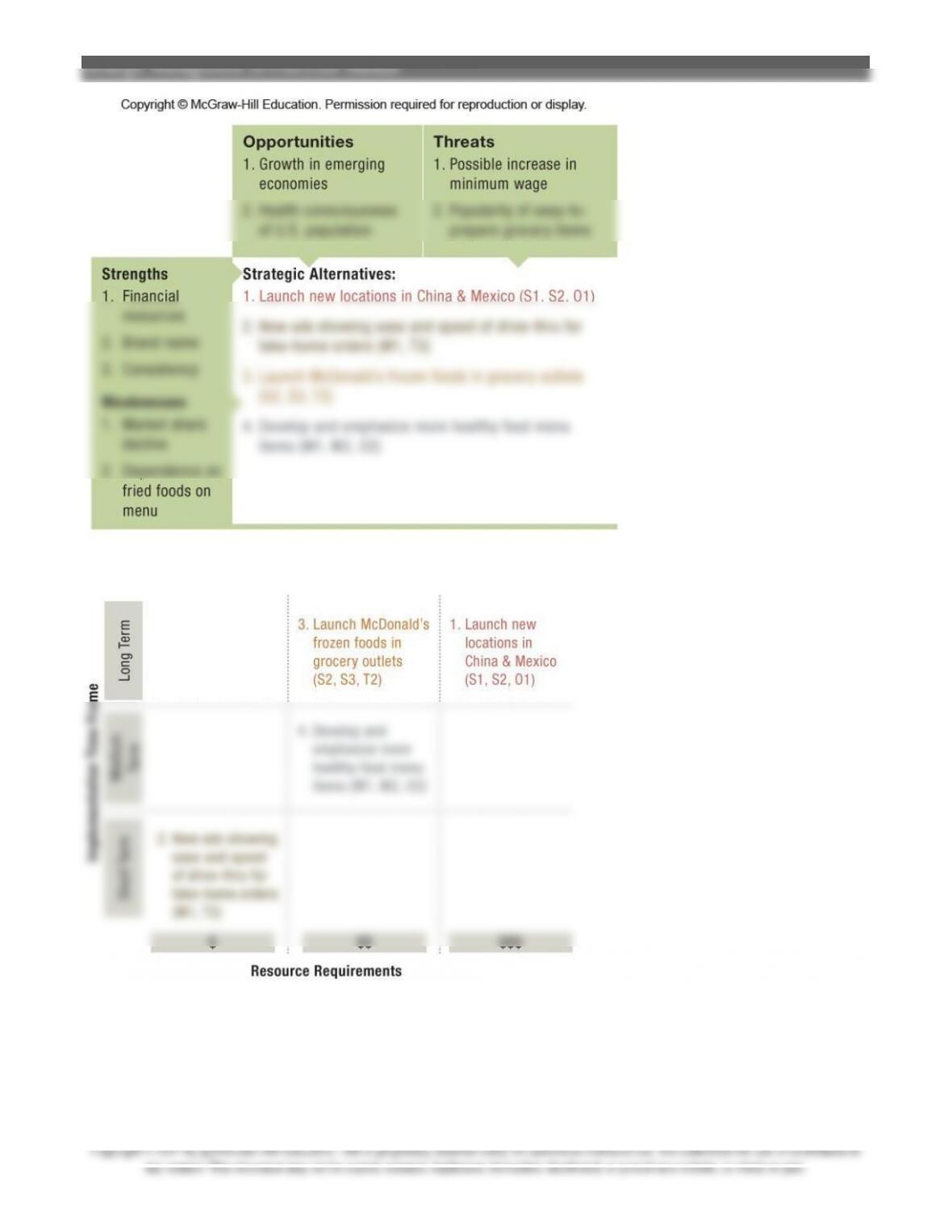
In Chapter 4, we discussed SWOT analysis. You can offer students the following example of a SWOT analysis for
McDonald’s and ask them to contrast the possible strategies in their resource and time requirements.
19
Possible answer:

Strategic Management 3
e
Instructor Manual
20
Strategy Term Project
Term Project Module 11
In this section, you will study your firm’s organization design and its fit with the firm’s strategy. AACSB 2015 Standard 9
Application of knowledge (able to translate knowledge of business and management into practice)
From your knowledge of the firm, identify a major strategic change the firm should seriously consider. Briefly
describe what the goal of the initiative is for the organization.
By this point in the project, students should have a good idea of what is working well at their firm and what areas need
Work your way through the six stages in Exhibit 11.13, answering as many of the questions as you can for the
proposed strategic change. As you develop the project plans with specifics for each of the stages, the plan should
provide flexibility, allowing for unexpected contingencies to emerge.
my
Strategy
POWERPOINT SLIDE 62
FOR WHAT TYPE OF ORGANIZATION ARE YOU BEST SUITED?
Review Exhibit 11.3 and circle the organizational characteristics you find appealing. Cross out those factors you think
you would not like. Do you find a trend toward either the mechanistic or organic organization? AACSB 2015 Standard
9 Reflective thinking (able to understand oneself in the context of society)
Have you been in school or work situations in which your values did not align with those of your peers or colleagues?
How did you handle the situation? Are there certain values or norms important enough for you to consider as you
look for a new job?
INTEGRATION
Running Case: HP
While offering each student the opportunity to explore and analyze the company of his/her choice can add interest to the
exercise, there are many advantages for an instructor when the entire class works on the same firm. Connect allows you to
do this with a running case for a single firm that encompasses every chapter in the textbook and tracks the Strategy Term
Project. Hewlett-Packard is provided as an example firm your students can use to see what information and analysis
would be helpful to cover this portion of the term project.

Strategic Management 3
e
Instructor Manual
21
As you consider your career after graduation, which control-and-rewards system discussed in the concluding section
of the chapter would you find most motivating? Is this different from the controls used at some jobs you have had in
the past? How do you think you would perform in a Holacracy such as Zappos is implementing?