
Part 09 – Performance Management
9-1
Major Purposes of Part Nine
Part Nine focuses on four important subjects―performance
management, professional performance, organizational
performance, and sustaining discipline.
Part Nine Objectives
After completing Part Nine, your students should be able to
better understand:
• The importance of performance management;
• Eight principles for setting performance objectives;
• Ten principles for conducting performance reviews;
• Their levels of professional performance in the areas of statesmanship,
entrepreneurship, and innovation;
• How to improve organizational performance; and
• Principles of effective discipline.
PART NINE—Performance Management

Part 09 – Performance Management
9-2
NOTES AND ANECDOTES
Setting performance objectives is not a new idea, as shown by the ancient “oath of the physician.”
The Hippocratic Oath
I swear by Apollo, the physician, and Asclepius and Health and All Heal and all the gods
and goddesses that, according to my ability and judgment, I will keep this oath and
stipulation:
To reckon him who taught me this art equally dear to me as my parents, to share my
substance with him and relieve his necessities if required; to regard his offspring as on
the same footing with my own brothers, and to teach them this art if they should wish to
learn it, without fee or stipulation, and that by precept, lecture and every other mode of
instruction, I will impart a knowledge of the art to my own sons and to those of my
teachers, and to disciples bound by a stipulation and oath, according to the law of
medicine, but to none others.
I will follow that method of treatment which, according to my ability and judgment, I
consider for the benefit of my patients, and abstain from whatever is deleterious and
mischievous. I will give no deadly medicine to anyone if asked, nor suggest any such
counsel; furthermore, I will not give to a woman an instrument to produce abortion.
With purity and with holiness I will pass my life and practice my art. I will not cut a
person who is suffering from a stone, but will leave this to be done by practitioners of this
work. Into whatever houses I enter, I will go into them for the benefit of the sick and will
abstain from every voluntary act of mischief and corruption; and further from the
seduction of females or males, bond or free.
Whatever, in connection with my professional practice, or not in connection with it, I
may see or hear in the lives of men which ought not to be spoken abroad I will not
divulge, as reckoning that all such should be kept secret.
While I continue to keep this oath unviolated may it be granted to me to enjoy life and the
practice of the art, respected by all men at all times but should I trespass and violate this
oath, may the reverse be my lot.
Physicians have used the Hippocratic oath as their performance ideal for over two thousand years.

Part 09 – Performance Management
9-3
NOTES AND ANECDOTES
Supervisor Response to Levels of Performance
If the employee exceeds standards, the supervisor should: (a) congratulate the employee and cite specific
examples of good work; (b) review the importance of effective performance for the individual and the
organization; (c) discuss the form that recognition will take, remembering that the discussion itself is a
form of recognition; (d) ask the employee for ideas that may improve personal performance and the work
of the group even more; (e) agree on specific actions each person will take; (f) set a date for a follow–up
meeting; and (g) thank the employee for good performance.
If the employee meets standards, the supervisor should: (a) congratulate the employee on performance
strengths and cite specific examples of good work; (b) review the importance of good performance for the
individual and the work group; (c) ask the employee if anything can be done to increase effectiveness, and
listen carefully to ideas; (d) if appropriate, indicate intention to take action; (e) set a date for a follow-up
meeting; and (f) thank the employee for good performance.
If the employee does not meet standards, the supervisor should: (a) review the areas in which
improved performance is necessary; (b) ask the employee to help solve each of the problems; (c) discuss
each idea thoroughly; (d) agree on specific actions each person will take; (e) establish a definite date for a
follow-up meeting; (f) review any areas of strength; and (g) express confidence in the employee’s ability
to improve.

Part 09 – Performance Management
9-4
NOTES AND ANECDOTES
The following are eight principles for setting performance objectives:
• Performance objectives should be meaningful. A manager’s objectives should include
the health and safety of the work group, excellence in workmanship, a high level of
employee morale, and efficient production—all meaningful goals.
• Performance objectives should be challenging, yet attainable. An employee whose
objectives are either too easy or too difficult will be a morale casualty, and sooner or
later, job performance will suffer. Setting unrealistically high goals leads to frustration
and failure; pursuing goals that are too low results in wasted opportunity; pursuing the
wrong goals results in disillusionment and dissatisfaction.
• Performance objectives should be measurable. A manager may have many
responsibilities, including operations, fiscal responsibility, and security. Measurable
objectives should be set in each of these areas. A sample safety objective is “to achieve a
twelve-month record of ‘zero’ injuries caused by unsafe equipment, facilities, and other
conditions under management control.” When performance objectives are measurable,
the individual knows when, and to what extent, they have been achieved.
• Performance objectives should be established for a specific time period. An employee’s
objectives may be set either by the project or by the calendar, but there should always be
a specified time by which objectives are to be accomplished.
• Performance objectives should be agreed on by those doing the work and those in
charge. An employee’s efforts to develop a new product or procedure may be wasted if
upper management does not agree about the need for or nature of the project.
• Performance objectives should be flexible. An employee should be willing to change the
work plan if, in the process, a greater need or opportunity is discovered. Managers
should also be open to making changes in a worker’s performance objectives. Conditions
change, and effective performance requires flexibility.
• Performance objectives should be written. If a job is important enough to work on eight
hours a day for a long period of time, it is important enough to write objectives for.
Memories are fallible, especially if a job has several elements. The palest ink is stronger
than the best memory.
• Performance objectives for work groups should consider the social dynamics of
cooperation and competition. As a rule, work groups perform better if members use
teamwork to achieve a common objective. Cooperation within the group should be
emphasized and rewarded, and competition between interdependent groups should be
discouraged. For example, the administrative staff should not compete with the field

Part 09 – Performance Management
9-5
staff, and the maintenance department should not compete with the operations
department. In contrast, work groups can increase performance by competing against
other, independent work groups. A sales team may try to outperform the competition and
thus maximize its own performance. Rivalry and contests between autonomous work
groups can be an effective motivator.

Part 09 – Performance Management
NOTES AND ANCDOTES
Cause-and-Effect in Three Types of Performance Review
Tell-and-Sell Method
(Supervisor acts as judge)
Tell-and-Listen Method
(Supervisor acts as
advisor)
Problem-Solving Method
(Supervisor acts as coach)
Objective
To evaluate and get
employee to change.
To communicate
evaluation and encourage
discussion.
To stimulate employee
growth and development.
Assumptions
Employees want to correct
weaknesses if they know
them. Any person can
improve if he or she
chooses. The supervisor is
qualified to evaluate the
employee.
People will change if
defensive feelings are
removed.
Growth can occur without
focusing on faults.
Discussion of job problems
leads to improved
performance.
Reactions of employee
Defensive behavior is
suppressed. Attempts are
made to cover up hostility.
Defensive behavior is
expressed. Employee feels
accepted.
Behavior is oriented
toward problem solving.
Skills required
Persuasiveness; patience.
Listening and reflecting
feelings; summarizing.
Listening and reflecting
feelings; using exploratory
questions; summarizing.
Attitude
People profit from criticism
and appreciate help.
One can respect the
feelings of others if one
understands them.
Discussion develops new
ideas and mutual interests.
Motivation
Use of positive or negative
extrinsic incentives
(motivation is not related to
task content).
Reduced resistance to
change.
Increased freedom;
increased responsibility
(use of intrinsic motivation
in that interest is inherent
in the task).
Gains
Success is most probable
when the employee
respects the supervisor.
Employee develops a
favorable attitude toward
the supervisor, which
increases the probability of
success.
Some improvement is
almost assured.
Risks
Loss of loyalty; inhibition of
independent judgment.
Need for change;
improvement may not be
recognized.
Employee may lack ideas.
Change may be different
from what the supervisor
had in mind.
Values
Perpetuates existing
values and practices.
Permits supervisor to
change views as a result of
employee responses;
some upward
communication.
Both employee and
supervisor learn, since
experience and views are
pooled. Change is
facilitated.
Source: “Three Types of Appraisal Interviews,” by Norman R.F. Maier, Personnel, March-April 1958, p. 39,
Part 09 – Performance Management
9-7
NOTES AND ANECDOTES
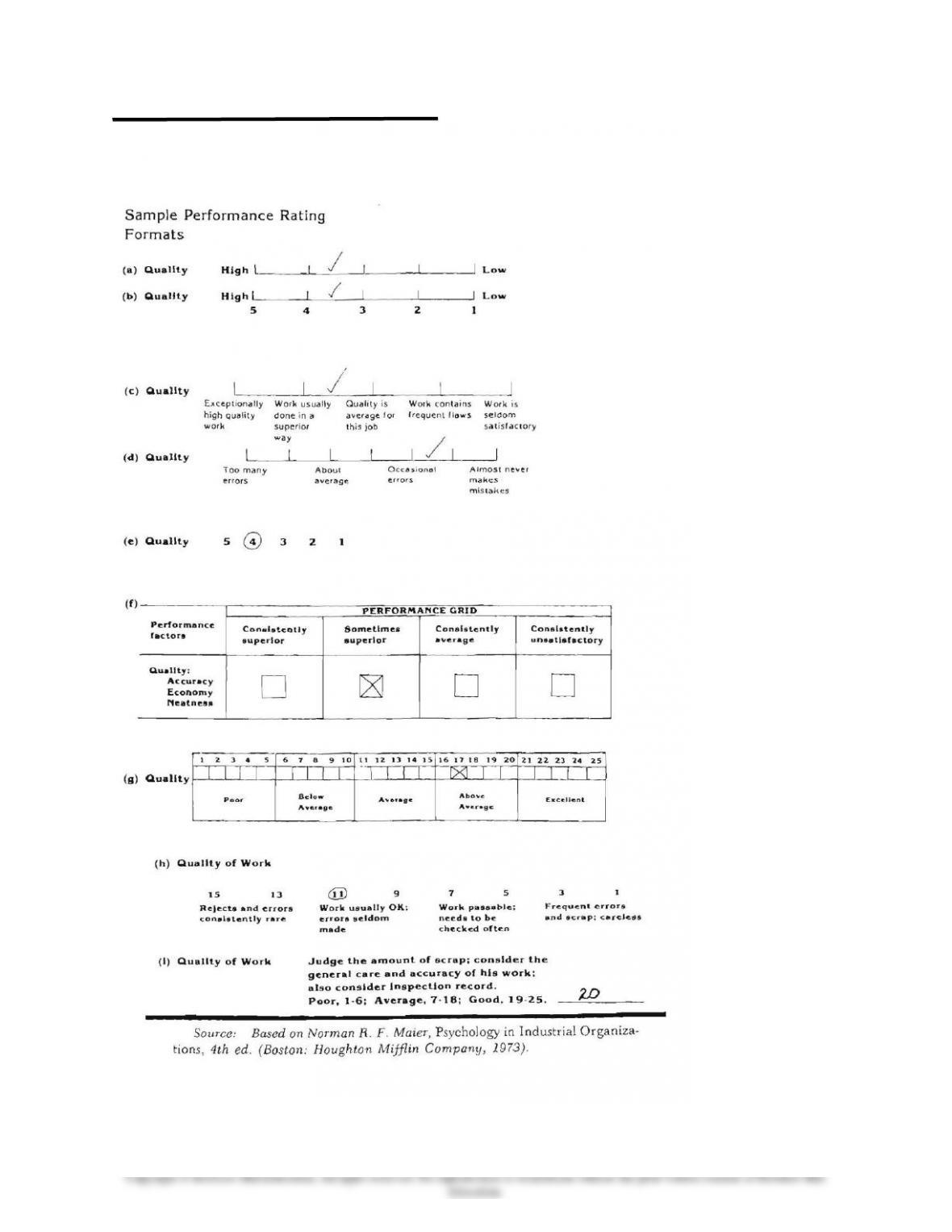
Sample Performance Rating Formats

Part 09 – Performance Management
9-8
EXERCISE 9.1: PERSONAL PERFORANCE RECORD
Directions: Read each question and circle the number that best describes your current performance
record (0 is lowest; 10 is highest).
Goal Orientation
1. Am I a self-starter? 0 1 2 3 4 5 6 7 8 9 10
2. Do I have clear goals? 0 1 2 3 4 5 6 7 8 9 10
3. Are my goals based on my values? 0 1 2 3 4 5 6 7 8 9 10
4. Do I meet objectives? 0 1 2 3 4 5 6 7 8 9 10
Dependability
5. Is my work done on time? 0 1 2 3 4 5 6 7 8 9 10
6. Is quantity acceptable? 0 1 2 3 4 5 6 7 8 9 10
7. Is quality acceptable? 0 1 2 3 4 5 6 7 8 9 10
Creativity
8. Am I open to change? 0 1 2 3 4 5 6 7 8 9 10
9. Do I make improvements in my job? 0 1 2 3 4 5 6 7 8 9 10

Part 09 – Performance Management
9-9
Planning
10. Do I plan ahead? 0 1 2 3 4 5 6 7 8 9 10
11. Am I prepared for problems
and emergencies? 0 1 2 3 4 5 6 7 8 9 10
Communication Skills
12. Do I listen to others? 0 1 2 3 4 5 6 7 8 9 10
13. Do I express myself effectively? 0 1 2 3 4 5 6 7 8 9 10
Job Knowledge
14. Do I have the information I need? 0 1 2 3 4 5 6 7 8 9 10
15. Do I know what I am doing? 0 1 2 3 4 5 6 7 8 9 10
16. Are my skills adequate? 0 1 2 3 4 5 6 7 8 9 10
Human Relations
17. Am I considerate of others? 0 1 2 3 4 5 6 7 8 9 10
18. Do I help others? 0 1 2 3 4 5 6 7 8 9 10
Resourcefulness
19. Do I identify opportunities? 0 1 2 3 4 5 6 7 8 9 10
20. Do I overcome obstacles? 0 1 2 3 4 5 6 7 8 9 10
21. Do I cope with change? 0 1 2 3 4 5 6 7 8 9 10

Part 09 – Performance Management
9-10
Problem Solving
22. Do I get the facts? 0 1 2 3 4 5 6 7 8 9 10
23. Do I consider alternatives? 0 1 2 3 4 5 6 7 8 9 10
24. Do I ask for advice when appropriate? 0 1 2 3 4 5 6 7 8 9 10
25. Am I decisive? 0 1 2 3 4 5 6 7 8 9 10
26. Do I follow up to see if my decisions are correct? 0 1 2 3 4 5 6 7 8 9 10
Scoring and Interpretation
To find your score on the Personal Performance Record, add the circled numbers. Find your score in the
following key to determine your current performance level:
Score Interpretation
0-26 Poor
27–91 Below average
92–168 Average
169–233 Very good
234–260 Excellent
Source: Rosanna Rizzo Little, based on Philip Marvin, Management Goals: Guidelines and
Accountability (Homewood, ILL.: Dow Jones-Irwin, Inc., 1980), 95-113

Part 09 – Performance Management
9-11
NOTES AND ANECDOTES
A performance review usually takes at least 30 minutes, sometimes much longer. Allow enough time for
the employee to become involved in the evaluation. Rushing through in 10 or 15 minutes shows that you
do not consider the employee or the review to be important. The average person spends 2,000 hours
every year on the job (40 hours per week for 50 weeks). In light of this, at least one half hour per
employee should be spent to let people know where they stand and provide guidance. Most people want
to know how they are doing and appreciate the opportunity to discuss job problems in an unhurried way.
Also, avoid scheduling performance reviews for all of your employees on the same day. It is demanding
work, requiring a lot of effort and concentration. Don’t wait until the last minute to do performance
reviews. Doing performance reviews in a rushed manner reduces credibility. Take the time to do it right.
Performance reviews should be conducted in a quiet, comfortable location, with a minimum of
interruptions. All calls, except emergencies, should be postponed. If you answer the phone while
conducting a review, the employee may think you are not interested. When arranging the physical
setting, create an atmosphere that encourages two-way conversation. The wrong physical setting can
reduce communication. If possible, sit approximately five feet apart, in comfortable chairs of the same
height, with no large barriers between you. Sitting on a desk and talking down to your subordinate, or
talking to the subordinate from across the room, will inhibit conversation and probably will be resented.
Sitting behind a desk clearly and unnecessarily indicates that you are the dominant person. This, too, may
prevent open communication.
Supervisors’ actions should support their words. Employees notice what supervisors do more than
what they say. If an employee receives a high evaluation but is not rewarded accordingly, continued high
performance will be discouraged; if an employee receives a poor evaluation but rewards are unaffected,
poor performance is reinforced. Managers encourage the behavior they reward. Consider what would
happen if the 100 lowest performing employees in an organization of 1,000 were discharged and their
salaries were distributed among the 100 best workers remaining. Soon thereafter, all 900 employees
would strive to be more productive. This simple action would encourage positive performance more
effectively than all of the words in the dictionary.

Part 09 – Performance Management
9-12
Notes and Anecdotes
The Candy Store Girls
Four salesgirls in a candy store were paid on commission. One girl always had a
long line of customers, while the others had few. The busy girl was asked, “What
is the secret of your success?” Her answer was insightful. She had noticed that
the other girls always scooped up more than a pound of candy and then took the
extra candy away. Her approach was to scoop up less than a pound and add to it.
The Shipping Tycoon
The famous shipping tycoon Emmet J. McCormack told the story of how, as a
young boy in the late nineteenth century, he sat, feeling dejected. He had just
been turned down by four different employers because none had enough work to
justify a full-time boy. Then he used insight. He went back to each employer and
offered his services one-fourth time for a dollar a week. They all hired him, and
Emmet J. McCormack became the first syndicated office boy.
The Maintenance Crew
A supervisor of a maintenance crew had two employees who had fought and did
not want to make up. The supervisor solved the problem by having each of the
workers wash the same window—one on the inside, one on the outside. With
nothing to do but look at each other, it didn’t take long for both to laugh, and
harmony was restored. The supervisor used insight.
The Low Bridge Problem
A large truck had become solidly wedged under a low bridge. Experts on the
construction of bridges were consulted about ways to dislodge it, and they offered
various suggestions. Because these people were involved daily with bridges, they
approached the problem in a conventional way: raise the bridge to release the
truck. But a young newsboy, who had not yet been trapped into habitual patterns
of thought, had a much better idea. He suggested that the truck be lowered, which
was easily accomplished by letting air out of the tires. The newsboy used insight
to solve the problem.
In evaluating our own approach to work, do you use insight in your approach to job
performance?

Part 09 – Performance Management
9-13
EXERCISE 9.2: HOW WELL DO YOU KNOW YOUR PEOPLE?
Directions: In Part I, indicate whether you know each fact about all of your subordinates. In
Part II, think about your work group and write the name of the subordinate who answers each
description.
Part I: Individual Characteristics
Do you know the following information about each of your subordinates?
Yes
No
Full name
_____
_____
Age
_____
_____
Marital status
_____
_____
Spouse’s name
_____
_____
Number of children
_____
_____
Approximate ages of children
_____
_____
Years of service
_____
_____
Career goals
_____
_____
Personal goals
_____
_____
Special interests
_____
_____
Educational level
_____
_____
Part II: Work Group Characteristics
Write the name of the subordinate who answers each description.
1. Who is the oldest employee by age? _______________
2. Who is the oldest employee by years of service? _______________
3. Who can handle the largest number of different jobs? _______________
4. Who is the fastest worker? _______________
5. Who does the best quality of work? _______________
6. Who has the fewest accidents? _______________
7. Who is your most skilled employee? _______________
8. Who is the best suited to help train new employees? _______________
9. Who should be in charge when you are not available? _______________

Part 09 – Performance Management
9-14
10. Who is your most dependable employee? _______________
11. Who is the best natured? _______________
12. Who is the most cooperative? _______________
13. Who is the most intelligent? _______________
14. Who is the best all-around employee? _______________
15. Who needs your help the most? _______________
Source: Rosanna Rizzo Little; based on Philip Marvin, Management Goals: Guidelines and
Accountability (Homewood, Ill.: Dow Jones-Irwin, Inc., 1980).
SCORING AND INTERPRETATION
To rate yourself on the How Well Do You Know Your People test, give yourself one point for
each yes answer in Part I and one point for each answer you completed in Part II. Add up your
total score and circle it on the scale below. The lower your total score, the less you know your
people; the higher your score, the more qualified you are as a statesman.
Statesmanship Skills
Low [1 2 3 4 5 6 7 8 9 10 11 12 13 14] [15 16 17] [18 19 20] [21 22 23] [24 25 26] High
F D C B A
Rating: A = Excellent
B = Very good
C = Good
D = Poor
F = Failing

Part 09 – Performance Management
9-15
NOTES AND ANECDOTES
Leadership Development—Retail
In order to improve leadership performance, one retail firm instituted a leadership development program
for the 60 members of its management team. The goal of this program was to improve practices in the
areas of leadership values, leadership principles, stress education, delegation skills, effective
communication, time management skills, and effective presentations. The leadership team was divided
into four groups, each of which included representatives from every level and division of the company.
Sub-goals of the initiative were to: 1) build relationships between group members; 2) solve common
performance problems; and 3) build team spirit (esprit de corps) in the leadership ranks.
Each week for seven weeks, the leadership team attended a three-hour workshop on one of the areas
targeted for improvement. At the end of each workshop, team members agreed upon performance
objectives. Then at the end of the following week, participants completed a checklist on personal
performance. If the performance objective was accomplished, it was checked; if not, it was left blank.
A coordinator for each leadership group collected the performance checklists and gave the group a
percentage completion score. This score was based on the total of actual checks of all the group
members, divided by the total checks possible multiplied by 100. (For example, a total of 80 checks,
divided by 160 possible checks, multiplied by 100, would result in a 50% performance record for the
group.) When the groups reported their weekly results, high performance records were praised. If low
performance was reported, appreciation for participation was expressed and the importance of the
performance objectives was reviewed.
The same three-step process was followed for each area targeted for improvement: (1) a workshop was
conducted to study the subject and agree upon performance objectives; (2) individual and group records
were kept on performance during the following week; and (3) reinforcement for good work was provided
in the form of recognition.
The following were the results of that leadership development program:
• Leadership improved in each performance area. Table 9.1 shows the performance improvement
record for each group.
• Employee turnover and grievances declined; many employees complimented their managers for
improved professional practices.
• The financial performance of the company improved dramatically.
• Morale and pride (esprit de corps) increased on the leadership team.
• Relationships were developed and communication improved on the leadership team.

Part 09 – Performance Management
9-16
TABLE 9.1: PERFORMANCE IMPROVEMENT RECORD
Area Targeted for Percentage Follow-Through Performance
improvement Averages for All
Groups
Group 1 Group 2 Group 3 Group 4
Leadership values
88%
86%
98%
90%
91%
Leadership principles
94%
92%
96%
91%
93%
Stress education
93%
94%
94%
91%
93%
Delegation skills
89%
87%
92%
87%
89%
Effective communication
92%
92%
94%
92%
93%
Time management skills
90%
90%
91%
90%
90%
Effective presentations
88%
89%
91%
90%
90%
Group averages for all
performance areas
91%
90%
94%
90%
The overall percentage of follow-through by the entire leadership team for all areas of improvement was
91%.
NOTES AND ANECDOTES
Organization Development ⎯Health Care
Every organization needs work, intelligence, leadership, and lasting power (will) to be successful. This is
perfectly illustrated in the story of one hospital as its board, management, and all of its employees
implemented an all hands organization development effort to improve performance.
First, the board agreed upon a vision and strategy for leading the hospital focusing on four key
factors—health outcomes, patient satisfaction, market share, and financial performance. The board
was committed to success in all four areas and charged the hospital’s leadership team to make this
happen.
Second, the leadership team devised a four-part response using the general theme, Image
Enhancement, that included: 1) implementation of a media “trust” campaign; 2) concrete actions to
improve physician satisfaction; 3) upgrades to the physical appearance of buildings and grounds; and
4) implementation of a patient satisfaction and employee teamwork program.

Part 09 – Performance Management
9-17
Third, employees responded positively to the board’s direction and to the leadership team’s four-part
plan for Image Enhancement. Over 1800 individuals participated in a three-part training program
focusing on patient satisfaction and employee teamwork. The result of this program was identification
and commitment to on-the-job, day-to-day behaviors that would focus and sustain all hospital
personnel. These behaviors were made constantly visible. They were featured on the walls and in the
halls. They were taught in new-employee orientation and used in employee evaluations. They were
communicated to patients, families, and physicians so everyone would understand the values and goals
of the hospital. These behaviors became pervasive in the life of the hospital. All employees pledged
to live by 12 behaviors in dealing with patients (Patient Trust), and to live by 12 behaviors in dealing
with co-workers (Partner Trust). See Table 9.2.
TABLE 9.2: PATIENT SATISFACTION AND EMPLOYEE TEAMWORK
We, the staff of the hospital, pledge to:
Provide compassion and respect for everyone Perform honorably as a team, supporting
who enters our hospital. and respecting each other.
Address the needs of our patients and their Address each other with understanding and be
families promptly. clear and courteous in our communications.
Thoroughly communicate all information Respect the ideas of others and listen in a
to our patients in an accurate and non-judgmental manner.
understandable manner.
Instill trust by honoring the confidentiality Treat each other with dignity, learn from our
of our patients and their families. diversity, and value everyone’s contribution.
Ensure a safe, clean, and comfortable environment. Negotiate, compromise, and remain flexible in
meeting the needs of our co-workers.
Nurture the physical, emotional and spiritual needs Encourage each other, celebrate our efforts,
of our patients, emphasizing quality patient services and recognize jobs well done.
as our Number One priority.
Take time to listen to our patients to understand Respond to each other in a friendly, polite,
their needs. and positive way.
Tend to the needs of our patients in an atmosphere Treat each other as equals and maintain
of support and open communications. a supportive and caring work environment.

Part 09 – Performance Management
9-18
Relate to our patients and their families in an Reach agreement in a cooperative manner;
honest and professional manner. offer assistance and promote harmony.
Understand the needs of our patients and Use honesty and integrity in all of our actions.
their families for privacy and dignity.
Show a positive attitude and helpfulness Show compassion and concern for each other,
in all that we do. being sensitive to each person’s special needs.
Train qualified and thoroughly knowledgeable Train, inform and lend a helping hand to all;
staff to provide courteous, kind, friendly, and Emphasize a one team attitude: Together
professional care for every patient every time. Everyone Accomplishes More !
PATIENT TRUST PARTNER TRUST
The “Trust” training program was well received by patients and popular with employees for three main
reasons: 1) the behaviors were developed by the front line people (1800 employees and volunteers had an
active voice); 2) the behaviors focused on patient trust and partner trust, the two areas the employees
considered to be most important for the success of the hospital; and 3) on-the-job reinforcement was used
to ensure success. Reinforcement included: a) monthly participation boards, employee presentations,
prizes, and celebrations; b) question and answer sessions with executives followed by published
responses; and c) eye-opening “stories” about patient care and teamwork.
Steps one, two, and three explain the success of this performance improvement initiative. The effort
was board initiated, management implemented, and employee supported. The strength of will was used.
The organization capitalized on its tradition of hard work, added intelligence to focus on the right goals,
involved employees through effective leadership, and took action steps for lasting power—follow through
and reinforcement of Patient Trust and Partner Trust behaviors.
The following were the results of the organization development effort:
• Everyone in the organization found the process “incredibly rejuvenating.”
• Patient satisfaction scores increased dramatically during the course of the program.
• Employee satisfaction evaluations rose to greater than 90%, and employee pride in the hospital
became evident in the community.
• Market share increased steadily over a period of two years.
• Two promises (one patient and one partner) were highlighted each month so that these promises
would not be forgotten and the momentum would continue.

Part 09 – Performance Management
9-19
Beginning in January, we took our Patient and Partner Promises a step farther and highlighted
one patient and one partner promise each month throughout the month, and had activities and prizes
associated with them. We purchased a display cabinet (curio cabinet) for each hospital, and had prizes
displayed in them that went along with the month’s promises, along with hospital logo items. Next to the
cabinet we had “participation boards” that we asked the employees to sign each month, to commit to that
month’s particular promises. From those names we selected employees to win the prizes displayed in the
cases. It went as follows:
JANUARY
Provide compassion and respect for everyone who enters our hospitals.
Prizes were themes around “hearts” for Valentines day with, some plush, lotions and candy along with
logo items.
Perform honorably as a team supporting and respecting each other.
Prizes were geared towards Aretha Franklin’s “Respect” CD and some others along with logo items. We
also had music playing in cafeteria during meal times.
FEBRUARY
Address the needs of our patients and their families promptly.
Prizes were some SLH clocks and logo items (sweatshirts, T-shirts, lunch bags, cups, key rings etc.)
Address each other with understanding and be clear and courteous in our communications.
Prizes were some books on communications skills, and different personality types, i.e. “Men Are From
Mars, Women Are From Venus” along with logo items.
MARCH
Thoroughly communicate all information to our patients in an accurate and understandable
manner.
Prizes were mostly logo items but we celebrated our communication styles we identified in Session I ( It’s
a Neapolitan World) by having Vanilla, Chocolate, Strawberry sundaes on all shifts. This was to
reinforce our own unique styles.
Respect the ideas of others and listen in a non-judgmental manner.
Prizes were nature CD’s geared toward “listening” and relaxation, along with logo items.

Part 09 – Performance Management
9-20
APRIL
Instill “Trust” by honoring the confidentiality of our patients and their families.
Prizes were logo items that had the “Trust” logo on them as well. Throughout the process we adopted
TRUST as our major theme, standing for “Trustworthy, Respectful, Unsurpassed, Special, Treatment.”
This theme is reinforced on cups and tote bags each participant received to remind them daily, as well as
on a lot of our logo items. The Trust theme was also used throughout all our advertising campaign in
both print, TV and radio.
Treat each other with dignity, learn from our diversity, and value everyone’s contribution.
Prizes in the case were mostly logo items, but we also hosted some diversity meals, that month by having
ethnic menus, Black American, Island and Oriental days in the cafeteria. We also highlighted some of
our diverse staff by displaying their ethnic backgrounds in lobby display cases.
MAY
Ensure safe, clean and comfortable environment for our patients and visitors.
Prizes were logo wear, but we highlighted our Environmental and Safety departments in the cases and
displayed some of their Performance Improvement initiatives as well.
Negotiate, compromise and remain flexible in meeting the needs or our co-workers.
Prizes were some exercise videos, and stress balls to highlight “flexibility” along with the logo items, we
also had our PT department do demonstrations in cafeteria hallways on how to become fit and flexible.
JUNE
Nurture the physical, emotional and spiritual needs or our patients, emphasizing quality patient
services as our number one priority.
We highlighted the educational materials we have available to our patients and families to assist them in
dealing with their health issues. We pointed out our Volunteer Chaplain program and our Patient
Representatives “Greeter and Visitor” programs. Raffle items also included such things as stethoscopes
and other items used in clinical care.
Encourage each other, celebrate our efforts and recognize a job well done.
We highlighted our Employee Morale and Care committees, picturing their many efforts throughout this
process. These committees were an off shoot of the Image campaign and encouraged employee
participation. The Care committee beefed up our CARE program to better recognize and reward
employees for a job well done. Logo items were also raffled.