Part 08 – Developing Others
8-95

Part 08 – Developing Others
8-96
Part 08 – Developing Others
8-97

Part 08 – Developing Others
8-98

Part 08 – Developing Others
8-99
NOTES AND ANCEDOTES
Randy Pausch
Randy Pausch was a special person and role model for living. In his “last lecture” at
Carnegie Mellon University, he shared 12 lessons he had learned.
1) Brick walls are there for a reason – to find out how much we want something.
2) Have something to bring to the table. It will make you more relevant.
3) When you screw up and no one says something, that’s when you know people have
given up on you.
4) Experience is what you get when you didn’t get what you wanted.
5) Wait long enough and people will almost always surprise and impress you.
6) Tell the truth.
7) Be earnest; it is better than hip.
8) Apologize when you make a mistake.
9) Focus on others, not yourself.
10) Don’t bail. The best gold is at the bottom of the barrel!
11) Get a feedback loop and listen to it.
12) Don’t complain; just work harder.

Part 08 – Developing Others
8-100
EXERCISE 8.5: PERSONAL AND INTERPERSONAL GROWTH
Personal and Interpersonal Growth
Introduction
There are seven points to remember about personal and interpersonal growth:
1. Growth is improvement in attitudes and behaviors that are related to self-concept.
2. Growth is not always possible in all areas of life. Heredity or strong environmental
forces may prevent ever desirable changes.
3. Habits, attitudes, and opinions may deter growth because they reduce receptiveness to
alternative ways of thinking and acting.
4. Defensive behavior may interfere with growth by distorting reality.
5. Growth is accelerated by openness, receptivity to new experience, curiosity, eagerness to
learn, and lack of fear.
6. Because of the complexity of who we are, the varying degrees of self-understanding, and
the difference in levels and kinds of aspirations we have, each person is unique in the
need for, and experience, of growth.
7. Generally, we have more ability and potential for personal and interpersonal growth than
we realize.
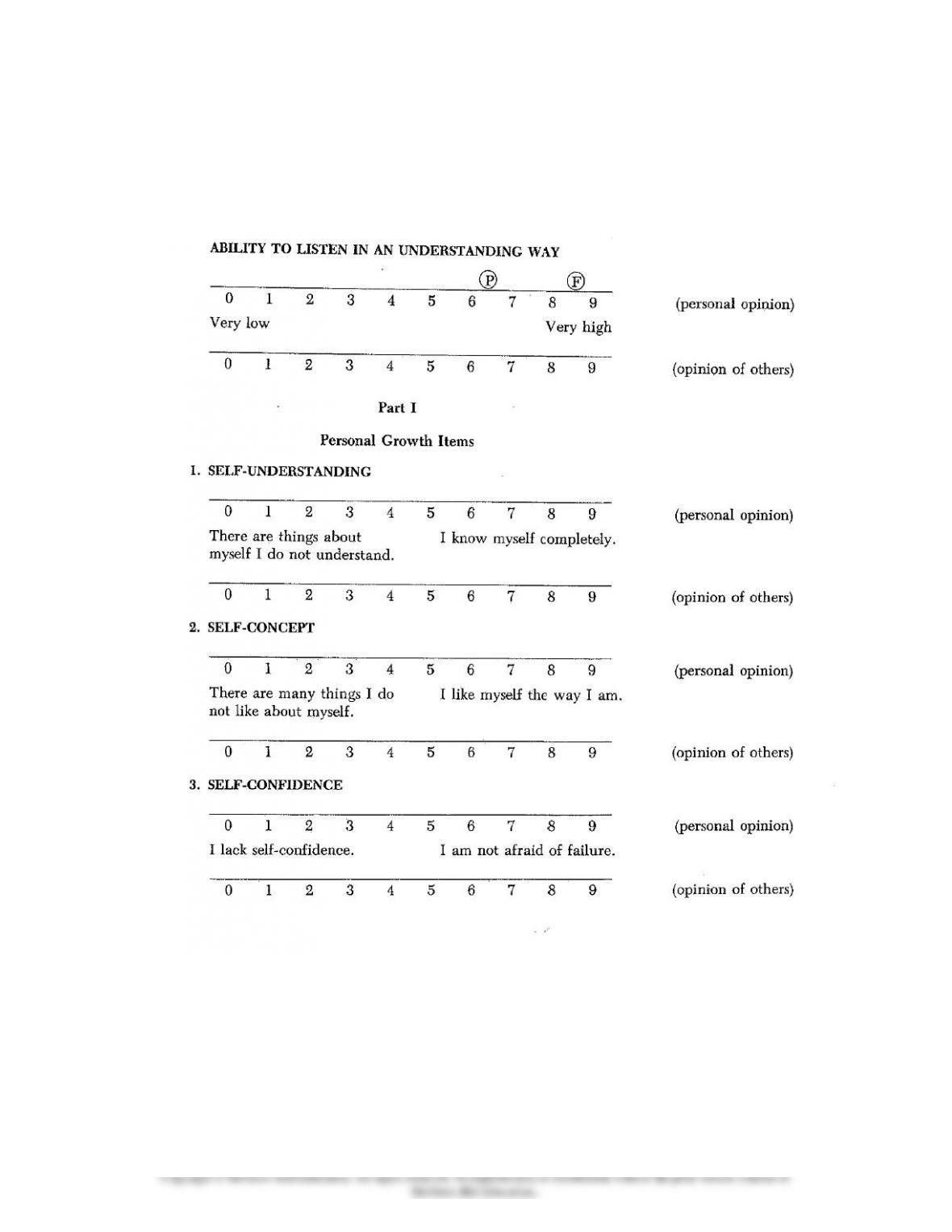
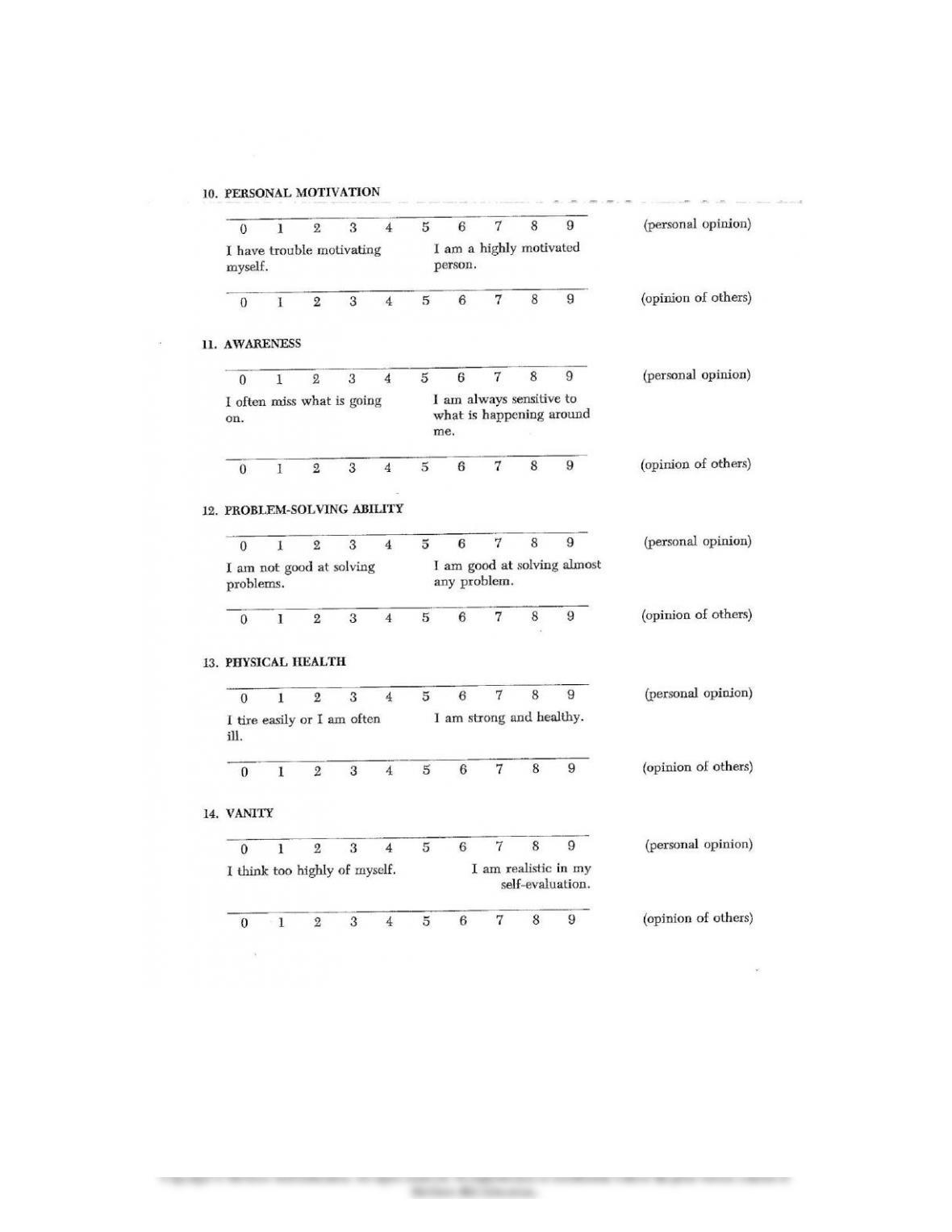
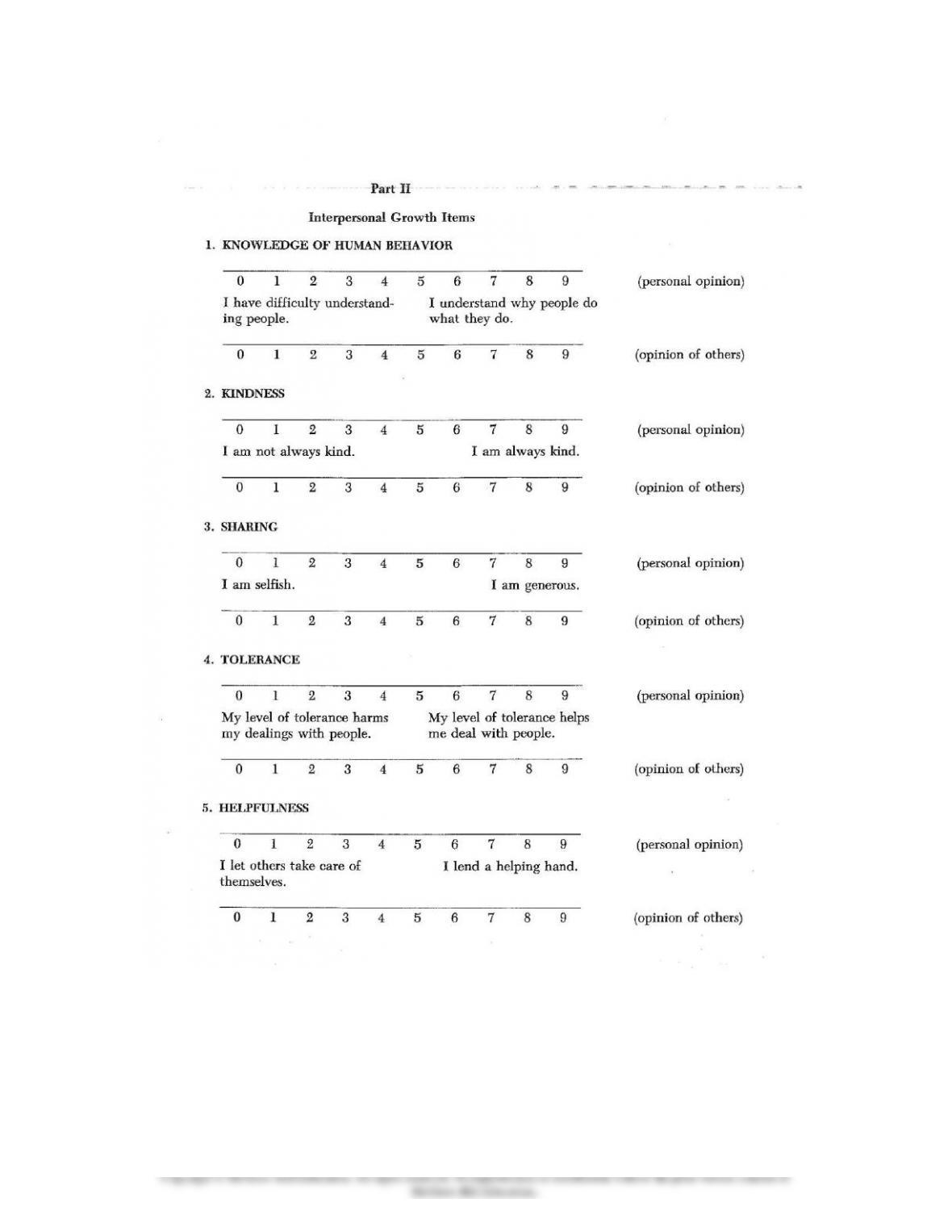
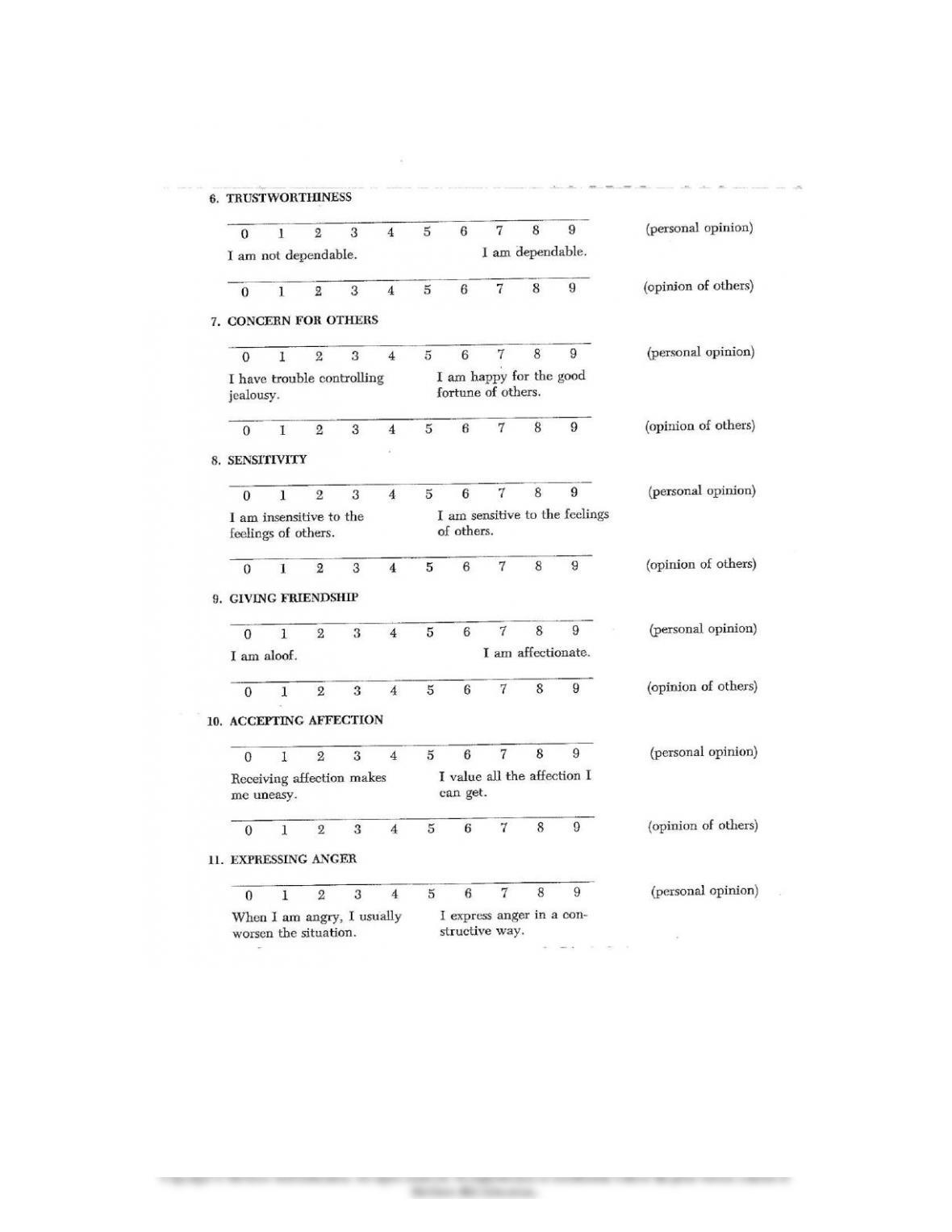
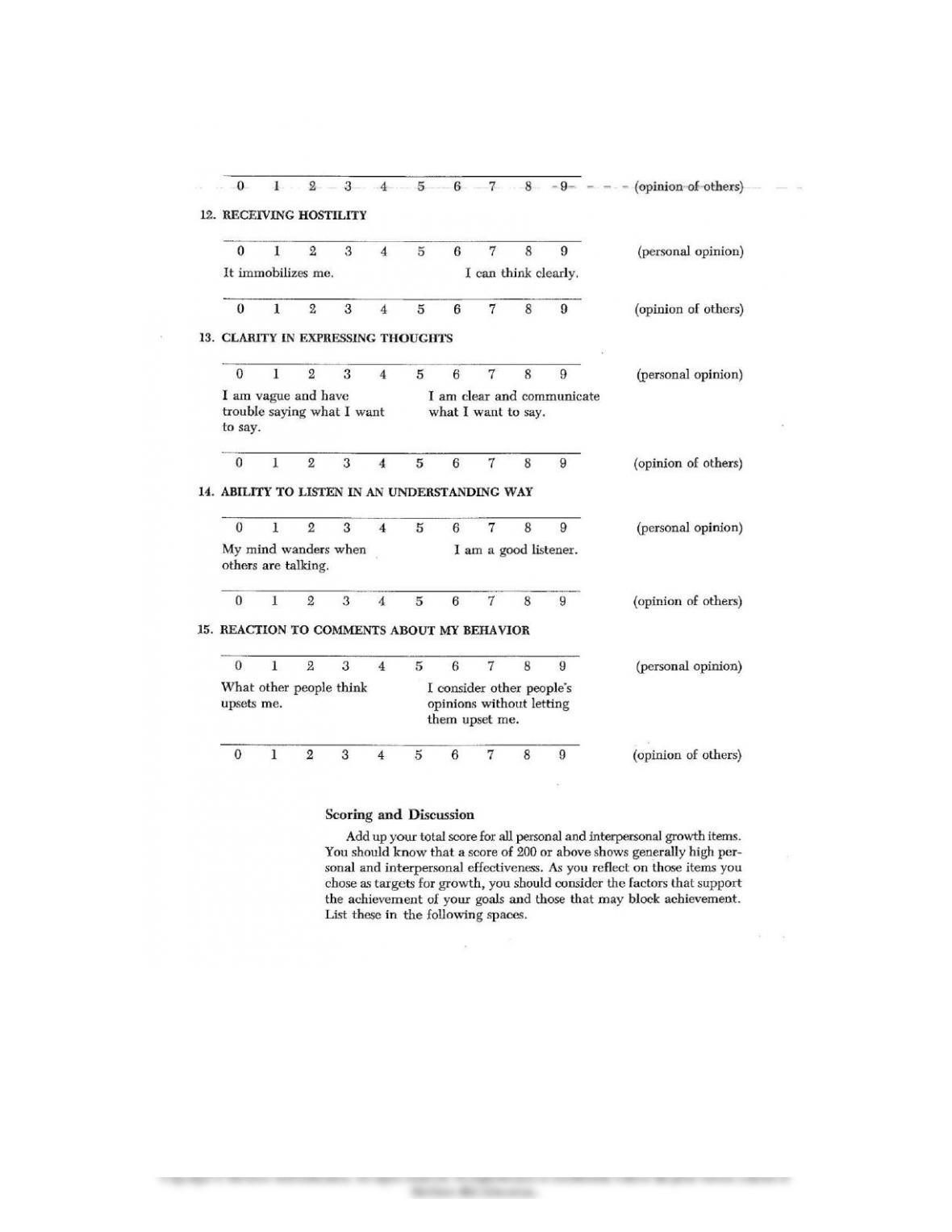
The following is a two-part inventory designed to help you maximize personal and
interpersonal growth. The inventory may be used alone, with another person, or in a group. This
is an instrument for learning and is not a test.
Directions
Read each item and place a “P” on the scale at the position that best describes your
opinion of yourself at present. You may see yourself as encompassing a segment of the scale. If
so, draw a circle around that part of the scale and label the whole area “P”. Do the same for each
item indicating your goals for the future. Mark this point with an “F” (P = present, F = future).
After completing all of the items, go back and put a check next to the three or four that you would
most like to improve. Next, depending on the situation, you may want to have another person
evaluate you on the “opinion of others” scale, and then discuss both evaluations.
Source: Jacques Huber, Southwestern Ohio Steel Company, 1976. Based on the work of Michael G.
Blansfield and Gordon L. Lippitt.
Part 08 – Developing Others
8-101
EXERCISE 8.5: PERSONAL AND INTERPERSONAL GROWTH (continued)
Example

Part 08 – Developing Others
8-102
Part 08 – Developing Others
8-103
Part 08 – Developing Others
8-104
Part 08 – Developing Others
8-105
Part 08 – Developing Others
8-106

Part 08 – Developing Others
8-107
Factors That Support you In Your Growth Goals
Factors in self: ________________________________________________________________
____________________________________________________________________________
____________________________________________________________________________
Factors in others: ______________________________________________________________
____________________________________________________________________________
____________________________________________________________________________
Factors in the work situation: ____________________________________________________
____________________________________________________________________________
____________________________________________________________________________
Factors That May Block You In Your Growth Goals
Factors in self: ________________________________________________________________
____________________________________________________________________________
____________________________________________________________________________
Factors in others: ______________________________________________________________
____________________________________________________________________________
____________________________________________________________________________
Factors in the work situation: ____________________________________________________
____________________________________________________________________________
____________________________________________________________________________
Consider what you can do to reduce the blocking forces in your life and encourage the supporting
forces. Establish a plan to improve, and set realistic behavior and time targets. Implement your
improvement plan, and record results. Reinforce the progress you make through meaningful intrinsic and
extrinsic rewards. These steps will allow you to realize your potential for personal growth.

Part 08 – Developing Others
8-108
DISCUSSION QUESTIONS AND ACTIVITIES
To personalize the subject of developing others, ask your students to consider questions such as
these:
1. What are the conditions necessary for growth to occur?
2. What is your approach to developing others―shaman, priest, missionary, elected leader, or
mystic leader?
3. Discuss the rules for succeeding in one’s work, and explain how these rules apply to your own
experience.
4. Discuss do’s and don’t for keeping good employees.
5. Identify a job burnout victim and discuss emergency, short term, and long-term aid to
improve.
6. What can a leader do to help people through change? What are the roles of attitude and
personal example?
7. Where are you in the burnout process? What steps can be taken for emergency, short-term,
and long-term aid?