
Part 08 – Developing Others
8-21
Leisure and Recreation
Economic Well-Being
After you have filled in all of the boxes with your goals, review them. Change or modify your
statements if necessary. Next, consider you priorities. Some of your goals may be more
important to you than others. Rate each one with the 1, 2, 3 method: number 1’s are most
important, then number 2’s, and then number 3’s. Rank all of your 1’s in order of importance, and
assign a due date for accomplishing them using the following form.
1. 4.
2. 5.
3. 6.
1. 4.
2. 5.
3. 6.

Part 08 – Developing Others
8-22
Goals
Priorities
Target Dates
Allocate time and resources to your most important goals first. Consider how you can best use
your time and resources to accomplish as many of these goals as possible. At least once a year,
repeat this exercise. Your birthday or New Year’s Day are excellent times to think about who you
are, where you are heading, what you are doing, and why you are doing it.

Part 08 – Developing Others
8-23
Φ APPLICATION
Significant People and Critical Events
Introduction
The following exercise deals with significant people and critical events in your life.
The Significant Other Tree
In the blank space below, draw a “significant other tree.” On the roots, trunk, and leaves, place
the names of those individuals who have helped to shape your life.
After you have completed “the significant other tree,” discuss the following questions:
Part 08 – Developing Others
8-24
1. Who have been positive forces in your life?
2. Who have been negative forces in your life?
3. Who has influenced you most to this point in your life?
4. Whom have you influenced most to this point in your life?
5. Have you been a positive force, and for whom?
6. What is your opinion of your “significant other tree?”
The Critical Events Line
On the figure below, put the calendar year of your birth in the box marked “Beginning.” Put the
calendar year you expect to die in the box marked “Ending.” Place an X on the line at the point
that represents your age today.
Ending
(Time Line)
Beginning

Part 08 – Developing Others
8-25
Above the time line, indicate the positive events that have been especially critical to this point
in your life and the positive events you expect to experience from this point on in your life.
Below the time line, indicate the negative events that have been critical in the past and the
negative events you expect to face in the future.
After you have finished the “critical events line,” discuss the following questions:
Have the events you listed been predominantly good or bad?
Have these events been triggered primarily by you or by others?
Do you feel satisfied with your life up to his point in time?
Do you feel satisfied with the events listed for the future?
What is your opinion of your “critical events line?”

Part 08 – Developing Others
8-26
Notes and Anecdotes
EFFECTIVE TIME MANAGEMENT
The French writer-philosopher Voltaire asked an interesting question in his book
Zadig or the Book of Fate. “What, of all things in the world, is the longest and shortest,
the swiftest and the slowest, the most divisible and the most extended, the most neglected
and the most regretted, without which nothing can be done, which devours all that is little
and enlivens all that is great?”
To this, Zadig answered, “Time.” Then he said: “Nothing is larger, since it is the
length of eternity; nothing is shorter, since there is never enough of it to satisfy our wants.
Nothing is faster for the person who is happy; nothing is slower for one who is sad. In
smallness, time is infinitely divisible; in greatness, time has no limit. People neglect
time, but they regret the loss of it. There is no action that can be done without time.
Time stores in darkness whatever is unworthy, and makes immortal all that is truly
great.”
One of the most important factors in job performance is effective use of your time.
You know you have a time management problem when:
• You are always late for meetings and appointments;
• You are typically behind in your work, school, or personal responsibilities;
• You often feel hurried, harried, and hassled;
• You don’t have enough time for basics—sleeping, eating, family affairs;
• You often feel fatigues—worn out physically and mentally;
• You often forget appointments, meetings, and other responsibilities;
• You are constantly working;
• You can’t meet deadlines—even if you are constantly working;
• Your activities are fragmented, disjointed, and incomplete.
Time is both personal and finite. It is personal in that the beat statement of who you
are is the way you spend your time. Your use of time reflects your needs, goals, and
accomplishments as does no other single thing. Time if finite in that each person has
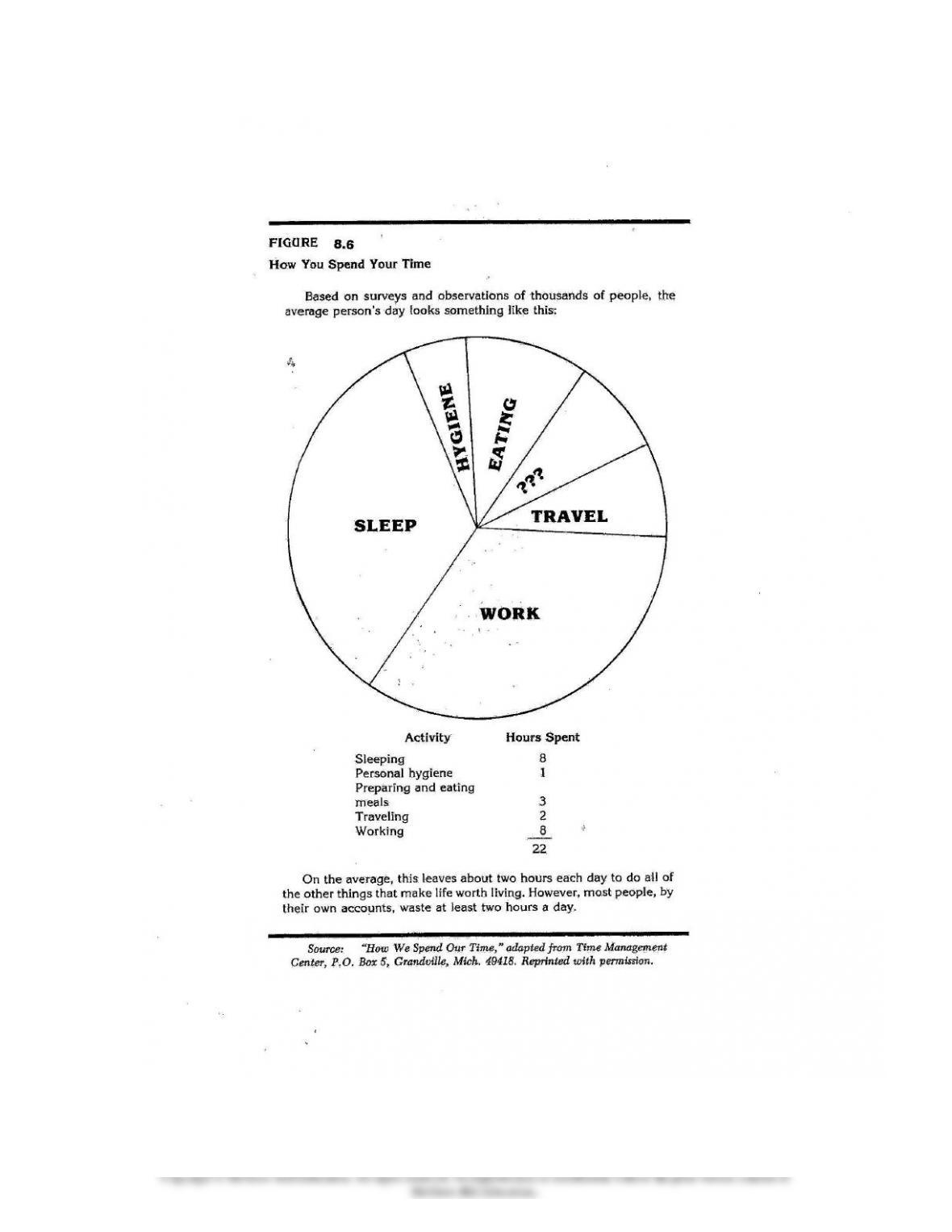
only 24 hours a day. Figure 8.6 shows how most people spend their time each day.
Part 08 – Developing Others
8-27

Part 08 – Developing Others
8-28
Getting full benefit from the 24 hours you have each day depends primarily on your
attitude toward time and on your time management skills.
The Importance of Attitude
The following shows an attitude toward time and life that will help you get the most
of both:
Just for Today…
Just for today, I will try to live through this day only and not tackle
all of my life’s problems at once. I hope I can do something for someone
and keep the memory of it for a lifetime.
Just for today, I will try to be happy. This assumes to be true what
Abraham Lincoln once said: “Most folks are as happy as they make their
minds up to be.”
Just for today, I will adjust myself to what is and try not to adjust
everything to my own desires. I will take my “chances” as they come and
fit myself to them.
Just for today, I will exercise myself in two ways: I will do somebody
a good turn and not get found out. I will do at least two things I don’t
want to do just because they are good for me.
Just for today, I will be agreeable. I will look as fit as I can, talk
softly, listen intently, act courteously, criticize not one bit, try not to find
fault, and try to regulate no one except myself.
Just for today, I will have a program. I may not follow it exactly, but I
will have it. I will try hard to save myself from two pests—hurry and
indecision.
Just for today, I will have a quiet moment or two all by myself and
relax. During this brief period, somehow, I will try to better myself and try
to get a better perspective of my life.
Just for today, I will be unafraid to enjoy what is beautiful and what is
common and to believe that as I give to the world and the people in it, so
will the world benefit.
Time Management Skills
The following story shows the importance of time management skills. Does the
situation sound familiar?
Bill slid behind the wheel of his car. It was late, and he was very tired.
As he thought back over his day, he said to himself, “Man, this job is
killing me!” He remembered arriving at work early and seeing the stacks
of paperwork and return call messages demanding his attention. At least
three of these were “hot items,” requiring immediate action. In his
briefcase were four letters he had written the night before to give to his
secretary and bits of a major report due by week’s end. In addition, there

Part 08 – Developing Others
8-29
was the note in his pocket from his wife: “Call the repairman.” Bill
remembered the desperation he had felt as he gathered his strength to dive
into the problems of the day. He felt like a rat, trapped in a familiar maze
and running a habitual treadmill. Finally, where was the coffee? He sure
wished he had a cup of coffee. Problems and people were to pour forth in
a relentless stream for ten consecutive hours.
Now, as he sat in his car, Bill thought; “The day has not gone
well…nor has the week. Come to think of it, the whole year has been one
crisis after another for the entire operation.” Several of his key people
seemed to feel “under siege” as well. Others didn’t seem to feel anything
at all. It was as if they were physically at work, but mentally absent—
undedicated and not very productive. Lately, it was as if everyone fell
into one of two camps—the unhelpful and the shell-shocked. Neither
camp had many smiles or many relaxed moments to savor
accomplishments. In fact, big-picture-wise, he himself had trouble
identifying the accomplishments of his operation. Bill thought: “Why is
this? Why do we lurch from personnel problems to financial crises to
production emergencies, one after another? Why do we always seem to be
fighting fires?”
Bill’s problem is called the “firehouse syndrome.” The symptoms are a high
level of frustration, overworked employees, burned-out managers, and decreased
productivity. The results are high stress levels, low morale, and organizational
breakdown. Often, the solution to the firehouse syndrome is better use of one’s
time. Bill could probably help his subordinates, his organization, and himself by
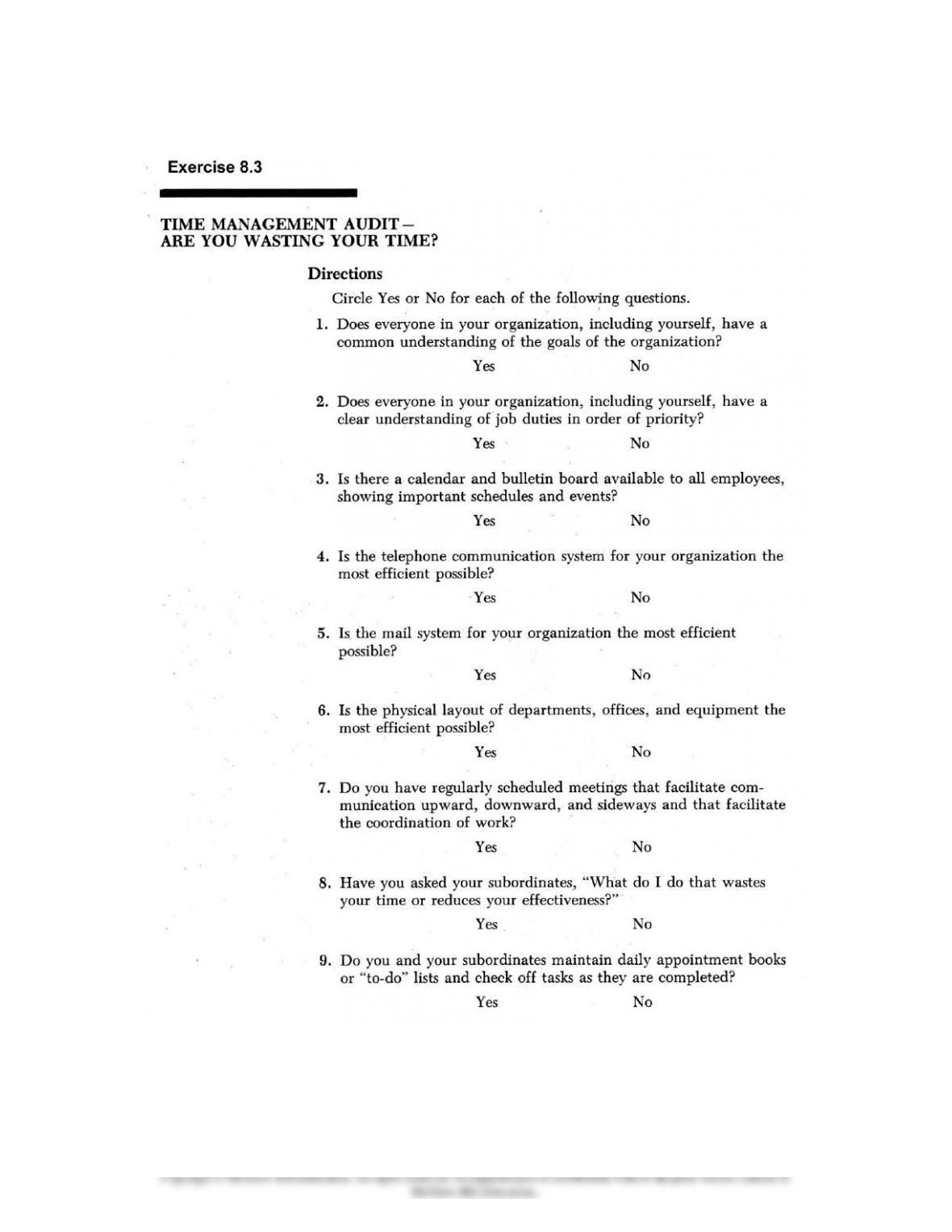
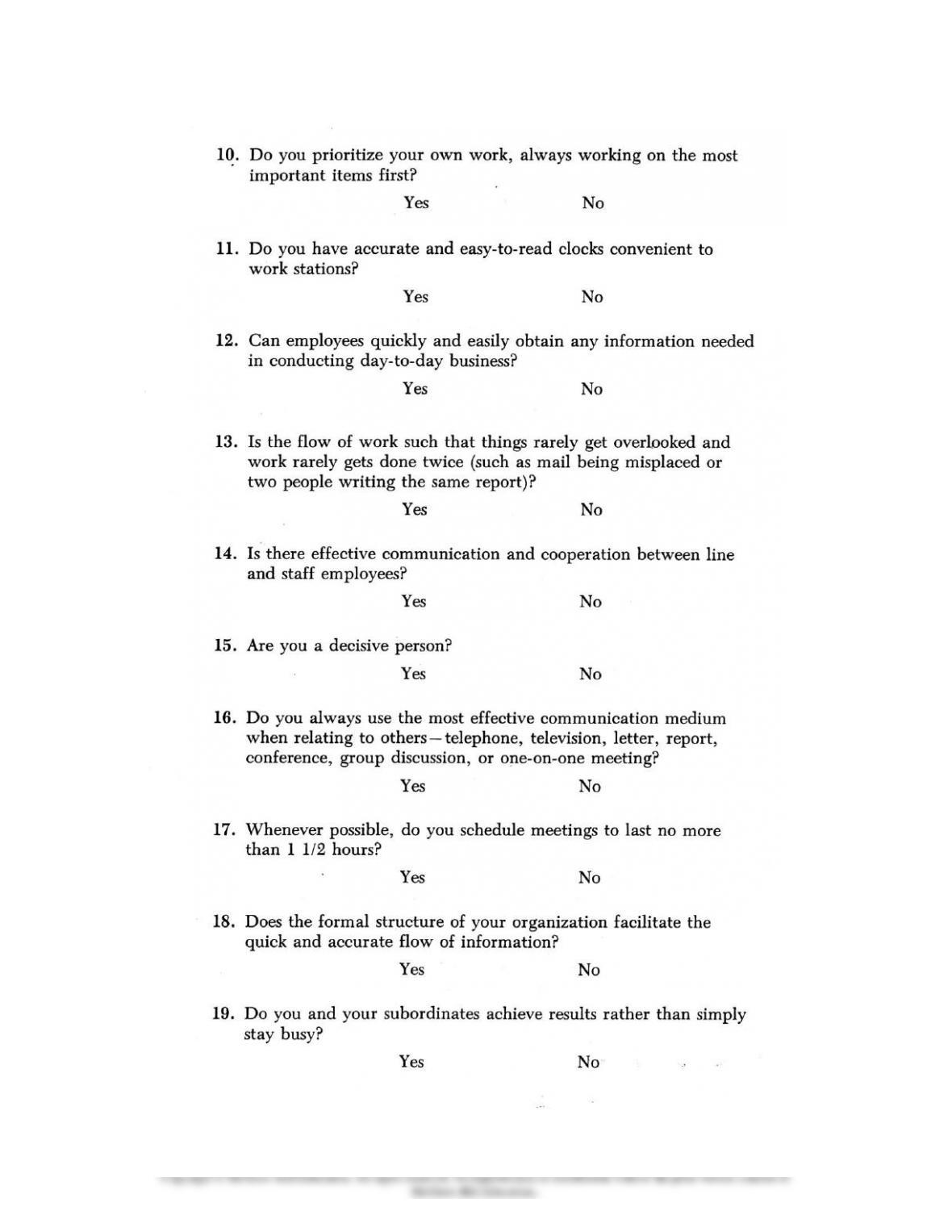
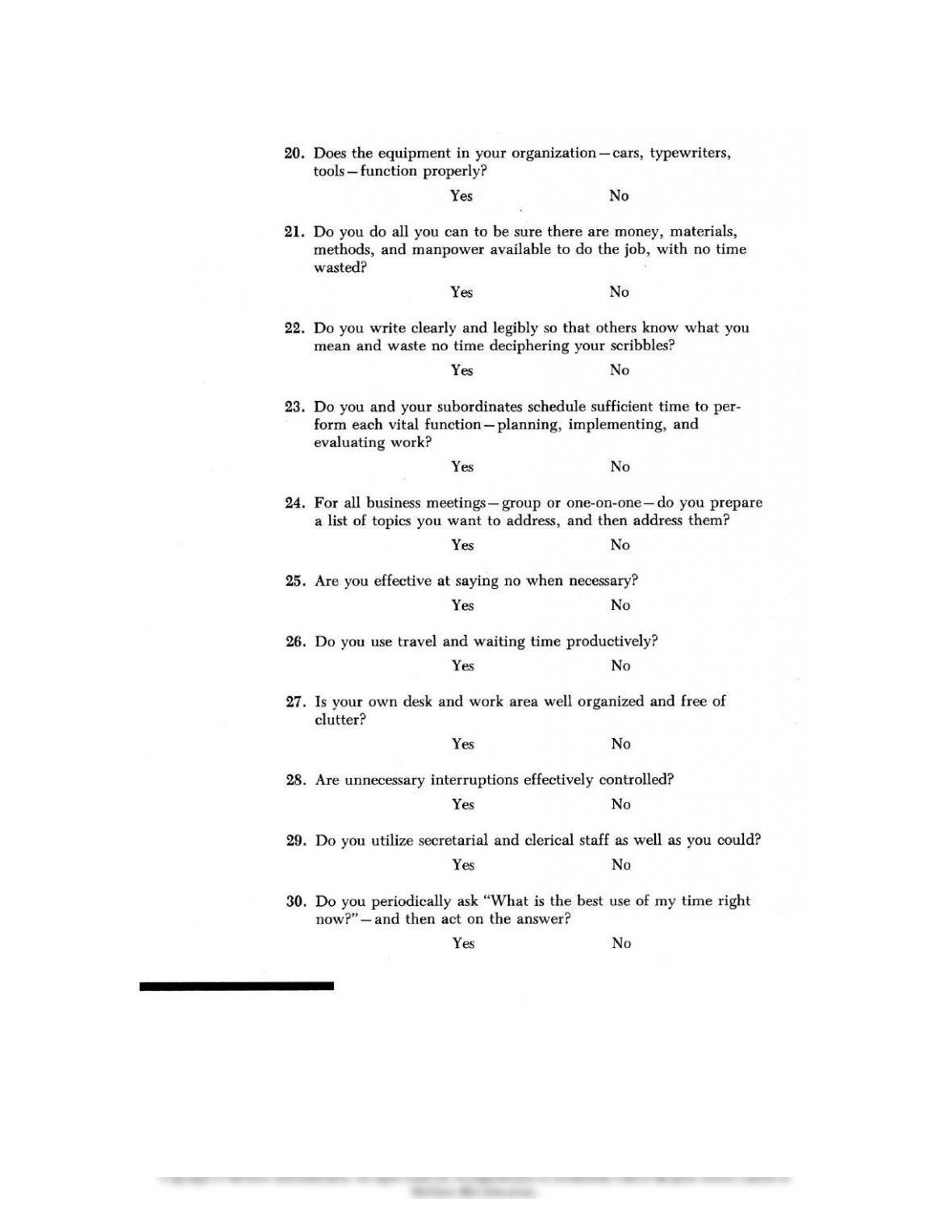
improving his time management skills. If you are a manager, complete the
following questionnaire to see if you are managing time effectively.
Part 08 – Developing Others
8-30
Part 08 – Developing Others
8-31
Part 08 – Developing Others
8-32

Part 08 – Developing Others
8-33
SCORING AND INTERPRETATION
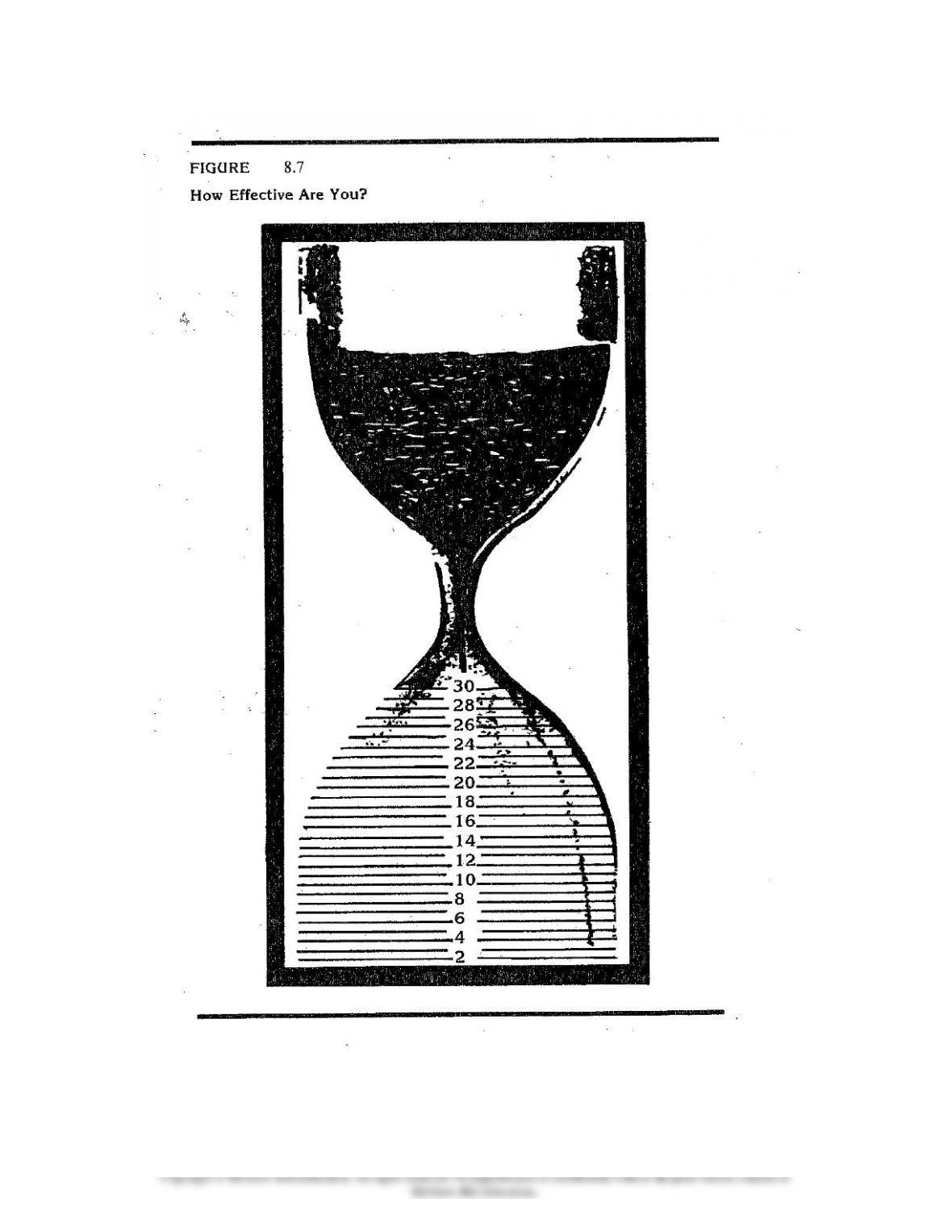
To find your score on the Time Management Audit, add up the number of yes
answers you circled and enter the total on the appropriate line of the hourglass in Figure
8.7. Fill in the space below this line to obtain a graphic illustration of your time
management effectiveness.
If you did not get a perfect score (30), go back to the items marked no and take
steps to correct your time management deficiency. This may require the help of others
who may be part of the problem or who may be affected by your poor time management
practices. You will know you have mastered your use of time when, besides having
achieved a perfect score on this test, you can sit quietly for at least two or three hours
during your work week to think about your organization, your work group, and yourself.
Every manager needs such time for thinking. You won’t have this time if you have
wasted it.
Notes and Anecdotes
Rules for Effective Time Management
People make many mistakes that result in wasted time, unfinished tasks, a sea of
paperwork, and missed opportunities. The following are rules for preventing or solving
the most common time management problems.
• Know what is expected of you. Good time management begins with knowing
what you are supposed to accomplish and in what order of priority. Reviewing
your responsibilities and objectives with your supervisor is of fundamental
importance. This review should result in mutual understanding of what you will
be accountable for and what your supervisor will do to help you succeed.
A manager in a computer software firm was criticized by the owner for being
ineffective. Asked why, the owner replied, “You have failed to keep the systems analyst
off my back.” The manager was surprised, and responded, “This must have been a
hidden purpose of my job. You never told me that before.” From that point on, the
manager increased his effectiveness by dealing with the complaints and concerns of the
systems analyst.
• Set priorities. Concentrate your time, energy, and talents on the tasks most
important to you and your organization. Busy people need a system for
prioritizing activities. One of the best methods is the “do–do” list. Make a list of
activities for each day and assign a one, two, or three rating to each item on the
list. Number one items are top priority; they have the highest value because they
must be done. Number two items have a medium value and should be done.
Number three items have the lowest value; they are worthwhile tasks (otherwise
they should not be on the list), but they are not critical. People who make best use
of their time work on number one items first, then number two’s, and relegate
number threes to a place that is out of sight but accessible if needed or after ones
and twos have been completed.
Part 08 – Developing Others
8-34

Part 08 – Developing Others
8-35
The following story illustrates how effective this method can be:
A well-known story about the efficiency of a to-do list concerns Charles Schwab
when he was president of Bethlehem Steel. He called in Ivy Lee, a consultant, and said,
“Show me a way to get more things done with my time, and I’ll pay you any fee within
reason.”
“Fine,” Lee replied. “I’ll give you something in twenty minutes that will step up
your output at least fifty percent.”
With that, Lee handed Schwab a blank piece of paper, and said: “Write down the
six most important tasks that you have to do tomorrow, and number them in order of their
importance. Then put this paper in your pocket, and the first thing tomorrow morning
look at item one and start working on it until you finish. Then do item two, and so on.
Do this until quitting time, and don’t be concerned if you have finished only one or two
items. You’ll be working on the most important ones first anyway. If you can’t finish
them all by this method, you couldn’t have by any other method, either; and without
some system, you’d probably not even have decided which was the most important.”
Then Lee said: “Try this system every working day. After you’ve convinced
yourself of the value of the system, have your employees try it. Try it as long as you
wish, and then send me a check for whatever you think it’s worth.”
Several weeks later, Schwab sent Lee a check for $25,000 with a note
proclaiming the advice to be the most profitable he had ever followed. This concept
helped Charles Schwab earn $100 million and turn Bethlehem Steel into the biggest
independent steel producer in the world.
You may think Charles Schwab was foolish to pay $25,000 for such a simple
idea. However, Schwab thought of that consulting fee as one of his best investments.
“Sure, it was a simple idea,” Schwab said. “But what ideas are not basically simple? For
the first time, my entire team and I are getting first things done first.”

Part 08 – Developing Others
8-36
• Start each day by making a to-do list. Make this practice as habitual as brushing
your teeth. Write down all the things you want to accomplish that day, and rank
these in order of importance. The small amount of time you invest in doing his
will repay you many times over. Two points to remember: make sure your to-do
list is on one sheet of paper rather than several sheets. Also, make the list on a
pad or piece of paper small enough to carry in your pocket or purse; it should go
where you go. If you are ever tempted to keep your to-do list in your head,
remember what Ziggy said: “I made a mental note to remember something very
important I had to do today…but I lost the note.”
• Eliminate time wasters. Good time management requires combining similar tasks
and eliminating unnecessary ones. You should eliminate meetings that serve no
useful purpose, eliminate unnecessary paperwork, and strive for efficiency in
travel. Why take several trips to town when all errands could be combined? Why
take a trip by plane if a telephone call will accomplish the same purpose?
• Make good use of waiting time. In our complex and interdependent society, we
often run into delays—at the repair shop, the bank, or the airport. Be prepared to
sue this time productively. Reading, writing, thinking, talking, resting, and
exercising are all preferable to wasting time.
• Log your day. Keep track of what you do each day for a period of one month. It is
good to know how you are spending your time, and the analysis may reveal
surprises.
One bank asked its branch managers to record the time they spent under
three headings—time with customers, time with administrative duties, and time
with staff. Analysis showed that too much time was spent on internal
administration and too little time was spent on marketing and staff development.
• Learn how, when, and why to say no. One of the best time management
techniques is the effective use of words yes and no. If saying yes helps
accomplish important goals, by all means do so. But if saying yes prevents you
from accomplishing more important things, learn how to say no in a tactful way.
If your supervisor interrupts your work with an additional assignment, discuss
how the new task will affect existing ones. Obtain a clear understanding of the
priorities of all your assignments.
• Stock up and clean house. Having the correct tools and materials, and knowing
where they are, saves time and energy. Proper supplies and an orderly work area
are basic to good time management. A few hours of housecleaning and stocking
up several times a year will usually improve efficiency.
• Provide enough time. The saying, “Haste makes waste,” is true. If you do not
give yourself sufficient time to accomplish a task, mistakes and decreased
performance are inevitable. As a rule of thumb, complex meetings involving
employee counseling, project planning, and staff development require at least one
hour from the moment they begin. A one-hour minimum is usually necessary to
establish a productive atmosphere, share basic information, deal with important
issues, draw conclusions, make decisions, agree on future steps, and end the work
session on a positive note.

Part 08 – Developing Others
8-37
• Work when you are fresh. If you have an especially critical day ahead, rest up the
night before. Otherwise, fatigue may affect judgment and results.
• Focus your efforts. A fundamental rule of effective time management is to
concentrate on the task at hand. Frustration and mistakes result from trying to do
too many things at once. Often it is not the quantity of time spent on a project
that counts, but the quality of time.
• Attack uninteresting tasks when your energy level s high. People have the
tendency to do what they enjoy, postponing uninteresting or unpleasant jobs until
their enthusiasm and energy are so low that these jobs become even less
enjoyable, and therefore harder to accomplish. By working on low-interest tasks
when your energy is high—whatever time of day that is—you will get more done
in the long in. When you complete the uninteresting task and turn to interesting
assignments, you will feel stimulated and energized.
• Don’t build a castle when a log cabin will do. The extra refinement may not be
worth the expense when a log cabin will accomplish the same purpose. This
principle applies in time management as well; in some instances, the best possible
performance may be far better, and far more expensive, than is necessary. For
example, a manager usually should not spend time performing tasks subordinates
could do. Even if the manager can do a better job, the loss in efficiency,
employee growth, and overall productivity of the work unit may not be worth the
extra refinement.
• Practice good telephone techniques. Avoid taking telephone calls while you are in
important meetings and problem-solving sessions. If you are working with
others, these interruptions will reduce both efficiency and goodwill. Save your
calls, and set aside a certain period of time to respond to them. Returning calls
one half hour before or after lunch, one half-hour before the end of the workday,
and the first half hour of the following workday is effective for many people.
Initiating telephone calls when others are most available and receptive is
another good practice. For example, you should avoid calling a company
president on the morning of the monthly board meeting. In general, it is best to
initiate telephone calls early in the morning, late in the morning, early in the
afternoon, and late in the afternoon of the business day. Remember, the telephone
can be both a time helper and time waster. One study found that 25 percent of the
time spent on the telephone was used in waiting.
• Use efficient mail and paperwork practices. Set aside a specific time of the day or
week to read mail and do paperwork. If you try to read incoming mail and
paperwork as it arrives, the quality of your work probably will deteriorate because
your efforts will lack a clear focus. A good technique is to reserve the last hour or
so of the workday for correspondence and paperwork.
Effective time management requires handling each piece of paper as few
times as possible. Each item should be dispatched in one of the following ways:
(a) read the item for information and discard it; (b) make a personal response,
such as making a telephone call, or dictating a memo, and then file the item; (c)
route the item to others for follow-through; (d) store the item for future personal
attention.
Part 08 – Developing Others
8-38
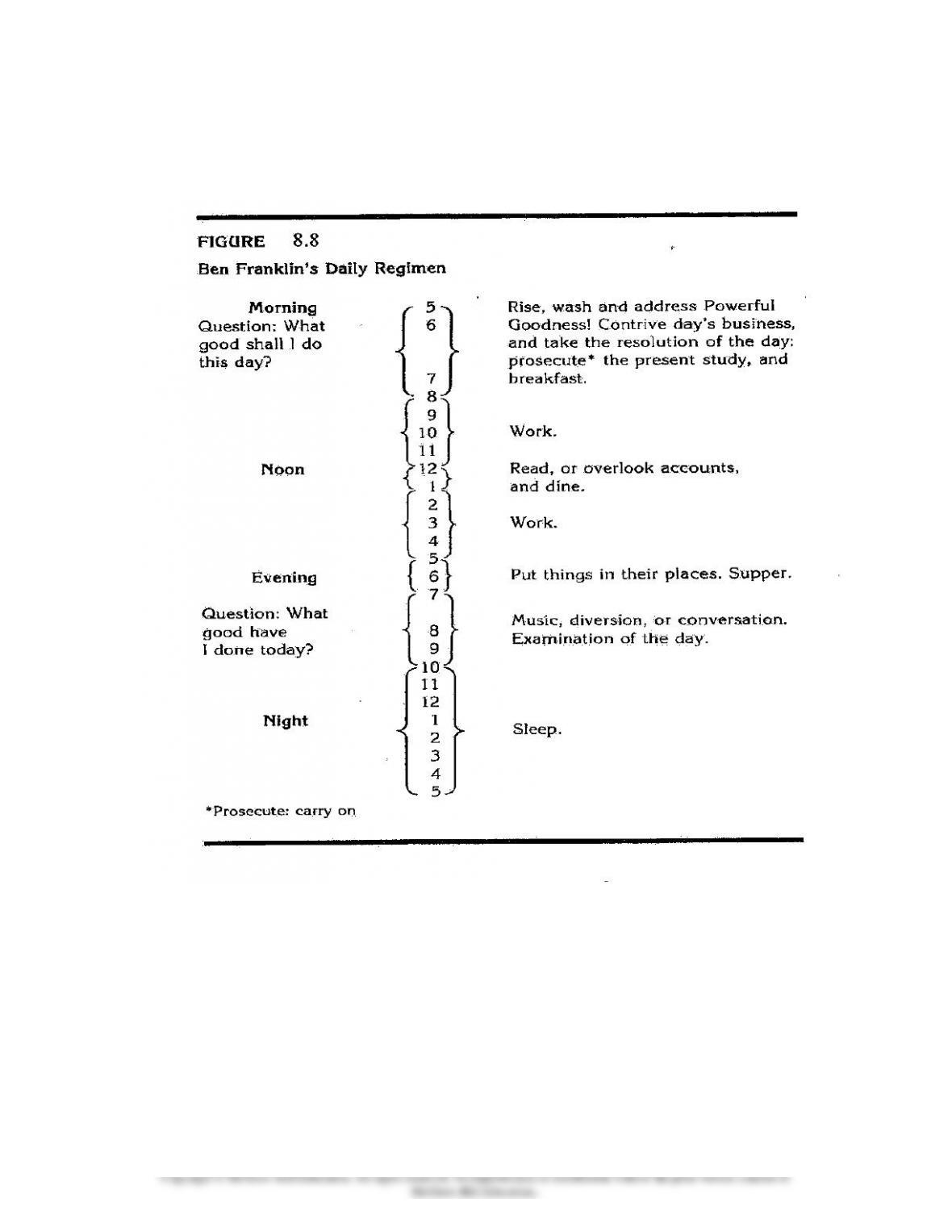
• Keep a schedule. Establish a work schedule that is efficient and satisfying, and try
to follow it as much as possible. The idea of having a plan for the day is an old
one, as shown in Figure 8.8.
• Keep a delegation file. Time and energy are wasted when managers fail to follow
up on tasks they delegate. Relying on memory is not good enough. A good
technique is to use a file or calendar to record assignments and review progress.
• Use meetings effectively. A meeting is a two-edged sword. It can be useful and
productive, or it can waste valuable time. Keep in mind that all who attend
meetings are individuals who may have something valuable to contribute and who
are contributing their own valuable time. The following are important points to
consider when planning and conducting a meeting:

Part 08 – Developing Others
8-39
a) Assure yourself that a meeting is necessary. Know the purpose of the meeting
and what you expect to accomplish.
b) Schedule the meeting far enough in advance to allow participants time to prepare.
c) Inform each participant of the nature of the meeting and the specific role you wish
the person to play—providing information, recording minutes, generating ideas,
making decisions.
d) Control the size of the meeting by inviting only those individuals who can benefit
or contribute.
e) Prepare an agenda, limiting the topics of discussion to a number that can be
reasonably handled in one session. Usually, meetings should convene and end
within a period of 1 ½ hours.
f) Advise people in advance if you expect them to make a presentation.
g) Begin and end on time.
h) During the meeting, be specific and clear and use data to support your statements.
i) Try to understand why people act in different ways, and use this knowledge to
avoid personal rivalries. When necessary, reject ideas—not people.
j) Know when to delegate. You can remove some of the burden from your
shoulders and keep everyone involved as well.
k) Before adjourning, review the purpose of the meeting, the accomplishments, and
what participants are to do next.
l) After the meeting, see that minutes are prepared and that everyone gets a copy.
Part 08 – Developing Others
8-40
Notes and Anecdotes
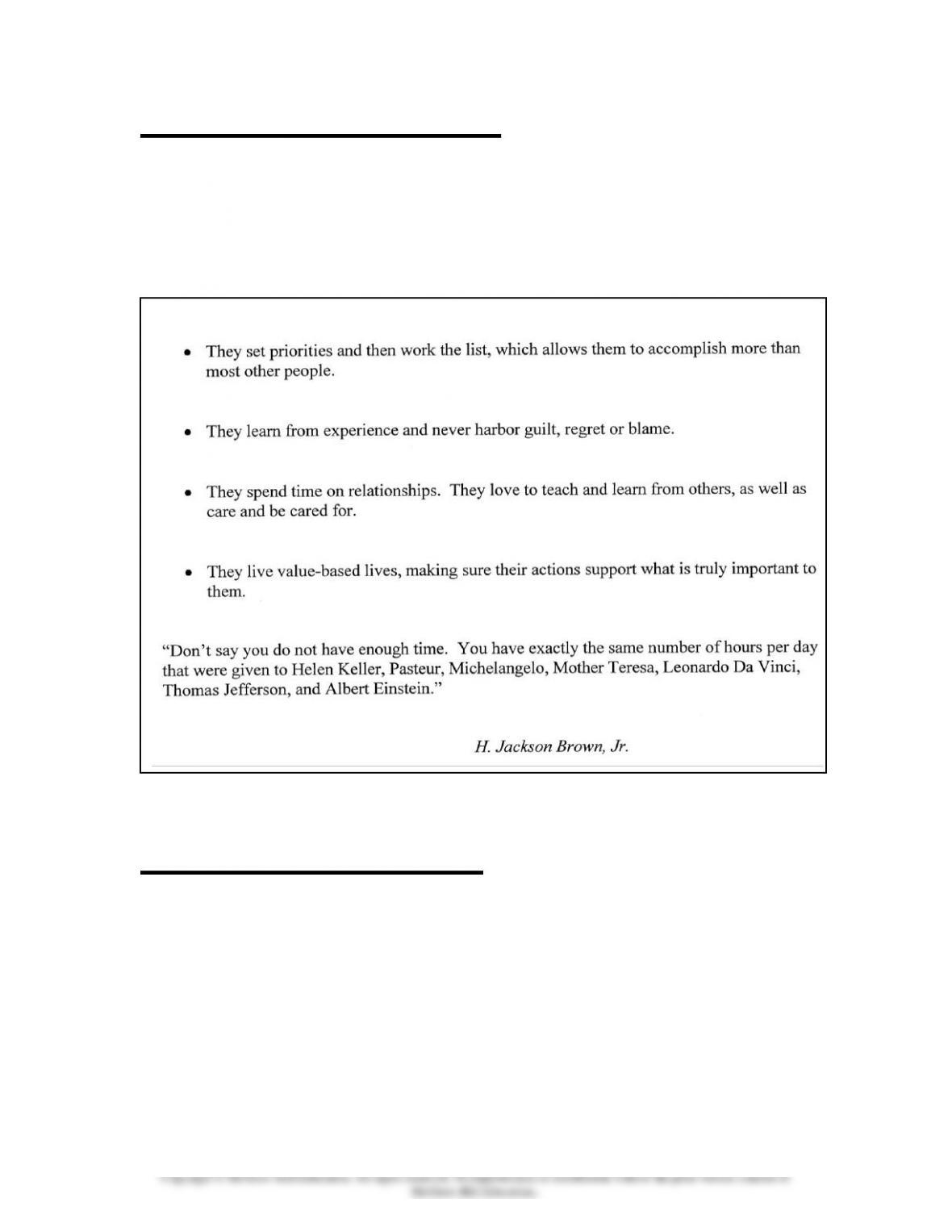
FOUR KEY TRAITS OF PEOPLE WHO ARE AT EASE WITH TIME