
Part 08 – Developing Others
8-1
Major Purposes of Part Eight
Part Eight focuses on four important subjects—
developing others, career development, helping people
through change, and burnout prevention.
Part Eight Objectives
After completing Part Eight, your students should be
able to better understand:
• The role of the leader as teacher and developer of people;
• Principles, methods, and techniques for developing others;
• Basic advice on career management;
• How to keep good employees;
• How to help people through change; and
• How to avoid job burnout.
PART EIGHT—Developing Others

Part 08 – Developing Others
8-2
NOTES AND ANECDOTES
New Employee Orientation
Exercise 8.1 presents a checklist for new employee orientation, one of the most important
development functions of a leader. The orientation checklist helps new people get off to a good
start. It also gives a positive impression of the leader as someone who cares and of the
organization as a good place to work. This checklist can be used by an organization to design an
effective orientation program.
EXERCISE 8.1: CHECKLIST FOR NEW EMPLOYEE ORIENTATION1
This outline can be followed for welcoming and training new employees. The orientation period
is important for winning the worker’s loyalty, stimulating interest, and helping the employee to be
productive. For each new employee, check each item and enter the date as it is completed.
Date Completed
1. Get ready to receive the new employee
❑ Have an up-to-date job description or list of duties and
responsibilities available for discussion. ________
❑ Review employee work experience and education. ________
❑ Have workplace, equipment, and supplies ready. ________
2. Welcome the new employee
❑ Explain your relationship to the new employee. ________
❑ Assign workplace and equipment. ________
3. Show interest in the employee
❑ Discuss the employee’s background and interests. ________
❑ Inquire about transportation to and from work; discuss
parking and security ________
❑ Discuss pay procedures and suggest sources of assistance:
A) Payroll; B) Accounting; C) Credit Union. ________

Part 08 – Developing Others
8-3
4. Explain the organization and the work group
❑ Describe the mission, goals, activities, and traditions of the
organization. ________
❑ Review the organization chart. ________
❑ Indicate the employee’s position in the organization. ________
❑ Explain the function of the work group. ________
❑ Explain the relationship of the employee to
others in the work group. ________
5. Introduce employee to co-workers
❑ Explain the new employee’s duties. ________
❑ Explain duties of each co-worker. ________
❑ Arrange for a co-worker to take the employee to lunch. ________
6. Show the layout of the work setting and available facilities
❑ Explain layout of work area. ________
❑ Show elevators, washroom, water fountain, fire exits
and other facilities. ________
7. Explain rules and regulations
❑ Hours of work. ________
❑ Punctuality and attendance. ________
❑ Lunch period. ________
❑ Rest periods. ________
❑ Use of telephone. ________
❑ Personal leave. ________
❑ Other rules, practices and procedures (smoking, fire regulations, etc.). ________
❑ Give written materials for later review (handbook,
policies, etc.). ________

Part 08 – Developing Others
8-4
Copyright © McGraw-Hill Education. All rights reserved. No reproduction or distribution without the prior written consent of
McGraw-Hill Education..
8. Train employee in job assignment
❑ Provide helpful instruction. _______
❑ Explain quality and quantity work standards. _______
❑ Provide learning aids—samples of work, manuals, job aids,
procedures, lists of special technical terms, etc. _______
❑ Stress security and safety aspects of job. Include OSHA
rules/guidelines. _______
❑ Indicate availability for future assistance. _______
9. Follow-up
❑ Check frequently on progress. _______
❑ Encourage questions. _______
❑ Make corrections and give encouragement. _______
NOTES AND ANECDOTES
What are the four characteristics of a good employee orientation program?
1) Give people what they need—before they ask.
2) Allow ample time for adjustment—days (or weeks), not hours. Orientation isn’t going to be
complete in a two-hour seminar.
3) Make orientation universal. Everyone from the front line employee to the new president
needs to learn the culture (think Disney, Starbucks, Southwest Airlines, Google, etc.).
4) Make orientation a positive experience. Remember, first impressions are lasting.
Does new employee orientation work? Is it worth the effort? Corning Glass Works has found
that employees who go through a structured orientation program are 69 percent more likely to be
with the company after three years than those who were left on their own to sort out the job.
Texas Instruments has found that employees who receive orientation training to the company and
their jobs reach full productivity an average of two months earlier than those who do not receive
training. Case after case shows that a well developed and executed new employee orientation
program makes a big difference between keeping good people and revolving door turnover.

Part 08 – Developing Others
8-5
NOTES AND ANECDOTES
Because developing others is so important, it is no wonder that teaching is called the highest
calling, and that so many leaders find training others to be so satisfying. Read carefully the
following profile of one of the most influential teachers in history. Remember that Socrates
taught Plato, who taught Aristotle, who taught Alexander; and collectively these ancient Greeks
taught Western civilization. The ideas and conduct of over 3 billion people have been influenced
by these great teachers. Caring leaders who believe in developing others will relate to the story of
Socrates.
The Highest Calling
Men and women were his objective; to them he had a mission. He wandered
through the streets and down to the market place, or often he would go to the
public gymnasium. Then he started business—the business of teaching. He would
talk to all people. High and low, great personages and folk of no importance
would listen to him and answer, or pretend to answer, the teasing questions by
which he made his points. It was his pretense to be the most ignorant man in any
discussion. He would use simple illustrations and ask simpler questions—the
famous Socratic technique—to draw his hearers to the examination of good.
Goodness was his objective. Socrates believed that all people would seek
goodness if they had true knowledge of it; that all virtue was the knowledge of
goodness; all sin the ignorance of goodness.
The life of Socrates was a living example of his ideals. His philosophy, as set
forth by Plato, marks an epic in human thought. “He brought philosophy down
from heaven to earth,” wrote Cicero. For Socrates was the founder of moral
philosophy. He was not concerned with abstract metaphysics, but with mankind
and its conduct. He was scoffed at for taking his examples from common life, but
he did so to lead the everyday person to goodness, truth, and beauty.
NOTES AND ANECDOTES
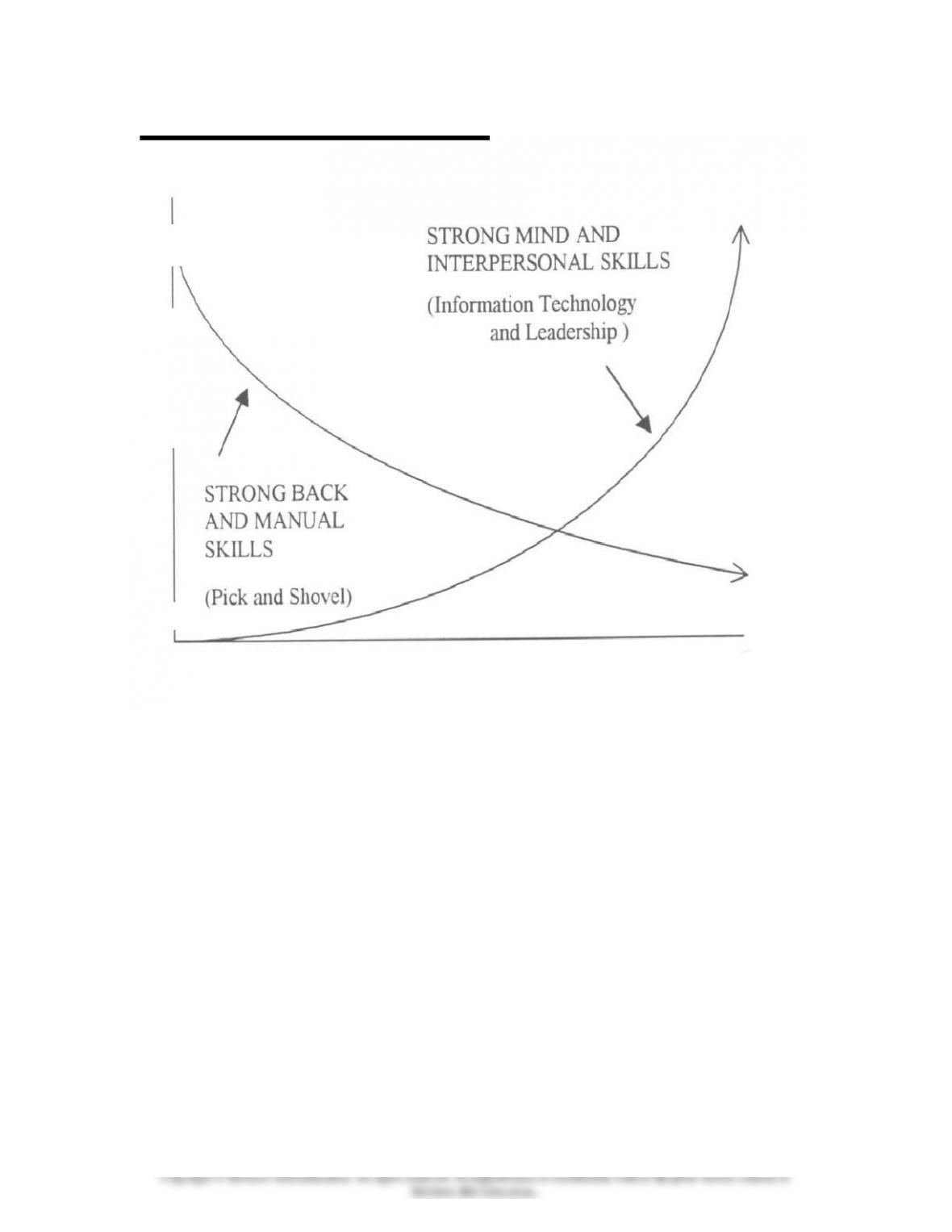
Identify Training Needs. Training needs equal the total requirements of the job minus current
performance. Training needs fall into three categories: skills (such as reading and writing),
attitudes (such as cooperation and self-confidence), and knowledge (such as history and science).
As Figure 8.1 shows, training needs have been changing over the years because of the changing
nature of jobs. There has been increasing need for people with strong minds and interpersonal
skills.
Part 08 – Developing Others
8-6
FIGURE 8.1: THE CHANGING NATURE OF JOBS AND TRAINING NEEDS
EXERCISE 8.2: NUMBERS NEVER LIE
Directions: Your task is to circle the numbers in Figure 8.2 beginning with 1 and proceeding
sequentially through 2, 3, 4, and so forth, to 60. Do not skip any numbers. You are to circle as
many as possible within 60-second time limit.
High
Low
Training Needs
1900’s
1930’s
2000’s

Part 08 – Developing Others
8-7
FIGURE 8.2: NUMBERS WORKSHEET
Discussion:
Now that you have completed the task, how did you do? How do you feel? Perhaps you did not
do as well as you would have liked, and probably you feel frustrated, much like Roger did in the
foregoing story.
Further Directions:
At this point, you are asked to repeat the task, but this time you will be given the benefit of
training.
Step 1:
Draw a straight line between the dots at the top and bottom of Figure 8.3.
Step 2:
Draw a straight line from the dot at the left side of the figure to the dot on the right side of the
figure.

Part 08 – Developing Others
8-8
FIGURE 8.3: NUMBERS WORKSHEET
Step 3:
You now have four quadrants. Notice that all the odd numbers are on the left side of the vertical
line; the even numbers are on the right side. Notice also that the first five numbers are in the top
half of the figure, the next five numbers are in the bottom half of the figure, and so on for every
sequence of five numbers up to 50. Finally, notice that numbers 51 to 60 alternate back and forth
from the lower left quadrant to the top right quadrant.
Step 4:
Your task is to circle the numbers in Figure 8.3, beginning with 1 and proceeding sequentially
through 2, 3, 4, and so forth, to 60. Do not skip any numbers. You are to circle as many as
possible within a 60-second time limit.

Part 08 – Developing Others
8-9
Further Discussion:
How did you do this time? How do you feel? Typically, people will do at least 25 percent
better—and even as much as 100 percent better. Usually, they feel much less frustrated. Both
performance and attitude improve because training has been provided. Again, think of Roger and
how his life might have changed for the better if his teacher had taken the time to give him proper
instructions.
The number counting that you did in the exercise was a simple task. In the work setting,
however, many complex and important jobs are performed—everything from repairing cars to
repairing bodies. Consider the potential for improving the quality of work and the quality of work
life through proper training. Imagine the benefit we would gain with even a 25 percent
improvement in job performance and satisfaction.
NOTES AND ANECDOTES
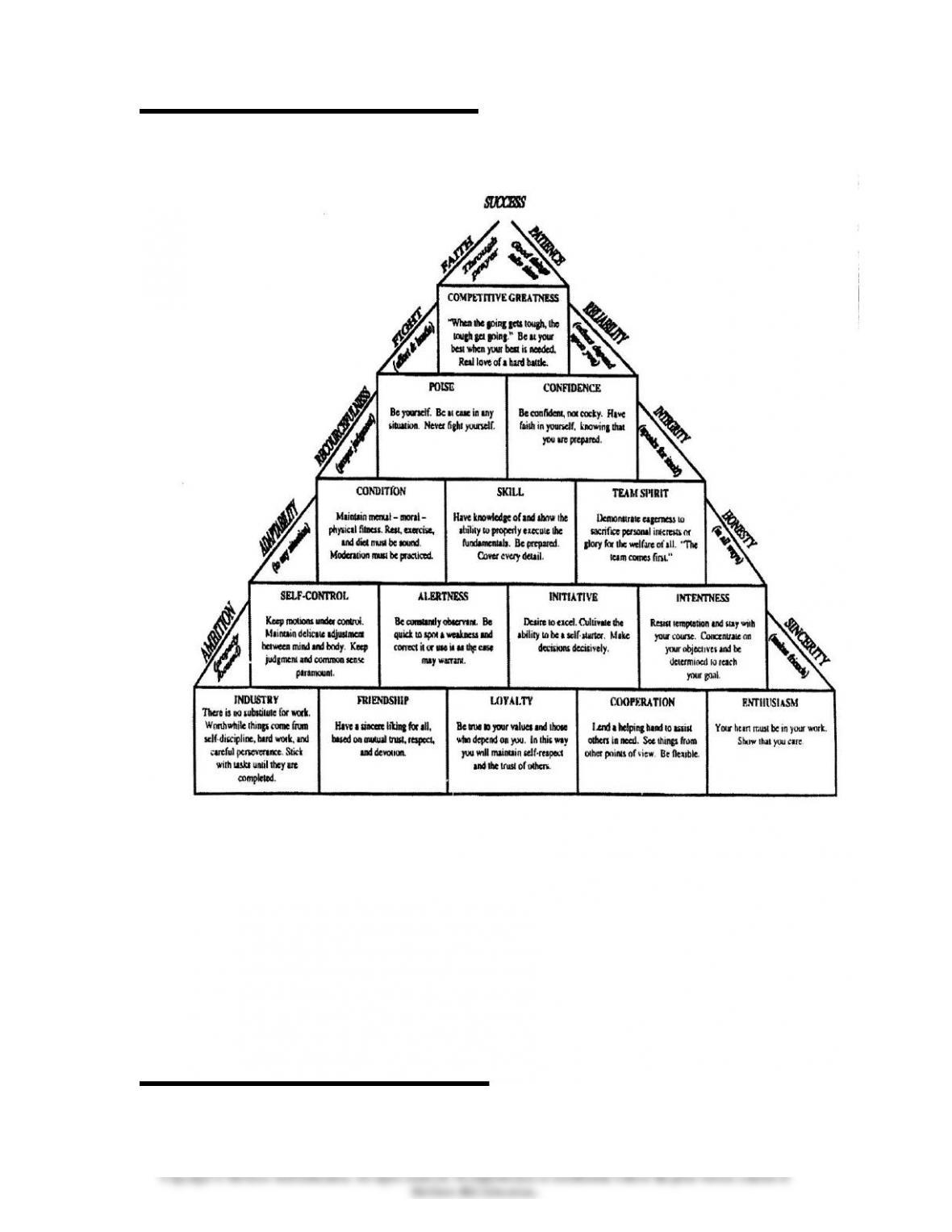
John Wooden was head basketball coach of UCLA and winner of ten NCAA national
championships. He was a master teacher and developer of people. He believed success to be
peace of mind that is the direct result of knowing that you have done your best to become the best
that you are capable of becoming. Wooden shared his ideas with students and players whenever
he could. His basic beliefs are capsulized in a pyramid of success. See Figure 8.4. Wooden’s
Pyramid of Success applies in all fields of work and all levels of responsibility. It is an excellent
resource for developing people.
Part 08 – Developing Others
8-10
FIGURE 8.4: PYRAMID OF SUCCESS

Part 08 – Developing Others
8-11
NOTES AND ANECDOTES
Types of Teacher/Leaders
Whether a leader is shaman, priest, elected leader, missionary, or mystic healer by type, certain
qualities are important for the leader to possess:
• Knowledge. Above all, leaders should possess knowledge of the subject. Successful leaders
will keep job knowledge current and maintain competence in their fields.
• Enthusiasm. IQ (intelligence quotient) and PQ (personality quotient) are important, but EQ
(enthusiasm quotient) is essential. The caring leader’s enthusiasm and dedication will ignite
a positive attitude in followers.
• Helpfulness. Leaders should teach for the benefit of others, not for personal advantage.
The leader’s goal is to share information and help others grow. The caring leader shows
interest and support for the learner.
• Cheerfulness. A smile costs little and goes far in creating a positive relationship. If leaders
win the hearts of others, they will win their minds far more easily. The successful leader
keeps a cheerful countenance.
• Respect. Respect for others is essential. The caring leader demonstrates respect through
effective listening. In his essay, “On Liberty,” John Stuart Mill explains the importance of
listening: (1) One’s ideas may be wrong, in which case presentation of the opposing view
should lead to the correct conclusions. (2) Any individual’s view on a matter generally
contains only a portion of the truth; so the more views considered, the more likely it is the
whole truth will appear. (3) If one’s conclusions are completely valid and are based on the
whole truth, they will withstand the onslaught of opposing arguments and emerge stronger
than ever.
• Communication. Leaders should know the exact meaning of words and have the ability to
speak effectively. At the same time, they should not talk over people’s heads, and they
should avoid talking down at others, making them feel inferior. Implied in communication
is physical and emotional availability. The effective leader is accessible and
communicative.

Part 08 – Developing Others
8-12
• Self-Control. The effective leader neither loses self-control (thus reducing the ability to
handle problems), nor criticizes destructively. If criticism is required, it is tactful, helpful,
and constructive.
• Self-confidence. Leaders should have self-confidence, based on knowledge and a sense of
purpose. The successful leader raises the confidence of others by having confidence in self.
• Tolerance. Leaders should be tolerant of different types of people and patient if others are
slow to learn. The caring leader shows flexibility and kindness in working with people.
• Honesty. First and foremost, leaders should be honest. The successful leader knows that
honesty is the basis of trust, and trust generates loyalty and the support of followers.
• Desire for Learning. The effective leader is a learner relating positively to Spinoza’s
observation, “To become what we are capable of becoming is the ultimate end of life,” and
to Maslow’s words, “If you deliberately choose to be less than you can be, you will be
doomed to be unhappy.” Successful leaders model growth and development as a way of
life. They are not lazy or complacent in their knowledge and skill, but have an avid desire
to improve.
These eleven characteristics can be used to select new leaders as well as help experienced
leaders maintain leadership effectiveness. Consider yourself: which qualities are your strengths,
and which qualities should you improve?

Part 08 – Developing Others
8-13
NOTES AND ANECDOTES
For a review of the learning effectiveness of different development methods, see Table 8.1.
TABLE 8.1: RATINGS OF EDUCATORS ON EFFECTIVENESS OF ALTERNATE
METHODS FOR VARIOUS DEVELOPMENT OBJECTIVES
KNOWLEDGE KNOWLEDGE CHANGING PROBLEM– I NTERPERSONAL PARTICIPANT
RETENTION ACQUISITION ATTITUDES SOLVING SKILLS SKILLS ACCEPTANCE
TRAINING
METHOD
Mean
Rank
Mean
Rank
Mean
Rank
Mean
Rank
Mean
Rank
Mean
Rank
Case Study
3.56
2
3.43
4
3.69
1
3.02
4
3.80
2
3.48
2
Conference
(discussion)
method
3.33
3
3.54
3
3.26
4
3.21
3
4.16
1
3.32
5
Lecture (with
questions)
2.53
9
2.20
8
2.00
9
1.90
8
2.74
8
2.49
8
Business Games
3.00
6
2.73
5
3.58
2
2.50
5
3.78
3
3.26
6
Movie Films
3.16
4
2.50
6
2.24
7
2.19
6
3.44
5
2.67
7
Programmed
Instruction
4.03
1
2.22
7
2.56
6
2.11
7
3.28
7
3.74
1
Role Playing
2.93
7
3.56
2
3.27
3
3.68
2
3.56
4
3.37
4
Sensitivity
training (T-
group)
2.77
8
3.96
1
2.98
5
3.95
1
3.33
6
3.44
3
Television
lecture
3.10
5
1.99
9
2.01
8
1.81
9
2.74
9
2.47
9

Part 08 – Developing Others
8-14
NOTES AND ANECDOTES
The American Society of Training and Development (ASTD) Board of Governors has identified
eleven characteristics of highly effective training. Effective training:
• is linked to business strategies;
• supports competitive goals;
• contributes to organizational growth;
• has top management support and participation;
• is integrated into line management;
• improves performance at the job level and the organizational level;
• is job-specific;
• uses good instructional design to enhance training quality and contain costs;
• uses measurements and evaluations consistent with organizational goals;
• offers training professionals adequate compensation and good career tracks; and
• is benchmarked against state-of-the-art programs in other organizations.

Part 08 – Developing Others
8-15
Table 8.2 provides a sample format for evaluating training costs versus benefits.
TABLE 8.2: SAMPLE COST-BENEFIT ANALYSIS FOR A TRAINING PROGRAM
Business Problem
A company wants to produce more profits in its increasingly competitive market.
Solution to Business Problem
1-day training program
Participants include the company president, 10 department heads, and a training expert.
Cost of Solution
Costs include:
A. Participants’ daily salaries and benefits
Number of participants x Average daily salaries and benefits—
11 participants x $500/day = $5,500
B. Training fee = $2,500
C. Hotel, meals and refreshments = $450
Cost of solution = $5,500 + 2,500 + 450 = $8450
$ Improvement Benefit
$520,000/year in increased sales
or
$130,000/year in increased profits
Improvement in sales
Amount of increased sales per week x number of weeks per year—
$10,000/week x 52 weeks/year = $520,000/year in increased sales
Improvement in profits
Amount of improvement in sales per year x percentage of sales that is profit
$520,000/year x 25% = $130,000/year in increased profits
Cost-Benefit Ratio
61:5 for increased sales ($520,000: $8,450)
or
15:4 for increased profit ($130,000: $8,450)

Part 08 – Developing Others
8-16
NOTES AND ANECDOTES
Stress Levels and Job Performance-Occupational Overload and Underload
In 1908, Robert Yerkes and J. D. Dodson of Yale University showed that stress improves
performance up to a maximum point, after which efficiency decreases. As seen in Figure 8.5,
stress is necessary for optimum job performance. If stress levels are either too low or too high,
job performance is reduced. The Yerkes-Dodson law can be illustrated in an athletic event, a
college exam, or a business transaction. The lesson is the same: People perform best when mental
and physical arousals are moderate rather than extreme. At the optimum performance zone, there
is high physical energy, mental alertness, and personal motivation.
FIGURE 8.5:
THE RELATIONSHIP BETWEEN STRESS LEVELS AND JOB PERFORMANCE
High
Job
Performance
Low
Low Stress High
Optimum Performance Zone

Part 08 – Developing Others
8-17
NOTES AND ANECDOTES
Some occupational stress comes from overload—too much pressure, conflict, and frustration;
some comes from underload—boredom, lack of meaning, and low job satisfaction. Both
overload and underload are likely to result in high levels of stress, poor health, and ultimately,
poor job performance.
The following report on air traffic controllers shows the impact that occupational overloading
can have on stress levels and health.
Tension in the Tower
Air traffic controllers at Chicago’s O’Hare International Airport are responsible
for millions of passengers a year. About 666,560 takeoffs and landings occur—
one every 20 seconds. Any letup from constant vigilance, a slight error in the
instructions, or a switch missed can result in a fatal air crash. This intense stress
in comparable to battle fatigue and has been labeled “collisionitis.”
By the controllers’ own estimates, there are two or three near-misses every day.
These near-misses might be avoided if the controllers followed the FAA
regulations that specify the minimum distance between landing aircraft: five
miles apart for big jets and three miles apart for standard-sized planes. That is the
theory. In practice, the controllers cannot “go by the book” because the volume of
traffic is too great. The standards become the maximum, not the minimum. When
peak traffic reached 220 takeoffs and landings in one hour, the controllers were
commended by their supervisors, commended in part for violating the safety
overload.
When the medical records of 4,000 flight controllers were compared to those of
8,000 second-class airmen, the results were startling. High blood pressure was
four times as common and developed at an earlier age among the controllers.
Twice as many controllers also suffered from peptic ulcers as did the airmen.
These psychosomatic illnesses, as well as anxiety, insomnia, loss of appetite,
irritability, and depression, were found to be greatest among controllers at the
busiest airports. And O’Hare is one of the busiest of all.

Part 08 – Developing Others
8-18
When an individual is unable to handle all the work required, a state of overload occurs.
Unlike an electrical system with a circuit breaker, people do not have an automatic safety device,
and the overload condition can lead to physical, mental, and job performance problems.
Some occupations are by nature more stressful than others. Police officers, firefighters, and
bus drivers hold relatively high-stress jobs because of the amount of pressure, conflict, and
frustration inherent in the work. Researchers from Cornell Medical College found that the most
stressful jobs combine high demands with lack of autonomy. People in this double bind suffer
three times the usual incidence of high blood pressure. Also, stress is compounded if the image of
the job is negative in either the public or the employee’s eye or if the employee perceives a lack of
organizational support.
In contrast to overloading, some employees are underloaded. They experience low challenge
and little intrinsic satisfaction in their jobs. Their workdays are boring and dissatisfying. The
following study shows the negative effect occupational underloading can have on stress levels
and health.
Assembly-Line Hysteria
This strange malady affects women more than men and strikes suddenly, without
warning. It spreads so quickly that an assembly line or an entire plant may have
to shut down within days or even hours of the first appearance of the disorder.
Consider the experience of an electronics plant in Ohio. One morning a worker
on the assembly line began to feel dizzy, light-headed, and nauseous. She
complained of muscular weakness and difficulty in breathing. In a matter of
minutes, some three dozen employees were being treated in the company’s
dispensary for the same symptoms. The illness spread. Shortly thereafter the
plant had to be closed.
Investigators thought it was something in the air-some chemical, gas, virus, or
other infectious agent. Physicians, toxicologists, and industrial hygienists
conducted an intensive search and found nothing in the plant that could explain
the disorder. The cause was assembly-line hysteria, a mass psychogenic illness
that spreads by contagion and has no physical origin. It is not uncommon.
Typical symptoms of assembly-line hysteria are headaches, nausea, chills,
blurred vision, muscular weakness, and difficulty in breathing. The condition
seems to be related to physical and psychological stress on the job.
Assembly-line hysteria is a psychological illness; there is nothing toxic in the air
to produce the symptoms. Psychological stressors may be more important.
Boredom seems to be the key. Monotonous, repetitive work can lead to muscle
tension, job dissatisfaction, and depression.

Part 08 – Developing Others
8-19
In general, the most stressed workers are those at the bottom of the job ladder—the bossed,
rather than the bosses. One reason is that they typically have far less control over their work
situations. People “on the front line” often have high pressure to perform but may have little
authority to make decisions. In addition, they may receive low financial rewards combined with
low job security and promotion prospects.
The most stressful jobs have “high demand” tasks with little relief, power, or pay. Or they
involve great responsibility and some control, but they do not meet the social esteem and
self-actualization needs of the worker. The best jobs have a high salary to compensate for stress,
involve the worker in making decisions, and are challenging for personal growth.
APPLICATION
How Will You Spend Your Life?
Six areas of life concern most people: work and career; self-development (mental, physical, and
spiritual); family and friends; civic and community involvement; leisure and recreation; and
economic well being. These six areas include most of the values that are important to us and
most of the goals we want to accomplish. Living a fulfilled life requires an appropriate balance
of activities within these areas. A box for each area follows.
What would you like to accomplish in each area? Think long range (at least three to five
years), and write all of the goals you would like to achieve in each box. Write rapidly; don’t
evaluate; don’t think about whether or not you can accomplish the goals. If you think of
something you would like to do, write it down.
Work and Career
1. 4.
2. 5.
3. 6.

Part 08 – Developing Others
8-20
Self-Development
(Mental, Physical, and Spiritual)
Family and Friends
Civic and Community Involvement
1. 4.
2. 5.
3. 6.
1. 4.
2. 5.
3. 6.
1. 4.
2. 5.
3. 6.