
Part 07 – Multiplying Effectiveness
7-21
SUPEREGO
Evaluate the influence of society on the formation of your values (consider parents and
teachers especially). Who has influenced you? What values were taught?
Consider your conscience. What principles and standards guide you? Describe your
personal ideals.
EGO
How effective is your ego? Are the physical drives of the id in balance with the idealistic
demands of the conscience? Evaluate yourself at this point in time.
CONSCIOUS AND SUBCONSCIOUS BEHAVIOR
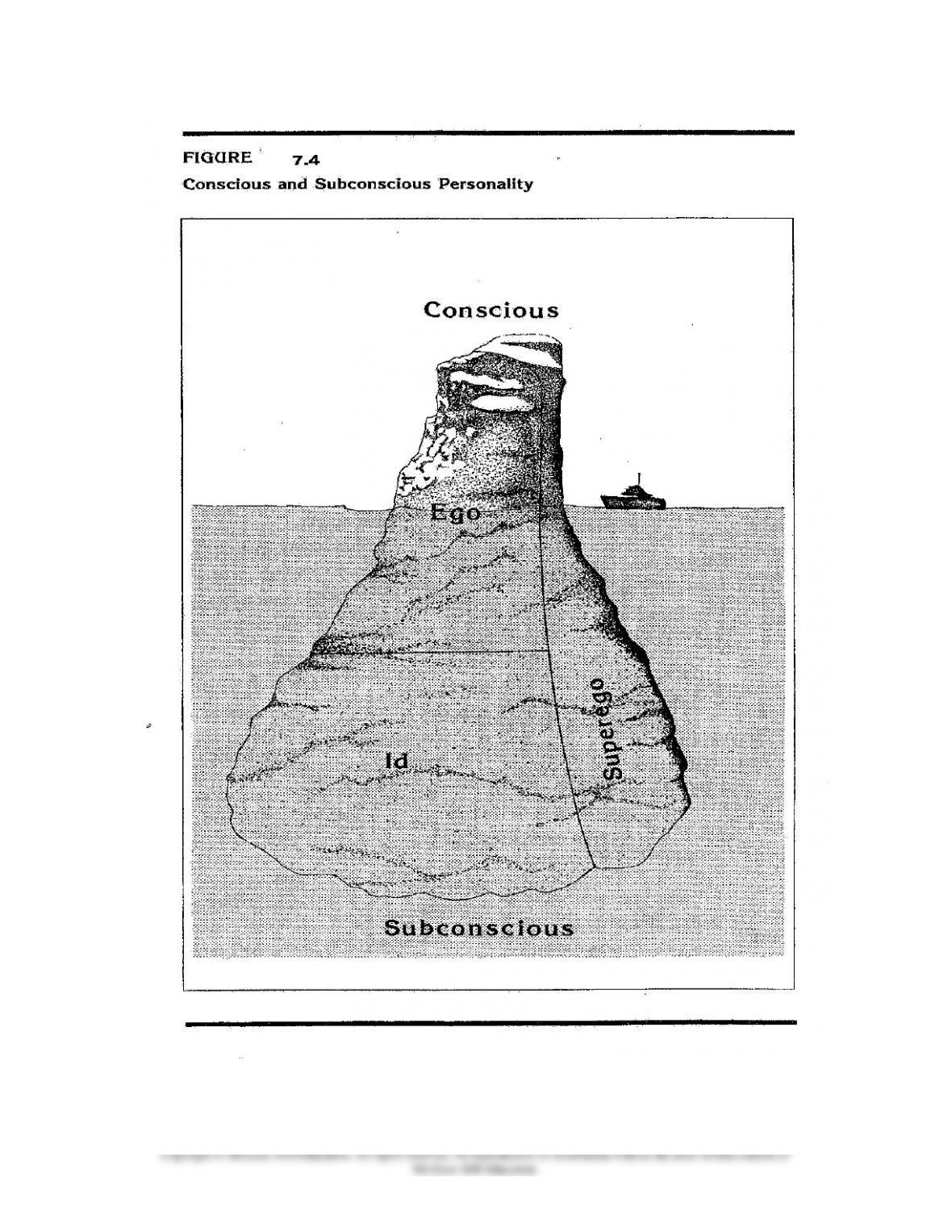
Imagine the human personality as an iceberg. Below the waterline is the mass of
the iceberg, and below the level of consciousness is the mass of personality. See Figure
7.4.
Part 07 – Multiplying Effectiveness
7-22

Part 07 – Multiplying Effectiveness
7-23
Just as you can only see the tip of the iceberg, so is conscious behavior only the
“tip” of the human personality. Below the water level lies the subconscious, the dwelling
place of things forgotten because of poor memory and things repressed because they are
unpleasant or threatening. Both positive and negative experiences and feelings live in the
subconscious.
If you are to fully understand and deal with human behavior—your own and that
of others—you should recognize that people often do what they do for subconscious
reasons. A person may dress or speak in a certain manner, and the subconscious motive
may be to be accepted by others; a person may shout or make an emotional display, and
the subconscious reason may be to gain attention; a person may distrust others, and the
subconscious reason may be to avoid being hurt.
Demonstrations like the following show the role of subconscious behavior:
During hypnosis, the subject was instructed that after he awakened, Dr. D. would
begin talking to him about some abstruse subject in which he was not at all interested,
and that, although he would actually be profoundly bored, he would try to appear
interested. He was told that he would want very much to close the conversation, that he
would wish for some way of shutting off this interminable flow of words, that he would
look around in the hope of finding some distraction, and that he would feel that Dr. D.
was terribly tiresome.
The subject was then awakened, whereupon Dr. D. began the conversation.
Although the subject appeared to be politely attentive, Dr. D. would occasionally say,
“Perhaps you’re not interested?” The subject would reply with excessive emphasis, “Oh,
yes, certainly, I’m very much interested.” Now and then, he would interrupt Dr. D.,
trying to pin him down to some definite point for discussion, but each time this effort was
evaded.
At length the subject began glancing about the room and was noted casually to
observe an open door. Finally, he interrupted Dr. D., saying, “Excuse me, I feel an awful
draft,” and got up to close the door. As he did so, he was asked what he was doing. He
replied, “The air seems to be awfully hot (‘hot air’); I thought I would shut off the draft.”
When the hypnotist pretended not to understand and asked him what he was doing, the
subject replied, “Why, I just shut the bore.”
How much of your own behavior is motivated below the level of consciousness?
Do you understand why you do what you do? Is your subconscious composed of positive
experiences and feelings, thus providing a source of strength, or is your subconscious
filled with negative attitudes and unresolved problems? Discuss.

Part 07 – Multiplying Effectiveness
7-24
DEFENSE MECHANISMS
People use defense mechanisms to preserve both biological and emotional health.
Biological protection ranges from the large muscle movements that allow you to fight off
physical attack to the microscopic efforts of white blood corpuscles that enable you to
combat infection and disease. In a healthy person, such biological defenses are natural
and automatic reactions to physical threat. In a similar way, you preserve emotional
well-being through psychological defense mechanisms. This is often subconscious
behavior brought into operation to protect feelings of self-worth and a positive self-
concept.
Everyone uses defense mechanisms, and they can be helpful as you adjust to life’s
demands. However, psychological defenses can be overused and can actually harm your
personality by distorting reality and preventing you from dealing with problems
effectively. The following is a discussion of eight common psychological defense
mechanisms.
Denial
If the truth is too threatening, you can deny it. Although this can give you needed
comfort in the short term, it is the equivalent to lying to yourself, and when carried to an
extreme, denial of reality can be harmful. People can deny physical illness, and this can
help them get through the day. But at some point, they must face and correct the reality
of physical illness, or greater harm may result.
Fantasy is a common form of denial and can be a pleasant escape. Through
fantasy, you can deny unpleasant experiences and conditions and can imagine the world
as you would like it to be. Although a certain amount of fantasizing is normal and
healthy, it can be harmful if practiced so much that you confuse a fantasy world with the
real world. Constant denial of important facts, faults, or failures prevents you from
cooping successfully with reality. Denial is usually seen in adults only under severe
stress.
Sublimation
If you have goals or desires that are unacceptable, a psychological defense is to
redirect your behavior into more acceptable areas. In this way, you preserve your self-
image, social reputation, and emotional health. This process is called sublimation.
People of all ages and in all areas of life use sublimation. A tackle executed on
the football field may represent sublimated aggression; a painting of a nude may
represent sublimated sexuality; and working in an orphanage may represent sublimated
parental urges for the person who does not have children. Freud viewed sublimation as
the most constructive of the defense mechanisms.
Displacement
If you transfer emotions toward one person or thing to another person or thing,
you are using displacement as a defense mechanism. Sometimes this can be constructive,
and sometimes not. It would not be constructive to shout at your spouse, strike your
children, or kick the cat because you are upset about your work. However, it may be
helpful to relieve your frustration by punching a bag of lifting weights.

Part 07 – Multiplying Effectiveness
7-25
It is usually best to deal with the source of emotional concern, even when this is
difficult or unpleasant. If your spouse upsets you, channel your energy into solving your
problems together rather than displacing the negative emotions onto your children or
other innocent bystanders.
Regression
Regression is a retreat from an unpleasant current situation to a more pleasant past. If
you go backward and return to childhood, you do not have to feel as responsible for your
actions or for other people. You can be playful, spontaneous, irresponsible, and even
selfish without feeling guilty.
Regression is a common defense mechanism when the personality is under stress.
Psychologist Bruno Bettelheim describes the general regression to infantile behavior seen
in many of the prisoners at Dachau and Buchenwald during World War II:
The prisoners lived, like children, only in the immediate present.
They became unable to plan for the future or to give up immediate
pleasure satisfactions to gain greater ones in the near future. They were
boastful, telling tales about what they had accomplished in their former
lives, or how they succeeded in cheating foremen or guards, and how they
sabotaged the work. Like children, they felt not at all set back or ashamed
when it became known that they had lied about their prowess.
More common examples of regression are the wife who goes home to her mother
every time she and her husband quarrel and the student who indulges in candy and ice
cream when the going gets tough, grades are low, and the world seems generally over-
whelming.
As a defense mechanism, regression is good to the extent that it results in
spontaneity and other healthy traits associated with childhood, and harmful to the extent
that it results in selfishness or other unhealthy behavior.
Identification
You can feel good about yourself through identification. If the individual, family,
country, company, or team you identify as your own is successful, you can take
satisfaction and pride in that success. When practiced in moderation, identification is
normal and healthy. However, when exercised to an extreme, or when used in place of
experiencing personal self-worth, identification can be harmful. The father who lives life
through his son’s achievements places an undue burden on the son for his own happiness
and fails to experience life on a firsthand basis. People who rely solely on the success of
others for their own sense of worth usually experience frustration and dissatisfaction in
the long run.
Repression
Repressing thoughts and feelings into the subconscious is a common defense
mechanism that can be helpful. If it is not helpful to dwell on some embarrassing
incident or failure, why do it? Better to keep it repressed and free your mind for
constructive activities. In this way, the personality remains undamaged.
Some experiences are so traumatic that one represses them into the subconscious
to prevent personality breakdown. This is the case of the battle-fatigued soldier who can

Part 07 – Multiplying Effectiveness
7-26
remember everything up to the point of physical combat, but who has repressed the
experiences of fear, killing, and death that he has undergone.
On the other hand, repression can be harmful if you fail to deal with the thoughts
and feelings satisfactorily before repressing them, or if you repress so much of your
personality that you do not know who you are, where you have been, or where you are
going. In such a case, repression harms personality development.
Undoing
Sometimes you are sorry for harmful things you do. By going through the
process of undoing, you can feel better about yourself and thus preserve your
psychological health. For example, you may cause another person pain, extra work, or
unhappiness. In order to undo this, you may take extraordinary steps to help them or to
otherwise make up for your actions. The unfaithful husband may suddenly shower his
wife with gifts to atone for his behavior; the businessman may seek to undo unethical
business practices by giving large sums of money to the church or community; or the
selfish mother may try to compensate by buying expensive presents and toys for her
children.
The process of undoing can be harmful if it becomes habitual behavior. People
lose patience and respect for the person who constantly makes mistakes and seeks
forgiveness by undoing.
Rationalization
“It wasn’t important anyway,” “What is meant to be will be,” and “If only…,” are
three common rationalizations. Rationalization is one of the psychological defense
mechanisms most often used to justify actions, explain failures, and alleviate frustrations.
Examples include the rejected lover who says, “I wasn’t ready to settle down anyway;”
the job applicant who says, “It would have been a terrible job,” after learning that
someone else has been selected; and the man, losing his hair, who reminds you that Don
Juan was completely bald.
In some instances, rationalization can be helpful, as it helps preserve self-worth
and self-confidence. However, rationalization is often used to justify unsatisfactory
behavior and mistakes in judgment, and this can be harmful. The person who justifies
cheating by pointing out that everyone does it and the individual who rationalizes
speeding in a car to make a business appointment on time are examples. When used to
extreme, rationalization results in a person who constantly justifies mistakes, does not
take responsibility for personal actions, and, ultimately, has low self-image.
Which defense mechanisms are you most likely to use? Can you cite a time when
defense mechanisms helped you preserve your mental health? Can you recall a time
when defenses were improperly used, resulting in reduced personal and social
adjustment? Complete the following exercise to evaluate your use of defense
mechanisms.

Part 07 – Multiplying Effectiveness
7-27
Exercise: 7.3: EGO-DEFENSE MECHANISMS
We all use defensive strategies to protect ourselves from anxiety. For Freud, the
concept of psychic defense was a major factor explaining why people do what they do.
He referred to defense mechanisms as the protective processes used by the ego to defend
the personality from painful and unacceptable thoughts and impulses.
Directions
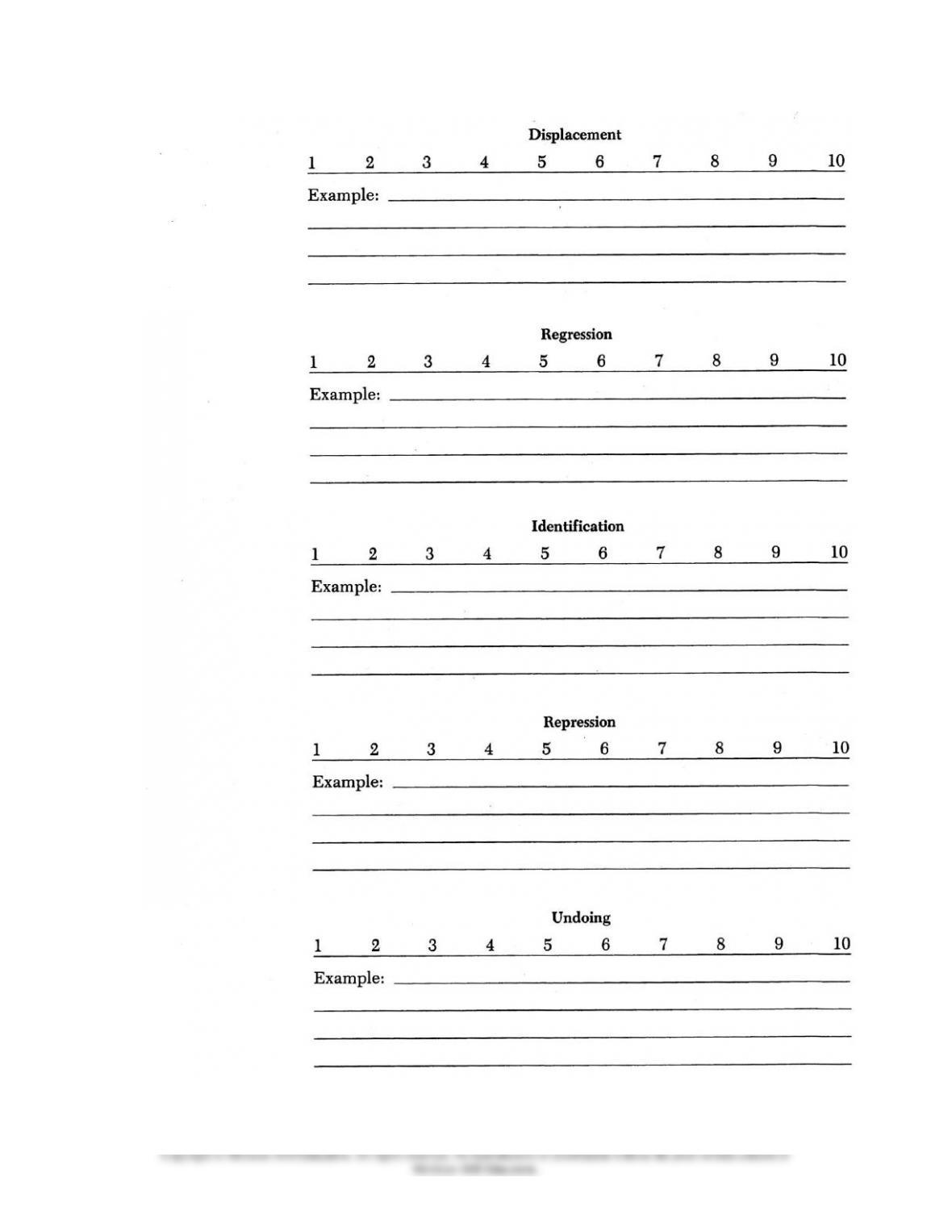
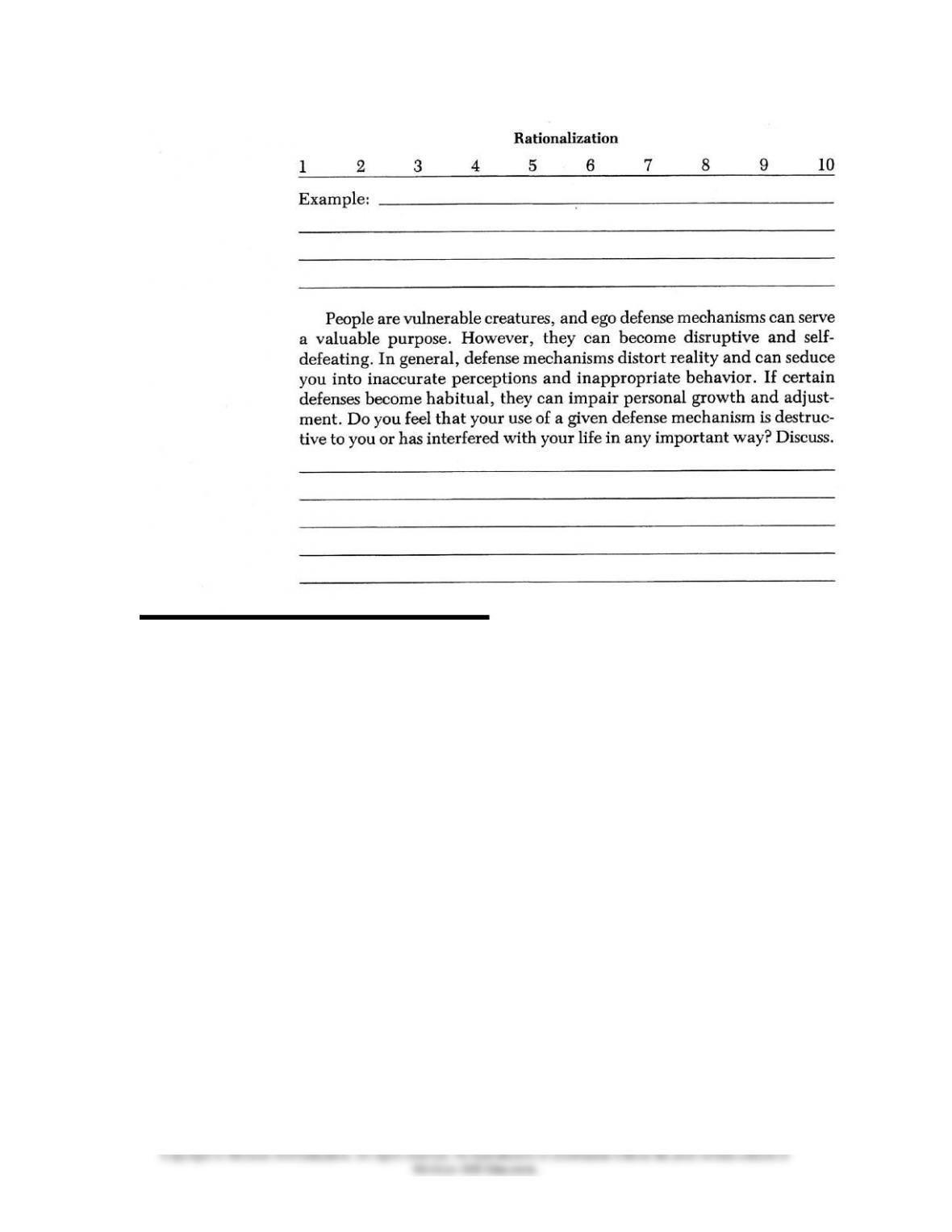
Before beginning this exercise, be sure the definition of each defense mechanism is clear
in your mind. Then consider each one and the role it plays in your life. Under each
defense mechanism, indicate on a scale of 1 to 10 how important you feel it is as a
current ego defense (1 is low; 10 is high). Place and (*) next to the defense mechanisms
you use the most.
Denial
1 2 3 4 5 6 7 8 9 10
Example:
Sublimation
1 2 3 4 5 6 7 8 9 10
Example:
Part 07 – Multiplying Effectiveness
7-28
Part 07 – Multiplying Effectiveness
7-29
Φ APPLICATION
Personality Traits and Job Demand Analysis
Use the following exercise to match personality traits with job demands. The manager should
complete Part I, A View of the Job, and the employee should complete Part II, A View of the
Person. The manager and employee should discuss Part III together.
PART I⎯A View of the Job
(To Be Completed by the Supervisor)
Directions: The following are job characteristics. Evaluate each characteristic for the job under
consideration according to the following scale:
1. Never true
2. Rarely true
3. Sometimes true
4. Usually true
5. Always true
In order to succeed in this job:

Part 07 – Multiplying Effectiveness
7-30
a. _____ Unpopular decisions must be made.
b. _____ A routine work pattern is required.
c. _____ Close supervision is required.
d. _____ Steady persistence at simple tasks is required.
e. _____ The ability to initiate contact with strangers is required.
f. _____ Decisiveness must be exercised in uncertain situations.
g. _____ Policy must be executed with extreme caution.
h. _____ Various types of people must be coordinated.
i. _____ Staying at one work station for long periods of time is required.
j. _____ The ability to overcome adversity, including the objections of others, is required.
k. _____ Systematic procedures and rules must be followed.
l. _____ The ability to solve human relations problems is required
m. _____ The ability to compete with others to accomplish goals is required.
n. _____ An enthusiastic personality and the ability to motivate people are required.
o. _____ Deviation from prescribed procedures is prohibited.
p. _____ Risk taking is necessary.
q. _____ Repetitive work must be done quickly and accurately.
r. _____ Social poise and persuasive ability are required.
s. _____ Exact and detailed work is required.
t. _____ A dedication to duty is necessary.
u. _____ The ability to plan ahead on a large scale is necessary.
v. _____ Selling or counseling skills are required.
w. _____ The willingness to work as a member of a team is required.
x. _____ Personal patience and an even temper are required.
SCORING

Part 07 – Multiplying Effectiveness
7-31
Step One
Transfer your ratings for each item to the following key, and total each column.
A
S
E
I
a. _____
e. _____
b. _____
c. _____
f. _____
h. _____
d. _____
g. _____
j. _____
l. _____
i. _____
k. _____
m. _____
n. _____
q. _____
o. _____
p. _____
r. _____
s. _____
t. _____
u. _____
v. _____
x. _____
w. _____
Totals
_____
_____
_____
_____
Ascendancy
Sociability
Emotionality
Individuality
Part 07 – Multiplying Effectiveness
7-32
Step Two
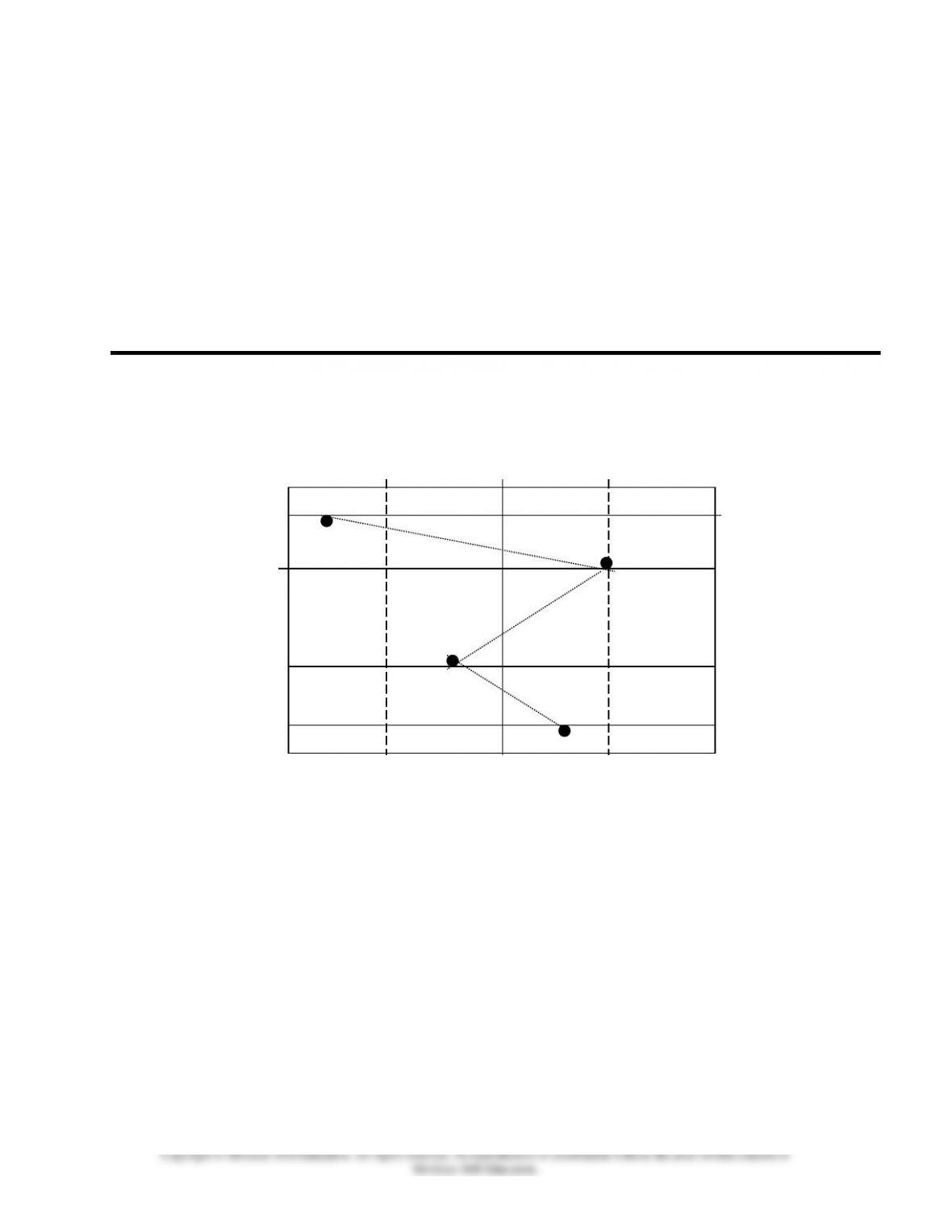
Plot the total scores on the appropriate A, S, E, and I lines on the following job graph. Connect
the points A and S, S and E, and E and I with straight lines (see the sample job graph).
Sample Job Graph
6 12 18 24 30
6 12 18 24 30
A
S
E
I
A
S
E
I
Low ascendancy
Low sociability
High emotionality
High individuality
High ascendancy
High sociability
Low emotionality
Low individuality
Part 07 – Multiplying Effectiveness
7-33
Job Graph
6 12 18 24 30
6 12 18 24 30
A
S
E
I
A
S
E
I
Low ascendancy
Low sociability
High emotionality
High individuality
High ascendancy
High sociability
Low emotionality
Low individuality

Part 07 – Multiplying Effectiveness
7-34
PART II ⎯A View of the Person
(To Be Completed by the Employee)
Directions
For each of the following four traits⎯ascendancy, sociability, emotionality, and individuality –
place an X at the position on the line that best reflects your personality.
A – Ascendancy
S – Sociability
E – Emotionality
• Is dominant in interpersonal
relations
• Likes power and authority
• Meets problems head-on
• Likes to make decisions
• Is peaceful, modest, and
accommodating
• Likes a secure environment
• Dislikes making decisions
• Dislikes confrontations and
arguments
• Likes to work with people
• Is outgoing and persuasive
• Has an open-door policy in
dealing with others
• Enjoys counseling and
teaching
• Is reserved and reflective
• Likes to be alone
• Likes clear-cut decisions
and black and white
answers
• Wants privacy

Part 07 – Multiplying Effectiveness
7-35
I – Individuality
• Is calm and stable
• Is comfortable following
established procedures
• Likes to concentrate on one
project at a time
• Is deliberate and methodical
in solving problems
• Likes adventure, variety,
and change
• Is easily bored and restless
• Is impatient with slow
speech, action, and progress
• Is quick to feel and express
emotions
• Wants structure and order
• Is comfortable with rules
and policies
• Is a cooperative team player
• Is comfortable with formal
supervision
• Needs freedom and
independence
• Dislikes routines and
restrictions
• Avoids close supervision
• Likes individual
ignments

Part 07 – Multiplying Effectiveness
7-36
Part III⎯Discussion
(Manager and Employee)
Directions
Compare the demands of the job (Part I) with the personality of the individual (Part II) by
answering the following questions:
1. Ascendancy – is the individual aggressive enough, or too dominant, for this job?
2. Sociability – is the individual outgoing enough, or too people-oriented, for this job?
3. Emotionality – is the individual versatile enough, or too variety-loving, for this job?
4. Individuality – is the individual independent enough, or too individualistic, for this job?
Based on this analysis, is the personality of the individual compatible with the demands of the
job? If not, can the demands of the job be changed? Discuss the importance of matching the
personality traits of the individual with the demands of the job for optimum employee satisfaction
and maximum job performance.

Part 07 – Multiplying Effectiveness
7-37
EXERCISE 7.4: THE SIGNIFICANT OTHER TREE
This exercise will help you identify significant people in your life who have helped form your
self-concept. In the blank space below, draw a “significant other tree.” On the roots, trunk, and
leaves, place the names of those individuals who have helped shape your life in chronological
order (roots being first, leaves being most recent.) Who has been a negative force in your life?
Who has influenced you most to this point in your life? Who have you influenced most to this
point in your life?
SIGNIFICANT OTHER TREE
What thoughts, feelings, and insights do you have as you consider your “significant other
tree”?

Part 07 – Multiplying Effectiveness
7-38
EXERCISE 7.5: THE CRITICAL EVENTS LINE
The Critical Events Line
This exercise will help you identify critical events in your life that have helped form your self–
concept. Using the time line below, put the year of your birth in the box marked “Beginning.”
Put the year you expect to die in the box marked “Ending.” Place an X on the line at the point
that represents your age today.
Above the time line, indicate the positive events that have been especially critical to this point in
your life and the positive events you expect to experience from this point on in your life. Below
the time line, indicate the negative events that have been critical in the past and the negative
events you expect to face in the future.
After you have finished the “critical events line,” discuss the following questions:
▪ Have the events you listed been predominantly good or bad?
▪ Have these events been triggered primarily by you or by others?
▪ How satisfied do you feel with your life?
▪ What thoughts, feelings, and insights do you have as you consider your critical events
line?
Beginning
Ending
(Time Line)

Part 07 – Multiplying Effectiveness
7-39
EXERCISE 7.6: TYPES OF PEOPLE—DIFFERENT STROKES FOR
DIFFERENT FOLKS
Directions
The following survey includes questions about your personality on two important traits:
ascendancy and sociability. It measures how dominant or peaceful you are and how introverted
or extroverted you are. There are no right or wrong answers on this questionnaire. Answer each
question as accurately as possible. If you are uncertain about a question, give your first natural
response. Read each question, decide how you feel about it, and circle your answer as follows.
Circle 1 for never.
Circle 2 for rarely.
Circle 3 for sometimes.
Circle 4 for often.
Circle 5 for always.
Questions
Never
Rarely
Sometimes
Often
Always
1. Are you a strong-willed
person?
1
2
3
4
5
2. Are you quiet and reserved in
new social situations?
1
2
3
4
5
3. Do you find it easy to forgive
and forget?
1
2
3
4
5
4. Are you spontaneous and
outgoing?
1
2
3
4
5
5. Do you continue arguments
when you know the other person
has had enough?
1
2
3
4
5
6. Do you embarrass easily?
1
2
3
4
5
7. Do you find it hard to say
“no” to a salesperson, even when
you really do not want the
product?
1
2
3
4
5
8. Are you at ease meeting new
people?
1
2
3
4
5
9. Will you ask to see someone
higher up when your requests are
not met?
1
2
3
4
5
10. Would you prefer to read a
character study over an
adventure story?
1
2
3
4
5
11. Is it difficult for you to ask
for something for yourself?
1
2
3
4
5