
Part 07 – Multiplying Effectiveness
7-1
Major Purposes of Part Seven
Part Seven focuses on three important subjects—
delegation skills, how to assign work, and the role of
personality.
Part Seven Objectives
After completing Part Seven, your students should be
able to better understand:
• Rules for effective delegation;
• How to assign work effectively;
• The vital shift as a career concept; and
• The leadership needs of different personalities.
PART SEVEN—Multiplying Effectiveness

Part 07 – Multiplying Effectiveness
7-2
Φ CASE
The Reluctant Backhoe Operator
Clyde Jones had been a backhoe operator in the Kentucky Junction Utility Department
for five years. Clyde was skilled at this job and continually won the praise of the city manager
for the speed with which he installed water lines.
One year ago, a large federal grant was obtained to expand the city’s water system to
serve a large new subdivision. In order to accomplish the task and maintain the expanded system,
twelve new employees were hired and divided into six-man crews. Clyde was promoted to crew
chief with the responsibility of supervising one of the new six-man crews.
Billy Martin, a newly hired backhoe operator, reported to Clyde’s team on a Monday
morning and was immediately assigned to a backhoe by Clyde. That afternoon, while the crew
was hard at work digging a trench for a new 8′ water main, Billy accidentally backed over a
section of pipe lying beside the trench. Clyde ran to inspect the damage and ordered Billy off the
backhoe ..”…you, kid, why the…..can’t you watch where you’re going? I’ve been watching you
and you’re slow enough as it is, without making this mistake.” As the rest of the crew watched,
Billy apologized and began removing the broken pipe section. Clyde operated the backhoe the
next two weeks himself.
One month later, Clyde was called in to the city manager’s office to explain why the
progress of the project had slowed considerably for the past 30 days. Clyde’s only explanation
was that the men on his crew were just too lazy.
Discussion Questions
How should Clyde have handled this situation?
How do you think Billy felt?
How does the Peter Principle apply in this incident?
What should the city manager do?

Part 07 – Multiplying Effectiveness
7-3
EXERCISE 7.1 : THINGS, PEOPLE, IDEAS⎯PERSONAL INTEREST INVENTORY
Directions
Each of the following questions is worth a total of three points. For each question, assign the
most points to the response you prefer and fewer points, in order of preference, to the others. For
example, if one response receives three points, the other two must receive zero; if one receives
two, then the others must receive one and zero; or each may receive one point.
Examples
1. Which activity interests you most?
____ a. Working with your hands
____ b. Working with people
____ c. Reading books
2. Which skills would you invest time in learning?
____ a. Research and writing
____ b. Organizing and leading
____ c. Crafts and art

Part 07 – Multiplying Effectiveness
7-4
3. Which job activities would you enjoy most?
____ a. Counseling and coaching
____ b. Building and doing
____ c. Thinking and planning
4. Which trait is most characteristic of you?
____ a. Helper
____ b. Doer
____ c. Scholar
5. Which would you most enjoy doing?
____ a. Talking with people
____ b. Writing a book
____ c. Building a house
6. How do you prefer to use your spare time?
____ a. Outdoor projects
____ b. Social activities
____ c. Thinking
7. Which of these traits is most important to you?
___ a. Physical coordination
____ b. Ability to deal with people
____ c. Mental ability

Part 07 – Multiplying Effectiveness
7-5
8. Which jobs most reflect your interests?
____ a. Teacher, social worker, counselor
____ b. Engineer, surveyor, craftsman
____ c. Researcher, historian, author
9. Which ability is your strongest?
____ a. Communication skills
____ b. Creative thinking
____ c. Physical skills
10. Which tasks do you perform best?
____ a. Operating and maintaining
____ b. Communicating and motivating
____ c. Developing and planning
11. Which occupation interests you most?
____ a. Pilot
____ b. Judge
____ c. Politician
12. Which of the following is most interesting to you?
____ a. Helping others
____ b. Thinking things through
____ c. Using your hands

Part 07 – Multiplying Effectiveness
7-6
13. Which skills could you learn with the least effort?
____ a. Leading and negotiating
____ b. Artwork and handicrafts
____ c. Language and theoretical reasoning
14. What tasks appeal to you most?
____ a. Developing new theories
____ b. Helping people with problems
____ c. Developing a skill
15. What assignment appeals to you most?
____ a. Working with ideas
____ b. Working with people
____ c. Working with things
16. Which is your greatest attribute?
____ a. Creativity
____ b. Competence
____ c. Sensitivity
17. For which occupation do you have natural talent?
____ a. Counselor
____ b. Builder
____ c. Scientist

Part 07 – Multiplying Effectiveness
7-7
18. Which subject interests you most?
____ a. Practical arts
____ b. Philosophy
____ c. Human relations
19. To which group would you prefer to belong?
____ a. Scientific society
____ b. Outdoor group
____ c. Social club
20. How do you like to work?
____ a. In a group, discussing and recommending solutions
____ b. Alone, using ideas and theories
____ c. Alone, using tools and materials
Scoring
To obtain your score on the Personal Interest Inventory, complete the following steps:
Step One
Record your scores in the appropriate spaces in Figure 7.1, and total each column. Note that the
arrangement of responses is not always alphabetical.
Step Two
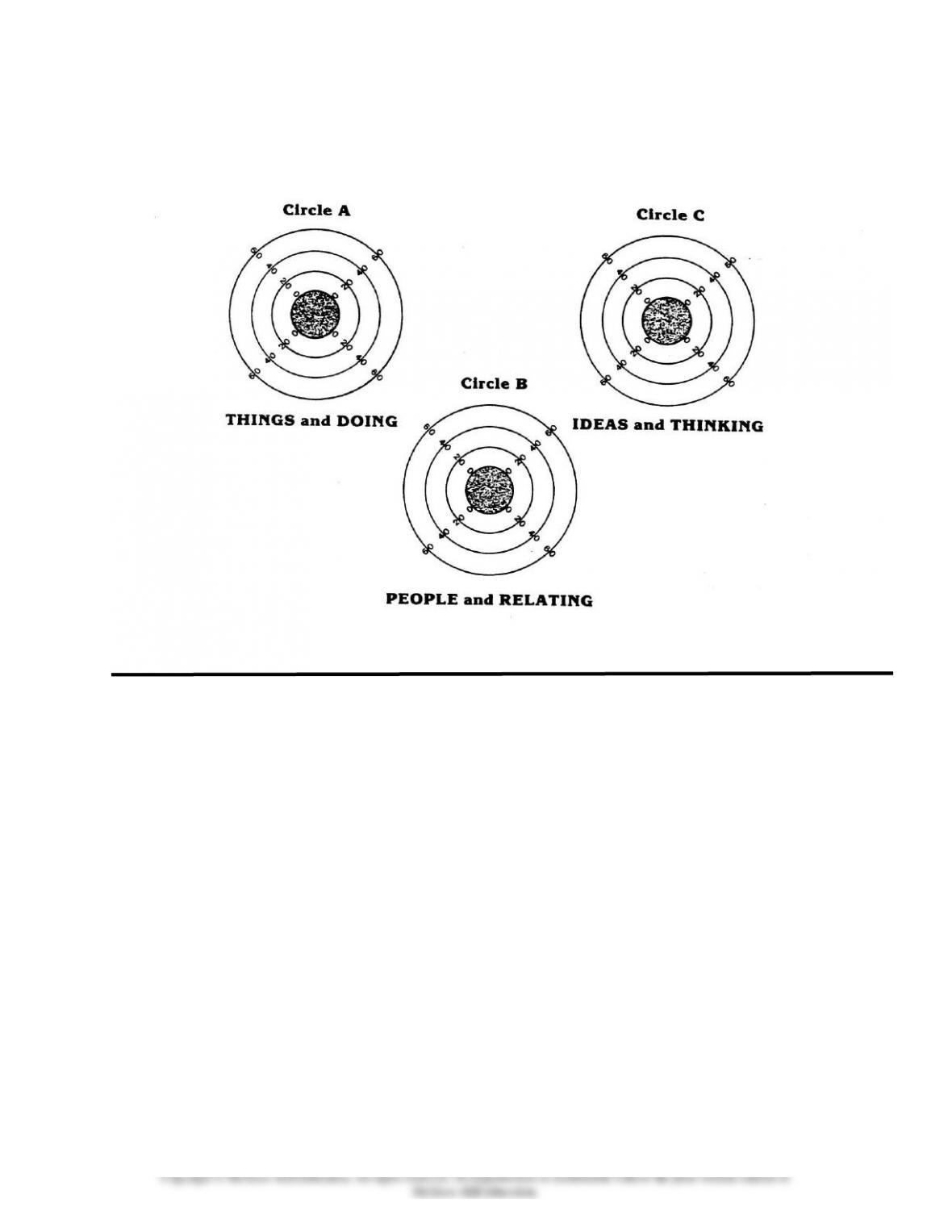
Plot your scores and shade the circles in Figure 7.2 representing things and doing, people and
relating, and ideas and thinking. This provides a picture of your personal interests.

Part 07 – Multiplying Effectiveness
7-8
Interpretation
There are five points to remember about scores on this inventory:
• The numerical scores and circles show the pattern of your interests and indicate the type
of work that would be most satisfying to you.
If A is your largest circle, you are primarily interested in working with you hands and with tools
and materials. As such, your interests are much like those of Amelia Earhart, who was happiest
when she was flying her plane, pitting her personal skills against the forces of machine and
nature. Occupations that call for an orientation toward things include forestry, farming, fishing,
woodworking, mechanics, and art.
If B is your largest circle, your interests are primarily in the human side of work. You are most
comfortable working with and through others, often for their welfare. Your interests are similar
to those of Jane Addams, pioneer social worker, who was happiest when she was working with
people. Occupations that require a high degree of interest in people include counseling,
supervising, coaching, nursing, and teaching.
If C is your largest circle, your primary interest is the world of ideas. Books, theories, and
philosophical discussion stimulate you. Your interest pattern is similar to that of Simone de
Beauvoir, one of the most respected women of French literature and an influential leader of the
women’s rights movement. Positions that call for interest in ideas include professor, scientist,
judge, and writer.
• Although interest patterns may change with time, experience, and mood, they are likely
to remain the same throughout a person’s life. Thus, the young tinkerer is likely to
become a mechanic or inventor; the young helper is likely to become a teacher or
counselor; and the young dreamer is likely to become a poet or philosopher.

Part 07 – Multiplying Effectiveness
7-9
FIGURE 7.1: SCORE MATRIX
Question Things People Ideas
1.
a.
b.
c.
2.
c.
b.
a.
3.
b.
a.
c.
4.
b.
a.
c.
5.
c.
a.
b.
6.
a.
b.
c.
7.
a.
b.
c.
8.
b.
a.
c.
9.
c.
a.
b.
10.
a.
b.
c.
11.
a.
c.
b.
12.
c.
a.
b.
13.
b.
a.
c.
14.
c.
b.
c.

Part 07 – Multiplying Effectiveness
7-10
15.
c.
b.
a.
16.
b.
c.
a.
17.
b.
a.
c.
18.
a.
c.
b.
19.
b.
c.
a.
20.
c.
a.
b.
TOTAL
TOTAL
TOTAL
Part 07 – Multiplying Effectiveness
7-11
FIGURE 7.2: PERSONAL INTEREST PATTERNS
• Some people are equally interested in all three areas—things, people, and ideas.
Leonardo da Vinci—artist, administrator, and philosopher—was such a person. There
are two notes to keep in mind if you have high interest in all three areas: beware of
running out of energy and becoming fatigued; and beware of the tendency to start
projects and fail to see them through to completion.
• The world operates on all three planes⎯things, people, and ideas. Thus, all three types
of people are needed. Having respect for individuals with different interest patterns will
help people get along even if they are not exactly alike. Imagine a “doer” wife with a
“thinker” husband, or a “relational” wife with a “thinker” or “doer” husband. Ideally,
each will tolerate and appreciate the interests of the other.
• The world of work involves things, people, and ideas. Ideally, the personal interests of
members of a work group will match the demands of the work. Imagine the problem if
all of the members of a work group were either relational or idea oriented when the job
required hand-on skills, or if the work required a good deal of communication and
cooperation and all of the members were individual performers, each “into” a distinct
skill or specialty. When there is a mismatch between the interests of the group and the
demands of the work, compromises must be made. Otherwise, both morale and
performance suffer.
Part 07 – Multiplying Effectiveness
7-12
NOTES AND ANECDOTES
Career Stages, Nature of Work, and Focus of Work
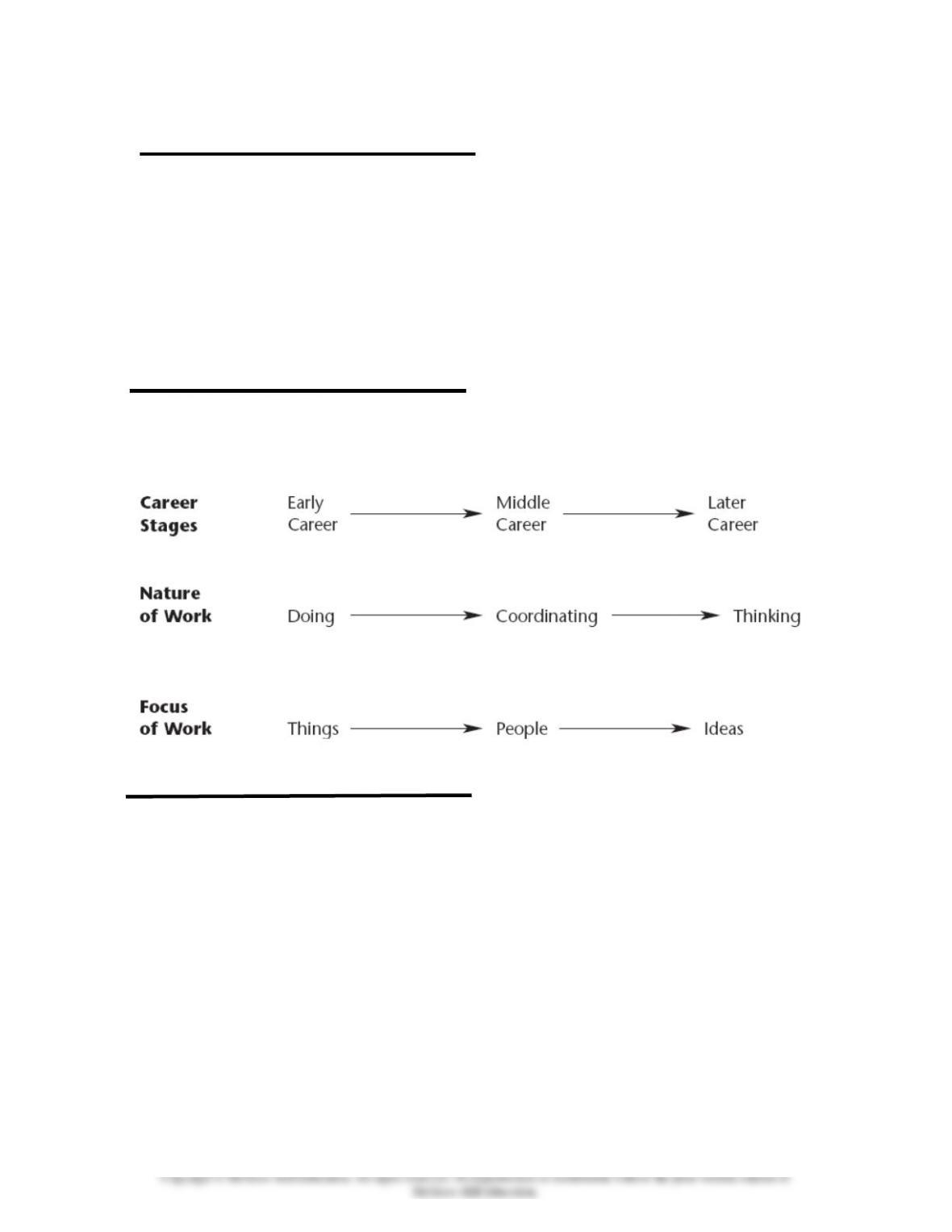
Three interrelated concepts—career stages, nature of work, and focus of work—influence job
performance. These concepts and the typical progression of careers are shown in Figure 7.3.
FIGURE 7.3: PROGRESSION OF CAREERS
In the early career, the individual is usually performing tasks. These tasks may include
physical effort and working with tools, machines, and materials. Or the job may involve working
with people, providing direct service. During this career stage, time is spent learning and applying
the skills of the trade or profession. In the beginning, the individual’s role may be that of
apprentice or trainee. After training, the role may be that of colleague and independent
contributor. The type of work performed represents frontline responsibility in the occupation or
organization. Police officer, carpenter, programmer, salesperson, and technician are job titles
typical of this stage.

Part 07 – Multiplying Effectiveness
7-13
In middle career, the individual may spend more time coordinating people. This stage may
involve leadership and training responsibilities. If so, the nature of the job becomes less that of
doing the work and more that of directing the work of others—coaching them and developing
their potential. Work in the middle career includes mid-level responsibility in the occupation or
organization. Coordinator, supervisor, and manager are typical job titles.
At the highest levels of an occupation or organization, thinking is the primary activity, and the
primary focus of attention is on ideas, such as plans and policies. Duties include determining the
long-range direction of the organization, making strategic decisions regarding products and
finances, and establishing the ethical tone of the organization. In most cases, the individual is not
faced with these responsibilities until the later career stage. Owner, president, chairman, and
executive director are common titles of office.
Not everyone experiences the career progression outlined here, because of personal choice or
the unique nature of the work. A farmer may choose to maintain a one-person operation for his or
her entire working life; similarly, the nature and focus of the artist’s work will probably remain
the same regardless of career stage.
It is important to match the personal interests of the individual with the demands of the job.
Imagine a president of a department store spending most of her time displaying merchandise and
running the cash register instead of making long-range plans and developing a management team;
or imagine a salesperson spending an inordinate amount of his time thinking about price, profit,
and public policy rather than focusing on customer service and the care of merchandise. When
personal interests and job requirements are mismatched, morale and performance are sure to
deteriorate, for both the president and the salesperson.
NOTES AND ANECDOTES
Mixing Personalities to Strengthen the Group
In building a team, some leaders select members in their own image. They choose associates with
personalities similar to their own. This approach can limit the potential of the group in meeting its
goals. Leaders should instead consider what members with different styles can gain from each
other. The following table shows how each style of interpersonal relations can add balance,
flexibility, and overall effectiveness to a group or organization.

Part 07 – Multiplying Effectiveness
7-14
Strengths of Traditionals
Strengths of Participatives
Strengths of Individualists
• Provide clarity of
assignment.
• Care about people.
• Challenge the system.
• Organize efforts.
• Bring harmony and peace.
• Find flaws in procedures.
• Give attention to detail.
• Teach and give counsel.
• Tackle problems with zest.
• Adhere to standards.
• Give encouragement to
others.
• Provide reform where
needed.
• Appreciate traditions.
• Instill team spirit.
• Generate new ideas.
• Remember facts and
figures.
• Persuade and motivate.
• Focus energies on the
present.
• Give structure and order.
• Are sensitive to others and
aware of their needs.
• Accentuate possibilities.
• Provide consistency.
• Provide warmth and support.
• Celebrate the individual.
As an organization experiences greater diversity, there is a need for greater tolerance. With
sufficient tolerance, the different positive qualities of traditional, participative, and individualistic
types of people can help the organization achieve its full potential. By nature, traditionals provide
needed structure and organization, participatives add warmth and supportive human relations, and
individualists bring creativity and the capacity for change from within.

Part 07 – Multiplying Effectiveness
7-15
NOTES AND ANECDOTES
Organizational Styles
Organizational styles are partly a product of the personality of the founder or head of the organization,
who embodies a certain style of behavior and sets up a particular kind of structure, thereby attracting
similar types of people. They, in turn, attract more of their own kind. As the company establishes
policies and practices with which these people are comfortable, a corporate style is developed. Over
time, people who do not fit the company profile are eliminated, and an organizational style becomes
well established. In his book, Executive, Harry Levinson describes corporate styles.
Employees of American Telephone and Telegraph (AT&T) traditionally looked
upon “Ma Bell” as maternalistic. The company always provided good benefits
and could be counted on to take care of its own. Its public image reflected this
dependability: AT&T was traditionally the soundest of the “widows-and–
orphans” stocks. It also tried to be a model of service, as shown in a well-known
advertisement in which a telephone operator sits at her switchboard while flood
waters rise around her. The psychological contract between the company and its
employees historically was one of support and dependency, although this has
changed in recent years as a result of social and economic pressures; employees
have been forced into early retirement, jobs have been eliminated by attrition,
and there is pressure on executives to be more competitive.
International Business Machines (IBM) has a different organizational style. Once
paternalistic like its founder, Thomas Watson, Sr., over time it developed the
aggressive characteristics of a marketer. People in marketing perform in a free
enterprise environment and are thus competition-driven. The path to success at
IBM is traditionally through sales, and there is intense competition among
salespeople, reinforced by a system of quotas. In years past, IBM represented
marketing at its best, because of the high-quality products, guaranteed service,
and a powerful ideal of integrity that backed up its marketing efforts. Currently
the company is striving to achieve its former luster.
At Sears, Roebuck, and Company, the organizational style was historically
egalitarian. The company was originally set up to give a great deal of
responsibility and flexibility to store managers. Sears had an unusually “flat”
organizational chart, with only three levels of management. As many as 30 store
managers would report to a single person. Because they were not closely
supervised, managers had great freedom to use their own judgment. Over the
years, Sears succumbed to pressures to economize by centralizing and
computerizing nationwide sales and promotion. These and other business
decisions did not serve Sears well, in contrast to the customer orientation and
popular personnel practices of more aggressive competitors. Sears is seeking to
recapture its earlier standing. Whether it can succeed by going back to its
successful roots is an unanswered question.

Part 07 – Multiplying Effectiveness
7-16
Just as most people find their own families more congenial than others, so are they
more at home with a certain kind of organizational style. Someone from a traditional
Italian family may feel comfortable as a second–in-command to an authoritarian boss,
whereas a person with a different background might not. Similarly, a rigid German
upbringing may serve a person well in the highly disciplined atmosphere typical of
machine tool factories, where precision and quality control are essential.
An interesting example of “fit” between individual and organizational style was the
Federal Bureau of Investigation during the Hoover years. The FBI attracted many
lawyers and accountants who grew up in families with traditional values and strict rules,
partly because they felt at home within the agency’s rigid structure and organization,
which was a lot like that of their families and schools.

Part 07 – Multiplying Effectiveness
7-17
NOTES AND ANECDOTES
The following story shows how a variety of styles can add to the effectiveness of a work
environment.
Variety Makes A Difference
Background
Of all the probation and parole offices in the state, Lancaster was the most
critical. It serviced the most populated county and city of the state; its parolees
and probationers had the worst offender records; and it was the largest office in
the state, both for personnel and budget. Also, of all the offices in the state,
Lancaster seemed best equipped to accomplish its mission. Its personnel had the
best education and most experience; the leadership was considered to be
exceptional; and extra funds had been provided to support the office in its critical
assignment.
The Situation
With so many factors working in its favor, the Lancaster probation and parole
office was expected to be successful, yet it was failing. Employee turnover was
the highest in the state; there was constant staff conflict over procedures and
policies; and the recidivism rates for parolees and probationers were the worst in
the state.
Evaluation
An evaluation of the staff of fifty officers and supervisory personnel revealed that
there were forty-eight individualists, one traditional, and one participative in the
group: (1) The forty-eight individualists were all probation and parole officers—
well-meaning and talented to a person. But each was pursuing his or her own
goals, often to the detriment of others in the office. (2) The single traditional was
the supervisor over approximately one-half of the officers. He was well
respected because of his ability and years of experience, but his basic reaction to
all of those individualists was just to shake his head. They were too loose and
too independent minded to suit him. (3) The participative was the director of the
office—the single factor holding the entire group together. Evaluation showed
the primary cause of the organization’s problems to be too many individualists.

Part 07 – Multiplying Effectiveness
7-18
The Solution
First, all staff members recognized the need for increased cooperation in day–to–
day operations. They realized that there were too many people who wanted to
operate independently, but who by doing so, were often counterproductive to the
work of others. The entire staff resolved to be more cooperative in their daily
behavior. Thus, regular staff meetings were scheduled, and everyone attended
them on time. Also, rules were developed for the use of telephones, cars,
computers and copy machines, as well as secretarial services; and everyone made
a conscientious effort to adhere to them.
In addition, each staff member took concrete steps to understand and appreciate
the different duties, personalities, and methods of the rest of the people in the
organization. This was accomplished not only over differences in style of
interpersonal relations, but also over differences in caseload management,
counseling techniques, and philosophy of criminal justice. The information
shared and ideas generated upgraded the quality of work of the entire office.
Interpersonal conflicts decreased, and the performance of the office improved.
Finally, as new people were hired to fill vacancies, traditional and participative
candidates were selected to help balance the work force when other qualifications
were equal. The traditionals introduced clarity and consistency, which all
organizations need; the participatives added the human or charismatic element so
that employees enjoyed working in the organization and clients felt supported.
Individualists were retained to provide creativity and new ideas. It was
recognized that all three were required in order to perform the best quality of
work.

Part 07 – Multiplying Effectiveness
7-19
NOTES AND ANECDOTES
Personality Structure and Dynamics
There are many theories of personality. Historically, the most influential has been the
psychoanalytic theory of Sigmund Freud.
The Id, Ego, and Superego of the Human Personality
Psychoanalytic theory identifies three systems or structures within the personality
and attributes to each one certain functions and energies.
One of these structures is the id, within which are two powerful drives: a
constructive drive (derived from sexual forces within the person) leading to love, growth,
and integration of the personality with the surrounding world; and a destructive drive
(derived from aggressive forces within the person) leading to feelings of hate,
constriction of personality, alienation from the surrounding world, and death. One of the
major tasks of the personality is to fuse these drives so that the constructive drive is
dominant. Also the site of repressed memories and experiences and of primitive wishes
and impulses, the id comprises the uncivilized core of man that continually struggles for
expression.
The job of the ego, considered to be the executive part of the personality, is to
control and guide the powerful drives of the id. The ego is made up of the five senses,
together with the abilities to concentrate, judge, form concepts, think reflectively, recall,
learn, and act. The ego seeks to master the outside world so that the person can survive.
The third structure is the superego or, more colloquially, the conscience—an
internal, self-governing agent with four functions:
Rules. As part of the process of growth, children identify with their parents and
other important figures in their environment. In doing so, they assimilate many of their
parents’ rules for living—rules about expressing aggressive impulses and about giving
and receiving love.
Values. By the same process of identification, children adopt and evolve certain
values that become the basis for their attitudes about important aspects of living. These
values range from such firmly and universally established ideals as the sanctity of human
life to more specific ones that are part of a professional discipline, such as the values of
privacy and confidentiality that govern the practice of medicine.
Ideals. The conscience spurs people on to attain an ego ideal, an internalized
image of oneself at one’s future best. This image is constructed from expectations held
by parents and others, from aspirations children develop for themselves out of
recognition of their capacities and abilities, and from identification with important figures
in the environment. Mark Twain said, “It may be called the master Passion, the hunger
for self-approval.” Concepts of “self–fulfillment” and “self-actualization” in part refer to
a person’s efforts to attain the ego ideal. However, the ego ideal, like a distant mountain
peak, is beyond one’s capacities so that it continues to serve as a goal toward which one
is constantly striving. Various social models, ranging from presidents, artists, scholars,
and saints on the one hand, to con men and drug dealers on the other—depending on the

Part 07 – Multiplying Effectiveness
7-20
cultural milieu from which the child comes—serve as the raw material for the ego ideal,
and their function as models is reinforced by history, literature, religion, myth, and
folklore.
Judgments. The fourth function of the conscience, and the most evident, is the one
that polices and makes judgments. Everyone has experienced pangs of conscience or
twinges of guilt after having violated the rules or values by which he lives or when he has
not met the demands of the ego idea.
Using Freud’s model of personality structure and dynamics, can you identify the
elements in your own behavior that seem to come from the id (sexual and aggressive
drives)? Which of your values and actions can you trace to the superego or conscience
(the influence of social programming and personal ideals)? How effective is your ego in
balancing the physical drives of the id with the idealistic demands of the superego? Who
is in control of your life—the id, ego, or superego?
Exercise 7.2: ID, SUPEREGO, and EGO—Personal Analysis
Directions: Use the spaces below to evaluate your personality according to Freud’s
psychoanalytic theory.
ID
Evaluate sexual (constructive) drives leading to love, growth, and creativity. To what
degree to you feel these drives? What behaviors can be traced to these drives?
Consider aggressive (destructive) drives leading to conflict, hate, and alienation. To what
degree do you feel these drives? What behaviors can be traced to them?