
Part 06 – Understanding People
6-30
▪ THE “STANDARDIZATION” HABIT—Recognizing that all people have
many common characteristics, but failing to appreciate that each also has
special interests, aptitudes, and needs.

Part 06 – Understanding People
6-31
NOTES AND ANECDOTES
People should see things from other points of view, recognizing that each person sees things from a
different perspective. John Saxe’s poem about six blind scholars shows the importance of individual
perception.

Part 06 – Understanding People
6-32
Deny the fact who can:
This marvel of an elephant
Is very like a fan.”
The sixth no sooner had begun
About the beast to grope
Then, seizing on the swinging tail
That fell within his scope,
“I see,” quoth he, “the elephant
Is very like a rope.”
And so these men of Indostan
Disputed loud and long,
Each in his own opinion
Exceeding stiff and strong;
Though each was partly in the right
And all were in the wrong.”

Part 06 – Understanding People
6-33
Φ APPLICATION
Tolerance Hearts
Learning Objectives
Clarify the subject of social tolerance in the American workplace
Clarify personal opinions and beliefs regarding tolerance in the workplace
Gain consensus on core principles and practices
Directions:
(1) Prepare 92 cards using the statements in Figure 6.6. See sample cards below. If preparing for
permanent use, laminating the cards is suggested.
(2) Shuffle and deal all of the cards in the Hearts deck⎯equal number for each participant (maximum 10
cards).
(3) Each participant ranks his or her cards from most desirable to least desirable as an ideal belief,
attitude, philosophy, or practice regarding tolerance in the American workplace (time=5 minutes).
(4) Form participant pairs based on diversity⎯age, gender, race, and other social differences.

Part 06 – Understanding People
6-34
(5) Pairs compare cards and create a most preferred tolerance hand (time=10 minutes).
(6) Group each pair with another pair. Groups discuss and create the ideal hand that depicts the most
preferred beliefs, attitudes, philosophy, and practices regarding tolerance in the workplace.
(7) Reassemble for large group report and open discussion.
Discussion Questions
What forces⎯people and events⎯have influenced current attitudes toward tolerance in the American
workplace?
Do everyday actions support the consensus on ideal principles and practices?
What organizational and personal steps should be taken to support this ideal?
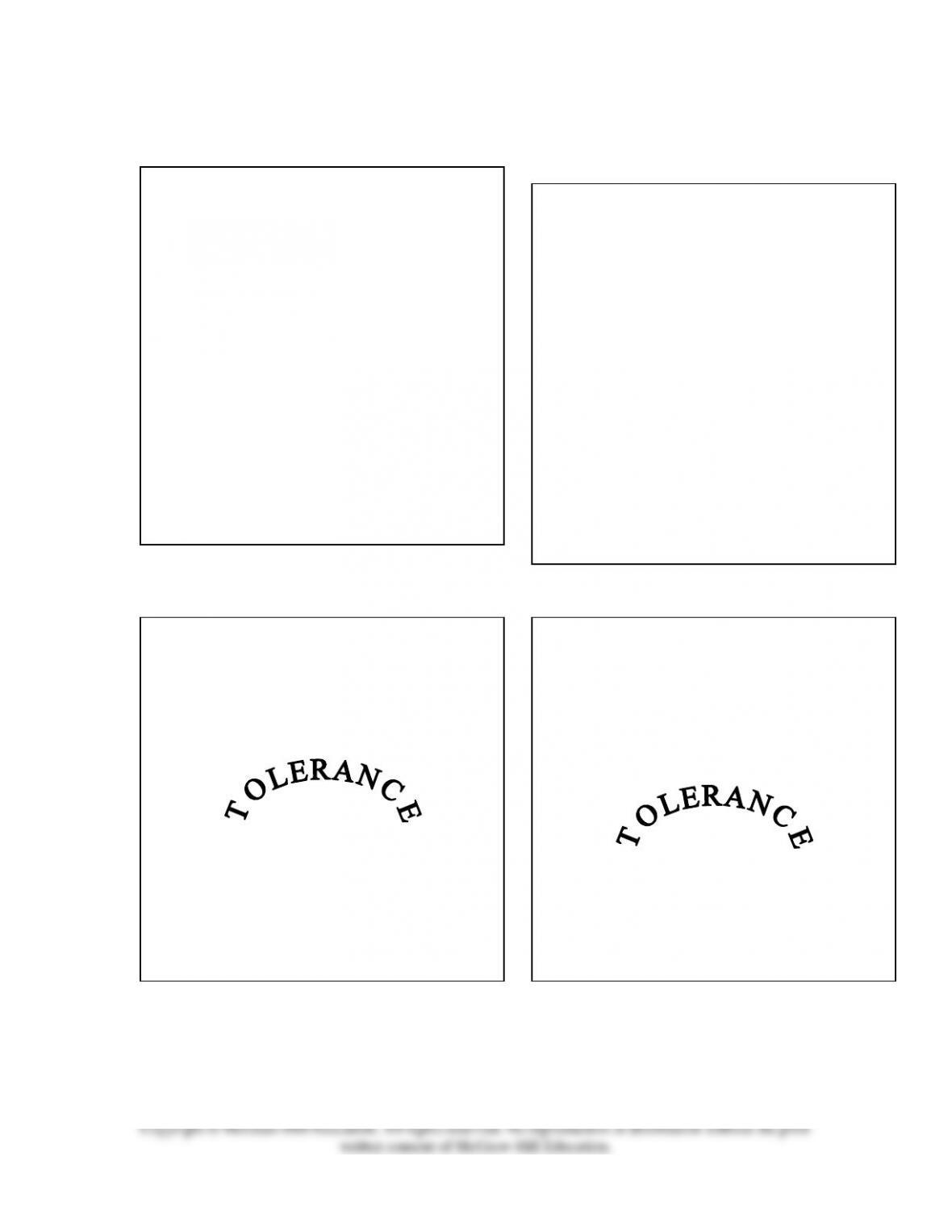
Part 06 – Understanding People
6-35
SAMPLE
As a basic principle,
the mother of a
financially sound family
should not work outside
the home.
1
SAMPLE
People may have stereotypes and
prejudices that convey a
message of nonacceptance or
exclusiveness that are
acted out because of fear.
2
H E A R T S
SAMPLE
H E A R T S
SAMPLE

Part 06 – Understanding People
6-36
FIGURE 6.6: STATEMENTS FOR TOLERANCE HEARTS
If a person or group is seen as inferior, little is
expected of them. If little is expected, there is a
tendency for them to withdraw. If one does not try,
achievement will be low. If achievement is low,
self-esteem will be low. Low self-esteem results in
low social-esteem, and the downward spiral
continues.
Perceived differences can cause people to dislike or
avoid each other even though they should work
together to accomplish a mission. This can happen
on an individual scale or on a group scale. Such was
the case in the United States with separate “Negro”
fighting units during World War I and World War II.
The workplace is not the right place to deal with
diversity issues.
Men and women are entirely different and unequal
beings, not because of socialization, but because they
are born to be so.
Women are basically superior to men.
It is difficult for an American male to work with a
female “boss.”
We should help people achieve their potential. This
involves listening to people, not being so arrogant to
assume we know the needs of all other people.
We would not want a world where everyone is
exactly the same. In The Rhinoceros, Eugene
Lonesco showed that conformity can be an evil
tyranny, just as great as discrimination.
While women’s and men’s work styles may be
different, neither should be considered somehow
better than the other. Instead, we should value the
differences and capitalize on them for the greatest
good of all.
Women and minorities should build
relationships, learn the prevailing norms of behavior,
and work to become effective.
Men and women are equal so any difference in job
placement or social treatment is the exclusive result
of social conditioning, not inborn characteristics.
It is a good practice to evaluate the holidays your
organization officially recognizes to see whether they
accommodate a diverse work force.
A man who is prejudiced against certain types of
people because of their age, sex, race, etc., will
remain that way unless he has new and satisfying
experiences that change
his mind.
In true community, there is a philosophy of
pluralism, an open climate for dissent, and a
relentless effort to eliminate racism, sexism, and
other discriminations.

Part 06 – Understanding People
6-37
No longer predominately white and male, in the
American workplace, three out of every five
employees are women and 25 percent are
minorities. It is good that now, for the first time in
history, white males constitute the minority class.
Men are basically superior to women.
Heroes and heroines in music, sports, theater,
politics, business, science, etc, of other cultures are
not as
important as those of our own culture.
The fact is, different races have different abilities.
Stereotyping ignores individuality and keeps human
relations on a superficial, unsatisfying plane.
Minority members need not be any more
competent than majority members of a
group or society to be accepted by the
dominant group.
Once formed, attitudes continue unless something
new, major, and emotional happens. A woman who
is uncomfortable with strangers will remain that
way unless she has new experiences that are
positive and rewarding.
In the enlightened community, social differences do
not divide people. Instead, diversity is welcome.
There is a wholeness that incorporates the wide
variety and richness of human experience.
Diversity in the workplace causes more harm than
good.
Intolerance results form attitudes formed both in the
home and in the larger community.
Today’s leaders have to create plans and goals that
incorporate the needs of a multicultural workforce,
and do this in such a way that all members may feel
a sense of ownership.
Even though individuals may be representatives of
their races and sexes, no two people are exactly the
same. Every person should be treated as he or she
uniquely is. In doing this, we demonstrate a basic
belief in the importance of the individual and a
respect for each person’s individuality.
People with high tolerance tend to have more stress
in human relations than people with low tolerance.
Be sure everyone is given the opportunity to
participate. Go for inclusion and openness as
important workplace values.
A woman’s place is in the home.
Valuing diversity provides strength and a positive
advantage for organizations operating in
multicultural environments.

Part 06 – Understanding People
6-38
People need social tolerance and a “live and let live”
attitude when absolutes do not apply and when
positive relations among different types of people
are desired. This attitude creates a sense of
belonging and respect, and it results in the greatest
good for all people.
You can’t change people’s attitudes.
The fellowship of human beings is more important
than the fellowship of race, class, and gender. Be
decent and fair, and insist that others be so in your
presence.
When dealing with people, little comes from trying
to imagine how you’d feel if the roles were reversed;
no one has that vivid of an imagination.
Don’t tell, laugh at, or in any way go along with
racial, ethnic, religious, or gender jokes, or with any
practices intended to demean rather than enhance
another human being.
It is a good thing to talk about what helps and harms
our relationships. We should express our true selves,
and listen to understand.
If you mix men and woman on the job, they will
carry on to the detriment of efficiency and good
morals.
All groups have the same motivation practices, so it
is easy to motivate everyone in the same way.
A workplace should show diversity in the physical
environment. Art work and literature should be
displayed representing a variety of cultures, and
structural changes should ensure accessibility by
all.
The greater the level of intolerance, the more
difficult it is to understand other people, and the
harder it is to adapt to new situations involving other
points of view.
Include people who are different from you in social
conversations, and invite them to be part of informal
work-related activities, such as going to lunch or
attending company social events.
Tolerance improves when we understand our own
culture and how it translates into our own lifestyle,
value, and views.
In general, women lack the skills required to be an
effective supervisor.
In general, a man lacks the skills required to be an
effective supervisor.
Problems are caused by people who do not accept
their place in the social order.
Company publications such as employee newsletters
should concentrate on the company and not be
concerned with diversity.
Attitudes are hard to conceal. Few people are
professional actors, so when intolerance exists, it is
usually no secret.
Valuing diversity involves attracting, developing,
and retaining the best talent possible.
Managing diversity requires the capacity to put
oneself in another person’s shoes.
One must recognize that differences among people
are inevitable, that minority members will be present
in almost every social grouping and that both
positive and negative feelings toward different types
of people are normal; however, one must not
discriminate in a harmful way.

Part 06 – Understanding People
6-39
There is a need to involve diverse viewpoints in the
design and development of products and services.
“Different” can and is often “good.”
Man may ignore or avoid dealing with feelings and
emotions, preferring instead to attach underlying
causes. Women, expecting to have their feelings
supported, may misconstrue men’s aggressive
approach and feel that they themselves are being
attacked. In general, where men seek status, women
seek connection.
A subtle, psychological cause of communication
breakdown is intolerance, an unwillingness to accept
people and ideas other than one’s own.
A healthy community is a safe place precisely
because no one is attempting to heal, convert, or fix
others. People accept each other as they are. They
tolerate individual foibles as good families do.
It is a misfortune that people cannot ordinarily
possess a talent without some desire to disparage all
others. If they have subtlety, they decry force; if
they are geometrists, they attach poetry. The
dominating mind compels others to submit to its own
judgments, and generally to its errors.
In the workplace, it is right to expect women,
minorities, and others outside the mainstream to do
all the adapting.
Employees should talk openly about diversity issues,
respect all points of view, and work cooperatively to
solve problems.
Double standards can be seen when mistakes made
by males are tolerated, but mistakes made by
females are not tolerated, and when, to be promoted,
a black must be clearly superior to every white
candidate available.
Social tolerance is different from personal patience.
It is possible for a person to be open-minded toward
different types of people and forms of behavior, but
to be inflexible when it comes to certain personal
habits or situations.
While you can’t learn all there is to know about
every culture, the more you know, the more
successful you will be because people will
appreciate your efforts. If you understand very little
about the background and characteristics of others,
how can you hope to interact effectively with them?
There is no “scientific basis” for theories touting the
genetic superiority of any one population over
another.
Valuing diversity requires modeling behavior that is
inclusive and not prejudging.
Diversity in the workplace is one more step toward
the breakdown of the modern family.

Part 06 – Understanding People
6-40
Dealing with diversity means behaving in a way
that creates a sense of community among people
and gains benefits from their differences.
Benefits of valuing diversity and achieving
inclusively include: increase in work force
creativity, broader range of knowledge and skill,
better decisions based on different perspectives, and
better services provided to diverse populations.
Far from being a stumbling block, diversity in the
workplace can be a springboard for opportunity and
excellence.
Where community exists, all people have reason to
believe that they are accepted and respected, and
their voices will be heard.
Community does not eliminate diversity. Instead, it
welcomes other points of view, embraces opposites,
and seeks to understand all sides of every issue.
Remaining sensitive to differences in others is an
ongoing process that is never fully completed.
Being discriminated against can result in feelings of
worthlessness and inferiority.
Leaders who manage men and women working
together should make business decisions based on
competence rather than gender.
We should have a policy that says we aren’t going to
tolerate any type of behavior that degrades personal
dignity or disrupts the growth and development of
all employees.
Once the genes for surface traits such as coloration
and stature are discounted, the human “races” are
remarkably alike under the skin.
Social attitudes that develop in the home and in the
community tend to remain with us all of our lives
and they play important roles in human relations.
All people should be treated with respect and dignity.
We must have an eyes-level approach rather than an
eyes-up or eyes-down approach in our dealings with
people, regardless of social status.
People tend to live up or down to their own self-
image, and this image is heavily influenced by the
attitudes of others.
Diversity training should include mentoring and
partnering programs that cross traditional social and
cultural boundaries.
Be sensitive to differences. Appreciate the
uniqueness of every individual.
Valuing diversity means trying to understand each
person as an individual, rather than seeing the person
as a representative of a group.
As a basic principle, the mother of a financially
sound family should not work outside the home.
People may have stereotypes and prejudices that
convey a message of non acceptance or
exclusiveness that are acted out because of fear.

Part 06 – Understanding People
6-41
There is a tendency for men to use conversation to
negotiate status; women to talk to create rapport.
The clash of the two styles can lead to frustration in
personal relations and in the workplace as well.
Too often, lack of tolerance leads to discrimination,
exclusion from opportunity, and other forms of social
injustice.
Most female employees don’t even trust other
females in higher positions to treat them fairly.
People who are prejudiced against certain types of
people because of their age, sex, race, etc., will
remain that way unless they have new and satisfying
experiences that change their minds.
Organizations must effectively manage diversity to
remain competitive, both internationally, as well
as in the workplace.
Nothing innate in children causes them to prefer a
certain color of skin or a certain shape of eyes.
Small children learn such preferences by association
and imitation.
Tolerance is important because intolerance can lead
to discrimination, and discrimination can have
harmful effects.
Share the rules. Communicate the customs of the
workplace and be willing to change them in order to
nurture diverse types of people.
Every person should model and reinforce an
essentially democratic character and humanistic
approach to
life.
A man should protect a woman, and a woman should
nurture a man, and the two should not work at the
same jobs.
DISCUSSION QUESTIONS AND ACTIVITIES
To personalize the subject of social tolerance, ask your students to consider questions such as these:
1. As it applies to you, describe how it feels to be: a minority member in a majority group;
stereotyped a certain way; the focus of negative prejudice, or a victim of discrimination.
2. What are people’s attitudes about your race, ethnic roots, religion, and gender? What are your
feelings about these social attitudes.
3. Discuss true-life examples of chauvinism, stereotyping, double standards, derogatory jokes,
and self-fulfilling prophecies. What action can an individual take to reduce negative prejudice
and prevent harmful discrimination?

Part 06 – Understanding People
6-42
4. Describe a time in your life when you were first exposed to different types of people.
5. Describe your attitudes regarding male and female social roles.
6. Use small group discussion to consider the meaning of the saying, “boys will be boys,” and
the meaning of the phrase, “women’s liberation.” Discuss areas of agreement and points of
difference.
7. Discuss the pros and cons in the trend for more women to enter employment and rise to
leadership positions.