
Part 06 – Understanding People
6-1
Major Purposes of Part Six
Part Six focuses on three important subjects—motivation in the
workplace, the art of persuasion, and the diversity challenge.
Part Six Objectives
After completing Part Six, your students should be able to better
understand:
• The personal and social nature of personality;
• The importance of self-concept;
• The relationship between employee needs and work performance;
• The concept of emotional intelligence as it applies to leadership
effectiveness;
• Diversity in the workplace; and
• The importance of social tolerance.
PART SIX—Understanding People

Part 06 – Understanding People
6-2
NOTES AND ANECDOTES
Studies of boys’ gangs show how social roles influence the behavior of young people:
Leaders. As a result of physical strength, intellectual ability, courage, or some other
characteristic, one individual in the group tends to emerge as the leader. The leader gives
instructions, settles disputes, coordinates activities, sets an example for the others, and
often serves as a group conscience. When a member of the gang gets into trouble with
outsiders, he may justify his behavior by blaming the leader: “He told me to do it.”
Advocates. These are youngsters who are more facile with words or ideas than the leader,
but who lack organizing ability or boldness in action. These group members may be cast
in the role of negotiators with rival gangs or defenders of the group against adult
disapproval. They are expected to be masters of the alibi and skilled at rationalization and
clever negotiation. They play a role roughly analogous to that of lawyer or diplomat.
Clowns. Many juvenile groups have their court jester—one who is expected to be funny.
Sometimes this person differs from the others in physical appearance (for example, very
tall, thin, or heavy), and sometimes the person is below par in other skills demanded by
the group. By combining humor and self-display, the clown can gain status in the group
and the affectionate regard of other members.
Fall guys. Often there is a member whose alleged ineptness, mistakes, or simply bad luck
get him blamed for almost everything that goes wrong for the group. The presence of
such a scapegoat tends to relieve the others of feelings of inferiority and insecurity that
would otherwise result from group failures.
Mascots. In some cases, the group adopts a mascot—an individual who is younger, physically disabled,
or otherwise different from other members of the group in a way that they consider inferior. The mascot
is usually well accepted by the group as long as he sticks to his role and does not attempt to participate
in the group as a full-fledged member. It is not unusual for male groups to adopt female mascots.
NOTES AND ANECDOTES
The Importance of Self-Concept
Self-concept is that constellation of central ideas and attitudes we have about ourselves. Prescott Leckey,
a psychologist early in the 20th century, explained the importance of self-concept in human behavior:
“Every person’s central mission in life is the preservation and enhancement of his concept of himself.”

Part 06 – Understanding People
6-3
This was put another way years later by educator S.I. Hayakawa: “The primary goal of a human being
is not self-preservation, but preservation of the symbolic self. Why else would a man spend hundreds of
dollars a year to catch a few fish? Or why would a woman skip lunch for years to buy a fur coat? Or why
would a soldier throw his body on a live grenade, killing himself to save comrades he might not even
know? We do what we do in order to be consistent with who we think we are.”
People know their self-concept, dimly or clearly, and can usually justify why they do what they do in a
word or phrase. Comedian Steve Martin says, “I’m a wild and crazy guy.” Oliver North explained his
motives to a congressional committee, “I did what I did because I am a patriot.” As author Jack Bickham
explains, people begin forming a self-concept early in life. They test it, and if it seems reasonably
accurate, they begin to define themselves more specifically by it. To themselves and others, they may say,
“I’m a man of action.” Or, “I’m a lady of quality.” Or, “I’m a brilliant writer, but I can’t do math.” Or,
“I’m a Danforth, and every Danforth is a leader.”
Whatever the roots of people’s perceptions, once they start making judgments about themselves, the
die is cast and it is hard to alter. People appear dedicated to become more of what they think they already
are. This can be seen throughout one’s life. The quiet and unassuming man who rushes into a burning
building to save a child may never have considered himself to be a hero, but he probably always
considered himself to be a man who loved children, and he could have told you earlier, “I’m a person who
does what he must.”
The following story illustrates the importance of self-concept.
The Mask
An ancient legend tells of a king who conquered and ruled over a vast domain. He was
brave and respected, but no one loved him. This made him lonely, and his face reflected
his inner bitterness. Deep, ugly lines developed around his mouth; and he never showed
a smile.
One day the king saw a beautiful young lady and fell in love with her immediately. He
decided to marry her. He clothed himself in his finest robes and placed a glittering crown
on his head. But when he looked into the mirror, he saw only a cruel, hard face.
He was terribly distressed until he thought of a wonderful idea. He called for his
magician and said: “Make me a mask, and paint it with your magic paints so that it will
make my face look kind and pleasant.”
“This I can do,” said the magician. “But on one condition—you must keep your real face
in the same lines that I paint; one frown or display of anger, and the mask will be ruined.”
“I will do anything you say in order to win the love of my lady. Tell me how to keep the
mask from cracking.”
“You must think kind thoughts,” replied the magician, “and to do this, you must do kind
deeds. You must strive to make your people happy rather than to acquire more territory.
Be kind and courteous to all of your subjects.”

Part 06 – Understanding People
6-4
The king agreed so the magician made a mask of very thin wax which he painted
skillfully. The king tried it on and he looked very handsome indeed. He had little
difficulty in winning the hand of the woman he loved.
The king was very careful not to spoil his mask, and his subjects were amazed at the
change that had come over him. They gave all the credit to his wife who, they said, had
made him over to be like herself.
Years went by, and as gentleness and thoughtfulness for others became a habit and part of
his personality, the king was convinced that he should be more honest and not just
pretend to be so.
He began to regret that he had deceived his beautiful wife with his magic mask, and he
called for his magician. “Remove this mask,” he said. “Take it away. This false face is
not my true one.”
“If I do, I can never make another mask like it,” warned the magician, “and you will have
to remain with your own real face as long as you live.” Still the king was true to his desire
to be honest.
The magician took off the mask, and the king ran to the mirror, full of fear and anguish
over what he might see. To his amazement, he saw that his eyes were bright and his lips
were curved into a radiant smile. The old ugly lines around his mouth and the old frown
had disappeared, and his face was the exact likeness of the mask he had worn for so long.
The king’s wife never noticed the difference. She saw only the familiar features of the
man she loved so dearly.
The importance of self-concept should not be underestimated. What a person thinks and feels about
her or himself influences every aspect of life. It affects how they treat themselves and how they treat
others. It is singularly the most important determinant of the quality of a person’s life. Magazines and
newspapers are full of accounts of famous people who have made a shambles of their lives and are
miserable, proving that nothing—not money, prestige, or the attention of others—can make up for not
liking oneself.
NOTES AND ANECDOTES
Before an individual can experience the need for fulfillment, certain cognitive structures of the brain must
be developed. Only with maturation of the higher centers of the nervous system is a person capable of
abstract reasoning and independent value judgments. Psychologist Jean Piaget, in his cognitive theory of
human development, refers to this as the “formal operations stage,” which covers the period from
adolescence to adulthood.

Part 06 – Understanding People
6-5
In the early teens (approximately age twelve), the potential to think as an adult usually develops and
continues to mature for several years. During this period, individuals are able to think abstractly about
such things as creativity, achievement, and fulfillment. From this time onward, the young person may be
motivated to satisfy fulfillment needs.
The essential difference is that adolescents and adults are no longer tied to concrete and specific
objects for logical thought. They can perform all of the operations entirely in their heads. During this
period, children’s cognitive structures become mature. They acquire all of the cognitive capability and
mental powers of an adult. This does not mean that their thinking is equivalent to that of an adult; rather,
it means that they have developed the potential to think as adults do. The content, function and use to
which they may apply their intellectual powers will be enriched throughout adulthood, but all of the
structures of intelligence have emerged.
Although an individual may appear to behave independently prior to adolescence, only the maturely
functioning human brain can discover, define, and express independent views on what is good, bad, right,
and wrong.
NOTES AND ANECDOTES
Once fulfillment is experienced, the need for it can become a dominant determinant of behavior,
overriding all other motives, including needs for survival, security, love, and respect. How else can you
explain the strivings of the explorer, the mountain climber, the scientist, the inventor, the writer, the artist,
or any person who throws himself into his work and life with tremendous zest and enthusiasm, often
risking social relationships and even physical health? Further, if a person seeks fulfillment but is
unfulfilled, discontent and mental anguish can be expected. In Maslow’s words, at this level of
motivation, “a musician must make music, an artist must paint, and a poet must write, if he is to be at
peace with himself.”
Maslow’s central concern was with the development and expression of needs, which he divided into
two main groups: deficiency needs (also called D-motives) and growth needs or being needs (also called
B-motives). Deficiency needs involve drives to correct imbalances or to maintain physical or emotional
homeostasis, such as satisfying thirst, getting enough rest, or winning the love and respect of others.
Deficiency needs are found in all primates.
Growth or being needs, in contrast, are distinctly human. Maslow argues that human beings have the
unique potential to question, discover, and understand, to give and receive love and respect, and to strive
for optimum fulfillment or peak performance apart from the influence of others.

Part 06 – Understanding People
6-6
People operate at varying levels of efficiency and motivation. In general, the satisfaction of deficiency
needs prevents illness, or cures illness, or recreates inner balance (homeostasis). These are necessary for
basic functioning. In contrast, the satisfaction of being needs produces a more positive and higher level
of health and happiness. The distinction is like the difference between fending off attacks or threats
versus experiencing positive triumph and achievement.
NOTES AND ANECDOTES
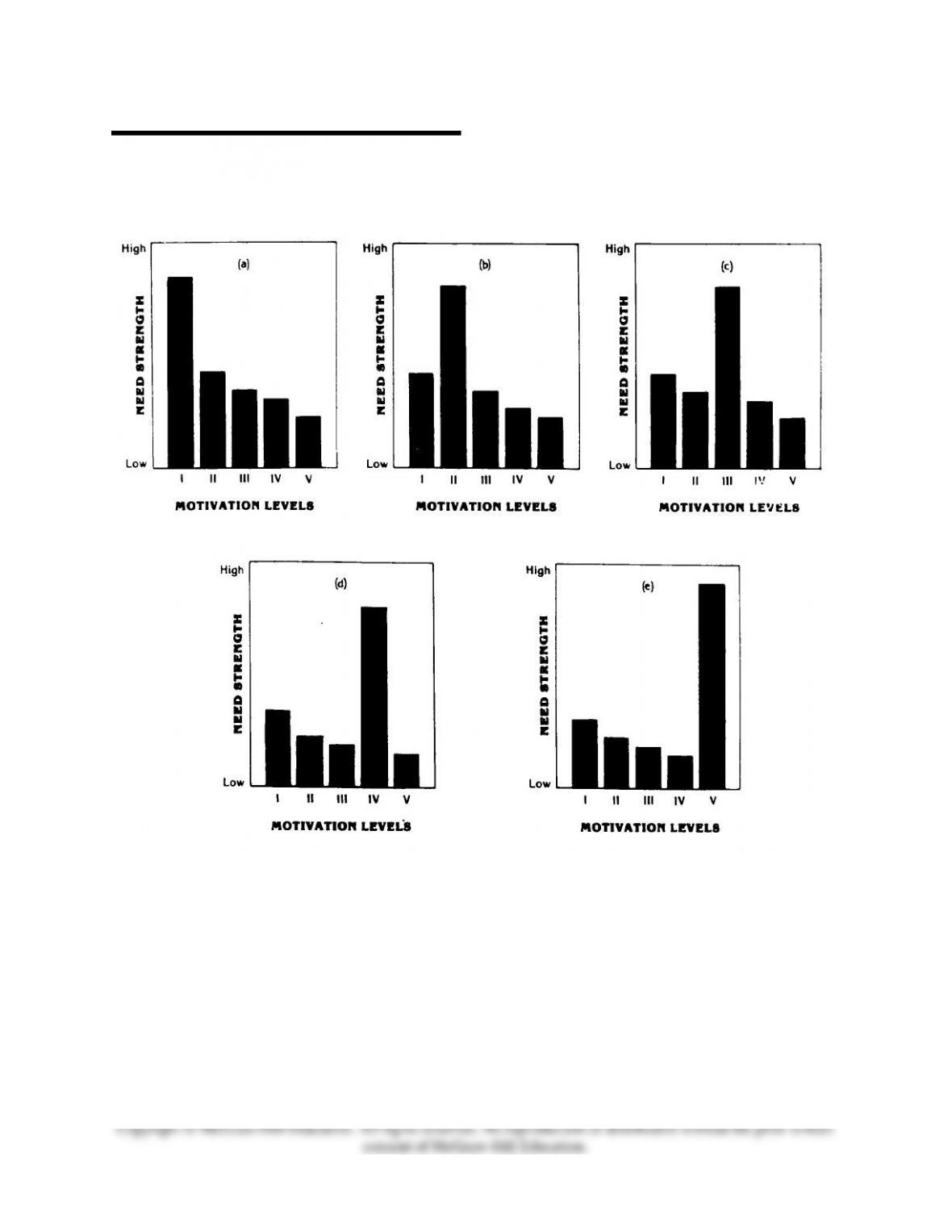
To understand how different needs can dominate your behavior at different periods of your life, consider
the case of Andrew, a young employee who takes his first job with a large accounting firm. See Figure
6.1. The initial interview and the young accountant’s successful efforts to locate housing remove his
concerns about base salary and shelter (see Survival Needs). Because Andrew has a wife and a small
child, he seeks information about job stability, medical coverage, and other fringe benefits. This
information, coupled with a long discussion with his supervisor about job security, satisfies his concerns
about these factors, and he takes the job (see Security Needs). Once on the job, frequent social
interactions with his supervisor, fellow workers, and clients prove to be most satisfying, and he becomes
an accepted member of the firm (see Belonging Needs). As time passes, Andrew concentrates more and
more effort on doing his job as effectively as possible. Within three years, he receives a promotion to the
position of senior staff accountant (see Respect Needs). Subsequent years find Andrew in the newly
created position of Director of Administrative Services, the external consulting arm of the accounting
firm. His outside activities include participation in civic, school board, and charitable affairs, plus a
revitalized interest in building furniture in his garage workshop (see Fulfillment Needs).
NOTES AND ANECDOTES
THE CLOSED MIND
A subtle, psychological cause of communication breakdown and failed human relations is
intolerance—an unwillingness to accept people, ideas, and backgrounds other than your own. The
stronger and more fixed your views, the greater the intolerance and the more difficult it is to understand
other people (communications) and the harder it is to adapt to new situations involving others (human
relations). Another word for intolerance is closed-mindedness.
Economist Paul Samuelson’s tongue–in-check description of working women shows the role of
intolerance in the world of work.
Women are built by nature to tend to babies in the home. They are emotional. They have
monthly ups and downs. They cannot carry heavy weights. They lack self-confidence.
Men will not work under a woman. Man–to-man talk will be inhibited by the presence of

Part 06 – Understanding People
6-7
women. Even women prefer a male physician to a female one. Women lack imagination
and creativity. If you mix men and women on the job, they will carry on to the detriment
of efficiency and good morals. By the time you have trained a woman, she’ll get married
and leave you, or have a baby, or alternatively, you won’t be able to ever to get rid of a
woman once you’ve hired her. If a woman does turn out to be a superlative economic
performer, she’s not feminine; she’s harsh and aggressive with a chip on her shoulder
against men and the world. (And she’s killing her chances of getting married.) Women
workers, seeking pin money, take bread from the mouths of family breadwinners.
Where do such ideas come from? How is intolerance developed? Intolerance results from social
attitudes formed both in the home and in the community.
Home
There is nothing innate in children that causes them to have preferences for a certain color of skin
or a certain shape of eyes. Small children learn such preferences by association and imitation. Children
observe the behavior of role models, particularly their parents, as they interact with others, and they begin
to learn preferences for their parents’ attitudes and ways of behaving. Preferences for many social
customs, such as eating, speaking, and living habits, are developed early as a result of home and family
influence. More than 200 years ago, Thomas Jefferson recognized the importance of the home
environment for shaping attitudes when he wrote, “…for man is an imitative animal. This quality is the
germ of all education to him. From his cradle to his grave, he is learning to do what he sees others do.”
As early as age three and usually be age five, children notice ethnic differences, and social
stereotyping begins. Consider the role of the family, as young boys and girls develop different attitudes
toward social roles. The following quotations depict boys as strong, capable, and worldly, and girls as
dependent and oriented toward life in the home.
How Boys and Girls are Different
“Mark! Janet!” said mother.
“What is going onhere?”
“She cannot skate,” said mark.
“I can help her;
I want to help her.
Look at her, mother;
Just look at her.
She is just like a girl;
She gives up.”
“Stop that, Janet,” said mother.
“Mark is going to help you.
He is going to help you now.
Come on Janet.
Get up!
I want to see you skate.”
“Now you see,” said Mark.
“Now you can skate.
But just with me to help you!”

Part 06 – Understanding People
6-8
Boys and Girls Do Different Things
They all jumped into the big box.
“A train,” one boy said.
“The box can be a train.”
“Get on the train,” said the boys.
The girls went into the box.
What could the box be now?
The box was not a boat.
It was not a train.
It was not a plane.
The box was a house.
And the girls played house all day.
In our society, boys and girls are treated differently from the time they are born. Boys are dressed
in blue and given cars and trucks for toys, while girls wear pink and are encouraged to play with dolls and
dishes. Boys are allowed more freedom and girls are treated more protectively.
By the age of three, most children know whether they are male or female, and they have distinct,
if not exaggerated, ideas of what masculinity and femininity should involve. Through conditioning (a
system of rewards and punishments), Imitation (copying the behavior of those perceived to be most like
themselves), and self-definition (categorizing people into two sexes and then deciding to which group
they belong), children establish sexual identity, a critical task for normal growth and development.
Just as attitudes toward sex roles are influenced by home and family, so are many other social
attitudes. These include broad views on work, health, and government, as well as specific opinions about
food, language, dress, and other people.
Community. Social attitudes continue to develop throughout later childhood and during the early teens,
as school, religion, social customs, and community stereotypes play important roles. The socialization
that most people experience during this period has tremendous influence on their likes and dislikes for
particular values and types of people. By late adolescence, attitudes usually solidify around the norms of
the community and groups with whom the person associates.
School. To see how schools can influence social attitudes, consider that textbooks from preschool on
historically have portrayed males more favorably than females. A study of books awarded prized for
excellence by The American Library Association found that male characters out-numbered females 11 to
1, in the case of animals with sex identities, 95 to 1. Throughout these books, males were shown in
adventurous and varied roles, while girls were usually shown only in supportive and homemaker roles.
In another study, social researcher Marjorie U’Ren found that only 15 percent of the schoolbooks
with illustrations of people included pictures of women. She writes: “We tend to forget the fact that the
female sex is half the human race, that women are not merely the ladies’ auxiliary to the human species.”
Religion. Religious teachings are important in shaping attitudes toward types and groups of people.
Consider the implications of the prayer all male Orthodox Jews are supposed to say every morning:
Blessed art thou, oh Lord our God, King of the Universe, that I was not born a gentile.
Blessed art thou, oh Lord our God, King of the Universe, that I was not born a slave.
Blessed art thou, oh Lord our God, King of the Universe, that I was not born a woman.

Part 06 – Understanding People
6-9
Similar antifeminist bias is reflected in Christianity due largely to the teachings of Saint Paul,
who viewed the inferior role of women as part of divine natural order. In I Corinthians 11:7—9, Paul
writes:
…A man…is the image of God and reflects God’s glory; but woman is the reflection of
man’s glory. For man did not come from woman; woman came from man. And man
was not created for the sake of woman, but woman was created for the sake of man.
Elsewhere in the New Testament Paul states:
…Wives should regard their husbands as they regard the Lord, since as Christ is the head
of the church and serves the whole body, so is a husband the head of his wife; and as the
church submits to Christ, so should wives submit to their husbands, in everything.
Social Custom. The role of social custom in forming attitudes is shown by the different roles of men and
women in different societies.
Social Custom and Sex Roles
Anthropologist Margaret Mead spent the years 1931-1933 in New Guinea studying
the contrasting attitudes of societies toward the sexes. Among three groups—the gentle
Arapesh, the cannibalistic Mundugumor, and the head hunting Tchambuli—living within
a radius of only about a hundred miles, she found strikingly different ideas about
masculinity and femininity.
Among the Arapesh, men and women are regarded as equally gentle and are equally
likely to initiate sexual relations. In fact, parents are more inclined to warn their sons that
their daughters against getting into situations in which they might be seduced. Males
take as much delight as females in those many aspects of parenthood that the North
American and European stereotypes regard as “maternal” behavior. So little distinction is
made between parental roles that the Arapesh verb that translates as “to bear child” refers
equally to males who have become fathers and to females who do the actual bearing.
When Mead remarked to al group of Arapesh that a certain middle-aged male was
handsome, they agreed, and then one added, “bur you should have seen him before he
bore all those children.”
The nearby Mundugumor also apply the same standards of behavior to both sexes,
but their ideal is the direct opposite to that of the gentle Arapesh. Both male and female
Mundugumors are taught from infancy to be independent and competitive. As adults,
females are expected to be every bit as aggressive in sexual encounters, and no less
violent, jealous, and quick to avenge insults than the males.
Among the third group, the Tchambuli, the sexes exhibit definite behavioral
differences, but with an exact reversal of the roles expected of them in most other
societies. The males spend much of their time playing the flute and cultivating the arts;
they take care in choosing their attire each day and in adorning themselves with jewelry;
and most of the work they do consists of shopping and trading. The females, on the other
hand, are assertive and practical; they show little interest in clothing or jewelry; and it is
they who, by fishing and by manufacturing utensils for trade, largely provide for the
family.
Community Stereotypes. Community stereotypes are important determinants of social attitudes.
Consider Russian author Leo Tolstoy’s characterization of people from different parts of Europe,
as described in War and Peace:

Part 06 – Understanding People
6-10
A Frenchman is self-assured, because he regards himself personally, both in mind
and body, as irresistibly attractive to men and women. An Englishman is self-assured, as
he sees himself as being a citizen of the best-organized state in the world. An Italian is
self-assured, because he is excitable and easily forgets himself and other people. A
Russian is self-assured, just because he knows nothing and does not want to know
anything, since he does not believe that anything can be known. The German’s self–
assurance is worst of all, stronger and more repulsive than any other, because he imagines
that he knows the truth—science—which he himself has invented, but which is, for him,
the absolute truth.
The tendency to generalize and the tendency to be stereotyped shape the attitudes and
experiences of many people. Consider the words of the English poet, Alfred Tennyson:
Man for the field, and woman for the hearth;
Man for the sword, and for the needle she;
Man with head, and woman with the heart;
Man to command, and woman to obey;
All else confusion…
Such ideas were widely shared and influenced conditions in nineteenth- century English society.
Social attitudes that develop in the home and in the community tend to remain with you all of
your life and play important roles in human relations. Once formed, these attitudes are difficult
to change. In The Nature of Prejudice, psychologist Gordon Allport reports the following
conversation:
Mr. X: The trouble with Jews is that they only take care of their own group.
Mr. Y: But the record of the community chest campaign shows that they give more
generously, in proportion to their numbers, to the general charities of the community,
than do non-Jews.
Mr. X: That shows they are always trying to buy favor and intrude into Christian affairs.
They think of nothing but money; that is why there are so many Jewish bankers.
Mr. Y: But a recent study shows that the percentage of Jews in the banking business is
negligible, for smaller than the percentage of non-Jews.
Mr. X: That’s just it; they don’t go in for respectable businesses; they are only in the
movie business or they run night clubs.
In effect, Mr. X is saying, “Don’t confuse me with the facts; my mind is made up,” and he will
create one rationalization after another to support his basic attitudes.
Besides attitudes toward specific groups and customs, people acquire a general orientation
toward the world through family, friends, school, and other influence factors. Some may
develop a world view that is black and white (good and evil, right and wrong), with no tolerance

Part 06 – Understanding People
6-11
for differences. Others may develop a world view that is neither black nor white but a reality in
between, so that their opinions are tentative and open to new information and new interpretation.
This world view is essentially open-minded. Your view of the world affects your entire life,
because it is carried into every relationship you have.
Part 06 – Understanding People
6-12
FIGURE 6.1: THE CAREER OF AN ACCOUNTING GRADUATE 1
RESPECT NEEDS
FULFILLMENT NEEDS
BELONGING NEEDS
SURVIVAL
SECURITY

Part 06 – Understanding People
6-13
NOTES AND ANECDOTES
The Criteria of Emotional Maturity
HAVING the ability to deal constructively with reality
HAVING the capacity to adapt to change
HAVING a relative freedom from symptoms that are produced by tensions and anxieties
HAVING the capacity to find more satisfaction in giving than receiving
HAVING the capacity to relate to other people in a consistent manner with mutual satisfaction and
helpfulness
HAVING the capacity to sublimate, to direct one’s instinctive hostile energy into creative and
constructive outlets
HAVING the capacity to love
William C. Menninger, M.D.
1899-1966

Part 06 – Understanding People
6-14
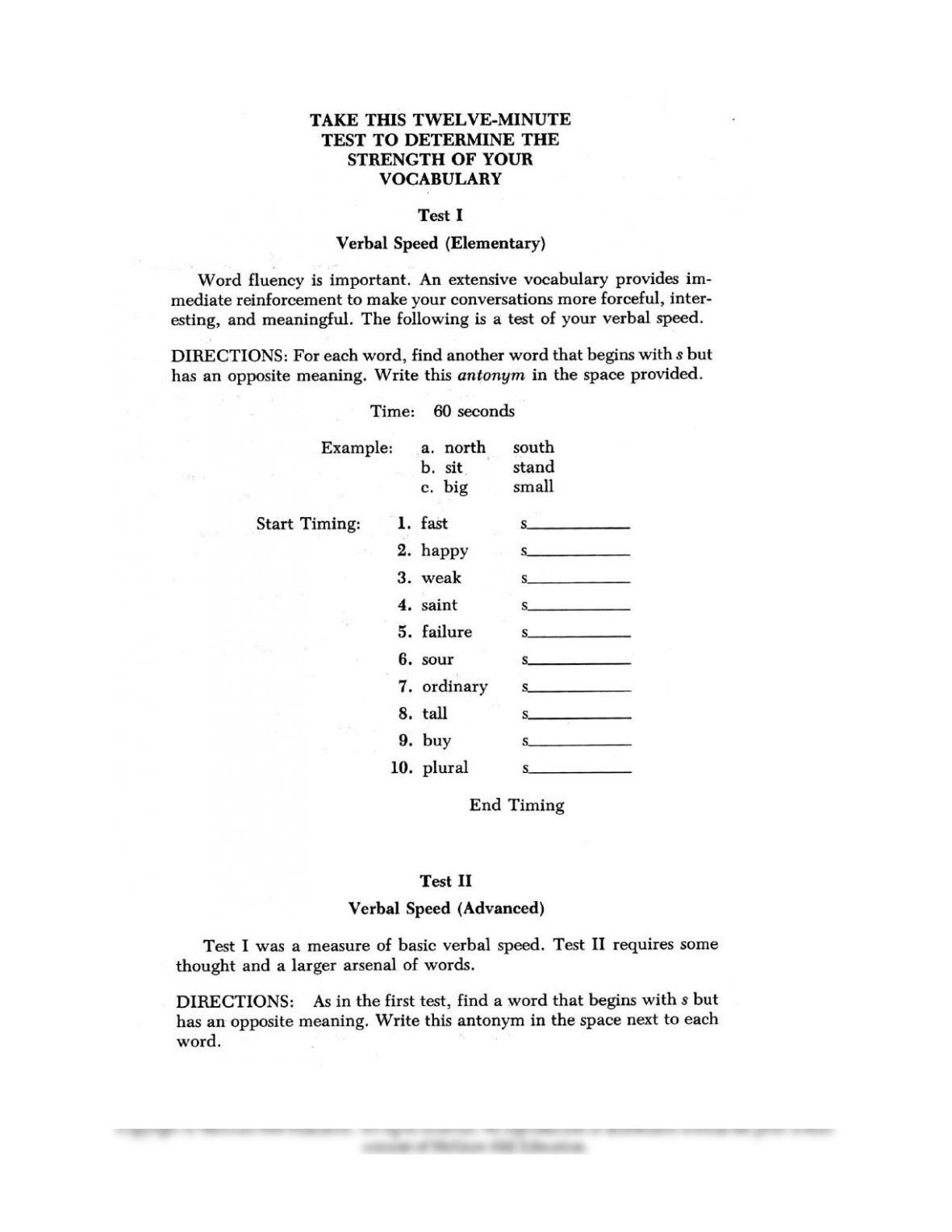
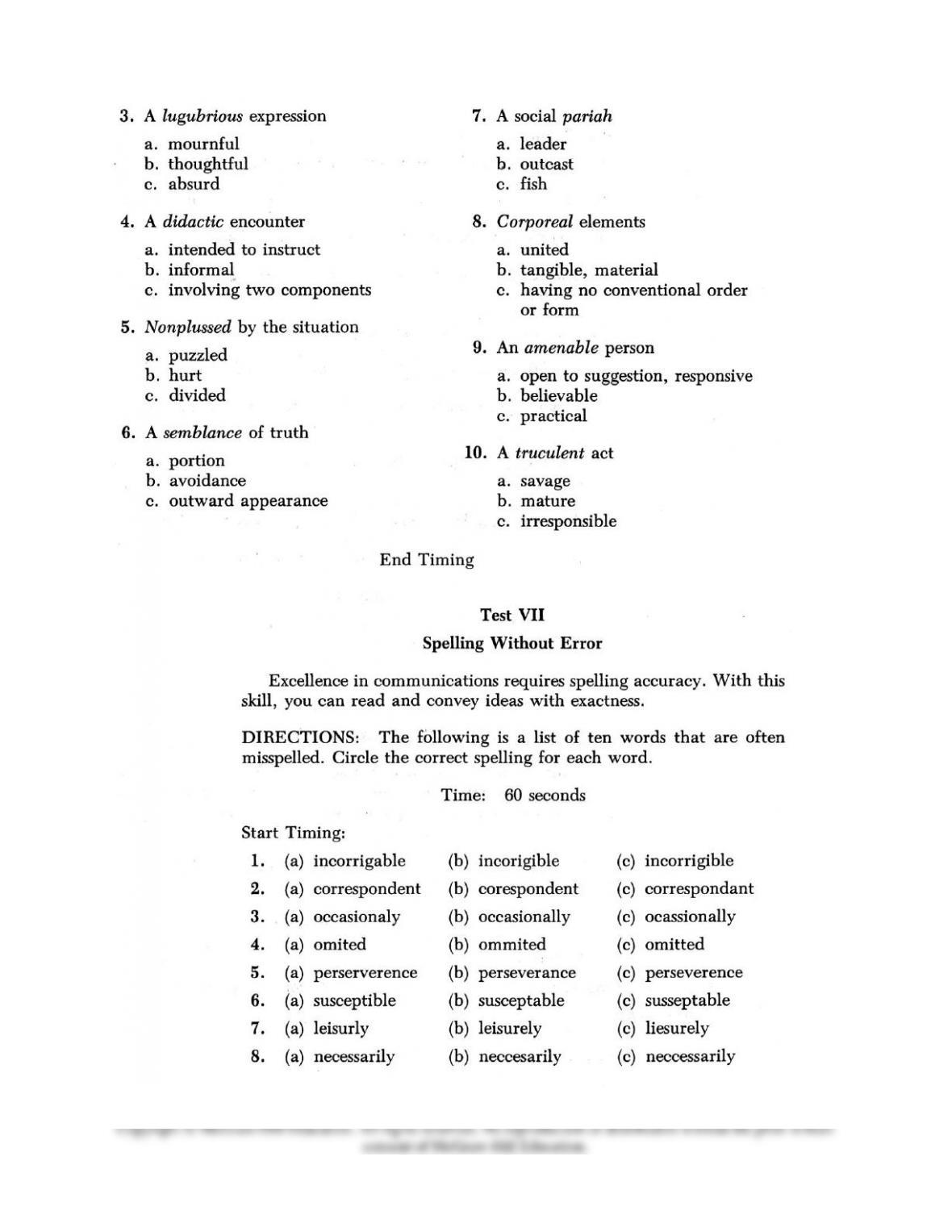
EXERCISE 6.1: The Power of Vocabulary
There are few things more important than the ability to transfer your thoughts and ideas
to the mind of another person with clarity and with the meaning unaltered. The power of
language carries over into every aspect of life—at home, at work, and in the community. Great
communicators have developed this power, and by the magic of their words, they persuade
others to think as they think and to feel as they feel.
An extensive understanding of the exact meaning of words is a common characteristic of
successful people. Words are tools for thinking. It follows that the more words you understand
and use, the more accurate your thinking process will be. Problem-solving ability sharpens when
you possess an efficient and extensive vocabulary.
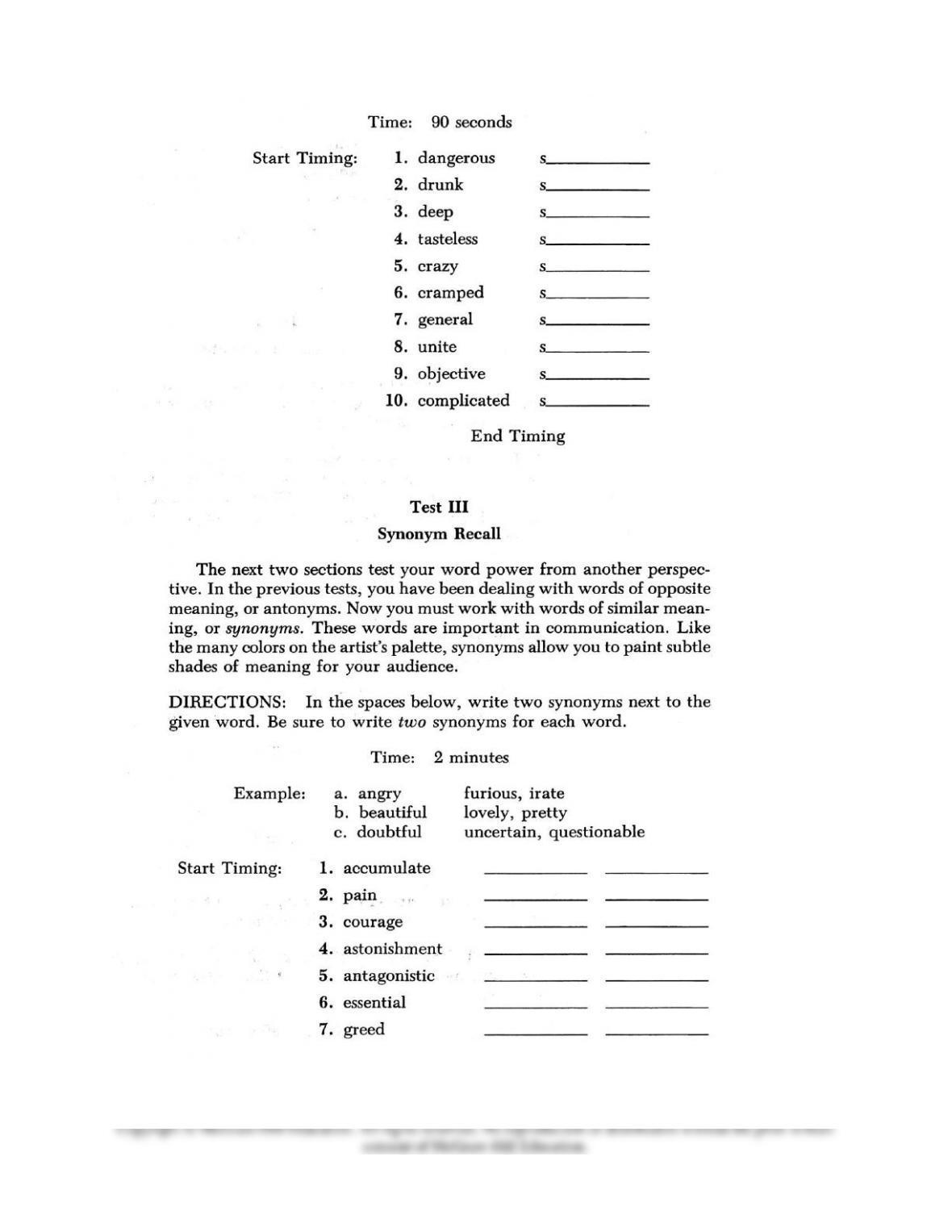
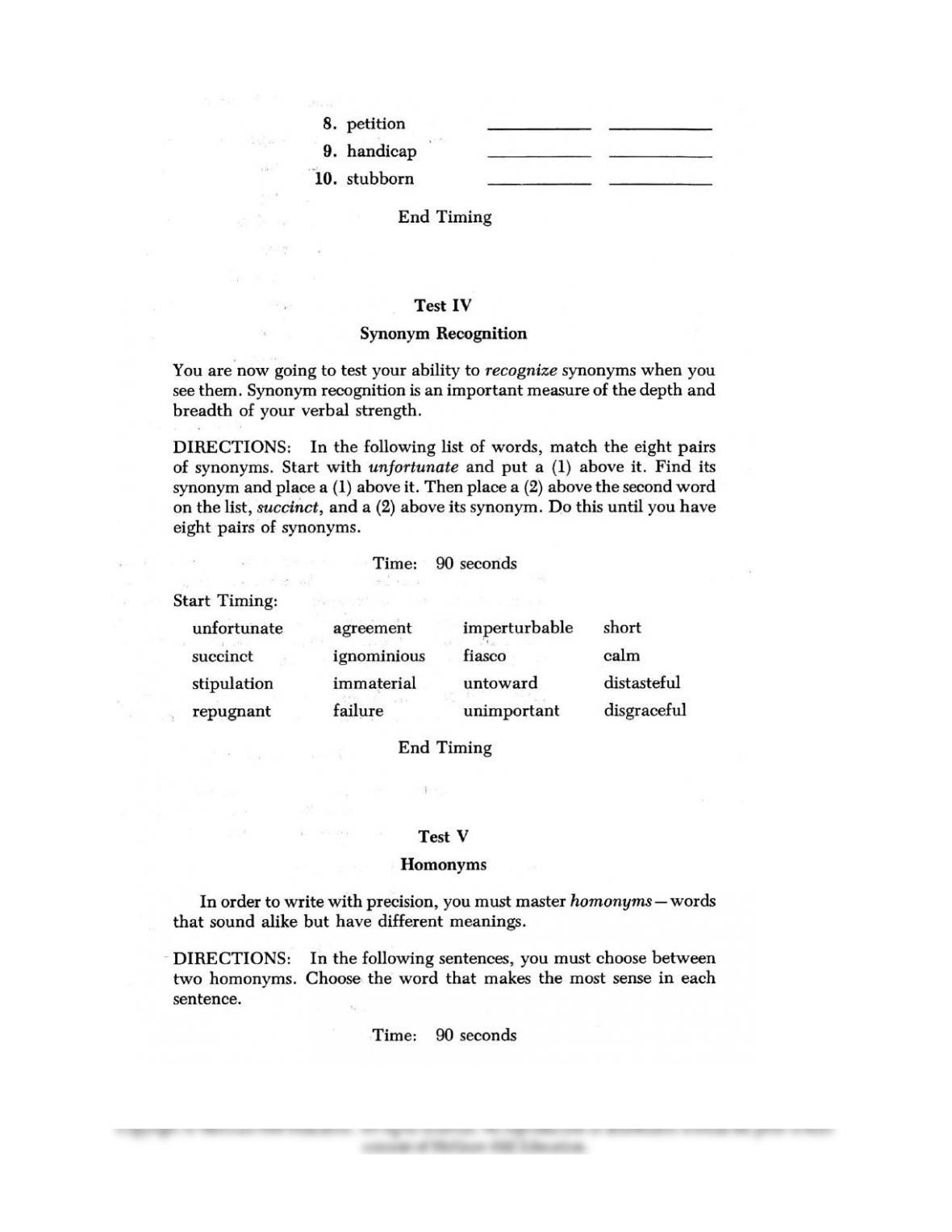
The following is a test of your verbal power. Take the test and score yourself. If your
vocabulary skills are below expectations, you may want to begin a vocabulary improvement
program. To improve your vocabulary, consider five helpful hints:
• Learn three new words a day.
• Learn the origins of words (etymologies).
• Keep a digest of new words.
• Do crossword puzzles.
• Study 30 Days to a More Powerful Vocabulary by Wilfred Funk and Norman Lewis
(New York: Pocket Books, 1970).
Source: Marie Nelson Moore, Northern Kentucky University, 1986, based on the work of
Wilfred Funk and Norman Lewis, 30 Days to a More Powerful Vocabulary (New York: Pocket
Books, 1970).
Part 06 – Understanding People
6-15
Part 06 – Understanding People
6-16
Part 06 – Understanding People
6-17

Part 06 – Understanding People
6-18
Part 06 – Understanding People
6-19

Part 06 – Understanding People
6-20