
Part 05 – Leadership Principles
5-79
EXERCISE 5.6: MEMBER EVALUATION (continued)
Additional Comments:
Scoring
Total the ratings for each person on the Member Evaluation form.
Interpretation
Find each member’s total score on the following chart
Total Score Member Evaluation
56–70 Good to Excellent
42–55 Adequate to Good
28–41 Fair to Adequate
14–27 Poor to Fair

Part 05 – Leadership Principles
5-80
EXERCISE 5.7: GROUP EVALUATION
Group: Date:
Evaluator:
To evaluate group effectiveness, circle the number that represents your response to the following
questions.
1. Communication: Do group members communicate freely?
1 2 3 4 5 6 7 8 9 10 11
Inhibited; never felt free to talk Open; always felt free to talk
2. Respect: Did group members respect each other?
1 2 3 4 5 6 7 8 9 10 11
Disrespect or disregard was common Respect and consideration were
common
3. Support: Did group members support each other?
1 2 3 4 5 6 7 8 9 10 11
The group was critical and unsupportive The group was receptive and
supportive
4. Atmosphere: What was the atmosphere in the group?
1 2 3 4 5 6 7 8 9 10 11
Unpleasant; quarrelsome; unfriendly Pleasant; cooperative; friendly
5. Creativity: How open to new ideas was the group?
1 2 3 4 5 6 7 8 9 10 11
Custom-bound; low creativity Spontaneous; high creativity
6. Involvement: Was participation broadly shared?
1 2 3 4 5 6 7 8 9 10 11
Group was dependent on just one or two people Participation was broadly shared

Part 05 – Leadership Principles
5-81
7. Results: How effective was the group in achieving results?
1 2 3 4 5 6 7 8 9 10 11
Ineffective; low results Very effective; high results
8. Satisfaction: How satisfied are you with your experience in the group?
1 2 3 4 5 6 7 8 9 10 11
Dissatisfied Satisfied
9. Overall Rating; How would you rate the group as a whole?
1 2 3 4 5 6 7 8 9 10 11
Poor; waste of time Excellent; time well spent
Additional Comments:
Scoring
Add the total ratings on the Group Evaluation form: _______________
Interpretation
Scores Evaluation Description
90–99 Excellent A superior group experience
63–89 Good Positive group experience
45–62 Fair Neither all good nor all bad; team building suggested
18–44 Needs improvement Attention to team building needed
9-17 Poor Failure as a group experience; team building
required, or disband the group.

Part 05 – Leadership Principles
5-82
EXERCISE 5.8: BROKEN SQUARES
Step One. Five people should sit in a circle, close enough so that each can reach the
space in front of the others in the group. A sixth person may be an observer.
Step Two. Using one set of broken squares, the observer should randomly distribute two
to four pieces to each participant. All of the pieces should be distributed.
Step Three. The group’s task is to assemble five squares of equal size. Note the
following guidelines:
▪ No person may speak;
▪ No one may reach over and get anyone else’s pieces;
▪ All of the pieces will be needed to accomplish the task;
▪ It is possible to make an incorrect square that would prevent the completion of the
other four squares;
▪ A person may give away some or all of his or her pieces;
▪ Fifteen minutes should be ample time to complete the task; sixth graders can do it
in six.

Part 05 – Leadership Principles
5-83

Part 05 – Leadership Principles
5-84
Exercise 5.9: EXPERIENCE IS A TEACHER: BROKEN SQUARES
Communication is a major problem faced by most organizations. It is important to have
open, free-flowing, and constant communication about work-related issues, such as products,
policies, and procedures. Another problem is lack of teamwork. Individuals and departments
may be so busy protecting their own interests that they fail to cooperate with others.
The price for failure to communicate and lack of teamwork include poor quality of work
and reduced quality of work life. This can happen in any work group or organization, and the
consequences can be great. Imagine the effects of poor communication and cooperation in a
hospital setting, or in almost any emergency situation.
The following exercise demonstrates the need for communication and teamwork. The
purpose of the exercise is to make participants aware of their own behavior in group problem–
solving situations. The time required to complete and discuss the exercise is 30-45 minutes.
Directions
Carry out the following five steps to complete the exercise:
Step One. Five people should sit in a circle. Sit close enough so that each can reach the space in
front of the others in the group. A sixth person may be an observer.
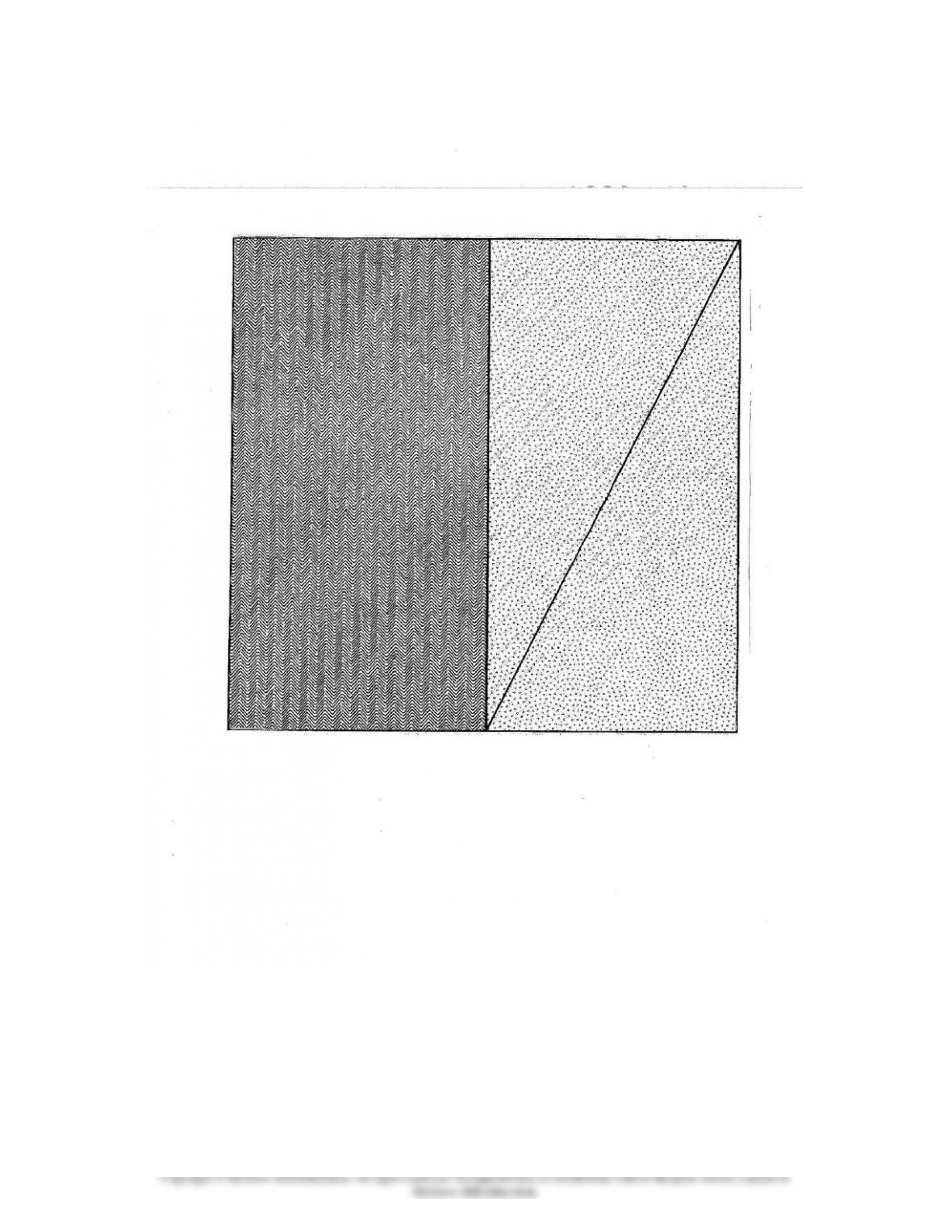
Step Two. Each participant should take one of the figures shown on the following five pages, cut
out the three parts of each figure, and place them on the table. Each should use a different page.
The instructor may want to cut the pieces and laminate them in advance for permanent use.
Step Three. All the pieces from all five pages should be placed in a single pile in the middle of
the table. One participant or the observer should randomly distribute two to four pieces to each
participant. All of the pieces should be used.
Step Four. The task facing the group is to assemble five squares of equal size. Note the
following guidelines.
▪ No participant may speak;
▪ No one may reach over and get anyone else’s pieces;
▪ All of the pieces of the puzzle will be needed to accomplish the task;
▪ It is possible to make an incorrect square that would prevent the completion of the other
four squares;
▪ A participant may give away some or all of the pieces, even if a square has already been
formed;
▪ Fifteen minutes should be ample time to complete the task; sixth graders can do it in 6.
Step Five. Begin.
*Source: Alex Bavelas, “Communication Patterns in Task–Oriented Groups,” Journal of the acoustical Society of
America 22 ((1950): 225-30; and J. William Pfeiffer and John E. Jones, eds., A Handbook of Structured Experiences
for Human relations Training—Vol. 1 (LaJolla, CA: University Associates, Inc., 1974), 25-30.

Part 05 – Leadership Principles
5-85
Part 05 – Leadership Principles
5-86

Part 05 – Leadership Principles
5-87

Part 05 – Leadership Principles
5-88

Part 05 – Leadership Principles
5-89

Part 05 – Leadership Principles
5-90
Exercise 5.9: EXPERIENCE IS A TEACHER: BROKEN SQUARES (continued)
DISCUSSION
After the group has completed the five squares (or after 15 minutes have passed), discuss
the following questions:
• Was it frustrating not to talk? Are there times on the job when traditions, conflicts, or
other barriers result in failure to communicate?
• Was there sensitivity to others? Did someone make a square and then sit back as if to
say, “Well, I’ve got mine—where’s yours?” Does this ever happen in the work setting?
• Did cooperation exist? Was anyone left without any pieces? How did it feel having a
task to do without the means to do it? Does this ever happen on the job?
• Did someone try to get other people’s pieces? Have you ever seen an asset—such as the
desire to do a good job—become a liability when a well-intentioned person intrudes on
the work or feelings of others?
• Did nonverbal behavior play a role in the exercise? Was it constructive or harmful?
What are the nonverbal actions that obtain positive results on the job? What nonverbal
actions obtain negative results?
• Did cheating occur? Is this what happens on the job when there is a failure to
communicate or lack of teamwork? Do people cheat to accomplish tasks?
• Are there problems and bottlenecks in your organization or team setting that could be
solved through better communication and teamwork? Would this improve the quality of
work and the quality of work life?
Notes:

Part 05 – Leadership Principles
5-91
APPLICATION
Checklist for Effective Meetings
A. Before the meeting
√ Think about the purpose of the meeting. What do you want to accomplish? Make an
agenda reflecting these goals. Limit topics of discussion to a number that can reasonably be
handled in one session.
Agenda
1. ____________________________
2. ____________________________
3. ____________________________
√ Invite participants. Schedule the meeting far enough in advance to allow time to plan
and prepare. Schedule a private and comfortable meeting place that will be free from
interruptions.
Date: _______ Time: _______ Location: ___________________
√ Control the meeting size. Invite only those who can directly involve themselves with the
problem. Greek mythology states that the optimum number of participants is between 4 and 8
(more than the 3 graces, fewer than the 9 muses). There is, however, much precedent for a group
size between 9 and 12 (9 Justices of the Supreme Court, 11 players on a football team, and 12
members on a jury).
Participants
1. __________ 4. _________ 7. _________ 10. ____________
2. __________ 5. __________ 8. _________ 11. ____________
3. __________ 6. __________ 9. __________ 12. ____________
√ Inform participants of the nature of the meeting and their expected roles. Examples:
Participant 1: Provide expert testimony.
Participant 2: Lead discussion if leader falters or is absent.
Participant 3: Share ideas and participate in discussion.
Participant 4: Record and distribute minutes.
√ Prepare equipment and materials. Are power points needed? What about a screen and
projector? Do you need a flip chart and markers? Should you provide pencils and note pads?

Part 05 – Leadership Principles
5-92
Supplies Needed
1. ______________ 5. ______________
2. ______________ 6. ______________
3. ______________ 7. ______________
4. ______________ 8. ______________
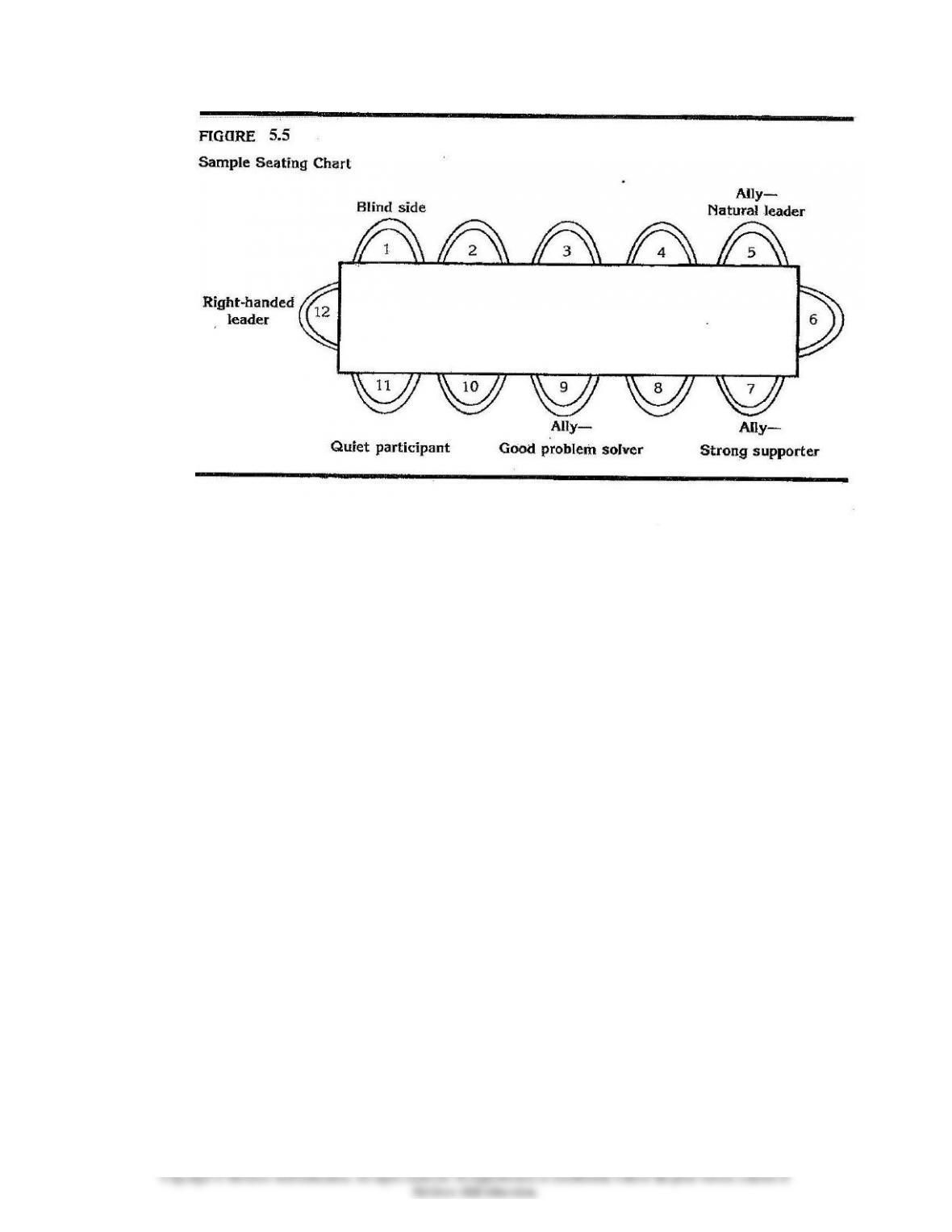
√ Plan the seating arrangement and prepare name cards. This shows the meeting is important
to you. The attitude will be contagious, causing participants to give their best efforts. Name
cards can also help in human engineering. You may want quiet members of the group to sit next
to people who will encourage them to talk. Overly vocal participants should sit on your blind
side, so that you can ignore them if necessary without hurting their feelings. People who do not
get along should not sit face to face. People who are friends and like to talk should sit apart.
Strong supporters, good problem solvers, and natural leaders should occupy the corners. See
Figure 5.5.
√ Consider refreshments. Coffee, tea, and soft drinks create a relaxed atmosphere. Avoid
mixing alcohol with meetings.
Refreshments: ___________ When served: __________________
B. During the Meeting
√ Allow participants time to get acquainted and comfortable.
√ Start the meeting as close as possible to the scheduled time; never end the meeting after
the scheduled time if at all possible.
√ Starting time: __________ Ending time: _________
√ Put the group at ease. Give a proper greeting, and tell an appropriate
story, anecdote, or joke. As soon as possible, state the purpose of the meeting. Give necessary
background information, list objectives to be achieved, outline the method or procedure of the
meeting, and begin.
Part 05 – Leadership Principles
5-93
√ Follow the agenda; keep the discussion on the topic. Encourage group participants by
exchanging ideas, asking questions, and preventing monopolization. Keep the meeting moving.
√ Be factual, specific, and clear when you speak, but never dogmatic. Use available data to
support your statements.
√Supporting data for the problem: _______________________________________
_______________________________________
_______________________________________
√ Neither dominate the discussion nor remain passive. Your goal should be to gain as much
involvement as possible from all participants. Every member of the group should make at least
one contribution at every meeting.
√ Understand why different people do what they do. Use this knowledge to avoid personal
rivalries. When you must deny a request, reject the idea, not the person. Be tolerant of divergent
views, but remain in control.
√ Follow principles of effective delegation. By delegating appropriately, you can remove
some of the burden from your own shoulders as well as keep everyone interested and involved.
Ask others to serve as recorder, arrange a meeting, or gather data, according to their interests and
the needs of the situation.
√ Before ending the meeting, summarize important points and actions members should take.
Communicate an action plan.

Part 05 – Leadership Principles
5-94
Points Made:
Who Does What by When?
Participant 1: _____________________________________________________
Participant 2: _____________________________________________________
Participant 3: _____________________________________________________
Participant 4: _____________________________________________________
Etc.: _____________________________________________________
C. After the Meeting
√ Review minutes of the meeting, and send a copy to all participants.
Minutes of Meeting
Group: ___________________________ Date: _____________________
Members present: _______________________ ______________________
_______________________ ______________________
_______________________ ______________________
_______________________ ______________________
_______________________ ______________________
_______________________ ______________________
Members absent: _______________________ ______________________
Visitors: _______________________ ______________________
Activities (including points made):

Part 05 – Leadership Principles
5-95
Application: Checklist for Effective Meetings (continued)
Action plan (including who does what by when):
_____________________________
Recorder

Part 05 – Leadership Principles
5-96
DISCUSSION QUESTIONS AND ACTIVITIES
To personalize the subject of human relations, ask your students to consider questions such as
these:
1. What are your beliefs about human nature? Do you have an optimistic or pessimistic
view? On what information and experiences do you base your views?
2. What is your style of human relations—turtle, owl, bull-in-a-china shop, or picture
window? How did you get this way? What roles have family, friends, and colleagues
played?
3. In dealing with people, have you ever experienced a turtle relationship? Have you ever
experienced a picture-window relationship? Describe the difference and its impact on
you.
4. Consider human relations in your workplace. Describe present conditions. How does
this influence morale and performance? What can you do to develop mutual trust and
interpersonal respect?
5. Give an example of your worst listening habit. What steps can you take to improve?
6. Discuss the role of civility in the workplace. Consider true-life efforts to create a
psychologically healthy work environment.
7. A sense of belonging and acceptance can transcend space and time. Write a letter to
someone who needs to hear from you. Show trust by sharing thoughts and feelings.
Show respect by asking for ideas and suggestions. Mail your letter.
8. Critique competing organizations such as two hospitals, restaurants, service stations, or
hotels, using the Characteristics of an Effective Group questionnaire. Which
organization does the better job? Where would you want to work?
9. Compare a negative group experience you have had with a positive group experience by
using the principles of group effectiveness. What was done to tap the constructive power
of the group? By the leader? By group members?
10. What is your problem-solving style—Einstein, Darwin, Socrates, or Ford? How does
your style apply in your work or educational experiences?
11. Divide into discussion groups. Cite true-life examples of team building efforts. What
were the dymanics? What were the results?
12. Use the leader, member, and team evaluation forms to rate conditions in a true-life
school, social, or work group.