
Part 05 – Leadership Principles
5-1
Major Purposes of Part Five
Part Five focuses on four important subjects—leadership
principles, work morale, human relations, and the team concept.
Part Five Objectives
After completing Part Five, your students should be able to
better understand:
• Universal principles of effective leadership;
• The importance of work morale;
• Human relations in the work setting;
• Characteristics of a high performance group;
• Positive versus negative group member roles; and
• Team building skills and strategies.
PART FIVE—Leadership Principles

Part 05 – Leadership Principles
5-2
NOTES AND ANECDOTES
The Importance of Morale
The evidence of the importance of morale is powerful. High morale and outstanding performance
go together. Which causes which is unclear, but an evaluation of the high morale—100 Best
Companies to Work for in America against the Russell 3000, an index of large and small
companies that mirrors the 100 Best, shows the following most recent year results: average
annual financial returns of 27.5% for the 100 Best Companies vs. 17.5% for the Russell 3000.
Ten year results tell the same story: 23.4% for the 100 Best vs. 14.8% for the Russell 3000. To
illustrate this huge difference, consider: $1000 invested in the 100 Best would grow to $8188 in a
decade, while $1000 invested in the Russell 3000 would become $3976.
NOTES AND ANECDOTES
We have seen dramatic changes in the meaning of work in Western culture from Greek scorn for
labor, to Hebraic atonement for sin, to early Christian disregard and disdain, to later Christian
calling to work, to socialist doctrines of work for joy, to the present day, when work represents
for many a search for meaning and self-expression.
THE CHANGING MEANING OF WORK
Negative Positive
— +
Greek and Early Christianity Later Socialist Modern
Hebrew Christianity Doctrine View
“curse and “means of “duty and “work for “growth
punishment” charity” “calling” joy” and self-
expression”
The value the individual attaches to the work experience is an important factor in the morale
equation. It makes an enormous difference whether work is viewed as punishment or as an
opportunity for fulfillment. Primarily because of the influence of culture, work has a positive
value for large numbers of people in American society, who seek personal meaning and a sense
of self-worth in the work experience. Consider the alcoholic who endures all loss until he loses
his job, or the employee whose loss of her status at work results in the afflictions of self-doubt
and depression.

Part 05 – Leadership Principles
5-3
NOTES AND ANECDOTES
Pessimism and Optimism
Table 5.1 illustrates how attitudes about people range from pessimism at one extreme to optimism
at the other.
TABLE 5.1: ATTITUDES ABOUT PEOPLE
The Pessimistic Pole (—) The Optimistic Pole ( + )
People are: People:
The Pessimistic Pole—Four Views of Human Nature. We begin by examining the attitude that
people are inherently selfish and uncooperative. An early giant in the history of Western thought,
Niccolό Machiavelli, in The Prince (1515), urged that, because of man’s selfish and
uncooperative nature, people must be strictly and ruthlessly controlled by anyone who seeks to
gain or maintain a position of power. A ruler must put aside any question of morality and achieve
control at any price and by whatever means available, including fear and force. Machiavelli
wrote:
It is much safer to be feared than loved. For it may be said of men in general that
they are ungrateful, voluble dissemblers, anxious to avoid dangers, and covetous
of gain.

Part 05 – Leadership Principles
5-4
The political philosopher Thomas Hobbes wrote in The Leviathan (1651) that human beings
covet power and material goods, and will attempt to attain these even at the expense of others.
They live in perpetual competition with their neighbors. He states, “If any two individuals desire
the same thing, which nevertheless they cannot both enjoy, they must become enemies. Law must
therefore define what is moral. But, in order for law to be effective, an authority must exist to
enforce it.” Hobbes believed that people recognize the need for laws and law enforcement out of
fear of loss of life and property. As a consequence, they enter into a social contract, giving up the
individual rights possessed in nature to a central authority. In this way, people bring about the
creation of a commonwealth ruled by a sovereign.
According to Sigmund Freud, the father of psychoanalysis, we are motivated by innate
instincts and drives that we must constantly struggle to pacify. These instincts and drives have
been identified with aggression and sex. Freud observed, in Civilization and Its Discontents
(1930), that society itself is threatened by the underlying hostilities that exist between human
beings. To the extent that society curbs these animal forces, we become civilized and our energies
can be turned toward socially acceptable goals. But, said Freud pessimistically:
Psychoanalysis has concluded that the primitive, savage, and evil impulses of
mankind have not vanished in any individual, but continue their existence,
although in repressed state; and they wait for opportunities to display their
activity.
A predisposition of human beings to be possessive and warlike was noted by the philosopher
Henri Bergson, who wrote:
The origin of war is ownership, individual or collective, and since humanity is
predestined to ownership by its structure, war is natural. So strong, indeed, is the
war instinct, that it is the first to appear when we scratch below the surface of
civilization in search of nature. We all know how little boys love fighting. They
get their heads punched. But they have the satisfaction of having punched the
other fellow’s head.
The Optimistic Pole—Four Views of Human Nature. Now let us turn to a more positive view
that emphasizes the human tendency to be helpful and cooperative. In On the Commonwealth (51
B.C.), the Roman philosopher Cicero argued that people by nature believe in goodness and abhor
savagery and baseness. On the assumption of mutual advantage, they come together by social
instinct. When enough individuals are gathered, they form a democratic association or
commonwealth for the benefit of all. Out of this group emerges a leader who governs voluntary
subjects through a moral claim to their allegiance rather than through regulation based on force.1
The philosopher John Locke argued that the human being’s fundamental inclination is to use
reason, and that reason itself establishes cooperation as the basis for human relationships. In The
Second Treatise of Government, Locke wrote that people of reason are inherently disposed
toward mutual support and cooperation:
Nature has a law to govern it, which obliges everyone; and reason, which is that
law, teaches all mankind that, being all equal and independent, no one ought to
harm another in his life, health, liberty, or possessions.

Part 05 – Leadership Principles
5-5
In Cooperation Among Animals, social biologist W.C. Allee reported research evidence
showing that cooperative relationships increase the probability of survival for any single
individual, as well as for a species as a whole. One of his experiments showed that it takes
proportionately less toxic colloidal silver to kill a single goldfish in an aquarium than if the
aquarium holds a number of goldfish. He suggested that the ability of a group of goldfish to
neutralize a poison increases faster than that of a single goldfish. As Allee explored further
evidences of cooperation in higher animals, he came to the following conclusion:
All through the animal kingdom—from amoeba, to insects, to man—animals
show automatic unconscious proto-cooperation and even true cooperation. There
is much evidence that the inclination toward natural cooperation is stronger than
the opposing tendency toward competition.
The psychologist Karen Horney believed that all individuals in their natural
development seek affection and approval from others. Where interpersonal relationships
are not supportive, anxiety develops and this interferes with the growth of a healthy
personality. In such cases, people tend to respond in three basic ways: 1) “moving toward
people”—feeling inadequate, they become attached and dependent; 2) “moving against
people”—rejected, they become rebellious and aggressive; and 3) “moving away from
people”—they seek comfort for rejection in symbolic substitutes and fantasy.”
Horney did not believe people are doomed by predetermined instincts, or that patterns of
behavior are eternally established by early life experience. Her concept of human existence is
hopeful and optimistic. She believed a person is born neither a devil nor a saint, but that from the
time of birth the course of a person’s development reflects the nature of relationships with
significant people in the person’s environment. Also, she viewed the human being as a proactive
pilot, not as a reactive robot. What is needed is not a method of controlling innately selfish or
even predatory drives toward competition and conflict with other people, but a means of tapping
the human potential for joining in productive relationships with others.
In general, the leader who has a positive attitude about people will generate the affection and
support of followers. The leader who has a pessimistic view will generate distrust and self–
protective behavior.

Part 05 – Leadership Principles
5-6
NOTES AND ANECDOTES
Dealing with Different Personalities
No two people are exactly alike; yet the leader must gain the support of all group members.
Table 5.2 shows how people are like animals, each with its own nature and potential to
contribute. Consider the rabbits, lions, and turtles of your work group or team, and capitalize on
the different needs and interests of each group member. Take action to channel his or her efforts
to help the group succeed.
TABLE 5.2: THE COMMUNITY ZOO
➢ ELEPHANT—Elephants always remember the bad things, so utilize this talent by asking,
“What could we have done differently?”
➢ ROOSTER—Tell roosters to be quiet until the timing is right. Roosters need attention, so
give it to them by letting them make announcements.
➢ PARROT—The parrot is like the rooster, but with lots of color, so put them in PR.
➢ RABBIT—Rabbits are full of energy, so give them something to do. Also, have meetings
with an agenda or they will jump from topic to topic.
➢ HOUND DOG—Hound dogs are loyal and they lie by the fire, so remind them of the group’s
purpose, give them a scent, and say, “Let’s go.“
➢ ALLIGATOR—Alligators usually won’t bother you unless provoked; then they snap your leg
off. If possible, work around the sensitivities and sore spots of alligators.
➢ SNAKE—The only agreement is that snakes are wiggly and can be dangerous, so, beware of
snakes.

Part 05 – Leadership Principles
5-7
➢ OSTRICH—The ostrich avoids, avoids, avoids. . . sticking its head in the sand to deny
reality. The ostrich won’t pay attention until touched personally, so touch them personally.
Then they will move fast.
➢ LEMMING—Lemmings don’t think for themselves. Conformity is their nature, so be sure
they are hanging out with the right crowd and going in the right direction.
➢ LION—The lion wants to be king. Recognition and the chance to influence events are
especially important to the lion, so give him importance.
➢ TURTLE—Turtles don’t go anywhere until they stick their necks out, so ask for ideas and
reward risk-taking behavior. Appreciate their talent for persistence and survival.
➢ MONKEY—Monkeys are very smart, but what they like to do is play, so make work play.
Capitalize on their natural tendencies to be creative and solve problems by turning work into
a challenge and a chance to have a good time.
➢ BUZZARD—Buzzards won’t initiate work, but they pick on everyone else’s bones, so
channel buzzards to handle important details that can’t be overlooked.
➢ SHARK—Sharks kill things. The secret is to get them to attack the right things, so get your
sharks lined up and committed to the right objectives.
Part 05 – Leadership Principles
5-8
Part 05 – Leadership Principles
5-9
Part 05 – Leadership Principles
5-10

Part 05 – Leadership Principles
NOTES AND ANECDOTES
Management author John Schermerhorn, Jr. identifies ten responsibilities of team leaders
and supervisors:
Ten Responsibilities of Team Leaders and Supervisors
1. Plan meetings and work schedules.
2. Clarify goals and tasks.
3. Gather ideas to improve performance.
4. Appraise performance and counsel team members.
5. Recommend pay increases and new assignments.
6. Recruit, train, and develop team members to meet performance standards.
7. Encourage high performance and teamwork.
8. Inform team members about organizational goals and expectations.
9. Inform senior leaders of team needs and accomplishments.
10. Coordinate with other teams and support their work efforts.
NOTES AND ANECDOTES
When the leader is effective, what are the results? What is the profile of a high performance
team? 2
PROFILE OF A DREAM TEAM

Part 05 – Leadership Principles
5-12
6. Builds morale internally
16.Welcomes challenges
7. Performs effectively and produces results
17. Keeps a can-do spirit
8. Accepts praise and criticism
18. Never gives up
9. Cooperates rather than competes
19. Shares pride in accomplishments
10. Maintains a positive mental attitude
20. Celebrates successes!
NOTES AND ANECDOTES
Deciding When to Use a Team Approach
A team approach usually works best when:
• Group acceptance is necessary for effective implementation.
• Knowledge and skill from more than one person is needed to make the best decision
or product.
• Group members possess specific information, problem-solving expertise, and group
process skills.
• There is sufficient time to meet as a group, discuss alternatives, and agree on a course
of action.
• The highest quality or most effective solution is desired.
An individual approach usually works best when:
• A decision involves a routine or simple task.
• Group members are already in agreement.
• Consensus or buy-in is not important.
• Immediate action is required; there is no time for discussion.

Part 05 – Leadership Principles
5-13
NOTES AND ANECDOTES
THE MIRACLE OF DIALOGUE—TRUST AND RESPECT
Trust and respect are the key elements of good human relations. Trust is
expressed by openness in sharing ideas and feelings. Respect is demonstrated by
willingness to listen to the ideas and feelings of others. Without trust and respect, human
relations break down. The need for trust is emphasized in the following story.
Trust in Me
Three turtles went for a walk, and one said to the others, “Let’s go
have a cup of coffee.”
They entered a restaurant, and soon thereafter it began to rain.
The oldest turtle said to the youngest, “Son, would you mind running
home for my umbrella?”
Whereupon, the young turtle replied skeptically, “I’ll go get your
umbrella if you promise not to drink my coffee.”
The old turtle promised, and the young turtle left to perform his
mission.
Two years passed, when the old turtle said: “You know, I don’t think
Harry is coming back. We might as well drink his coffee.”
Just then, a tiny voice was heard from behind the door: “If you do, I
won’t go get your umbrella.”
The following exercise shows the level of trust and respect you have
with other people. You will discover whether you are a turtle, an owl, a
bull-in-a-china-shop, or a picture window in your style of human relations.
This exercise can be completed individually or with another person. It is
useful in all areas of human relations, including management
development, team building, and family counseling.

Part 05 – Leadership Principles
5-14
EXERCISE 5.1: STYLES OF HUMAN RELATIONS—TURTLE, OWL, BULL-IN-A-
CHINA SHOP, AND PICTURE WINDOW
Directions
Below is a 5-point scale to be used in evaluating yourself and another person on the use
of 24 behaviors important for good human relations. Read each behavior and determine how
much it is like the person you are rating. Select a value from the scale and enter the number in
the appropriate space at the right.
Scale Value
Meaning
5
Extremely characteristic; always does this
4
Quite characteristic; usually does this
3
Somewhat characteristic; seldom does this
2
Quite uncharacteristic; seldom does this
1
Extremely uncharacteristic; never does this
Human Relation Behaviors
Self
Partner
(T)
1. Says what he or she believes.
(R)
2. Listens to criticism without being defensive.
(T)
3. Admits to confusion or lack of knowledge.
(R)
4. Body posture, facial expressions, and eyes show
interest in what others have to say.
(T)
5. Expresses self openly.
(R)
6. Gives support to others who are struggling to express
themselves.
(T)
7. Admits to being wrong rather than attempting to cover
up or place blame.
(R)
8. Keeps private conversations private.
(T)
9. Tells others things they need to know, even if
unpleasant.
(R)
10. Invites ideas; does not dominate discussions.
(T)
11. Is honest in relationships.
(R)
12. Respects the feelings of others.
(T)
13. Shares concerns, hopes, and goals with others.
(R)
14. Does not make others feel they are wasting his or her
time.
(T)
15. Shares thoughts, no matter how “far out” they may
seem.
(R)
16. Does not fake attention or merely pretend to listen.
(T)
17. Calls things as seen, refusing to lie.
(R)
18. Does not act hurt, angry, or mistreated when others
disagree.
(T)
19. Portrays self honestly; does not pretend.
(R)
20. Accepts help from others.

Part 05 – Leadership Principles
5-15
(T)
21. Uses language and terms others can understand.
(R)
22. Tries to prevent interruptions, such as telephone calls
and people walking in during important discussions.
(T)
23. Tells others when they are wrong or need to change.
(R)
24. Encourages others to express themselves.
Source: Joseph Luft and Harrington Ingram, “The Johari Window: A Graphic Model of Interpersonal
Awareness,” Proceedings of the Western Training Laboratory in Group Development (University of
California, Los Angeles: Extension Office, 1953); Joseph Luft, Group Processes: An Introduction to Group
Dynamics, 2d ed. (Palo Alto, CA: National Press, 1970); Jay Hall, Team Effectiveness Survey (Conroe,
TX: Telometrics International, 1968); Naomi Miller, Northern Kentucky University, 1982.
SCORING
Step One
Total the scores you gave yourself for the odd-numbered questions—all questions with T
in front of them. This total represents your evaluation of your willingness to express
yourself. Record the score on the TRUST axis in Figure 5.1. Next, total the scores you
gave yourself for the even-numbered questions –all questions with R in front of them.
This is your willingness to listen to others. Record this score on the RESPECT axis. Then
find the point where the two scores intersect and shade in the enclosed area.
Step Two
You are now ready to analyze the scores you gave your partner. Total the scores you gave
your partner for all odd-numbered questions—questions with (T) in front of them.
Record this score on the TRUST axis in Figure 5.2. Next, total the scores you gave you
partner for all even numbered questions—all questions with (R) in front of them. Record
this score on the RESPECT axis in Figure 5.2. Then find the point where these two
scores intersect and shade in the enclosed area.

Part 05 – Leadership Principles
5-16
Step Three
Exchange evaluations with your partner.
Step Four
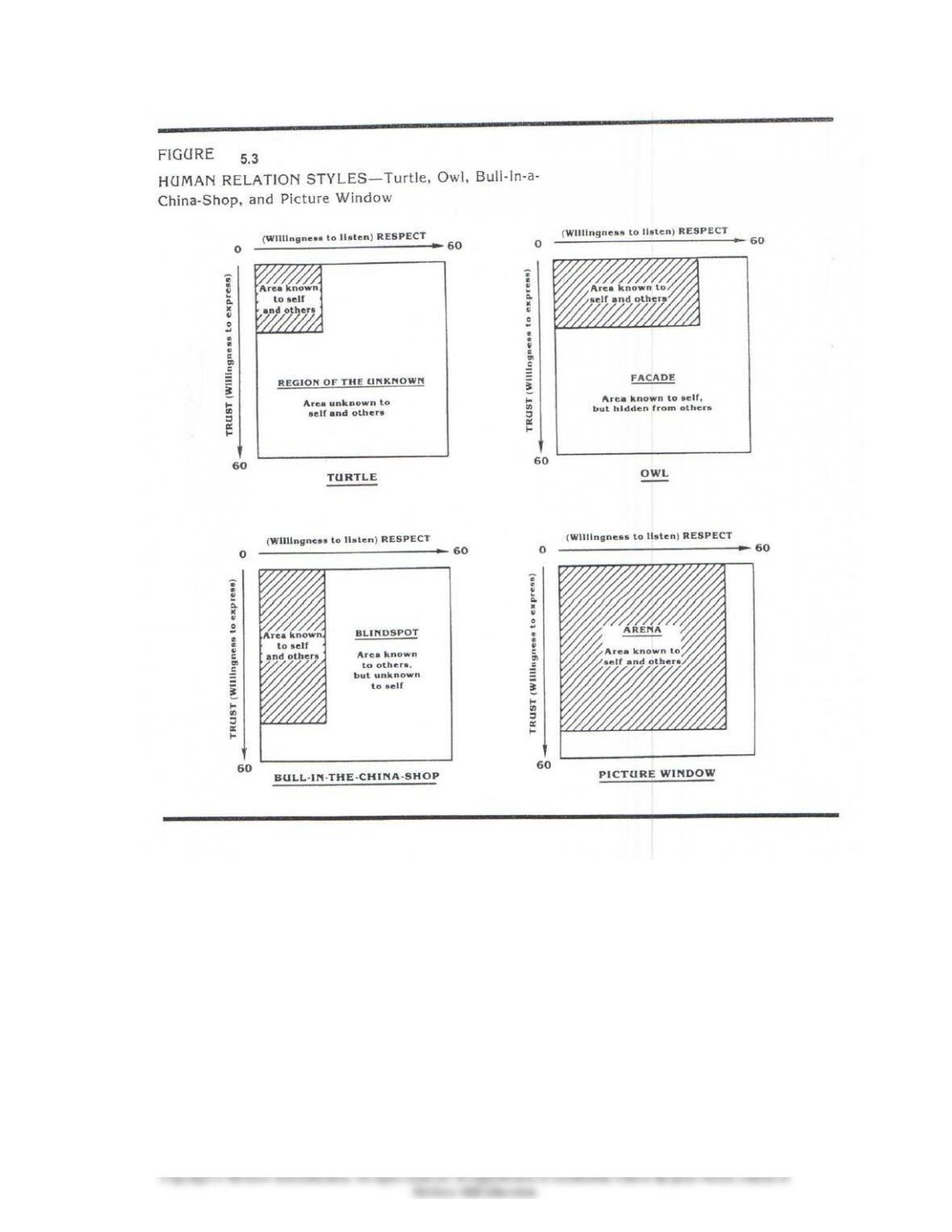
Compare your self-evaluation and your partner’s evaluation with the four human relation styles in
Figure 5.3. Which style do you think you are most like? Which does your partner think you are
most like? Does your partner see you as you see yourself?

Part 05 – Leadership Principles
5-17
Step Five
Go back to the questionnaire and ask your partner what specific things you could do to raise your
low scores. Also give recommendations to your partner to raise low scores.
Step Six
Discuss the importance of self-expression (showing trust) and listening (showing respect) as these
relate to your partnership. Are these two traints important in relations with others on the job and
in the home?
Part 05 – Leadership Principles
5-18
INTERPRETATION
The following paragraphs describe each style of human relations.
Turtle
The turtle is reluctant to express ideas or feelings to others; nor does the turtle
listen to others. The turtle is in a shell. Whether meaning to or not, the turtle
communicates low trust in the motives of others and low respect for others’ opinions.
The result is a large “region of the unknown”. Misunderstanding, frustration, untapped
creativity, and unresolved problems live in the region. People who have turtle
relationships find them to be cold, impersonal, and unsatisfying.

Part 05 – Leadership Principles
5-19
Just as partners may experience turtle styles of human relations, so may whole
groups. Turtle relationships may exist between working groups, between management
and employees, and between an organization and its public. Such relationships are
characterized by low morale and poor performance.
Turtle relationships can be improved if people listen to the ideas and feelings of
others and openly express their own ideas and feelings. This process can be started by
one, but it takes two to improve a turtle relationship. Someone must take the initiative,
and someone must respond favorably.
Owl
The owl style of human relations is better than the turtle, because it shows a good
deal of respect toward others. The owl gives time and attention, thus showing concern for
the ideas and feelings of others. However, when someone listens, listens, listens, but
does not share ideas and feelings in return, a “façade” develops, with tow corresponding
drawbacks: 1) an impression of role playing and insincerity and 2) suppression of
conflict, with a resulting decrease in creativity and potential for problem solving.
Avoidance of self-expression and an overreliance on listening is present in the
owl style. Ultimately, this will not be satisfying for either partner, because it represents a
one-sided relationship. The solution is to demonstrate trust in others by becoming more
self-expressive. A woman who listens to her family and friends, but who continually
censors her own behavior because she fears disapproval, has an owl style of human
relations. By more openly expressing herself, she can lower the façade and raise the
quality of her relationships.
It takes two to improve an owl relationship: 1) The owl gradually must become
more open, which takes time because the idea that they must change is difficult for many
people to accept. Also dealing with confrontation and being honest in self-expression can
be threatening. 2) The owl’s partner must show respect by listening as ideas, hopes,
goals, and feelings are shared.
Bull-in-a-China Shop
The bull-in-a-china-shop style of human relations is like the owl in that it is half-
good and half-bad. The good part is that the bull is open and honest with feelings and
ideas. Whether they are right or wrong, popular or not, you always know where bulls
stand. By open self-expression, the bull says, “I trust you and I believe you will not use
what I say to hurt me.” This is the good part. The bad part is the enormous “blind spot”
the bull has created by not listening to others. Perhaps unintentionally, the bull is
demonstrating that other people’s feelings and ideas are unimportant.
Whether the bull-in-a-china-shop style develops as a result of ego striving, natural
aggressiveness, or actual superiority, it is often destructive in human relationships. The
blind spot typically contains negative data—the frustration, resentment, and anger of
others – which may one day erupt. Eruption could take the form of revolution, such as
sabotage or escape. Eruption could also be turned inward and result in inferiority
feelings and low self-esteem for the bull’s partner and friends.
The solution is for the bull-in-a-china-shop to listen more to others. The bull
must realize that others need to express themselves too and should show respect for them
by listening. People who rarely ask for others’ opinions or listen to their problems, have

Part 05 – Leadership Principles
5-20
a bull-in-a-china-shop style of human relations, and they have a big blind spot. By
listening, they can reduce this blind spot and improve the quality of their relationships on
the job and in the home.
Picture Window
The best style of human relations results in dialogue between people, and it is
symbolized by the picture window. With this style, mutual respect is shown as each
person listens to the ideas and feelings of others. Interpersonal trust is also demonstrated
as ideas and feelings are shared openly and honestly.
It is important to note that the arena is the dominant feature of picture window
relationships, and what goes on in the arena is candid and free flowing discussion about
issues, events, and experiences. By no means is this dialogue tame. Indeed, opposing
points of view and diverse values sometimes clash in this arena. Conflict is viewed
positively, however, as all parties recognize that they are not identical twins, that
disagreement is natural, and that out of diversity can come increased creativity and
intense satisfaction.
DISCUSSION
How do people achieve picture windows? How can fear be replaced by trust in a
relationship? First, look at some climates in which interaction takes place. Normally,
people are unwilling to engage in self-disclosure if they feel what they say or do will be
used against them. Consider the case of oppressed people, such as ghetto Jews during
World War II. Self-survival dictated distrust. Or consider the consumer who wants to
purchase a used car from an unscrupulous seller. Sometimes a buyer-beware climate may
require distrust.