
Part 04 – The Empowerment of People
4-21
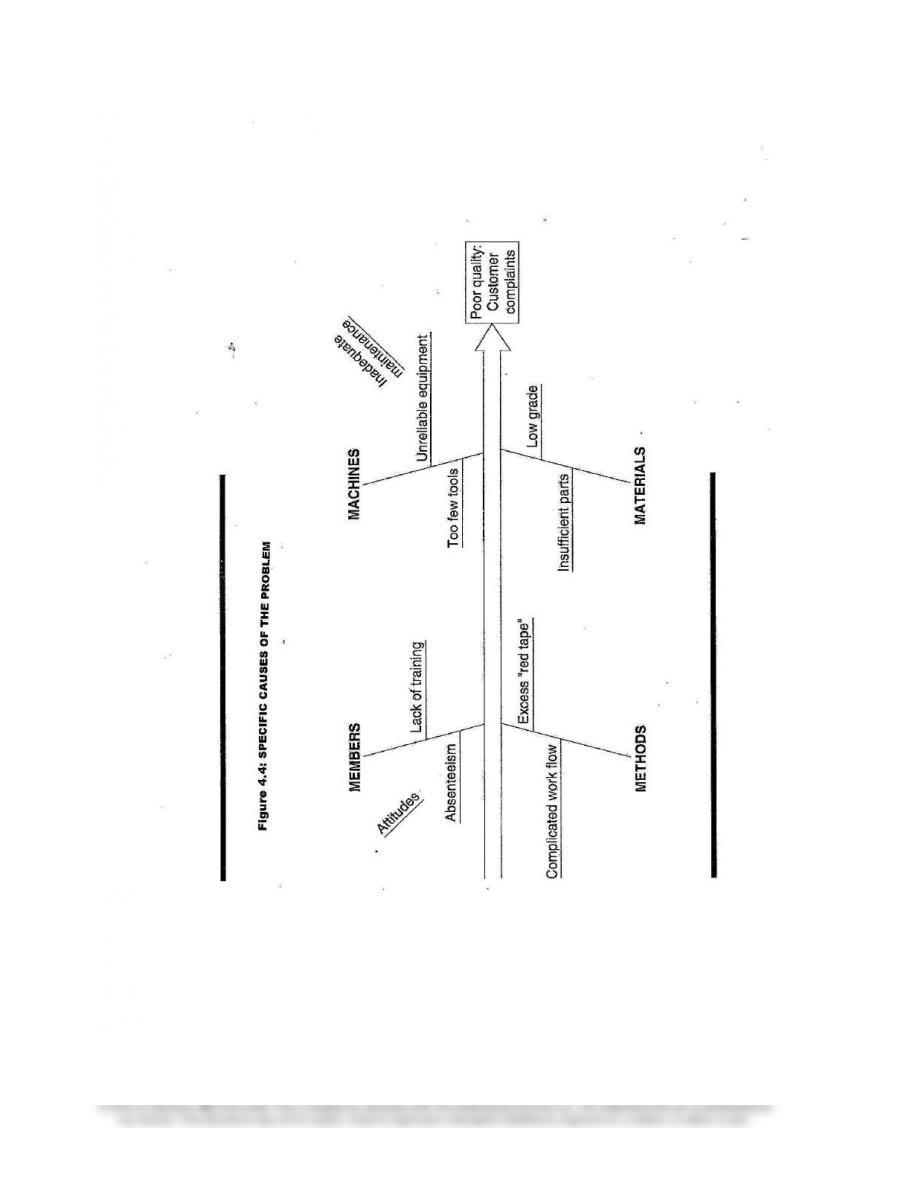
FIGURE 4.3: STATEMENT OF THE PROBLEM
Poor quality:
Customer complaints
Part 04 – The Empowerment of People
4-22

Part 04 – The Empowerment of People
4-23
Step 7 Consider and decide the best Solution(s) to the problem. For example:
Eliminate unnecessary work.
Combine work when practical.
Rearrange work for better sequence.
Simplify all necessary work.
Don’t rush this step. It takes time to do creative thinking.
Step 8 Use creative exercises one and two to stimulate creativity.
Step 9 Prepare, present, and implement solution. Having decided on the best solution to the
problem, prepare recommendations. Make action steps clear. Specify who should do
what by when, including expected costs and benefits. Benefits can be psychological,
such as increased morale, as well as quantitative, such as reduced costs, improved
sales, and increased profits.
If approval is required from others outside the group, present clearly stated
recommendations. Remember to discuss ideas and details with others who are
responsible for approving changes and implementing new methods. Include their ideas
and win their support.
After approval, implement solutions.
Step 10 Follow-up and evaluate. If the quality of work and/or the quality of work life has
improved, continue the solution. If not, go back to step 5 and develop a more workable
solution.
CREATIVITY EXERCISE ONE
Connect all of the nine dots in Figure 4.5 using four straight lines. Follow these two
rules:
1. The end of one line must touch the beginning of the next.
2. When drawing the lines, don’t lift your pen or pencil from the paper.
See Figure 4.6 for the solution to the “nine dot exercise.”

Part 04 – The Empowerment of People
4-24
Figure 4.5: NINE DOT EXERCISE
Figure 4.6: SOLUTION TO THE NINE DOT EXERCISE

Part 04 – The Empowerment of People
4-25
Notice that the problem cannot be solved unless you get outside of the box. Most people
erroneously assume that they are not allowed to draw outside the boundaries of the dots. This
same principle applies to problem solving in general. Many effective solutions are those that
involve thinking outside the structure of the situation.
CREATIVITY EXERCISE TWO
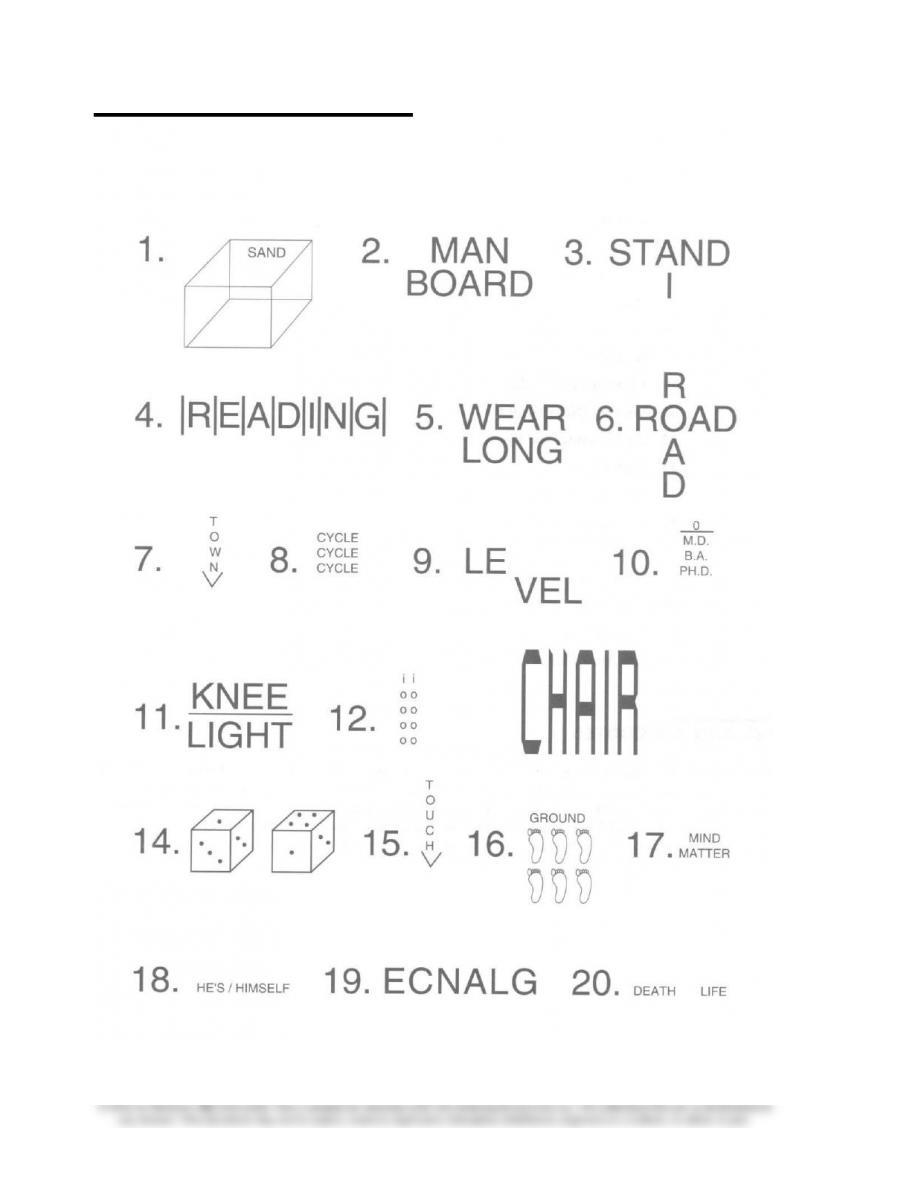
Gather in groups. Allow five to ten minutes to solve the twenty puzzles found on Figure 4.7.
The group with the highest number solved wins.
Part 04 – The Empowerment of People
4-26
Figure 4.7: PUZZLES
13.

Part 04 – The Empowerment of People
4-27
ANSWERS:

Part 04 – The Empowerment of People
4-28
NOTES AND ANECDOTES
Quality improvement groups can be categorized as organic or multifunctional. See Figure 4.8.
Organic or “vertical” slice groups are ideal for addressing issues inside a single work unit, such
as the accounting department or sales force. Multifunctional or “diagonal” slice groups, such
as quality council or management team, are best for addressing issues involving more than one
work unit or division.

Part 04 – The Empowerment of People
4-29
Figure 4.8: Types of Quality Improvement Groups
Organic or “Vertical Slice” Groups Multifunctional or “Diagonal Slice” Groups

Part 04 – The Empowerment of People
4-30
NOTES AND ANECDOTES
In today’s workplace, characterized by employee empowerment and the constant need to
communicate, almost no one can escape making presentations, whether to direct reports, upper
management, other work groups, outside agencies, or to the final customer.
Masters of communication are able to convey their ideas and have them adopted. They have
mastered the art of speaking and the power of persuasion. The four basic methods of making
presentations are lecture (telling), conference (discussing), demonstrating (showing), and problem
solving (doing).
Lecture. The lecture method is an effective way to convey a large amount of information and is
more appropriate for large audiences and short time periods than for small groups and long time
periods.
Conference. With the conference method, the presenter lays a foundation for discussion, asks one
or more challenging questions, stimulates the group to consider the subject, and guides the discussion to
a logical conclusion. The conference method is good for small audiences. Its benefits include a relaxed
atmosphere and creative interchange of ideas. The conference method promotes interest through active
participation and feelings of group accomplishment.
Demonstration. The demonstration is a credible and dramatic method of making presentations.
It can be used to support an idea, pose a problem, or answer a question. Demonstrations clarify
information and save time and confusion. Demonstrations should be accompanied by explanation
(show and tell).
Problem Solving. The problem-solving method directly and actively involves the audience.
Actual cases and problems are used to arouse the interest and gain the commitment of participants. A
combination of problem-solving methods can be used in presentations. Variety holds the interest of the
group by offering a change of pace, appeals to a wide range of listeners, and can be useful in placing
emphasis where it is needed.
The following are proven principles for making presentations:
• Be prepared. The best way to overcome stage fright is to be prepared, even overly prepared.
Know your topic well. Think through the main idea you are trying to express. State the idea in
a simple, clear statement.
• Be organized. Outline your presentation. Divide it into three parts: Introduction, body, and
conclusion. A strong opening and closing are vital. People are most likely to remember the
first and last things you have to say.
• Simplify. Keep presentations simple. Don’t try to make too many points. Most presentations
have only one point to make; two or three at the most. After a long and windy church service, a
farmer’s wife asked him what the sermon had been about. “Sin,” said the farmer. “What did
the preacher say about it?” she asked. “He was against it,” the farmer replied. Remember, your
audience is only going to remember one or two points, not twenty.
• Rehearse. Practice, practice, practice…makes perfect. You can work from a detailed outline or
note cards, or you may be more comfortable having the presentation completely written. In any
case, rehearse. Rehearse to yourself, a tape recorder, a friend, the family pet—to anyone who
will listen. Aim for the right length, relaxed delivery, and well-coordinated visual aids. Do not
try to memorize the word by word content of your talk. It is likely to sound “canned” if you do.
• Using time. The length of a presentation ranges from five minutes to a half hour or more.
Whatever your allotment is, don’t exceed it. Ten minutes equals ten minutes, not fifteen.
Finishing a little ahead of time is better than disrupting others by running over. Practice your
timing so you can give the presentation comfortably, with proper pauses and clear diction. As a

Part 04 – The Empowerment of People
4-31
rule of thumb, ten minutes equals about one thousand words, thirty minutes equals about three
thousand words. Three thousand words will usually fit into ten to twelve pages of double
spaced typed copy.
• Look your best. Wear appropriate cloths. A favorite outfit will help you feel comfortable, and
the audience will feel comfortable with you.
• Relax. You are not the first to present to others. You have prepared thoroughly and know your
subject well. You probably will be nervous—most people are, even experienced speakers.
Remember, the audience is sympathetic and eager to hear your message. Relax.
• Start strongly. Don’t begin speaking immediately. Give yourself and the audience a chance to
adjust. Don’t begin until you have the group’s attention. Everyone will get the idea that you are
speaking to them directly and they will tune in. Advise the audience what to expect by giving
an overview or outline. Tell them why they should pay attention. Arouse the receiver’s self–
interest, then proceed to the first topic. Be positive and enthusiastic.
• Engage the audience. Look at them, talk to them, remember them constantly. You are not
speaking to the ceiling, the walls, or the floor, but to interested people seated in front of you.
Pause to emphasize key points. Use simple, direct words. Use body language to support your
delivery. Often you can communicate shapes and sizes and paint mental images with body
language.
• Be personal in your delivery. Preparation is important for effective speaking, but a successful
presentation must come from the heart as well as the head. Make points with stories and
personal experiences whenever you can. Robert Frost once said, “No tears in the writer, no
tears in the reader.”
• Keep your composure. Avoid unusual or erratic gestures that distract the audience. Move
around naturally, but do not pace. Try not to clutch the podium. If you forget a point, stop and
refer to your notes; the audience will understand. Plan on a few noises and distractions from
the audience. People will come and go occasionally. Don’t panic and assume they are
deserting you; maybe they have to keep an appointment.
• Use eye contact. Look at the audience, not over their heads or at the floor. This holds their
attention and increases your command. Eyes give many clues, helping you to communicate. It
is acceptable to refer to notes occasionally, but avoid reading the whole presentation. Strive for
maximum eye contact. Talk and look; don’t read.
• Use visual aids and examples. Use, but don’t overuse, visual aids. Slides, charts, and power
points can help communicate your message. Keep them simple, uncluttered, and legible. Give
the audience time to absorb major points before plunging into details. Remember the advice of
Cicero who said, “Without examples, nothing is taught and nothing is learned.” Illustrative
stories, parables, analogies, and metaphors are excellent ways to get your point across.
• Be human; be yourself. The presenter must come across as a person, not merely a type or
symbol. Don’t’ be afraid to express your personal opinions. People like to hear other people’s
opinions, even if they disagree with them. Being yourself is the most important rule for making
a good presentation. You may not be dynamic, and you may not have a booming voice; few
people do. The best speakers are effective simply because they are being themselves; they let
their own personalities shine through. That is what the audience wants more than anything
else.

Part 04 – The Empowerment of People
4-32
• Use the Rule of Eight. The good presenter
Does
Does Not
1. Know the subject
2. Come prepared
3. Act naturally
4. Show enthusiasm
5. Show patience
6. Show interest
7. Observe reactions
8. Remain flexible
1. Use sarcasm
2. Apologize in advance
3. forget the audience
4. Talk down to others
5. Embarrass others
6. Talk to notes
7. List and count
8. Talk too long

Part 04 – The Empowerment of People
4-33
Φ CASE
The Cloak of Omnipotence: A Parable
In the forest about a mile or so from Organizationville, there once lived a lion whose name was Lionel.
From the time he was a cub, Lionel had been an outstanding lion. He was strong, quick, and intelligent,
and very well liked by the other animals in the forest.
Lionel’s parents were very proud of him and often remarked to each other, “Lionel is a natural
leader. He will go far when he grows up and will do important things.”
Lionel played and studied hard at Lion Elementary School. He was happy and free. Being around
Lionel was very pleasant for others. Even when all the young animals played touch football and Lionel
would block them quite hard, they would all laugh and get up and play some more. The other animals
knew that Lionel was kind and had a good heart, so none feared him despite his great strength.
One day, Lionel’s mother happened to come by the playground just as he was making a particularly
spectacular block in which he knocked down Willie Lion with this shoulder, Charlie Bear with his hind
quarters, and even brushed Ronald Zebra out of the play with his tail. Lionel’s teammates congratulated
him, and even the animals on the other team slapped him on the shanks and said, “Well done.” But
Lionel’s mother gasped with alarm and called Lionel to her.
“Lionel,” she said in a worried tone, ” I am concerned about the way you are playing. You must
realize that you are bigger and stronger than some of the other animals, and you might hurt them if you
play too hard.”
“But Mother,” said Lionel, who was puzzled, “the other animals play as hard as they can, too, and
sometimes they knock me down, or sometimes they dodge around me.”
“Still and all,” said his mother, “I am worried and I do wish you would be more careful. I don’t
know what I would say to their mothers if you hurt any of the cubs. You wouldn’t want others to think
of you as a bully would you, Lionel?”
“No, Mother,” said Lionel, though he wasn’t quite sure what a bully was.
“That’s a good cub,” Lionel’s mother said, smiling. “Now you can go back and play with your
friends and I will get your favorite dinner at the market. Remember, always be considerate of other
animals’ feelings and they will like you.”
“Yes, Mother,” Lionel said, and he returned to the game.
As he played, Lionel tried to remember his mother’s advice. He held back his strength when he
blocked, and he even slowed down a bit when he ran. He still played pretty well, but not as well as
before and somehow in this game and those that followed, he never had quite as much fun. Still and all,
life was happy for Lionel in his cubhood and he had few cares or worries.